Journal of Chemical and Pharmaceutical Research, 2015, 7(9):563-568
Research Article
CODEN(USA) : JCPRC5ISSN : 0975-7384Improvement of the cell density of Streptococcus suis by application of pH
control and pH feedback substrate feeding
Likun Cheng
a, Jing Wang
b, Shuguang Li
a, Qiang Fu
a, Shijun Fu
a, Xiuyan Yang
a, Feng Li
a,
Lizhong MIao
a, Zhiqiang Shen
a*
aShandong Binzhou Animal Science and Veterinary Medicine Academy, Shandong Binzhou Research, Development
and Promotion Center for Livestock and Poultry Propolis Vaccine, Shandong Lvdu Bio-science and Technology Co. Ltd., Binzhou, Shandong, P. R. China
bIntensive Care Unit, Binzhou Medical University Hospital, Binzhou, Shandong, P. R. China
Likun Cheng and Jing Wang contributed equally to this work
_____________________________________________________________________________________________
ABSTRACT
pH is a key culture parameter for growth of Streptococcus suis and formation of lactate, and an appropriate pH is important to increase the cell density of S. suis. Here, we investigated the effect of pH on S. suis fermentation, and the results indicated that the optimum pH range was 7.0-7.5 and pH controlled using a two-stage strategy [pH 7.0 (0-4 h) and pH 7.5 (4-10 h)] had a positive impact on improvement of cell density. Specifically, NaOH was used to adjust pH during the initial 4 h and mixture of NaOH and KOH (2:1, v/v) were used to control pH during 4-10 h, which resulted in the concentrations of Na+ and K+ below the threshold for inhibiting S. suis fermentation. Furthermore, a pH feedback feeding strategy was applied in S. suis fermentation, the concentration of residual glucose was maintained at approximately 0.10 g/L, and the accumulation of lactate decreased to 4.17 g/L, and the concentration of Na+ and K+ were 70.2 mmol/L and 30.1 mmol/L. which was accompanied by a high cell density (2.347) and viability (8.42x10⁹ colony forming units/mL) because of the reduction of lactate accumulation and proper levels of pH, Na+ and K+.
Keywords: Streptococcus suis, pH control, metal ions, neutralization reagent, pH feedback feeding
_____________________________________________________________________________________________
INTRODUCTION
Streptococcus suis is an important pathogen of swine, causing a wide range of diseases in pig industry worldwide,
including meningitis, septicaemia, pneumonia, endocarditis [1, 2], and arthritis, which is also a zoonotic organisms and its public health importance for human. While thirty-five serotypes (1 to 34 and 1/2) have been identified according to the capsular antigens, and serotype 2 is considered as the most virulent form of the bacteria and is most frequently isolated from diseased pigs and humans [3]. Human illness following S. suis infection has been reported in many countries, and two outbreaks in humans documented in China in 1999 and 2005, hundreds of people were infected and 52 died because of toxic shock syndrome and meningitis [4]. S. suis infection has been raised great public concern worldwide regarding this pathogen as an emerging zoonotic agent. The propolis adjuvant inactivated vaccine of S. suis serotype 2 is a effective strategy for protecting pigs against S. suis serotype 2 infection [5]. The use of this vaccine is limited by the low cell density of S. suis serotype 2 and its high cost. Increased the cell density will likely reduce production cost and expand the market of the vaccine, which results in protecting the swine production industry and public health.
______________________________________________________________________________
(TCA) cycle are induced by the pH extremes, such as SucB and SucC [7]. The sucB and sucC are induced at low pH, which results in increasing the capacity of TCA cycle. In the production of L-tryptophan by E. coli, the accumulation of acetate was decreased with pH controlled at low value because of the improvement of expression level of sucB and sucC [8]. Overloading the TCA cycle by rapid metabolic flux through glycolysis is considered as the primary cause of pyruvate and acetate accumulation [9]. Lactate is the primary metabolite in culture of S. suis that inhibits the growth of strain [5]. The excretion of lactate is caused from the accumulation of pyruvate, but not from the increased expression of lactate dehydrogenase [10]. Due to the improvement of TCA cycle capacity with low pH, the excretion of pyruvate and lactate were decreased. The slightly alkaline condition is beneficial to the growth of S. suis [11]. Thus, it is important to maintain an appropriate pH value for growth of S. suis and reduction of lactate accumulation.
It has been reported that external pH can be shifted substantially by bacterial metabolism, either through fermentative generation of acids or through aerobic consumption of acids [7]. In the culture of S. suis, the alkaline solution is added to maintain the stability of pH because of the generation of acidic metabolic by-products [5]. Several neutralization reagents can be used to adjust the value of pH. In the production of succinic acid by A.
succinogenes, cells could not grow with NH4OH used as neutralizer due to the toxicity of NH4OH [12]. However,
NH4OH is the preferred neutralization reagent for L-tryptophan production, because it can be also used as nitrogen
source [8]. NaOH and KOH can be used as neutralization reagents, and their cations affect nutrient uptake and the optimal growth [12]. KOH was used to adjust pH to avoid inhibition of growth by Na+ at high pH in E. coli cultivation [7]. The mixture of NH4OH and KOH was used to adjust pH in L-tryptophan production to avoid the
inhibition caused by high concentration of NH4+ [8]. MgCO3 was the best neutralization reagent for enhancing
succinic acid production of A. succinogenes 130Z [12]. The appropriate pH neutralization reagent is important for culture of strain.
In S. suis ST171 fermentation, the cell density and viable count were increased and the accumulation of lactate was decreased by using glucose-stat feeding strategy [5]. Changes in DO or pH can be easily monitored on line to reduce formation of by-products for the duration of fed-batch process, and many feeding strategies based on pH have been developed [13]. The pH–stat activates addition of a nutrient when the pH increases, which results in a growth rate and glucose concentration significantly below the threshold for production of by-products [14]. A pH-feedback feeding method was applied in production of L-tryprophan, the steady-state concentration of glucose was maintained at a low level and low concentration of acetate was accumulated, leading to obtaining high biomass and production of L-tryptophan [8].
In the present study, we investigated the effects of pH value on S. suis fermentation and obtained optimum pH range for S. suis fermentation. Different strategy of pH stage control were proposed in S. suis fermentation. According to the effects of pH stage control and cations on fermentation of S. suis, a mixture of aqueous alkali was used to control the pH of S. suis fermentation. In addition, the pH feedback feeding strategy was used in S. suis fermentation to decrease the accumulation of lactate and increase the cell density.
EXPERIMENTAL SECTION
Bacteria and culture media
The strain S. suis serotype 2, used in this study, was obtained from China Institute of Veterinary Drugs Control (CVCC 562) and stored at the culture collection of the Shandong Binzhou Animal Science and Veterinary Medicine Academy.
The seed media contained the following components: 2 g/L glucose, 5 g/L yeast extract, 3 g/L MgSO4·7H2O, 3 g/L
KH2PO4 and 0.1 g/L vitamin B1. The fermentation media for S. suis serotype 2 contained the following components:
2 g/L glucose, 5 g/L yeast extract, 2 g/L MgSO4·7H2O, 2 g/L KH2PO4 and 0.1 g/L vitamin B1. The pH of the seed
and fermentation media was adjusted to 7.0 with 4 mol/L NaOH.
Culture methods
Fermentation in baffled flasks
A 250 mL baffled flask containing 50 mL of seed medium was inoculated with a single colony of S. suis and cultivated at 37℃, 200 rpm for 8 h. Two milliliters of this culture was inoculated into a 250 mL baffled flask
containing 50 mL fermentation medium and cultivated at 37℃, with shaking at 200 rpm for 10 h.
Fermentation in a bioreactor
L fermenter containing 5 L fermentation medium and cultivated at 37℃ for 10 h. The level of dissolved oxygen (DO)
was maintained at 20% by adjusting the agitation and aeration rates. Unless otherwise specified, pH was adjusted to different values with 4 mol/L NaOH. When the initial glucose was depleted, the glucose solution was added to the fermenter to maintain the concentration of glucose at 0.5 g/L. All experiments were conducted in triplicate, and data were presented as the mean ± standard deviation (SD) and statistical significance was defined as p<0.05.
Analysis of fermentation products
The DO, pH, and temperature were measured automatically with electrodes attached to the fermenters. The optical density (OD) was monitored by measuring the absorbance at 600 nm using a spectrophotometer (722N, INESA, China). The viable count of strain in 1 mL of fermentation broth was determined as described previously [5]. The concentrations of glucose and lactate were monitored by an SBA-40E biosensor analyzer (Biology Institute of Shandong Academy of Sciences, China). Concentrations of NH4+, Na+ and K+ were measured with a Bioprofile
300A biochemical analyzer (Nova Biomedical, Waltham, MA).
RESULTS AND DISCUSSION
S. suis fermentation with different culture pH
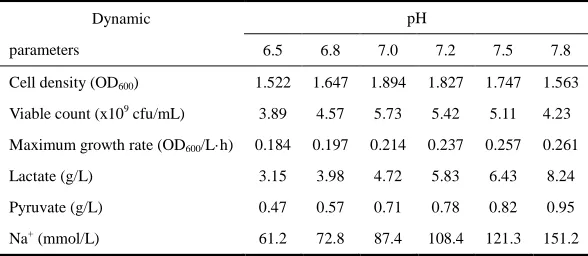
[image:3.595.159.453.412.540.2]The culture pH was controlled at 6.5, 6.8, 7.0, 7.2, 7.5 and 7.8 to investigate the effect of pH on S. suis fermentation, and the results with different culture pH are displayed in Table 1. The highest cell density and viable count were obtained with pH maintained at 7.0, which were 1.894 and 5.73X10⁹ cfu/mL. The maximum growth rate of strain and concentrations of lactate and pyruvate increased with higher culture pH. Due to the low activity of enzymes at low pH, the growth rate was lower [8], while the growth rate with high pH was higher because of the high enzymes activity and physiological property of S. suis [11]. The high growth rate and lower capacity of TCA cycle resulted in higher accumulations of pyruvate and lactate with high pH [5, 8]. More solution of NaOH was added to adjust the pH with high pH resulted from the high accumulation of pyruvate and lactate and high level of pH, leading to increasing the concentration of Na+ with higher pH [8]. In addition, the results indicated that the optimal pH range for S. suis fermentation was 7.0-7.5.
Table 1 Efffect of different culture pH on S. suis fermentation
Dynamic
parameters
pH
6.5 6.8 7.0 7.2 7.5 7.8
Cell density (OD600) 1.522 1.647 1.894 1.827 1.747 1.563
Viable count (x109 cfu/mL) 3.89 4.57 5.73 5.42 5.11 4.23
Maximum growth rate (OD600/L·h) 0.184 0.197 0.214 0.237 0.257 0.261
Lactate (g/L) 3.15 3.98 4.72 5.83 6.43 8.24
Pyruvate (g/L) 0.47 0.57 0.71 0.78 0.82 0.95
Na+ (mmol/L) 61.2 72.8 87.4 108.4 121.3 151.2
S. suis feremntation with stage control of pH
Based on the above study about S. suis with different pH and the mechanism of lactate formation, six pH control strategies were carried out as follows: Ⅰ pH 7.0 (0-4 h) and pH 7.2 (4-10 h), Ⅱ pH 7.0 (0-4 h) and pH 7.5 (4-10 h),
Ⅲ pH 7.2 (0-4 h) and pH 7.5 (4-10 h), Ⅳ pH 7.2 (0-4 h) and pH 7.0 (4-10 h), Ⅴ pH 7.5 (0-4 h) and pH 7.0 (4-10 h)
and Ⅵ pH 7.5 (0-4 h) and pH 7.2 (4-10 h). The effect of different pH stage control on S. suis fermentation are
presented in Table 2. The results showed that low pH controlled during the early fermentation period and high pH maintained during the later culture phase had a positive impact on improvement of cell density and viable count of strain [11]. With pH stage control Ⅱ, the highest cell density (1.987) and viable count (6.53x10
9 cfu/mL) were
obtained and the accumulation of lactate and concentration of Na+ were 5.43 g/L and 113.5 mmol/L. The cell density (1.712) and viable count (4.72x10⁹ cfu/mL) obtained with pH stage control Ⅴ were lowest, and 5.67 g/L lactate and
108.3 mmol/L Na+ accumulated. The lowest concentration of lactate accumulated with pH stage control Ⅰ was 5.14
______________________________________________________________________________
Table 2 Effect of different pH stage control strategy on S. suis fermentation
Dynamic
parameters
pH stage control strategy
Ⅰ Ⅱ Ⅲ Ⅳ Ⅴ Ⅵ
Cell density (OD600) 1.925 1.987 1.892 1.732 1.712 1.812
Viable count (x109 cfu/mL) 6.14 6.53 5.72 5.13 4.72 4.93
Maximum growth rate (OD600/L·h) 0.224 0.237 0.241 0.227 0.248 0.251
Lactate (g/L) 5.14 5.43 5.98 5.43 5.67 5.87
Pyruvate (g/L) 0.75 0.77 0.83 0.76 0.79 0.81
Na+ (mmol/L) 94.2 113.5 118.4 101.3 108.3 115.2
Impact of metal ions on S. suis fermentation
The concentration of metal ions was considered as an important factor for nutrients uptake and growth of strain, and the cell density and physiological status of strain were impacted by the metal ions contained in pH neutralization reagent [15]. The effects of Na+. K+ and NH4+ on S. suis fermentation were investigated by the fermentation media
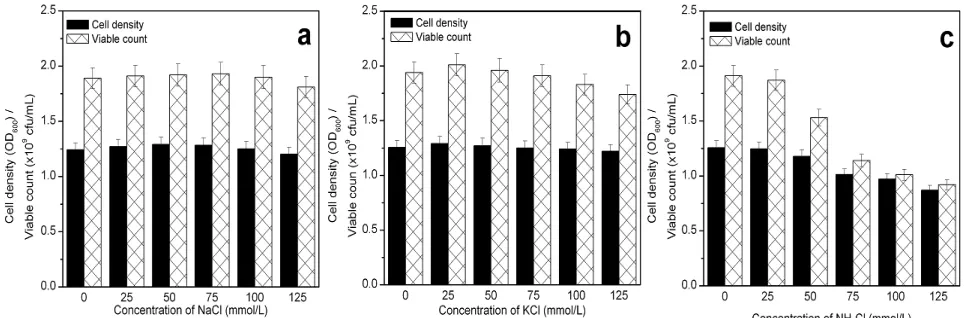
containing different concentrations (0-125 mmol/L) of NaCl, KCl and NH4Cl. Figure 1 shows the results of S, suis
fermentation with different concentrations of NaCl, KCl and NH4Cl, and concentrations of Na +
, K+ and NH4 +
markedly affected cell density and viable count. As for the addition of NaCl, the concentration of NaCl above 100 mmol/L decreased cell density and viable count and there was not significance difference in cell density and viable count with the media containing below 100 mmol/L NaCl. When 25 mmol/L KCl was added in the media, the highest cell density (1.291) and viable count (2.01 x10⁹ cfu/mL) were obtained, which were 2.71% and 3.61% higher than these with no addition of KCl, and cell density and viable count were decreased with addition of KCl above 50 mmol/L. Potassium ion serves as a cofactor in many enzymatic reactions, and high concentration of K+ causes the inhibition for growth of strain and formation of desired product [7, 8]. The cell density and viable count decreased with higher addition of NH4Cl, and the results indicated that NH4Cl was harmful to growth and activity of S. suis. When the availability of energy was inadequate, cells stop functioning properly with the presence of NH4+
[16]. NaOH and KOH were better neutralization reagent for pH control than NH4OH for S. suis fermentation, and
the concentrations of Na+ and K+ should be below the threshold value for inhibition of S. suis fermentation.
Figure 1 Effect of the concentration ion of sodium, potassium and ammonia on S. suis fermentation. Cells were grown aerobically in 250 mL shake flasks. (a), (b) and (c) Different concentrations of NaCl, KCl and NH4Cl contained in the fermentation medium, respectively..
(p<0.05)
S. suis fermentation with pH control by mixture of NaOH and KOH
The pH stage control Ⅱ was the better pH control strategy for S. suis fermentation, but the concentration of Na +
(113.5 mmol/L) inhibited the growth and activity of S. suis. KOH and NaOH were selected to control the pH of S.
[image:4.595.74.556.438.597.2]their volumes was either 1:1 or 1:2 because of higher concentration of K+. and 57.4 mmol/L K+ accumulated at the volume ratio of 1:1 while 69.2 mmol/L K+ with the volume ratio of 1:2. There was not significance difference in excretion of lactate with different ratio of NaOH to KOH, and the accumulation of lactate was increased with higher cell densities, which indicated that the concentration of lactate was directly proportional to the cell density [17].
Figure 2 Effect of pH control by mixture of NaOH and KOH on S. suis fermentation. (a) Filled symbols represent cell density and open symbols represent viable count of strain. (b) Filled symbols represent concentration of Na+, open symbols represent concentration of K+
and half-filled symbols represent concentration of lactate. (p<0.05)
pH feedback fed-batch culture for S. suis fermentation
The culture pH during the entire fermentation process was controlled with stage control strategy Ⅱ, and the pH of
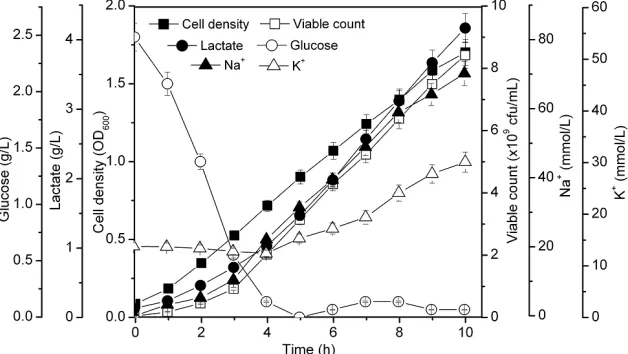
fermentation period of 0-4 h and 4-10 h were adjusted by NaOH and mixture of NaOH and KOH (volume ratio at 2:1), respectively. As the pH limits were set to 6.98-702 (0-4 h) and 7.48-7.52 (4-10 h), the pump of glucose solution coupled to the pH controller was activated when the pH above the higher limit. The results of S. suis fermentation using the pH feedback fed-batch culture method are showed in Figure 3. With application of this feeding strategy, the concentration of residual glucose was maintained at approximately 0.10 g/L, the accumulation of lactate decreased to 4.17 g/L. The concentration of glucose maintained at a low level is the most effective way to reduce the formation of by-products, and the excretion of lactate in S. suis ST171 fermentation was low with low concentration of carbon source [5, 18]. Due to the reduction of lactate accumulation, less alkaline solution was added to control pH and the concentrations of Na+ and K+ were 70.2 mmol/L and 30.1 mmol/L [8]. The cell density and viable count of S.
suis increased to 2.347 and 8.42x10⁹ cfu/mL because of the reduction of lactate and proper concentrations of Na+ and K+. In production of L-isoleucine, the accumulation of acetate was decreased and the biomass and production of L-isoleucine were increased obviously by using the DO feedback feeding [19]. An appropriate feeding strategy is important to decrease the accumulation of by-products and increase the production of desired product [20].
Figure 3 Application of pH feedback feeding strategy in S. suis fermentation. (p<0.05)
CONCLUSION
[image:5.595.149.463.533.710.2]______________________________________________________________________________
control had a positive impact on increasing the cell density of S. suis, and higher cell density and viability were obtained by using the pH feedback feeding strategy because of the reduction of lactate accumulation and proper levels of pH, Na+ and K+. The improvement of cell density can reduce production cost and expand application market of the vaccine, and this study illustrates a useful approach for large-scale production of a vaccine strain of S.
suis serotype 2. This enhances the application of a vaccine results in prevention of the occurrence of pig
streptococcus disease and promotion of the pig industry development.
Acknowledgments
This work was supported by Doctoral Program Foundation of Shandong Binzhou Animal Science and Veterinary Medicine Academy (BS201402), Shandong Province Natural Science Foundation of China (ZR2014CQ009), Development of Science and Technology Plan Program of Binzhou (2013GG0304), and Innovation Program of Pig Industry of Modern Agricultural Industry System of Shandong (SDAIT-06-011-14).
REFERENCES
[1] M Meijerink; ML Ferrando; G Lammers; N Taverne; HE Smith; JM Wells. Plos One, 2012, 7(4), e35849. [2] TF Zhang; Y Ding; TT Li; Y Wan; W Li; HC Chen; R Zhou. BMC Microbiol., 2012, 12, 85.
[3] L Bonifait; MC Dominguez-Punaro; K Vaillancourt; C Bart; J Slater; M Frenette; M Gottschalk; D Grenier. BMC
Microbiol., 2010, 10, 42.
[4] ML Liu; LR Fang; C Tan; TS Long; HC Chen; SB Xiao. BMC Genomics, 2011, 12, 253.
[5] LK Cheng; J Wang; Q Fu; LZ Miao; XY Yang; SG Li; F Li; ZQ Shen. Biotechnol. Biotechnol. Equip., 2015, 29(4), 779-785.
[6] M Follmann; I Ochrombel; R Krämer; C Trötschel; A, Poetsch; C Rückert; A Hüser; M Persicke; D Seiferling; J Kalinowski; K Marin. BMC Genomics., 2009, 10, 621.
[7] LM Stancik; DM Stancik; B Schmidt; DM Barnhart; YN Yoncheva; JL Slonczewski. J. Bacteriol., 2002, 184(15), 4246-4258.
[8] LK Cheng; J Wang; QY Xu; CG Zhao; ZQ Shen; XX Xie; N Chen. World J. Microbiol. Biotechnol., 2013, 29, 883-890.
[9] JN Phue; J Shiloach. Metab. Eng., 2005, 7, 353-363. [10] HF Zhu; K Shimizu. Metab. Eng., 2005, 7, 104-115.
[11] Q Guo; SJ Ahn; J Kaspar; X Zhou; RA Burneb. J. Bacteriol., 2014, 196(2), 227-236.
[12] YP Liu; P Zheng; ZH Sun; Y Ni; JJ Dong; P Wei. J. Chem. Technol. Biotechnol., 2008, 83, 722-729. [13] C Zhang; W Cong; SY Shi. Appl. Biochem. Biotechnol., 2010, 162, 2149-2156.
[14] W Johnston; R Cord-Ruwisch; MJ Cooney. Bioprocess Biosyst. Eng., 2002, 25(2), 111-120. [15] PC Lee; WG Lee; SY Lee; HN Chang. Process Biochem., 1999, 35, 49-55.
[16] GZ Ye; M Jiang; KQ Chen; J Li; YL Xi; XM Huang; P Wei. Chin. J. Biotechnol., 2010, 26(2), 183-188. [17] YG Ryu; M Butler; KF Chater; KJ Lee. Appl. Environ. Microbiol., 2006, 72, 7132-7139.
[18] J Wang; LK Cheng; N Chen. Biotechnol. Biotechnol. Equip., 2014, 28(3), 495-501.
[19] J Wang; B Wen; QY Xu; XX Xie; N Chen. Biotechnol. Biotechnol. Equip., 2015, 29(2), 374-380.