Science of the Total Env~ronment 496 (2014) 607-623
Contents lists available at ScienceDirect
Science of the Total Environment
journal homepage:
w w w . e l s e v i e r . c o m / l o c a t e l s c i t o t e n vL2-f.A
Risk-based decision-making framework for the selection of sediment
0
CrossMarkdredging option
Norpadzlihatun Manap
a.b.*,
Nikolaos Voulvoulis
a Faculb
ofTechnolow Management
and Business Universiti Tun Hussein Onn Malaysia 86400 Pmit Rajo. BotuPohatjohor. Malaysia
CentrefOTErmironmentalPolicy. Wal College London,United
KingdomCentre
forEnvironmental
Policy, lmpen'olCollege
London, UnitedKingdom
H I G H L I G H T S
A
new integrated. holistic and staged framework
was
developed.
This framework aimed
to
select the best sediment dredging option.
This
new
framework is beneficial for dredging and sediment management industries.
A R T I C L E
I N F O
A B S T R A C T
Article
history:
Received
22March
2014Received
inrevised
form 2July
2014Accepted
2 July 2014Available online
xxxx
Editor: D. Baraelo
Keywords:
Integrated environmental management
Risk-based method
Dredging
Ecological
riskassessment
Multi-uiteria
decisionanalaysis
Decision-making
methodThe aim of this study was to develop a risk-based deasion-making framework for the selection of sediment
dredging option. Descriptions using case studies of the newly integrated. holistic and staged framework were
followed. The first stage utilized the historical dredging monitoring data and the contamination lwel in media
data into Ecological Risk Assessment phases. which have been altered for benefits in cost time and simplicity.
How Multi-Crlteria Decision Analysis
(MCDA) canbe
used to analyze and prioritize dredging areas based on en-
vironmental, socio-economic and managerial criteria was described for the next stage. The results from
MCDAwill be integrated into Ecological Risk Assessment to characterize the degree of contamination in
the
prioritized
areas. The last stage was later described using these findings and analyzed using
MCDA,
in order to identify the
best sediment dredging option. accounting for the economic environmental and technical aspects of dredging,
which is beneficial for dredging and sediment manaEement industries.
-
-
-
0 2014
Elsevier
B.V.All rights resewed.
Dredging is a process that removes sediments from river and sea
beds mainly to aid ship navigation, and was first used more than a thou-
sand years ago by the peoples who lived on the banks of the Tigris and
Euphrates to deepen sea channels (Herbich, 1975; Montgomery, 1984;
Shankland, 1931
).In addition. other purposes of dredging have historically included
extraction of sediments for the construction and agricultural industries.
removal of sediments for wharf expansion, protection of coastal areas
*
Corresponding author at: Depament
ofConstruction Management. Faculty
ofTechnology Management
and Business. Universiti Tun Hussein Onn Malaysia, Beg k k u n c i101.86400
F%t
Raja, BatuPahatJohor, MaIaysiaTel.:
+60 7 453 3911; faxr f 607 4.53 3833. E-moiladdress: [email protected]
(N. Manap).Present permanent address:
1515.15 Prince's Gardens. Imperial College London.South
Kensington Campampus, LondonSW7
UIZ, UnitedKingdom.
through land reclamation, environmental improvement in the form of
flood prevention or contamination remediation. and infrashucture pur-
poses such as underwater cabling and pipelines (Blazquez et a]., 2001
;
Gurfinkel and Shepsis, 1993; Orosz and Bierbauer, 1994; Sheehan
et al., 2010b). There are two main types of dredging. Capital dredging
occurs in previously undisturbed areas, and Maintenance dredging
takes place to sustain areas adequately deepened (Montgomery. 1984;
Yell and Riddell, 1995).
In recent years, the growing need to perform extensive maintenance
dredging has been due to ships growing in size and numbers due to
increased maritime trading activities. Capital dredging has been needed
to build or extend wharfs and ports. with a number of mega dredging
projects currently in progress. including one on the River Scheldt and
another as part of the expansion of the Panama Canal (Krizner, 2010;
Schexnayder. 2010). In addition. there is an emerging demand for
dredging in developing countries due to growing global trade, with
India estimated to become the largest dredging market, in light of the
N.
Manap. N Voulvoulir/Science of the Total Environment496 (2014) 607-623Compmsation cost for1ocrl comrm~llity
0.06
I
I
I/
-
.
-
Original
weight
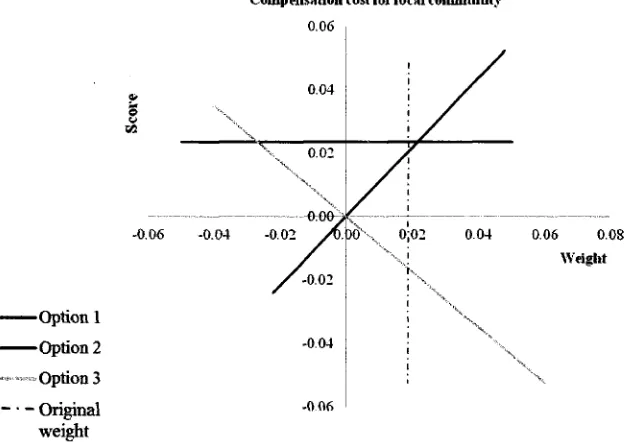
Fig18 Sensitivity analysis results showing rankings of the options after variations of weights assign to sub-criteria of Compensation cost for local community.
to apply &e best sediment dredging option that minimiza h e impacts of
Burton J. Allen G. Sediment quality criteria in use around the world. Limnology 2002;3: 65-76.drrdging
and lowers
quality analysis
and management
Cappuyns V. Assessment of heavy metal mobility in dredged sediments: porewater anal-costs
can
be achieved through the implementation of this framework
A
ysis. single and sequential extractions. Soil Sediment Contam 2006:15:169.dredging permit
can
be
issued
to relevant dredging stakeholders to
im-
Census of Marine tife. UNESCO. Ocean B~ogeograph~c Information System; 2012.plement
a
drrdgjng
projeb, in which compliance to
environmental
Clarke S. Jackson A. NeffJ. Development of a nsk assessment methodology for evaluahng potential impacts assoc~ated wlth contarnlnated mud disposal in the marine envlron-rules
and regulations
can be
monitored. The application of this framework
ment. Chemosphere 2000;41:69-76.should be in parallel
with
h e work of constructing national dredging and
Commision of ~uropean Communities. Directive of the European Pariiment and of thecontaminated land policies.
merefore,
future
dredging
work
should use
Council establishing a framework for the protection of soil and amending Directive 2004/35/EC 2006;2006/0086 (COD).this framework in order to help decision-making in dredging and sedi-
cmpr
KM,
B * ~ ~ ~CRS, ~~f~~ E, , hcuhs
M, neddum ~~~k~ et al. A~~~~~~~~~ment management industries This m e w o r k should be treated dynam-
of ecosystem function following marine aggregate dredging. J Exp Mar Biol Ecol2008: 366:82-91.ical'y
and
should
be
after it has
to
dredging
Constantino R Clam dredging etrects and subsequent recovery of benthic communities atprojects, where changes can be made accordingly.
different depth ranees. Mar Environ Res 2009:67:89-99.Acknowledgments are given to Universiti
Tun
Hussein
OM
Malaysia.
the Ministry of Higher Education Malaysia, Malaysian Maritime and
Dredging Corporation Sdn. Bhd. for the support given during the writing
of this paper.
References
Agius 5, Porebski L Towards the assessment and management of contaminated dredged materials. Integrated environmental assessment and management 2008:4:255-60.
Alvarez Guerra M. Viguri J. Casado Martinez MC DeIValls TA. Casado-Martnez MC Sedi- ment quality assessment and dredged material management in Spain: Part I, applica- tion of sediment quality guidelines in the Bay of Santander. lntegr Environ Assess Manag 2007:3:52%38.
Alvarez Guerra M. Viguri J. Voulvoulis N. A multicriteria-based methodology for site prioritisation in sediment management. Environ Int 2009;35:920-30.
Anderson
MJ,
Barkdoll BD. Incorporation of Air Emissions in Dredging Method Selection. Journal of waterway. port coastal. and ocean engineering 2010;136:191-9. Aquaculture Department Southeast Asian Fuheries Development Center Tigbauan, lloilo,Philippines. Husbandry and Health Management of Grouper. SEAFDEC Aquaculture Department 2001 ; Asia-Pacific Economic Cooperab'on Fisheries Working Group 011 2000:l-95.
Balchand AN, Rasheed
K
Assessment of short term environmental impacts on dredging in a tropical estuary. Terra Aqua 2000:16-26.Blazquez C. Adams T, KeiUor P. Optimization of mechanical dredging operations for sedi- ment remediation. J Waterw Port Coast Ocean Eng 2001 ;127:299-307.
Bonvicini Pdgliai AM. Cognetti Varri.de AM. G e m
4
Curini Gallem: M. Vandini Zunarelli R Environmental impact of extensive dredging in a coastal marine area. Mar Pollut Bull 1985:16:483-8.Bridge J, Demicco R. Earth surface processes, landforms and sediment deposits. GB: Cambridge University Press: 2008.
Gowe SE Gayis IT,t i s o
RF.
Bergquist DC. Jutte PC, Van DolahRF.
Impact of the Charleston Ocean Dredged Material Disposal Site on nearby hard bottom reef habitats. Mar Pollut Bull 2010;60:679-91.Cruz-MottaJ. Collins J. Impacts of dredged material disposal on a tropical soft-bottom benthic assemblage. Mar Pollut Bull 2004;48:270-80.
de LeeuwJ. Strategic assessment of the magnitude and impacts of sand mining in Poyang Lake. China. Reg Environ Chang Nat Soc Asp 2010;10:95-102.
Deliman PN. Ruiz
CE.
Schroeder PR Dredging Risk Assessment Modelling Applications (DRAMA) for evaluation of dredgingimpacts. Proceedings of the third specialty con- ference on dredging and dredged material disposal; 2002.Department of Environment MEnvironmental Qual~ty Report 2OOSAnnual Environmen- tal Quality Report of Malaysia: 2005. p. 1-78.
Department of Environment M.Environmental Quality Report 2006Annual Environmen- tal Quality Report of Malaysia; 2006. p. 1-78.
Department of Environment Mhvironmental Quality Report 2007Annual Environmen- tal Quality Report of Malaysia; 2007. p. 1-78.
Department of Environment MEnvironmental Quality Report 2008Annual Environmen- tal Quality Report of Malaysia; 2008. p. 1-78.
Department of Environment MEnvironmental Quality Report 2009Annual Environmen- tal Quality Report of Malaysia: 2009. p. 1-78.
Department of Environment MEnvironmental Quality Report 2OlOAnnual Environmen- tal Quality Report of Malaysia; 2010. p. 1-78.
Department of Environment MEnvironmental Quality Report 2OllAnnual Environmen- tal Quality Report of Malaysia; 2011. p. 1-78.
Department of Environment Malaysia Malaysian recommended site screening levels for contaminated land. Contaminated Land Management and Conbol Guidelines. 1. ; 2009. p. 1-59,
Department of Environment Malaysia Interim National Water Quality Standards for Malaysia (INWQS). Deparbnent of Environment Malaysia; 2013a.
Department of Environment Malaysia. Marine Water Quality Standards and Criteria (MWQSC). Department of Environment Malaysia; 2013b.
Department of Fisheries MalaysiaAnnual Fisheries Statistic 2010; 2010. p. 1-45, Desprez M. Physical and biological impact of marine aggregate extraction along the
French coast of the Eastern English Channel: short-and long-term post-dredging res- toration. ICES J Mar Sci 2000:57:1428.
Eisler R Zinc hazards to fish, wildlife, and invertebrates: a synoptic review; 1993. Ellery
W.
McCarthy T. Environmental change over two decades since dredging and exca- [image:16.601.147.461.64.285.2]N. Manap,
N.
Vouboulis /Science of the Finley B. Su S. A review of the risk assessment methods used to establish permittingcriteria for open ocean disposal of dredged NY/NJ harbor sediments. Dredged mate- rial management options and environmental considerations; 2000. p. 263. George C Obstacles and opportunities. Dredging and port construction; 2011. p. 26-9
(January 2012).
Ghanrni
Z
Rouabhia M. Othmane 0. Deschaw PA Effects of metal ions on cyprinid fish immune response: In viho effects of Zn2+
and Mn2+
on the mitogenic response of carp pronephros lymphocytes. Ecotoxicol Environ Saf 1989;17:183-9.Government of Malaysia. Environmental quality (Prescribed activities) (Environmental impact assessment) Order; 1987 (1987 5th November).
Great Lakes and Ohio River Division US. Army Corps of Engineers. Great Lakes System: Dredged Material Management Long Term Strategic Plan: 2010. p. 1-76. Croote JD, Dumon G. Vangheluwe IN Jansen C Environmental monitoring of dredging op-
erations in the Belgian nearshore zone. Terra Aqua 1998;70:21-5.
Guerra
R,
Pasteris A, Ponti M. Impacts of maintenance channel dredging in a northem Adriatic coastal lagoon. I: effects on sediment properties, contamination and toxicity. Estuar Coast Shelf Sci 2009;85:134.Gupta AK Gupta SK, Gupti Rashmi SP. Environmental management plan for port and har- bour projects. Clean Technol Environ Policy 2005;7:133.
Curlinkel AH. Shepsis V. Waste free dredging of waterways
-
uses dredged material for fabricating useful building prods. e.g. moulded bricks onto light w t aggregate; 1993 (US767147:O-9).Hakanson L An ecological risk index for aquatic pollution control. A sedimentological ap- proach. Water Res 1980;14:975-1001.
Hall LW. Scott M$ Killen
WD.
Ecological risk assessment of copper and cadmium in sur- face waters of Chesapeake Bay watershed. Environ Toxicol Chem 1998:17:1172-89. Herbich JB.Coastal and deep ocean dredging Texas: Gulf Publishing Company; 1975. IUCN. The IUCN red list of threatened species version; 2012 (1.2012).Jones
M,
Shuber J, Apte S. Simpson S, Vicente-Beckett V.Johnson % e t al. A risk assess- ment approach to contaminants in Port Curtis. Queensland. Australia. Mar Pollut Bull 2005;51:448-58.IZenny AJ. Rees HL The effects of marine gravel extraction on the macrobenthos: early post-dredging recolonization. Mar Pollut Bull 1994;28:442-7.
Kenny AJ. Rees HLThe effects of marine gravel extraction on the macrobenthos: results 2 years post-dredging. Mar Pollut Bull 1996;32:615-22.
Krizner K. Manufacturers make their move. World Trade 2010;23:16. (W100). Laiwu Starring Trading Co. Ud. Polypropylene woven geotextile for silt curtain; 2013. Linkov I. Satterseom FIC Kiker G. Batchelor $ Bridges T. From comparative risk assess-
ment to multi-criteria decision analysis and adaptive management: recent develop- ments and applications. Environ Int 2006;32:1072-93.
Iinkov I. Cornier $ Gold J. Sat@rseom FK. Bridges T. Using Our Brains to Develop Better Policy. Risk analysis 2012:32:374-80.
Lions j. Metal availability in a highly contaminated, dredged-sediment disposal site: field measurements and geochemical modeling Environ Pollut 201 0;158:2857-64. Ljung K. Canal estate development in an acid sulfate soil-Implications for human metal
exposure. Landsc Urban Plan 2010;97:123-31.
Mackie JA Declining metal levels at Foundry Cove (Hudson River, New York): response to localized dredging of contaminated sediments. Environ Pollut 2007:149:141-8. Manap
N,
VouhroulisN.
Zulkifli N. The applications of driving force, pressure, state, impactand response in Malaysia's dredging industry. lnt J Food Agnc Environ 2012:10:1031-8. Manap
N.
Vwlvoulis N. Environmental Screening Method for Dredging in ContaminatedRiver. Vol. 567. In Applied Mechanics and Materials; 2014 August p. 50-5. Messieh
SN,
Rowell 'IW, Peer DL Ganford PJ. The effects of trawling, dredging and oceandumping on the eastern Canadian continental shelf seabed. Cont Shelf Res 1991;ll: 1237-63.
Ministry of Finance Malaysia Anggaran Perbelanjaan Persekutuan 201 1 , l . ; 2010. p. 6E4.
Mink F. Dirks M. Raalte GV. Russell M. Impact of European Union Environmental Law on dredging. Terra Aqua; 2006.
Mohamad M. The way forward -vision 2010; 2010 (2011).
Montgomery
RL
Dredging and dredged material disposal techniques for contaminated sediments. Proceedings of the Annual Conference-
North American Lake Manage- ment Society, 1.:
1984. p. 586. (Conference).Munawar M. In situ bioassessment of dredging and disposal activities in a contaminated ecosystem: Toronto Harbour. Hydrobiologia 1989:188-189:601-18.
National Research Council. Nutrient requirements of fish. Washington D.C.: National Academy Press; 1993
National Research Council (US). Committee on Minerals. Mineral tolerance of animals. 2nd Revised ed. National Academy Press; 2005.
Newell RC Hitchcock DR Seiderer LJ. Organic enrichment associated with outwash from marine aggregates dredging: a probable explanation for surface sheens and enhanced benrhic production in the vicinity of dredging operations. Mar Pollut Bull 1999;38: 804-1 8.
Nithuuer C 4 Austin J r J 4 Field ME KravitzJH. Syvitski. James
PM.
et al. Writing a Rosetta stone: insights into continental margin sedimentary processes and strata Speo'al Pub- lication number 37 of International Association of Sedimentologists; 2007. p. 1-38. Office of Naval Research. Soence and technology focus; 2008 (2010).Oken SL Ulristensen
FM.
Hamchild M. PedersenF.
Larsen HF.Twslev
J. Life cycle impact assessment and risk assessment of chemicals-
a methodological comparison. Envi- ron lmpact Assess Rev 2001;21:385-404.Omar SZ Information and com~nunication technology for fisheries industry development in Malaysia. Afr J Agric Res 2011;6:4166.
Orosz
.
I
Bierbauer A Extraction and processing of sandy aggregate-
to form dry and/or wet concrete mixes; 1994. p. HU003275.Otto DME. Impaired inducibility of xenobiotic and antioxidant responses in rainbow trout exposed to polychlorinated biphenyl contaminated sediments in the St. Lawrence River. Chemosphere 1996;33:2021.
Padmalal D. Environmental effects of river sand mining: a case from the river catchments of Vembanad lake. Southwest coast of India. Environ Geol2008;54:879-89. Pan J. Environmental risk assessment of inorganic chemicals in the mining environments.
Imperial College London; 2009. p. 1-389 (PhD Thesis).
Pekey H, K a d q D. Ayberk S, Tolun
L
Bako lu M. Ecological risk assessment using trace elements from surface sediments of lzmit Bay (Northeastern Marmara Sea) Turkey. Mar Pollut Bull 2004;48:946-53.Permdin Y. Babut M. Bedell J, Bray M. Clement B. Delolme C. e t al. Assessment of ecotox- icological risks related to depositing dredged materials from canals in northern France on soil. Environ Int 2006;32:804-14.
Piou %Changes in the geochemistry and ecotoxicity of a Zn and Cd contaminated dredged sediment over time alter land disposal. Environ Res 2009;109:712-20.
Ponti
M,
Pasteris A, Guerra R Abbiati M. Impacts of maintenance channel dredging in a northern Adriatic coastal lagoon. 11: effects on macrobenthic assemblages in channels and ponds. Estuar Coast Shelf Sci 2009;85:143-50.Powilleit M. Kleine J. Leuchs H. Impacts of experimental dredged material disposal on a shallow, sublittoral macrofauna community in Mecklenburg Bay (western Baltic Sea). Mar Pollut Bull 2006;52:386-96.
Rasheed
K,
Balchand AN. Environmental studies on impacts of dredging. Int J Environ Stud 2001;58:703.Rhodes
K
Reproductive movement, residency and fisheries vulnerability of brown-marbled grouper, Epinephelusfuscoguttah~s (Forssbl. 1775). Coral Reefs 2012;31:443-53. Riley JP, ChesterR
Introduction to marine chemistry London. London: Academic PressInc.; 1971.
Salomom W. Brils J. Contaminated Sediments in European River Basins. European Sedi- ment Research Network 2004:71.
Schexnayder CJ. Panama Canal project revs up with new award. ENR 2010;265:1. Sergeev A. The impact of two newly built port terminals in the Eastem Gulf of Finland on
sedimentation processes and coastal zone dynamics. Est J Eng 2M)9:15:212-26. Shankland EC Dredging of harbours and rivers Glasgow: Brown. Son and Ferguson, lim-
ited. nautical; 1931.
Sheehan C, Harrington J. Murphy JD. An environmental and economic assessment of top- soil production from dredge material. Resour Conserv Recyd 2010:55:209-20. Shigaki F, KleinmanPJA. Schmidt J. Sharpley
4
M e n Almpact of dredging on phosphorustransport in agricultural drainage ditches of the Atlantic Coastal Plain 1. J Am Water Resour Assoc 2008;44:1500.
Spalding M. World atlas of coral reefs; 2W1.
Sparrrvik M. Barton DN. Bates ME. Linkov I.Use of Stochastic Multi-Criteria Decision Anal- ysis to Support Sustainable Management of Contaminated Sediments. Environ Sci Technol2011;46:1326-34.
Stolzenbach KD. Adams EE. Contaminated sediments in Boston Harbor Massachusetts: marine center for coastal processes. M r Sea Grant College Program; 1998. Su S. Potential long-term ecological impacts caused by disturbance of contaminated sed-
iments: a case study. Environ Manage 2002:29:234-49. Thacker S. Dredging projects. Int Finan law Rev 2007;26:59.
The UK Marine Management Organisation. Licensable activities and exemptions. Dredg- ing (includ~ng daregate dredging) 201 3.
The
UK
Marine Management Organisation. Dredging, disposal and aggregate dredging. Marine licensing guidance 2011;3:1-32.Thibodeaux LJ. Duckworth KT. The effectiveness of environmental dredging: a study of three sites. Remediat j 2001 :I 1 5-33,
Toes R Effects of deposition of heavy-metal-polluted harbor mud on microbial diversity and metal resistance in sandy marine sediments. Arch Environ Contam Toxicol 2008;55:372-85.
Tun Abdul
Razak
MN. The 201 1 budget speech; 2010. p. 1-38.Turekian
KK.
SteeleJH, Thorpe SA. A derivative encyclopedia of ocean sciences. Clim Oceans 2010;l:l-647.U.S. Environmental Protection Agency. Ambient aquatic life water quality criteria for dis- solved oxygen (saltwater): Cape Cod to Cape Hatteras; 2000 (EPA-822-R4&012:149). US. Envimntnental Protection Agency. Freshwater sediment screening benchmarks; 2012a. US. Environmental Protection Agency. Marine screening benchmarks; 2012b. US. Environmental Prutection Agency. Marine sediment screening benchmark; 2012c. van den Hurk P. Eertman RHM. Stmnkhorst J.Toxicity of harbour canal sediments before
dredging and after off-shore disposal. Mar Pollut Bull 1997;34:244-9.
Vivier
L
Cyrus DP. Dune mining and the Nhlabane Estuary. South Africa: the effect of a dredger crossing on the zoobenthic community. Mar Pollut Bull 1999:39:308-14. Ware S. Bolam SG, Rees HL lmpact and recovery associated with the deposition of capitaldredging at UK disposal sites: lessons for future licensing and monitoring. Mar Pollut Bull 2010;60:79-90.
Wilber DH. Clarke DG. Rees SI. Responses of benthic macroinvertebrates to thin-layer dis- posal of dredged material in Mississippi Sound, USA. Mar Pollut Bull 2007;54:42-52. Wu G, de LeeuwJ. Skidmore A, Prim H. LiuY. Concurrent monitoring of vessels and water turbidiw enhances the strength of evidence in remotely sensed dredging impact as- sessment. Water Res 2007;41:3271-80.
Yell D. Riddell J. Institute of Civil Engineers design and practice guides. London: Thomas Telford Publications: 1995.
Zeman A, Pattenon T, Calabrese EJ. Kostedd lT, Dragun J. Characterization of contaminat- ed sediments for remediation projects in Hamilton Harbour