Assessing critical function of knowledge and information literacy skills
in using weblog for learning:
A case study of postgraduate students
Nurul Fariha Mokdin
1, aand Alias Masek
2, b1, 2 Faculty of Technical and Vocational Education, Universiti Tun Hussein Onn Malaysia
86400 Batu Pahat, Johor, Malaysia
a[email protected], b[email protected]
Keywords: weblog, literacy skills, knowledge, engineering education
Abstract. Everyone might aware of the typical function of weblogs for personal uses, but very little amongst us who are aware of weblog function as a learning medium. Literature suggests that optimal usage of weblog as learning medium has resulted students with better performance. This study was a case study conducted to investigate students’ readiness on weblog usage to support course work, amongst postgraduate students in engineering education. A survey was carried out to identify knowledge (awareness), information literacy and constraints faced by postgraduate students on the uses of weblog as a learning medium. Data collection involved 171 postgraduate students from multiple engineering backgrounds, undertaking engineering education program in Faculty of Technical and Vocational Education. The finding indicated that students are knowledgeable and have high level of information literacy regarding the use of the weblog as a learning medium. Several constraints were identified, but did not hinder students to make use of weblog. The implication is that educators should diversify their teaching and learning medium and make use the latest technology at any mode and level of education. By doing so, postgraduate students will have several options to enhance their learning process, including using weblog for learning.
Introduction
Weblog is a new platform for the new generation that is useful in many ways. According to [1], the authors stated that a weblog is a smart web 2.0, is user-friendly, and is a read-write web. Its access is typically available for free in any platform, ranging from mobile devices to home desktops. For that reason, the increasing number of weblogs is due to its main function as a platform for trading such as online business as well as for sharing information. In addition, weblog can serve as a real online journal and a place for people to express their personal ideas and thoughts [2], while sometimes blog functions as a diary to record personal sweet memories [3].
In view of the wide range of benefits of using weblog for personal purpose high stake users such as students, especially postgraduate students, might be using weblog for learning and research purposes. Students who are undertaking research in a particular area, such as engineering education can easily join a research community and gather the latest materials online from colleagues. However, the public perception that weblog is used for personal purpose might have overshadowed the function of weblog for education. For example, several previous studies found that students prefer to use the web for social purpose [4]. Although students have good information literacy skills, they use weblog for entertainment and online gaming [5]. In the worst-case scenario, some students have even misused weblog for downloading free illegal materials, games, and even pornographic materials [5].
stimulate learning [7] and enhance knowledge [8, 9]. However, several factors must be considered in order to ensure optimum benefits are reaped from using weblog for education.
Using weblog, especially for learning purpose requires a set of specific skills, which is known as information literacy skills; they are important for using weblog for education purpose [10]. Literacy skills include skills such as finding, organising, retrieving, and evaluating a bulk of information. Students might have high literacy skills in using social media, but lack of literacy skills in using weblog for learning purpose. According to [10], this author noted that students with low information literacy skills are inclined to misuse weblog for unethical purpose. On the other hand, students with literacy skills might access weblog for a good purpose, such as downloading lecture notes and searching for information to complete their assignments [5]. It is common that students will access weblog when they are offered several rewards. For example, students will have the incentive to access weblog when personal frequency and hits on the particular topic of discussion are assigned scoring mark.
Using weblog for education purpose is believed to be beneficial, especially for postgraduate students who have to engage with current and latest information around the clock. Users who frequently access weblog must be equipped with good literacy skills to ensure they obtain the benefits of using weblog for information sharing, downloading lecture notes, completing assignment, and getting the best scoring mark as reward. Knowledge and literacy skills are two important predictors that determine the use of weblog, either for learning or personal purpose. Therefore, this study is conducted to determine the level of knowledge and information literacy of students using weblogs for learning as well as to identify the constraints faced by students in using weblog for learning.
Methodology
A descriptive survey study design was used, since descriptive study is suitable for a large population [11]. The sample was selected from Technical Vocational Education and Training (TVET) trainee teachers, who were undertaking a master’s degree course in the Faculty of Technical and Vocational Education, Universiti Tun Hussein Onn Malaysia. A total of 171 questionnaires were distributed, and 135 (79%) were returned for data analysis
Instruments. A questionnaire was used for data collection, and it consisted of four parts: part A = demographic information, part B = students’ knowledge in using weblog for learning purpose, part C = information literacy skills, and part D = constraints in using weblog for learning. The items were developed and adapted from [12] and verified by three experts from the IT department.
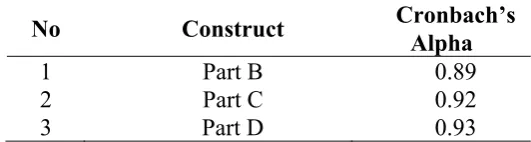
[image:2.595.163.429.711.782.2]Part A comprises several demographic items such as gender, previous education background, and the current semester. Several items were also included such as “have you ever used weblog?” and “what is your reason for using weblog?” The five-point Likert scales were used for respondents to indicate their level of agreement with each item in parts B, C and D. In part B, 13 items were used to gauge students’ knowledge, for example, “weblog functions as a platform for fruitful discussion”. In part C, the item to gauge students’ information literacy was “I know how to post a new topic for discussion”. In part D, the item to gauge constraints was “I don’t have internet access in my hostel”. The reliability coefficient using Cronbach’s Alpha for the entire items was 0.94, which is acceptable as it is above 0.6 [13], while the value for each construct is indicated in table 1
Table 1, Cronbach’s Alpha value for each construct
No Construct Cronbach’s Alpha
1 Part B 0.89
2 Part C 0.92
3 Part D 0.93
Data Analysis. Data from questionnaire were analysed using descriptive statistics such as percentage, frequencies, and central tendency using mean score and standard deviation (SD).
Results and Discussion
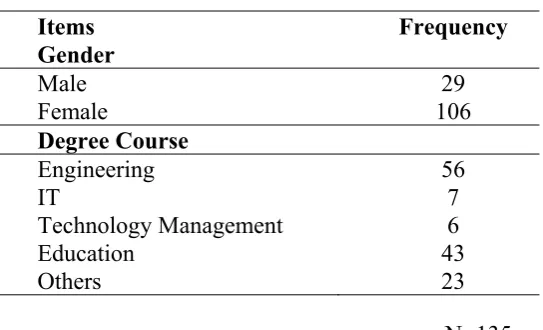
[image:3.595.163.435.257.422.2]In terms of gender, data indicated that the majority of the TVET trainee teacher participants were females, with 78.5% females and 21.5% males. 41.5% of the respondents have engineering background, 31.9% are from pure education and the rest are from multiple backgrounds, including information technology, technology management, finance, and food science fields. Further details of demographic information are indicated in table 2,
Table 2, Demographic information
N=135
In part A, respondents were also asked their purpose of using weblog. The result indicated that the majority of respondents were using weblog for learning with 51.1%, followed by personal with 25.2% and entertainment with 11.9%. The detailed numbers of respondents according to each purpose are indicated in table 3,
Table 3, Purpose of using weblog
N=135
However, this finding contradicts the finding from [4]. These authors found that undergraduate students were using weblog mostly for social networking and personal purpose. The maturity level of the respondents might be different since this study focuses on mature postgraduate students who were also trainee teachers at the same time.
Items Frequency Gender
Male Female
29 106
Degree Course
Engineering IT
Technology Management Education
Others
56 7 6 43 23
Items Frequency
What is the purpose of using weblog? Learning
Personal Entertainment Politics Business Others
Knowledge of Using Weblog for learning. Data analysis was performed using mean score and standard deviation to determine students’ knowledge level in using weblog for learning purpose. The result shows that students have a high level of knowledge of using weblog for learning purpose with mean score of 3.87 (SD = 0.49). The second item achieved the highest mean score with 4.30 (SD = 0.62). 95.2% of the respondents agreed that weblog functions as a medium for information sharing. Three selected items are showed in table 4,
Table 4, Selected items to gauge students’ knowledge level
No Items Mean SD
1 Weblog is a medium for information sharing
4.30 0.62
2 Weblog is useful for outside class activity 4.07 0.72 3 Weblog increases productivity of
assignment
3.70 0.78
A previous study by [5] found that students have a relatively high level of knowledge, which is in line with this study’s finding. Therefore, knowledge is necessary for students in using weblog for learning and more importantly to avoid misuse of weblog. According to [14], students should be aware of three aspects in using weblog for learning; first, weblog is a source of unlimited knowledge and information; second, weblog is useful for expressing ideas and thoughts; and third, weblog can be a medium for meaningful interaction and participation in learning activities.
Information Literacy Skills. The result indicated that students’ information literacy skills in using weblog for learning purpose were also at a high level with mean score of 3.75 (SD = 0.56). The item that attained the highest mean score was “I can find particular information using weblog” with 4.00 (SD = 0.77), where 82.5% of the respondents agreed with this particular statement. Other selected items are as shown in table 5,
Table 5, Items of information literacy skills
No Items Mean SD
1 I can find particular information using weblog
4.00 0.77
2 I can collect relevant information from weblog
3.92 0.71
3 I can ensure validity of information from weblog
3.47 0.93
This study’s finding is in line with the finding from [15], but it contradicts the information reported by [16]. In the study by [16], students lacked information literacy skills in searching, organising, retrieving, and evaluating a bulk of information obtained from Google search engine. Meanwhile, students in this study were able to search for relevant information (finding/searching) and evaluate the validity of particular information collected. Organising information is one of the most important components in literacy skills, where students in this study are perceived to be competent, similar to findings from [17].
Constraints in Using Weblog for Learning. Based on the data, several predefined items regarding
Table 6, Items of information literacy skills
No Items Mean SD
1 Internet problem caused by server down 4.18 0.86
2 Limited access to Wi-Fi 4.16 0.82
3 Worry about computer virus infection 4.12 0.86 4 Nothing to do with weblog 3.20 1.01
Findings from [18] support the fact that server down has been the main reason that hindered students from accessing weblog for learning purpose. The sophisticated weblog that is integrated with e-learning application should be built with a powerful server, stable computer networking system, and reliable internet platform; thus, the server can accommodate any access from terminal users. In addition, the potential threat from virus is another reason students do not access weblog for learning purpose. According to [19], this author had stated that there is no limitation of time in using blogs for learning; thus, weblog must be accessible at any time and place.
Conclusion
Weblog is useful to facilitate learning, especially for postgraduate students who need to have information access around the clock. In addition, it fulfils the need to engage in fruitful discussion with colleagues and lecturers. Weblog is also used beyond its basic functions, especially sophisticated weblog. However, knowledge and literacy skills are significantly important for students to access weblog for learning purpose. Without knowledge and literacy skills, weblog might be used for other unethical activities such as downloading illegal materials for gaming. Moreover, several constraints must be tackled before weblog is being used for learning.
Using weblog for learning can increase confidence and motivation levels because the weblog owner can impress students by uploading various interesting and useful materials. In addition, students can make their own preparation with materials obtained from the weblog before attending lectures. It has become a trend that lecturer is the person to ensure students constantly use weblog for learning. Lecturers should therefore be actively involved in the use of weblog as a medium for teaching and learning. It is vital that lecturers diversify their teaching and learning methods and make use of the latest technology at any mode and level of education. By doing so, postgraduate students will have several options to enhance their learning process.
References
[1] S. Aghaei, M.A, Nematbaksh, & H.K. Farsani. Evolution of the World Wide Web, International Journal of Web & Semantic Technology (IJWesT), 3, (2012).
[2] T.D. Green, A. Brown, & L. Robinsson, Making the most of the web in your classroom: A teacher’s guide to blogs, podcasts, wikis, pages, and sites. Corwin Press, Inc., 2008.
[3] J.W. Rettberg. Blogging: Digital media and society series. Policy Press, United Kingdom, 2008
[4] Z, Tasir, J.S. Linggu & J. Harun, Pengunaan alat rangkaian sosial di kalangan pelajar di sebuah IPTS di Kota Kinabalu, Malaysia. Jurnal Teknologi Pendidikan Malaysia, 1 (2011).
[5] A.A. Rahman & E. Y. Ibrahim. Penggunaan e-pembelajaran dan hubungannya dengan pencapaian akademik pelajar di Fakulti Pendidikan, Eprints, UTM, Skudai, 2010.
[7] Y. Lin & M.V. Hooft, The impact of blogs on student perceptions toward social interaction and learning satisfaction in blended learning, Accessed, April, 23 2013 from www.apse.net/icce2008/content/proceeding_0833.pdf.
[8] J. Hassan & N. Edje, Penggunaan internet di dalam mempertingkatkan proses pengajaran dan pembelajaran (P&P) dalam kalangan pensyarah, Eprints, UTM, Skudai, 2010.
[9] Q. Zeng & X. Zhong, The design of individual knowledge sharing platform based on blog for online information literacy education. 2012 International Conference on Medical Physics and Biomedical Engineering, 33 (2012), 1426-1432.
[10] H. Mohamed, H.M. Judi, S.F. Noor, & Z. Yusof, Jurang Digital dan Pendidikan di Luar Bandar: Tahap Literasi Teknologi Maklumat dan Komunikasi Pelajar. Australia Journal of Basic and Applied Sciences, 6 (2012), 39 – 45.
[11]M.L. Dantzker, & R.D. Hunter, Research Methods for Criminology and Criminal Justice, Jones & Bartlett Learning, Canada, 2012.
[12] H.S. Ronnie, C.D. Christopher, & M. W. Ng. Eugenia, Analysis of the technology acceptance model in examining students’ behavioral intention to use an e-portfolio system. Australian Journal of Educational Technology, 27 (2011), 600-618.
[13] R. Perera, C. Heneghan, & D, Badenoch, Statistics toolkit, Blackwell Publishing, Massachusetts, 2008.
[14] Y. Park, G.M. Heo & R. Lee, Blogging for informal learning, analyzing bloggers’ perceptions using learning perspective, Educational Technology & Society, 14 (2011), 149-160.
[15] N. Ismail, Z. Hussin and M.K. Khalid, Tahap literasi kopuetr pelajar Sekolah Menengah di Kedah, Jurnal Pendidikan, 30 (2005), 129 – 139.
[16] K. Kingslay, G.M. Galbraith, M. Herring, E. Stowers, T. Stewart, and K.V. Kingsley, Why not just Google it, An assessment of information literacy skills in a biomedical science curriculum, BMC Medical Education, 17 (2011).
[17] A.R. Idris, & N.A. Hassan, Literasi ICT dalam kalangan pelajat tahun empat Fakulti Pendidikan UTM, Eprints, UTM, Skudai, 2010.
[18] A.A. Rahman & F. Shamsudin, Penggunaan E-pembelajaran di kalangan pelajar Jabatan Pendidikan Teknik dan Kejuruteraan, Universiti Teknologi Malaysia, Eprints, UTM, Skudai, 2010.