DEVELOPMENT OF TIME DELAY VOLTAGE CONTROL FOR LEAD ACID BATTERY USING ARDUINO
NURUL NADIA BINTI MOHAMMAD
A project report submitted in partial fulfillment of the requirement for the award of the
Degree of Master of Electrical Engineering
Faculty of Electrical and Electronic Engineering Universiti Tun Hussein Onn Malaysia
v
ABSTRACT
ABSTRAK
vii
CONTENTS
TITLE i
DECLARATION ii
DEDICATION iii
ACKNOWLEDGEMENT iv
ABSTRACT v
CONTENTS vii
LIST OF TABLE x
LIST OF FIGURE xi
LIST OF SYMBOLS AND ABBREVIATIONS xiii
LIST OF APPENDICES xiv
CHAPTER 1 : INTRODUCTION
1.1 Project background 1
1.2 Problem statement 3
1.3 Project objectives 3
1.4 Scope project 4
CHAPTER 2 : LITERATURE REVIEW
2.1 Battery 5
2.1.1 Rechargeable battery 6
2.2 Converter (DC to DC ) 7
2.2.1 Buck converter 8 2.2.2 Boost converter 8 2.2.3 Buckboost converter 9
2.3.1 Adaptive controller 9 2.3.1.1 PID controller 11 2.3.1.2 Fuzzy logic controller 12
2.4 Proposed controller 13
2.5 Arduino 15
CHAPTER 3 : METHODOLOGY
3.1 Block diagram of project 17
3.2 Flow chart of system 18
3.3 Flow chart of project 20
3.4 Overall closed loop sysytem of theproject 22
3.5 Hardware development 23
3.5.1 Implement buckboost circuit 23
3.5.1.1 Buckboost circuit 23
3.5.1.2 Calculation theory of buckboost circuit 24
3.5.1.3 Buckboost switching 26
3.6 Gate driver design 28
3.7 Voltage sensor 30
3.8 Software development 32
3.8.1 Time delay controller 32 3.9 Experiment setup 33 CHAPTER 4 : RESULT AND ANALYSIS
4.1 Simulation from MATLAB/Simulink 35
4.2 Open loop control 38
4.2.1 Simulation of open loop control 38
4.2.2 Open loop hardware 40
4.3 Close loop control 43
4.3.1 Simulation of closed loop control 43
ix CHAPTER 5 : CONCLUSION AND RECOMMEDATION
5.1 Conclusion 52
5.2 Recommendations 53
REFERENCES 54
LIST OF TABLE
NO TITLE PAGE
Table 3.1: List of components for buckboost circuit 24
Table 3.2: Calculation theory of buckboostcircuit 29
Table 3.3: List of components for gate driver 29
Table 3.4: List of component of voltage sensor 31 Table 4.1: Result of open loop simulation 39 Table 4.2 Result of open loop hardware 42 Table 4.3: Comparison result of simulation and hardware approach of
open loop control 42 Table 4.4: Result of closed loop simulation 44 Table 4.5: Overall result of hardware approach during closed loop control 50 Table 4.6: Comparison result of simulation and hardware approach of
xi
LIST OF FIGURE
NO TITLE PAGE
Figure 2.1: Generalized battery charging circuit 7
Figure 2.2: General buck converter circuit 8
Figure 2.3: General boost converter circuit 8
Figure 2.4: General buckboost converter circuit 9
Figure 2.5: PID controller 11 Figure 2.6: Functional block diagram of fuzzy logic controller 13 Figure 2.7: Basic time delay controller 14 Figure 2.8: Time delay controller 15 Figure 2.9: Arduino board 16 Figure 3.1: Block diagram of the project 17 Figure 3.2: Flow chart of system 18 Figure 3.3: Flow chart of project development 20 Figure 3.4: Overall closed loop system of the project 22 Figure 3.5:Modified buckboost converter circuit 23 Figure 3.6: Hardware development of buckboost circuit 24
Figure 3.7: General buckboost circuit 26
Figure 3.8: General buck circuit 26
Figure 3.9: General boost circuit 26
Figure 3.10: Relational operation of buckboost switching 27
Figure 3.11: Truth table for AND gate and OR gate 27
Figure 3.12: Position of the switches according truth table 27 Figure 3.13: Position of the switches of buckboost cicuit 28
Figure 3.14: Schematic diagram of the gate driver 29
Figure 3.15: Hardware development ofngate driver 30
Figure 3.17: Design of time delay controller 32
Figure 3.18: Parameter of time delay controller 33
Figure 3.19: Experiment setup 33
Figure 4.1: Simulation of buckboost circuit 36 Figure 4.2: Simulation result of boost operation 37 Figure 4.3: Simulation result of buck operation 37 Figure 4.4: Design of open loop control 38 Figure 4.5: Output voltage waveformfor for open loop control 39 Figure 4.6: Output result for open loop test when input voltage at 10V 40 Figure 4.7: Output result for open loop test when input voltage at 15V 40 Figure 4.8: Output result for open loop test when input voltage at 17V 41 Figure 4.9 : Output result for open loop test when input voltage at 18V 41 Figure 4.10: Simulation design of closed loop control 43
Figure 4.11: Block diagram of closed loop control 45
Figure 4.12: Output result for closed loop test when input voltage at 18V 46
Figure 4.13: Output result for closed loop test when input voltage at 17V 46
Figure 4.14: Output result for closed loop test when input voltage at 16V 47
Figure 4.15: Output result for closed loop test when input voltage at 15V 47
Figure 4.16: Output result for closed loop test when input voltage at 14V 48
Figure 4.17: Output result for closed loop test when input voltage at 13V 48
Figure 4.18: Output result for closed loop test when input voltage at 12V 49
Figure 4.19: Output result for closed loop test when input voltage at 11V 49
xiii
LIST OF SYMBOLS AND ABBREVIATIONS
PID - Proportional Integral Derivative;
PWM - Pulse Width Modulation FLC - Fuzzy Logic Controller ADC - Analog to Digital Converter DAC - Digital to Analog Converter DSP - Digital signal Processing - Proportional gain
- Integral gain
LIST OF APPENDICES
APPENDIX TITLE PAGE
A Characteristic of Battery 57
B List of Equipment 58
C Data sheet of MOSFET IRF 540 59
CHAPTER 1
INTRODUCTION
1.1 Project background
A battery, which is actually an electric cell, is a device that produces
electricity from a chemical reaction and therefore the battery is an essential component of almost in various applications in electrical systems such as electric vehicle and others. Batteries are also extensively adopted in various applications, such as telecommunication power supply, uninterruptible power supplies, photovoltaic systems and many of portable electronics products [1]. For example, a portable device requires a battery as its power source when an AC adapter is not available [2]. Normally, batteries are used to start engines and auxiliary power units, to provide emergency backup power for essential avionics equipment. Many of these functions are mission critical, so the performance and reliability of the battery is considerable importance such as rapid recharge capability. This is because the charging mode of the battery normally takes several hours to complete the charging. The battery acts very an important role in the system performance such as system run-time and system stability [2]. So, some factor must be taking into consideration for example rapidly charging in term of to maintain the battery performance and the time for the battery to fully charging.
in process technology like welding, power supplies for telecommunications systems, aerospace, military environment and so on [3]. In general, converter has several topologies such as boost, buck, buck–boost and multi-level converters. The selection of the converter depends on the different applications that have been approached. There are five commonly used in DC-DC conversion topologies that suitable for battery operated systems which are buck, boost, non-inverting buck-boost, charge pump and flyback converters [2]. So, here the buck boost topology has been introduced as a converter to convert the voltage from the power supply to the battery. In junction to control the charging process, the controller is an important element to achieve desired process charging in term of time. There are many controllers that have been developed such as proportional-integral-derivative (PID), fuzzy logic, P-resonant, neural network and others. However, time delay controller is been introduced as this controller have their advantages such as dynamic, simple structure compared to others controller. In recent years, time delay control schemes have been suggested as an effective way for a control of systems with unknown dynamics and uncertainties since these schemes require little knowledge of the dynamics of the system [4]. The development of time delay controller can control the battery with the used of voltage control technique. The voltage control method will control the instantaneous voltage waveform and also in term of accuracy. Therefore, this technique was normally used as the industry-standard to control the battery charging.
3
1.2 Problem statement
Batteries are widely used in various applications such as telecommunication power supply, electric vehicles and portable electronics products, for example lead-acid battery. As they are inexpensive compared to newer technologies, lead-lead-acid batteries are widely used even when surge current is not important and other designs could provide higher energy densities. Lead-acid battery is an electrical storage device that uses a reversible chemical reaction to store energy. It has a capacity up to six or more volts. However, this battery has its own capacity charging mode that influent how long the battery will fully charging. The charge mode significantly influences the battery life and capacity [1]. Battery charging is related to the time taken to recharge any battery that dependent on the voltage and current applied. Normally, the used of batteries are depend on the application or works that have been applied. If the application or works used more capacity of the battery, therefore the capacity of the battery will reduce rapidly. If the charge current or voltage is too low, then the recharge time will be relatively long and if the current or voltage is high then the recharge time will be short. Here, the recharge capability has been approached to complete the charging and the time delay controller with voltage source technique is applied to resolve the battery charging making better replacement.
1.3 Project objectives
The objectives of this project are listed as follows:
1. To develop a time delay control as a controller in this system.
2. To develop the hardware for buck-boost circuit to control DC power supply.
3. To develop the gate driver as a medium connection between ARDUINO and the buck-boost circuit.
1.4 Scope project
In this project the scope of work will be undertaken in the following four developmental stages:
The type of the battery that has been used is lead-acid battery and the rating voltage is 12V and with 7Ah.
The buck-boost circuit that been construct to control the input power supply and the battery that have the rating maximum output is about 14V and the value of the inductance and capacitance must be determined.
The gate driver that been develop in order to connect the ARDUINO software and buck-boost circuit.
CHAPTER 2
LITERATURE REVIEW
2.1 Battery
Battery is a device that consists of one or more electrochemical cells that convert stored chemical energy into electrical energy. Each battery consists of a negative electrode material, a positive electrode material, an electrolyte that allows ions to move between the electrodes, and terminals that allow current to flow out of the battery to perform a work. They are two types of battery which is primary battery and secondary primary. The primary battery is not rechargeable and must be replaced once the reactants are depleted. Common examples for primary include carbon-zinc (Leclanche or dry cell), alkaline-manganese, mercury-zinc, silver-zinc, and lithium cells The secondary battery can be discharged and recharged multiple times whereas the original composition of the electrodes can be restored by reverse current. Common examples of secondary battery include the lead-acid batteries used in vehicles and lithium ion batteries used for portable electronics. Batteries operate by converting chemical energy into electrical energy through electrochemical discharge reactions.
2.1.1 Rechargeable battery
7
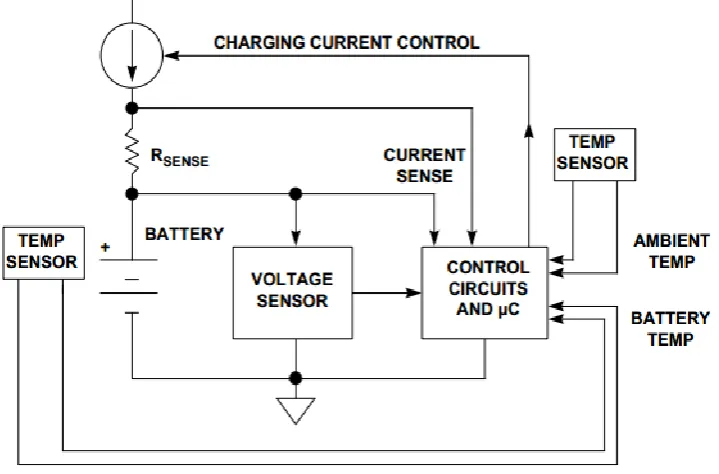
Figure 2.1 Generalized battery charging circuit
2.2 Converter (DC to DC)
DC to DC converters are important in portable electronic devices such as cellular phones and laptop computers. Most DC to DC converters also regulate the output voltage. A DC-to-DC converter also converts a source of direct current (DC) from one voltage level to another. It is a class of power converter. DC-DC converter was very useful for portable applications in general or any application which uses rechargeable batteries [10]. Dc converters widely used for traction motor in electric automobiles, trolley cars, marine hoists, and forklift trucks. They provide smooth acceleration control, high efficiency, and fast dynamic response. The basic DC-DC converters use a pair of switches, usually one controlled example MOSFET and one uncontrolled example diode to achieve unidirectional power flow from input to output. The converters also use one capacitor and one inductor to store and transfer energy from input to output and buck converter also filter or give smooth voltage and current. There are many types of DC-DC convertor which is buck (step down) converter, boost (step-up) converter, buck-boost (step up- step-down) convertor [11].
The functions of DC-DC converters are stated as below:
iii. Reduce the AC voltage ripple on the DC output voltage below the required level. iv. Provide isolation between the input source and the load (if required).
[image:19.595.143.495.165.297.2]2.2.1 Buck Converter
Figure 2.2: General buck converter circuit
The buck converter is used to generate a lower output voltage from a higher DC input voltage. Stepdown as refer to buck converters are integral to modern electronics. Stepdown converters transfer small packets of energy using a switch, a diode, an inductor and several capacitors. Though substantially larger and noisier than their linear-regulator counterparts, buck converters offer higher efficiency in most cases. The Figure 2.2 depicts the general buck converter circuit.
2.2.2 Boost Converter
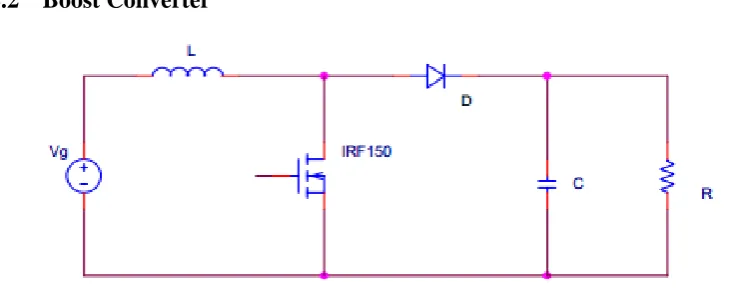
Figure 2.3: General boost converter circuit
[image:19.595.128.495.496.641.2]9 converter is sometimes called a step-up converter since it steps up the source voltage. The Figure 2.3 depicts the general boost converter circuit.
[image:20.595.137.498.165.295.2]2.2.3 Buck-boost Converter
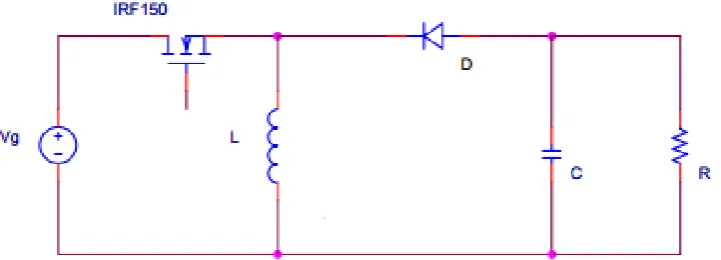
Figure 2.4: General buck boost converter circuit
DC-DC converters have a wide range of uses today and are becoming increasingly more important in daily use. DC power supplies are probably the largest use of the converters and are much more compact and efficient than the old method of conversion with transformers. These converters can have an output of any range; for instance, one can run logic gates or large dc motor drives with a simple converter. The buck–boost converter is a type of DC-to-DC converter that has an output voltage magnitude that is either greater than or less than the input voltage magnitude. The two different topologies are called buck–boost converter. Both of them can produce a range of output voltages, from an output voltage much larger (in absolute magnitude) than the input voltage, down to almost zero. Both buck down) and boost (step-up) converters are widely used in power management circuits, little attention has been given to integrated buck-boost converters for portable applications [12]. Figure 2.4 shows the general buck-boost converter circuit.
2.3 Controller
passive power controller is hysteresis, relay and sliding mode control and for adaptive power controller is PID, fuzzy, and P-resonant controller. Each of them has their own advantages, such as simple structure and low maintenance cost.
2.3.1 Adaptive controller
Adaptive controller is a controller that can modify its behavior in response to changes in the dynamics of the process and the disturbances. A great number of industrial control loops are under adaptive control. These include a wide range of applications in aerospace, process control, ship steering, robotics and other industrial control systems. Because of the ability of the adaptive controller, there are the reasons for using adaptive control such as variations in process dynamics, variations in the character of the disturbances and engineering efficiency [13]. The model reference adaptive system of [14,15] assumed to be represented by a transfer function as in eqn (2.1):
Where and are relatively prime monic polynomials of degree m and n respectively and is a scalar.
Battery is receiving a vast amount of attention as the most important energy storage device in electric vehicles. Due to the battery dynamics, an adaptive and nonlinear methods, such as an extended Kalman filter and a sliding-mode observer are deployed [16]. The methodology has been applied to improve the energy and power density of the batteries.
11 2.3.1.1 PID controller
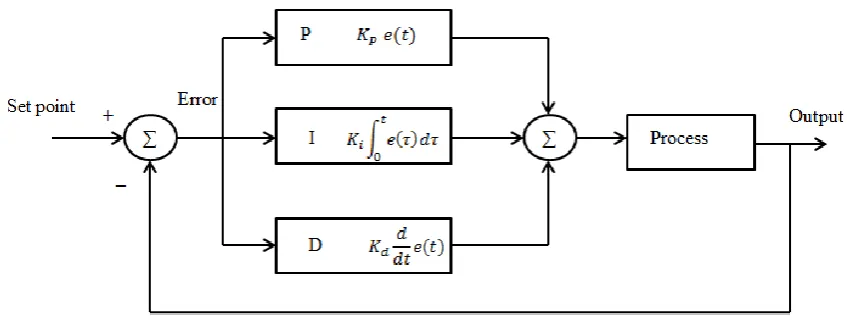
Figure 2.5: PID controller
The PID controller (proportional integral derivative controller) is widely used in industrial control system as shown in Figure 2.5. A PID controller calculates an “error” value as the difference between the measured process variable and the desired set point. The PID controller calculation involves three separate constants and is accordingly sometimes called three-term control which the proportional, the integral and derivative values are denoted by P, I and d respectively. The proportional, integral, and derivative terms are summed to calculate the output of the
PID controller. Defining as the controller output, the final form of the PID algorithm is in eqn (2.2):
Where:
: Proportional gain, a tuning parameter
: Integral gain, a tuning parameter
: Derivative gain, a tuning parameter
: Error
: Time or instantaneous time (the present)
: Variable of integration; takes on values from time 0 to the present
The proportional gain determines the ratio of output response to the error signal. In general, increasing the proportional gain will increase the speed of the control system response. The integral component sums the error term over time. The result is that even a small error term will cause the integral component to increase slowly. The derivative component causes the output to decrease if the process variable is increasing rapidly. The derivative response is proportional to the rate of change of the process variable. Increasing the derivative time parameter will cause the control system to react more strongly to changes in the error term and will increase the speed of the overall control system response.
In the paper [18] explains a proposed method of computing Proportional, Integral and Derivative (PID) parameters controller for positive buck-boost converter with mode-select circuit and with wide range of input voltages. By employing PID controller the converter operates effectively and improves the output voltage, when the supply voltage changes[18]. Therefore, the proposed converter can improve its transient response when the supply voltage changes.
In the paper [19] explains a proposed of a PID controlled buck-boost DC-DC converter for battery load system. The complete converter-load system has been developed, analyzed, and validated by the simulation. Simulation results show robustness of the proposed method to system parameters variations.
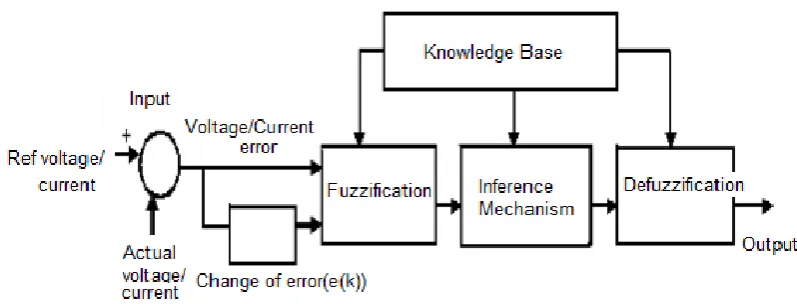
2.3.1.2 Fuzzy controller
13 controllers that can be implemented for charging battery. The Figure 2.6 illustrates the functional block diagram of fuzzy logic controller.
Figure 2.6 Functional block diagram of fuzzy logic controller
The paper [22] explains a proposed of a Fuzzy Logic Controlled (FLC) buck-boost DC-DC converter for solar energy-battery systems. For the controller FLC, PI, and FLC+PI controllers are used and the simulation results are compared. The result can be seen that there is no big overshoot in output voltage and no need for any change in parameters to stable the system. It can be noted that it is possible to use a fuzzy logic controller for power electronics applications and also practical to simulate the designed circuits in MATLAB or Simulink [22].
2.4 Proposed controller
in the past to directly estimate the unknown dynamics or uncertainties at any given instant through the time delay [23]. Moreover, time delay control is depends on estimation of specific parameters, discontinuous control, nor repetitive actions [24].
[image:25.595.134.506.342.479.2]Normally, time delay control is suitable for nonlinear system that varying with the time. A time delay controller has been suggested as an effective control technique for nonlinear time-varying systems with uncertain dynamics and for unpredictable disturbances [25]. Time delay in the structure of a controller may improve its performance [26]. Therefore the used of time delay as a controller in the system may enhance and gives better performance. The time delay controller normally involved delay component which is used to predict the future path. Essentially, the time delay controller proposed includes a delay element in a positive feedback and a reference model in the forward path [26].
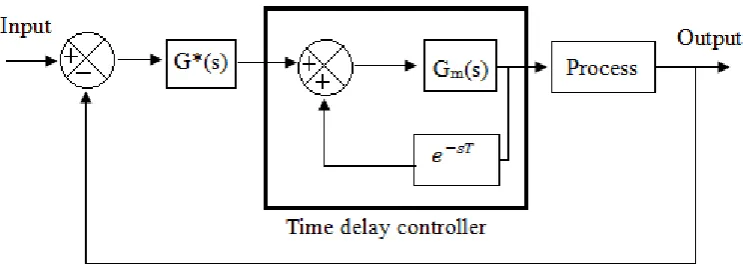
Figure 2.7: Basic time delay controller
Figure 2.7 illustrates basic time-delay controller where G(s) includes only the rational part of the transfer function and where Gm(s) is a rational transfer function that selected by the user. Suppose that the closed-loop reference model is represented by eqn (2.3).
15
Figure 2.8: Time delay controller
This project proposed a time delay controller to control the voltage of the charging battery as depicts in Figure 2.7. The time delay control scheme is one of the simple controllers of the primary goal in this project to apply knowledge and technically on how to control a charging battery. Therefore, faster output that is in term of time is required for the battery charging system. Here, the controller which is time delay will control the charging of the battery. The main contribution in this project is the algorithm of the time delay controller.
The eqn (2.4) has been implemented as the time delay controller algorithm. The main task of the control scheme in a voltage source is to obtain the voltage that is similar to the reference voltage signals although the input voltage is varied.
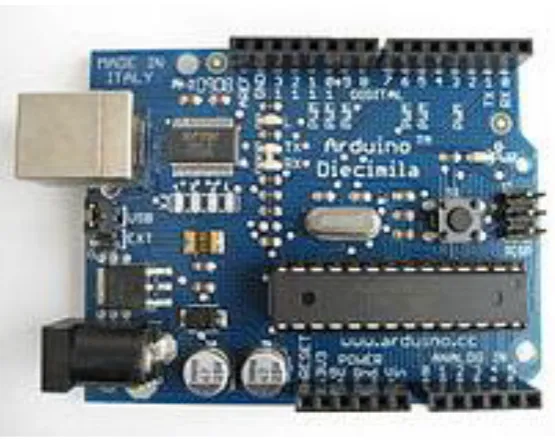
2.5 Arduino
a cross-platform application written in Java, and is derived from the IDE for the Processing programming language and the wiring projects.
Moreover, ARDUINO is used to create prototypes, its underlying hardware works at the same level of sophistication that engineers employ to build embedded devices[6]. ARDUINO is the best known neither for its hardware nor software. Both the hardware and the software are using ARDUINO. The combination enables to create projects that sense and control the physical world.
[image:27.595.179.457.507.727.2]MATLAB is a high-performance language for technical computing. It integrates computation, visualization, and programming in an easy-to-use environment where problems and solutions are expressed in familiar mathematical notation such as matrix manipulations, plotting of functions and data, implementation of algorithms, creation of user interfaces, and interfacing with programs written in other languages, including C and Simulink that adds graphical multi-domain simulation and Model-Based Design for dynamic and embedded systems. An additional package MATLAB Support Package for ARDUINO enables to use MATLAB or Simulink to communicate with the ARDUINO board over a USB cable. This package is based on a server program running on the board, which listens to commands arriving via serial port, executes the commands, and, if needed, returns a result.
CHAPTER 3
METHODOLOGY
The work includes stages such as designing, simulation, implementation and verification. The designing part involves using PROTEUS software for buckboost and gate driver design. The simulation part is conducted using MATLAB/Simulink software for controller design, download and implemented on the ARDUINO in the implementation stages. The verification stage involves the testing of the controller design using a hardware development to verify its correctness.
[image:28.595.127.525.448.741.2]3.1 Block diagram of project
In this project, it consists of the main component which is a battery where the charging process occurs in this system. Figure 3.1 illustrates the overall of the block diagram of the project. Firstly, the DC source will supply the voltage and current in order to supply voltage to the battery. Here, the buck-boost converter is needed because to control the power supply flow from the source to the battery. Here the voltage sensor will sense the actual voltage and will be compared to the reference voltage. The result of the comparison voltage between reference and actual will produce the difference voltage. The difference voltage will send to the ARDUINO board and simultaneously the signal will be adjusted together with the time delay controller algorithm by using MATLAB Simulink. Then, the time delay controller will control the Pulse Width Modulation (PWM) signal. PWM is the most widely used method for controlling the output voltage [27]. Then the PWM signal will send back the signal to the ARDUINO board and here the gate driver is needed to give switching control to the buck-boost converter and send the output of voltage to the battery charging process.
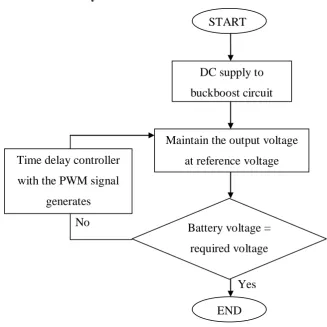
3.2 Flow chart of system
No
[image:29.595.134.462.414.742.2]
Yes
Figure 3.2: Flow chart of system START
DC supply to buckboost circuit
Maintain the output voltage at reference voltage
Battery voltage = required voltage
END Time delay controller
3.3 Flow chart of project
[image:31.595.122.522.100.729.2]Yes
Figure 3.3: Flowchart of project development No
Hardware part
Study the buckboost circuit
Study the gate driver
Upload to ARDUINO Time delay control design
Study the structure of buckboost converter Software part (MATLAB
simulink)
Write thesis Hardware setup
Voltage meet requirement
Observe performance of the project
Start
21 The Figure 3.3 illustrated the flowchart of the project development. This project consists of two parts that must be conducted which are software part and hardware part. For software part, this project using MATLAB Simulink with ARDUINO support package. Firstly, the design of the buckboost circuit is constructed in the MATLAB software to verify whether the output voltage is maintained as a required voltage. Then, the time delay controller that acts as a controller is design to control the system. Here, any input that is in the range of 10V to 18V has been tested and applied. When the result of output voltage is maintained at the reference voltage meaning that the software part are successfully been designed and developed.
3.4 Overall closed loop system of the project
Figure 3.4: Overall closed loop system of the project
23 voltage sensors have been replaced at the output and input of the buckboost circuit. On the other hands, it been used as an interfacing which is ADC converter and once making the closed loop system that illustrated in Figure 3.4.
3.5 Hardware Development
There are three parts that involve in hardware development which are the buckboost circuit, gate driver and ARDUINO board. This hardware development is very important to ensure the process is sufficient and successful.
3.5.1 Implement buckboost circuit
First of all, in preparing and designing the buckboost circuit, the value of the duty cycle, capacitor and inductor must be determined. Duty cycle is defined as the ratio of switch on time to reciprocal of the switching frequency [27]. Besides that, control switching of the MOSFET also important to drive the buckboost circuit.
[image:34.595.123.523.456.641.2]3.5.1.1 Buckboost circuit
Figure 3.5: Modified buck-boost converter circuit
has been designed in this project by using Proteus software and Figure 3.6 illustrates the hardware of buckboost circuit. Table 3.1 had shown the list of component that has been used.
Figure 3.6: Hardware development of buckboost circuit
Table 3.1: List of component for buckboost circuit
NO COMPONENT UNIT
1 Switches IRF 540 2
2 Inductance 10mH 1
3 Capacitance 47uF 1
4 Diode 1N4148 2
5 Resistor 100Ω, 10W 1
3.5.1.2 Calculation theory of buckboost circuit
[image:35.595.157.483.455.585.2]54
REFERENCES
[1] Y.-L. Ke, Y.-C. Chuang, and S.-W. Huang, “Application of Buck Zero-Current-Switching Pulse-Width-Modulated Converter in Battery Chargers,” 2007 IEEE/IAS Industrial & Commercial Power Systems Technical
Conference, pp. 1–8, May 2007.
[2] L. Zhao, J. Qian, and T. Instruments, “DC-DC Power Conversions and System Design Considerations for Battery Operated System.”
[3] A. H. Bhat and P. Agarwal, “Three-phase, power quality improvement ac/dc converters,” Electric Power Systems Research, vol. 78, no. 2, pp. 276–289, Feb. 2008.
[4] K. Kim and M. Youn, “A Simple and Robust Digital Current Control Technique of a PM Synchronous Motor Using Time,” vol. 16, no. 1, pp. 72– 82, 2001.
[5] Y. P. Siwakoti and G. E. Town, “Design of FPGA-controlled power electronics and drives using MATLAB Simulink,” 2013 IEEE ECCE Asia Downunder, pp. 571–577, Jun. 2013.
[6] Y. V. N. Kumar, P. H. Bindu, A. D. Sneha, and A. Sravani, “A Novel Implementation of Phase Control Technique for Speed Control of Induction Motor Using ARDUINO,” vol. 3, no. 4, pp. 469–473, 2013.
[7] D. G. Vutetakis, “10.1 Introduction,” 2001.
[8] R. Battery, C. In, and P. Equipment, “B ATTERY C HARGERS SECTION 5 BATTERY CHARGERS,” pp. 1–25.
[9] F. Instructions, “STORAGE BATTERY Internet version of This Manual Created BUREAU OF RECLAMATION,” vol. 3, 1998.
[10] A. Mcu-based, “AN2389 Application note,” no. August 2007, pp. 1–16. [11] M. H. Rashid, Power Electronics Circuits, Devices, and Applications, 2nd ed.
Pearson, 1993.
[13] P. Z. Vukic, “A tutorial on Adaptive control: The self-tuning Approach,” Croatia, 2000.
[14] K. . N. and L. . Valavani, “Stable adaptive Controller Design,” IEEE Trans Automatic Control, vol. 23, pp. 570–583, 1978.
[15] Stephen Boyd and Shankar Sastry, “On Parameter Convergence in Adaptive Control,” Elsevier Science Publishers, pp. 311–319, 1983.
[16] H. Rahimi-eichi, S. Member, and M. Chow, “Adaptive Parameter Identification and State-of-Charge Estimation of Lithium- Ion Batteries Adaptive Parameter Identification and State-of-Charge Estimation of Lithium-Ion Batteries,” 2012.
[17] H. Ke and J. Li, “Adaptive Control for a Class of Nonlinear System with Redistributed Models,” Journal of Control Science and Engineering, vol. 2012, no. 1, pp. 1–6, 2012.
[18] K. Vijaykaran and J. Jeyashanthi, “A Positive Buck-Boost DC-DC Converter with Mode-Select Circuit Using PID Controller,” vol. 3, no. 3, pp. 221–226, 2014.
[19] “A PID CONTROLLED PV POWERED BUCK-BOOST DC-DC
CONVERTER FOR BATTERY-LOAD SYSTEM,” no. May, p. 2013, 2013. [20] G. E. M. D. C. Bandara, R. M. Ivanov, and S. Gishin, “Fuzzy control of a
universal battery charger,” 18th International Conference of the North American Fuzzy Information Processing Society - NAFIPS (Cat. No.99TH8397), pp. 844–848, 1999.
[21] K. N. Sujatha and K. V. Member, “Self-Tuning Fuzzy PI Scheme for DTC Induction Motor Drive,” pp. 1–6, 2010.
[22] M. E. Sahin and H. I. Okumus, “Fuzzy logic controlled buck-boost DC-DC converter for solar energy-battery system,” 2011 International Symposium on Innovations in Intelligent Systems and Applications, vol. 394, no. 6, pp. 394– 397, Jun. 2011.
[23] K. Kim and M. Youn, “A simple and robust digital current control scheme of a permanent magnet synchronous motor using time delay control approach,” Conference Record of the 2000 IEEE Industry Applications Conference. Thirty-Fifth IAS Annual Meeting and World Conference on Industrial Applications of Electrical Energy (Cat. No.00CH37129), vol. 3, pp. 1689– 1696, 2000.
[24] O. F. The and C. Law, “A TIME DELAY CONTROLLER FOR SYSTEMS WITH UNKNOWN DYNAMICS.”
56 [26] K. M. Tsang, W. L. Lo, and a. B. Rad, “Adaptive time-delay controller,” IEEE
Transactions on Industrial Electronics, vol. 47, no. 6, pp. 1350–1353, 2000.