Munich Personal RePEc Archive
Bootstrap Tests Based on
Goodness-of-Fit Measures for Nonnested
Hypotheses in Regression Models
Jeong, Jinook
Yonsei University
April 2006
Online at
https://mpra.ub.uni-muenchen.de/9789/
Bootstrap Tests Based on Goodness-of-Fit Measures for Nonnested
Hypotheses in Regression Models
by
Jinook Jeong Department of Economics
Yonsei University
February 2007
Abstract
This paper utilizes the bootstrap to construct tests using the measures for goodness-of-fit for nonnested regression models. The bootstrap enables us to compute the statistical significance of the differences in the measures and to formally test on nonnested regression models. The bootstrap tests that this paper proposes are expected to show better finite sample properties since they do not have accumulated errors in the computation process. Moreover, the bootstrap tests remove the possibility of inconsistent test results that the previous tests suffer from. Because the bootstrap tests only evaluate if a model has a significantly higher explanatory power than the other model, there is no possibility for inconsistent results. This study presents Monte Carlo simulation results to compare the finite sample properties of the proposed tests with the previous tests such as Cox test and J-test.
Keywords: nonnested regression models, bootstrap, goodness-of-fit measures
JEL Classification: C12, C14, C15
Acknowledgements: I am grateful for the helpful comments from Tae-Hwan Kim, Tae-Kyu Park and the participants of Yonsei Economic Research Institute seminar. I am also grateful for the excellent research assistance by So Yeon Park, Sung Sam Chung and Byunguk Kang. This work was supported by Korea Research Foundation Grant (KRF-2002-041-B00055).
Correspondences: Professor Jinook Jeong Department of Economics Yonsei University
Seoul, Korea 120-749
1. Introduction
When a researcher chooses from nonnested regression models, it is difficult to apply the
usual F-test because there do not exist testable common restrictions.1 There have been
proposed several tests for nonnested hypotheses in the literature. Cox test has been originally
proposed by Cox (1961, 1962) and further developed by Pesaran (1974) and Pesaran and
Deaton (1978) for nonnested regression models. Cox test is a likelihood ratio test comparing
the likelihood under model 1 (H1) to the one under model 2 (H2). Cox test has some
shortcomings. It is computationally burdensome and is not robust to distributional assumption.
Also, the consistency in its test result is not guaranteed: it may favor H1 over H2, and at the same
time favor H2 over H1. Third, as the test is based on an asymptotic distribution, the power in
finite samples is questionable.
Davidson and MacKinnon (1981) suggest J-test for nonnested regression models. J-test
is a two-step test based on ‘artificial nesting.’ Though J-test is easier and more practical than
Cox test, it still has the problem of inconsistent test results as Cox test. Also, as it is based on an
asymptotic distribution, the small sample performance of J-test is not satisfactory. Godfrey
(1998), Fan and Li (1995), and Davidson and MacKinnon (2002) apply bootstrap procedures
for J-test and succeed to improve its power in finite samples. However, the possibility of
inconsistent test results still remains.
Another approach to nonnested models is the tests based on ‘encompassing principle.’
All the above tests assume that the true conditional distribution of the data is either H1 or H2.
However, in practice, there always exists the third possibility. Mizon and Richard (1986)
among others criticize the assumption and propose Encompassing test which include J-test as a
special case.
There are many other test procedures for nonnested regression model in the literature.
1
However, all the previous tests have two common problems. First, the possibility of
inconsistent test results prevails. Second, the test power in finite samples is not satisfactory.
The low power can be explained in two ways. One, most tests use asymptotic distributions
which is not accurate enough in small samples. Two, as most previous tests involve complex
computation, they may suffer from some distortion of information in the process of
computation. For example, J-test uses the predicted values from the first stage regression in the
second stage. As a result, the estimation error in the first stage regression is carried over to the
second stage and reduces the accuracy of the second stage results as Pagan (1984, 1986) points
out.
This paper suggests a simple new test procedure for nonnested regression models.
When we consider two competing regression models, the first comparison we usually do is the
coefficient of determination (R2) of the models. R2 is probably the simplest and most intuitive
measure for the fit of a regression model, although there exist a number of alternative measures
such as adjusted R2 (R ), Akaike Information Criterion (AIC), Bayesian Information Criterion 2
(BIC), Predicted Residual Sum of Squares (PRESS), and Hocking’s Sp, among others.
However, it has not been possible to construct a test with such measures for model selection,
since none of the exact distributions of the measures or of the difference (or ratio) of the
measures is known. Comparison of the goodness-of-fit measures is limited only to eyeball
inspection and intuitive benchmarking.
This paper utilizes a computation-oriented nonparametric method, the bootstrap, to
construct tests using the goodness-of-fit measures for nonnested regression models. The
bootstrap enables us to compute the statistical significance of the differences in those measures
and to formally test about nonnested regression models. It is not new to apply bootstrap
procedures for nonnested regression models. As mentioned above, bootstrap has been applied
been maximized as J-test has the problem of accumulated errors from its two-step procedure.
Bootstrap tests that this paper proposes are expected to show better finite sample properties
since they do not have such accumulated errors in the computation process. Moreover, the
bootstrap tests using goodness-of-fit measures have another important advantage: there is no
possibility of inconsistent test results. Because the bootstrap tests only evaluate if a model has
a significantly higher explanatory power than the other model, inconsistent results cannot
happen. We present Monte Carlo simulation results to compare the finite sample properties of
the proposed tests with the previous tests such as Cox test and J-test.
2. Model
Consider the following two regression models.
H1: y = Xβ + u (1)
H2: y = Zγ + v (2)
where y is the (n×1) vector of the dependent variable, X and Z are (n×k1) and (n×k2) matrices of
regressors, and u and v are (n×1) vectors of errors. We assume that E(u) = E(v) = 0 and var(u)
=σ12I and var(v) =σ22I. We also assume the two alternative sets of regressors, X and Z, may
have some common variables, but neither is a subset of the other. The problem here is to decide
which is a better model.
Cox (1961, 1962) developed a variant of likelihood ratio test for nonnested hypotheses.
Pesaran (1974), Pesaran and Deaton (1978), and McAleer (1984) have derived various versions
of Cox test for the regression cases. For our hypotheses (1) and (2), the Cox statistic for testing
that H1 is correct and H2 is not is,
⎥ ⎦ ⎤ ⎢ ⎣ ⎡
= 2
ZX 2 Z 12
s s log 2 n
c (3)
The test statistic of Cox test is as follows. 4 ZX Z X Z 2 X 12 12 12 s ) ˆ X M M M ' X ' ˆ ( s c ) c ( SE c β β
= (4)
where 'MX =I−X(X'X)−1X . Cox has shown that the test statistic in (4) is asymptotically
distributed as a standard normal variable under H1. A significantly larger value of the statistic
from zero is evidence against H1.
The J test proposed by Davidson and MacKinnon (1981) is a linearized version of the
Cox test. It uses the following ‘artificially nested’ model.
y = (1−λ)Xβ + λZγ + e (5)
In this model, if the hypothesis H1 is true, then λ = 0. The problem is that λ is not identified in
the estimation of equation (5). Davidson and MacKinnon (1981) suggest a two-step procedure:
γ is estimated by least squares from equation (2), and the estimator, γˆ, is replaced for the
unknown γ in equation (5) to separately estimate λ. Thus in the second stage, the following
equation is estimated by least squares.
y = (1−λ)Xβ + λ(Zγˆ) + e (6)
As Pesaran (1982) shows, if H1 is true, the test statistic becomes:
) ˆ Z M ' Z ' ˆ ( s y M ' Z ' ˆ J X 2 1 X 1 γ γ γ
= (7)
where s is the estimated error variance of regression in (6). J12 1 is asymptotically distributed as
a standard normal variable. A large value of J1 is evidence against H1.
Similarly, the test statistic J2 can be derived for a test of H2 against H1 in the following
model.
) ˆ X M ' X ' ˆ ( s y M ' X ' ˆ J Z 2 2 Z 2 β β β
= (9)
where s is the estimated error variance of regression in (8). As discussed in the introduction, 22
the result of the J1 test and the J2 test may not be consistent. It is possible that the tests reject
both, neither, or either one of the hypotheses H1 and H2.
There are a number of alternative versions of the J tests by using different estimates of γ
in equation (6) and β in equation (8). The alternative tests are summarized in Davidson and
MacKinnon (2004).
3. Bootstrapping the difference in Goodness-of-Fit Measures
First, the coefficient of determination, R2, of a regression model y = Xβ + u is defined as
follows.2 ) y y ( )' y y ( uˆ ' uˆ 1 R2 − − − = (10)
where uˆ=y−Xβˆ and βˆ is the least squares estimator of β. The distribution of R2 for normally
distributed errors has been derived by Cramer (1987) among others. Assuming u ~ N(0, σ2I),
the dimension of y is (n×1), the dimension of X is (n×k), and the first column in X is a vector of
ones, the density function of R2, with argument r, is:
∑
∞ = − − − + − − + = 0 j 1 p q 1 j p ) r 1 ( r ) p q , j p ( B 1 ) j ( w ) r ( f (11) where ! j ) 2 / ( e ) j ( w j 2 / λ= −λ ,
2 1 k p= − ,
2 1 n
q= − , and B(·) is the beta function.
For two competing regression models with normally distributed errors, e.g. (1) y = Xβ +
u and (2) y = Zγ + v, Schmidt (1973) suggests a numerical method for calculating
2
) R R (
P 2
Zy 2
Xy> when model (1) is true. Ebbeler (1975) extends Schmidt’s work to the adjusted
R2 (i.e. R ) comparison. Though their works allow us to estimate the probability of correct 2
model selections based on R2 (or R ) under normality assumption, it is still an open question 2
how to compute the statistical significance of an observed difference in two R2’s.
The advantages of bootstrapping the difference in R2’s (and in the other measures of
goodness-of-fit) are as follows. First, it allows us to compute the significance of an observed
difference in two R2’s using the empirical (bootstrap) distribution of the difference.
Accordingly, one can perform a test on alternative models with the computed significance level.
Second, bootstrap method is robust to the distributional assumption. Even though the
distribution of error terms is not normal, bootstrap can still compute the statistical significance
of the observed difference in R2’s.
It should be noted that the R2’s are not pivotal, and the standard bootstrap confidence
interval may not work well. In this paper, two alternative bootstrap procedures are employed.
First, the standard simple bootstrap confidence interval is applied to ‘transformed’ R2’s to
overcome the range-restrictiveness.3 Second, a double bootstrapped confidence interval is
employed for the transformed R2’s (and other goodness-of-fit measures). The double bootstrap
procedure is: (a) draw the bootstrap sample, (b) estimate the standard error of the statistic of
interest θˆ , sB, by a ‘nested’ bootstrap procedure, (c) using the formula
B 0
s ˆ
t = θ−θ , a
‘prepivoted’ root t is constructed, and (d) determine the critical values for the test from the
‘outer’ bootstrap empirical distribution of the root t by repeating (a) through (c).4
Similar standard and double bootstrap procedures are applied to the alternative
3
The
2 2
R 1
R
− transfrormation has been used. Actually, the results with the original form of R
2
and the results with
the transformed R2 are not much different. The detailed results are available from the author upon request.
4
measures for goodness-of-fit: R , AIC, BIC, PRESS, and Hocking’s S2 p.5 The definitions of
the measures are as follows.6
) R 1 ( k n 1 n 1
R2 − 2
− − − ≡ (12) n k 2 n uˆ ' uˆ log
AIC ⎟+
⎠ ⎞ ⎜ ⎝ ⎛
≡ (13)
n ) n (log k n uˆ ' uˆ log
BIC ⎟+
⎠ ⎞ ⎜ ⎝ ⎛
≡ (14)
* *
u ' u
PRESS≡ (15)
) 1 k n )( k n ( uˆ ' uˆ Sp − − −
≡ (16)
where i i * i h 1 uˆ u −
≡ , and hi is the ith diagonal element of X(X'X)−1X. The results are compared
along with the Cox test and J test in the nest section.
4. Finite Sample Performance of Alternative Tests for Nonnested Regression Models
To compare the finite sample performances of the alternative tests for nonnested
regression models, we adopt the Monte Carlo design of Godfrey (1998) for equation (1) and (2).
The elements xij of X are N(0,22) variables that are independent over i and j, i = 1, 2, …, n and j
= 1, 2, …, k1. The elements zij of Z are generated as follows.
ij ij
ij x e
z =α + j = 1, 2, …, min(k1, k2) (17)
ij
ij e
z = j = k1+1, k1+2, …, k2 (if k1 < k2) (18)
We assume that eij are independent random picks from N(0,22), and that the error terms of (1)
and (2), ui and vi , are independent random picks from normal distributions with zero means and
5
Mallows’ Cp is another widely-used measure for goodness-of-fit. I use Hocking’s Sp rather than Mallows’ Cp for
two reasons. First, Mallows’ Cp requires the knowledge of the error variance. Second, it has been shown by Kinal
and Lahiri (1984) that the stochastic version of Mallows’ Cp is identical to Hocking’s Sp.
6
variances of 2 u
σ and 2 v
σ , respectively.7 Without loss of generality, we set every element of β
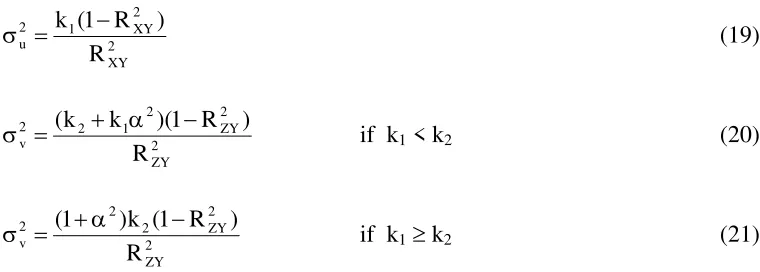
and γ is one. To maintain a constant R2 in a simulation, σ2u and σ2v are set as follows.8
2 XY 2 XY 1 2 u R ) R 1 ( k − = σ (19) 2 ZY 2 ZY 2 1 2 2 v R ) R 1 )( k k
( + α −
=
σ if k1 < k2 (20)
2 ZY 2 ZY 2 2 2 v R ) R 1 ( k ) 1
( +α −
=
σ if k1≥ k2 (21)
The value of α is determined by the correlation between xij and zij. With the correlation
coefficient ρ between xij and zij,
2
1−ρ
ρ =
[image:10.595.143.523.138.274.2]α .
Table 1 and Table 2 present the performances of alternative tests when the numbers of
regressors (k1 and k2) are symmetric. The tests compared in the simulations are: Cox test
(‘Cox’ in the Tables), J-test (‘J’ in the Tables), R2, R , AIC, BIC, PRESS, and S2 p. All the
goodness-of-fit measures (R2, R , AIC, BIC, PRESS, and S2 p) are bootstrapped through two
alternative procedures, as explained in section 3: standard bootstrap (‘SB’ in the Tables) and
double bootstrap (‘DB’ in the Tables). Thus, we compare all 14 alternative test procedures as in
Tables 1 and 2.
For these 14 alternative tests, Tables 1 and 2 show the rejection rates of H1: y = Xβ + u
when H2: y = Zγ + v is the true model. The rejection rates are reported for various values of ρ,
the correlation coefficients between xij and zij. When ρ is low, it should be easy for any test to
distinguish the true model (H2 here) from the wrong model (H1). As ρ becomes higher, it must
be more difficult for any test to reject the wrong model against the true model. When ρ=1, both
7
the models become identical and the test should reject the wrong model only for the nominal
size. In the simulations, because α is not defined when ρ=1, the rejection rates of H1 when
ρ=0.9999 instead are computed. Thus, the rejection rates reported in the far-right column of
ρ=0.9999 represent the ‘empirical sizes’ of the tests. To capture the finite sample performances
of the alternative tests, four different sample sizes are employed in the Monte Carlo simulation:
20, 50, 100, and 200. The frequency of resampling in the process of bootstrap is set to 500. The
simulation is done 1000 times.9
Table 1 shows the rejection rates of the 14 alternative tests when each model (H1 and
H2) has two regressors, i.e. k1=2 and k2=2. It is clear from Table 1 that the bootstrap tests
outperform Cox test and J-test. First of all, the empirical sizes of the bootstrap tests are more
accurate than Cox test or J-test. For all the sample sizes, the empirical sizes of Cox test and
J-test are much smaller than the nominal size of 0.05. For example, when the sample size is 50,
the empirical size of Cox test is 0.002 and the empirical size of J-test is 0.001. The empirical
sizes of bootstrap tests are much closer to the nominal level. For the same case of sample size
of 50, the empirical size of standard bootstrap test using R2 is 0.053. All the other measures
show similar empirical sizes ranging from 0.051 to 0.087 for n = 50. Regardless of the error
distribution or the sample size, the bootstrap tests show reasonably better size than Cox test or
J-test.10
It is also obvious from Table 1 that the bootstrap tests have higher power than Cox test
or J-test. For the whole range (0.00 to 0.95) of ρ, the standard bootstrap test and double
bootstrap test produce consistently higher empirical power that Cox test or J-test. For example,
let us look at the case when the sample size is 100 and ρ equals 0.75. The empirical power of
distributions.
8
If β or γ is not a vector of ones, these expressions would become a bit more complex.
9
For the double bootstrap procedures, to reduce the computational burden, the nested bootstrap repetition is reduced to 100 times, the outer bootstrap repetition is reduced to 200 times, and the simulation is done 300 times.
10
Cox test is 0.953 and the empirical power of J-test is 0.951 while the empirical powers of the
bootstrap tests are all 1.000. For all the sample sizes and all the values of ρ, the bootstrap tests
show better power than Cox test or J-test.
Table 2 repeats the same findings for the case of four regressors in each model (k1=4
and k2=4). Although the performances of the four tests are a bit worse than Table 1 (k1=2 and
k2=2 case) due to the reduction in the degrees of freedom, the simulation results basically tell us
that the bootstrap tests have more accurate size and higher power. The reason why Cox test and
J-test under-reject the null hypothesis should be related to the problems explained in section 2.
Especially, the inconsistency in the test results of Cox test and J-test may have weakened the
performance of the tests. It is possible for the two tests show inconsistent results, because Cox
test and J-test evaluate the hypothesis twice: once test H1 against H2, and then test H2 against H1.
Table 3 presents how frequently Cox test and J-test produce inconsistent test results. As seen in
the Table, in all the cases considered in the simulation, Cox test and J-test show considerable
rates of the inconsistent results. These inconsistent results have lowered the power of Cox test
and J-test. Besides, as explained in section 2, the complexity of computation in Cox test and the
two-step estimation process in J-test may have created distortions.
It has been argued that the finite sample properties of J-test may become problematic
when the two competing models have asymmetric numbers of regressors. Davidson and
MacKinnon (2002, 2004) give a good summary of the asymmetric regressor problem in J-test.11
Unfortunately, because R2 is not robust to the number of regressors, it is also reasonable to
expect that the performance of any test using R2 would not be ideal for asymmetric regressor
cases. However, as the other measures of goodness-of-fit are robust to the number of regressors,
their performances may not be affected by the asymmetry of the models. To see the effects of
asymmetric regressors, Tables 4 – 5 report the rejection rates of the fourteen tests in various
results are available from the author upon request.
11
combinations of asymmetric regressor cases.
Table 4 shows the rejection rates of the alternative tests when the X-model (H1) has 2
regressors and the Z-model (H2) has 4 regressors, that is, k1=2 and k2=4. Since the true data
generation process in the simulation is Z-model, the situation is that the true model has more
regressors than the wrong model. As expected, the finite sample performances of the bootstrap
tests using R2’s, as well as Cox test or J-test, are far from perfect. All the four tests over-reject
the true model.12 The magnitude of such over-rejection is highest with standard bootstrap test
using R2, and lowest with J-test. Overall, however, none of the four tests is acceptable in terms
of empirical size.
It is not surprising that the tests using R2 do not perform well. It is well known that R2
does not provide any penalty for adding irrelevant regressors. To remedy the limitation of R2,
the alternative measures have been proposed such as R , AIC, BIC, PRESS, and S2 p. The
bootstrap tests using these measures show much better performance. For example, when n = 20,
the empirical size of standard bootstrap test using R is 0.059 and the empirical size of double 2
bootstrap test using R is 0.053 respectively, which are pretty close to the nominal size of 2
0.050. The tests using AIC, BIC, PRESS or Sp somewhat under-rejects the true model, but their
rejection rates are much closer to the nominal size than Cox test, J-test, and the bootstrap tests
using R2.
Tables 5 shows the effects of regressor asymmetry in the opposite way: the X-model
(H1) has more regressors than the Z-model. Thus, the wrong model now has more regressors
than the true model. Table 5 presents the rejection rates of X-model for the alternative tests
when k1=4 and k2=2. In this case, J-test shows the most accurate size, and all the other tests
show the tendency of under-rejection when the null hypothesis is true. In terms of power,
however, J-test does not show as high power as the bootstrap tests using R2, R , AIC, BIC, 2
12
PRESS or Sp except when n = 20. One interesting phenomenon about BIC is that the empirical
size of bootstrapped BIC test tends to increase as the sample size grows. For example, the
empirical size of the standard bootstrap test using BIC is 0.008 when n = 20, 0.214 when n = 50,
0.432 when n = 100, and as high as 0.600 when n = 200. The empirical sizes of double
bootstrap test using BIC have weaker tendency of escalating but still increases as the sample
size becomes larger: 0.000 when n = 20, 0.037 when n = 50, 0.220 when n = 100, and as high as
0.400 when n = 200. This is probably due to the definition of BIC. As shown in (14), BIC
penalizes the inclusion of more explanatory variables with a factor of log(n). Due to such
definition, the penalty for including more explanatory variables depends on the number of
samples (n). In short, BIC gives too much penalty for inclusion of new explanatory variables,
and the over-penalization escalates with the sample size.
6. Conclusion
This paper suggests a simple new test procedure for nonnested regression models. It
utilizes a computation-oriented nonparametric method, the bootstrap, to construct a test using
various measures for goodness-of-fit such as R2 , R , AIC, BIC, PRESS, and S2 p for nonnested
regression models. The bootstrap enables us to compute the statistical significance of the
differences in those measures and to formally test to choose the best model among nonnested
regression models. The bootstrap tests that this paper proposes have an obvious strength over
the existing ones: they never show inconsistent test results. Because the bootstrap tests only
evaluate if a model has a significantly higher explanatory power than the other model, there is
no possibility for inconsistent results.
The Monte Carlo simulation results to compare the finite sample properties of the
proposed tests with the previous tests such as Cox test and J-test show that the proposed
previous tests when the number of regressors are symmetric. In the cases of asymmetric
regressor cases, however, the finite sample performances of the suggested bootstrap tests show
some mixed results. Overall, the bootstrap tests using R show the best finite sample 2
References
Cox, D.R. (1961), "Test of Seperate Families of Hypotheses," Proceedings of the Fourth
Berkeley Symposium on Mathematical Statistics and Probability 1, pp.105-123
Cox, D.R. (1962), "Further Results on Tests of Separate Families of Hypotheses," Journal of the Royal Statistical Society 24, pp.406-24
Cramer, J.S. (1987), “Mean and Variance of R2 in Small and Moderate Samples,” Journal of
Econometrics 35, pp.253-266
Davidson, R. and J.G. MacKinnon (1981), "Several Tests for Model Specification in the Presence of Alternative Hypotheses," Econometrica 49 , pp.781-793
Davidson, R. and J.G. MacKinnon (2002), "Bootstrap J Tests of Non-nested Linear Regression Models," Journal of Econometrics 109 , pp.167-193
Davidson, R. and J.G. MacKinnon (2004), Econometric Theory and Methods, Oxford University Press, New York.
Ebbeler, D.H. (1975), “On the Probability of Correct Model Selection Using the Maximum R 2 Choice Criterion,” International Economic Review 16, pp.516-520.
Fan, Y. and Q. Li (1995), "Bootstrapping J-type Tests for Non-nested Regrssion Models,"
Economics Letters 48 , pp.107-112
Godfrey, L.G. (1998), "Tests of Non-nested Regression models : Some Results on Small Sample Behaviour and the Bootstrap," Journal of Econometrics 84 , pp.59-74
Jeong, J. and S. Chung (2001), "Bootstrap Tests for Autocorrelation," Computational Statistics
and Data Analysis 38, pp.49-69.
Jeong, J. and G.S. Maddala (1993), "A Perspective on Application of Bootstrap Methods in Econometrics," Handbook of Statistics, Volume 11: Econometrics, North-Holland, (ed) by G.S. Maddala, C.R. Rao, and H.D. Vinod, pp.573-610.
Kinal, T. and K. Lahiri (1984), “A Note on ‘Selection of Regressors,’” International Economic
Review 25, pp.625-629.
McAleer, M. (1984), "Specification Tests for Separate Models: A Survey," in M.L. King and D.E.A. Giles (eds), Specification Analysis in the Linear Model: Essays in Honor of Donald Cochrane
Mizon, G.E. and J.F. Richard (1986), "The Encompassing Principle and its Application to Testing Non-nested Hypotheses," Econometrica 54 , pp.657-678
Pagan, A. (1984), "Econometric issues in the analysis of regressions with generated regressors," International Economic Review 25, pp.221-247.
Economic Studies 53, pp.517-538
Pesaran, M.H. (1974), "On the General Problem of Model Selection," Review of Economic Studies 41 , pp.153-171
Pesaran, M.H. and A.S. Deaton (1978), "Testing Non-nested Nonlinear Regression Models,"
Econometrica 46 , pp.677-694
Pesaran, M.H. (1982), "Comparison of Local Power of Alternative Tests of Nonnested Regression Models," Econometrica 50, pp.1287-1306
Schmidt, P. (1973), “Calculating the Power of the Minimum Standard Error Choice Criterion,”
<Table 1> Rejection Rates of H1: y = Xβ + u (k1=2, k2=2) True Model: H2, True Rzy2 = 0.9, Nominal Size = 0.05.
ρ 0.00 0.30 0.60 0.70 0.75 0.80 0.85 0.90 0.95 0.9999
n=20
Cox 0.907 0.912 0.930 0.920 0.926 0.913 0.923 0.931 0.924 0.005 J 0.919 0.912 0.922 0.925 0.918 0.908 0.928 0.936 0.918 0.008 SB (R2) 1 1 1 1 1 1 0.999 0.999 0.959 0.065 DB (R2) 1 1 1 1 1 1 1 1 0.970 0.067 SB ( 2
R ) 1 1 1 1 1 1 0.999 0.999 0.959 0.065 DB ( 2
R ) 1 1 1 1 1 1 1 1 0.970 0.063
SB (AIC) 1 1 1 1 1 1 0.999 0.999 0.959 0.065 DB (AIC) 1 1 1 1 1 1 1 1 0.970 0.060 SB (BIC) 1 1 1 1 1 1 0.999 0.999 0.959 0.065 DB (BIC) 1 1 1 1 1 1 1 1 0.970 0.060 SB (PRESS) 1 1 1 1 1 1 1 0.999 0.955 0.068 DB (PRESS) 1 1 1 1 1 1 1 1 0.967 0.073 SB (Sp) 1 1 1 1 1 1 0.999 0.999 0.959 0.065
DB (Sp) 1 1 1 1 1 1 1 1 0.967 0.067
n=50
Cox 0.921 0.946 0.929 0.937 0.946 0.945 0.937 0.944 0.939 0.002 J 0.932 0.940 0.923 0.933 0.950 0.940 0.934 0.952 0.949 0.001
SB (R2) 1 1 1 1 1 1 1 1 1 0.053
DB (R2) 1 1 1 1 1 1 1 1 1 0.083
SB ( 2
R ) 1 1 1 1 1 1 1 1 1 0.053
DB ( 2
R ) 1 1 1 1 1 1 1 1 1 0.083
SB (AIC) 1 1 1 1 1 1 1 1 1 0.053
DB (AIC) 1 1 1 1 1 1 1 1 1 0.073
SB (BIC) 1 1 1 1 1 1 1 1 1 0.053
DB (BIC) 1 1 1 1 1 1 1 1 1 0.073
SB (PRESS) 1 1 1 1 1 1 1 1 1 0.051
DB (PRESS) 1 1 1 1 1 1 1 1 1 0.087
SB (Sp) 1 1 1 1 1 1 1 1 1 0.053
DB (Sp) 1 1 1 1 1 1 1 1 1 0.087
n=100
Cox 0.923 0.940 0.943 0.942 0.953 0.950 0.946 0.947 0.937 0.006 J 0.936 0.942 0.950 0.943 0.951 0.948 0.948 0.950 0.942 0.006
SB (R2) 1 1 1 1 1 1 1 1 1 0.065
DB (R2) 1 1 1 1 1 1 1 1 1 0.067
SB ( 2
R ) 1 1 1 1 1 1 1 1 1 0.065
DB ( 2
R ) 1 1 1 1 1 1 1 1 1 0.067
SB (AIC) 1 1 1 1 1 1 1 1 1 0.065
DB (AIC) 1 1 1 1 1 1 1 1 1 0.060
SB (BIC) 1 1 1 1 1 1 1 1 1 0.065
DB (BIC) 1 1 1 1 1 1 1 1 1 0.060
SB (PRESS) 1 1 1 1 1 1 1 1 1 0.065
DB (PRESS) 1 1 1 1 1 1 1 1 1 0.070
SB (Sp) 1 1 1 1 1 1 1 1 1 0.065
n=200
Cox 0.935 0.946 0.942 0.958 0.945 0.939 0.948 0.954 0.954 0.011 J 0.942 0.948 0.940 0.951 0.945 0.941 0.945 0.954 0.953 0.010
SB (R2) 1 1 1 1 1 1 1 1 1 0.079
DB (R2) 1 1 1 1 1 1 1 1 1 0.043
SB (R2) 1 1 1 1 1 1 1 1 1 0.079
DB (R2) 1 1 1 1 1 1 1 1 1 0.043
SB (AIC) 1 1 1 1 1 1 1 1 1 0.079
DB (AIC) 1 1 1 1 1 1 1 1 1 0.040
SB (BIC) 1 1 1 1 1 1 1 1 1 0.079
DB (BIC) 1 1 1 1 1 1 1 1 1 0.040
SB (PRESS) 1 1 1 1 1 1 1 1 1 0.079
DB (PRESS) 1 1 1 1 1 1 1 1 1 0.050
SB (Sp) 1 1 1 1 1 1 1 1 1 0.079
<Table 2> Rejection Rates of H1: y = Xβ + u (k1=4, k2=4) True Model: H2, True Rzy2 = 0.9, Nominal Size = 0.05.
ρ 0.00 0.30 0.60 0.70 0.75 0.80 0.85 0.90 0.95 0.9999
n=20
Cox 0.900 0.891 0.905 0.910 0.912 0.902 0.898 0.889 0.885 0.005 J 0.908 0.914 0.920 0.924 0.933 0.915 0.907 0.909 0.912 0.001 SB (R2) 1 1 1 1 1 0.999 0.995 0.991 0.928 0.052 DB (R2) 1 1 1 1 1 0.997 0.990 0.993 0.963 0.063 SB ( 2
R ) 1 1 1 1 1 0.999 0.995 0.991 0.928 0.052 DB ( 2
R ) 1 1 1 1 1 0.997 0.990 0.993 0.963 0.063 SB (AIC) 1 1 1 1 1 0.999 0.995 0.991 0.928 0.052 DB (AIC) 1 1 1 1 1 0.997 0.990 0.993 0.963 0.050 SB (BIC) 1 1 1 1 1 0.999 0.995 0.991 0.928 0.052 DB (BIC) 1 1 1 1 1 0.997 0.990 0.993 0.963 0.050 SB (PRESS) 1 1 1 1 1 0.999 0.995 0.990 0.924 0.039 DB (PRESS) 1 1 1 1 1 0.997 0.990 0.983 0.950 0.057 SB (Sp) 1 1 1 1 1 0.999 0.995 0.991 0.928 0.052
DB (Sp) 1 1 1 1 1 0.997 0.990 0.993 0.957 0.063
n=50
Cox 0.923 0.929 0.944 0.947 0.937 0.930 0.945 0.924 0.933 0.005 J 0.925 0.934 0.945 0.952 0.939 0.935 0.947 0.934 0.941 0.005
SB (R2) 1 1 1 1 1 1 1 1 1 0.076
DB (R2) 1 1 1 1 1 1 1 1 1 0.083
SB ( 2
R ) 1 1 1 1 1 1 1 1 1 0.076
DB ( 2
R ) 1 1 1 1 1 1 1 1 1 0.083
SB (AIC) 1 1 1 1 1 1 1 1 1 0.076
DB (AIC) 1 1 1 1 1 1 1 1 1 0.080
SB (BIC) 1 1 1 1 1 1 1 1 1 0.076
DB (BIC) 1 1 1 1 1 1 1 1 1 0.080
SB (PRESS) 1 1 1 1 1 1 1 1 1 0.070
DB (PRESS) 1 1 1 1 1 1 1 1 1 0.087
SB (Sp) 1 1 1 1 1 1 1 1 1 0.076
DB (Sp) 1 1 1 1 1 1 1 1 1 0.087
n=100
Cox 0.919 0.945 0.937 0.940 0.947 0.936 0.943 0.938 0.954 0.002 J 0.922 0.948 0.938 0.940 0.951 0.933 0.942 0.946 0.959 0.002
SB (R2) 1 1 1 1 1 1 1 1 1 0.057
DB (R2) 1 1 1 1 1 1 1 1 1 0.063
SB ( 2
R ) 1 1 1 1 1 1 1 1 1 0.057
DB ( 2
R ) 1 1 1 1 1 1 1 1 1 0.063
SB (AIC) 1 1 1 1 1 1 1 1 1 0.057
DB (AIC) 1 1 1 1 1 1 1 1 1 0.060
SB (BIC) 1 1 1 1 1 1 1 1 1 0.057
DB (BIC) 1 1 1 1 1 1 1 1 1 0.060
SB (PRESS) 1 1 1 1 1 1 1 1 1 0.057
DB (PRESS) 1 1 1 1 1 1 1 1 1 0.073
SB (Sp) 1 1 1 1 1 1 1 1 1 0.057
n=200
Cox 0.933 0.941 0.946 0.949 0.947 0.945 0.944 0.946 0.955 0.008 J 0.937 0.944 0.945 0.951 0.946 0.950 0.945 0.947 0.955 0.008
SB (R2) 1 1 1 1 1 1 1 1 1 0.060
DB (R2) 1 1 1 1 1 1 1 1 1 0.063
SB ( 2
R ) 1 1 1 1 1 1 1 1 1 0.060
DB ( 2
R ) 1 1 1 1 1 1 1 1 1 0.063
SB (AIC) 1 1 1 1 1 1 1 1 1 0.060
DB (AIC) 1 1 1 1 1 1 1 1 1 0.060
SB (BIC) 1 1 1 1 1 1 1 1 1 0.060
DB (BIC) 1 1 1 1 1 1 1 1 1 0.060
SB (PRESS) 1 1 1 1 1 1 1 1 1 0.057
DB (PRESS) 1 1 1 1 1 1 1 1 1 0.067
SB (Sp) 1 1 1 1 1 1 1 1 1 0.060
<Table 3> Rates of Inconsistent Test Results
Error Distribution: Normal (0,1), k1=2, k2=2
0.00 0.30 0.60 0.70 0.75 0.80 0.85 0.90 0.95 0.9999
n=20 Cox 0.063 0.091 0.054 0.070 0.073 0.064 0.077 0.066 0.102 0.993 J 0.071 0.089 0.064 0.081 0.075 0.073 0.084 0.065 0.085 0.992
n=50 Cox 0.082 0.071 0.058 0.056 0.062 0.056 0.070 0.063 0.040 0.995 J 0.065 0.072 0.059 0.057 0.067 0.050 0.070 0.059 0.039 0.996
n=100 Cox 0.063 0.050 0.050 0.056 0.056 0.055 0.051 0.064 0.056 0.990 J 0.054 0.049 0.054 0.059 0.053 0.056 0.050 0.065 0.060 0.989
n=200 Cox 0.069 0.059 0.051 0.068 0.057 0.050 0.047 0.046 0.047 0.990 J 0.057 0.054 0.049 0.066 0.057 0.049 0.048 0.045 0.050 0.989
Error Distribution: Uniform (0,1), k1=2, k2=2
0.00 0.30 0.60 0.70 0.75 0.80 0.85 0.90 0.95 0.9999
n=20 Cox 0.101 0.082 0.063 0.063 0.074 0.060 0.081 0.073 0.086 0.995 J 0.091 0.067 0.068 0.069 0.077 0.066 0.084 0.067 0.085 0.993
n=50 Cox 0.069 0.049 0.059 0.055 0.064 0.053 0.057 0.046 0.053 0.992 J 0.057 0.053 0.064 0.057 0.065 0.058 0.051 0.049 0.052 0.992
n=100 Cox 0.072 0.070 0.049 0.059 0.055 0.058 0.055 0.058 0.051 0.991 J 0.067 0.066 0.053 0.055 0.057 0.059 0.053 0.060 0.055 0.991
n=200 Cox 0.075 0.061 0.052 0.056 0.051 0.059 0.062 0.062 0.046 0.983 J 0.061 0.065 0.054 0.048 0.056 0.061 0.060 0.059 0.046 0.983
Error Distribution: Normal (0,1), k1=4, k2=4
0.00 0.30 0.60 0.70 0.75 0.80 0.85 0.90 0.95 0.9999
n=20 Cox 0.112 0.101 0.099 0.095 0.101 0.094 0.098 0.118 0.098 0.992 J 0.099 0.084 0.077 0.086 0.08 0.074 0.082 0.089 0.073 0.991
n=50 Cox 0.074 0.063 0.068 0.061 0.064 0.060 0.074 0.071 0.066 0.988 J 0.065 0.059 0.069 0.060 0.054 0.059 0.070 0.066 0.060 0.988
n=100 Cox 0.067 0.053 0.069 0.068 0.048 0.053 0.066 0.066 0.040 0.990 J 0.067 0.050 0.069 0.063 0.047 0.048 0.058 0.066 0.038 0.990
n=200 Cox 0.059 0.049 0.050 0.066 0.053 0.052 0.046 0.052 0.046 0.988 J 0.056 0.046 0.047 0.067 0.050 0.052 0.045 0.056 0.045 0.989
Error Distribution: Uniform (0,1), k1=4, k2=4
0.00 0.30 0.60 0.70 0.75 0.80 0.85 0.90 0.95 0.9999
n=20 Cox 0.086 0.088 0.097 0.107 0.102 0.099 0.082 0.111 0.095 0.988 J 0.072 0.079 0.086 0.091 0.089 0.086 0.062 0.084 0.075 0.993
n=50 Cox 0.062 0.076 0.059 0.058 0.076 0.055 0.065 0.072 0.052 0.990 J 0.061 0.075 0.058 0.056 0.072 0.05 0.052 0.061 0.052 0.996
n=100 Cox 0.067 0.055 0.039 0.063 0.068 0.044 0.064 0.067 0.057 0.993 J 0.064 0.051 0.039 0.049 0.068 0.041 0.060 0.060 0.059 0.993
<Table 4> Rejection Rates of H1: y = Xβ + u (k1=2, k2=4)
True Model: H2, Error Distribution: Normal, True Rzy2 = 0.9, Nominal Size = 0.05.
ρ 0.00 0.30 0.60 0.70 0.75 0.80 0.85 0.90 0.95 0.9999
n=20
Cox 0.899 0.908 0.920 0.895 0.915 0.911 0.922 0.911 0.913 0.868 J 0.920 0.927 0.931 0.910 0.923 0.922 0.938 0.931 0.931 0.207
SB (R2) 1 1 1 1 1 1 1 1 1 0.970
DB (R2) 1 1 1 1 1 1 1 1 1 0.980
SB ( 2
R ) 1 1 1 1 1 1 1 1 1 0.059
DB ( 2
R ) 1 1 1 1 1 1 1 1 0.997 0.053
SB (AIC) 1 1 1 1 1 1 1 1 0.999 0.018 DB (AIC) 1 1 1 1 1 1 1 1 0.997 0.017 SB (BIC) 1 1 1 1 1 1 1 1 0.999 0.005 DB (BIC) 1 1 1 1 1 1 1 1 0.987 0.003 SB (PRESS) 1 1 1 1 1 1 1 1 0.999 0.004 DB (PRESS) 1 1 1 1 1 1 1 1 0.993 0.010
SB (Sp) 1 1 1 1 1 1 1 1 0.999 0.010
DB (Sp) 1 1 1 1 1 1 1 1 0.997 0.007
n=50
Cox 0.921 0.938 0.938 0.936 0.929 0.943 0.947 0.932 0.938 0.864 J 0.933 0.948 0.949 0.943 0.936 0.945 0.947 0.941 0.948 0.158
SB (R2) 1 1 1 1 1 1 1 1 1 0.947
DB (R2) 1 1 1 1 1 1 1 1 1 0.917
SB (R2) 1 1 1 1 1 1 1 1 1 0.032
DB (R2) 1 1 1 1 1 1 1 1 1 0.040
SB (AIC) 1 1 1 1 1 1 1 1 1 0.005
DB (AIC) 1 1 1 1 1 1 1 1 1 0.010
SB (BIC) 1 1 1 1 1 1 1 1 1 0.000
DB (BIC) 1 1 1 1 1 1 1 1 1 0.000
SB (PRESS) 1 1 1 1 1 1 1 1 1 0.008
DB (PRESS) 1 1 1 1 1 1 1 1 1 0.010
SB (Sp) 1 1 1 1 1 1 1 1 1 0.004
DB (Sp) 1 1 1 1 1 1 1 1 1 0.007
n=100
Cox 0.930 0.949 0.953 0.942 0.949 0.946 0.939 0.947 0.946 0.812 J 0.937 0.954 0.954 0.946 0.945 0.950 0.936 0.950 0.947 0.159
SB (R2) 1 1 1 1 1 1 1 1 1 0.874
DB (R2) 1 1 1 1 1 1 1 1 1 0.877
SB (R2) 1 1 1 1 1 1 1 1 1 0.028
DB (R2) 1 1 1 1 1 1 1 1 1 0.037
SB (AIC) 1 1 1 1 1 1 1 1 1 0.004
DB (AIC) 1 1 1 1 1 1 1 1 1 0.007
SB (BIC) 1 1 1 1 1 1 1 1 1 0.000
DB (BIC) 1 1 1 1 1 1 1 1 1 0.000
SB (PRESS) 1 1 1 1 1 1 1 1 1 0.004
DB (PRESS) 1 1 1 1 1 1 1 1 1 0.003
SB (Sp) 1 1 1 1 1 1 1 1 1 0.003
n=200
Cox 0.931 0.948 0.953 0.949 0.945 0.945 0.954 0.952 0.936 0.774 J 0.935 0.946 0.956 0.953 0.946 0.948 0.957 0.955 0.934 0.142
SB (R2) 1 1 1 1 1 1 1 1 1 0.807
DB (R2) 1 1 1 1 1 1 1 1 1 0.790
SB (R2) 1 1 1 1 1 1 1 1 1 0.028
DB (R2) 1 1 1 1 1 1 1 1 1 0.027
SB (AIC) 1 1 1 1 1 1 1 1 1 0.005
DB (AIC) 1 1 1 1 1 1 1 1 1 0.003
SB (BIC) 1 1 1 1 1 1 1 1 1 0.000
DB (BIC) 1 1 1 1 1 1 1 1 1 0.000
SB (PRESS) 1 1 1 1 1 1 1 1 1 0.005
DB (PRESS) 1 1 1 1 1 1 1 1 1 0.003
SB (Sp) 1 1 1 1 1 1 1 1 1 0.005
<Table 5> Rejection Rates of H1: y = Xβ + u (k1=4, k2=2)
True Model: H2, Error Distribution: Normal, True Rzy2 = 0.9, Nominal Size = 0.05.
ρ 0.00 0.30 0.60 0.70 0.75 0.80 0.85 0.90 0.95 0.9999
n=20
Cox 0.939 0.923 0.932 0.922 0.938 0.907 0.915 0.912 0.886 0.006 J 0.930 0.921 0.928 0.921 0.934 0.910 0.919 0.912 0.900 0.062 SB (R2) 1 1 1 1 1 1 0.998 0.982 0.846 0.000 DB (R2) 1 1 1 1 1 1 0.997 0.977 0.830 0.000 SB ( 2
R ) 1 1 1 1 1 1 0.998 0.989 0.894 0.000 DB ( 2
R ) 1 1 1 1 1 1 0.997 0.983 0.900 0.000 SB (AIC) 1 1 1 1 1 1 0.999 0.991 0.918 0.000 DB (AIC) 1 1 1 1 1 1 0.997 0.983 0.923 0.000 SB (BIC) 1 1 1 1 1 1 0.999 0.997 0.944 0.008 DB (BIC) 1 1 1 1 1 1 0.997 0.997 0.937 0.000 SB (PRESS) 1 1 1 1 1 1 0.999 0.998 0.928 0.000 DB (PRESS) 1 1 1 1 1 1 1 0.993 0.940 0.000 SB (Sp) 1 1 1 1 1 1 0.999 0.994 0.932 0.001
DB (Sp) 1 1 1 1 0.997 1 0.987 0.963 0.770 0.000
n=50
Cox 0.931 0.944 0.931 0.934 0.930 0.927 0.943 0.947 0.921 0.007 J 0.933 0.944 0.930 0.935 0.925 0.924 0.941 0.947 0.925 0.043
SB (R2) 1 1 1 1 1 1 1 1 1 0.000
DB (R2) 1 1 1 1 1 1 1 1 1 0.000
SB ( 2
R ) 1 1 1 1 1 1 1 1 1 0.000
DB ( 2
R ) 1 1 1 1 1 1 1 1 1 0.000
SB (AIC) 1 1 1 1 1 1 1 1 1 0.000
DB (AIC) 1 1 1 1 1 1 1 1 1 0.000
SB (BIC) 1 1 1 1 1 1 1 1 1 0.214
DB (BIC) 1 1 1 1 1 1 1 1 1 0.037
SB (PRESS) 1 1 1 1 1 1 1 1 1 0.000
DB (PRESS) 1 1 1 1 1 1 1 1 1 0.000
SB (Sp) 1 1 1 1 1 1 1 1 1 0.000
DB (Sp) 1 1 1 1 1 1 1 1 1 0.003
n=100
Cox 0.939 0.938 0.943 0.953 0.947 0.942 0.946 0.940 0.930 0.006 J 0.940 0.945 0.942 0.945 0.942 0.943 0.947 0.942 0.939 0.038
SB (R2) 1 1 1 1 1 1 1 1 1 0.000
DB (R2) 1 1 1 1 1 1 1 1 1 0.000
SB ( 2
R ) 1 1 1 1 1 1 1 1 1 0.000
DB ( 2
R ) 1 1 1 1 1 1 1 1 1 0.000
SB (AIC) 1 1 1 1 1 1 1 1 1 0.000
DB (AIC) 1 1 1 1 1 1 1 1 1 0.000
SB (BIC) 1 1 1 1 1 1 1 1 1 0.432
DB (BIC) 1 1 1 1 1 1 1 1 1 0.220
SB (PRESS) 1 1 1 1 1 1 1 1 1 0.000
DB (PRESS) 1 1 1 1 1 1 1 1 1 0.000
SB (Sp) 1 1 1 1 1 1 1 1 1 0.000
n=200
Cox 0.930 0.956 0.945 0.955 0.957 0.942 0.944 0.958 0.944 0.015 J 0.936 0.956 0.943 0.952 0.955 0.942 0.946 0.959 0.944 0.031
SB (R2) 1 1 1 1 1 1 1 1 1 0.000
DB (R2) 1 1 1 1 1 1 1 1 1 0.000
SB ( 2
R ) 1 1 1 1 1 1 1 1 1 0.000
DB ( 2
R ) 1 1 1 1 1 1 1 1 1 0.000
SB (AIC) 1 1 1 1 1 1 1 1 1 0.000
DB (AIC) 1 1 1 1 1 1 1 1 1 0.000
SB (BIC) 1 1 1 1 1 1 1 1 1 0.600
DB (BIC) 1 1 1 1 1 1 1 1 1 0.400
SB (PRESS) 1 1 1 1 1 1 1 1 1 0.000
DB (PRESS) 1 1 1 1 1 1 1 1 1 0.000
SB (Sp) 1 1 1 1 1 1 1 1 1 0.000