http://dx.doi.org/10.4236/jss.2014.24036
Integrated Learning-Based SME Credit
Rating
Limei Wang, Zhe Wang, Yu Hu, Tian Bai
College of Computer Science and Technology, Jilin University, Changchun, China
Email: [email protected], [email protected], [email protected], [email protected]
Received 28 February 2014; revised 3 April 2014; accepted 12 April 2014
Copyright © 2014 by authors and Scientific Research Publishing Inc.
This work is licensed under the Creative Commons Attribution International License (CC BY). http://creativecommons.org/licenses/by/4.0/
Abstract
SME Credit rating index system becomes a significant research topic in recent years. So many re-searches have focused on this topic. However, the existing rere-searches are only focused on one as-pect of the SME Credit Rating problem. In order to resolve this problem, in this paper, we use the idea of ensemble learning, which integrated several basic machine learning algorithms to improve the learning result. Through further amendments, we build a set of SME corporate credit evalua-tion models which have higher forecast accuracy and stronger anti-jamming capability. Finally, we prove the effectiveness of our model through carrying out a set of experiments.
Keywords
SME; Ensemble Learning; Credit Rating
1. Introduction
SME, as an emerging research area, has attracted so many researchers in recent years [1] [2]. It also plays an in-creasingly important role for the development in China’s socialist market economy.
However, the development process of SMEs suffered from many problems, especially the financing problem [3]. For example, SME financing costs are generally higher than bank’s lending rates. And SME lending source is less than 20% of the whole society’s lending rates. The most fundamental way to solve the above problems is to evaluate SME credit conditions. It will reduce the risk of financial intermediaries and the corresponding transaction costs. Through these measures, we can make capital markets more stable. On the other hand, capital can flows to SME initiatively.
me-thod of ensemble learning. Our purpose is to response credit conditions of SME more comprehensive, accuracy and scientifically.
The rest of the paper is organized as follow: in Section 2, we briefly review some related works of SME credit rating. We study the SME credit evaluation model in Section 3. The proposed model is introduced in Section 4. In Section 5, we introduce the experimental result. We conclude our work in Section 6.
2. Background
In this section, we introduce some background knowledge and related works of our research.
2.1. Review the History of Credit Rating
Credit rating is a social service agency, which provides enterprise credit information to financial institutions. It also provides funding sources for expanding reproduction. Credit rating was originally produced in the early 20th century in United States by John Moody. And later, the credit rating was extended to a variety of financial products and a variety of evaluation objects, and it was also extended to other countries including Europe, Japan and Germany. In industry circle, the credit rating and firm size are not the same, so the credit rating model and content are also very different. Foreign credit rating can be roughly divided into three stages: Expert judgment stage, Credit scoring stage and Comprehensive evaluation stage. The credit rating method is the mainly qualita-tive analysis method in Expert judgment stage. In the stage of credit scoring, the existing methods are combine quantitative and qualitative analysis. And the key problem is the selection of weighting and feature vector. In the stage of Comprehensive Evaluation, the existing approaches are mainly based on quantitative analysis and sup-plemented on qualitative analysis. Now the rating method of this model is applied widely at home and abroad. Relatively speaking, our research in this area is relatively late. Affected by the planned economy, the develop-ment of SMEs in China has not been taken seriously. Until 1980, along with China’s economic restructuring, it ushered in the spring of SME. Academic scholars are increasingly concerned about the linkages between SMEs credit conditions and economic development.
2.2. Related Works
In the context of enterprise credit evaluation index system designing, Yuanliang Liu et al. [4] added Supply Chain Finance to credit evaluation index system. This approach enhances the accuracy of the corporate credit rating. In [5], Shengxiang Bao et al. proposed several ways to improve SME financing capacity, such as minim-ize the short-term loans or increase their short-term liquidity. When researching the credit rating system of SME, Fang Gao et al. put the innovation capacity of enterprises, growth and development, product and market condi-tions into the construction of the index system [6]. In [7], Hong Ji et al. divided the growth stage of high-tech SMEs into entrepreneurship, growth, maturity, recession. According to the characteristics of the different growth stages of the high-tech SMEs, the authors suggest the composition factors of technological innovation capability for SME to improve it.
the comparison and analysis of financial data, business status, history and other information.
However, the above researches are mainly used to solve the problem of credit evaluation of SMEs, and few of them are specialized on small and medium-sized enterprises. Small and medium-sized enterprises, as the mains-tay and the new force of technological innovation field in China, need more attention. It is obviously that, com-pletely copy the evaluation index system and evaluation model cannot meet the needs of small and medium- sized enterprises credit evaluation. Therefore, it is necessary to do in-depth study specifically for small and me-dium-sized enterprises, and providing new impetus for the benign development of the capital market.
3. The Construction of Credit Evaluation Index System of High Tech SMEs
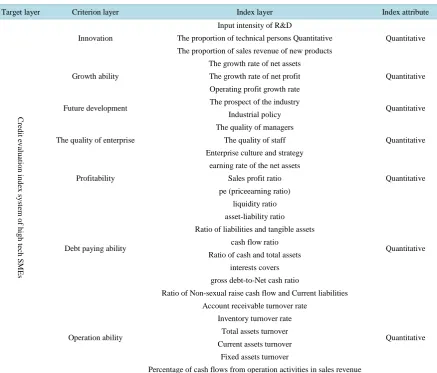
In this research, we summarized the SME credit index factors and thought that indicators can be roughly divided into the growth of enterprises, innovation ability, the quality of enterprise and financial status (including debt paying ability, operating ability and profit ability). In this paper, financial index is suitable for most enterprises and essentials. This is also true in the SME credit evaluation. It is a quantitative index that reflecting the enter-prise credit. We can query the data through the accounting statements of enterenter-prises. And the data can be ob-tained easily. Then, the innovation ability and development ability of SME is the core in the whole life cycle of the enterprises, which related to the survival and death of enterprise. So these two points must be incorporated into the index factors. The index system includes the above factors as the basic study model in this paper. Based on the index system from Shengxiang Bao et al. [5] about the indicators of high-tech SME credit evaluation, we deleted some strong correlated coefficients. The constructed index system is showed in Figure 1.
Target layer Criterion layer Index layer Index attribute
C re d it e v al ua tio n in de x s y st em o f h igh t ec h S M E s Innovation
Input intensity of R&D
Quantitative The proportion of technical persons Quantitative
The proportion of sales revenue of new products
Growth ability
The growth rate of net assets
Quantitative The growth rate of net profit
Operating profit growth rate
Future development The prospect of the industry Quantitative Industrial policy
The quality of enterprise
The quality of managers
Quantitative The quality of staff
Enterprise culture and strategy
Profitability
earning rate of the net assets
Quantitative Sales profit ratio
pe (priceearning ratio)
Debt paying ability
liquidity ratio
Quantitative asset-liability ratio
Ratio of liabilities and tangible assets
cash flow ratio
Ratio of cash and total assets
interests covers
gross debt-to-Net cash ratio
Ratio of Non-sexual raise cash flow and Current liabilities
Operation ability
Account receivable turnover rate
Quantitative Inventory turnover rate
Total assets turnover
Current assets turnover
Fixed assets turnover
[image:3.595.95.533.328.701.2]Percentage of cash flows from operation activities in sales revenue
4. Study on the SME Credit Evaluation Model
In this paper, we select Ensemble learning method [14] for SME credit evaluation. Ensemble learning was pio-neered by Hanson and Salamon. In [14], the authors found that combined model arranged from kinds of neural network model according to certain rules can significantly improve forecast accuracy in classifying and predict-ing. The Boosting algorithm is the most primitive ensemble learning algorithm. The algorithm has good genera-lization ability. Inspired by this thought, a large number of scholars have conducted research on the integrated learning research. Later scholars have improved the ensemble learning method that changes from the simply combination of multiple identical learning machines, which are used for solving a plurality of problem, to com-bination of multiple similar learning machines, which are used for classifying and multiple problems. The reason of ensemble better is obviously: if the two learning machines are the same, the credit evaluation result can only be one result, which is both right or both wrong. Obviously the test effect of single learning machine and mul-tiple learning machines are the same. This combination has no meaning. The prediction results may have two different results when using two learning machines, which are similar. Finally model can determine what kind of classification is correct and the most close to the fact through determining the result again. The study of this pa-per is about classification. In this papa-per, three kinds of classification learning algorithms are selected as the basic algorithm for the ensemble learning model. And we use the ensemble model for the credit evaluation of high-tech SMEs. The combined model includes BP-Neural Networks, SVM, and Decision Tree. We brief intro-duce these three algorithms in the following.
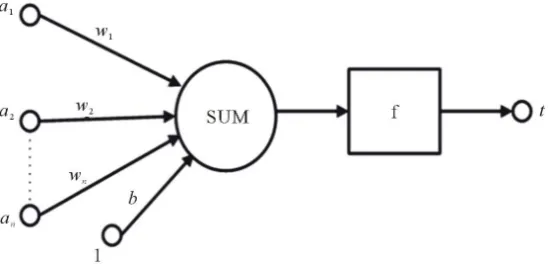
The neural network method has a strong advantage in researching on complex problems [14]. It is a simula-tion and simplificasimula-tion of the biological neural network. The neural net work consists of a large number of neu-rons and prominent. The network structure is showed in Figure 2.
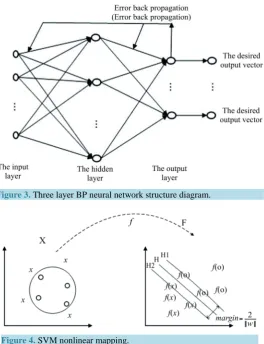
The interaction between neurons can realize the memory and storage of information. Neural network simu-lated by computer can achieve this function like biological neural network. On the other hand, the BP neural network system is a highly nonlinear mapping system. By using this classification method, the data does not need to be processed dimensionally. This technique simplifies the learning process. Neural network learning process can be divided into two stages: The first stage is the training and learning stage. In this stage, we need to set the network initial weights and bias. Then put the data into the model. The model will continue to adjust the weights and bias of the model until convergence is reached. The second stage is the prediction stage. This stage is a test of the model which formed in the first stage. The output data is obtained in this stage. The structure of neural network is variety. There is a schematic diagram of three layer network structure feedback neural network model showed in Figure 3.
The Neural network model requires a large number of learning samples. On the other hand, we use the gra-dient descent method in adjusting the weight value and bias value. So the results of training will be trapped into local minima. In order to solve the above problems, we introduced the support vector learning method [14]. The theory and methods of SVM are introduced as follows:
[image:4.595.177.455.573.707.2]The support vector machine method is a kind of popular statistical learning theory method. It is similar to the structural risk minimization principle. This method can solve problems of getting stuck in a local minimum, over learning or large sample demands etc. This paper makes up for the deficiency of the neural network by in-troducing SVM. The principle of support vector machine is shown in Figure 4.
Figure 3. Three layer BP neural network structure diagram.
Figure 4.SVM nonlinear mapping.
SVM maps the data to a high dimensional space that the samples can be divided in that space. Then we can establish the optimal hyper plane in high-dimensional space. And in that space, the data has maximum margin and the minimum number of error classification that is the minimum structure risk. Assume that the training sample is T=
{
(
x , y1 1) (
, x , y2 2) (
x , yn n)
}
. Among them, xi∈X =Rn; yi∈ − +{ 1, 1}. The problem can be ex-pressed as(
ω⋅xi)
+ − ≥b] 1 0,i=1, 2,,n (1) Adding constraints to the expressions, the problem can be converted into(
)
21 1
, 2
n
i i
Q ω ξ ω C ξ
−
= +
∑
(2)Among them, C is the penalty factor of error data, ξi is the number of error samples. Support vector ma-chine will face with a complex problem in mapping the low dimensional data into high dimension. The process is not easy to realize. On the other hand, if the problem is converted into a dual problem we can use the theory of Mercer [14] to simplify the problem. So the decision function of SVM can be transformed into the following form:
( )
*(
)
*1
sgn ,
n
i i i j
i
f x a y K x x b
=
= +
∑
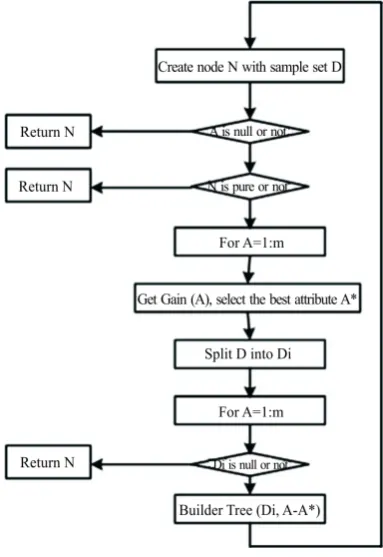
(3)two stages. The first stage is the tree construction and tree pruning, and the second stage is t sample prediction. The first stage is more complex and spends more time. The second stage is relatively simple. The typical deci-sion tree algorithms are ID3, C4.5 and Cart etc. Construction process of decideci-sion tree is shown in Figure 5.
In this paper, we use three common algorithms, which is complementary advantages to classify and prediction. This combined model can improve the prediction accuracy. Inspired by the ensemble learning theory, the author constructed an integrated learning model through arranging the three kinds of machine learning parallel in the field of machine learning. The model is shown in Figure 6.
5. Empirical Analysis
In this section, we test our method using the real SME data.
5.1. Sample Acquiring and Processing
In this paper, we use the data which provided by the intermediary. In order to classify and predict, we selected 140 SMEs data. Test samples are selected randomly. Because accounting system of SME is not perfect. Missing data is a common phenomenon. In order to reduce impact of attributes missing on the final evaluation results and ensure the authenticity of final evaluation results, we have filtered the data before inputting data into the model. The data set is divided into four sub tasks in the stage of empirical analysis.
Task 1: Takes the first 10 data as the training sample, the latter 133 data as the test sample; Task 2: Takes the first 30 data as the training sample, the latter 113 data as the test sample; Task 3: Takes the first 50 data as the training sample, the latter 93 data as the test sample; Task 4: Takes the first 70 data as the training sample, the latter 73 data as the test sample.
5.2. SME Credit Evaluation
[image:6.595.216.408.431.710.2]The classical machine learning algorithms can be implemented using MATLAB software. Therefore, we use MATLAB to build the ensemble learning model. We compared three classical machine learning algorithms. Ac- curate rate was selected to evaluate the algorithms. Classification accuracy of four models as shown in Table 1:
Figure 6.Integrated learning model.
Table 1. Comparison of prediction accuracy.
Proposed Method SVM BP-Neural Network Decision Tree
Task 1 0.6500 0.6250 0.5083 0.7833
Task 2 0.7600 0.7600 0.7700 0.7200
Task 3 0.7500 0.7250 0.5750 0.6500
Task 4 0.8000 0.7000 0.7333 0.7667
From the table, we can see that the ensemble learning method we proposed has higher forecasting precision.
6. Conclusions and Future Work
In this paper, we have investigated the credit rating problem by using ensemble learning theory. Three basic machine learning algorithms are selected to construct the ensemble model. The experimental result showed the effectiveness of our method.
However, when constructing models, we need to consider investment preference of the bank. On the other hand, corporate credit rating also needs to be divided into several grades. Therefore, the model needs further improvement to cover the above situation.
Acknowledgements
This work is supported by National Natural Science Foundation of China (NSFC) under Grant No. 61373051; the National Science and Technology Pillar Program (Grant No. 2013BAH07F05), Jilin Province Science and Technology Development Program (Grant No. 20111020); Project of Science and Technology Innovation Plat-form of Computing and Software Science (985 engineering), and the Key Laboratory for Symbolic Computation and Knowledge Engineering, Ministry of Education, China.
References
[1] Li, X.F. and Li, J. (2003) Data Mining and Knowledge Discovery. Higher Education Press, Beijing.
[2] Lin, X.-J. (2009) The Design of Medical Image Classification Based on Ensemble Leaning. Computer Knowledge and Technology, 5, 9515-9517.
[3] Lu, Y. (2012) Research on the Credit Rating of SME. Anhui University, Hefei.
[4] Liu, Y.L. and Liu, S.L. (2013) Research on Credit Risk Identification of Small Enterprises Based on Supply Chain Finance. Financial Market.
[5] Bao, S.X. and Yin, Y.F. (2009) Credit Evaluation and Empirical Analysis of SME. Science & Technology Progress and Polic, 26, 143-148.
[6] Gao, F. (2010) Research on the Credit Rating System of Chinese High Tech SMEs. Hebei University, Baoding.
[7] Ji, H., Cao, Z.C. and Xie, W. (2012) Research Based on the Growth Theory of Small and Medium Enterprises in Tech- nological Innovation Ability. Scientific Research.
[8] Wang, C.F. and Wang, H.H. (2010) Summary of Enterprise Credit Rating Index System Research. Financial Forum, 8.
471.
[10] Wang, Y.Q., Wang, S.Y. and Lai, K.K. (2005) A New Fuzzy Support Vector Machine to Evaluate Credit Risk. IEEE Transactions on Fuzzy System, 13, 820-831.
[11] Lin, J.X., Luo, W.Q. and Pang, S.L. (2005) Bayes Discriminant Credit Evaluation Model and Its Application. Statistics and Decision.
[12] Ye, Z.X. and Yu, M.J. (2006) Genetic Algorithm and Classification Tree Method Based Credit Rating Method. Journal of Systems Engineering.
[13] Pang, S.-L., Li, R.-Z. and Xu, J.-M. (2005) Application of BP Algorithm in Credit Risk Analysis. Control Theory and Applications.