Fingerprint Recognition System for Matching
Manmeet Kaur Virdi
Department Of Electronics And Telecommunication, Chouksey Engineering College, Bilaspur(C.G.)
Abstract- Fingerprint Recognition refers to the automated method of verifying a match between two human fingerprints. Fingerprints are one of many forms of biometrics used to identify individuals and verify their identity. Everyone is known to have unique, immutable fingerprints. Fingerprint recognition algorithm extract’s primarily uniqueness of the images obtained from the fingerprint. Fingerprint Recognition is a widely popular but a complex pattern recognition problem. Among all the biometric techniques, fingerprint-based identification is the oldest method which has been successfully used in numerous applications. A fingerprint is made of a series of ridges and furrows on the surface of the finger. The uniqueness of a fingerprint can be determined by the pattern of ridges and furrows as well as the minutiae points. Minutiae points are local ridge characteristics that occur at either a ridge bifurcation or a ridge ending. The information contained in a fingerprint can be categorized into three different levels, namely, Level 1 (pattern), Level2 (minutia points), and Level 3 (pores and ridge contours). Despite their discriminative power, the Level 3 features are barely used by the vast. Majority of contemporary automated fingerprint authentication systems which rely mostly on minutiae features. In this thesis the above mentioned techniques have been addressed and a new approach of identification ofminutia term‘s with bifurcation, termination and orientation has been proposed. In our thesis extraction of minutia terms from the image is developed using termination and bifurcation process and elimination of false minutia from the image is carried out using distance formulae’s. All those minutiae points are thus undergone with orientation characteristics’ which gives the determination more powerful in case of image sizing and plasticity. All these terms are stored in a user profile for matching .Results and testing is performed by taking different user profiles.
Index Terms- Fingerprint, Image Enhancement, Minutiae Extraction.
1.INTRODUCTION
Biometric based recognition, or biometrics, is the science of identifying, or verifying the identity of, a person based on physiological and/or behavioral characteristics .Physiological traits are related to the physiology of the body and mainly include Fingerprint, face, DNA, ear, iris, retina, and hand and palm geometry. Behavioral traits are related to behavior of a person and examples include signature, typing rhythm, gait, voice etc. Biometric recognition offers many advantages over traditional PIN number or password and token-based (e.g., ID cards) approaches. A biometric trait cannot be easily transferred, forgotten or lost, the rightful owner of the biometric template can
be easily identified, and it is difficult to duplicate a biometric trait.
There are a number of desirable properties for any chosen biometric characteristic.
These include:
1. Universality: Every person should have the characteristic. 2. Uniqueness: No two persons should be the same in terms of the biometric characteristic.
3. Permanence: The biometric characteristics should not change, or change minimally, over time.
4. Collectability: The biometric characteristic should be measurable with some (practical) sensing device.
5. Acceptability: The user population and the public in general should have no
(Strong)objection to the measuring/collection of the biometric trait.
The effectiveness of a biometric system can be judged by following characteristics:
1. Performance : This refers to the achievable recognition accuracy, speed, robustness, the resource requirements to achieve the desired recognition accuracy and speed, as well as
operational (work environment of individual, e.g., manual workers may have a large number of cuts and bruises on their fingerprints) or environmental factors (humidity, illumination etc.) that affect the recognition accuracy and speed .
2. Scalability : This refers to the ability to encompass large number of individuals
without a significant decrease in the performance.
3. Non-invasiveness : This refers to the ease with which the information can be
captured from individuals, without damaging an individual's physical integrity and ideally without special preparations by/of an individual.
4. Circumvention : This refers to the degree to which the system is resistant to spoofs or attacks.
A practical biometric system should meet the specified recognition accuracy, speed, and resource requirements, be harmless to the users, be accepted by the intended population, and be sufficiently robust to various fraudulent methods and attacks to the system.
Fingerprint Representation
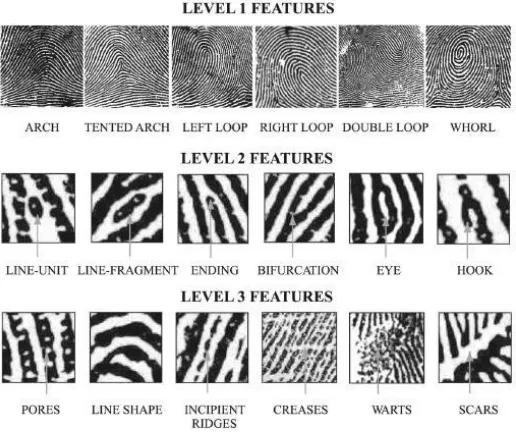
Fig 1.1: Fingerprint features at Level 1, Level 2 and Level 3
termination, etc. These regions are broadly classified into arch, loop, and whorl. The arch, loop and whorl can further be classified into various subcategories. Level 1 features comprises these global patterns and morphological information. They alone do not contain sufficient information to uniquely identify fingerprints but are used for broad classification of fingerprints. Level 2 features or minutiae refers to the various ways that the ridges can be discontinuous. These are essentially Galton characteristics, namely ridge endings and ridge bifurcations. A ridge ending is defined as the ridge point where a ridge ends abruptly. A bifurcation is defined as the ridge point where a ridge bifurcates into two ridges. Minutiae are the most prominent features, generally stable and robust to fingerprint impression conditions. The distribution of minutiae in a fingerprint is considered unique and most of the automated matchers use this property to uniquely identify fingerprints. Uniqueness of fingerprint based on minutia points has been quantified by Galton . Statistical analysis has shown that Level 2 features, have sufficient discriminating power to establish the
individuality of fingerprints .
Level 3 features are the extremely fine intra ridge details present in fingerprints . These are essentially the sweat pores and ridge contours. Pores are the openings of the sweat glands and they are distributed along the ridges. Studies have shown that density of pores on a ridge varies from 23 to 45 pores per inch and 20 to 40 pores should be sufficient to determine the identity of an individual. A pore can be either open or closed, based on its perspiration activity. A closed pore is entirely enclosed by a ridge, while an open pore intersects with the valley lying between two ridges as shown in Fig 1.2. The pore information (position, number and shape) are considered to be permanent, immutable and highly distinctive but very few automatic matching techniques use pores since their reliable extraction requires high resolution and good quality fingerprint images. Ridge contours contain valuable. Level 3 information including ridge width and edge shape. Various shapes on the friction ridge edges can be classified into eight categories, namely, straight, convex, peak, table, pocket, concave, angle, and others as shown
in Fig 1.3. The shapes and relative position of ridge edges are considered as permanent and unique.
Fig 1.2: Open and closed pores
Fig 1.3: Characteristics of ridge contours and edges
PROBLEM IDENTIFIED AND APPROACH
Fingerprint recognition is a complex pattern recognition problem. It is difficult to design accurate algorithms capable of extracting salient features and matching them in a robust way, especially in poor quality fingerprint images and when low-cost acquisition devices with small area are adopted. There is a popular misconception that automatic fingerprint recognition is a fully solved problem since it was one of the first applications of machine pattern recognition. On the contrary, fingerprint recognition is still a challenging and important pattern
recognition problem. The real challenge is matching fingerprints affected by:
Matching partial fingerprints presents several problems: • the number of minutia points available in such prints is few, thus reducing its discriminating power;
• uncontrolled impression environments result in unspecified orientations of partial fingerprints; and
[image:2.612.315.578.92.250.2]• the elasticity of human skin and humidity can cause distortions. The challenges faced in implementation of matching systems that deal with partial or incomplete fingerprints are outlined in Fig 1.1. Since only a small number of feature points are present on a partial fingerprint, the decision making based just on the number of matched feature points is prone to failure.
In this thesis an approach has been presented which addresses the various issues and challenges in Fingerprint matching. The aim is to reduce the error rates, namely False Acceptance Rate (FAR) and False Rejection Error (FRR) in the existing Fingerprint matching algorithms. In first stage image extraction where binarization and thinning of image is carried out by setting and thresholding image constituents. After thinning minutia detection is done by 3X3 window pixel determination for bifurcation and termination of ridges. Again spurious minutia is suppressed by using Euclidean distance formulae and ROI by which false minutia is suppressed. Orientation of minutia is also carried out for both bifurcation and termination which gives algorithm a solid foundation for matching process. Results are processed and a text file with the details is saved for a template.
Of image enhancement, feature extraction, and matching techniques that are used in Minutiae-based fingerprint recognition systems.
Global Ridge Pattern
This representation relies on the ridge structure, global
landmarks and ridge pattern characteristics. Such as the singular points, ridge orientation map, and the ridge frequency map. This representation is sensitive to the quality of the fingerprint images . However, the discriminative abilities of this
representation are limited due to absence of singular points.
Local Ridge Detail
This is the most widely used and studied fingerprint
representation. Local ridge details are the discontinuities of local ridge structure referred to as minutiae? Sir Francis Galton (1822-1922) was the first person who observed the structures and permanence of minutiae. Therefore, minutiae are also called “Galton details”. They are used by forensic exports to Match two fingerprints. There are about 150 different types of minutiae categorized based on their configuration.
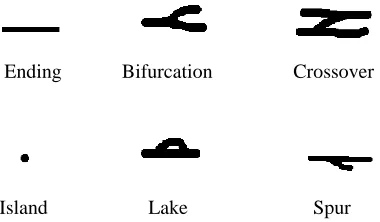
Among these minutia types, “ridge ending” and “ridge
bifurcation” are the most used, since all other types of minutiae can be seen as the combinations of “ridge endings” and “ridge bifurcations”. Some minutiae are illustrated in Fig 1.4.
The American National Standards Institute-National Institute of Standard and Technology (ANSI-NIST) proposed a minutiae-based fingerprint representation. It includes minutiae location and orientation. The minutia orientation is defined as the
direction of the underlying ridge at the minutia location (Fig 1.5). Minutiae-based fingerprint.
Ending Bifurcation Crossover
Island Lake Spur
Fig 1.4: Some of the common minutiae types.
representation also has an advantage in helping privacy issues since one cannot reconstruct the original image from using only minutiae information. Minutia is relatively stable and
(a)
(b)
Fig 1.5: (a) A ridge ending minutia: (x,y) are the minutia coordinates; theta is the minutia’s orientation; (b) A ridge bifurcation minutia: (x,y) are the minutia coordinates; theta is the minutia’s orientation.
robust to contrast, image resolutions, and global distortion when compared to other representations. However, to extract the minutiae from a poor quality image is not an easy task.
[image:3.612.345.522.264.422.2]
Fig 1.5: A portion of a fingerprint where sweat pores (white dots on ridges) are visible
.
Today, most of the automatic fingerprint recognition systems are designed to use minutiae
as their fingerprint representations.
Intra-ridge Detail
On every ridge of the finger epidermis, there are many tiny sweat pores (Fig 1.5). Pores are considered to be highly distinctive in terms of their number, positions, and shapes. However, extracting pores is feasible only in high-resolution fingerprint images (for example 1000 DPI) and with good image quality. Therefore, this kind of representation is not practical for most applications.
2. SOFTWARE USED In this project we had used MATLAB.
The MATLAB high-performance language for technical computing integrates computation, visualization, and programming in an easy-to-use environment where problems and solutions are expressed in familiar mathematical notation. Typical uses include
• Math and computation
[image:3.612.49.239.427.538.2]• Data acquisition
• Modeling, simulation, and prototyping
• Data analysis, exploration, and visualization
• Scientific and engineering graphics
• Application development, including graphical user interface building
MATLAB is an interactive system whose basic data element is an array that does not require dimensioning. It allows you to solve many technical computing problems, especially those with matrix and vector formulations.
Images in Matlab
This worksheet is an introduction on how to handle images in Matlab. When working with images in Matlab, there are many things to keep in mind such as loading an image, using the right format, saving the data as different data types, how to display an image, conversion between different image formats, etc.This worksheet presents some of the commands designed for these operations. Most of these commands require the Image processing tool box installed with Matlab. To find out if it is installed, type ver at the Matlab prompt. This gives a list of what tool boxes that are installed on the system.
Supported Formats
The following image formats are supported by Matlab:
BMP HDF JPEG PCX TIFF XWB
Working formats in Matlab
If an image is stored as a JPEG-image on disc firstly read it into Matlab. However, in order to start working with an image, for example perform a wavelet transform on the image, it is must convert it into a different format.
RGB COLOR MODEL
A representation of additive color mixing. Projection of primary color lights on a screen shows secondary colors where two overlap; the combination of all three of red, green, and blue in appropriate intensities makes white .An RGB image, along with its separate R, G and B components.
Grayscale
A gray scale or greyscale is an image in which the value of every picture element is a single sample, that is, it carries only intensities information. Images of this sort, are also known as black and white, are composed exclusively of shades of gray value, varying from black at the weakest intensity to white at the strongest.
Grayscale as single channels of multichannel color images
Color images are often built of several stacked color channels, each of them representing value levels of the given channel. For example, RGB images are composed of three independent channels for red, green and blue primary color components; CMYK images have four channels for cyan, magenta, yellow and black ink plates, etc.
3. RESULT AND CONCLUSION
In reference to the idea propose in IEEE journal Fingerprint Reconstruction: From minutiae to Phase, Fingerprint
reconstruction is carried out from the minutiae template to phase image, which is then converted into grayscale image.
Reconstructed image thus eliminate false minutiae terms that corresponds to minutiae. Our thesis is centered upon collection of minutiae terms on the bases of
1. Ridge bifurcation and endings
2. False minutiae rejection based on distance from ridges. 3. Orientation field of minutiae terms based on
a) Termination b) Bifurcation
All these data sets are then reutilized in a manner for direct verification of fingerprint and reconstruction of phase image as describe by the paper. Among all these things Region of Interest of the image is carried out in a autonomous way, which makes the work fitted to reconstruction and recognition phases further.
ACKNOWLEDGMENT
Expression of giving thanks are just a part of those feelings which are too large for words, but shall remain as memories of wonderful people with whom I have got pleasure of working during the completion of project.
College is an organization which trains a lot of technical trainee. They not only train the students but they change the entries prospect of our life. I am greatful to “CHOUKSEY ENGINEERING COLLEGE” which helped me to do so.
I have also taken the opportunity to thank our
OSD Mr. S.K. Kaushik for providing us good facility for successfull completion for our project.
This is never ending, so I give thanks to all the persons who have directly or indirectly helped me to achieve success in my endeavor.
REFERNCES
[1] International Biometric Group. Analysis of Level 3 Features at High Resolutions. http://level3tk.sourceforge.net/, 2008.
[2] Jianjiang Feng “ Combing minutiae descriptors for fingerprint matching” Pattern recognition 41, pp. 342 – 352, 2008.
[3] Anil Jain, Arun Ross, Salil Prabhakar “ Fingerprint matching using minutiae and texture features” appeared in Proc. Of ICIP, pp. 282-285. [4] Muhammad Umer Muni, Dr. Muhammad Younas javed “Fingerprint
matching using Gabor filter” National conference on emerging technologies, paper no. 3, pp. 147 – 151.
[5] A. K. Jain, S. Prabhakar “An introduction to biometric recognition” IEEE Transaction Vol. 14, Issue -1, pp.4 -20, January 2004.
[6] Smital D. Patil, Shailaja A. Patil “Fingerprint recognition using minutia
matching” World journal science and technologies 2(4) ISSN : 2231-2587, pp.178 -181, 2012.
[7] Arun Ross, Anil Jain, James Reisman “ A hybrid fingerprint matcher” appeared in ICPR, august 11 -15, 2002.
[8] Jianjiang Feng Anil K jain Fingerprint Reconstruction:From Minutae to phase IEEE Transactions on pattern analysis and machine intelligence, Vol. 33, No.2, February 2011.
[9] Mrs. Hemlata Patel, Pallavi Asrodia “Fingerprint matching using two methods” International Journal of Engineering Research application, Vol. 2, Issue-3,
ISSN : 2248 -9622, pp.857 -860, 2012.
[10] Ridges and Furrows - history and science of fingerprint identfication, technology and legal issues.
http://ridgesandfurrows.homestead.com/fingerprint.html.
[11]Anil Jain, Lin Hong, and Ruud Bolle, “On-Line Fingerprint Verification”, IEEE Transactions on Pattern Analysis and Machine Intelligence, 19(4):302-314, 1997.
[12] Miroslav Krlk and Ladislav Nejman, “ Fingerprints on artifacts and historical Items: examples and documents”, Journal of Ancient Fingerprints, August2007.
[13] H. Faulds. On the skin-furrows of the hand. Nature, 22:605, 1880. [14] Francis Galton. Fingerprints. Macmillan, London, 1892.
[15] G. S. Sodhi and Jasjeet Kaur, “The forgotten Indian pioneers of fingerprint Science”, Current Science, 88(1), January 2005.
[16] E. Locard, Les Pores et L “Identification Des Criminels Biologica: Revue Scientifique de Medicine”, pg. no.- 357-365, 1912.
AUTHORS