ROBUST CONTROLLER DESIGN FOR POSITION TRACKING OF
NONLINEAR SYSTEM USING BACKSTEPPING-GSA APPROACH
Sahazati Md Rozali
1,
Mohd Fua’ad Rahmat
2, Abd Rashid Husain
3and Muhammad Nizam Kamarudin
41Department of Control System and Automation, Faculty of Electrical Engineering, Universiti Teknikal Malaysia Melaka, Durian
Tunggal, Melaka, Malaysia
2
Department of Control and Mechatronics Engineering, Faculty of Electrical Engineering, Universiti Teknologi Malaysia, Skudai, Johor, Malaysia
3Centre of Student Innovation, Universiti Teknologi Malaysia, Skudai, Johor, Malaysia 4
Department of Power Electronic and Drives, Faculty of Electrical Engineering, Universiti Teknikal Malaysia Melaka, Durian Tunggal, Melaka, Malaysia
E-Mail: [email protected]
ABSTRACT
Electro-hydraulic actuator (EHA) system is highly non-linear system with uncertain dynamics in which the mathematical representation of the system cannot sufficiently represent the practical system. Nonlinearities of the system come from either the system itself or external disturbance signals. These dynamic characteristics are the reasons that cause the controller design for the system to be quite challenging. In this paper, back-stepping controller design for tracking purpose of this system is presented based on Lyapunov stability condition. Gravitational Search Algorithm (GSA) technique is then used to optimize the control parameters in order to achieve a predefined system performance. The performance is evaluated based on the tracking output and the tracking error between reference input and the system
output. The results show that the system’s output follow the reference input given but the tracking performance is influenced by the condition of the system and number of agents and iteration in the algorithm.
Keywords: backstepping, lyapunov function, disturbance, gravitational search algorithm, sum of squared error.
INTRODUCTION
Back-stepping control method permits to obtain global stability in the cases when the feedback linearization method only secures local stability (Anna,
et.al, 2007). The fundamental concept of back-stepping
method is introduced in (Kristic M, et al, 1995, Khalil, 2002). It is used as an observer (Nakkarat, et al, 2009, Payam, 2006), controller for electro-hydraulic system (Kaddissi, et al,2006,Sirouspour,et.al,2000, Ursu,
et.al,2006), enhance the stability of power system (Karimi,
2005), as an adaptive method (Ji Min Le, et al, 2009, Qingwei Wang,et.al,2006) and controller for electro-pneumatic system (M.Smaoui,et.al,2006). The control parameter of back-stepping is important in order to achieve performance target. The value can be determined by several methods such as heuristic approach, artificial intelligent technique (Younes Al-Younes,et.al,2006) and optimization algorithm (Chao-Kuang Chen, et al, 2010, Anna, et al, 2007,Chao-Yong Li, et al, 2009, Ali Karimi,
et al, 2005, Yu Hong, et al, 2004, R.J. Wai, et al, 2010,
Faa-Jeng Lin, et al, 2010).
This research work focused on designing back-stepping controller for position tracking of electro hydraulic actuator system (EHA). The control parameters of back-stepping controller are then tuned by using Gravitational Search Algorithm (GSA) technique in order
objective function for this algorithm. The pattern of SSE value is observed by increasing number of agent and iteration in the simulation process such that the information on the optimum parameters of the controller algorithm which generates optimum output can be attained. The effectiveness of the back-stepping controller is verified in simulation environment under various system set-up subjected to different type of external disturbance given to its actuator.
PROBLEM FORMULATION
Consider a state-space model of EHA system is given as follow [10]:
̇ =
̇ = −�� − � +�� −���
̇ = −�
� − �
� + �√ �−� �
�� (1)
=�[� + −�� � + � ̇ −� � + � ] (3)
= ̇ − � (4)
SIMULATION RESULTS AND DISCUSSION
The parameter of the testing system is given as � = . �� /��, � = �� , = . ��/��,
� = �/��, = . ��, ��= �/�� ,
� = . , � = . × − �� /��, ��= . ��/�, � = . × − �� /� and � = . × −7�� /�� . For presentation of results in this chapter, the output plot yielded by 10 agents within 20 iterations, 15 agents within
30 iterations and 25 agents within 50 iterations are chosen for GSA in order to observe the performance of the designed controller with small, medium and bigger number of agents and iterations. Two dissimilar type of signal is given as an external perturbation to the system.
Case 1
In this case, constant value of signal ��=
is added as perturbation to system’s actuator. Figure 1, 2
and 3 show the system’s output, tracking error and SSE
obtained from back-stepping-GSA with 10 agents within 20 iterations, 15 agents within 30 iterations and 25 agents within 50 iterations respectively.
Figure-1. Position output, tracking error and SSE obtained from backstepping-GSA with 10 agents within 20 iterations.
0 1 2 3 4 5 6 7 8 9 10
-1 0 1 2
time(s)
p
o
si
ti
o
n
o
u
tp
u
t,
x
1
(c
m
) x1 obtained from backstepping-GSA with 10 agents within 20 iterations
0 1 2 3 4 5 6 7 8 9 10
-0.5 0 0.5 1
time(s)
tr
a
c
k
in
g
e
r
r
o
r
,e
e obtained from backstepping-GSA with 10 agents within 20 iterations
0 5 10 15 20 25
3729 3730 3731 3732
Number of iterations,T
S
u
m
o
f
S
q
u
a
r
e
d
E
r
r
o
r
,S
S
E SSE with respect to T with 10 agents within 20 iterations
Figure-2. Position output, tracking error and SSE obtained from backstepping-GSA with 15 agents within 30 iterations.
Figure-3. Position output, tracking error and SSE obtained from back-stepping-GSA with 25 agents within 50 iterations.
Referring to these Figures, the top plot illustrates the output yielded by back-stepping-GSA, the middle plot
values of these parameters are improved with the increment of agents and iterations. Better output
0 1 2 3 4 5 6 7 8 9 10
-0.5 0 0.5 1 1.5
time(s)
p
o
s
it
io
n
o
u
t
p
u
t
,x
1
(
c
m
) x1 obtained from backstepping-GSA with 15 agents within 30 iterations
0 1 2 3 4 5 6 7 8 9 10
-0.5 0 0.5
time(s)
t
r
a
c
k
in
g
e
r
r
o
r
,e
e obtained from backstepping-GSA with 15 agents within 30 iterations
0 5 10 15 20 25 30 35
553 554 555 556
number of iterations,T
S
u
m
o
f
S
q
u
a
r
e
d
E
r
r
o
r
,S
S
E SSE with respect to T obtained from backstepping-GSA with 15 agents within 30 iterations
reference input
backstepping-GSA
0 1 2 3 4 5 6 7 8 9 10
-0.5 0 0.5 1 1.5
time(s)
p
o
s
it
io
n
o
u
tp
u
t,
x
1
(c
m
) x1 obtained from backstepping-GSA with 25 agents within 50 iterations
0 1 2 3 4 5 6 7 8 9 10
-0.4 -0.2 0 0.2 0.4
time(s)
tr
a
c
k
in
g
e
r
r
o
r
,e
e obtained from backstepping-GSA with 25 agents within 50 iterations
0 10 20 30 40 50 60
18 19 20 21
number of iterations,T
S
u
m
o
f
S
q
u
a
r
e
d
E
r
r
o
r
,S
S
E SSE with respect to T with 25 agents within 50 iterations
Case 2
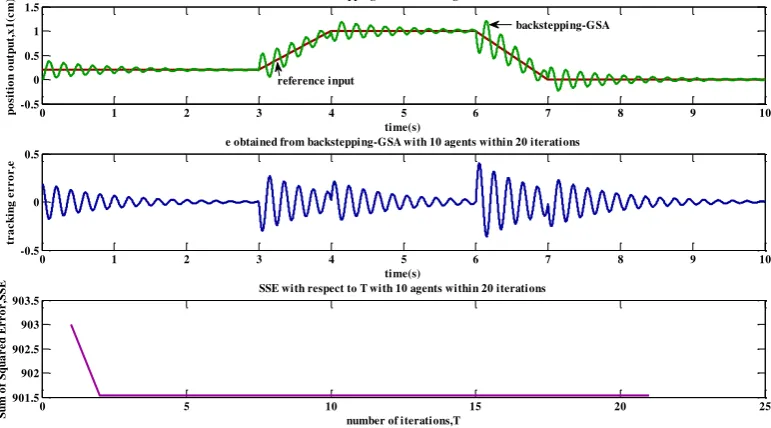
In this case, time-varying signal is given to replace the signal disturbance to the system’s actuator. Figure 4, 5 and 6 respectively show system output, tracking error and SSE for incorporation of back-stepping with GSA with 10 agents within 20 iterations, 15 agents within 30 iterations and 25 agents within 50 iterations. By
looking at these figures, similar as previous case, the
system’s output and its tracking error is bigger when
[image:4.595.105.491.206.420.2]smaller agents within short iterations are given to the system. On the other hand, the output and tracking error is improved when the system operates with bigger number of agents within longer iterations.
[image:4.595.105.493.474.682.2]Figure-4. Position output, tracking error and SSE obtained from backstepping-GSA with 10 agents within 20 iterations.
Figure-5. Position output, tracking error and SSE obtained from backstepping-GSA with 15 agents within 30 iterations.
0 1 2 3 4 5 6 7 8 9 10
-0.5 0 0.5 1 1.5
time(s)
p
o
si
ti
o
n
o
u
tp
u
t,
x
1
(c
m
) x1 obtained from backstepping-GSA with 10 agents within 20 iterations
0 1 2 3 4 5 6 7 8 9 10
-0.5 0 0.5
time(s)
tr
a
c
k
in
g
e
r
r
o
r
,e
e obtained from backstepping-GSA with 10 agents within 20 iterations
0 5 10 15 20 25
901.5 902 902.5 903 903.5
number of iterations,T
S
u
m
o
f
S
q
u
a
r
e
d
E
r
r
o
r
,S
S
E SSE with respect to T with 10 agents within 20 iterations reference input
backstepping-GSA
0 1 2 3 4 5 6 7 8 9 10
-0.5 0 0.5 1 1.5
time(s)
p
o
si
ti
o
n
o
u
tp
u
t,
x
1
(c
m
) x1 obtained from backstepping-GSA with 15 agents within 30 iterations
0 1 2 3 4 5 6 7 8 9 10
-0.2 0 0.2
time(s)
tr
a
c
k
in
g
e
r
r
o
r
,e
e obtained from backstepping-GSA with 15 agents within 30 iterations
0 5 10 15 20 25 30 35
107 108 109 110 111
number of iterations,T
S
u
m
o
f
S
q
u
a
r
e
d
E
r
r
o
r
,S
S
E SSE with respect to T with 15 agents within 30 iterations reference input
Figure-6. Position output, tracking error and SSE obtained from backstepping-GSA with 25 agents within 50 iterations.
CONCLUSIONS
Generally, the proposed back-stepping controller has mathematically fulfilled the requirement of stability of control system. External perturbation injected to the
system’s actuator is considered as nonlinearities in the chosen system. Since the performance of the designed controller relies on its control parameters, specific method should be determined in order to obtain the suitable value of these parameters such that good tracking performance is achieved. Although the trial and error method is good enough to set the value of control parameters such that the
system’s output tracked the reference input given, this
manual method consumes a lot of time and require good experience and knowledge of the user to fix it on certain value and condition. Thus, Gravitational Search Algorithm (GSA) technique is integrated with back-stepping controller so that the controller has the own capability to tune its control parameters automatically in any condition of the system. Although back-stepping-GSA applied on the chosen system cannot completely tracked the reference input given smoothly, the performance of this integration of controller still can be improved by providing bigger number of agents and iterations for optimization algorithm. It can be concluded in each case, additional number of agents and iterations of GSA produced better tracking performance with smaller tracking output and oscillation of the system. SSE value generated by the similar algorithm with more number of agent and iteration is also reduced.
REFERENCES
Ali Karimi, Amer Al-Hinai, Karl Schoder and Ali Feliachi. 2005. Power System Stability Enhancement Using Backstepping Controller Tuned by Particle Swarm Optimization Technique. Proc. of IEEE Power Engineering Society General Meeting. Vol 2, pp. 1388-1395.
Ali Karimi and Ali Feliachi. 2006. PSO-Tuned Adaptive Backstepping Control of Power Systems. Proc of 2006 Power Systems Conference and Exposition, pp. 1315-1320.
B.M.B.A. Farrokh Payam. 2006. Nonlinear Sliding Mode Controller for Sensorless Speed Control of DC Servo Motor Using Adaptive Backstepping Observer. Proc. of International Conference on Power Electronics, Drives and Energy Systems.
Chao-Kuang Chen and Wei-Yen Wang. 2010. Compact Ant Colony Optimization Algorithm Based Fuzzy Neural Network Backstepping Controller for MIMO Nonlinear Systems. Proc of International Conference on System Science and Engineering, pp. 146-149.
Chao-Yong Li, Wu-Xing Jing and Chang-Sheng Gao. 2009. Adaptive Backstepping-Based Flight Control System Using Integral Filters. Aerospace Science and Technology. 13, pp. 105-113.
Faa-Jeng Lin and Syuan-Yi Chen. 2010. Intelligent Integral Backstepping Sliding Mode Control Using
0 1 2 3 4 5 6 7 8 9 10
-0.5 0 0.5 1 1.5
time(s)
p
o
si
ti
o
n
o
u
tp
u
t,
x
1
(c
m
) x1 obtained from backstepping-GSA with 25 agents within 50 iterations
0 1 2 3 4 5 6 7 8 9 10
-0.2 0 0.2
time(s)
tr
a
ck
in
g
e
rr
o
r,
e
e obtained from backstepping-GSA with 25 agents within 50 iterations
0 10 20 30 40 50 60
38 39 40 41
number of iterations,T
S
u
m
o
f
S
q
u
a
re
d
E
rr
o
r,
S
S
E SSE with respect to T with 25 agents within 50 iterations reference input
H. K.Khalil. 2002. Nonlinear Systems,3rd ed.Prentice Hall.
Ioan Ursu, FeliciaUrsu and Florica Popescu. 2006. Backstepping Design for Controlling Electro hydraulic Servos. Journal of Franklin Institute. 343, pp. 94-110.
Ji Min Le, Han Me Kim, Sung Hwan Park and Jong Shik Kim. A Position Control of Electro-Hydraulic Actuator Systems Using the Adaptive Control Scheme. 2009. Proc of the 7th Asian Control Conference. pp. 21-26.
J.P.L. Claude Kaddissi, Maarouf Saad. 2005. Draw by Wire Control of an Electro-Hydraulic Active Suspension: A Backstepping Approach. Proc of IEEE Conference on Control Applications.
K. I. Kristic M, Kokotovic P.V. 1995. Nonlinear and Adaptive Control Design, John Wiley and Sons.
Mohammad R. Sirouspour, S.E. Salcudean. 2000. On the Nonlinear Control of Hydraulic Servo Systems. Proc. of the 2000 IEEE International Conference on Robotics and Automation, pp.1276-1282.
M. Smaouix. Brun, D. Thomasset. 2006. A Study on Tracking Position Control of An Electro pneumatic System Using Backstepping Design. Control Engineering Practice. 14, pp. 923-933.
Prut Nakkaratand Suwat Kuntanapreda. 2009. Observer Based Backstepping Force Control of An Electro hydraulic Actuator. Control Engineering Practice 17, pp. 895-902.
Qingwei Wang, Zhenghua Liu and LianjieEr. 2006. Disturbance Observer Based Backstepping Control for Flight Simulator. Proc of the First International Conference on Innovative Computing, Information and Contro. l, pp. 1366-1370.
R.J. Wai and K.L. Chuang. 2010. Design of Backstepping Particle-Swarm Optimisation Control for Maglev Transportation System. IET Control Theory and Applications. Vol. 4(4), pp. 625-645.
Yu Hong, Feng Zheng-Jin, Wang Xu-Yong. (2004). Nonlinear Control for a Class of Hydraulic Servo System. Journal of Zhejiang University Science, pp.1413-1417.