www.ijsrp.org
Design, Development and Analysis of Z-Axis
Translation for an Earth Sensor Test Facility
GHANASHYAM K G
1, VASUDEVAMURTHY B H
2, KRISHNAPRASAD A K
31
M.Tech. Student (Machine Design), Department Mechanical Engineering, SIET, Tumkur-06
2
Professor and Head, Department Mechanical Engineering, SIET, Tumkur-06
3
Head, MSD, SDA, Scientist/Engineer-SG, LEOS-ISRO, Bengaluru-58
Abstract: The objective of this current work is to design a z-axis translation for an earth sensor test facility in the Earth Lab, Laboratory for Electro-Optics System (LEOS), ISRO Bangalore. It is targeted to develop the best solution for the z-axis translation, taking into account the physical and material constraints as well as the operator’s safety and easy accessibility of the device. Nowadays there exist a set of z-axis translators that has been implemented on a limited number for testing equipments. The device developed in this thesis reveals a relatively new concept that is fitting space, safety and easy-access requirements of the test facility in the earth lab. To achieve the goals of this current work, I followed the project design methodology from specialized books that lead us to final concept which was submitted to structural analysis and that will be furthermore optimized. Careful consideration of functional and physical domains guided us to an effective solution to this design problem. This solution is viable from the point of view of the structural analysis.
Index Terms: z-axis translation, lead screws, scissor links, structural analysis.
I. INTRODUCTION
arth horizon sensors have been used on most orbiting spacecraft because they provide a convenient means for indicating the local vertical. In many applications they are used as the sensory components of active attitude-control systems; in others, sensed data is used to correlate the orientation of instruments, antennas, etc., with the local vertical. IRES is a two axis infrared Earth horizon sensor for accurate measurement of pitch and roll attitude angles with respect to the Earth disk centre. It is used in three-axis stabilized spacecrafts operating in GEO (Geostationary Earth Orbit) and MEO (Medium Earth Orbit).
Geostationary or communications satellites are PARKED in space 22,300 miles (35,900 km) above the equator of the
[image:1.595.355.507.215.365.2]STATIONARY earth. Geostationary satellites are used for weather forecasting, satellite TV, satellite radio and most other types of global communications. At exactly 22,000 miles (35,900 km) above the equator, the earth's force of gravity is canceled by the centrifugal force of the rotating universe. This is the ideal location to park a stationary satellite. The signal to the satellite is very, very precise and any movement of the satellite would cause a loss of the signal.
Figure 1: Geo-stationary Orbit
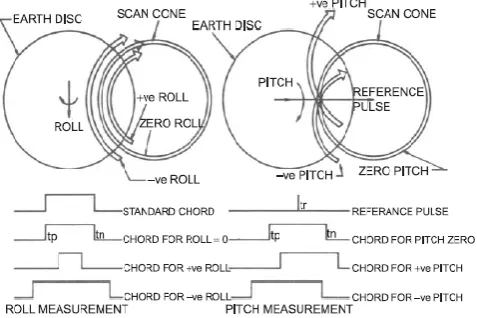
The difference between the earth center and mirror scan center of earth sensor is proportional to PITCH ERROR of space craft. The difference between south and north earth chord width is proportional to the ROLL ERROR of the spacecraft.
Figure 4- roll and pitch measurement.
[image:1.595.314.553.483.642.2]ISSN 2250-3153
www.ijsrp.org major discomforts or even serious injuries that could affect
testing.
Consequently, an adjustable lifting table will be required in the earth sensor lab to improve the efficiency of personnel. In order to do this, a mechanism is recommended to be incorporated into the table platform where the height is adjustable.
Conventional z-axis translators are inconvenient to handle delicate dangerous materials at greater heights. Maintenance at greater heights is tedious as considerable height is not available. To facilitate these a folding z-axis translator can be used which works on principle of scissor mechanism. There is a platform on top of the z-axis translator for lifting purpose. This z-axis translator can be raised at any intermediate height from the ground level without slipping down with the help of self locking arrangements.
The basic idea is that by displacing lower ends of the scissor slightly in the horizontal direction, the z-axis translator gives considerable vertical displacement. This z-axis translator has smooth opening and closing of the scissor, so that there is a less chance of accidents in lifting and lowering delicate, expensive or heavy materials thus minimizing losses. ∴ In practice this will prove to be economical. The z-axis translator can be used not only maintenance but also for material handling and similar other purposes, the device is easily transportable and rigid to handle heavy materials.
Z-axis translator is a device used to raise all or part of the earth sensor test facility into the air in order to facilitate adjustment height in earth sensor lab LEOS (ISRO), Bangalore. Available Z-axis translators, however, are typically manually operated and therefore require substantial laborious physical effort on the part of the user. Such Z-axis translators present difficulties for the elderly and handicapped and are especially disadvantageous under adverse weather conditions.
II. DESIGNOFDIFFERENTCOMPONENTSOFZ-AXIS TRANSLATIONFORANEARTHSENSORTEST
FACILITY
Z-axis translation comprises of six components. There is no concrete design procedure available for designing these components. The main components of the lift are Base plate, Upper plate, lead screw, nut, links and pins. On the basis of certain assumptions the design procedure for each of the components has been described as follows:
III. SYSTEMANALYSIS
Mathematical model will be developed for all the components of the device and parts of the design to prove its performance in real sense. The system will be divided into the following for proper presentation of fact and figures to ease design effort:
a) Frame
FRAME
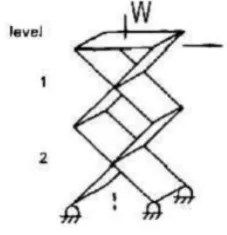
[image:2.595.310.508.358.501.2]The frame is made up of the scissor arms which are acting as the support to the entire structure. A table bed platform will be at the top of the scissor link arm. Also a similar bed will be at the bottom of the frame to accommodate the scissor link mechanism when fully collapsed. Figure 3.1 shows a schematic drawing of a scissor frame with 2-tier and the forces. It has six possible ways of application of load, but for the scope of this study, only one of them will be discussed. The notation at any particular point is used to identify linear force but with a subscript to identify where the force is acting on. At each joint there is also six possible forces and moment, but only few will be taken into consideration because of the symmetry of various joint and parts of the structure, i.e. reaction forces at similar but opposite point will also be similar but might be of different direction when all conditions are met. M will stand for the moment about any point, while ω will be the weight inherent in the system (i.e. weight). Also W will be used to represent applied load i.e., WX, WY, &WZ in the X, Y, & Z directions.
Figure 3.1 A Schematic Drawing of a Scissors Lift Showing the Forces 1.) Load type 1: centered load in the negative y-direction (normal, loading)
Figure 3.3 Schematic Drawing of Scissors Structure Showing Vertical Load Total load in the system will be the applied load plus the weight of the scissor lift. Total weight of the system in the negative Y-direction will be
[image:2.595.311.425.561.679.2]www.ijsrp.org Since it is vertical and centered load, the reaction forces on the
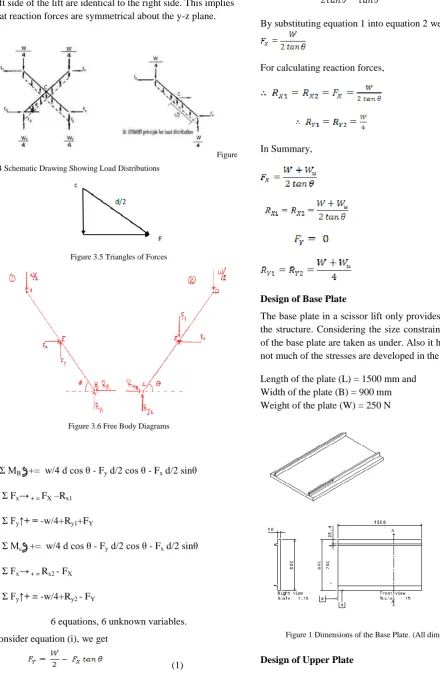
[image:3.595.44.485.80.755.2] [image:3.595.313.469.507.691.2]left side of the lift are identical to the right side. This implies that reaction forces are symmetrical about the y-z plane.
Figure 3.4 Schematic Drawing Showing Load Distributions
Figure 3.5 Triangles of Forces
Figure 3.6 Free Body Diagrams
1.Σ MB += w/4 d cos θ - Fy d/2 cos θ - Fx d/2 sinθ
2. Σ Fx→ + = FX –Rx1
3. Σ Fy↑+ = -w/4+Ry1+FY
4. Σ Mc += w/4 d cos θ - Fy d/2 cos θ - Fx d/2 sinθ
5. Σ Fx→ + = Rx2 - FX
6. Σ Fy↑+ = -w/4+Ry2 - FY
6 equations, 6 unknown variables.
Consider equation (i), we get
(1)
Consider equation (ii), we get
(2)
By substituting equation 1 into equation 2 we get,
For calculating reaction forces,
In Summary,
Design of Base Plate
The base plate in a scissor lift only provides proper balance to the structure. Considering the size constraints, the dimensions of the base plate are taken as under. Also it has been found that not much of the stresses are developed in the base plate.
Length of the plate (L) = 1500 mm and Width of the plate (B) = 900 mm Weight of the plate (W) = 250 N
Figure 1 Dimensions of the Base Plate. (All dimensions in mm) Design of Upper Plate
ISSN 2250-3153
www.ijsrp.org undertaken similar as the base plate. The upper plate has the
[image:4.595.36.236.113.178.2]similar requirements as the base plate. Also it has been found that not much of the stresses are developed in the upper plate
Figure 2 Dimensions of the Upper Plate. (All dimensions in mm) Design of Lead Screw
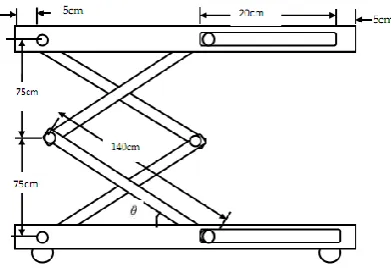
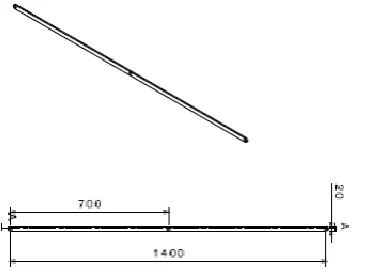
Lead screw is the ultimate component that takes up the load that is to be lifted or lowered by lift. It also delivers torque from the handle to the nut and also prevents falling of the lift due to its own weight. Link length is assumed to be 1400 mm.
[image:4.595.40.236.352.491.2]It can be seen from the below figure 3 that maximum pull on the power screw occurs when lift is in lowermost position.
Figure 3 Scissor lift showing maximum positions. In minimum position,
The core diameter of the screw is taken as dc = 27 mm
And the pitch of the screw is taken as p = 6 mm
Therefore outer diameter do = 33 mm.
And the average diameter, d = 30 mm
Let α be the helix angle
Now tan α = p / (Π .d) = 6 / (Π .30) = 3.642
Assume μ = tan Ø. Thus we get Ø = 8.5307
Effort required to rotate the screw while increasing the height, P = W x tan (α + Ø) = 952.319 N
Similarly effort required to reduce the height,
P = W x tan (Ø - α) = 377.55 N
Torque required in rotating the screw,
T = P x (d/2) = 14284.79 N.mm
Torsional shear stress (calculated) = 17.348 N/mm2
Maximum principle stress (calculated) = 26.821 N/mm2
Maximum shear stress (calculated) = 17.348 N/mm2
It has been found that all the above calculated values are within the permissible limits. Therefore all dimensions considered are correct.
Design of Nut
The material of the nut is assumed to be mild steel. And therefore the bearing pressure of mild steel = 20 N/mm2.
Assumed that the load W is uniformly distributed over the cross sectional area of the nut, therefore the bearing pressure between the threads is given by
Pb = W / (Π/4) x [(do 2
) – (dc2)] x n
Thus we get n = 0.1903 (n is the number of threads in contact with screw)
In order to have good stability and also to prevent the undesirable movement of screw in the nut, take n = 4 Now thickness of nut (t) = n x p = 24 mm and width of nut (b) = 1.5 do = 27 mm
Figure 4 Dimensions of Nut (All dimensions in mm) Design of Link
Load acting on one link = F / 2 = 1471.5 N
The link is designed for buckling load, assuming factor of safety (FOS) = 3.58
Thus critical buckling load = 1471.5 x 3.8
Thus critical buckling load = 5591.7 N
[image:4.595.303.510.462.595.2]www.ijsrp.org Moment of Inertia = mm2
Radius of gyration = 0.866 x thickness
Since for buckling of the link in the vertical plane, the ends are considered as hinged, therefore equivalent length of the link is, L = 1400 mm.
[image:5.595.38.221.203.341.2]Considering the Rankine’s Formula, we find Thickness of link = 8 mm and Width of link = 24 mm
Figure 5 Dimensions of Link (All dimensions in mm) DESIGN OF PIN
[image:5.595.38.216.438.555.2]The pins will be in double shear conditions. Thus the diameter of pin is calculated as 20 mm
Figure 6 Dimensions of Pin (All dimensions in mm) Wheels
The wheels are made of Polyurethane, have a 136 kg (300lb) load capacity each, and are 127 mm (5 inches) in diameter, wheel width 38 mm (1-1/2 in), 4 bolt holes, and the break locks both the wheels and the swivel motion. Locking the swivel motion would be ideal for extra stability. The wheels are chosen on the base on the design load criteria which can sustain the external load and well as the equipment load during transpiration in industrial line. The main function of using wheels for this equipment is that machine can be moved from corner to the other corner of the Earth lab as per the requirement to lift the load.
Figure 7: Shepherd Caster Corp. Twin Lock Casters IV. CONCLUSIONSANDRECOMMENDATION The design of a portable work platform elevated by the turning effect of a horizontal screw spindle was carried out successfully meeting the required design standards. The portable work platform is operated by turning a handle attached to the horizontal spindle. The scissor lift is only for average load, because the higher the load the higher the effort required. The screw operated scissor lift is simple in use and does not require much maintenance. For the present dimension we get a lift of 150cm, the scissor lift can lift a load of 300kg. The main constraint of this device is its high initial cost, but has a low operating cost. The shearing tool should be heat treated to have high strength. The device affords plenty of scope for modifications for further improvements and operational efficiency, which should make it commercially available and attractive. Hence, it should have a wide application in engineering industries and not just automotive industry alone. Thus, it is recommended for the engineering industry and for commercial production.
RECOMMENDATIONS
It is recommended that the screw and thread should be lubricated frequently so as to reduce the amount of effort required to operate the system. This also reduces the amount of wear between the screw and the nut. It is also suggested that the spindle and nut should not be exposed to moisture so that it would not be susceptible to corrosion there by reducing its strength and toughness.
REFERENCES
[1]. Stephens R. C. (1979): Strength of Material Theory and Examples. Edward Arnold publishers Ltd London.
[2].Allens H. R., Alfred R. H. and Herman G. L. (1980): Theory and Problems of Machine Design. Schaums Outline Series. McGraw Hill Book Company
[3].Shigleys Mechanical Engineering Design (2008). Richard G. B. and Nisbett J. K. Design (2008). 8th Edition
[4].Jain P. K. (1988): Machine/Mechanical Engineering Design Khanna Publishers. 5Th Edition
ISSN 2250-3153
www.ijsrp.org [6].Alexander j., Kaman P., Jack P., and David S. (1978),
Physic for Engineering Technology. John Willey and Sons Inc USA.
[7]. Machine design; Hall, holowenko, Laughlin [schaum’s outlines series] adopted by Ltd., New Delhi, special Indian edition, 2008.
AUTHOR
GHANASHYAM K G - M.Tech. Student (Machine Design), Department Mechanical Engineering, Shridevi Institute of Engineering and Technology, Tumkur-06
VASUDEVAMURTHY B H - Professor and Head, Department Mechanical Engineering, Shridevi Institute of Engineering and Technology, Tumkur-06