4467
GREEN INFORMATION TECHNOLOGY GOVERNMENT
REGULATION COMPONENTS:
IMPROVING INDONESIA GREEN INFORMATION
TECHNOLOGY
1HUDIARTO SUKARMAN, 2NURIL KUSUMAWARDANI SOEPRAPTO PUTRI,3CAROLYN
HONG GUI QING
1Mr., Information Systems Department, School of Information Systems, Bina Nusantara University,
Jakarta, Indonesia 11480
2Mrs., Information Systems Department, School of Information Systems, Bina Nusantara University,
Jakarta, Indonesia 11480
3Ms., Information Systems Department, School of Information Systems, Bina Nusantara University,
Jakarta, Indonesia 11480
E-mail: 1[email protected], 2[email protected], 3[email protected]
ABSTRACT
Information and communication technology (ICT) becomes one of the key drivers of economic growth and competitiveness. In contrary, the increasing of the ICT usage is not followed by the increasing of the green ICT awareness and behavior. Our previous research on Private higher education institution practice of green information technology governance model had resulted some obstruction on the implementation. One of the most crucial aspect among others is the government policies and regulations deficiencies. Hence, this study describes as well as proposes green IT government regulation components which can be regulated by Indonesia’s government. 6(six) green IT government regulation components (green knowledge, regulatory design, regulation dimensions, directive cost, awareness and innovation/technology) were categorized based on literature review.
Keywords: Green Computing, Green Information Technology, Green Information Technology
Government, Government Regulation)
1. INTRODUCTION
The digital era emergence has transform the society way of living and doing business, primarily on the education sector. Kvavik [1] discover where “net generation students” would demand daily teaching and learning activities involving the most recent technology. As they easily became outdated, they anticipate to engage to the current technologies. It is supported by the fact that university now days, need to utilize technological advances to improve the quality of teaching and learning system as well as the campus management. It is included the infrastructure, curriculum, facilities, services and technology-based learning activities [2].
Various technologies for different usefulness, have been used simultaneously depend on its activities. Students found laptop useful for typing notes, desktop convenient for browsing and the tablet technology supports their designing and
4468 During the green IT governance model application for private higher education institution in DKI Jakarta, Indonesia, some limitations have been identified. As a private institution, university owners impel to assume that the eco-friendly technology adoption is costly. It is also supported by Nguyen, Phan, Cao, & Nguyen [7], who stated that high cost is the most relevant barrier to procure the eco-friendly products. In fact, a majority of Indonesia’s private universities, utilize small to middle scale data center in contrast to state universities who acquire data center in large scale. Therefore, green information technology is not the main concern. As the fourth biggest population nation worldwide according to Worldometers [8], Indonesia has 4.637 higher educations in the presence, while there are 4.217 private institutions [9]. Despite of having these huge numbers, none intend to developed Green Information Technology Information system or Information Technology for strategic nor eco-friendly usage due to the insufficient government policies and regulations [5].
Hence, the research question of this paper asserts “what are the regulation components needed in green it government regulation”. Several components ought to be encompassed in order to formulate the green information technology policy which can utilized on indonesia’s higher education and other institutions.theoretical framework
2. GREEN INFORMATION TECHNOLOGY
According to Abenius [10], green information technology can be described as when a company/organization/person looks at possible areas in society where information technology related work can be used to reduce the carbon dioxide emissions. The use of information technology makes the human life easier, on the other hand it also pollutes the environment through the electronic junk of obsolete hardware and Greenhouse Gas (GHG) emission though its electricity consumption. The four main components of IT infrastructure that support the reduction of Greenhouse Gas (GHG): (1) Efficient use of hardware and eco-friendly disposal, (2) Development of Green Software, (3) Green Data Center and data storage, and (4) Green IT personal [11]. According to Kazandjieva, Heller, Omprakash, Hofer, & Kozyrakis [12], the hardware efficiency is more important than software regarding both energy and economic perspective. They tended to propose the replacement of desktop
PC into laptop as it is can meet user workloads at a lower energy cost.
Green IT goals can be concluded into 5(five): (1) To diminish consuming power of the products, (2) To reduce harmful effects to the environments through the use of hazardous material, (3) to prolong the product life time, (4) To expand energy efficiency of product’s lifetime, (5) To advertise defunct products and factory waste recyclability [13].
2.1 Green IT component
2.1.1 Green hardware
4469
2.1.2 Green software
The importance of green computing along the emerging computing system have to take into account, so energy conservation strategy could maintain eco friendly impact toward human environment. Various approaches to computing energy conservation are mentioned as the sleep mode function, turning off computer, using energy star hardware such as laptops desktops, printers and other computing devices, hibernate, turning off the computer and its brightness and lastly stop informal disposals. Using LCD screen instead of CRT(Cathode Ray Tube) screen, recycling old hardware are some other attempt to green computing [6]. Pursuant to Abenius’ s remark [10], testing applied on the program instructed by computer system or known as software is a leading potential to determine the green concept sustainability. Three software grouping action induces holistic approach of increasing speed outflow to search in internet, monitoring energy tools to visualize power consumption as well as the estimation energy saving and accelerate invention done by optimizing algorithm of decision processes [16]. These three different green software intend to improve efficiency of the decision process in internet searching. Gas emission can be reduced and minimize internet traffic load to the minimum, thanks to 3 existing tools as green software ready to monitoring and measuring energy use and increase speed usage.
Siebra and other authors highlight the emphasis of software design and development is essential to the power dissipation of computational system [17]. The lack of software data demands collection of software data consumption, so it could assist in designing and developing the best energy efficient algorithm [14]. Acknowledgement of software energy causes Hindle’s generalizability relative to OS version, application version, environment, various hardware category and deficiency of researches data arise concern to increase essence of software energy consumption knowledge [14].The best deployment to conserve computing energy with the involvement of Litegreen and sleep server software. Litegreen is a VM software purposely to save desktop energy by virtualizing user’s into a virtual environment. Sleepserver known as a software-only approach for PC’s energy consumption diminution within enterprise environments [12].
2.1.3 Green data center
4470
2.1.4 Electronic waste
Based on Bhoi & Shah’s perspective, they described electronic waste as an old, life ending electrical appliance [21]. As Singh & Gautam [22]assert e-waste, the overall type of electrical and electronic equipment which in general term comprises TV, computer, refrigerator, washing machine, dryer, and almost any electrical household appliances. Moreover, e-waste differentiates into urban and industrial waste in either chemical and physical state. E-waste categories splitting into large or small household appliance, IT and communication equipment, lighting or consumer equipment, medical devices, monitoring and control instrument and many more [23]. Due to the technology growth and internet connectivity expansion, municipal waste comparatively contains toxic components that threaten environment, for instance, hazardous material found in computing appliance such as computer, and television embodies lead, mercury, and cadmium [24]. E-waste involuntarily harm human health and living being welfare as the environment impact to immense measure [20], [21]. All the projected growth of e-waste production and consumption alongside with GDP (Gross domestic product) indicate the raising of unmanaged and unprocessed e-wastes. There are several methods currently implied which is landfill, incineration, and acid baths [25]. Landfill is the dump site where e-waste is thrown to spread poisonous acid that reaches to human habitats in counts of certain time period. While incineration is the pyrolysis heating of substance in the absence of oxygen and convert them into fumes, oil and gas. Lastly, acid baths are solution method which extract copper, gold and silver by dissolving the waste substance.
However, from most of the case study and practices applied, the most recommended resolution prefers recycling method. Shah Alam in Selangor, Malaysia applied e-waste disposal practices of sending waste to recycle center, disassembled to use, donation, given to scrap collector, thrown away, sell as second-handed equipment or store in on premise [26]. In addition, some countries ran recycling method by free of charge in Swiss or charged with fees as in Japan, in the recycling facilities e-waste are shredded and sort based on the type of materials. Most of the recycled materials deliver to refineries or electrical industries for recovery and reused on new products, hence, the remaining will goes to the incinerator as small percentage goes to landfill [23]. Recycling is the ultimate conservation solution as it maximize reuse
of materials and minimize cost [15]- a fastest growing waste production.
2.1.5 Paperless
Arising waves of technologies and communication tools, paperless is recommended to sustain environment and adapted to greening concept. Paperless simply means decreasing usage of paper and refer to other material. According to the revolution of information & technology, the authors encourage immediate paperless office indicating a friendly changing in company or industries [27]. The predominate of digitalization doesn’t influence the substitution of paper usage, instead of wood sheets consumption increases due to the fact that paper act as a medium in exchanging human collaboration in work. There are tons of reasons to rush paperless strategy, because electronic device offers easy storage of documents with unlimited range, time saving as people can searches and retrieve documents in split seconds, digital document management system can ensure better security, email efficiency, simple accessibility and many more [28]. Future computers trends in green computing [4] demands efficient practice of sustainability relies on hardware, software and also material used in daily business productivities. As company perceives paperless is beneficial in the way or cost reduction, boosting efficiency and effectiveness, and optimization in many aspects. However, there are obstacles such as the lack of proper training of IT personnel, system error, poor connectivity, cultural barriers for both organization & users, technical and integration difficulties which hinder the success of paperless strategic project [29]. As it requires extensive time, habitual changes and high consciousness of the willingness to sustainability transformation.
2.3 Green Information Technology Governance
Model and Electronic Waste Handling within Private Institutions of Higher Education and Information Technology
4471 reusing and recycling its IT equipment and establishing rules and policies according to green IT purpose. Thus, top-down (centralization-decentralization) strategy are used toward this paradigm. Whereas pull model adopted from Just In Time (JIT) system in the manufacturing industry. Pull model in this context, depends on the data center elements which lean on 3(three) variety of efficiency technique. The types of efficiency technique (IT efficiency technique, facility efficiency technique and integration efficiency technique) may be adapted separately or simultaneously, to achieve best result. However, bottom-up strategy (decentralization-centralization) is being used to support pull model [30].
In furtherance of identifying and enhancing the implementation of green IT for Private Higher Education Institutions in DKI Jakarta area, they need to evaluate current green IT performances using capability maturity level.
Fig. 1 shows Green IT Governance Model for Private Institution of Higher Education. The Green IT Governance Model is a visualization of two types of activity, where the activities are based on the strategy and the target they want to achieve. Green color varies to red color of the block determines the maturity level, i.e., Optimizing (green color).
Figure 1: Green IT Governance Model for Private Institution of Higher Education [30].
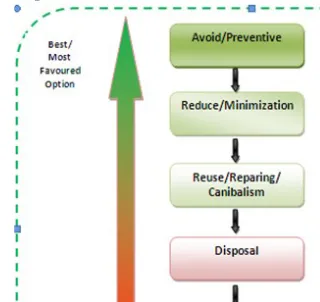
There are 6(six) methods proposed in e-waste model for private institution of higher education model (avoid/preventive, reduce/minimization, reuse/repairing/cannibalism, disposal, incineration and landfill). The green indicators are best or favored option for electronic waste handling method, while the red indications are becoming the worst or last option for electronic
waste handling method. However, based on the evaluation result, universities tend to practice avoid/preventive, reduce/minimization and reuse/repairing/cannibalism for their electronic waste. It is proven to be environmentally friendly by maximizing the use of materials. Meanwhile, disposal, incineration and landfill are poorly to fairly implemented in the university. As it is shown in figure 2, the toxin and hazard have become the outcome of the processes. Therefore, many universities tend to avoid this method due to the high risk of the impact [5].
Fig. 2 displays the E-Waste Model for Private Institution of Higher Education, in which it differs from the best/most favored option to the last/worst option.
Figure 2: E-Waste Model for Private Higher Education Institution [5].
3. METHOD
[image:5.612.342.502.277.428.2] [image:5.612.93.297.428.560.2]4472
4. INDONESIA’S GOVERNMENT, LAWS AND REGULATION MAKERS OVERVIEW
4.1 Central and Regional Government in
Indonesia
As stated in the Republic of Indonesia’s law number 32 of 2004, Central government is headed by the President and Vice President and assisted by the Ministers(executive chamber) organize the government of the Unitary State of the Republic of Indonesia (NKRI). For the legislative chambers include House of Representatives (DPR) , the Regional Representative Council (DPD), and the People’s Consultative Assembly (MPR). While Judicial institution consist of the Supreme Court (MA), the Constitutional Court (MK) and the Judicial Commission (KY). In the mean time, the Regional Government is a government regulator of the regions related government affair conforming to the expansive possible autonomy and assistance principle within the NKRI system. Regional Government Organizer comprise of Governor, Regent, Mayor and other apparatus (Head of Office, Head of Agency, and another work units sorted by the Regional Secretary). Nevertheless, Assembly at Provincial I (DPRD I) provincial level is detected as the legislative chamber, while Assembly at Provincial II (DPRD II) settled for district and mayor level [31].
4.2 Central and Regional Government in
Indonesia
In general, the regulation varies into two sections : (1) Central level regulation and (2) local level regulations. The Central Regulation elaborated as a drafted rule established by the central government. The established of Central Regulations apply to all Indonesian citizens. E.g. 1945 Constitution of the Republic of Indonesia (UUD 1045), Presidential Decree, and MPR Decree. While the local regulations made by the Regional Government only applies to certain areas. Moreover, there are 7(seven) constitutional level in Indonesia, comprise of : (1) 1945 Constitution of the Republic of Indonesia (UUD 1945), (2) The People’s Consultative Assembly Decree (MPR Tap), (3) Law (Act) or Government Regulation in Lieu of Law (Perppu), (4) Government Regulation (PP), (5) Presidential Regulation (Perpres), (6) Provincial Regional Regulation, and (7) District Regional Regulation. The Center for Statistical and Information Data (Pusdatin) is an echelon-level work unit, a constituent supporting the Ministry’s data and
information duties, and under the responsibility to the Minister, taking account through the Secretary General and led by a leader. The work unit task is to carry out statistical management, in addition of analysis and dissemination of information, as well as the Information System/ Information Technology and data banks development. Pusdatin possess a crucial strategic role and function for the Ministry. Therefore, Pusdatin should perpetually optimized its performance based on the demands and needs of the Ministry to enhance decision-making quality.
5. DISCUSSION
5.1 Green Information Technology
Government Regulation Components
5.1.1 Green data center
Not everyone has adequate knowledge on green IT. Green IT policy will not be implemented accordingly without sufficient Green IT knowledge. Based on our prior research on green IT governance model and e-waste handling model, several elements of green knowledge have been concluded into 5 elements, there are: (a) Green Hardware, (b) Green Software, (c) Green Data Center, (d) E-Waste, and (e) Paperless.
These elements conjoining with awareness of active human will generate successful implementation of green computing project. As the fundamental foundation overall , lies on the understanding of green computing itself and the requirements of resources needed to apply. In green software, the programmers of the future will be handling the requirement and designing software with sustainable energy efficiency. They will not only depend on education, instruction and training, they also must build disposal powerful models and tools that are integrated into their development environment [14].
5.1.2 Regulation design
4473 and Punishment, and (g) Authority of Central and Local Government control and Monitoring, (e) Reporting, (f) Reward and Punishment, and (g) Authority of Central and Local Government.
5.1.3 Regulation dimension
Regulatory dimensions are the measurement conditions in regulation itself. It is formulated from the purpose of the green IT governance model for private institution of higher education Fig. 1. The Green IT regulation dimension consists of: Energy Consumption and Material Consumption. Without any proper measurement, regulation cannot be measured. Improvement can never be measured with certainty. Understanding of automatic regulation will not be implicitly implied - but must be explicitly stated. The absence of a regulatory dimension will make it difficult to understand.
5.1.4 Directive Cost
Regulation always has amount of cost consequences. The regulation costs that arise consist of: (a) Training / Education, (b) Change Management, (c) Communication, (d) Integrated Ways of Working (Business Process), (e) Green SOP, (f) Green Policy, (g) Green Best Practices, and (h) Audience Size. Limitations in terms of costs will interfere the delivery of regulation to all business lines.
5.1.5 Awareness
Attitudes to disregard, not paying attention to, and ignore regulations can occur - whether individually, an assembly of people, or organizations - in the Green IT framework, it means: (a) Central Government / Ministry, (b) Local Government, (c) Company / Industry, and (d) Household / Community. Awareness about tasks, roles and relationships. Awareness is also related to personal, emotional and needs.
5.1.6 Innovation/Technology
The Green IT Regulation will have an impact on the implementation of technology as an embodiment of innovation. Technology arises due to the regulation of Green IT: (a) Waste B3, (b) Recycling, (c) Renewable Energy, and (d) Electronic Document
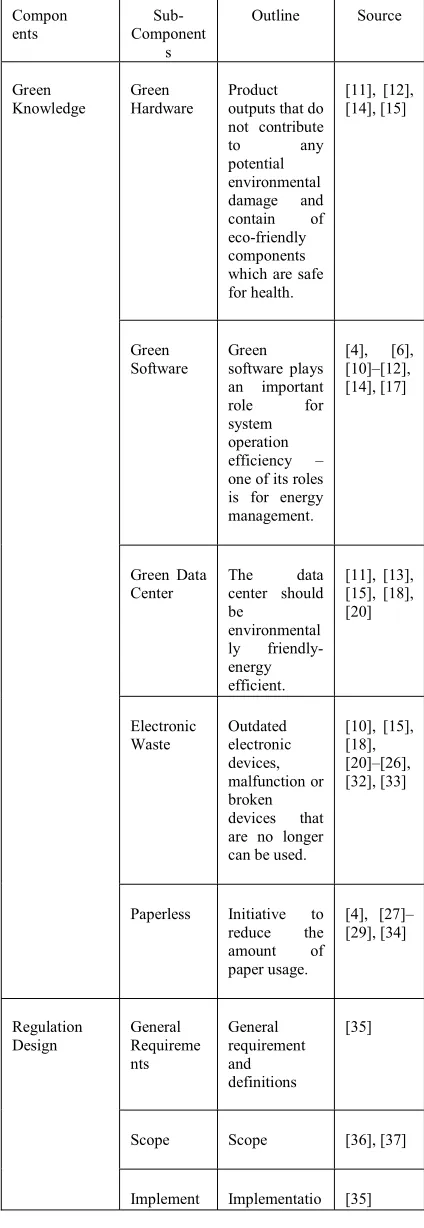
The Green IT government regulation components are shown in Table 1 along with its sub-components, outline, and its sources.
Table 1: Green Information Technology Government Regulation Components
Compon ents
Sub-Component
s
Outline Source
Green Knowledge
Green Hardware
Product outputs that do not contribute to any potential environmental damage and contain of eco-friendly components which are safe for health.
[11], [12], [14], [15]
Green Software
Green software plays an important role for system operation efficiency – one of its roles is for energy management.
[4], [6], [10]–[12], [14], [17]
Green Data
Center The center should data be
environmental ly friendly-energy efficient.
[11], [13], [15], [18], [20]
Electronic Waste
Outdated electronic devices, malfunction or broken devices that are no longer can be used.
[10], [15], [18], [20]–[26], [32], [33]
Paperless Initiative to reduce the amount of paper usage.
[4], [27]– [29], [34]
Regulation Design
General Requireme nts
General requirement and definitions
[35]
Scope Scope [36], [37]
[image:7.612.308.520.125.739.2]4474 ation n
Control and Monitoring
Control and monitoring
[19], [29], [38]
Reporting Reporting [19], [38] Reward and Punishing Central and Local Governmen t Authority
Reward and Punishment Central and local government authority [36], [38], [39] Regulation Dimension Energy Consumpti on
The amount of energy usage for doing activity.
[13], [14], [17], [20], [40], [41]
Material Consumpti on
The amount of material usage for doing activity.
[18], [20], [23], [25]–[28], [32], [40], [41] Directive Cost Training/E ducation Providing training/educa tion or knowledge transfer.
[19], [24], [29], [38], [42]
Change Manageme nt
Effort taken due to any changes in the organization.
[14], [43], [44]
Communic ation
Using information to connect within each other.
[38]
Integrated Ways of Working (Business Process)
Ways to cooperate to achieve target.
[16], [44]–[46]
Green SOP Instruction phase for standardize operational activity.
[37], [38], [41], [46] Green Policy Policy guidelines [42]
Green Best Practices
The efficiency and effectivity ways to do work based on best practices
[13], [27], [32], [39]
Audience Size
The amount of knowledge sharing audience. [35], [47] Awareness Central Governmen t/Ministries Government
organizer [19], [24]–[26], [32], [48]
Local Governmen t
Implementatio n of government affairs by the Regional Government and the Regional House of Representative s. [19], [24]–[26], [32] Companies
/Industries A group of organization. [19], [24], [26], [32], [48], [49]
Societies A group of individual.
[19], [24], [26], [32]
Innovation/ Technology
B3 Waste Waste of hazardous and toxic materials.
[4], [18], [21], [32], [41]
Recycling The process of converting used materials into new materials with the aim of preventing the garbage existence.
[4], [10], [15], [18], [22]–[24], [26], [32], [41], [42]
Renewable Energy
Energy that is disproportiona te / will not run out in nature.
4475 Electronic
Document
Electronic information in the digital format.
[27]–[29], [34], [49]–[51]
6. LIMITATION AND FURTHER RESEARCH
Given that the scope of this research is at the level of the Private Institution of Higher Education located in the DKI Jakarta, Indonesia, there are some limitations found in the regulation formulation that can be used in a general and comprehensive manner in Indonesia. These limitations deal with the research scope that has not involved State Universities, Institutions and Agency in the Government or SOEs, private companies both large and medium, which use Information Technology (IT) massively. The IT governance that already developed should be expanded to include other organizations. The results of this study still need to be studied further by expertise on this area.
7. CONCLUSION REMARKS
The Information Technology (IT) governance model for Private institution of higher education institution located in DKI Jakarta, Indonesia, has been successfully developed. However, various obstacles in its implementation have led to the need for further research related to regulations and legislation. Therefore, the implementation of green IT can be carried out wholeheartedly by users. Without this kind of legal umbrella, there will still be doubts and reluctance from IT users to implement good governance. If research can be extended to more diverse bodies, agencies or organizations, the governance model is expected to be applicable. Thus, the proposed regulation will be more towards national goals, namely energy savings, e-waste reduction and increased awareness of healthy IT use.
Green IT government regulation component research are useful in long term further studies as there is no Green IT regulation carried out by Indonesian government in the present. Through this deliberate research, this paper offers the introduction and discovery of green IT regulation components which include green knowledge, regulation design, regulation dimension, directive cost, awareness and lastly Innovation/technology.
REFERENCES:
[1] R.B. Kvavik, “Convenience, Communications, and Control: How Students Use Technology.”
[Online]. Available:
https://www.educause.edu/research-and-
publications/books/educating-net- generation/convenience-communications-and-control-how-students-use-technology. [Accessed: 15-Mar-2019].
[2] A. A. Putri S., “Penting... Perguruan Tinggi Wajib Melek Teknologi!,” 04-Jan-2016.
[Online]. Available:
https://edukasi.kompas.com/read/2016/01/04/0 7030081/Penting.Perguruan.Tinggi.Wajib.Mel ek.Teknologi. [Accessed: 12-Jun-2019]. [3] K. eun Oh and J. Gwizdka, “Impatient
opportunists: a study of technology use in a higher education classroom,” J. Appl. Res.
High. Educ., vol. 3, no. 2, pp. 81–96, Sep.
2011.
[4] G. Jindal and M. Gupta, “Green Computing " Future of Computers ",” Int. J. Emerg. Res.
Manag. Technol., pp. 14–18, 2012.
[5] H. Sukarman and N. K. Soeprapto Putri, “Green Information Technology Policy in Indonesia,” in 2018 International Conference on Information Management and Technology
(ICIMTech), Jakarta, 2018, pp. 309–314.
[6] D. P. Mittal and N. Kaur, “Green Computing – Need and Implementation,” vol. 2, no. 3, p. 4, 2013.
[7] T. N. Nguyen, T. T. H. Phan, T. K. Cao, and H. V. Nguyen, “Green purchase behavior: mitigating barriers in developing countries,”
Strateg. Dir., vol. 33, no. 8, pp. 4–6, Aug.
2017.
[8] “Population by Country (2019) - Worldometers.” [Online]. Available:
https://www.worldometers.info/world-population/population-by-country/.
[9] “SRV4 PDDIKTI : Pangkalan Data Pendidikan Tinggi.” [Online]. Available: https://forlap.ristekdikti.go.id/perguruantinggi/ homegraphpt. [Accessed: 12-Jun-2019]. [10] S. Abenius, “Green IT & Green Software -
Time and Energy Savings Using Existing Tools,” p. 10, 2009.
[11] A. K. Bhardwaj and Y. Gajpal, “Green Information System Framework: A Step towards Sustainable Information Technology,” p. 10, 2016.
4476 or Hardware: The Future of Green Enterprise Computing,” p. 13.
[13] S. Patodi, R. Sharma, and A. Solanki, “Green Computing: Driving Economic and Environmental Conditions,” vol. 6, p. 3, 2015. [14] A. Hindle, “Green software engineering: the
curse of methodology,” 2016.
[15] P. Pazowski and M. C. Sk, “GREEN COMPUTING: LATEST PRACTICES AND
TECHNOLOGIES FOR ICT
SUSTAINABILITY,” p. 8, 2015.
[16] A. Rugman and R. Hodgetts, “The end of global strategy,” Eur. Manag. J., vol. 19, no. 4, pp. 333–343, Aug. 2001.
[17] C. Siebra, P. Costa, F. Q. B. da Silva, A. L. M. Santos, and A. Mascaro, “The hardware and software aspects of energy consumption in the mobile development platform,” Int. J.
Pervasive Comput. Commun., vol. 9, no. 2, pp.
139–162, Jun. 2013.
[18] Mueen Uddin, “Green Information Technology (IT) framework for energy efficient data centers using virtualization,” Int.
J. Phys. Sci., vol. 7, no. 13, Mar. 2012.
[19] A. Di Vaio and L. Varriale, “Management Innovation for Environmental Sustainability in Seaports: Managerial Accounting Instruments and Training for Competitive Green Ports beyond the Regulations,” Sustainability, vol. 10, no. 3, p. 783, Mar. 2018.
[20] B. Saha, “Green Computing,” Int. J. Comput.
Trends Technol. IJCTT, vol. 14, no. 2, 2014.
[21] V. N. Bhoi and T. Shah, “E-Waste: A New Environmental Challenge,” Int. J. Adv. Res.
Comput. Sci. Softw. Eng., p. 6, 2014.
[22] A. Singh and A. K. Gautam, “Study and Comparison of E-waste Disposal Solutions,” vol. 4, no. 5, p. 4, 2014.
[23] G. Gaidajis, D. Aktsoglou, K. Angelakoglou, Department of Production Engineering and Management, School of Engineering, Democritus University of Thrace, 67100, Xanthi, Greece, D. Aktsoglou, and Department of Production Engineering and Management, School of Engineering, Democritus University of Thrace, 67100, Xanthi, Greece, “E-waste: Environmental Problems and Current Management,” J. Eng. Sci. Technol. Rev., vol. 3, no. 1, pp. 193–199, Jun. 2010.
[24] M. K. S. Bhutta, A. Omar, and X. Yang, “Electronic Waste: A Growing Concern in Today’s Environment,” Econ. Res. Int., vol. 2011, pp. 1–8, 2011.
[25] S. Sivaramanan, “E-Waste Management, Disposal and Its Impacts on the Environment,” p. 7, 2013.
[26] J. A. Kalana, “Electrical and Electronic Waste Management Practice by households in Shah Alam, Selangor, Malaysia,” vol. 1, no. 2, p. 13, 2010.
[27] S.-D. Orantes-Jiménez, A. Zavala-Galindo, and G. Vázquez-Álvarez, “Paperless Office: a new proposal for organizations,” vol. 13, no. 3, p. 9, 2015.
[28] U. Sandhu and R. Seth, “Paperless Office: A New Name to Technology,” vol. 4, no. 2, p. 3, 2014.
[29] Faculty of Business and Management Sciences, Cape Peninsula University of Technology, South Africa et al., “The influence of a paperless office environment on the sustainability of the Master of the High Court in Cape Town,” Environ. Econ., vol. 7, no. 3, pp. 33–44, Oct. 2016.
[30] N. K. S. Putri, Hudiarto, Argogalih, and H. Muljoredjo, “THE USE OF GREEN
INFORMATION TECHNOLOGY
GOVERNANCE MODEL TO DETERMINE CAPABILITY MATURITY LEVEL IN DKI
JAKARTA PRIVATE HIGHER
EDUCATION INSTITUTIONS,” J. Theor.
Appl. Inf. Technol., vol. 61, no. 1, p. 7, 2005.
[31] Government of Indonesia,
“UNDANG-UNDANG REPUBLIK INDONESIA
NOMOR 32 TAHUN 2004 TENTANG PEMERINTAHAN DAERAH.”
[32] A. Shamim and A. M. K, “E-Waste Trading Impact on Public Health and Ecosystem Services in Developing Countries,” Int. J.
Waste Resour., vol. 05, no. 04, 2015.
[33] V. Pinto, “E-waste hazard: The impending challenge,” Indian J. Occup. Environ. Med., vol. 12, no. 2, p. 65, 2008.
[34] J. Runnels and A. Rutson-Griffiths, “Tablet PCs in a paperless classroom: Student and teacher perceptions on screen size,” p. 11. [35] G. Elliehausen and B. R. Lowrey, “The Costs
of Implementing Regulatory Changes: The Truth in Savings Act,” p. 15, 2000.
[36] L. A. Stewart, “The Impact of Regulation on Innovation in the United States: A Cross-Industry Literature Review,” p. 29, 2010. [37] Y. Xue et al., “Full Scope-of-Practice
Regulation Is Associated With Higher Supply of Nurse Practitioners in Rural and Primary Care Health Professional Shortage Counties,”
J. Nurs. Regul., vol. 8, no. 4, pp. 5–13, Jan.
4477 [38] D. B. András, “Compliance Management – a
new response to legal and business challenges,” Acta Polytech. Hung., vol. 9, no. 3, p. 14, 2012.
[39] A. Shleifer, “Understanding Regulation,” Eur.
Financ. Manag., vol. 11, no. 4, pp. 439–451,
Sep. 2005.
[40] D. I. Lakshmi and G. D. DhanaLakshmi, “A Study on Green Computing: Go Green and Save Energy,” p. 10, 2015.
[41] R. Joshi and S. Ahmed, “Status and challenges of municipal solid waste management in India: A review,” Cogent Environ. Sci., vol. 2, no. 1, Feb. 2016.
[42] S. Ahmad, “Green Human Resource Management: Policies and practices,” Cogent
Bus. Manag., vol. 2, no. 1, Apr. 2015.
[43] D. Loorbach, “Transition Management for Sustainable Development: A Prescriptive, Complexity-Based Governance Framework,”
Governance, vol. 23, no. 1, pp. 161–183, Jan.
2010.
[44] J. H. Pieterse, M. C. J. Caniëls, and T. Homan, “Professional discourses and resistance to change,” J. Organ. Change Manag., vol. 25, no. 6, pp. 798–818, Oct. 2012.
[45] I. C. Mell, “Can you tell a green field from a cold steel rail? Examining the ‘green’ of Green Infrastructure development,” Local Environ., vol. 18, no. 2, pp. 152–166, Feb. 2013.
[46] J. Balogun and V. H. Hailey, Exploring
Strategic Change, Third. Prentice-Hall, 2008.
[47] I. A. Diugwu, D. L. Baba, and A. E. Egila, “Effective Regulation and Level of Awareness: An Exposé of the Nigeria’s Construction Industry,” Open J. Saf. Sci.
Technol., vol. 02, no. 04, pp. 140–146, 2012.
[48] I. Otieno and E. Omwenga, “E-Waste Management in Kenya: Challenges and Opportunities,” vol. 6, no. 12, p. 6, 2015. [49] D. U. Tiwari, T. D. Diwan, and N. Sahu,
“SAVE GREEN, GO GREEN THROUGH PAPERLESS,” vol. 03, no. 01, p. 7, 2017. [50] M. Mason, “Get Ready, Get Set,
Go…PAPERLESS!,” p. 4.
[51] M. Prasanthi, “A STUDY ON
E-DEVELOPMENT OF PAPERLESS