4600
MESSAGE FRAMING STRATEGY AND BRAND
ATTACHMENT FOR IT PRODUCTS
1SEUNGBAE PARK, 2SANGCHUL WOO, *3JAEWON HONG
1Department of Industrial Management, Seoil University, Seoul 02192, Republic of Korea
2Department of Hotel Management, Korea Tourism College, Icheon 17306, Republic of Korea
3Corresponding Author, Dept. of Global Trade, Gyeongnam National University of Science and
Technology, Jinju 52725, Republic of Korea
E-mail: 1[email protected], 2[email protected], 3[email protected]
ABSTRACT
The objective of this study is to understand the relationship between type of advertising and brand attachment in IT products. For this purpose, 4 experimental groups in total were structured by applying 2 (Gain and Loss) × 2 (Reference and Scarcity Pressure) between-subjects factorial design for IT and non-IT products. The results showed that the gain-loss frame and scarcity pressures on brand attachment were not statistically significant in IT products. And, interaction effect of gain-loss frames and scarcity pressure on brand attachment was found in IT products. However, in non-IT products, only the effect of gain-loss frame was shown. That is, the more emphasis on gain and the less pressure on scarcity, the more effective ad type for brand attachment in IT products. On the basis of the results, theoretical and managerial implications, and directions for further research discussed.
Keywords: IT Products, Brand Attachment, Gain-Loss Frame, Scarcity Pressure, Advertising
1. INTRODUCTION
"In China, the crowd who was waiting for the release of iPhone 4S got angry and threw out many eggs and there occurred some disturbances like fist-fighting between some of them since the opening of an Apple store in Beijing was delayed." [1]. Whenever a new upgrade version is released, i phone owners share information when the new i phone is due for release and let each other know what specifications the new i phone has. As purchasing of i-Phone, it is hard to explain that the aggressive purchasing behaviors of consumers are an early adapter's behavior. "An innovator or an early adapter is a person who quickly buys a new product, has an innovative mind and the outstanding opinion leadership, spends much time for searching information and feels curious of new things a lot" [2]. In addition, such a person has a high desire to show his/her own leading edge status to other people [3] However, "the innovative property of an innovator or an early adapter is the personality implicit in his/her self" [2]. And "A consumer's passion for an innovative product is rational" [4]. That is, even though an innovative
consumer is similar to a consumer showing his/her brand attachment in the aspect that he/she reserves for a product in advance and tries to buy a new product quickly, such kind of passion is rational while he/she doesn't want to endure any physical pains as the implicit personality, but not the results from the accumulated emotion and behaviors unlike brand attachment. In addition, the passion for an innovative product is exerted when the brand is very innovative.
Therefore, it can be said that the aggressive purchasing behavior of a consumer who wants to buy an iPhone is the behavior that it is hard to be done without the brand attachment. That is, "it is a behavior which expresses the bondage of a consumer and a brand and appears after a consumer shows his/her brand attachment (love) as a core factor which maintains or strengthens the brand royalty that a consumer contributes to the brand as well as loving it." Interestingly, such purchasing behavior is also free from situational factors that show negative effects on consumer behaviors such as pressure.
4601 attachment when framing by loss and gain. Also, this study investigated the effect of scarcity pressure on brand attachment.
2. RELATED WORK
2.1 Attachment theory
Attachment means the quality of active and interactive relationships based on affection, as a stable and sustained emotional bond between individuals [2, 3].
Bowlly [3] explained that attachment is formed through the continuing process of a spiritual representation model formed through close relationships as a child, particularly through repeated interaction experiences with a mother, and said that mental representation models formed in infants affect the subsequent belief in themselves and the formation of relationships with others [3]. In addition, the infant's attachment behavior does not only appear as an approach to the attachment, but as a protective behavior to preserve the attachment. And when attachment bonds are established reliably, they appear as a search behavior for the environment [3]. Attachment is formed through an internal working model that creates a mental representation of a particular object, which continues to form attachment to a specific person who provides psychological well-being, as well as to children and adults and older people, and as attachment is formed, the follow-up behavior is shown in 1989 Multiple attachment models are also presented, including not only mothers but also professional caregivers such as fathers and kindergarten teachers [4, 5]. In other words, brand attachment is a very attractive concept in explaining consumer behavior and inner psychology of a brand long-term relationship because attachment is formed according to the quality of the relationship that the infant has with the caregiver and emotional bond with the object that was initially formed.
From this point of view of multi-adoption model, it is the brand attachment that enables consumers to form active, loving, and interactive relationships with the brand and share their emotions with the brand [6, 7]. As relationships between consumers and brands have become more important in terms of relationship marketing [8], studies have been conducted, such as brand attachment and attachment [6, 9], attachment styles [10]. In other words, the study on brand attachment is being conducted in an effort to improve the effectiveness of relationship marketing by identifying the relationship between consumers and
brands in a situation where the core value and efficiency or effectiveness of the relationship marketing is questioned. Emotional attachment to a brand is associated with feelings of relationships, affection, love, and passion [11], and the target of attachment is not only for family members, friends, lovers, celebrities, etc., but also for consumers' experiences such as pets, places, products and brands [6].
2.2 Self-expression theory and self-expansion
theory
The brand attachment behavior of consumers can be described by the theory of self-expression [12] and the theory of self-extension based on the social identity theory [13]. The implication of the social identity theory is that self-concepts are based, and consumer spending is used as a means to realize their ideal shape [14].
Self-presentation is a process in which people continue to control and manage information in order to convey their identity to others [15], through which they can present themselves to others [12]. In addition, they try to express self-awareness again by modifying and altering the objects they are attached to [16].
In addition, self-expansion theory states that consumers have an inherent incentive to shape their self-concepts and expand their self [17]. The ability to express oneself reflecting a personal identity also helps form a successful interpersonal relationship by understanding and empathizing with the thoughts and intentions of oneself and others. Therefore, people who value social interaction try to self-expression that reflects their individual identity [12], which means they can extend themselves by consuming objects that combine not only individual intrinsic motivations but also social motivations to represent their own unique needs, values, beliefs and standards and express themselves. Therefore, brands play an important role in expressing self-expression needs, and the more brands they are included in themselves, the stronger their brand and solidarity [18], the more they want to reinforce self-expression by transforming the brands they are engaged in.
2.3 Studies on Brand Attachment
4602 ventilated by the stimulus associated with the brand. Over time, brand experience may lead to emotional cohesion, but emotion is merely an internal result of experience [19].
Pre-research on brand attachment defines the concept of brand attachment by separating it from other attachment concepts or identifying related variables of brand attachment [6, 18] or two variables that affect brand attachment characteristics focus on [10, 20-22].
First, if you look at studies of the concept of brand attachment, there are several subcomponents or concepts that make up a brand attachment. Consumers' brand attachment has three dimensions: trust, emotional bond, and love and care. Thomson et al. also presents three dimensions of love, passion and connection [6].
Second, studies have been conducted on factors affecting brand attachment [6, 23, 24]. Product benefits affect brand attachment and brand attachment drives brand immersion. And in the process of people becoming attached to a target, they exhibit characterized behaviors such as proximity tracking, safe-based behavior, safety orientation, and separation resistance [6]. In addition, Lambert-Pandraud and Laurent studied perfume products for their age and found that they tend to change frequently when they are young and adopt the latest, and that they tend to be attached as they get older [25].
Brand attachment is created by matching consumer's identity with brand personality. However, it is important to match the brand's individuality with the real self or with the ideal self [23]. Studies by Malür, et al. have shown that in general, matching the true self has an effect on brand attachment [23]. The adjustment variables such as involvement, pride, and public self-awareness have positive effects on brand attachment, but negative effects of ideal self-satisfaction.
Orth, Limon and Rose have a brand attachment effect, and as a consumer characteristic, the number of customers with high levels of extroversion, openness, acceptance, and conscientiousness increases [24].
Brand attachment reflects the quality of the relationship between consumers and brands. In the means by which a brand is considered an agent of its own, the psychological state in which individuals feel a strong cognitive and emotional bond associated with the brand, the more likely it is to become attached to the brand, whether it is a brand that creates a differentiated image from
others or sets up or protects the status or wealth of consumers themselves.
Third, research has been conducted on which consumers are more attached to the brand. However, these studies should identify the psychological characteristics of consumers because attachment to the brand is from the characteristics of the consumer. Based on Bowlby [3] formatted attachment types into stable, frightening, negligible, and immersive, depending on whether the internal operating model for himself and others is positive or negative. Studies on these types of attachment form the basis of research on the type of brand attachment.
Studies of attachment styles have been conducted in this regard [10, 20-22]. However, it is not easy to identify characteristics of consumers through attachment styles. Consequently, it would be more advantageous for companies to conduct marketing activities to induce brand attachment by identifying consumers' post-attachment behavior and consumers who represent brand attachment as a result of their actions. Fourth, prior studies of post-brand behaviors suggest relational variables such as purchase intent, payment intent, oral, forgiveness [26], repurchase, conversion behavior, and recommendation [7]. Research is needed to look at these relationships with consumers, as well as product-related behaviors directly performed by consumers.
Fedorikhin, Park, and Thomson identified the relationship between brand attachment and brand extension, saying they acted in favor of expanding the brand after brand attachment [26]. In other words, brand attachment is favorable to brand expansion such as intent to purchase, willingness to pay, oral, forgiveness, and so on, and fitness for brand expansion plays. And when brand attachment is formed, it shows behaviors such as recommendation, delay of purchase, premium pricing, brand community membership, brand display [18].
2.4 Relationship between Brand Attachment
and Scarcity
Scarcity increases the value of a product or an opportunity. That is, "thanks to scarcity caused by the consumers' desire for uniqueness pursuing such uniqueness, the value increases relatively." The consumers who have a brand attachment get immersed in the relevant brand. And it was found that to match a consumer to his/her self is generally effective to a brand attachment [23].
4603 consumer." [7]. That is, the more a brand becomes a part of a self, the closer the bond being connected to the brand. "As the relationship between a brand and a self evolves as time goes by, a brand attachment is generated." [27]. People's possessions have a close relationship with their selves and reflect their selves. "The possession and use of a product are helpful for a consumer to define his/her identity and live his/her life."[8]. Since scarcity becomes a very useful tool for a consumer to transmit his/her uniqueness, if a consumer cannot express the uniqueness of his/her self by using scarcity pressure, the consumer who has the brand attachment might feel much bigger scarcity pressure. Therefore, it is possible to attach a brand that does not put scarcity pressure on.
"Consumers usually select a specific brand which they think it matches to their selves well.", and to hold a brand means that a consumer distinguish himself/herself from other people and verifies his/her identity. In addition, "the consumers who have brand attachments typically show their characteristics as collectors, so they tend to invest their time, efforts and energy for a target to be collected which reflects their own selves." [8].
A brand attachment is built by mating the self of a consumer and the individuality of a brand. As a concept reflecting the quality of the relationship between a consumer and a brand, a brand attachment is a psychological status which a consumer feels a strong cognitive and emotional bond which is connected and as a means which is felt instead of his/her self, it is said that the more a brand builds a differential image from others' ones, expresses his/her position or wealth or saves/keeps his/her face, the higher the possibility that the relevant brand attachment can be built.
3. HYPOTHESIS DEVELOPMENT
A message frame is a way to select certain elements and features and highlight them prominently in a message, meaning the same meaning but the expression of the content is different. Particularly widely used message frames are gain-loss frames centering on the probabilistic theory of Tversky and Kahneman [28]. Prospect theory states that even in the same situation, people's preferences and attitudes to targets and situations can vary depending on how they express them in a message, especially if the results of the brand shown in an ad are framed in either direction of profit or loss. In general, it is referred to as a gain frame to present the positive results that can be obtained by using the brand through messages, and
it is called a loss frame to present the negative consequences that must be borne by not using the brand [28].
The larger the difference between a model's body image and one's body image shown in an ad, the less dissatisfied and self-esteem your body is. In other words, using the body of a superior advertising model as a comparative evaluation of our body will result in the recognition of a negative frame that causes negative emotions. If the contents of the advertisement are negatively framed, it can negatively affect brand attachment. On the other hand, ads that present better results in connection with themselves or frame them with benefits can have a positive effect on brand attachment.
HYPOTHESIS 1. The frame of advertising has effect on brand attachment.
Consumers' information processing patterns are divided into internal, independent and interactive cognitive processes and affect the final assessment of targets [29]. According to their dual information processing model, an associative-propositional evaluation (APE), exposure to internal emotional processing as an implicit assessment results in automatic processing of information based on mood or emotional response rather than information content and an emotional attitude toward the target. On the other hand, as an explicit assessment, external cognitive processes assess the stimulus or information and check the validity of the target. This process is related to how consumers handle dual information that is separated by the emotional content of an ad and the cognitive stimuli of an ad, and the impact on brand attachment was identified in this study by presenting a frame that emphasizes the unique nature of the ad as an emotional aspect of the ad, and the loss and gain as a cognitive stimulus of the ad.
4604 and this affects the brand attachment. In other words, the uniqueness of the brand shown in the ad is linked to its own self, influencing its attachment.
HYPOTHESIS 2. Advertisements that do not emphasize scarcity pressure have a greater impact on brand attachment.
The effect of a gain-loss frame can be adjusted by a variety of variables, because the gain-loss frame is merely a representation of the same message content at different points of reference. Therefore, it is important to go further from whether to frame messages as gains or losses and focus on which factors more interactively can increase the persuasion effect of the gain-loss frame [28]. In this context, this study looks at the unique characteristics of the creative aspects of advertising combined with the gain-loss frame.
Emotional aspects of advertising and brand attachment can be directly related to brand attachment as part of self. In other words, the more emotional aspects an ad represents match the concept of self, the more attached the brand it is advertising. Also, ads that emphasize loss-benefit as a cognitive stimulus of advertising will affect the brand attachment being advertised. Emotional, not cognitive, can have a greater impact on brand attachment than on profit. However, this study suggests that ads emphasizing benefits rather than emphasizing negative losses will have more impact on brand attachment because they are cognitively aware of losses and benefits.
HYPOTHESIS 3. The more emphasis is on gain, the less scarcity pressure effect on brand attachment.
The research model is summarized as follows. In order to verify the hypothesis, we analyzed IT products and non - IT products respectively.
Figure 1: Research Model
4. EXPERIMENTAL RESULT
4.1 Study 1: IT Products
4.1.1 Research process
For this study, 4 experimental groups in total were structured by applying 2 (Gain and Loss) × 2 (Reference and Scarcity Pressures) between-subjects factorial design. Specifically speaking, to research the brand attachments, some products, such as, smart phones, tablet PCs, PDAs, Smart TVs, game consoles and digital cameras, etc., were selected through a prior research.
And the scarcity pressure situation was classified into high and low scarcity pressures depending on the types of clues which are suggested in the scenario.
To select the sample, we used a survey company having enough experiment objects since they have enough number of consumer panels and we implemented the experiment by using some scenarios targeting 470 people in order for each experimental group to have over 200 people respectively (Table 2). In order to comprehend the appropriateness of the scenarios that was selected through some in-depth interviews with marketing experts, the scenarios were reviewed through a prior research targeting 30 university students additionally. Based on the results from the verification of the appropriateness of the scenarios, this research was conducted targeting the subjects other than the ones who participated in the prior research.
The virtual advertising leaflets were produced by requesting to some specialized copywriters and designers in the relevant areas in order to enhance the reality of the survey. The overall tone & manner and the proportion of text and images of the overall advertise are fixed at the same, but it was composed of the 'leaflets in a type of notice on sales promotion activity' in order to provide the information on pressure situations properly.
4605 "Limited Edition", etc. In addition, social pressure was expressed by creating a scenario suggesting the attitudes of a reference group and place pressure was done by producing promotion leaflets expressing place pressure limiting to "Pop-Up Store", etc.
4.1.2 Result of hypothesis test
First, an operational check of the experiment was performed to determine whether the experiment was appropriate.
The brand attachment was measured by four items, and the validity and reliability of each
item were measured through factor analysis and reliability analysis. As a result of the factor analysis, it was bundled as one factor and it was 3.119 in Eigenvalue. Also, Factor loading, which means the degree of correlation between each variable and the factor, is more than 0.8, which is valid.
In addition, reliability analysis was conducted to confirm whether the research variables were measured accurately and consistently. Cronbach's α value, which shows the reliability of the measurement result, was confirmed by the brand attachment .905.
Table 1: Creditability Test of Measurement for IT product
Factor Items Factor loading Cronbach's α
Brand attachment
I love the brand. .901
.905 The brand has a charm that captivates me. .886
I have a bond with the brand. .874
I have an attachment to the brand. .872
To verify hypotheses, a total of 4 experimental groups were performed ANOVA 2 (Gain and Loss) × 2 (Reference and Scarcity Pressures) between-subjects.
First, Hypothesis 1 predicted that the frame of advertising effect on brand attachment. However, unlike the expectation, this relationship was not statistically significant (F = 3.54, p = .311). Second, Hypothesis 2 predicted that it does not emphasize the scarcity pressures greater advertising more impact on brand attachment.
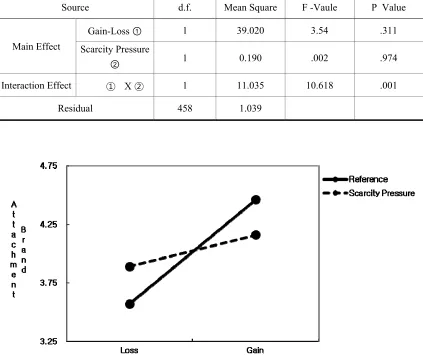
However, unlike the expectation, this relationship was not statistically significant (F = 0.02, p = .974). Third, Hypothesis 3 predicted that the more emphasis is on gain, the less scarcity pressure effect on brand attachment. As we expected, the interaction effect between loss / gain frame and quantity constraint was statistically significant. The experimental result is in Table 2 and Figure 2.
Table 2: Difference of mean between Group for IT products Reference
(n=227) Scarcity Pressure (n=235) Loss
(n=231) 3.57(.91) 3.89(1.12) 3.73(1.03)
Gain
(n=231) 4.46(.91) 4.16(1.11) 4.30(1.02)
4606
Table 3: Experimental Results of ANOVA. for IT Product
Source d.f. Mean Square F -Vaule P Value
Main Effect
Gain-Loss ① 1 39.020 3.54 .311
Scarcity Pressure
② 1 0.190 .002 .974
Interaction Effect ① X ② 1 11.035 10.618 .001
Residual 458 1.039
Figure 2: Interaction Effect between Advertising Frame and Scarcity Pressure for IT Product
4.2 Study 2: Non - IT Products
4.2.1 Research process
In this study, 4 experimental groups in total were structured by applying the 2 (Gain and Loss) × 2 (Reference and Scarcity Pressures) between-subjects factorial design like study 1. Sports shoes were selected to investigate brand attachments of non - IT products.
To select the sample, we used a survey company with a professional consumer panel, and implemented the experiment using scenarios. The experimental process was similar to that of study 1,
except product. A total of 434 valid samples were collected from the survey (Table 5), and the characteristics of sample groups are shown in Table 4.
4.2.2 Result of hypothesis test
4607
Table 4: Creditability Test of Measurement for non - IT product
Factor Items Factor loading Cronbach's α
Brand attachment
I love the brand. .899
.938 The brand has a charm that captivates me. .925
I have a bond with the brand. .924
I have an attachment to the brand. .925
In study 2, a total of 4 experimental groups were performed ANOVA 2 (Gain and Loss) × 2 (Reference and Scarcity Pressures) between-subjects like study 1.
As a result, the effect of advertising on brand attachment was statistically significant. (F = 7.94, p = .005). However, the effect of scarcity pressure on brand attachment was not statistically
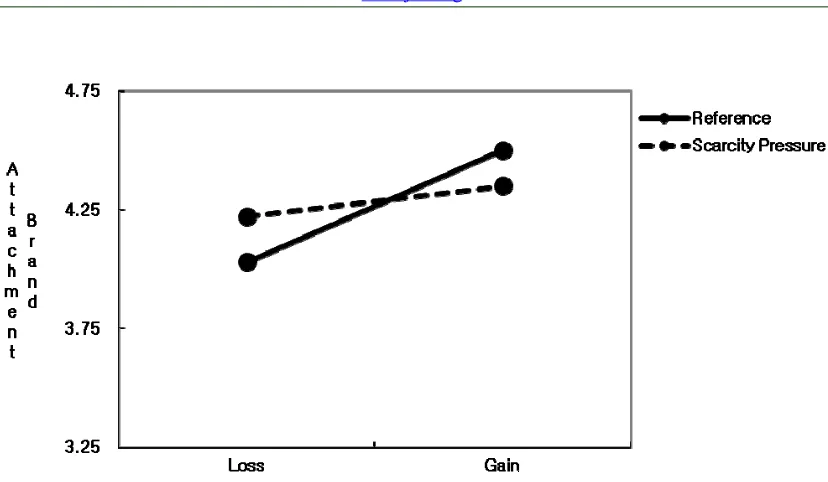
significant (F = .03, p = .867). Finally, the interaction effect between the loss / gain frame and the quantity constraint was not statistically significant (F = 2.46, p = .118). The experimental results are shown in Table 6 and Figure 2.
Table 5: Difference of mean between Group for non - IT product Reference
(n=213) Scarcity Pressure (n=221) Loss
(n=218) 4.03(1.20) 4.21(1.11) 4.13(1.15)
Gain
(n=216) 4.50(.93) 4.35(1.14) 4.42(1.04)
4.26(1.10) 4.29(1.12)
Table6: Experimental Results of ANOVA. for non - IT Product
Source d.f. Mean Square F -Vaule P Value
Main Effect
Gain-Loss ① 1 9.610 7.94 .005
Scarcity Pressure
② 1 .034 .03 .867
Interaction Effect ① X ② 1 2.978 2.46 .118
4608
Figure 3: Interaction Effect between Advertising Frame and Scarcity Pressure for non - IT Product
4.3 Discussions
Previous studies have shown that consumers are generally known to be sensitive to losses, but in advertising messages the effects of gain frames and loss frames are mixed, and in brand attachments, gain frames are more effective than loss frames [31]. In addition, if brand attachment and scarcity pressure have an effect on purchasing intent, and if the brand attachment is high and the scarcity pressure increases, the purchasing intent is increased. However, this study suggests scarcity pressure as a moderating variable in the effect of gain/loss frames on brand attachment. It also contributes to the research that extends the products studied into IT products and non-IT products.
The result shows the interaction effects of scarcity pressure in the relationship between gain/loss frame and brand attachment for IT products. That is, for IT products, brand attachment was high for advertising without scarcity pressure in the gain frame. But non-IT products, only the main effects of gain/loss frames were shown, rather than the interaction effects of scarcity pressures. That is, for non-IT products, the advertising of gain frames was highly brand-attached.
5. CONCLUSIONS
This study investigates the types of advertising that affect brand attachment in IT products and non-IT product when framing by loss
and gain. Also, it investigated the interaction effect of scarcity pressure on brand attachment. As a result, unlike the non-IT product, IT products showed an interaction effect between gain-loss frame and scarcity pressure. On the other hand, non-IT products showed only the main effects of loss/benefit frames, unlike IT products, indicating that gain frames increased brand attachment. This suggests that there is a suitable message frame strategy for IT products in advertising.
It is effective to emphasize strengths of IT products and not press for brand attachment. In other words, psychological pressure negatively affects brand attachment.
In other words, psychological pressure negatively affects brand attachment. Because brand attachment is an emotional bond, stimuli that interfere with it can have a negative impact on brand attachment. In addition, since it disturbs proximity seeking, the pressure stimulus may cause deterioration of brand attachment. On the other hand, for non-IT products, advertising that emphasizes gain frames will be effective.
The existing studies on brand attachments are mainly focused on some affirmative factors. However, this study deals with some effects which can influence negatively on the pressures against consumers in the ways of inducing consumers' irrational impulse buying, etc., in the aspect of the consumers' empathy. Especially, this study focused on scarcity pressure.
4609 pressure situations as time pressure under which a consumer doesn't have enough time to make a rational decision [32], place pressure occurring in case that a specific product must be purchased (is hard to be purchased) at a specific place [33], place pressure and scarcity pressure occurring due to the scarcity of a product, social pressure by some influential other parties like a reference group and compulsive buying tendency as an individual characteristic [34].
And even though it is not dealt in this study as one of activities after brand attachments, the non-alignable difference preferring behaviors which were suggested in the structural alignability may be dealt with [35]. That is, since the consumers who have brand attachments consider feasibility more important than desirability, they can do their behaviors preferring non-alignable traits to alignable ones. In addition, a study for comprehending the differences between the types of brand attachments might be conducted.
Since this kind of study deduces the results that the consumers' behaviors after brand attachments can reduce some negative effects under some pressure situations of the consumers, it can be the base for doing the relationship marketing more efficiently by showing the values that the consumers who have brand attachments can have unlike the habitual buying behaviors.
However, in order for consumers to do some rational buying behaviors, it is important to exclude some pressure situations for buying behaviors. That is, the result from this study can improve the understanding of the social problems that can occur when consumers' responses to some pressure situations are excessive. For example, pressure situations can induce basically impulse buying or instigate overconsumption compared to general buying situations.
Finally, it can be said that one thing that pressure situations are avoided is the heuristic habit. And it can be said that one type of the representative heuristic habits is a brand attachment. However, as can be seen in the cases of the purchase of Apple iPhone cell phones, the difference between habits and brand attachments can be said that it is the passion for a brand that the concept, 'brand attachment' has from the beginning. Thus, it is thought that the understanding of the difference between habits and brand attachments as the inertia to consumers can be enhanced.
Moreover, it can be enlightened the fact that brand attachments as well as habitual buying are the natural behaviors of consumers and have the values that can reduce some non-rational behaviors
which can be done by consumers as well as reducing the emotional aspect.
ACKNOWLEDGMENTS
The present research has been conducted by the Research Grant of Seoil University in 2019.
REFRENCES:
[1] https://www.ctvnews.ca/large-crowds-disrupt-china-s-launch-of-iphone-4s-1.753442,
13/01/2012.
[2] Ainsworth, M. D. S., “Attachments beyond Infancy”, American Psychologist, Vol. 44,
1989, pp. 709-716.
[3] Bowlby, J., Attachment and Loss: Loss, Sadness and Depression, 1980, New York: Basic Books. [4] Van IJzendoorn, M. H., “Adult Attachment, Representations, Parental Responsiveness, and Infant Attachment: A Meta-Analysis on the Predictive Validity of the Adult Attachment Interview”, Psychological Bulletin, Vol. 117,
No. 3, 1995, pp. 387-403.
[5] Sagi-Schwartz, A., and D. Aviezer, Correlates of Attachment to Multiple Caregivers in Kibbutz Children from Birth to Emerging Adulthood: The Major Longitudinal Studies, New York: Guilford Publications, Inc., 2005, pp.165-197. [6] Thomson, Matthew., MacInnis, Deborah J.; and
Park, C. Whan., “The Ties That Bind: Measuring the Strength of Consumers' Emotional Attachments to Brands”, Journal of Consumer Psychology, Vol. 15, No. 1, 2005,
pp. 77-91.
[7] Park, C. Whan., MacInnis, Deborah J., Priester, Joseph., Eisingerich, Andreas B., and Dawn Iacobucci, “Brand Attachment and Brand Attitude Strength: Conceptual and Empirical Differentiation of Two Critical Brand Equity Drivers”, Journal of Marketing, Vol. 74, No. 6,
2010, pp. 1-17.
[8] Fournier, Susan, “Consumers and their brands: Developing relationship theory in consumer research”, Journal of consumer research, Vol.
24, No. 4, 1998, pp. 343-353.
[9] Thomson, Matthew, Allison R. Johnson, “Marketplace and personal space: Investigating the differential effects of attachment style across relationship contexts”, Psychology and Marketing, Vol. 23, No. 8, 2006, pp. 711-726.
4610 Repurchase Intentions, and Changes in Relationship Breadth”, Journal of Marketing Research, Vol. 50, No. 1, 2013, pp. 125-142.
[11] Brennan, K. A., Clark, C. L., and Shaver, P. R., Self-Report Measurement of Adult Attachment: An Integrative Overview, New York: Guilford Press, 1998, pp. 46–76.
[12] Leary, M. R. and Kowalski, R.M., “Impression Management: A Literature Review and Two-Component Model”, Psychological Bulletin,
Vo1. 107, No. 1, 1990, pp. 34-47.
[13] Tajfel, H., Turner, J. C., Austin, W. G., and Worchel, S., An integrative theory of intergroup conflict. Organizational identity: A reader, pp. 56-65.
[14] Sirgy, M. J., “Self-Concept in Consumer Behavior: A Critical Review”, Journal of Consumer Research, Vol. 9, No. 4, 1982, pp.
287-300.
[15] Trammell, K.D., A. Keshelaslwli, “Examining the New Influencers: A Self-Presentation Study of A-List Blogs”, Journalism and Mass Communication Quarterly, 2005, Vol. 82, No.
4, pp. 968-982.
[16] Mugge, Ruth, Hendrik N. J. Schifferstein, and Jan P. L. Schoormans, “Product attachment and satisfaction: understanding consumers’ post-purchase behavior”, Journal of Consumer Marketing, Vol. 27, No. 3, 2010, pp. 271–282.
[17] Aron, Arthur., E. N. Aron, and Danny Smollan, “Inclusion of Other in the Self-Scale and the Structure of Interpersonal Closeness”, Journal of Personality and Social Psychology, Vol. 63,
No. 4, 1992, pp. 596-612.
[18] Park, C. Whan, Deborah J. Macinnis, “What's In and What's Out: Questions on the Boundaries of the Attitude Construct”, Journal of Consumer Research, Vol. 33, No. 1, 2008, pp. 16-18.
[19] Brakus, Josko J., Schmitt, Bernd H., and Lia Zarantonello, “Brand Experience: What Is It? How Is It Measured? Does It Affect Loyalty”,
Journal of Marketing, Vol. 73, No. 2, 2009, pp.
52-68.
[20] Bottonari, Kathryn A., John E. Roberts., Morgen A.R. Kelly., Todd B. Kashdan., and Jeffrey A. Ciesla, “A prospective investigation of the impact of attachment style on stress generation among clinically depressed individuals”, Behaviour Research and Therapy,
Vol. 45, No. 1, 2007, pp. 179–188.
[21] Thomson, Matthew., Jodie Whelan, and Allison R. Johnson, “Why brands should fear fearful consumers: How attachment style predicts
retaliation”, Journal of Consumer Psychology,
Vol. 22, No. 2, 2012, pp. 289-298.
[22] Swaminathan, Vanitha., Karen M. Stilley, and Rohini. Ahluwalia, “When Brand Personality Matters: The Moderating Role of Attachment Styles”, Journal of Consumer Research, Vol.
35, No. 6, 2009, pp. 985-1002.
[23] Malär, Lucia., Krohmer, Harley., Hoyer, Wayne D., and Bettina Nyffenegger, “Emotional Brand Attachment and Brand Personality: The Relative Importance of the Actual and the Ideal Self”, Journal of Marketing, Vol. 75, No. 4, 2011, pp. 35-52.
[24] Orth, Ulrich R., Yonca Limon, and Gregory Rose, “Store-evoked affect, personalities, and consumer emotional attachments to brands”,
Journal of Business Research, Vol. 63, No. 11,
2010, pp. 1202–1208.
[25] Lambert-Pandraud, Raphaëlle, and Gilles Laurent, “Why Do Older Consumers Buy Older Brands? The Role of Attachment and Declining Innovativeness”, Journal of Marketing, Vol. 74,
No. 5, 2010, pp. 104-121.
[26] Fedorikhin, Alexander., Park, C. Whan, and Matthew, Thomson, “Beyond fit and attitude: The effect of emotional attachment on consumer responses to brand extensions”,
Journal of Consumer Psychology, Vol. 18, No.
4, 2008, pp. 281-291.
[27] Raphaëlle, L. P, and G. Laurent, “Why Do Older Consumers Buy Older Brands? The Role of Attachment and Declining Innovativeness,
Journal of Marketing, Vol. 74, No. 5, 2010, pp.
104-120.
[28] Tversky, Amos, and Daniel Kahneman, “The framing of decisions and the psychology of choice”, Science, Vol. 211, No. 4481, 1981, pp.
453-458.
[29] Gawronski, Bertram, and Galen V. Bodenhausen, "Implicit and explicit evaluation: A brief review of the associative–propositional evaluation model", Social and Personality Psychology Compass, Vol. 8. No. 8, 2014, pp.
448-462.
[30] Pinker, Steven, and Paul Bloom, "Natural language and natural selection", Behavioral and brain sciences, Vol. 13. No. 4, 1990, pp.
707-727.
[31] Park, Seungbae, Jaewon Hong,“The Moderating Effect of Gain and Loss Framework between advertisement Uniqueness and Brand Attachment”, Journal of the Korea Society of Computer and Information , Vol. 24, No. 1, pp.
4611 [32] Maule, A. John, and Anne C. Edland, "The
effects of time pressure on human judgment and decision making", Decision making: Cognitive models and explanations, 1997, pp. 189-204.
[33] Smith, M. D, “The impact of shopbots on electronic markets”, Journal of the Academy of Marketing Science, Vol. 30, No. 4, 2002, pp.
446-454.
[34] White, K, and B. Simpson, “When Do (and Don't) Normative Appeals Influence Sustainable Consumer Behaviors?”, Journal of Marketing, Vol. 77, No. 2, 2013, pp. 78-95.
[35] Liberman, N., and Y. Trope, “The Role of Feasibility and Desirability Considerations in Near and Distant Future Decisions: A Test of Temporal Construal Theory”, Journal of Personality and Social Psychology, Vol. 75, No.