IJPSR (2014), Vol. 5, Issue 1 (Research Article)
Received on 03 August, 2013; received in revised form, 27 September, 2013; accepted, 15 December, 2013; published 01 January, 2014
A COMPARISON OF VOLATILE COMPOUNDS IN DIFFERENT GENOTYPES OF SESAMUM
INDICUM L. BY GC-MS
Ruchi Tyagi and Vinay Sharma*
Department of Bioscience and Biotechnology, Banasthali University, Banasthali-304022, Rajasthan, India
ABSTRACT: The aim of the present study was to investigate the oil composition extracted from Sesamum indicum seeds. The oil was extracted from seeds by soxhlet method and analyzed by gas chromatography-mass spectrometry (GC-MS). A total of 84 different components were identified and out of which 12 are fatty acid components. The principal compounds identified and present in all samples were silane, trimethyl[5-methyl-2-(1-me thylethyl)phenoxy]-; silicic acid, diethyl bis (trimethylsilyl)ester; stearic acid; oleic acid; n-Hexadecanoic acid; myristic acid; indole-2-one 2,3-dihydro-N-hydroxy-4-methoxy-3,3-dimethyl-; cyclotrisiloxane, hexamethyl-; acetamide, N-[-4-(trimethylsilyl)phenyl]-; benzene, 2-[(tert-butyldimethylsilyl)oxy]-1-isopropyl-4-methyl-; benzo[h]quinoline, 2,4-dimethyl-, trichloroacetic acid undec-enyl ester and 2-Ethylacridine. Among fatty acids, palmitic acid and oleic acid were identified in highest concentration. In comparison, myristic acid and stearic acid were present in lesser amount. Variation was found between chemical compositions of different genotypes of sesame. The obtained results supported the use of seed oil as edible oil and in pharmaceuticals. This study is also important as identification of volatile compounds in Indian genotypes of Sesamum indicum was done for the first time.
INTRODUCTION: Sesame (Sesamum indicum
L.) belongs to Pedaliaceae family, is one of the most ancient oilseeds crop. It was domesticated on
the Indian subcontinent during Harappan era 1 but
now in all tropical and subtropical countries.
India is the leading producer in the world and sesame is the third most important Indian oil seed crop 2.
QUICK RESPONSE CODE
DOI:
10.13040/IJPSR.0975-8232.5(1).249-58
Article can be accessed online on:
www.ijpsr.com
DOI link: http://dx.doi.org/10.13040/IJPSR.0975-8232.5(1).249-58
It is known by different names in different countries such as til (Hindi), huma (Chinese), sesame (French), goma (Japanese), gergelim (Portuguese) and ajonjoli (Spanish). It is cultivated for its high edible oil content and protein.
The edible oil is highly valuable and has certain industrial applications including human nutrition such as pharmaceuticals, cosmetics, perfumery,
soaps, paints and insecticides, hair oil,
hydrogenated oil and certain medicines 3.
It is called queen of the oilseeds crops because of
its high oil content, mildness and pleasant taste 4.
The oil is free of unwanted odors and rancidity resistant and has high level of unsaturated
fatty-acids which makes it suitable for cooking 5.
Keywords:
Essential oil, n-Hexadecanoic acid, Myristic acid, GC-MS, Sesamum
indicum Correspondence to Author: Vinay Sharma
Department of Bioscience and Biotechnology, Banasthali University, Banasthali-304022, Rajasthan, India
Sesame oil contains 20% saturated fatty-acids mainly palmitic (7.9-12%) and stearic (4.8-6.1%) and more than 80% unsaturated fatty-acids (oleic acid 35.9-42.3%, linoleic acid 41.5-47.9%). Other fatty acids are also present in minor amount (less than 1%) viz. myristic (~0.1), palmitoleic (~0.1-0.2), heptadecanoic (~0.2) and fatty acid
composition varies with the sesame’s species 6
. Sesame oil has good amount of unsaponification matter (~2%) which includes sterols, triterpenes, triterpene alcohols, tocopherols and lignans. It is an annual, erect herb and has indeterminate growth which grows best at 25-27°C temperature and neutral pH.
From medicinal point of view, sesame oil has numerous functions such as antiaging, lowers
serum lipid, blood pressure and other functions7.
The genetic and environmental factors affect oil
content and fatty acid composition in sesame8.
GC/MS appears an ideal technique for the detection of fatty acids and their concentrations. There are few reports on fatty acid composition
analysis of sesame oil in India 9-11. But there is not
any report on chemical characterization of sesame oil so far in India. The purpose of the present study was to investigate the chemical compounds present in sesame oil and comparison of chemical composition of sesame oil between different Indian sesame genotypes. This will further increase its medicinal and cosmetic importance and resultant its production.
MATERIAL AND METHODS:
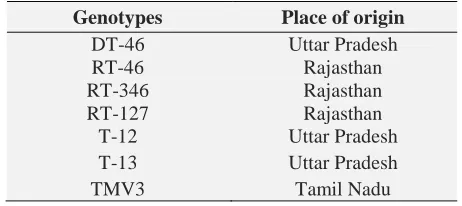
Plant Material: Seeds of Sesamum indicum were collected from different states (Rajasthan, Uttar Pradesh, Madhya Pradesh, Punjab, Tamil Nadu and
Gujarat) of India as illustrated in Table 1. Seeds
were made clear of foreign particles like dust particles and sand.
TABLE 1: LIST OF SESAMUM INDICUM L. GENOTYPES USED ALONG WITH THEIR PLACE OF ORIGIN
Genotypes Place of origin
DT-46 Uttar Pradesh
RT-46 Rajasthan
RT-346 Rajasthan
RT-127 Rajasthan
T-12 Uttar Pradesh
T-13 Uttar Pradesh
TMV3 Tamil Nadu
Oil extraction: 5 gram grounded seeds were placed into a cellulose paper cone and extracted using light petroleum ether (b.p. 40-60°C) in a
Soxhlet extractor for 8 hrs 12. The oil was then
recovered by evaporating of the solvent using rotary vacuum evaporator and residual solvent was removed by drying in an oven at 60°C for 1 hour.
GC-MS analysis: Agilent 6890 gas
chromatograph coupled with 5975B mass
spectrometer was used for GC-MS analysis. The chromatographic separation of analytes occurred on a capillary column of fused silica HP-5ms (0.25mm x 30m x 0.25 µM). The oven
programming was maintained at 50°C 13. 1 µl of
extract was injected in the split mode (1:50) at 280°C. The mass spectrometer was operated in electron impact mode. The mass scan range was
m/z- 40 to150 atom mass units (amu). All the mass
spectra of the identified peaks were compared with the spectra from the NIST’05 and WILAY spectral library. The compounds were reported as percentage of the total area of their peaks in the total ion chromatogram.
RESULT AND DISCUSSION: The GC-MS
chromatogram of volatile oil samples revealed the presence of 84 compounds, which were identified in comparison to the fragmentation patterns in the resulting mass spectra with those published in literature and using the National Institute of Standards and Technology (NIST), Mass Spectral
Database of the gas chromatograph–mass
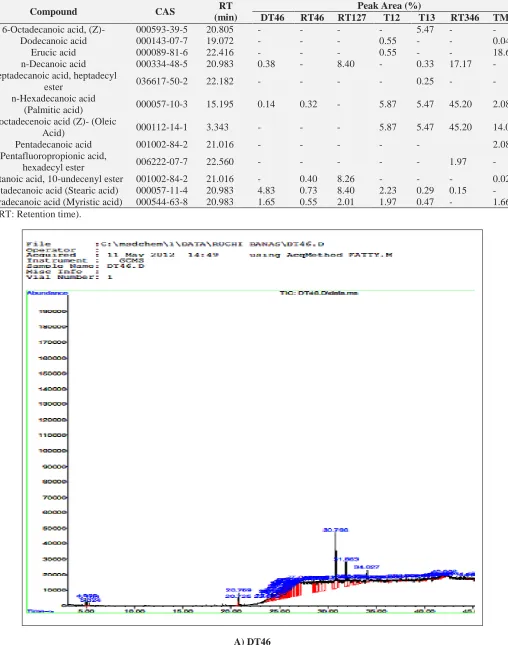
spectrometer. A number of other compounds were also detected but not of good quality. The maximum number of compounds was found in T13 genotype. The chemical names with retention time (RT) and peak area (%) of the compounds which
were detected was given in Table 2.
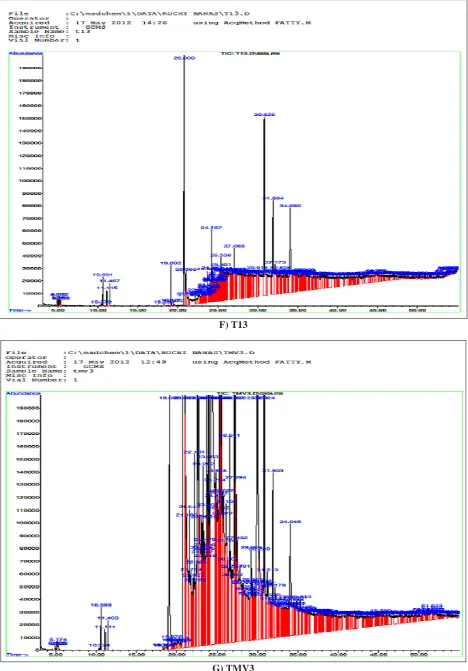
The mass spectra of different samples were shown in Fig. 1. The major compounds identified and present in almost each genotype were silane,
trimethyl[5-methyl-2-(1-me thylethyl)phenoxy]-;
silicic acid, diethyl bis (trimethylsilyl)ester; stearic acid; oleic acid; n-Hexadecanoic acid; myristic
acid; indole-2-one
2,3-dihydro-N-hydroxy-4-methoxy-3,3-dimethyl-; cyclotrisiloxane, hexa
methyl-; acetamide, N-[-4-(trimethylsilyl) phenyl];
benzene, 2-[(tert-butyldimethylsilyl)oxy]-1-iso
propyl-4-methyl-; benzo[h]quinoline,
[image:2.612.57.288.641.744.2]and 2-Ethylacridine. The fatty acids identified in sesame oil were given in Table 3.
TABLE 2: LIST OF CHEMICAL COMPOUNDS IDENTIFIED IN SESAME OIL BY GC-MS.
Compound CAS RT
(min)
Peak Area (%)
DT46 RT46 RT127 T12 T13 RT346 TMV3
1-(4-Methoxy-phenyl)-5,5-dioxo-hexahydro-5.lambda.(6)-thieno[3,4-b]p
yrrol-2-one
1000297-17-8 24.249 - - - 1.64 - - -
1,1,1,3,5,5,5-Heptamethyltrisiloxa
Ne 001873-88-7 34.491 0.13 - - 2.49 2.08 - 0.04
1,2-Benzisothiazole-3-propanoic acid 050565-45-2 31.869 - 13.03 - - 0.41 - -
1,2-Bis (trimethylsilyl) benzene 017151-09-6 41.712 0.16 0.13 - 0.27 0.17 0.41 -
1,3-Benzodioxole, 5,5'-(tetrahydro -1H,3H-furo[3,4-c]furan-1,4-diyl)b is-, [1S-(1.alpha.,3a.alpha.,4.bet
a.,6a.alpha.)]-
000133-03-9 30.792 - - - 20.04 - - -
1,3-Dioxolane, 4-ethyl-5-octyl-2,2-bis
(trifluoromethyl)-, trans- 038274-73-6 24.171 - - - - 1.65 - -
1-Eicosanol 000629-96-9 22.782 - - - - 0.20 - -
1-Octadecanol 000112-92-5 20.783 - - - 5.87 - - -
2-(Acetoxymethyl)-3-
(methoxycarbonyl) biphenylene 093103-70-9 41.945 - - - - 0.25 - -
2-(Acetoxymethyl)-3-(methoxycarbonyl) biphenylene 093103-70-9 29.148 - - - - 0.46 - -
2,4-Decadienal 025152-84-5 11.463 - - - 0.04
2,4-Decadienal, (E,E)- 025152-84-5 11.118 - - - - 0.18 - 0.04
2-Cyclohexen-1-ol 000822-67-3 10.596 - - - 0.08
2-Decenal, (E,)- 003913-81-3 10.596 - - - - 0.37 - -
2-Ethylacridine 055751-83-2 31.858 5.84 0.46 - 0.89 0.29 2.15 -
2-Heptenal 1000143-48-6 21.327 - - - - 0.34 - -
2-Heptenal, (E)- 018829-55-5 5.186 - - - - 0.09 -
Methoxybenzoic acid,
2-methylpropyl ester 081763-24-8 31.858 - - - 11.55 - - 0.04
2-Nonanone 000821-55-6 18.206 - - 0.19 - - - -
2-undecanone 000112-12-9 14.196 - - 0.22 - - - -
3-Amino-4-piperonyl-5-pyrazolone 014731-77-2 31.891 - - - - 3.55 - -
3-Carboxy-2-piperidone 003731-16-6 10.383 - - - 0.01
3-Hexanol 000623-37-0 4.953 - - - 0.79 0.07 - 0.01
4-Methylthieno[2,3-b]pyridine 013362-81-7 30.792 - - - 20.04 - - 0.01
5-Octadecenal 056554-88-2 20.961 - - - 0.88 - - -
6-Methylthieno[2,3-b]pyridine 001759-30-4 30.792 - - - 20.04 - - -
6-Octadecanoic acid, (Z)- 000593-39-5 20.805 - - - - 5.47 - -
9, 17-Octadecadienal, (Z)- 056554-35-9 22.027 - - - 14.07
9,12-Octadecadienoic acid (Z,Z)- 000060-33-3 20.728 - - - 1.83 - 5.47 1.44
9H-Fluorene-2-carboxylic acid, 9-oxo-,
(2-hydroxyethyl) (methyl) amide 1000316-02-1 32.183 - - - - 0.75 - 0.25
9-Octadecenoic acid, (E)- 000112-79-8 20.805 - - - - 5.47 - -
Acetamide,
N-[-4-(trimethylsilyl)phenyl]- 000541-05-9 45.155 0.16 0.41 - - 0.41 1.27 14.07
Benzene,
2-[(tert- butyldimethylsilyl)oxy]-1-isopropyl-4-methyl-
330455-64-6 24.449 0.91 - - 2.27 0.57 - -
Benzeneamine,
4-(2-phenylethenyl)-N-(3,5-dimethyl-1-pyrazolylmethyl)- 1000260-49-5 25.337 - - - - 1.16 - -
Benzo[h]quinoline, 2,4-dimethyl- 000605-67-4 34.424 0.30 0.48 - - 0.98 0.21 -
Beta-Sitosterol 000083-46-5 34.036 - 13.59 - - 4.16 - -
Chloromethyl 9-chloroundecanoate 080418-95-7 19.861 - - - 0.84
Cyclohexane,1-(1,5-dimethylhexyl)-4-(4-methylpentyl)- 056009-20-2 22.738 - - - 1.66
Cyclopentanol, 1-(1-methylene-2-pr openyl)-
078158-11-9
cis-6-Nonen-1-ol 035854-86-5 21.238 - - 2.97 - - - 0.04
Cyclopropaneoctanal, 2-octyl- 056196-06-6 21.783 - - - 0.39
Cyclotrisiloxane, hexamethyl- 000541-05-9 25.338 1.36 1.32 - 2.60 1.06 2.15 0.65
Cycloundecane, 1-methyl- 088828-82-4 20.727 2.55 0.91 0.84 - - -
Dodecanoic acid 000143-07-7 19.072 - - - 0.55 - - 0.04
Erucic acid 000089-81-6 22.416 - - - 0.55 - - 18.63
Ethyladamantane-1-carboxylate 002094-73-7 31.858 - - - 11.55 - - -
Fenchyl alcohol 001632-73-1 17.673 - - 0.44 - - - -
Furfuryl alcohol 000098-00-0 25.549 - - 4.96 - - - 18.63
Furo [2,3-c]pyridine, 2,3-dihydro-2,
7-dimethyl- 069022-82-8 19.194 - - - - 0.06 - -
Gamma-Sitosterol 000083-47-6 34.058 - 13.59 - - 4.16 - 0.84
Heptadecanoic acid, heptadecyl ester 036617-50-2 22.182 - - - - 0.25 - -
Indole 029812-79-1 21.316 0.63 0.08 0.39 - 4.16 - -
Indole-2-one,
2,3-dihydro-N-hydroxy-4-methoxy-3,3-dimethyl- 000120-72-9 25.149 1.17 0.26 - 2.14 0.42 0.80 0.19
Isopulegol 059905-50-2 21.583 - - 2.09 - - - -
Lauric acid 000143-07-7 22.738 - - 2.01 - - - -
Lauric aldehyde 000112-54-9 18.050 - - 0.30 - - - -
Lauryl acetate 000112-66-3 25.916 - - 0.18 - - - -
Lauryl alcohol 000112-53-8 16.417 - - 0.15 - - - -
Methyl
3-(1-pyrrolo)thiophene-2-carboxylate 074772-16-0 24.249 - - - 1.64 - - -
Myristic acid ( Tetradecanoic acid) 000544-63-8 20.983 1.65 0.55 2.01 1.97 0.47 - 1.66
N-(2-Acetylcyclopentylidene)
cyclohexylamine 1000100-48-5 22.716 - - - - 0.24 - -
n-decanal 000112-44-7 25.916 - - 8.26 - - - -
n-Decanoic acid 000334-48-5 20.983 - - - 17.17 -
n-Eicosane 000112-95-8 19.461 - 3.38 - - - - -
n-Hexadecanoic acid
(Palmitic acid) 000057-10-3 15.195 0.14 0.32 - 5.87 5.47 45.20 2.08
N-Methyl-1-adamntaneacetamide 013897-93-5 32.169 - - - - 2.08 - -
n-Octadecane 000593-45-3 17.439 - - - 4.62 -
Nonahexacontanoic acid 040710-32-5 21.316 - - - 0.52 - - -
n-Teracosane 000646-31-1 22.994 - 1.75 - - - - -
Oleic Acid (9-octadecenoic acid (Z)- 000112-14-1 3.343 - - - 5.87 5.47 45.20 14.07
Omega-6-Hexadecalactone, Ambrettol
007779-50-2 17.806 - - 0.85 - - - -
Oxycyclotetradecan-2-one 000112-14-1 3.343 - - - 17.17 -
Pentadecanoic acid 001002-84-2 21.016 - - - 2.08
Pentafluoropropionic acid, hexadecyl
ester 006222-07-7 22.560 - - - 1.97 -
Pentanoic acid, 10-undecenyl ester 001002-84-2 21.016 - 0.40 8.26 - - - 0.02
Silane, trimethyl[5-methyl-2-(1-me thylethyl)phenoxy]-
055012-80-1
23.216 1.37 0.31 - 1.93 1.16 0.25 0.40
Silicic acid, diethyl bis
(trimethylsilyl)ester 003555-45-1 29.148 4.83 0.57 - 2.23 0.62 0.32 0.07
Stearic acid ( Octadecanoic acid) 000057-11-4 20.983 4.83 0.73 8.40 2.23 0.29 0.15 -
Stigmasterol, 22,23-dihydro- 003555-45-1 29.148 - - - 0.26 - -
Tetrasiloxane, decamethyl- 1000214-20-7 34.047 4.83 0.31 - 1.93 1.16 0.25 -
Trichloroacetic acid, undec-2-enyl ester 1000299-26-1 22.860 4.83 0.57 - 2.23 0.62 0.32 0.40
Tridecanoic acid 000638-53-9 19.094 - 0.73 8.40 2.23 0.45 0.15 0.07
Trimethyl[4-(2-methyl-4-oxo-2-pent
yl)phenoxy]silane 1000283-54-9 25.404 - - - 1.68 -
Undecanoic acid, monoethyl ester 003927-60-4 18.472 - - - 0.01
TABLE 3: LIST OF FATTY ACIDS PRESENT IN SESAME OIL OBTAINED BY GC-MS.
Compound CAS RT
(min)
Peak Area (%)
DT46 RT46 RT127 T12 T13 RT346 TMV3
6-Octadecanoic acid, (Z)- 000593-39-5 20.805 - - - - 5.47 - -
Dodecanoic acid 000143-07-7 19.072 - - - 0.55 - - 0.04
Erucic acid 000089-81-6 22.416 - - - 0.55 - - 18.63
n-Decanoic acid 000334-48-5 20.983 0.38 - 8.40 - 0.33 17.17 -
Heptadecanoic acid, heptadecyl
ester 036617-50-2 22.182 - - - - 0.25 - -
n-Hexadecanoic acid
(Palmitic acid) 000057-10-3 15.195 0.14 0.32 - 5.87 5.47 45.20 2.08
9-octadecenoic acid (Z)- (Oleic
Acid) 000112-14-1 3.343 - - - 5.87 5.47 45.20 14.07
Pentadecanoic acid 001002-84-2 21.016 - - - 2.08
Pentafluoropropionic acid,
hexadecyl ester 006222-07-7 22.560 - - - 1.97 -
Pentanoic acid, 10-undecenyl ester 001002-84-2 21.016 - 0.40 8.26 - - - 0.02
Octadecanoic acid (Stearic acid) 000057-11-4 20.983 4.83 0.73 8.40 2.23 0.29 0.15 -
Tetradecanoic acid (Myristic acid) 000544-63-8 20.983 1.65 0.55 2.01 1.97 0.47 - 1.66
(RT: Retention time).
B) RT46
D) RT346
F) T13
G) TMV3
[image:8.612.72.540.43.714.2]Likewise, the oil content and fatty acid composition of eleven genotypes of pot marigold (Calendula officinalis L.) seeds were determined14. In the present study a wide variation was found between chemical compositions of different genotypes of sesame. It was supported by literature which stated that chemical composition of volatile oils could differ widely within the same species depending on several factors such as the ecological
niches, climatic conditions and trophic level 15, 16.
Similar studies had been done previously in sesame oil and more than 400 components have been isolated and identified including pyrazines, pyridines, pyrroles, furans, thiophens, thiazoles,
carbonyl compounds and others 17, 18.
Recently, in 2010 GC-MS analysis performed on white sesame seeds in Germany and novel aroma-active thiols were found. It includes 2-furfurylthiol,
4-hydroxy-2, 5-dimethyl-3(2h)-furanone,
thenylthiol (thiophen-yl-methylthiol), and 2-methoxy-4-vinylphenol.
In addition, 9 odor-active thiols were also identified for the first time in roasted sesame seeds
including 2-methyl-1-propene-1-thiol,
(Z)-3-methyl-1-butene-1-thiol,
(E)-3-methyl-1-butene-1-thiol, (Z)-2-methyl-1-butene-1-thiol19. Fatty acid
analysis was done in different plants by GC-MS
including Sterculia foetida Linn.20, Lawsonia
inermis 21, Tabernaemontana divaricate 22, Ziziphus mauritiana 23, rocket seed oil 24, Datura alba 25. In similar manner, seed oil of Ferulago trachycarpa Boiss. collected from two different localities was analyzed for their fatty acids by GC-MS.
In this study 9-octadeceneoic acid, 9, 12-octadecadienoic acid, 9-hexadeceneoic acid and 11-octadecenoic acid were found as main
components 26. A comparative analysis of essential
oil components of two Daucus species from
Algeria was done and a total of 67 compounds
were found 27.
But this study is important as comparison of genotypes for volatile compounds was done for the first time in sesame. And also important as volatile compounds identification in Indian genotypes of
Sesamum indicum was done first time.
CONCLUSION: In the present study, total 84 volatile chemical compounds were identified in
sesame oil of Sesamum indicum by help of
GC-MS. Although the number of compounds vary between individual genotypes. The volatile compounds present in almost all genotypes were n-hexadecanoic acid, myristic acid; indole-2-one 2,3-dihydro-N-hydroxy-4-methoxy-3,3-dimethyl-; cyclotrisiloxane, hexamethyl-; acetamide,
N-[-4-(trimethylsilyl)phenyl]-; benzene,
2-[(tert-butyldimethylsilyl)oxy]-1-isopropyl-4-methyl-;
benzo[h]quinoline, 2,4-dimethyl- and
2-Ethylacridine.
The current study will offer a sound basis of selection of genotypes which are chemically complex and help in effective utilization of sesame. And it laid a foundation for searching chemical
compound’s nature and application for
pharmaceutical, cosmetics and food industry.
ACKNOWLEDGEMENT: Financial support
given by Department of Science and Technology, Jaipur, Rajasthan is gratefully acknowledged.
REFERENCES:
1. Ashri A. Sesame (Sesamum indicum L.): Genetic
Resources, Chromosome Engineering and crop
improvement: Oilseed Crops (Singh, R.J. ed.) CRC Press, Boca Raton, FL, USA. Vol. 4, 2007: 231-289.
2. Bisht IS, Mahajan RK, Loknathan TR, Agrawal RC. Diversity in Indian sesame collection and stratification of germplasm varieties in different diversity groups. Genetic Resources and Crop Evolution. 1998; 45: 325–335. 3. Quasem JM, Mazahreh AS, Abu-Alruz K. Development
of vegetable based milk from decorticated sesame (Sesamum Indicum). American Journal of Applied Sciences. 2009; 6(5): 888–896.
4. Namiki M, Kobayashi T. Goma no Kagaku (Sesame Science) (Eds.) Asakura Shoten Co. Tokyo, 1989: 246.
5. Salunkhe DK, Chavan JK, Adsule RN, Kadam SS.
Sesame: World Oilseeds: History, technology and utilization. Van Nostrand Reinhold, New York, 2009; 371–402.
6. Shyu YS, Hwang LS. Antioxidative activity of the crude extract of lignan glycosides from unroasted Burma black sesame meal. Food Research International. 2002; 35: 357–365.
7. Namiki M. Goma, sono Kagaku to Kinousei (Advances in sesame science and function). Ed. Maruzen Planet Co. Tokyo, 1998:268.
8. Carlsson AS, Chanana NP, Gudu S, Suh MC, Were BA. Sesame: Compendium of transgenic crop plant transgenic oilseed crops (Kole, C., et al. Eds.) 2008: 227–246. 9. Awasthi CP, Sharma N: Nutritional catalogue of sesame
(Sesamum indicum L.) germplasm. CSK Himachal Pradesh Krishi Vishvavidyalaya, Palampur, 2008; 1–51. 10. Hiremath SC, Patil CG, Patil KB, Nagasampige MH.
Genetic diversity of seed lipid content and fatty acid
(Pedaliaceae).African Journal of Biotechnology. 2007; 6: 539–543.
11. Mondal N, Bhat KV, PS Srivastava. Variation in fatty acid composition in indian germplasm of sesame. Journal of the American Oil Chemists Society. 2010; 87:1263–1269. 12. Pena DG, Anguiano RGL, Arredondo JJM. Modification of the method 1 AOAC (CBmethod) for the detection of aflatoxins. Bulletin of Environmental Contamination and Toxicology. 1992; 49: 485–489.
13. Medini H et al. Comparison of the antimicrobial activity and the essential oil composition of Juniperus oxycedrus
subsp. Macrocarpa and J. Oxycedrus subsp. rufescens
obtained by hydrodistillation and supercritical carbon dioxide extraction methods. Chemistry of Natural Compounds.2009; 45(5).
14. Dulf FV, Pamfil D, Baciu AD, Pintea A. Fatty acid composition of lipids in pot marigold (Calendula Officinalis L.) seed genotypes. Chemistry Central Journal 2013; 7-8.
15. Vijayalaksmi D, Paramathma M. Metabolic profiling of seed sources of Jatropha curcus Linn collections of Tamil Nadu for biofuel characteristics. Advance Biotech. 2009; 44-46.
16. Ixtaina VY et al. Characterization of chia seed oils obtained by pressing and solvent extraction. Journal of Food Composition and Analysis2011;24(2): 166-174.
17. Shimoda M, Nakada Y, Nakashima M, Osajima Y.
Quantative comparison of volatile flavor compounds in deep-roasted and light-roasted sesame seed oils. Journal of Agricultural and Food Chemistry. 1997; 45: 3193–3196. 18. Shahide F, Aishima T, Abou-Gharbia HA, Toussei M,
Shehata AAY. Effect of processing on flavor precursor amino acids and volatiles of sesame paste (Tehina). Journal of the American Oil Chemists Society. 1997; 174: 667–678.
19. Tamura H, Fujita Ak, Steinhaus M, Takahisa E, Hiroyuki W, Schieberle P. Identification of novel aroma-active
thiols in pan-roasted white sesame seeds. Journal of Agricultural and Food Chemistry. Journal of Agriculture and Food Chemistry 2010; 58: 7368–7375.
20. Kale SS, Darade V, Thakur HA. Analysis of fixed oil from Sterculia foetida Linn. International Journal of Pharmaceutical Science and Research. 2011; 2(11): 2908-2914.
21. Jacob PP, Saral AM. GC-MS analysis of Lawsonia inermis seed oil. International Journal of Pharmacy and Pharmaceutical Sciences. 2013; 5(2): 617-618.
22. Basumatary S, Barua P, Deka DC. Identification of chemical composition of biodiesel from Tabernaemontana divaricata seed oil. Journal of Chemical and Pharmaceutical Research, 2013, 5(1):172-179.
23. Memon AA, Memon N, Luthria DL, Pitafi AA, Bhanger MI. Phenolic compounds and seed oil composition of
Ziziphus Mauritiana L. fruit. Polish Journal of Food and Nutrition Science. 2012; 62(1): 15-21.
24. TariqM et al. Identification, FT-IR, NMR (1H and 13C) and GC/MS studies of fatty acid methyl esters in biodiesel from Rocket seed oil. Fuel Processing Technology. 2011; 92(3): 336–341.
25. Qureshi MN, Siddique M, Rahman IU, Kanwal F.
Analytical characterization of fatty acids composition of
Datura alba seed oil by gas chromatography mass spectrometry. Journal of The Chinese Chemical Society. 2011; 58: 236-240.
26. Erdemoglu N, Emine A, Akgöç M, Çıkrıkçı S, Bilsel G. Comparison of the seed oils of Ferulago trachycarpa Boiss. Different Localities with Respect to Fatty Acids. Records of Natural Products. 2008; 13-18.
27. Nawel M, ElAmine DM, Hocine A, Boufeldja T.
Comparative analysis of essential oil components of two
Daucus species from algeria and their antimicrobial activity. International Research Journal of Biological Sciences2013; 2(1): 22-29.
All © 2013 are reserved by International Journal of Pharmaceutical Sciences and Research. This Journal licensed under a Creative Commons Attribution-NonCommercial-ShareAlike 3.0 Unported License.
This article can be downloaded to ANDROID OS based mobile. Scan QR Code using Code/Bar Scanner from your mobile. (Scanners are available on Google Playstore)
How to cite this article: