80
CRITICAL FACTORS IN KNOWLEDGE COMMUNICATION
OF MALAYSIAN PUBLIC SECTOR
1ROHAIZAN DAUD, 2NOR ZAIRAH AB RAHIM, 3ROSLINA IBRAHIM, 4SURAYA YA’ACOB, 5ROSIDA AB RAZAK
1-4Advanced Informatics School, Universiti Teknologi Malaysia, Malaysia
5Malaysian Administrative Modernisation and Planning Unit (MAMPU), Malaysia
1[email protected], 2 [email protected],3 [email protected], 4[email protected], 5[email protected]
ABSTRACT
In the Malaysian public sector, a group of Information Technology (IT) experts and decision makers is the mastermind of the future in Information Technology (IT). Therefore, common understanding between the IT experts and the decision makers is imperative for a collaborative and comprehensive decision making. However, there are few studies that gauge the parties’ potential in knowledge integration, especially in terms of communication. Hence, developing further understanding of the communication factors that influence the knowledge integration between IT experts and decision makers is essential. Literature analysis showed that four factors influence the knowledge communication conceptual model: sharer, knowledge, relationship, and institution. However, after examining the Malaysian public sector by using purposive sampling strategy, there is a need to enhance the factors by highlighting two new items: high-level thinking and type of knowledge. These additional factors would improve the comprehensive knowledge communication in organizations for the decision making process.
Keywords - Knowledge Communication, IT Experts, Decision Makers, Malaysian Public Sector, IT Projects
1. INTRODUCTION
Knowledge Management (KM) has been extensively applied to elevate the importance of knowledge in organizations since knowledge has become one of the main elements in the decision-making. Knowledge is defined as information combined with experience, interpretation and background, and is a high-value resource ready to be applied to decisions and actions [1]. Knowledge is also considered as a resource and a competitive advantage to organizations. According to [2] the early stage of KM in 1990s was driven by IT where new capabilities provided by Internet was utilized for sharing knowledge across the organizations effectively, preventing knowledge redundancies in order for the organizations to earn more profit. Then, human and culture needed to be addressed in the next stage as deploying technology was insufficient to share and access knowledge. Finally, the third stage was particularly for content retrieval
81 an organization’s mission and vision [4]. However, KMBOK and PMBOK are two divisions of management interconnected in practical and theoretical ways [5]. A project management requires managing knowledge while knowledge management is essential to a project management process including the human capital, the technical and the socio-cultural aspects. PMBOK consists of integration, scope, time, cost, quality, human resource, communication, risk, and procurement management, all of which is the sensible components of KMBOK [4], [6]. The Malaysian public sector, due to population dynamics and technology trends, makes delivery sector as an obligation. Being one of the developing countries, the Malaysian government intends to be more citizen-centric and to focus on enhancing the productivity of the public sector through a whole-of-government approach. It will be supported by a lean and agile structure, competent talents, an effective delivery of projects, and efficient services of the local authority to mirror developed countries such as Japan and the United Kingdom. Therefore, the parties responsible for determining the direction of the organization should have the skills and the strategic thinking in order to produce more high-performance results. Since many IT projects will soon be developed in Malaysia, the development of the IT projects in the Malaysian public sector is one of the remarkable areas to explore. In line with a previous study [7], many projects were successfully executed in terms of the technical work but the projects did not meet the stakeholders’ expectations because of poor communication. For instance, one out of five projects was unsuccessful due to ineffective communication [8]. Most of the IT projects in the Malaysian public sector were unable to meet the stakeholders’ expectations [9] whereas one of the factors in a successful IT project is an effective communication [10]. Consequently, many studies have been conducted to find out reasons and to resolve the problems from the perspective of IT expertise and technology. One of the challenges is to integrate knowledge between IT experts and decision makers, owing to the different common ground among them such as the different language usage, the numerous fields of expertise, and the IT jargons [11]. Therefore, it is difficult for the decision makers to understand, digest, and integrate the presented information into valuable knowledge during a decision-making process [11]–[13]. Since small attention is given in the knowledge communication area and in the existing academic publications, the objectives of this paper are:
i) to explain the importance of knowledge communication in the Malaysian public sector; and
ii) to identify relevant factors based on conceptual knowledge communication model and preliminary study.
In order to achieve the objectives, we conducted a literature analysis to identify factors in knowledge communication conceptual model. Then, for clarification purposes, a preliminary study was conducted. We performed the preliminary study by interviewing five participants that have experiences with IT projects in the Malaysian public sector. The following sections are organized as followed: section 2 explains the general idea of knowledge communication, section 3 discusses the applied methodology, section 4 describes the analysis of the findings and the discussion of the study and section 6 concludes and provides recommended scope for future research.
2. LITERATURE REVIEW AND
RESEARCH WORK
82 the stage of project initiation [17]. The business analysis is also crucial during the project initiation [18]. During business analysis, IT experts need to engage with decision makers to help with defining the project’s scopes, the expected outcomes (deliverable), the acceptance criteria, and the business requirements. One of the essential elements during business analysis is the communication pattern between IT experts, decision makers, stakeholders, and an IT team to clarify the knowledge for a successful project. Therefore, a proper knowledge communication model is imperative so that organizations can produce the best product in their field.
2.1 Knowledge Communication Theoretical
Background
As mentioned earlier, knowledge communication (KC) is one of the divisions in KM. Although the concept of KC is still new, the effectiveness in managing aspects of an organization is undeniable. KC is beyond communicating information or feeling because it requires conveying the entirety, including the situation, the background, and the basic hypothesis. Moreover, it requires the statement of personal opinions and experiences. It differs not only in what is communicated, but also in how one communicates with another. High-quality communication between decision makers and experts is possible if the experts can adapt their content and communication style to the needs of the decision makers; and if the decision makers fully instruct the experts their requests, and provide clear and regular feedbacks [11]. Communication is a process of acquiring all information, then interprets and circulates it to the parties involved while knowledge is the understanding of information by experience or study [19].
According to a study, “knowledge communication can be defined as (deliberate) activity of interactively conveying and co-constructing insights, assessments, experiences, or skills through verbal and non-verbal means” [20]. KC has taken place when an insight, experience or skill has been successfully reconstructed by an individual because of the communicative actions of another. The exchange of know-how, know-why, know-what, and know-who through face-to-face or media-based interaction is crucial. Although the phenomenon of KC has been going on for quite some time in many organizations, it is still new in the world of academic research learning. KC is more than communicating information or emotions
such as facts, figure, hopes, commitments, and others because it requires expressing perspective, basic hypothesis, personal opinions, experiences, and backgrounds of any situation. Experts from numerous fields share their opinions and insights to managements or clients to better understand the relevant issues.
2.2 Knowledge Communication Conceptual
Model
Since KC is used to overcome the existing weakness of KM in knowledge sharing and knowledge transfer [21], the knowledge sharing framework [22] and the knowledge transfer framework [23] were chosen to develop knowledge communication conceptual model. A total of 5 research databases were searched with journals or articles from 2007 until the present (2016). The databases were web of science, emerald, Science Direct, IEEE explore digital library, google scholar. The keywords used are “knowledge” AND “sharing” AND “framework” for knowledge sharing framework while keywords for knowledge transfer model are “knowledge” AND “transfer” AND “model” or “framework” anywhere in the articles. Then, a comprehensive examination was made and at this point any articles or journals were excluded if the organization or communication were insufficiently described by the authors. Relevant publication titles were also selected during this period of time. Finally 5 relevant knowledge sharing frameworks and 5 relevant knowledge transfer frameworks were chosen [24].
83 public sector and remarkable to look into it in this study context.
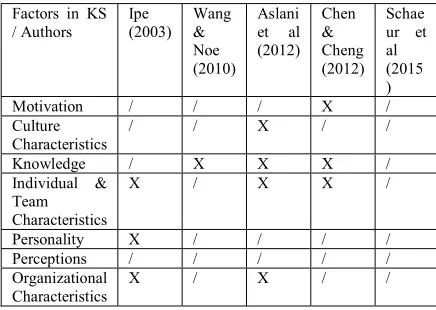
[image:4.612.309.529.127.299.2]The table lists seven (7) highly mentioned factors being discussed by authors in various studies. However, two (2) factors were less mentioned: knowledge, and individual and team characteristics. Therefore, this research will focus on those less mentioned factors. In this research, we chose ShaRInk framework by Schauer et al. (2015) because it is the most recent out of all, the 12 interrelationships, with all the factors related to the KC in the Malaysian public sector; an enhancement from a previous study [26]; and an opportunity to explore this framework in the study.
Table 1: Factors of Five Selected Knowledge Sharing Framework
With regards to knowledge transfer, according to a study [29], knowledge transfer involves communicating what one knows with others or consulting to learn what they know. Although the knowledge transfer models/frameworks are slightly different from each other, they still share some resemblance. Fundamentally, the idea of knowledge transfer is the communication or partnership between two main components; a source (sender) that shares knowledge and a receiver who obtains the knowledge [30]. Therefore, it will provide a solid foundation to gather proof and facts which will enable to confirm, invalidate, or revise each process before a new thought of the most appropriate selections might occur.
[image:4.612.84.302.315.470.2]
Table 2: Factors of Five Selected Knowledge Transfer Framework
Factors /Authors
Goh (2002 )
Bhaga t et al (2002 )
Ward et al (2010 )
Liyanag e et al (2009)
Wavera n et al (2014)
Knowledge Type
/ / / / /
Transfer Mechanism
/ / / / /
Transfer
Success X X / / /
Problem Identificatio n
/ X / / X
Context analysis
X X / X X
Absorptive
Capability / / X / X
Leadership / X X X X
Based on the prior research, five (5) knowledge transfer frameworks were selected and compared. The frameworks were taken from multiple studies [23], [31]–[34]. Similar to knowledge sharing frameworks, the selection of these five knowledge transfer frameworks are based on the context of communication. Even though some of them are not specifically mentioned in the communication, but the context and purpose are for communication benefit and show concern in transferring knowledge. Based on table 2, there are seven (7) common factors found in the five (5) frameworks. Nevertheless, two (2) factors were less mentioned: leadership and context analysis. Hence, this research will focus on these two (2) factors. The idea of the chosen knowledge transfer model is mainly built upon two main elements, source and receiver, or known as ‘an act of communication’ [23]. The type of knowledge in this model is tacit and explicit based on a previous study [35].
The proposed KC conceptual model combined both knowledge sharing framework [22] and knowledge transfer model [23] with four main categories: sharer, relationship, institution, and knowledge. Since the type of knowledge was included as an element for the knowledge category, this proposed model should have a better perspective of any project management especially in IT. The first category was sharer which consisted of three factors: individual characteristics, motivations, and perceptions on knowledge to be shared. The second category was institution which included cultural characteristics and organizational context as the factors. For the relationship category, interpersonal and team characteristic was the only factor. The last category was knowledge in which Factors in KS
/ Authors Ipe (2003) Wang & Noe (2010)
Aslani et al (2012)
Chen & Cheng (2012)
Schae ur et al (2015 )
Motivation / / / X /
Culture Characteristics
/ / X / /
Knowledge / X X X /
Individual & Team Characteristics
X / X X /
Personality X / / / /
Perceptions / / / / /
Organizational Characteristics
84 type of knowledge was the factor. The modes of knowledge transfer from the source to the receiver were divided into four types [35]. The complete background, the context and the experience in relevant issues or problems can be shared amongst a team of decision makers and IT experts. A mutual understanding between IT experts and decision makers will lead to an improved and well thought-out decision-making. The next section explains the KC in the Malaysian public sector and the preliminary study conducted on the Malaysian public sector.
2.3 Knowledge Communication in Malaysian Public Sector
Initially this study is to continue in greater depth the perspective of the decision makers in the Malaysian public sector environment. The relevance of this field was gauged by directly observing the cases of the public sector in Malaysia where IT experts and decision makers have differing requirements, and guidelines for a comprehensive overview. An initial study was done in one of the agency in Malaysian public sector in order to confirm on knowledge communication difficulty occurred between IT experts and decision makers. Based on result, IT experts are having problems with explanation of their findings to the decision makers. With different individual backgrounds, extensive scopes, and diverse ideas, it is difficult to grasp the big picture, especially when the integration is carried out between various domains of knowledge.
Decision makers on the other hand also have difficulties while expressing the needs and requirements condition to the IT experts. Therefore, when IT experts and decision makers discuss on a particular issue without proper guidelines, they will construct an overall picture of the issues based on their own understanding. The uncertainty and the confusion in establishing a comprehensive overview will lead to actions that deviate during the phase of analysis and subsequent synthesis. As a result, to resolve certain issues, laying down the overview of the standards and focuses is important to readjust the mental model of all parties involved, and to reach a mutual understanding. The overview will also act as a blueprint that becomes the main driver to the understanding, to improve on the understanding, and to make decisions with high integrity [10], [34]–[36].
2.3.1. Preliminary study
A preliminary study then was conducted on the Malaysian public sector to get further information on KC after initial study was done six month before. According to some studies [36], [37], the IT projects in the Malaysian public sector were decided during a steering committee meeting. There are four layers of steering committee for IT projects in the Malaysian public sector. The first IT steering committee is ICT and Internet Governance Committee (IIGC), Ministry ICT Steering Committee (MISC) for the ministries, ICT Technical Committee (ITC), and Agency ICT Steering Committee (AISC) for the agencies. Hence, both IT experts and decision makers have full authorities on the IT projects, and responsibilities in making an informed decision together. Subsequently, enhancing the aforementioned steering committees is vital in order for IT experts and decision makers to understand and to appreciate the value of IT projects. Thus, all the approved IT projects will base itself on not only the business point of view, but also the deeper understanding from the IT perspectives. By considering the motivation and the initial steps taken from a published study [11], this research is to further delve into the perspective of the decision makers in the Malaysian public sector environment. A set of questionnaires were given to five participants involved in IT projects. They had different occupation and education background, and consisted of two (2) IT experts (P1, P2) and three (3) decision makers (P3, P4 and P5). Further explanation on methodology is in Section 3.
3. METHODOLOGY
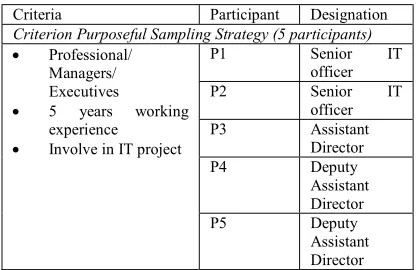
85 process. The participants’ criteria were listed in Table 3.
Table 3: Participant’s Criteria
Criteria Participant Designation
Criterion Purposeful Sampling Strategy (5 participants)
Professional/ Managers/ Executives
5 years working
experience Involve in IT project
P1 Senior IT
officer
P2 Senior IT
officer
P3 Assistant
Director
P4 Deputy
Assistant Director
P5 Deputy
Assistant Director
The criterion sampling was used to select individuals that represent a part of the population to determine the characteristics of the whole population. Since this study was to explore the activities that originated from the domain of organization, the first criterion was that the activities must be in a communicative condition. The interviews with all participants were held at their organizations. Each interview was held between 30-45 minutes. The questions were related to the participants’ involvement in IT projects, the familiarity with the current practices of IT project management and with the relevant standard operating procedures (SOP), the challenges, the issues and the recommendations to improve the quality of the IT project management in the Malaysian public sector. Since the participants included both IT experts and decision makers, this study was able to draw a rich and excellent insight and the relevant data on the KC in the Malaysian public sector.
4. ANALYSIS AND DISCUSSION
From the highlighted factors in the previous model, the finding showed four main factors influencing KC in managing IT projects in the Malaysian public sector. The factors were similar to the proposed KC conceptual model. However, there was one element that was not mentioned by any participants: culture characteristics. During the interview, all participants agreed that the culture characteristics were not relevant since all of them worked in the same ministry but they agreed that it was important to keep the element in the model as it would be
[image:6.612.306.529.198.397.2]applicable in case studies dealing with different ministries or agencies. The findings from preliminary study were shown in Table 4. The participants, however, suggested two additional elements: higher-level thinking and nature of task.
Table 4: Factors Influence Knowledge Communication In Malaysian Public Sector IT Projects
Factors / Participants (P)
P1 P2 P3 P4 P5
1. Sharer i.Individual
characteristics / / / X /
ii. Motivational / X / X X
iii. Perceptions / X X / /
2. Institution i.Cultural
characteristics X X X X X
ii.Organizational context
X / / / /
3. Relationship i. Interpersonal & Team characteristics
/ / / / /
4. Knowledge
i. Nature of task* / X X / X
ii.Type of knowledge / X / / X
iii.Higher level thinking*
/ X X X X
Based on the table 4, the majority of the participants agreed about four main factors that contribute to KC namely i) Sharer, ii) Institution, iii) Relationship and iv) Knowledge. For the sharers’ factor, including the background such as education, lifestyle, working experience and the motivations towards helping colleagues having absorptive capability in absorbing the knowledge helped improve the process of making reliable and astute decisions for the organization. Sharer is usually a knowledgeable person on certain topics and willing to engage the knowledge sharing with other people. Participant 1 has agreed on the three elements which are individual characteristics, motivational and perceptions. However, participant 2 has the same opinion on individual characteristics only while participant 4 is on perceptions. The participant 3 has agreed on individual characteristics and motivational. On the other hand participant 5 approve on individual characteristics and perceptions toward knowledge communication for the sharer.
86 management. However, we strongly believe that organizational culture is a system of shared assumptions, values and beliefs which governs how people behave in organizations. These shared values have a strong influence on the people in the organization and dictate how they dress, act, communicate and perform their tasks. Indirectly, this culture will determine how the communication process occurs within the institution.
In contrast, 4 out of 5 participants realized the importance of organizational context that has direct influence to the KC. Since the organizational context refers to the scope of an entity such as parent organization, enterprise, division or department. Since this research focus on experts and decision, then KC is significant within internal or inter department communication. By understanding the organizational context, Thus, KC process between experts and decision makers must align to the organization or institutional goal.
For the relationship factor, the study found the essential of collaboration between experts and decision makers while performing KC. That’s why all the participants agreed that interpersonal and team characteristics are important to improve the relationship between the sharers during KC. Generally, while handling task, KC process requires the views from multiple sharers (usually experts from different areas within the institute and the decision makers). The sharers need to perform a task jointly, thus require the teamwork to work within different mental model. Each mental model perceives a different value that is biased on their interest. Thus, by having different mental model and a very specific view on task, the relationship among the sharer must have collaborative interpersonal skills that able to appreciate the teamwork spirit in order to achieve the shared goal. Although the KC process usually occurred during office hours, it is undeniable that some knowledge was communicated outside of work as the communication channels such as WhatsApp, emails, Skype and Messenger were widely put into practice during recent times. However, discussing relevant issues that could be answered during office hours provided opportunity, flexibility, and comfortable situations among the teammates. A long-term relationship among the teammates may provide sturdy ties in facilitating knowledge communication. All participants agreed in this preliminary study with the relationship factor.
For knowledge factors, there are three elements have been said that influence the
knowledge during knowledge communication between experts and decision makers; nature of task, type of knowledge and higher level thinking. This is because, according to participant 1 and 4, the nature of task for collaborative experts and decision makers always involved complex cognitive activities (CCA) [39] such as decision making, strategic planning, sense-making and analytical reasoning. The nature of task played a huge role for the sharers to understand and to keep them updated on the current knowledge trend since each CCA dealt based on subject of interest. For example, decision makers must be aware of the current IT trend (e.g: big data) so that the ability to relate and to understand the depth of expertise in each of big data component increases. Additionally, participant 1, 3 and 4 agreed that these kinds of CCA required higher level thinking. Instead of remembering, knowing, and applying, the experts and decision makers need to perform higher level thinking such as analyzing, synthesizing, creating, and evaluating [40]. Thus, in order to perform more effective decision and outcomes for CCA in this kind of task’s nature, the sharer needs higher level thinking skills.
In addition to that, participant 1, 3 and 4 have highlighted the tacit knowledge as an additional factor during the interview. They emphasized the difficulties to handle unseen and undocumented knowledge during the knowledge communication between experts and decision makers. This is because, instead of what, where, who and when knowledge, the CCA process were more concerned about why and how knowledge [41]. In general, the why-how knowledge was classified as tacit knowledge and was always known as insightful, and largely based on personal sharer experience. Tacit knowledge was also considered as the most valuable knowledge and the most likely to lead to breakthroughs for an organization [42]. Therefore, in order to perform more effective KC, it is significant to explicit the tacit knowledge during the CCA process [12].
87 Web services are foreseen as one of the most built up technology by providing better voice commands, cloud adoption data centre, and gadget-technology integration, thus it is essential for KC to use web services. Moreover, web services are also capable to reach new or current users, are operating efficiently and are worth to apply. The channels of communication use web services, thus decision-making process will be easier and smoother for parties involved, and the KC between IT experts and decision makers can be held anywhere and anytime over the internet.
5. CONCLUSION AND FUTURE WORK This paper presents the findings on factors that shape KC conceptual model within the IT project portfolio in the Malaysian public sector. The findings indicated two new elements: nature of task and higher level thinking. Another additional improvement identified during the interview was to focus on tacit knowledge. The new KC refined model will present more integrative ideas which provide sufficient flexibility to accommodate a wide range of underlying discoveries by other field of studies.
Therefore, further research on tacit knowledge is highly recommended since tacit knowledge is important to obtain mutual connection and understanding between parties for a reliable decision-making process. Another interesting future research is on higher level thinking since many organizations are facing problems in realizing their IT planning. Based on the findings, we believe that the new proposed KC
model is likely to be more comprehensive, covering more important aspects of KC process.
In conclusion, the discovery of the new research area on KC has contributed an enriched understanding on decision-making process for IT projects in the Malaysian public sector. Additionally, the new findings in this study suggest an interesting exploration of other areas or industries, such as manufacturing and health care. ACKNOWLEDGMENT
The research is financially supported by Public Service Department of Malaysia and Universiti Teknologi Malaysia under Research University
Grant (UTM-RUG), Vot No:
Q.K130000.2538.14H16.
REFERENCES
[1] T. H. Davenport, D. W. De Long, and M. C. Beers, “Successful Knowledge Management Projects,” Sloan Manage. Rev., vol. 39, no. 2, pp. 43–57, 1998. [2] M. E. D. Koenig, “What is KM ?
Knowledge Management Explained Governance to Address,” KMWorld
Magazine, 2012. [Online]. Available:
http://www.kmworld.com/Articles/Editorial /What-Is-.../What-is-KM-Knowledge-Management-Explained-82405.aspx. [3] D. Clark, “Nonaka & Hirotaka Takauk -
The Knowledge Spiral,” A Big Dog, Little
Dog and Knowledge Jump Production,
2011. [Online]. Available: http://www.nwlink.com/~donclark/history_ knowledge/nonaka.html. [Accessed: 20-May-2017].
[4] M. A. Donovan, “Toward A Knowledge Management Body Of Knowledge ( KMBOK ): A Philosophical Discourse In KM Concepts And Ideas,” J. Knowledg
Manag. Pract., vol. 9, no. 4, pp. 1–9, 2008.
[5] M. A. Donovan, “Leadership And The Knowledge Ecosystem : Revisiting And Reconceptualizing The KMBOK Model,” vol. 11, no. 4, 2010.
[6] C. F. Gray and E. W. Larson, Project
Management The Managerial Process,
Fifth. McGraw-Hill, 2008.
[7] B. Roseke, “Project Communication Management According to the PMBOK,”
Rivergreen Software Inc, 2017. [Online].
Available:
http://www.projectengineer.net/project-88 management/.
[8] M. Y. Foong, “Effective Communication: A Challenge To Project Managers,”
PMtimes, 2014. [Online]. Available:
https://www.projecttimes.com/articles/effec tive-communication-a-challenge-to-project-managers.html. [Accessed: 20-May-2017]. [9] M. N. Nayan, H. B. Zaman, and T. M.
Tengku Sembuk, “Defining Information System Failure in Malaysia : Results from Delphi Technique,” IEEE, pp. 1616–1621, 2010.
[10] R. Ab Razak, “Kerangka Pengukuran Governan Teknologi Maklumat Dan Komunikasi: Kajian Kes Di Sektor Awam Malaysia,” Universiti Kebangsaan Malaysia, 2016.
[11] J. Mengis and M. J. Eppler, “Integrating Knowledge through Communication : An Analysis of Expert-Decision Maker Interactions,” Universtu of Lugano, 2007. [12] S. Ya’acob, “Visual Representation Design
For Collaborative Complex Cognitive Activities,” 2015.
[13] P. S. Rogers, L. Pawlik, and B. L. Shwom, “Working Paper The Role of Deliverables in Project Work,” 2015.
[14] R. M. Grant, “Towrds a Knowledge-Based Theory of the Firm,” Strateg. Manag. J., vol. 17, no. Winter 1996, pp. 109–122, 1996.
[15] M. J. Eppler, “10 Years of Knowledge- Communication . org Results , Insights , Perspectives,” 2012.
[16] J. Mengis, “Integrating Knowledge Through Communication - The Case of Experts and Decision Makers,” in OLKC 2007, 2007, vol. 44, no. 0, pp. 699–720. [17] K. Knipfer, E. Mayr, C. Zahn, S. Schwan,
and F. W. Hesse, “Computer support for knowledge communication in science exhibitions: Novel perspectives from research on collaborative learning,” Educ.
Res. Rev., vol. 4, no. 3, pp. 196–209, 2009.
[18] S. Korban, “Project Manager And Business Analyst In Tandem For Success,” BA
Times, 2014. .
[19] M. Mctear, “Chapter 5 HANDLING
MISCOMMUNICATION : WHY
BOTHER ?,” Recent Trends Discource
Dialogue, pp. 101–122, 2008.
[20] M. J. Eppler, “Knowledge Communication Problems between Experts and Decision Makers : an Overview and Classification,”
Electron. J. Knowl. Manag., vol. 5, no. 3,
pp. 291–300, 2007.
[21] R. Reinhardt and B. Stattkus, “Fostering Knowledge Communication: Concept and Implementation,” J. Univers. Comput. Sci., vol. 8, no. 5, pp. 536–545, 2002.
[22] A. Schauer, A. . Vasconcelos, and B. Sen, “The ShaRInk framework: a holistic perspective on key categories of influences shaping individual perceptions of knowledge sharing,” J. Knowl. Manag., vol. 4, no. 19, 2015.
[23] C. Liyanage, T. Elhag, T. Ballal, and Q. Li, “Knowledge Communication and Translation – a Knowledge Transfer Model,” J. Knowl. Manag., vol. 13, no. 3, pp. 1–23, 2009.
[24] R. Daud, N. Zairah, A. Rahim, and R. Ibrahim, “The Knowledge Communication Conceptual Model in Malaysian Public Sector,” Commun. Comput. Inf. Sci., 2017. [25] M. Ipe, “Human Resource Development
Review,” Hum. Resour. Manag. Rev., vol. 2, no. 4, pp. 337–359, 2003.
[26] R. A. Noe and S. Wang, “Knowledge Sharing : A Review and Directions for Future Research,” Hum. Resour. Manag. Rev., no. June 2010, 2010.
[27] W. Chen and H. Cheng, “Management Factors affecting the knowledge sharing attitude of hotel service personnel,” Int.
Jounal Hosp. Manag., vol. 31, pp. 468–
476, 2012.
[28] F. Aslani, M. Mousakhani, and A. Aslani, “Knowledge Sharing : A Survey , Assessment and Directions for Future Research : Individual Behavior Perspective,” Int. J. Soc. Behav. Educ.
Econ. Bus. Ind. Eng., vol. 6, no. 8, pp.
2025–2029, 2012.
[29] B. Van Den Hooff and J. A. De Ridder, “Knowledge sharing in context : the in ¯ uence of organizational commitment , communication climate and CMC use on knowledge sharing,” 2005.
[30] P. R. Carlile, “Transfering, Translating, and Transforming: An Integrative Framework for Managing Knowledge Across Boundaries,” Organ. Sci., vol. 15, no. 5, pp. 555–568, 2004.
[31] S. C. Goh, “Managing effective knowledge transfer : An integrative framework and some practice implications,” J. Knowl.
Manag., vol. 6, no. 1, p. 23, 2002.
89 Harveston, and C. H. Triandis, “Cultural Variations in the Cross-Border Transfer of Organizational Knowledge : An Integrative Framework,” Acad. Manag. Rev., vol. 27, no. 2, pp. 204–221, 2002.
[33] V. Ward, A. House, and S. Hamer, “Developing a framework for transferring knowledge into action : a thematic analysis of the literature,” J. Heal. Serv. Res Policy, vol. 14, no. 3, pp. 1–8, 2010.
[34] C. C. Van Waveren, L. A. G. Oerlemans, and M. W. Pretorius, “Knowledge Transfer in Project- E ased Organizations . A Conceptual Model for Investigating Knowledge Type , Transfer Mechanisms and Transfer Success,” in IEEE, 2014, pp. 1176–1181.
[35] I. Nonaka, “A Dynamic Theory of Organizational Knowledge Creation,”
Organ. Sci., vol. 5, no. 1, pp. 14–37, 1994.
[36] MAMPU, “Surat Pekeliling Am Bil 2 Tahun 2015,” 2015.
[37] Kementerian Kewangan Malaysia, “Garis Panduan Perolehan ICT Kerajaan,” 2013. [38] M. Patton, “Designing Qualitative Studies,”
in Qualitative evaluation and research
methods, Beverly Hills, CA: SAGE, 1990,
pp. 169–186.
[39] S. Ya’acob, N. Mohamed Ali, and N. M. Nayan, “Understanding big picture and its challenges: experts and decision makers perspectives.,” in International Visual
Informatics Conference, 2013, no.
November, pp. 311–322.
[40] D. R. Krathwohl, “A Revision of Bloom ’s Taxonomy : An Overview,” Theory Pract., vol. 41, no. 4, pp. 212–219, 2002.
[41] K. Sedig and P. Parsons, “Transactions on Human - Computer Interaction (THCI),”
AIS Trans. Human-Computer Interact., vol.
5, no. 2, pp. 84–133, 2013.
[42] C. W. Choo, “Information Management for the Intelligent Organization : Roles and Implications for the Information Professions,” in Digital Libraries