Tao, D. and Tang, X. and Li, Xuelong and Rui, Y. (2006) Direct kernel
biased discriminant analysis: a new content-based image retrieval relevance
feedback algorithm. IEEE Transactions on Multimedia 8 (4), pp. 716-727.
ISSN 1520-9210.
Downloaded from:
Usage Guidelines:
Please refer to usage guidelines at
or alternatively
Birkbeck ePrints: an open access repository of the
research output of Birkbeck College
http://eprints.bbk.ac.uk
Tao, Dacheng; Tang, Xiaoou; Li, Xuelong and Rui,
Yong (2006). Direct kernel biased discriminant
analysis: a new content-based image retrieval
relevance feedback algorithm.
IEEE Transactions
on Multimedia
8
(4) 716-727.
Copyright © 2006 IEEE. Reprinted from IEEE Transactions on Multimedia
(ISSN 1520-9210). This material is posted here with permission of the IEEE.
Such permission of the IEEE does not in any way imply IEEE endorsement of
any of Birkbeck’s products or services. Internal or personal use of this
material is permitted. However, permission to reprint/republish this material for
advertising or promotional purposes or for creating new collective works for
resale or redistribution must be obtained from the IEEE by writing to
[email protected].
By choosing to view this document, you agree to all provisions of the
copyright laws protecting it.
Citation for this copy:
Tao, Dacheng; Tang, Xiaoou; Li, Xuelong and Rui, Yong (2006). Direct kernel
biased discriminant analysis: a new content-based image retrieval relevance
feedback algorithm. London: Birkbeck ePrints. Available at:
http://eprints.bbk.ac.uk/archive/00000452
Citation as published:
Tao, Dacheng; Tang, Xiaoou; Li, Xuelong and Rui, Yong (2006). Direct kernel
biased discriminant analysis: a new content-based image retrieval relevance
feedback algorithm. IEEE Transactions on Multimedia
8
(4) 716-727.
http://eprints.bbk.ac.uk
Direct Kernel Biased Discriminant Analysis:
A New Content-Based Image Retrieval
Relevance Feedback
Algorithm
Dacheng Tao
, Student Member, IEEE
, Xiaoou Tang
, Senior Member, IEEE
, Xuelong Li
, Member, IEEE
, and
Yong Rui
, Senior Member, IEEE
Abstract—In recent years, a variety of relevance feedback (RF) schemes have been developed to improve the performance of con-tent-based image retrieval (CBIR). Given user feedback informa-tion, the key to a RF scheme is how to select a subset of image fea-tures to construct a suitable dissimilarity measure. Among various RF schemes, biased discriminant analysis (BDA) based RF is one of the most promising. It is based on the observation that all positive samples are alike, while in general each negative sample is negative in its own way. However, to use BDA, the small sample size (SSS) problem is a big challenge, as users tend to give a small number of feedback samples. To explore solutions to this issue, this paper proposes a direct kernel BDA (DKBDA), which is less sensitive to SSS. An incremental DKBDA (IDKBDA) is also developed to speed up the analysis. Experimental results are reported on a real-world image collection to demonstrate that the proposed methods outper-form the traditional kernel BDA (KBDA) and the support vector machine (SVM) based RF algorithms.
Index Terms—Biased discriminant analysis (BDA), content-based image retrieval (CBIR), direct kernel biased discriminant analysis (DKBDA), incremental direct kernel biased discriminant analysis (IDKBDA), kernel biased discriminant analysis (KBDA), relevance feedback (RF).
I. INTRODUCTION
W
ITH the explosive growth in image records and the rapid increase of computer power, retrieving images from a large-scale image database becomes one of the most active re-search fields [1], [2]. To give all images text annotations manu-ally is tedious and impractical and to automaticmanu-ally annotate an image is beyond current technology.Content-based image retrieval (CBIR) is a technique to re-trieve images semantically relevant to the user’s query from an image database. It is based on automatically extracted visual features from an image, such as color [3], [4], [10]–[12], texture [5]–[10], [12], and shape [11]–[13]. However, the gap between these low-level visual features and high-level semantic mean-ings usually leads to poor performance.
Manuscript received October 31, 2004; revised May 31, 2005. The work of D. Tao and X. Tang was supported by grants from the Research Grants Council of the Hong Kong (SAR). The associate editor coordinating the review of this manuscript and approving it for publication was Dr. Jiebo Luo.
D. Tao and X. Li are with the School of Computer Science and Information Systems, Birkbeck, University of London, London WC1E 7HX, U.K. (e-mail: [email protected]; [email protected]).
X. Tang is with the Department of Information Engineering, The Chinese University of Hong Kong, Shatin, N.T., Hong Kong (e-mail: [email protected]. edu.hk).
Y. Rui is with the Microsoft Research, Redmond, WA 98052 USA (e–mail: [email protected]).
Digital Object Identifier 10.1109/TMM.2005.861375
Relevance feedback (RF) is a way to bridge this gap and to scale the performance in CBIR systems [14]–[17]. RF focuses on the interactions between the user and the search engine by letting the user label semantically positive or negative samples. RF is different from the traditional classification problem be-cause the user is not likely to label a large number of images.
As a result, small sample learning methods, where the number of the training samples is much smaller than the dimension of the descriptive features, are important in CBIR RF. Discrimi-nant analysis [18]–[26] and the support vector machine (SVM) method [27]–[31] are two small sample learning methods used in recent years to obtainstate-of-the-artperformances.
Discriminant analysis [18] is one of the most popular solu-tions for the small sample learning problem. In the last 20 years, Fisher linear discriminant analysis (LDA) has been successfully used in face recognition [19]–[23], [26]. LDA was first used in CBIR for feature selection and extracts the most discrimi-nant subset feature for image retrieval. The remaining images in the database were then projected onto the subspace and fi-nally, some similarity or dissimilarity measures were used to sort these images. However, with LDA all negative feedbacks are deemed equivalent, and this is a severe limitation of the method becauseall positive examples are alike and each neg-ative example is negneg-ative in its own way. With this observation, biased discriminant analysis (BDA) [24], [25] was developed by Zhou and Huang to scale the performance of CBIR and ob-tained a more satisfactory result. In the BDA model, the nega-tive feedbacks are required to stay away from the center of the positive feedbacks. Motivated by the kernel trick successfully used in pattern recognition [32], Zhouet al.also generalized the BDA to the kernel feature space as the kernel biased dis-criminant analysis (KBDA). KBDA performs much better than BDA [24], [25]. Just like LDA, BDA and KBDA also lead to the small sample size (SSS) problem [33] because the number of the sample is much smaller than the dimension of the repre-sentative features of images. Traditionally, the SSS problem is solved by the regularization method [33], [24], [25].
However, the regularization method to solve the SSS problem is not a good choice for LDA, as is pointed out by many papers on face recognition [20]–[23], [26]. We aim to significantly im-prove the performance of CBIR RF and utilize the direct idea to the BDA algorithm in the kernel feature space. We name the approach as the direct kernel BDA (DKBDA) [34]. DKBDA is motivated by a) direct LDA (DLDA) [23], [26], which has been successfully applied to face recognition; (b) unlike face recogni-tion, image retrieval deals with diverse images, so the nonlinear
properties of image features should be considered because of the success of kernel algorithms in pattern recognition.
The DKBDA algorithm can be regarded as an enhanced KBDA. According to the kernel trick idea, the original input space is first nonlinearly mapped to an arbitrarily high dimen-sion feature space, in which the distribution of the images’ patterns is linearized. Then, the DLDA idea [23], [26] is used to obtain a set of optimal discriminant basis vectors in the kernel feature space. The BDA criterion is modified as in Liuet al.
[20], so that a robust result can be gained.
The following section describes the related previous work: BDA, KBDA, and DLDA; DKBDA is then proposed in Sec-tion III; in SecSec-tion IV, an image retrieval system is introduced; in Section V, a large number of experiments validate the effec-tiveness and efficiency of DKBDA on a large real world image database; possible future work is briefly described in Section VI; finally, Section VII draws conclusions. Detailed deduction of DKBDA is given in Appendix A; Appendix B provides full de-duction of the incremental DKBDA (IDKBDA).
II. PREVIOUSWORK
In this section, previous work including Direct Linear Dis-criminant Analysis (DLDA), Biased DisDis-criminant Analysis (BDA), and Kernel Biased Discriminant Analysis (KBDA) are introduced.
A. Direct Linear Discriminant Analysis (DLDA)
Before describing DLDA [23], we first describe linear dis-criminant analysis (LDA) [18].
LDA tries to find the best discriminating subspace for dif-ferent classes. It is spanned by a set of vectors , which aims at maximizing the ratio between and , thewithin-class scatter matrixand thebetween-class scatter matrix:
(1) Assume the training set contains individual classes and each class has samples. Then and are defined as
(2)
where . is the mean vector of the total training set. is the mean vector for the individual class . is the sample belongs to class . Therefore, can be computed from the eigenvectors of . Given equals 2, LDA changes to Fisher discrimi-nant analysis (FDA); otherwise, multiple discrimidiscrimi-nant analysis (MDA).
LDA has the SSS problem when the number of the training samples is smaller than the dimension of the low-level visual features, which is almost always true for CBIR RF.
Yu et al. [23] propose a DLDA method. It accepts high-dimensional data as input, and optimizes Fisher’s criterion directly without any feature extraction or dimension reduction steps. So, it takes advantage of all the information within and
outside of the null space of . In this approach, is first diagonalized, then the null space of is removed:
(3) where comprises eigenvectors and comprises the corre-sponding nonzero eigenvalues of . is transformed to
(4) where is diagonalized by eigenanalysis:
(5) The LDA transformation matrix is defined as
(6) In DLDA, the null space of is removed, and the discrimi-nant vectors are restricted in the subspace spanned by class cen-ters. It is assumed that the null space of contains no discrim-inative information at all.
B. Biased Discriminant Analysis (BDA)
Zhouet al.[24], [25] developed BDA, which defines the -class classification problem. This means there is an unknown number of classes but the user is only interested in one class.
BDA tries to find the subspace to discriminate the positive samples (the only class of concern to the user) and negative sam-ples (unknown number of classes). It is spanned by a set of vec-tors maximizing the ratio between the biased matrix and the positive covariance matrix :
(7) Assume the training set contains positive and negative samples. and can be defined as (8):
(8)
where denotes the positive samples, denotes the negative samples, and is the mean vector of the positive samples. can be computed from the eigenvectors of . Firstly, BDA minimizes the variance of the positive samples. Then it maximizes the distance between the two cen-ters of the positive feedbacks and all negative feedbacks.
C. Kernel Biased Discriminant Analysis (KBDA)
The data is mapped from into a po-tentially much higher dimensional feature space . Now, given a learning problem, one can consider the BDA in instead of . In other words, the idea behind KBDA is to perform the BDA in the feature space instead of the input space .
Let and be thepositive within-class scatter and the
negative scatter with respect to positive centroidmatrices in the feature space . They can be respectively expressed as follows:
(11)
(12)
where is the centroid of positive samples, is the positive samples’ number, and is the neg-ative samples’ number. KBDA determines a set of optimal dis-criminant basis vectors , which, according to eigenvectors of , can be obtained to solve the following eigenvalue problem:
(13)
The dimension of the feature space is arbitrarily high, and possibly infinite. Fortunately, there is no need to use the exact to calculate , because the kernel method can be utilized to avoid mapping the feature point from the linear input space to a nonlinear kernel feature space. This mapping is based on replacing the dot product with a kernel function in .
In KBDA based RF, the number of feedback samples is much smaller than the dimension of the low-level visual feature. This leads to a degenerated , i.e., the SSS problem or the matrix singular problem. Zhouet al.[24], [25] solve the SSS problem by the regularized version and , which adds small quanti-ties to the diagonal of the scatter matrices. However, this is not an optimal solution and sometimes it may lead to an ill-posed problem, which limits the performance of their method.
III. DIRECTKERNELBIASEDDISCRIMINANTANALYSIS
(DKBDA)ANDITSINCREMENTALVERSION
The regularization method to solve the SSS problem is not a good choice for LDA, as is pointed out by many papers on face recognition [20]–[23], and [26]. We aim to significantly improve the performance of CBIR RF and utilize the direct idea to the BDA algorithm in the kernel feature space. This direct method is proposed based onall positive examples are alike and each negative example is negative in its own way[24], [25]. We name the approach as the direct kernel BDA (DKBDA).
DKBDA is motivated by a) the fact that direct LDA (DLDA) [23], [26], recently developed for face recognition, has made some advances; and b) unlike face recognition, image retrieval deals with diverse images, so the nonlinear properties of image
features should be considered because of the success of kernel algorithms in pattern recognition.
DKBDA can be regarded as an enhanced KBDA. According to the kernel trick idea, the original input space is first nonlin-early mapped to an arbitrarily high dimension feature space, in which the distribution of the images’ patterns is linearized. Then, the DLDA idea [23], [26] is used to obtain a set of op-timal discriminant basis vectors in the kernel feature space. The BDA criterion is modified as in Liuet al.[20], so that a robust result can be gained. First of all, the kernel matrix is intro-duced:
(14) where
where stands for positive feedback samples, and is the number of positive feedback samples; stands for negative feedback samples, and is the number of negative feedback samples. is the kernel function. Some typical kernel func-tions can be employed, such as Polynomial, Gaussian, or Sig-moid based kernel functions.
DKBDA begins from the analysis of thenegative scatter with respect to positive centroidmatrix (11). Since the dimension of could be arbitrarily infinitive, it is impossible to calculate directly and implement eigen analysis with . Fortunately, this can be avoided through the following analysis:
(15) The dimension of is the number of negative RF sam-ples. The next problem is to obtain the matrix:
(16)
, , , and
should then be calculated. The detailed deductions can be seen from Appendix A and the results are given by the following formulations:
(17)
(18)
(19)
So the following formulations can be obtained according to the kernel matrix (14):
(20) where . is an by sized matrix (all terms equal to 1), the same for , and
.
Do eigenanalysis with (20), and obtain the nonzero space of , so that . According to (15),
can be obtained as the normalized nonzero subspace, which can diagonalize the , i.e.,
. Here, no need to calculate . Similar to the DLDA, thepositive within class scattermatrix is projected onto the nonzero space:
(21) From (21), to calculate can be avoided. The new problem is to reckon . With the following deduction (22)–(26), conclusion can be drawn that is only related to the kernel matrix (14), just like .
(22) To compute , only need to calculate .
(23)
should be calculated after , , and . Here, and are cal-culated in (18) and (17) respectively. In (24), is reckoned:
(24)
Then is obtained by (25):
(25) Then is obtained by (26) and detailed deduction can be found in Appendix A:
(26) where
TABLE I DKBDA ALGORITHM
With the idea of DLDA, do the eigen analysis of , and select the eigenvectors of with the smallest eigenvalues , i.e.,
(27) Finally, the overall projection matrix
is established.
It is possible that some diagonal values in the matrix are zero, which means that does not exist. The zero eigen-value problems can be avoided based on a modified KBDA cri-terion, according to [20]. The modified KBDA criterion is
(28)
The modified criterion equals to the original KBDA crite-rion according to the proof in [20]. Upon the modified KBDA criterion, the singular value problem can be avoided because
.
With the optimal discriminant directions, which are drawn from the previous derivations, the projection of a new pattern to is given by
(29)
DKBDA algorithm is summarized in Table I. ;
;
; ; and
TABLE II IDKBDA ALGORITHM
( is determined by the kernel parameter and kernel function).
The above theoretical rank analyzes show that DKBDA elimi-nates the SSS problem. Based on DKBDA, the CBIR RF perfor-mances can be much improved. A large number of experimental results are given in Section V.
DKBDA can be accelerated by the incremental technique. The deduction of the incremental DKBDA (IDKBDA) is given in Appendix B. The algorithm of IDKBDA is provided in Table II and many comparative experimental results are also provided in the Section V of this article.
IV. IMAGERETRIEVALSYSTEM
For CBIR the search engine is required to feedback the most semantically relevant images after each previous RF iteration. The user will not label many images for each iteration and will usually only do a few iterations. Thus, the following CBIR framework is used into which any RF algorithm can be embedded.
[image:7.594.301.558.65.161.2]As shown in Fig. 1, when a query is submitted, its low-level visual features are extracted. Then, all images in the database are sorted based on a similarity metric. If the user is satisfied with the result, the retrieval process is ended. If the user is not satisfied s/he can label some images as positive feedbacks and/or some images as negative feedbacks. Using this feedback process, the system is trained based on machine learning using the embedded RF algorithm. Then, all the images are re-sorted based on the recalculated similarity metric. If the user is still not content with the result, s/he repeats the process.
[image:7.594.303.553.159.376.2]Fig. 1. System flow chart.
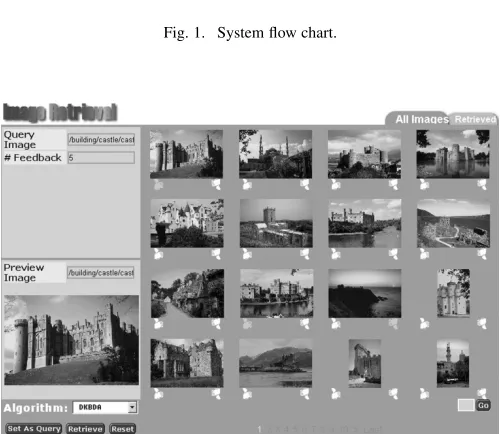
Fig. 2. User interface of the system.
Fig. 2 shows our query by example (QBE) system GUI. In our experiments the user first selects an image from the gallery and this image is then shown in the Preview Image window. Secondly, the user clicks the “Retrieval” button, and the images in the gallery are sorted using the similarity metric. Then, the user provides feedback by clicking on the “thumb up” or “thumb down” button according to his/her judgment of the relevance of the sorted images. Finally the user clicks the “Retrieval” button to resort the images in the gallery, which uses this feedback in-formation. The last two steps can iterate to obtain a more satis-factory result. The number of iterations is shown in the Query Image/# Feedback window.
The “All Images” tab-page excludes the images marked as ei-ther relevant or irrelevant in previous iterations. For the next it-eration only these images are resorted using the further modified metric. Consequently, the images marked for next iteration do not overlap with the previous feedback images. The “Retrieved” tab-page contains all images marked as relevant in previous iter-ations plus a number of the top images from the latest iteration.
V. EXPERIMENT
In the Corel Photo Gallery, each folder includes 100 images. However, the folders’ names are not suitable as conceptual classes, because many images with similar concepts are not in the same folder and some images whose semantic contents are quite different are in the same folder. The existing folders in the Corel Photo Gallery were therefore ignored and all 10 800 images were manually divided into 80 concept groups. These concept groups were only used in the evaluation of the results of our experiments.
Generally in a CBIR RF system images are represented by the three main features: color [3], [4], and [10]–[12], texture [5]–[10], [12], and shape [11]–[13]. For the color feature we se-lect three measures, hue, saturation, and value. We use these to form a histogram [3]. Hue and saturation are both quantized into eight bins and value into four bins. A 128-dimensional Color coherence vector (CCV) [4] in Lab color space and a 9-dimen-sional color moment feature in Luv color space are both em-ployed. For the texture feature a pyramidal wavelet transform (PWT) is extracted from the Y component in YCbCr space. Every image is decomposed by the traditional pyramid-type wavelet transform with Haar wavelet. The mean and standard deviation are calculated in terms of the subbands at each de-composed level. PWT results in a feature vector of 24 values. In addition, we also extract the tree-structured wavelet transform (TWT) in form of a 104-dimensional feature.
Each of these features has its own power to characterize a type of image content. The system combines the color and tex-ture featex-tures into a featex-ture vector, and then normalizes it into a normal distribution.
Precision is widely used to evaluate retrieval performance. It is the ratio of the number of relevant images retrieved in the top retrieved images. In our experiments, comparisons are made of the performances of the BDA, KBDA [24], [25], SVM based RF [28], and the direct BDA (DBDA is similar to the DLDA. We can substitute and by and , respectively. With this substitution, this direct version of BDA is obtained), DKBDA and its incremental version, IDKBDA.
Experiments with 300 different query images were per-formed. In the experiments there were nine iterations. For each iteration the top 48 images resulting from the resorted results were examined serially from the top and each image was marked as correct or incorrect. The first five correct images and the first five incorrect images were then used as feedback unless fewer such images were found among the top 48 in which case the fewer number found was used as feedback.
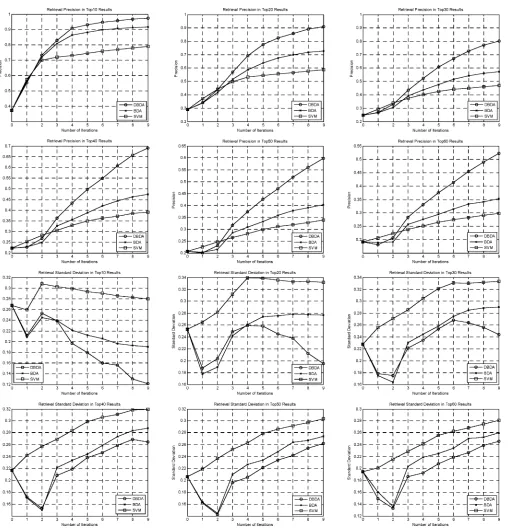
As can be seen in Fig. 3, the proposed DBDA algorithm consistently outperforms the BDA algorithm and the SVM RF algorithm. The images for the 300 query experiments were randomly selected. The first six figures show the average precision for the 300 experiments for the top ten, 20, 30, 40, 50, and 60 results. We note that for the results DBDA clearly gives a superior performance. There is more benefit from further iterations. In the case of the top ten results, after four iterations, the precision of the proposed DBDA is already higher than 90% while seven iterations are required for the BDA algorithm and more than nine iterations for the SVM RF. When more top results are considered, DKBDA again gives superior performance. The last six figures show
the standard deviation for the 300 experiments for the top ten, 20, 30, 40, and 60 results. These six figures correspond to the above six average precision figures, respectively. We note that the standard deviation of the DBDA is the smaller than that of BDA and SVM RF’s under all of our experimental conditions. This shows that the proposed DBDA is stable for the retrieval problem.
As shown in Fig. 4, in the kernel space the DKBDA also out-performs the KBDA consistently. The first six figures show the average precision for the 300 experiments for the top ten, 20, 30, 40, 50, and 60 results. Comparing with the experimental re-sults in Fig. 3, both KBDA and DKBDA perform better than their non-kernel space versions. In the case of the top ten results, after three iterations, precisions of both KBDA and DKBDA are higher than 90%. Note that after three iterations there is little fur-ther improvement with any of the algorithms but that DKBDA still clearly gives a superior performance. The corresponding standard deviation is shown by the last six figures in Fig. 4 for the top ten, 20, 30, 40, and 60 results, respectively. DKBDA gives smallest values in most cases. In other word, the DKBDA is more stable than KBDA.
DKBDA is also compared with its incremental version ID-KBDA in all the experiments reported in Fig. 4. For all situa-tions, the curves of IDKBDA press close to the DKBDA curves. Therefore, IDKBDA is proved to be of approximately the same capabilities as DKBDA, but it can speed up the DKBDA re-markably by saving about 20% of the running time (9 and 11 h for all the 300 queries and nine iterations for each query).
The problem of mislabeled samples is an open issue in small sample learning. The number of labeled samples is small. There-fore, when the number of the mislabeled samples is smaller than the correctly labeled samples, the learning machine can still ob-tain a correct model for the retrieval process by ignoring the minor mistake. However, if a user mislabels too many images during the relevance feedback, the learning will be misled to an incorrect retrieval model. Thereafter, the retrieval system cannot give a satisfactory performance.
In our experiments, the computer does the relevance feedback iterations automatically without mislabeled samples using the 80 concept groups described previously.
For each experiment, the concept group of the randomly se-lected image, which was to be used as the query image, was noted. For each iteration this concept group was compared with the concept groups of the top sorted images and when they are the same the image was labeled the positive feedback (“thumbs up”) and when they are different, the image was labeled as a negative feedback (“thumbs down”).
In all experiments, the Gaussian kernel
is chosen. For SVM RF we chose and for the KBDA, DKBDA, and IDKBDA based RF’s we chose . These values were chosen to give the best performance for these methods.
VI. DISCUSSION ANDFUTUREWORK
Fig. 3. Average precision and the standard deviation of DBDA, BDA, and SVM.
improve both the speed and the precision. More low-level visual features can help better characterize the content of an image. The kernel parameters can be further tuned.
Indexing: a much larger image database will be utilized in the current platform. To accelerate the retrieval speed, the indexing of database is important. Recently, many image-in-dexing algorithms have been developed. There are two major styles, each of which has its intrinsic advantage. 1) Classi-fication based indexing [35] focuses on the improvement of retrieval precision. In this method, each image is assigned one or more distinct labels. Then, based on these labels, the indexing can be constructed through semantic classifications.
Thereafter, the search results will cater to most of the users. 2) Low-level visual feature based indexing is employed to speed up the retrieval. There are many feature-based indexing approaches such as a variety of tree-based indexing structures for high-dimensional databases and VQ and VA methods [2]. A promising approach is to combine the feature and classifi-cation information in the indexing structure to improve both speed and precision.
Fig. 4. Average precision and the standard deviation of DKBDA, IDKBDA, and KBDA.
Kernel Parameter Selection: in DKBDA, different choices of kernel parameters affect its performance. How to select the kernel parameters is still an open issue. Recently, the tuning method was used to select the SVM parameters [28]. In the future, we plan to generalize the tuning method to select the parameters of kernel-based algorithms. For RF in CBIR, the training size of the training set is small, so the leave-one-out
method to tune the parameters can be used. VII. CONCLUSION
Utilizing the direct idea to the biased discriminant analysis, this paper proposed a straightforward method of direct kernel
APPENDIXA
, , and are calculated. 1) Calculate
where is an by 1 column vector (all terms equal to 1). Consequently, is given by
where . , , , and are by sized matrices with all terms equal to 1:
Therefore, is obtained as
2) Calculate
where
APPENDIXB
DKBDA can be accelerated by the incremental technique. Assume in the iteration, we have positive samples and
negative samples and in the iteration, we have incremental positive samples and incremental negative sam-ples. The deduction is given as follows.
In the iteration, the kernel matrix is
, where , and in the it-eration, the kernel matrix is , where
. , , and
The incremental DKBDA depends on the incremental kernel matrix and eigenvalue decomposition.
The incremental version of is shown at the bottom of the page.
, where is a small value. . is an by sized matrix with all terms equal to 1, so are , and .
The incremental version of is shown at the top of the next page.
, where is a small value. Then we have the incremental version of as
To conduct the incremental learning, we also need the incre-mental singular value decomposition (SVD).
Theorem 1: ([36]) If , then
, where .
Let , then we get the in-cremental version of SVD as
Theorem 2: Given , then can be de-composed by
where
.
Let
and the incremental SVD of the matrix is
. Theorem 2 can be obtained from Theorem1 easily.
where
The incremental DKBDA can be obtained with the theorem 2. Two conditions can guarantee its rightness:
1) , where is a small value. 2) , where is a small value.
With the two conditions (for the incremental SVD) and the incremental computation of the kernel matrix , , , and , the incremental version DKBDA can be obtained as in Table II.
ACKNOWLEDGMENT
The authors thank Professor P. King (University of London) for helpful discussions and assistance with the presentation of this material. They also thank J. Li for her assistance on the incremental learning.
REFERENCES
[1] A. Smeulders, M. Worring, S. Santini, A. Gupta, and R. Jain, “Content-based image retrieval at the end of the early years,”IEEE Trans. Pattern Anal. Mach. Intell., vol. 22, no. 12, pp. 1349–1380, Dec. 2000. [2] W. Ma and H. Zhang, “Content-based image indexing and retrieval,” in
Handbook of Multimedia Computing, B. Furht ed. Boca Raton, FL: CRC, 1998, pp. 227–254.
[3] M. Swain and D. Ballard, “Color indexing,”Int. J. Comput. Vis., vol. 7, no. 1, pp. 11–32, 1991.
[4] G. Pass, R. Zabih, and J. Miller, “Comparing images using color co-herence vectors,” inProc. ACM Multimedia, 1996, pp. 65–73. [5] H. Tamura, S. Mori, and T. Yamawaki, “Texture features corresponding
to visual perception,”IEEE Trans. Syst., Man, Cybern., vol. SMC-8, no. 6, pp. 460–473, Jun. 1978.
[6] B. Manjunath and W. Ma, “Texture features for browsing and retrieval of image data,”IEEE Trans. Pattern Anal. Mach. Intell., vol. 18, no. 8, pp. 837–842, Aug. 1996.
[7] J. Mao and A. Jain, “Texture classification and segmentation using mul-tiresolution simultaneous autoregressive models,”Pattern Recognit., vol. 25, no. 2, pp. 173–188, 1992.
[8] T. Chang and C. Kuo, “Texture analysis and classification with tree-structured wavelet transform,”IEEE Trans. Image Process., vol. 2, no. 4, pp. 429–441, Oct. 1993.
[9] J. Wang, J. Li, and G. Wiederhold, “SIMPLIcity: semantics-sensitive integrated matching for picture libraries,”IEEE Trans. Pattern Anal. Mach. Intell., vol. 23, no. 9, pp. 947–963, Sep. 2001.
[10] B. Manjunath, J. Ohm, V. Vasudevan, and A. Yamada, “Color and texture descriptors circuits and systems for video technology,”IEEE Trans. Circuits Syst. Video Technol., vol. 11, no. 6, pp. 703–715, June 2001.
[11] A. Jain and A. Vailaya, “Image retrieval using color and shape,”Pattern Recognit., vol. 29, no. 8, pp. 1233–1244, Aug. 1996.
[12] W. Niblack, R. Barber, W. Equitz, M. Flickner, E. Glasman, D. Petkovic, P. Yanker, C. Faloutsos, and G. Taubino, “The QBIC project: querying images by content using color, texture, and shape,” inProc. SPIE, Storage and Retrieval for Images and Video Databases, Feb. 1993, pp. 173–181.
[13] A. Jain and A. Vailaya, “Shape-based retrieval: a case study with trademark image databases,”Pattern Recognit., vol. 31, no. 9, pp. 1369–1390, 1998.
[14] Y. Ishikawa, R. Subramanya, and C. Faloutsos, “Mindreader: querying databases through multiple examples,” inProc. Int. Conf. Very Large Data Base, 1998, pp. 433–438.
[15] Y. Rui, T. Huang, M. Ortega, and S. Mehrotra, “Relevance feedback: a power tool in interactive content-based image retrieval,”IEEE Trans. Circuits Syst. Video Technol., vol. 8, no. 5, pp. 644–655, Sep. 1998. [16] Y. Rui, T. Huang, and S. Mehrotra, “Relevance feedback techniques
in interactive content-based image retrieval,” inProc. SPIE, Storage and Retrieval of Images and Video Databases VI, 1998, vol. 3312, pp. 25–36.
[17] Y. Rui, T. Huang, and S. Chang, “Image retrieval: current techniques, promising directions and open issues,”J. Vis. Commun. Image Repre-sent., vol. 10, no. 1, pp. 1–23, Mar. 1999.
[18] K. Fukunaga, Statistical Pattern Recognition, 2nd ed. Boston, MA: Academic, 1990.
[19] Y. Cheng, Y. Zhuang, and J. Yang, “Optimal fisher discriminant analysis using the rank decomposition,”Pattern Recognit., vol. 25, pp. 101–111, 1992.
[20] K. Liu, Y. Cheng, J. Yang, and X. Liu, “An efficient algorithm for Foley-Sammon optimal set of discriminant vectors by algebraic method,”Pattern Recognit., vol. 6, pp. 817–829, 1992.
[22] W. Zhao, R. Chellappa, and A. Krishnaswamy, “Discriminant analysis of principal components for face recognition,” inProc. IEEE Int. Conf. Automatic Face and Gesture Recognition, 1998, pp. 336–341. [23] H. Yu and J. Yang, “A direct LDA algorithm for high-dimensional data
with application to face recognition,”Pattern Recognit., vol. 34, pp. 2067–2070, 2001.
[24] X. Zhou and T. Huang, “Small sample learning during multimedia re-trieval using biasmap,” inProc. IEEE Int. Conf. Computer Vision and Pattern Recognition (CVPR), 2001, vol. 1, pp. 11–17.
[25] ——, “Comparing discriminate transformations and SVM for learning during multimedia retrieval,” inProc. ACM Multimedia, 2001, pp. 137–146.
[26] J. Lu, K. Plataniotis, and A. Venetsanopoulos, “Face recognition using kernel direct discriminant analysis algorithms,”IEEE Trans. Neural Netw., vol. 14, no. 1, pp. 117–126, Jan. 2003.
[27] V. Vapnik, The Nature of Statistical Learning Theory. New York: Springer-Verlag, 1995.
[28] L. Zhang, F. Lin, and B. Zhang, “Support vector machine learning for image retrieval,” inProc. IEEE Int. Conf. Image Processing (ICIP), 2001, pp. 721–724.
[29] P. Hong, Q. Tian, and T. Huang, “Incorporate support vector machines to content-based image retrieval with relevant feedback,” inProc. ICIP, 2000, pp. 750–753.
[30] Y. Chen, X. Zhou, and T. Huang, “One-class SVM for learning in image retrieval,” inProc. ICIP, 2001, pp. 815–818.
[31] G. Guo, A. Jain, W. Ma, and H. Zhang, “Learning similarity mea-sure for natural image retrieval with relevance feedback,”IEEE Trans. Neural Netw., vol. 12, no. 4, pp. 811–820, Jul. 2002.
[32] K. Muller, S. Mika, G. Ratsch, K. Tsuda, and B. Scholkopf, “An in-troduction to kernel-based learning algorithms,”IEEE. Trans. Neural Netw., vol. 12, no. 2, pp. 181–201, Mar. 2001.
[33] A. Roger and C. Johnson, Matrix Analysis. Cambridge, U.K.: Cam-bridge Univ. Press, 1990.
[34] D. Tao and X. Tang, “A direct method to solve the biased discriminant analysis in kernel feature space for content-based image retrieval,” in
IEEE Int. Conf. Acoustics, Speech, and Signal Processing, 2004, vol. 3, pp. 441–444.
[35] N. Vasconcelos, “Image indexing with mixture hierarchies,” inProc. CVPR, 2001, pp. 3–10.
[36] M. Brand, “Incremental singular value decomposition of uncertain data with missing values,” inProc. Eur. Conf. Computer Vision, 2002, pp. 707–720.
Dacheng Tao(S’06) received the B.Eng. degree from the University of Science and Technology of China, Hefei, and the M.Phil. degree from the Chinese Uni-versity of Hong Kong. He is currently pursuing the Ph.D. degree at the University of London, U.K.
His research interests include acoustic signal matching and retrieval, bioinformatics, biometrics, computer vision, data mining, image processing, machine learning, multimedia information retrieval, pattern classification, and visual surveillance. He published extensively in IEEE T-PAMI, IEEE T-IP, IEEE T-MM, IEEE T-CSVT, CVPR, ACM SIGMM, etc.
Mr. Tao gained several Meritorious Awards from the International Interdisci-plinary Contest in Modeling, which is the highest level mathematical modeling contest in the world, organized by COMAP.
Xiaoou Tang (S’93–M’96–SM’02) received the B.S. degree from the University of Science and Technology of China, Hefei, in 1990, and the M.S. degree from the University of Rochester, Rochester, NY, in 1991. He received the Ph.D. degree from the Massachusetts Institute of Technology, Cambridge, in 1996.
He was a Professor and the Director of Multimedia Lab in the Department of Information Engineering, the Chinese University of Hong Kong, until 2005. Currently, he is the group manager of the Visual Computing Group at the Microsoft Research Asia. His research interests include computer vision, pattern recognition, and video processing.
Dr. Tang is a local chair of the IEEE International Conference on Computer Vision (ICCV) 2005, an area chair of ICCV’07, a program chair of ICCV’09, a general chair of the IEEE ICCV International Workshop on Analysis and Mod-eling of Faces and Gestures 2005. He is a guest editor of the Special Issue on Underwater Image and Video Processing for IEEE JOURNAL OFOCEANIC ENGINEERINGand the Special Issue on Image- and Video-based Biometrics for the IEEE T-CSVT. He is an associate editor of the IEEE T-PAMI.
Xuelong Li(M’03) is a Lecturer at the University of London, U.K. His current research interests include visual surveillance, biometrics, data mining, mul-timedia information retrieval, cognitive computing, image processing, pattern recognition, and industrial applications. He published more than 40 papers in journals (IEEE T-CSVT, T-IP, T-MM, T-PAMI, etc.) and conferences (IEEE CVPR, ICASSP, ICDM, etc.). He was on program committees of more than thirty conferences (BMVC, ECIR, ICDM, ICME, ICMLC, ICPR, PAKDD, PCM, SMC, WI, etc.). He co-chaired the 5th UKCI. He is an associate editor of IEEE T-SMC Part C, IJIG (World Scientific) andNeurocomputing(Elsevier). He is also on the editorial board of IJITDM (World Scientific). He is a guest editor for an IJCM (Taylor & Francis) special issue. He is a reviewer for around 60 journals and conferences, including nine IEEE Transactions.
Yong Rui(SM’04) received the Ph.D. degree from the University of Illinois at Urbana-Champaign (UIUC).
He serves as the Technical Assist to President of China R&D Group, where he facilitates and helps drive the overall China R&D strategy. Before this role, he managed the Multimedia Collaboration team at Microsoft Research, Redmond, WA. His research interests include computer vision, signal processing, machine learning, and their applications in communication, collaboration, and multimedia systems. He has published two books, six book chapters, and over 60 referred journal and conference papers in the above areas. He holds 30 issued and pending U.S. patents.