THE PILQT PROGRAMME
FOR
INTEGRATED RURAL DEVELOPMENT
1988-90
Copies of this paper may be obtained from The Economic and Social Research Institute (Limited CompaO, aVo. 18269). Registered Offce: 4 Burlington Road, Dublin 4.
Price IR£ 10.00
THE PILO T PROGRAMME
FOR
INTEGRA TED RURAL DEVELOPMENT
1988-90
EoinO’MaHey
© THE ECONOMIC AND SOCIAL RESEARCH |NSTITUTE DUBLIN, 1992
This paper is largely based on a report which was commissioned by the Department of Agriculture and Food. I am grateful to officials of that Department for their co-operation, assistance and comments on an early draft. 1 would also like to thank Mr Tom Lyons of the h’ish Productivity Centre and Mr Tom Murray of Price Waterhouse Management Consultants, who were membcrs of tile planning team for the pilot programme, for their assistance and comments. I am indebted, too, to the co-ordinators and core group members who co-operated fully in the preparation of this report; they arc listed in Appendices 2 and 3.
I received helpfnl comments on earlier drafts from Peter Murray and Robert O’Connm" of the ESRI, fi’om an anonymous external referee, and fi’om tile Department of Finance, Shannon Development, Teagasc and Udaras na Gaehachta. I would like to thank tile clerical staff of the ESRI, and Phil Browne, Deirdre Wlaitaker and Mary McEIhone, who prepared tile paper Ibr publication. Finally, none of the above is responsible for the views cxpressed in this paper, which are those of the author.
Chapler I 2
10
A cknowledgemeals General Sumatar.),
CONTEJVTS
Part 1
The /lpproach of the Pilot Integrated Rural Development Progmalme
Introduction
Design and Structure of the Programme
F’art I1
The Pilot Programme in Action
An Outline of the Operation of the Pilot Programme Getting the Pilot Progl’amme Established
Project Activity in the Pilot Programme
Part IIl
Experieaces and Lessons of the Pilot Programme
Experiences and Views of the Co-ordinators Experiences and Views of the Core Groups
Successes and F’roblems of the IRD Pilot Programme Lessons and Issues Arising from the Pilot IRD Programme
Part IV
Epilogue
Nationwide Extension of the IRD Programnm
References
Page
iv 1
12 16
26 35 40
54 60 68 78
88
4.1
5.!
5.2
5.3
5.4
Core Group ,Members, by Occupation
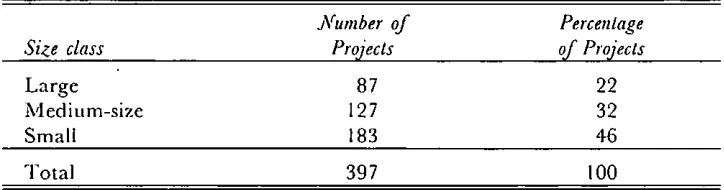
Distribution of Projecls b)’ Size Class
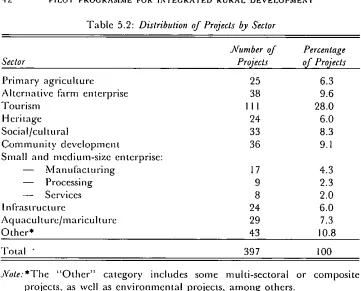
Distribution of Projects by Sector
Percentage of Priority Projccts Undertaken by Different Types of Promoter
Number of Projects Obtaining Assistance from Various Agencies and Institutions
MAP
Locations of Integrated Rural Development Pilot Areas
Page
37
41
42
47
51
17
Appendix
APPEND ICES
The Original Pilot Programnle Design
The Co-ordinators
"File Corc Group Members
Priority Projects in Each Pilot Area
Projects Receiving Technical Assistance Funding
Page
93
94.
95
100
153
The pilot programme for integrated rural development (IRD) operated during the two-year period October 1988 to October 1990. It was stated at
tile time of the launching of tile pilot programnle that tile intention was to gain the experience necessary before considering whether to launch a
nationwide IRD programme. This paper gives an account of the experience of the pilot phase.
Design and Structure of the Programme
The general objective of the pilot IRD progl’amme was to improve the employment opportunities, earning potential, quality of life and sense of community identity anaong people in rural areas. It was aimed to achieve this by mobilising local people to work for the economic, social and cultural development of their own area, to decide on their own development priorities,
and to take the initiativc in bringing their own aspirations to reality. The emphasis was on tbstering viable private and community enterprise, based on fnll ntilisation of the abilities and talents of local people.
Thus, the pilot programme did not aim to impose rural devclopmcnt "fi’om the top down", but rather it sought to stimulate and encourage development initiatives coming "from the bottom up".
The pilot programme operated in twelve selected rural areas, most of which had a population of between 6,000 and 15,000 people. In choosing the pilot areas, it was intended to select a variety of areas which would be broadly representative of the variety of rural districts in the country, with a good geographical spread. In practice, the twelve areas selected were somewhat more representative of tile western than the eastern half of the COU n t ry,
The overall design and subsequent management of the pilot programme, and the training of the full-time staff engaged in it, were entrusted to consuhants fi’om outside the civil service. These consuhants, together witla senior civil servants li’om the Department of Agriculture and Food, constituted a "planning team". This planning team held regular meetings during the course of the programme to review progress and to resolve any operational problems arising.
PILOT PROGRAMME FOR INTEGRATED RURAL DEVELOPMENT
and developments, to encourage them to come up with new initiatives, to give practical assistance in implementing such initiatives, and to liaise with existing advisory and developmental agencies and with local voluntary organisations. It was not intended that the co-ordinators would be leaders
and initiators; rather they would stimulate, assist and facilitate the initiatives of members of the local community.
The first task required of each co-ordinator was to organise a Core Group of local people in the area. This group was to consist of individuals with a strong commitment to the development of the area and a willingness to
make the effort, on a voluntary basis, necessary to bring about such development. Co-ordinators were advised to select group members with a variety of relevant experience and competence, and also to be sensitive to any existing community or development organisations when selecting group members. They were also advised that a group of about eight members would be the ideal size. The core group was intended to become the body responsible for the operation of the pilot programme in its own area, with the co-ordinator increasingly handing over the initiative to the group and adopting the role of facilitator and adviser in implementing projects selected hy the group. The co-ordinators were also advised that they could, if desired, set up "advisory" groups in order to involve representatives of important
local organisations or interests. And they could also set up "sub-groups" such as functional]specialist groups, or groups focusing on specific districts within their areas.
A basic characteristic of the pilot IR.D programme was that it was buih around the concept of shared learning between all the individuals and all the core groups engaged in its operation.
The shared learning process in the pilot programme was designed to operate in various ways. A key aspect of the process was a series of four workshops held over the two-year pilot period. Each workshop was to be attended by all the core groups, the co-ordinators and the planning team. The agenda for each workshop varied, but a general intention was to exchange ideas and to report on experiences, as well as to inspire and motivate those involved through contact with the examples and achievements of the others. The timing and agendas of the workshops were also intended to set a quite ambitious pace for achieving results, and to communicate a "work ethic" and seriousness of purpose.
Finally, each pilot area was to he "twinned" with another, and the co-ordinators and core groups fi’om tile two areas were to visit each other at regular intervals to compare i)roblems, discuss solutions, exchange ideas and assess progress and aspirations.
In tile second half of the pilot progranmle, the twinning system was revised and became a more flexihle "networking" arraugemcnt. This allowed core groups, or some members of them, to visit other areas in which tile}, had a special interest related to their own development projects.
It was intended fi’om the start that little additional funding would be made available to finance projects emerging as a resuh of tile pilot programme. Rather, it was aimed to ensure that effective use would be made of existing financial resources, as well as the services, expertise and financial assistance available fi’om State development agencies. The only finance made available undcr the pilot programme itself to help get potential projects started was a small "technical assistance" fund. Aid was made available fi’om this fund to meet part of the cost of obtaining professional advice or assistance required to advance projccts which were identified by the core groups.
A basic fcature of the programme was that each core group was encouraged to identi~, the needs and potential of its own area, and to pursue its chosen objectives in a manner which it judged most appropriate. No restriction was placed on tile type of project, or the sectors or range of activities which might be pursued. The only requirement was that actions undertaken should be aimed at tile development of the area, in accordance with the wishes of tile local comu~uuity. Thus, there were no very precise expectations about what sort of initiatives would emerge from the pilot prograname, ahhough it was envisaged that the core groups might aim to foster small or medium-size enterprises, agricultural diversification, rural tourism and amenity and social improvements, among other things.
The Operation of the Pilot Programme
In general, the programme of training for the co-ordinators, the workshops, tile monthly meetings of tile co-ordinators and members of the planning team, and tile other formal events and activities which were intended to be held under tile pilot programme, operated as was planned. The first training session for co-ordinators was held at tile start of the pilot period and subsequent training sessions were held during tile course of the programme. The core groups were largely formed in tile first t’.vo months, in time for tile first introductory workshop in Noveml)er 1988, and there was a good attendance at that workshop.
PILOT PROGRAMME FOR [NTEGRATED RURAL DEVELOPMENT
presentation at the second workshop in March 1989. Twinning and networking visits between core groups took place during the programme, as intended. The core groups also set up quite a number of sub-groups for specific purposes. At the third and fourth workshops, held in November 1989 and May 1990, the core groups reported ou progress on their selected projects and tbese two events were well attended.
The formal events and activities held under the IRD pilot programme can be summarised statistically as follows:
Number of Workshops 4
Number of Co-ordinators’ Meetings/
Training Sessions 22
Number of Core Group Meetings 274
Number of Sub-group Meetings More than 380
Number of Twinning Meetings 17
Number of Networking Visits 34
Number of Public Meetings 156
Getting the Pilot Programme Eslablished
In getting the pilot programme established, the co-ordinators had to familiarise themselves with their pilot areas and select a core group. Together with their core groups, they then prepared profiles of their areas for presentation to all the other core groups at the first workshop.
The co-ordinators generally began by making contact with bodies such as existing community councils and development associations, State development agencies, local authorities, sporting organisations, the ICA, co-operatives and farmers’ organisations, as well as local councillors, clergy and business people. By such meetings and contacts, the co-ordinators were able to reach decisions about who to invite to participate in tim core groups.
Most of the core groups ended up being a little larger than the originally envisaged eight members. Relative to tile pilot areas’ population as a whole, the core group members included a high proportion of managers, business people and professional people; between them, these categories accounted for 57 per cent of the core group members. There was also a relatively high proportion of public administration employees, many of them involved in development activities. Farming was also quite well represented. Other occupations had a very limited presence in tile core groups.
Project ActiviO, in the Pilot Programme
During the course of the pilot programme, each core group identified and selected a number of ideas for projects which it aimed to advance for the purpose of furthering the economic and social development of time area concerned. The groups’ activity was then largely focused on furthering the implementation of their agreed priority projects.
Time tweh,e core groups combined settled on a total of 397 priority projects. These projects, however, were not all fully implemented by the end of time two years of the pilot programme, since many of them were then still in the planning stage or the early stages of implementation.
The priority projects covered a very diverse range of activities. Classified by sector, they were distributed as shown in time table.
Distribution of Projects by Sector
Seclor
Primary agriculture Ahernative farm enterprise Tourism
Heritage Social]cultural
Community development
Small and meclium-size enterprise: -- Manufacturing
-- Processing -- Services
[tmfrastruet u|’c
Aquacuhure]maricuhure Other
Number of Percentage Proiects of Proiects
25 6.3
38 9.6
I I I 28.0
24 6.0
33 8.3
36 9.1
17 4.3
9 2.3
8 2.0
24 6.0
29 7.3
43 10.8
Total 397 100.0
While close to one-fifth of the projects were concerned with community developmcm or social and cuhural objectives, the large majority of them
were overtly "productive" in character, aiming to make a contribution to the local economy, whether by giving employnmcnt ou" by generating additional incomes.
The core groups’ priority projects included some which were completely new and were initiated during the pilot IRD programme, while others involved giving impetus to existing initiatives. About two-thirds of the priority projects were in tim first category while time remainder related to
6 PILOT PROGRAMME FOR INTEGRATED RURAL DEVELOPMENT
To understand the role of the core groups in developing their projects, it is necessary to bear in mind that tbe core groups, by design, did not constitute companies or business entities. Consequently, the core groups were not in a position to undertake directly the implementation of most of their priority projects, so that they needed to work with some sort of project promoter on most of them.
Tile core groups worked with various types of promoters on different projects. Almost haft of the projects were promoted by local community groups or development associations, and a further 1 I per cent were promoted
by co-operatives.
Basically, the role of tile core groups and co-ordinators was to act as catalysts, in a manner that was additional and complementary to the activities of local groups and associations, State development agencies, local autborities and private enterprises. The core groups generated or identified ideas for projects, tile), sought out suitable promoters, and with the full-time assistance of tile co-ordinators they identified sources of funding, organised various forms of assistance for promoters, and frequently brought together and co-ordinated numbers of people or organisatlons as required for individual projects.
Views of the Co-ordinators
At the end of tile pilot programme, most of the co-ordinators were distinctly positive in their overall assessment of it. In a written report, they considered it a "privilege" to have participated in it and they felt that the programme was "unique and refreshing in its approacb and progressive in its outlook". The), also concluded that the design of the programme was effective in mobilising local human resources and providing a structured approach to community-based development. They considered, too, that the IRD pilot programme, in a relatively short period of time, brought about real beneficial change in tile pilot areas. On the basis of their experiences, therefore, they recommended retaining in any future programme the key elements of the programme design, including core groups, workshops, networking, technical assistance, State-paid co-ordinators, professional consuhants and a planning team and monthly co-ordinator meetings. Against this background of overall satisfaction with tbe pilot programme, however, the co-ordinators were also somewhat critical of certain aspects, and they made a number of recommendations for changes in any future programme.
l/iews of the Core Groups
programme. They mostly approved of its general approach and most of the principal elements of the programme design, and they wanted to see it continue, ahhough with various suggested modifications.
Against this background of prevailing overall approval, most of the core groups had some criticisms and recommendations for changes or modifications
in a follow-up programme, but there was little agreement between them on these.
The core groups were asked to recommend in their reports which elements of the pilot programme should be retained and which should be changed or
modified in a future programme. Nearly all of the core groups recommended retaining co-ordinators, core groups, workshops, twinning/networking (with rather more specific mention of networking than twinning) and technical assistance funding. There was also a good deal of specific support for retaining the "bottom up" approach and the planning team.
As regards changes or modifications, the only recommendation which was put forward by a majority of the groups was to provide more financial assistance, including more technical assistance funding and/or more broadly applied funding for purposes such as feasibility studies and seed capital.
hnpact of the Pilot Programme
In considering whether the pilot programme was a success, it is significant that the prevailing overall view anlong the co-ordinators and the core group members was that it was very worthwhile. In particular, in the case of the core group members, it should lye borne in mind that their participation in tile pilot programme was entirely voluntary and unpaid. There was no very strong incentive for them to stay with i( (as nearly all of then1 did), or to pronounce it an overall success and to recommend its continuation, unless they really felt that it was achieving worthwhile results for their area.
While the main participants in the pilot programme mostly regarded it as successfid and worthwhile, it is rather difficult to assess its impact ol~ectively
in quantitative terms. This is so for a number of reasons.
First, two years is too short a period of time for a programme aiming to foster economic and social development to lye able to demonstrate its impact fully. Many of the projects selected were still in the planning stage or at the very early stages of implementation when the pilot period concluded, and consequendy they had yet to deliver the full expected results.
PILOT PROGRAMME FOR iNTEGRATED RURAL DEVELOPMENT
and agencies. Thus, quite frequently, the IRD participants could not be full), credited with all the restllts since others also made major contributions. This naturally creates a basic conceptual difficulty in measuring the impact of the IRD programme per se.
A third difficuhy in measuring the effects of the pilot programme is that a significant minority of the projects undertaken had inherendy non-quantifiable social objectives.
Despite these problems in assessing the full results of the pilot programme in a quantitative manner, it is at least possible to say that the projects undertaken had already generated significant employment and incomes by
the end of the pilot period. If the full expected results were to be eventually attained, or even mostly attained, the outcome would be impressive. While
it would be too much to etairn, certainly after just two years’ experience, that the approach of the pilot IRD programme could substantially transform rm’a[ areas, it does look likely that it can make a distinctly useful contribution to economic and social development.
The method of operation of the pilot programme meant that, for relatively small expenditures on employing paid staff; the voluntary efforts of much larger numbers of people were mobilised. With twelve full-time paid co-ordinators together with quite intensive managernent and guidance as well as administrative back-up, the programme secured the involvement of about 125-130 core group members (the precise number varied). It also involved a larger number of sub-group members, and stimulated new efforts by many members of other local organisations and other project promoters. Given this high level of voluntary work (or at least unpaid by the State) in relation to the numbers of paid staff, the programme probably gave good value for nloney.
Conclusions
The pilot programme sought to bring to rural development policy a programme with an IRD approach. The term "IRD", however, does not have a single generally accepted meaning. In the case of the Irish pilot programme, it rneant a programme aiming to link and promote muhi-sectoral projects, on a geographical area basis, over a number of years. It also meant aiming to mobilise local leadership and initiative, and to encourage non-statutory or voluntary organisations to foster development
projects while availing of the assistance available from statutory agencies. In addition, it incorporated the notion that systematic learning and sharing of
ideas, experience and information can be beneficial in a process of participative change and development.
economic and social development in their own areas. It was clear, too, that those involved generally found the experience worthwhile and looked forward to continuation of the programme in some form. In terms of what it aimed to achieve, the programme could he regarded as successful, providing good grounds for continuing with this approach, with appropriate modifications.
While the pilot programme stimulated and encouraged initiatives coming fi’om local communities themselves, it needsto be recognised that this was not spontaneous and that the programme worked through a focused, directed and quite conscious process. The initiatives taken on projects were genuinely local, but there was systematic central guidance of the overall process. Establishing and guiding the process took a good deal of care, and similar care and attention would be needed in extending such a programme to other areas.
PART I
THE APPROACH OF THE PILOT INTEGRATED
INTRODUCTION
The pilot programme for integrated rural development (IRD) was in operation during the two-year period October 1988 to October 1990. The intention to establish such a programme had previously been announced in the government’s Programme for National Recovery, which was published in October 1987. That document stated that "integrated rural development programmes on a pilot area basis will be introduced to promote rural enterprise (e.g., inchlding agri-tourism) and to benefit to the greatest extent possible from EC funding". Planning and preparation by the Department of Agrieultnre and Food Ibr a two-year pilot programme continued through
1988, and the programme went into operation in October 1988 with financial support fi’om the EC. It was stated at the time of the launching of the pilot programme that the purpose of the pilot approach was to gain the experience necessary before considering whether to launch a nationwide IRD programme.
This paper gives an account of the experience of the pilot phase; it is largely based on a report which was prepared for the Department of Agricuhure and Food at the end of the pilot programme.
The Meaning of Integrated Rural Developmeat
"Integrated Rural Development", or IRD, was the name given to the particular pilot programme which was operated in Ireland in 1988-1990 and is discussed in this paper. However, the term "integrated rural development" has also been in use in Ireland and elsewhere for some time past, to refer to a general concept or set of concepts.
Indeed, even before the term came into common use, much of what is implied by the concept of IRD had been advocated previously. For example, as Commins (1991) points out, almost 90 years ago Horace Plunkett enunciated a concept of what was later to become known as IRD when he argued that "not by agrieuhure alone is Ireland to be saved", and called for the development of industries in the countryside. Commins also notes that a similar concept was part of official thinking in Ireland in the 1960s, to the extent that the Second Programme for Economic Expansion saw part of the solution to the problems of low income farming in the development of industry, forestry and tourism, including the idea of package farmhouse holiday schemes.
INTRODUCTION J 3
Outside Ireland, the concept of IRD was in use in the context of development policies in the Thi~’d World in the early 1970s, for example i~ connection with US foreign aid to developing cotmtries (Varley, 1988, p. 14). The tern] subsequently came into common use in EC parlance in the late 1970s.
While the tcrm 1RD has bccn commonly used, however, it does zlot flare a single universally accepted meaning; it means somewhat different things to different people (Murray, 1989). As Varley (1988, p. 29) observes, integrated rural development "can be variously interpreted to mean a multi-sectoral, co-ordinated approach to development, the pursuit of growth-with-equity objectives, participative development or even environmental protectionism".
More specifically, Commins ( 1991 ) and Grecr a!ld Murray (1991) present (somewhat difl’erent) lists" of the various prescriptions or elements which could be incltnded as part of the IRD approach. These include:
-- IRD should link together various projects into an integrated progranarue. -- IRD should involve a multi-sectoral approach to development, promoting, e.g., tourism, forestry a~d industry in addition to agriculture, preferably in a mutually supportive manner.
-- IRD should be planned and implemented on a geographical arca basis, not on a sectoral basis.
-- An IRD programme should link activities across several years (multi-annual planning).
-- IRD should enhance the collaboration of statutory agencies and rlon-statutory organisations in dcvelopn’tent efforts.
-- In the IRD approach, local people should become actively involved in identi~,ing needs and opportunities for development in their areas, and in the implementation of projects. To this cnd, IRD should give attention to the promotion, training and mobilisation of local leadership and initiative.
-- IRD sl~otdd involve a degree of devolution of powers fi’om the central to the regional and local levels of administration.
-- IRD should concentrate eftbrts on aiding poor areas ancl~ more specifically, the poorcr people living in such areas.
Thus, it did aim to link and promote muhi-sectoral projects. It operated on a geographical area basis and looked ahead over a number of years. It also sought to mobilise local leadership and initiative to identify and implement projects, and to encourage non-statutory oz" voluntary local organisatlons to avail of the assistance available From statutory agencies. However, the Irish pilot programme did not involve substantial devolution of formal administrative powers. Nor did it involve an explicit concentration on the poorest areas of the country or on the needs of the poorest people in the areas where it operated, ahhough a particular focus on the needs of
such people in the areas concerned was not ruled out. Chapter 2 provides a
more detailed account of the aims and content of the pilot programme.
The I,Vider Policy Conlext
The pilot IRD programme was intended to gain experience with one particular approach to contributing to rural development, but it was not envisaged that this approach would be the only policy for promoting development of rural areas. For both the Irish government and the EC operate a range of policies which have an influence on rural development. Such policies include the Common Agricultural Policy (CAP) for the agricultural sector, policies to develop tourism and forestry, policies to expand and to disperse industry geographically, and policies to improve infrastructure and the environment (see Brady, 1990). It was intended that the IRD approach would operate within this wider policy context and would be additional and complementary to other efforts to develop rural areas.
The pilot IRD programme, and increased concern about rural development generally, emerged in Ireland in the late 1980s in the context of concern about the effects of reform of the CAP, as well as the introduction of the Single European Market. It was felt that these developments would, or could, have negative effects on Irish agriculture and on rural areas generally, al a time when rural tmemploymeJH and/or emigration were already very serious problems. At about the same time: in tbe interests of fostering economic and social "cohesion" in the EC, when faced with these potential threats to "lagging" regions and many rural areas, the EC was undertaking reform of the Structural Funds. These reforms were to involve a doubling of the amounts awdlable between 1989 and 1993, as well as concentration on five priority objectives, which were to include the development of rural areas.
INTRODUCTION l 5
opportunity to introduce new rural development initiatives, and one such initiative by tile h’ish Government was tile establishnaent of tile pilot IRD programme ill 1988.
While EC funding was made available to support the pilot 1RD programme, this was done outside the framework of the Structural Funds. However, the intention was, through tile pilot programme, to develop an approach to contributing to rural development which would subsequently be eligible for assistance from tile enhanced Structural Funds -- after tile pilot phase.
Ahhough this paper is concerned with giving an account of the pilot IRD programme itself, it is worth noting here that, since the conclusion of the pilot phase, tile administrative arrangements for a follow-up to the pilot have been announced by the Minister for Agriculture and Food. This new nationwide IRD progt’amme is intended to generate projects whicb will be eligible to benefit from EC Structural Funds, although tile structure or administrative arrangements of the programme do not qualify for EC supports. We outline the arrangements for this follow-up programme in Chapter 10.
It was to be expected that tile EC would be intcrested ill assisting a follow-up IRD programme, since not only did.it fund the h’ish pilot programme but it has also supported IRD-type programmes elsewbere since the late 1970s, e.g., in Belgium, France and Scotland. (It is not our intention bere to review tile considerable literature on this; see Varley, 1988, pp. 23-27, for a succinct survey of experience elsewhere in the EC.) As was mentioned above, however, tile term IRD has had some’.vbat different meanings at different times and in different places, and tile particular approach of tbe Irish pilot IRD programme of 1988-90 is outlined in the next cbapter.
Contents of this Report
Chapter 2 describes the design and structure of tile IRD pilot programme. C, hapters 3 to 5 then go on to give an account of the actual operation of the programme. Tbis includes an outline of the timing and content of a series of meetings and worksbops in Chapter 3, a description of how tile programme was rnade operational "on the ground" in Chapter 4, and a description and analysis of project activity in Chapter 5.
Chapters 6 to 9 are concerned with reviewing the experiences and lessons of tile pilot programme, with an account of the experiences and views of participants in Chapters 6 and 7. Chapter 8 then higblights tile successes and problems, and Chapter 9 points to some lessons and some issues which needed further consideration.
DESIGaV AND STRUCTURE OF THE PROGRAMME
The General Approach
The purpose of the pilot programme was, in the first place, to build up a base of experience with a particular approach to rural development before launching a broader national programme, while also hopefully achieving some useful development results in the pilot areas. The general objective of the approach was to improve the employment, earning potential, quality of life and sense of community identity among people in rural areas.
It was aimed to achieve this by mobilising local people to work for the economic, social and cultural development of their own area, to decide on their own development priorities, and to take the initiative in bringing their own aspirations to reality. The emphasis was on fostering viable private and community enterprise, based on full utilisation of the abilities and talents of local people.
Thus the pilot programme did not aim to impose rural development "from the top down", but rather it sought to stimulate and encourage development initiatives coming "from the bottom up". Consequently, the general approach of the programme could be described as that of a "state-backed, self-help initiative".
The Pilol Areas
The pilot IRD programme was conceived as one programme with a unified approach and design. In the nature of a pilot, however, it was to operate only in part of the country and it was thought best to select a variety of areas in which to implement it. Consequently, 12 pilot areas were selected and these areas together formed the field of operation for the pilot
programme as a whole. The twelve selected areas were: 1. The district of Skibbereen, Co. Cork.
2. The South-West Kerry region 3. The Macamores, Co. Wexford.
4. Slieve Felim, Counties Tipperary and Limerick. 5. Tbe Cooley peninsula, Co. Louth.
6. The lnny Basin, Counties Westmeath and Cavan.
7. The district of Gort and part of district of Scariff, Counties Galway and Clare.
DESIGN AND STRUCTURE OF TIlE PROGRAMME
Location of Integrated Rural Development Pilot Areas
17
ISLANDS
INISHOWEN
8. Erris, Co. Mayo.
9. The district of Manorhamilton, Co. Leitrirn. 10. The lnishowen Peninsula, Co. Donegal.
11. The inhabited islands off" the northern half of tile west coast. 12. The inhabited islands off the southern half of the west coast.
Tile location of these areas is shown on the map. Most of the pilot areas have a population of between 6,000 and 15,000 people, ahhough a few of them have populations lying outside this range. Tile two island groups each have less than 2,000 inhabitants and lnishowen has much the largest population with 29,000. The total population of the twelve pilot areas amounts to 123,900, which represents 8 per cent of the population of rural Ireland (i.e., the "Aggregate Rural Areas" in the Census of Population).
The twelve areas vary considerably in natural advantages and disadvantages, patterns of production and employment, and levels of income. They also vary significantly in tile extent of their previous experience with community based development efforts. In selecting the pilot areas the aim was not to choose a particular type of area, such ,as the most disadvantaged. Rather, it was intended to select a group of areas which would be broadly representative of the variety of rural districts in the country, with a good geographical spread, although in practice the twelve areas selected were somewhat more representative of tile western than the eastern half of the country. All of tile pilot districts are rural since none of them has a town with more than about 3,000 inhabitants~ while the largest town in most of them has less than 2,000 inhabitants. Some of them, however, are within commuting distance of larger towns such as Dundalk, Sligo or Limerick.
Pilot Programme Design and Management
DESIGN AND STRUCTURE OF TIlE PROGRAI’,IME 19
Tile Co-ordinators
Tile programnae design provided that a rural development co-ordinator would be appointed for each pilot area. The co-ordinators were to be selected fi’om within the ptd)lic sector and were to become full-time employees of the Department of Agriculture and Food, with a good deal of day-to-day independencc. The task of the co-ordinators was to stimulate their local communities to consider new activities and developments, to encourage them to comc up with new initiativcs, to give practical assistance in implementing such initiatives, and to liaise with existing advisory and developmental agencics and with local voluntary organisations. It was not intended that the co-ordinators would be leaders and initiators; rather they would stimulate, assist and facilitate the initiatives of menabers of the local conamunity. While the co-ordinators clearly had to take the initiative in some respects at the early stages of the programme, it was intcnded that "ownership" of the project would be transferred to members of the local conamunity.
The co-ordinators were to receive training both at the start of the programme and on an ongoing basis during the programme. This training was to cover the philosophy underlying the programme, methods of implementing it by stimulating eommuoity action, and practical informatiort on matters such as the workings of central and regional administrations and of the EC. The intention was to organise additional training modules for
the co-ordinators as seen necessary during the course of the programme.
7"he Core Groups
The first task required of each co-ordinator was to organise a Core Group of local people in the area. This group was to consist of individuals with a strong commitment to the development of the area and a willingness to make the effort, on a voluntary basis, necessary to bring about such development. Co-ordinators were advised to select group members with a variety of relevant experience and competence, and also to be sensitive to any existing community or development organisations when selecting group members. They were also advised that a group of about eight members would be the ideal size. The core group was intended to become the body responsible for the operation of the pilot programme in its own area, with the co-ordinator increasingly handing over the initiative to the group and adopting the role of facilitator and adviser in implementing projects selected by the group.
groups focusing on specific districts within their areas. The configuration of such groups was to be a matter of discretion, whereas each of the twelve areas had to have a core group.
Shared Learning
A basic characteristic of the pilot IRD programme -- designed by consultants with experience in this regard -- was that it was built around the concept of shared learning between all the individuals and all the core groups engaged in its operation. The shared learning model was derived from previous experience of the Irish Productivity Centre with projects involving participative change mainly in industrial companies. However, the approach was adapted by the originator of this process for the different setting of a rural development programme.
As developed originally for operation in companies, "shared learning" is a process for accelerating beneficial organisational change. Through a process of problem-solving, jointly sponsored by management and unions, it aims also to develop the quality of human relationships within organisations. This approach holds that good and lasting change depends on the way that change is constituted, who participates in the generative process, ,.*,’hat rules have been applied and what relationships have been implemented. It also aims to create "learning organisations", i.e., organisations developing a corporate culture of learning from their experiences through joint team problem-solving between employees and management.
The shared learning process provides for experiences in "networking" and "participation". Networking is the activity of initiating and managing the introduction of effective change within a supportive system or network of active organlsations and "core groups" which act as agents of change, for a given period of time, with back-up expertise. Participation involves providing a means of sharing influence within an organisation, with such a process
being introduced in addition to other existing legitimate influences. Thus, the structure formed for the purpose of sharing influence appears as a parallel structure aiming to stimulate innovation, which is complementary to structures already in place in an organisation.
DESIGN AND STRUCTURE OF THE PROGRAMME 21
for change. The groups fi’om the various orgauisations came together periodically at workshops to exchange experiences and to receive guidance and expert inputs. The initiatives which resulted included, for example, introducing a job appraisal system, initiating flexibility training programmes, setting up interdepartmental project teams and developing draft technology agreements.
The first shared learning experience was generally considered to have proved an effecdve means of stimulating and bringing about participative change, in the context of companies and public sector agencies (Whelan, 1987). It was thought by those in the Department of Agricuhure and Food who were responsible for organising the pilot IRD programme that a suitably modified version of the shared learning model could underpin this IRD programme. For the pilot IRD programme was to seek to bring about change, in the form of rural development initiatives, with an emphasis on participation by local rural people and organisations in deciding on and stimulating such initiatives. The context was clearly rather different from the first shared learning experience, but the emphasis on participative change, as well as the scope for nsefully sharing learning and experiences between different groups, was similar in both contexts.
Shared Learning in the Pilot IRD Programme
The shared learning process in the pilot IRD programme was designed to operate in various ways. A key aspect of the process was a series of four workshops held over the two year pilot period. Each workshop was to be attended by all the core groups, the co-ordinators and the planning team. The agenda for each workshop varied as the pilot programme proceeded, but a general intention was to exchange ideas and to report on experiences, as well as to inspire and motivate those involved through contact with the examples and achievements of the others. The tinting and agendas of the workshops were also intended to set a quite ambitious pace for achieving results, to communicate a "work ethic" and seriousness of purpose, and to provide a forum for demonstrating results achieved, thereby setting standards for groups to compare with their own experiences.
Tbc shared learning process was also intended to operate by individual core group members benefiting fi’om interaction with their fellow members. In addition, the co-ordinators were to meet each month, together with members of the planning team, to share experiences, discuss progress and problems, and to receive further training and guidance fi’om time to time.
-- Macamores/Cooley; -- Skibbereen/Slieve Felim; -- Gort/South-West Kerry; -- Manorhamihon/I nishowen; -- Inny Basin/Erris;
I South Islands/North Islands.
In the second half of the pilot programme, the twinning system was revised and became a more flexible "networking" arrangement. This allowed one or more core groups, or some members of them, to visit any other pilot area in which they had a special interest related to their own development projects. Ahernatively, members of two or more groups could together visit development projects of special interest anywhere in the country.
A schematic outline of the basic design of the pilot programme is shown in Appendix I. This was formally described to all participants at the first workshop, and it did not change significantly during the operation of the
programme.
Financial Arrangements
It was intended from the start that little additional funding would be made available to finance projects emerging as a result of the pilot programme. Rather, it was aimed to ensure that effective use would be made of existing financial resources, as well as the services, expertise and financial assistance available fi’om state development agencies under existing legislation and funding arrangements. Expenditure under the pilot IRD programme itself covered staff salaries and expenses, costs of holding workshops, consultants’ fees, and travel and accommodation expenses of voluntary participants in the programme incurred in association with workshops, twinning visits, etc.
Apart from these expenditures, which were basically meeting the running costs of the programme, the only finance made available under the pilot programme itself to help get potential projects started was a small "technical assistance" fund. Aid was made available from this fund to meet part of the cost of obtaining professional advice or assistance required to advance
DESIGN AND STRUCTURE OF THE PROGRAMME
expenditure on technical assistance, tile total cost of tile pilot programme anaounted to IR./~I.5 million, the major part of which was contributed by
the EC.
Recording and Assessment
The pilot programme design also provided for recording and assessment of tile programme by The Economic and Social Research Institute. This involved recording what went on and the experiences of those involved. Tile objective was to produce a report at the end which would facilitate a structured approach to ensuring that tile lessons learned from the pilot phase would be taken on board in any futu.re expansion of the IRD programme.
To this end, the attthor of the present report attended all four workshops as well as the monthly meetings of the co-ordinators and most of their training sessions, and visited each of the pilot areas at least once, attending core group meetings in most of them or else meeting with some core group members separately in others. There were also available, its inputs for the preparation of this report, separate reports from each core group containing factual information on their activities and their experiences and views of the pilot programme~ its well its a report from tile co-ordinators as a group containing their experiences and views of the programme. The format of these reports was initially proposed by the planning team and then discussed with the co-ordinators, while tile author of the present report was able to specify any elements which he felt should be included in tile format.
To a considerable extent, tile element of assessment of the pilot programme in tile i)resent report rests on tile factual iuformation, views and assessments presented by tile programme participants in their reports, as will bc seen in Chapters 6-9. However, by regularly attending tile monthly meetings and workshops and by visiting tile pilot areas and attending some core group meetings, it was also possible for this author to see some key elements of the process at work and to form judgements on the reliability or validity of the material presented by the participants. But it could scarcely be said that suft]cicnt in-depth investigation was undertaken to make for a completely independent critical evaluation or to verify all the details.
The element of assessment in this report relates primarily to programme
processes rather than to precise quantification of programme outcomes such as
Expectations
A basic feature of the programme was that each core group was encouraged to identify the needs and potential of its own area, and to pursue its chosen objectives in a manner which it judged most appropriate. No restriction was placed on the type of project, or the sectors or range of activities which might be pursued. The only requirement was that actions undertaken should be aimed at the development of the area, in accordance with the wishes of the local community.
Thus, there were no very precise expectations about what sort of initiatives would emerge from the pilot programme. Nevertheless, it was thought likely that in most pilot areas the main emphasis would be on four types of activity:
I. Small[medium size rural businesses, such as arts and crafts, country shops, fishing and mariculture.
2. On-farm enterprises, such as diversification from mainstream agriculture into deer, rabbits, goats, fruit and non-traditional vegetables, as well as organic farming, forestry and horse breeding.
PART H
A.A; OUTLIJVE OF TAlE OPERA TION OF THE PILOT PROGRAMME
The pilot 1RI) programme started to operate when the co-ordinators took up their duties. Tile twelve co-ordinators were appointed on schedule, but tile appointee [br South-’vVest Kerry dropped out at an early stage and there was some delay in recruiting a replacement during the first few months of the programme. The other eleven hegan work in early Octoher 1988. The replacement co-ordinator for South-West Kerry started some four months later.
Appendix 2 lists thc twelve co-ordinators, showing their previous occupations and their previous knowledge of tile pilot areas to which they were assigned. As can be seen in Appendix 2, their previous occupations meant that most, httt not all, of them were familiar with some sector of potential rural development activity, such as forestry oz" agriculture. However, it was not considered essential for the co-ordinators to be sectoral experts since the pilot programme design took account of tile fact that core group members would have somc relevant expertise while there is also an existing structure of sectoral devclopment agencies which provide advice and support. The pilot progranmae, and the co-ordinators, were intcndcd to facilitate people in drawing on such support and expertise. Thus, the programme did not particularly set out to provide additional sectoral expertise through tile co-ordinators, or indeed in tile planning team.
Thc prcvlous occupalions of the co-ordinators did not gcnerally give them professional experience in activity involving a "bottom up" approach to community development with voluntary participants. One of tile co-ordinators had prcvious professional experience of somewhat similar devclopnlent activity including work with voluntary participants, whilc a I~:w oHlers were previously cmploycd by a development agency. In addition, seven of tile co-ordinators had prcvious experience of community development as voluntary activists, while two report no prior experience in such activity.
For the most parl, however, the co-ordinators did not have prior professional experience in a "hottom up" development programme. The planning tcam (br tile pilot programme was aware of this fact and reeognised it as an element of risk in attempting to operate the programnae.
Appendix 2 also shows that while some of tile co-ordinators were very I~tnailizu" with their pilot areas, many of them had either no previous
AN OUTLINE OF TIlE OPERATION OF THE PILOT PROGRAMME 27
knowledge of the areas to which they were assigned, or else had only limited acquainta,ce with them based on occasional visits. This, too, was recognised as possibly an element of risk.
MonthO, Co-ordinators" Meetings and Trahdng Sessions
When the co-ordinators took up their duties, their training began with a three-day module in the first week of October 1988. This session aimed to develop their understanding of and comnaitment to the programme, to
clarify the role of the co-ordinator, to begin the process of working as a team, to begin to ideuti~, their learning needs, and to prepare for the immediate tasks of the slart-up phase. The co-ordinators identified a number of learning needs including skills such as working with groups, interpersonal skills, conducting meetings, etc., and a need for hformalion on various state agencies and grant schemes, and various areas of governmem policy and EC policy.
Module 2 of the co-ordinators’ training programme was held two weeks later, and the co-ordinators were asked to start work on a i1Llulber Of tasks before then. These tasks were to assemble data for a profile of their area, to hold at least one "open" event on the IRD programme in their area, and to target, but not necessarily to recruit potential core group members. Given that some of the co-ordinators were already familiar with their areas and communities, while others were newcomers, it was recognised that some could proceed more quickly than others in organising the core groups.
[n Module 2 of the training prograname, a range of start-up problems were discussecl. It was clear that the two groups of islands would have particular problems in fully operating the pilot programme as designed: clue to the difficuhy of holding regular meetings because of problems with transport and access. Other, more general, start-up problems included uncertainties among co-ordinators ;.ll)otll how tO select core group members, how to "sell" the programme when it offered no additional funding, and how to relate to existing organisalions and interests.
The main content of the training module then focused on how to establish core groups and other sub-groups; how to prepare "area profiles" tbr
presentation to all the core groups at the forthcoming Workshop I scheduled for the weekend of 25-27 November 1988; how to conduct and behave effectively at meetings; and how to apply a rational approach to decision-making by groups. The co-ordinators were advised that their core group meetings should be run informally, without a chairperson, and that the groups should aim to make decisions by consensus and avoid voting on issues.
Such monthly meetings continued to be held throughout tile pilot programme. In tile interval betbrc thai first monthly meeting, tile co-ordinators were asked to recruit their core-group members, or at least time nucleus of a core group, so as to have a group ready to attend Workshop 1. They were also asked to have most of time work done on preparation of a profile of their areas, which was to be presented at Workshop I, involving tile core group members in this task as much as possible.
At tile first monthly meeting on 16 November, the co-ordinators all reported that they had a group ready to attend the workshop. Not all core groups were finalised, but all had at least five committed members.
(Although South-West Kcrry still lacked a co-ordinator and hence a formal "core group", arrangements were made to have a group from that area attend the workshop too.) Various issues and problems encountered in forming balanced core groups were discussed. The preparation of area profiles Ibr the workshop was also reported to lye generally well advanced, and most groups had selected two members (not including the co-ordinator)
to present tile arca profiles at the workshop.
I’Vor,(’shop 1
Workshop I was held in Galway on 25-27 November 1988. It was attended by the II~,D phmnilag team, time eleven co-ordinators, a core group of between five and fourteen members from each of time eleven operational areas (as well as a group fi’om South-VCest Kerry), and a number of invited speakers and obscrvers. The speakers includcd the Minister for Agriculture and Food as well as time Secretary and Assistant Secretary of his Department, who stressed tile commitment of tile government and tile Department to the
pilot IRD programme. Other invited speakers included academics and others with expertise in rural development, and speakers fi’om a number of the State development agencies.
The general objectives of V~om’kshop I were to establish comnmitment to time pilot programme, to agree oudinc objectives, and to create a "public
arena" it] which the groups could prcscnt thcmselves and encounter each other. To these ends, a substantial part of time workshop involved active
AN OUTLINE OF TIlE OPERATION OF TIlE PILOT PROGRAMME 29
Considering thai the pilot IRD programme was less than two months ill operation by tile time of Workshop 1, it was quite a success. There was evidence of a good cleal of commitnlent and enthusiasm among the core group memhers and they participated very actively in tile event.
From I’l;orkshop I to I’Vorkshop 11
Tile design of tile pilot programme called for the second workshop involving all core group members to he held in March 1989, about foul" months after the first one. It was intended that tile period between the two workshops would be one in which tile core groups would work mainly on considering and identi~,ing potential development projects which could realistically bc undertaken ill their areas. Thus it was envisaged that tile groups would he in a position to present a short-list of potential projects or types of projects at Workshop II. It was not expected that tile list of potential projects would be finalised by that tinae, and there would prohably still be a need for further research and consideration to work out the details of projects hefore they could actually be implemented. In working towards this goal, regular core group meetings were held, tile monthly co-ordinators’ meetings continued, and reciprocal visits between tile twinned areas were orgunised.
The first monthly co-ordinators’ meeting after Workshop 1 reviewed tile workshop and planned tile next steps. Ill particular, tile co-ordinators were asked to finalisc their core group nlembership by Workshop II (if this was not already done), and to make decisions soon ahout estahlishing any "advisory" groups or :’sub-groups". They were also advised to establish a regular pattern of core group meetings anti to organise reciprocal twinning visits before Workshop 11. The work plan up to Workshop 11 was then discussed ill detail, including tile process of identifying potential development projects. Tile co-ordinators’ further training requirements were also discussed, and a third training module was subsequently arranged: incorporating the regular naonthly meeting for January 1989.
medium-size projects were defined to be those requiring expenditure of up to IR£20,000, and large prqiects were defined to be those requiring greater expenditure than this.) These project lists would not lye fiualised in detail by Workshop If, but would represent provisional lists of potential projects
to lye followed up in more detail subsequently. The lists could be revised in the light of lessons learned and ideas gained at the workshop itself.
The next co-ordinators’ monthly meeting was held in February 1989; (the co-ordinator tbr South-West Kerry had been appointed before this meeting). The agenda covered area progress reports on fiualisation of core group
membership, twinning meetings, identification of projects, and preparation of display material Ibr Workshop I I. It also covered the detailed programme for the workshop, which was to lye held in March. In general, the groups were reported to lye on target in most respects for the workshop.
Workshop II was held in Galway on the weekend of 10-12 March 1989. As in Workshop 1, the agenda provided for inputs from invited speakers as well as presentations by each of the core groups. However, it allocated longer periods Ibr group interaction and group presentations than in Workshop I. The general aims of Workshop ll were to confirm objectives, to present and discuss plans, a~d to identify and discuss strategic approaches.
Three of the invited speakers presented case histories of different types of successful local development initiatives in which they were involved. Others spoke on the EC Commission’s approach to rural development, "market-led" approaches, and the past experience of community-led development in h’eland.
Much of the workshop, however, involved the core groups presenting and recciving feedback on their project proposals in interactive sessions with their twinned groups and with large and small mixed groupings from other areas. All the core groups had a list of potential projects ready for this purpose, ahhough some were firmer and more advanced in preparation than others.
AN OUTLINE OF THE OPERATION OF TEIE PILOT PROGRAMME 31
From Workshop 11 to Workshop HI
After Workshop 11 in March 1989, further co-ordinators’ meetings were held each naontfi. The first of these meetings, held in April, incorporated both a particularly in-depth review of progress, issues and problems in each pilot area, and a training session on planning of projects. From tile review of each area, it emerged that most areas were progressing quite satisfactorily, but some diMculties wcrc also reported in a number of areas. It was concluded subsequently that it would be helpful if tile consuhants managing tile programme were to visit each pilot area in turn before Workshop 111 in November, in order to meet with the core groups and to discuss any problenas.
The training session on planning of projects at tile April meeting covered tile content and format of formal "business plans". The co-ordinators were also informed at this meeting tfiat a technical assistance fund would be available to cover part of tile costs of obtaining professional advice or assistance needed to aclwuaee projects which were identified by tile core groups. The meeting concluded with a question and answer session with the planning team and tile Secretary of tile Department of Agriculture and Food.
The programnac of :’twlnniug" visits was also reconsidered at this time. It was decided that it would be sul]]cient to have one pair of reciprocal visits before Workshop Ill in November 1989, phls one other joint visit elsewhere by each core group, and i~erhaps another field trip by tile co-ordinators with a I~:w group members. (Some of tile co-ordinators had reported that it would bc difficult to persuade all of their group mcnabcrs to undertake two pairs of reciprocal twinning visits betbre Workshop 111, as was originally planned.)
The monthly meetings during tile Summer of 1989 covered tile usual round of progress reports fi’om each area co-ordinator. Most of them reported satisfactory progress, with core group members generally being actively engaged in working out tile details of projects and implementing them. South-West Kerry was somctfiing of a special case since tile co-ordinator there ]lad been appointed so recently, but nevertheless that area ]lad a working core group by this time.
The .June monthly meeting also included a briefing by a consultant fi’om the Irish Productivity Centre on legal structures tbr business enterprises, since many of tile groups were by then at a stage when they needed to consider appropriate formal structures for undertaking projects.
Applications to tile planning team fi’om core groups for technical assistance funding began to come in during tile Summer of 1989, beginiaing in May and .June, as tile groups were proceeding with working out tile details of
initially about what types of expenditures were eligible [br this assistance and the position was clarified as follows. First, aid was to be available only in relation to specific projects selected by core groups, and it would not be available for preparing surveys, area profiles or general studies. Second, aid would consist of a contribution towards the cost of obtaining professional advice Ol" assistance in relation to the project, only after the groundwork had heen undertaken by the proiect’s promoter and such professional assistance was needed to advance the project to implementation. Third, aid would be paid directly to the actual promoters of projects, not to the core groups, ahhough the applications for assistance would have to be approved and submitted by the core groups. And fourth, there was to be no predetermined rate of assistance from the fund, although there was an overall ceiling of IR£7,000 available to each core group for all applications it submitted in the period Summer 1989 to Spring 1990.
Workshop III was held in Newmarket-on-Fergus, Co. Clare, on the weekend of 10-12 November 1989. The aims of this workshop were to provide an opportunity for the core groups to report on progress and to share experiences, to re-establish commitment, and to provide inspiration and enhance motivation. The agenda allocated a greater proportion of time than in previous workshops to core group presentations and feedback, ahhough there were also some inputs from invited speakers. The guest speakers spoke on the "Communities for Economic Excellence" programme in the USA, a case study of a successful local development initiative in Ireland, opportunities to enhance local projects through using latest technology, and co-operative structures in community development.
From Workshop Ill to Workshop IV
The nmnthly co-ordinators’ meetings continued to be held regularly after Workshop Ill. Reports from the various pilot areas generally indicated satisfactory progress in nearly all cases. At the first meeting after Workshop
IIl, held in December 1989, two changes in the operation of the programme were introduced. These changes reflected confidence by the planning team in the proven abilities and sense of responsibility of the co-ordinators, and they were also natural evolutions in line with the "bottom up" ethos of the pilot programme which did not ftmdamentally alter its design.
AN OUTLINE OF THE OPERATION OF TIlE PILOT PROGRAMME 33
The second change was the evolution of formal "twinning" into a more flexible "networki~g" system. ’Dais allowed one or more core groups, or some members of them, to visit any other pilot area in which they had a special interest related to their own development projects. Alternatively, members of two or more groups could together visit development projects of special interest anywhere in the country. The new arrangement was agreed in discussion with the co-ordinators, and decision-making on approvals of travel and accommodation expenses for networking was delegated to them as well.
From this time on, discussion and approval of technical assistance funding and networking expenses formed a regular part of the content of monthly co-ordinators’ meetings. During this period, further training sessions for the co-ordinators were also held in conjunction with the meetings. These covered revision of earlier sessions on conducting and behaving at meetings, group decision-making and interpersonal skills. They also covered business planning. At the co-ordinators’ meeting in March 1990, il was announced that there would be a second round of technical assistance I’tmding available after Workshop IV, which was to be held in May. In the second phase of this funding, thcrc would bc six individual relatively large grants of 1R£5,000 Ibr "headline" projects, going to one selected projcct in each of six sectors to be suggested and agreed by the co-ordinators. There would also be six grants of IR£2,000 to "special interest" projects which could be of wider general interest for more thai1 one core group, with the headillgs or categories [br thcsc grants again being suggested and agreed by the co-ordinators.
Workshop IX/ was held in Galway on 11-13 May 1990. The aim of this final workshop was to provide a forum for the core groups to make full presentations on their progress to date, to indicate successes and difficulties encountered, and to learn fi’om each others’ experiences. Unlike previous workshops, there were no invited speakers and the agenda for the working sessions on this occasion consisted only of the core groups’ presentations. All core group i~lenll)ers were encouraged to participate in these presentations or in answering questions fi’om the audience, while the co-ordinators took seats in thc audience. The core groups gcncrally indicated that they had
found the cxperlencc of the pilot programme very worthwhile, and there was a good deal of concern that it shotdd continue after the two-year pilot period. The Secretary of the Dcpartmelat of Agricuhure and Food announced at the workshop that existing arrangements would in fact be extended for an additional three months after the end of the formal pilot period in early October, pcndilag decisions on the further implementation of such a
After Workshop IV
The monthly co-ordinators’ meetings continued after Workshop IV, with progress reports, technical assistance and networking expenses applications being regular items on time agenda.
Time May 1990 meeting decided on tbe awards of IR~5,000 for technical assistance for six "headline" projects, under the headings Aquacuhure/ Maricuhure, Rural Tourism/Tourism Development, Heritage, Agricnhure, Community Development and Small and Medium-Size Enterprises. This was a rather ditt’crent aud more difficult decision-making process for the co-ordinators than previous approvals of technical assistance, since it involved not only approving applications as eligible but also selecting some projects over others. Only six of the core groups could succeed in their applications. Nevertheless, a consensus was attained. Apart from tbe six awards of
IR£5,000 for "headline" projects, a further six awards of IR£2,000 each for projects of special merit were also made to tbose areas not receiving the
"headline" project awards.
The meetings of May to July 1990 were also concerned with arranging to havc formal reports prepared by each core group, in which they would report their experiences and assessment of the IRD pilot programme. Similarly, time co-~-~rdlnators were asked to prepare such a formal report from themselves, as a group. Tbcse reports were duly completed and were available as inputs to the present report.
Summary of Activity and Events
The formal events and activities held under time IRD pilot programme can be summarised statistically as follows:
Number of \’Vorksbops 4
Number of Co-ordinators’ Meetings/
Training Sessions 22
Number of Core Group Meetings 274
Number of Sub-Group Meetings More thatm 380
Number of Twinning Meetings 17
Number of Networking Visits 34