Towards a dynamic knowledge-based theory of
the firm: an activity system perspective
Yasmina Khadir-Poggi
Thesis submitted for the degree of Doctor of Philosophy
in Business Studies
T
RINITYB
USINESSS
CHOOLTrinity College Dublin
Towards a dynamic knowledge-based theory of
the firm: an activity system perspective
A study of the mechanisms and dynamics underlying organisational
knowledge and knowing emergence and creation
in asset management firms using activity theory
I declare that this thesis has not been submitted as an exercise for a degree at this or any
Summary
Addressing the challenges posed by both theorists and practitioners over the past 20 years regarding knowledge-based value creation in organisations, this dissertation empirically investigates the emergence and / or creation of knowing and knowledge within asset management firms. The continued interest in the field has been linked to the constant attempts in understanding the mechanisms and dynamics supporting organisational knowing (OK) emergence and / or creation. The existing contributions are partial, prescriptive and fragmented.
While the concepts and principles associated with OK, underpinned by a broad range of theoretical and practical knowledge-based approaches and prescriptive models in the literature, current research paradigms do not provide an adequate methodological perspective to explore the processes involved in OK emergence and creation. Moreover, the prevailing philosophical stance on which the study of knowledge-based issues in organisations currently rests is the positivist paradigm. This positivist perspective is limited in enabling the investigation of mechanisms and dynamics of OK emergence and creation.
This thesis proposes a novel methodological approach involving two levels of analysis. A first step was to identify a unifying terminology to qualify asset management firms in terms of knowledge-based characteristics. The results from this step informed a second stage of analysis: a conceptual framework rooted in activity theory and substantiated by empirical evidence. Relying on a combination of epistemological knowledge approaches and the organisation as an activity system, the mechanisms and dynamics involved in OK emergence and creation are explored.
The contributions of this thesis are two-fold. Firstly, at a theoretical level, a holistic and dynamic knowledge-based theory of the firm is proposed. Supporting this finding, the firm is envisaged as an activity system that embodies OK emergence and creation at both collective and personal levels. As such, activity systems provide a language and a framework to capture and represent the dynamic OK creation. Further, this thesis suggests a unifying framework ‘making sense’ of the fragmented literature.
As the result of this exploratory and explanatory study, the understanding on the mechanisms and dynamics underpinning knowledge creation has been enabled. Relying on activity theorists’ concepts and principles, a tool was designed to first explore existing OK emergence and creation patterns. Second, the findings underscore the potential for creating new knowledge that may stem from the activity system capacity to resolve its systemic tensions in expansive ways such as the adoption of new technologies or new processes. On one side, this thesis has built upon the works of Spender (1989, 1996, 2007), Grant (1996), Nonaka (1994), Cook and Brown (1999), Tsoukas (1996, 2005), Tsoukas and Vladimirou (2001) and Brown and Duguid (2001) who pioneered the field of knowledge creation and management in organisations. On the other side, this study integrated insights from developmental psychologists literature and drew substantially on Vygotsky (1978), Engeström (1987, 2001), and Yamagata-Lynch (2010).
It is believed that this unique research has extended the field of OK creation and emergence in knowledge-based firms, which in my opinion will allow further ground breaking work in the area of the holistic and dynamic knowledge-based theory of the firm.
To my Mother
and
Acknowledgements
During the many years it took to complete this thesis, a great number of people accompanied and supported me and deserve my heartfelt gratitude. My deepest thanks go to my supervisor from Trinity Business School, Professor Mary Keating. Without her constant support through the good and bad times alike, always adapting to my quite complicated life and my constant physical and professional moves, her precious comments and constructive criticisms on my numerous drafts, I doubt very much that this thesis would have been completed. I am grateful to her for supporting me to achieve scholarship from where I began, to pursue my interests in organisational knowledge and activity theory, and for helping me to shape and express my thoughts. And, not least, I would like to thank her for her eternal patience in enduring my philosophical and epistemological wanderings that were so precious for the making of this manuscript. I would also like to thank the many people in Trinity College Dublin for their contributions and insights. In particular, I would like to thank Professor Joe McDonagh for the feedback he provided me that helped me consolidate and clarify some confusing themes. Thank you also to Valerie McCarthy, former Programme Administrator, Graduate Research Programmes for her efficiency and discretion on all occasions, and her support especially when I was panicking.
I would also like to thank the many people in American College Dublin who provided support and encouragement throughout those years. In particular, I would like to thank Stephen Chandler, then Head of the International Business Department in American College Dublin, for his constant support and his help in reconciling work duties with my research requirements. So, thank you for this Stephen and for putting up with me all these years! I also express my gratitude to Rowland Crawte, Director of Communication for helping me to do the transition from a PC environment to Apple, and supporting me through my technological darkness.
Eva for your sharp ‘art des mots et de la répartie’. Knowing that all of you were part of my life kept me going, more often than you think.
My utmost gratitude goes to Jean-Paul, my dear husband, for always being there when I needed it the most, for his faith in me, for all the sacrifices we had to go through, and for understanding how this PhD was important for me. And last but not least, Rayhan, who had to grow up with his mum’s PhD always nearby. There will be no more plan postponed until
‘après le PhD’, I promise! You both have always been, and always will be the most important
Table of Contents
Summary ... i
Acknowledgements ... viii
Table of contents ... x
List of Tables ... xv
List of Figures ... xvi
List of Appendices ... xvii
List of Abbreviations ... xviii
1 - Introduction ... 1
1.1 Background ... 2
1.2 Research problem ... 6
1.3 Scope of the thesis ... 7
1.4 Thesis outline ... 8
2 - Knowledge in organisations: a critical perspective ... 10
2.1 The question of knowledge in philosophy ... 12
2.1.1 Limitations of the positivist epistemology ... 13
2.1.2 Alternatives to the positivist paradigm ... 15
2.1.3 Conclusion ... 17
2.2 Knowledge in developmental psychology ... 19
2.3 Knowledge in economic theories ... 21
2.4 Knowledge in management and organisation theories ... 22
2.4.1 Development of the field ... 22
2.4.2 Knowledge-centred organisations ... 23
2.4.3 The resource-based view of the firm ... 24
2.4.4 Nonaka and Takeuchi’s theory of organisational knowledge creation ... 25
2.4.5 The knowledge-based view of the firm paradigm ... 29
2.5 Conclusion: understanding knowledge in organisations ... 32
2.6 Theory of knowledge ... 34
2.6.1 Perspectives on a static view of knowledge in organisations ... 35
2.6.2 Perspectives on a dynamic view of knowledge in organisations ... 43
2.7 Theory of the firm ... 47
2.7.1 The question of the knowledge-based firm and its boundaries ... 47
2.7.2 Mechanisms and dynamics ... 49
2.8 Concluding remarks and research questions ... 51
3 - Conceptual framework ... 55
3.1 The concept of Activity Theory ... 55
3.2 Founding principles in activity theory ... 58
3.2.1 The mediated relationship between subject and object ... 58
3.2.2 Internalisation and externalisation processes ... 59
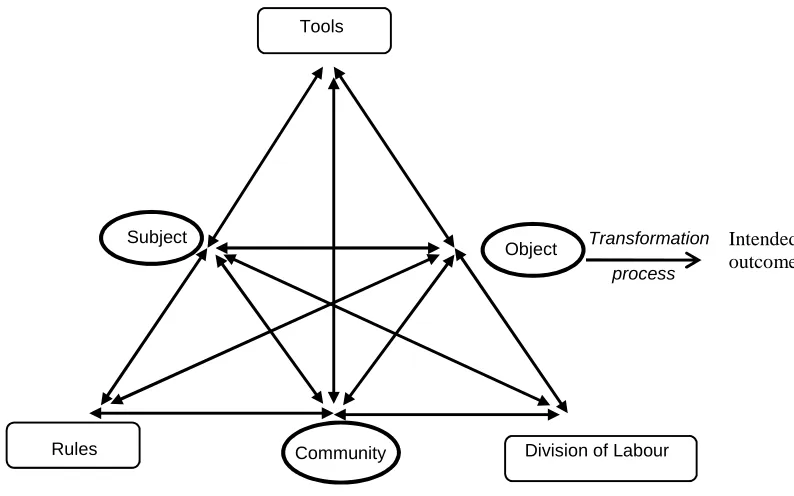
3.2.3 Engeström’s contextualised mediated activity ... 62
3.3 Cultural-historical context and contradictions ... 65
3.3.1 Cultural-historical context ... 65
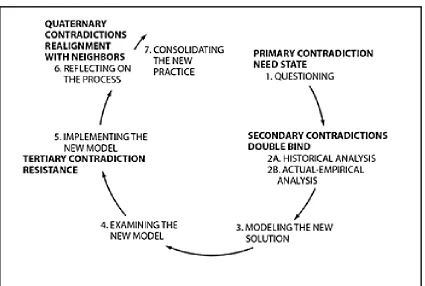
3.3.2 Tensions and contradictions ... 65
3.4.1 The object-oriented activity as the fundamental unit of analysis ... 69
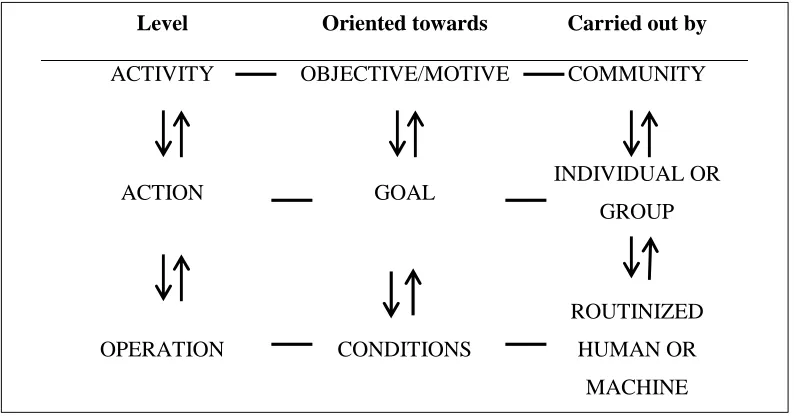
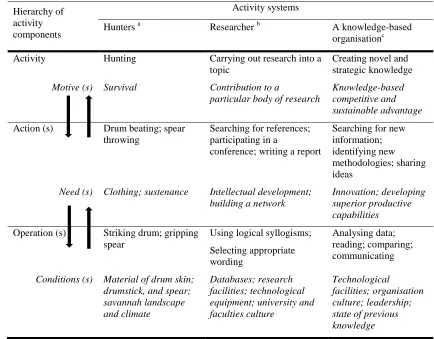
3.4.2 Hierarchical structure of the activity ... 69
3.4.3 Conclusion ... 72
3.5 Designing a conceptual framework for the study of organisational knowing emergence and / or creation ... 72
3.5.1 The seven elements of the activity system ... 73
3.5.2 Representation of the activity system guiding the study ... 75
3.6 Conclusion ... 76
4 - Research Methodology ... 77
4.1 Research problem ... 78
4.1.1 Research objectives ... 78
4.1.2 Research questions ... 79
4.2 The case for asset management firms in Ireland ... 80
4.3 Philosophical perspective ... 83
4.3.1 Questioning the quantitative paradigm ... 83
4.3.2 Questioning the qualitative paradigm ... 84
4.3.3 The case for a realist approach ... 85
4.4 Research strategy ... 89
4.4.1 Retroductive logic and intensive design of the research ... 89
4.4.2 Role of theory ... 90
4.5 Research design ... 92
4.5.1 Case study, critical realism and activity theory ... 92
4.5.2 Case design ... 94
4.6 Data collection ... 100
4.6.1 Case study protocol ... 100
4.6.2 Interviews... 101
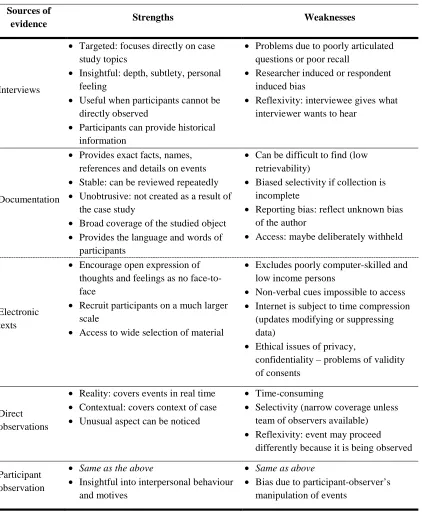
4.6.3 Other data collection methods ... 104
4.6.4 Triangulation and the value of multiple data sources ... 105
4.7 Ethical considerations ... 106
4.7.1 Ethical issues throughout the interview inquiry ... 106
4.7.2 Consent and informed consent ... 107
4.7.3 Confidentiality and anonymity ... 108
4.7.4 Harm ... 109
4.7.5 Pilot case ... 110
4.8 Within case analysis ... 111
4.8.1 Data reduction using the constant comparative method ... 112
4.8.2 Activity system modelling ... 114
4.9 Two-case comparison ... 116
4.10 Evaluating research design ... 116
4.10.1 Possible issues with the research design ... 117
4.10.2 Rigor and validity in qualitative research ... 117
4.11 Conclusion ... 121
5 - Delta Limited case ... 123
5.1 Cultural and historical context... 123
5.2 Characterising DLT’s organisational knowledge base ... 126
5.2.1 Bounding the collection of the data and instrumentation ... 126
5.3 Goal-directed object and intended outcome, KDL subjects and network of
practice ... 129
5.3.1 The goal-oriented object and intended outcome ... 130
5.3.2 The knowing, doing and learning subjects... 134
5.3.3 The network of practice ... 137
5.3.4 Conclusion ... 140
5.4 Emergence and creation of organisatoinal knowing at a collective level ... 141
5.4.1 Subject-object relationship mediated by the KDL framework ... 141
5.4.2 Subject-object relationship mediated by multivoicedness ... 144
5.4.3 Conclusion ... 148
5.5 Emergence and /or creation of organisational knowing at the personal level ... 148
5.5.1 Subject-object relationships mediated by the KDL tools ... 149
5.5.2 Conclusion ... 155
5.6 Tensions and contradictions ... 156
5.6.1 Experience and knowledge, incremental knowledge base ... 157
5.6.2 Structure and infrastructures issues ... 158
5.6.3 KDL subjects and technology intensity ... 161
5.6.4 Tertiary type of contradictions ... 162
5.6.5 Conclusion ... 164
5.7 Conclusion ... 164
5.8 Limitations... 166
6 - KIPOS Limited case ... 167
6.1 Cultural and historical context... 167
6.2 Characterising KPS’ organisational knowledge base ... 171
6.2.1 Bounding the collection of the data ... 171
6.2.2 KPS organisational knowledge characteristics ... 171
6.3 Goal-directed object and intended outcome, KDL subjects and network of practice ... 173
6.3.1 The goal-oriented object and intended outcome ... 174
6.3.2 The knowing, doing and learning subjects... 177
6.3.3 The network of practice ... 180
6.3.4 Conclusion ... 182
6.4 Emergence and creation of organisational knowing at a collective level ... 183
6.4.1 Subject-object relationship mediated by the KDL framework ... 183
6.4.2 Subject-object relationship mediated by multivoicedness ... 186
6.4.3 Conclusion ... 190
6.5 Organisational knowing emergence and / or creation at the personal level ... 190
6.5.1 Subject-object relationships mediated by the KDL tools ... 188
6.5.2 Conclusion ... 197
6.6 Tensions and contradictions ... 198
6.6.1 Structure and infrastructure and KDL subjects ... 198
6.6.2 Structures and infrastructures and goal-oriented object ... 202
6.6.3 Tertiary type of contradictions ... 203
6.6.4 Conclusion ... 204
6.7 Conclusion ... 205
6.8 Limitations... 207
7.1 Contextual considerations ... 209
7.2 Comparing DLT’s and KPS’ organisational knowledge-intensiveness ... 213
7.2.1 Knowledge-based competitive and sustainable advantage ... 214
7.2.2 Structures and infrastructures ... 215
7.2.3 Flexibility ... 216
7.2.4 Firm’s processes ... 217
7.2.5 Entrepreneurship ... 217
7.2.6 Experience and knowledge ... 219
7.2.7 Employees’ specific skill set ... 219
7.2.8 Communications capabilities ... 220
7.2.9 Staff self-development ... 221
7.2.10 Workers’ engagement ... 221
7.2.11 Leadership ... 222
7.2.12 Incremental knowledge base... 223
7.2.13 Collaboration and knowledge sharing ... 224
7.2.14 Outsourcing, in-sourcing and networking ... 225
7.2.15 Market driven ethos ... 226
7.2.16 Industry changes ... 227
7.2.17 Innovation and creativity ... 228
7.2.18 Technology-intensity ... 229
7.2.19 Conclusion ... 230
7.3 Goal-directed object and intended outcome, KDL subjects and network of practice ... 233
7.3.1 The goal-oriented object and intended outcome in DLT and KPS ... 234
7.3.2 DLT’s and KPS’ subjects ... 235
7.3.3 Subject-object relationship mediated by the network of practice ... 235
7.3.4 Conclusion ... 237
7.4 Emergence and creation of organisational knowing within the zone of proximal development ... 239
7.4.1 Subject-object relationship mediated by KDL framework ... 240
7.4.2 Subject – object relationship mediated by multivoicedness ... 241
7.4.3 Conclusion ... 243
7.5 Emergence and creation of organisational knowing within the internal plane of action ... 245
7.5.2 Conclusion ... 250
7.6 Conclusions on the emergence and creation of knowing in the ZDP and the IPA .. 250
7.7 Systemic tensions and contradictions as a source of OK creation... 253
7.7.1 DLT’s tensions and contradictions ... 255
7.7.2 KPS’ tensions and contradictions ... 256
7.7.3 Conclusion ... 257
7.8 Conclusion ... 257
8 - Conclusion ... 261
8.1 Summary of the project ... 261
8.1.1 Research background ... 261
8.1.2 Research problem ... 263
8.1.3 Research strategy ... 264
8.3 Findings relating to the theory of knowledge ... 267
8.3.1 Organisational knowing and organisational knowledge ... 267
8.3.2 Personal knowing and collective knowing ... 268
8.3.3 Knowledge creation, knowing emergence and creation ... 269
8.3.4 Modes of knowledge representation using the organisational knowledge-intensity lens ... 270
8.3.5 Conclusion ... 271
8.4 Findings relating to the theory of the firm ... 271
8.4.1 The question of the boundaries of the firm: the unit of analysis ... 272
8.4.2 Binding and coordinating mechanisms ... 273
8.4.3 Dynamics supporting organisational knowing emergence and creation ... 274
8.5 Concluding remarks on the findings ... 276
8.6 Limitations of the study ... 278
8.7 Directions for future work ... 279
List of Tables
Table 2-1 Major organisational knowledge-intensity characteristics ... 38
Table 3-1 Comparing Nonakian and AT principles ... 58
Table 3-2 A hierarchical distribution of components in an activity system ... 71
Table 4-1 Activity systems analysis and a case study ... 95
Table 4-2 Strengths and weaknesses of five data collection methods ... 104
Table 4-3 Multiple sources of data ... 106
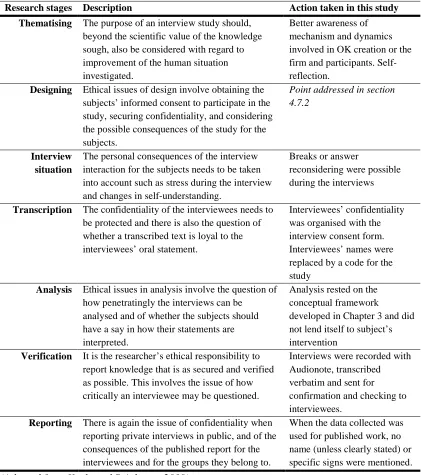
Table 4-4 Ethical issues at seven research stages and action taken ... 107
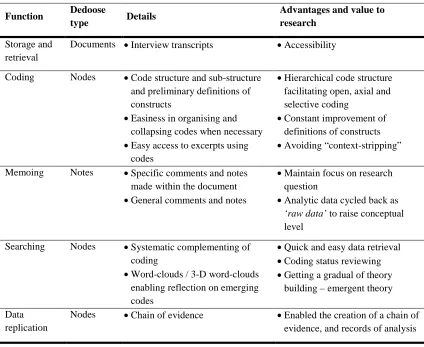
Table 4-5 Main uses of Dedoose for this study ... 114
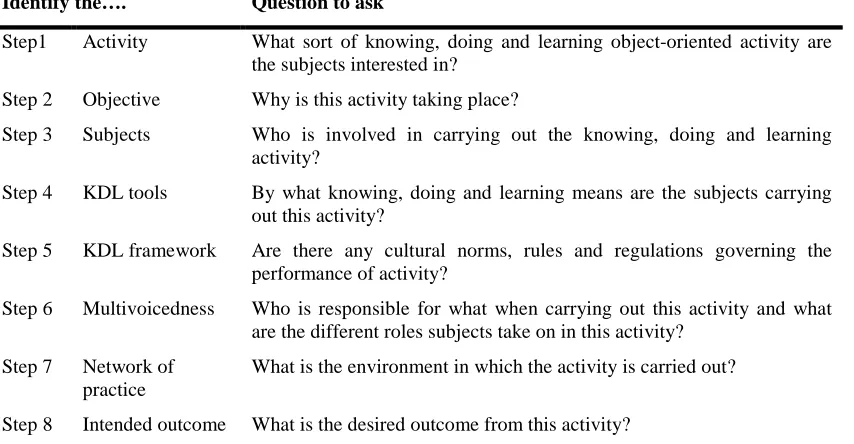
Table 4-6 Eight-step-model for translating activity systems ... 115
Table 4-7 Validity in qualitative research ... 118
Table 7-1 Contextual dynamics: contrasting similarities and differences between cases .... 212
Table 7-2 Organisational knowledge-based characteristics identified for KPS and DLT .... 213
Table 7-3 KPS organisational knowledge-intensiveness: a person-centric orientation ... 231
Table 7-4 DLT’s organisational knowledge-intensiveness: a firm-centric orientation ... 231
Table 7-5 Comparing KPS’ and DLT’s KDL framework and multivoicedness ... 240
Table 7-6 Comparing DLT’s and KPS’ tools and artefacts ... 246
List of figures
Figure 3-1 Vygotsky’s mediated action triangle ... 59
Figure 3-2 Expanded activity theory structure ... 63
Figure 3-3 Network of two interacting activity systems ... 64
Figure 3-4 The cycle of expansive learning ... 68
Figure 3-5 The hierarchical structure of Activity ... 70
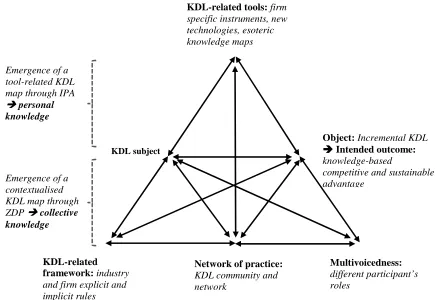
Figure 3-6 Activity system for the understanding of OK emergence and creation ... 75
Figure 4-1 The stratified ontology of critical realism ... 87
Figure 5-1 DLT’s organisational knowledge characteristics ... 128
Figure 5-2 Core of the activity system ... 129
Figure 5-3 Goal-oriented object and intended outcomes for DLT ... 130
Figure 5-4 DLT’s network of practice ... 138
Figure 5-5 Relationships mediated by KDL framework for DLT ... 141
Figure 5-6 DLT: relationships mediated by multivoicedness in the ZPD ... 145
Figure 5-7 KDL tools-mediated relationships ... 149
Figure 5-8 General activity system for DLT ... 156
Figure 5-9 Contradictions and tensions impacting the object ... 164
Figure 5-10 DLT’s general activity system ... 166
Figure 6-1 Themes emerging from selective coding (KPS) ... 172
Figure 6-2 Core of the activity system ... 174
Figure 6-3 Goal-oriented object and intended outcomes for KPS ... 174
Figure 6-4 KPS’ Network of practice ... 180
Figure 6-5 Relationships mediated by KDL framework for KPS ... 183
Figure 6-6 KPS: relationships mediated by multivoicedness in the ZPD ... 186
Figure 6-7 KPS KDL-related tools mediated relationships ... 191
Figure 6-8 General activity system for KPS ... 198
Figure 6-9 KPS’ contradictions and tensions ... 205
Figure 6-10 Contradictions and tensions impacting ... 207
Figure 7-1 Core of the activity system ... 234
Figure 7-2 OK emergence and creation within social context ... 239
Figure 7-3 OK emergence and creation at the personal level ... 245
Figure 7-4 Summary of all mediators for KPS and DLT ... 253
Figure 7-5 Summary of the mediated relationships for DLT and KPS ... 260
List of appendices
Appendix 1 – Attributes characterising KI in organisations: the firm centric approach ... 298
Appendix 2 – Attributes characterising KI in organisations: the person-centric approach ... 300
Appendix 3 – Attributes characterising KI in organisations: shared characteristics ... 303
Appendix 4 – Texts for establishing contacts ... 305
Appendix 5 – Potential benefits of the study ... 306
Appendix 6 – Description of the project ... 308
Appendix 7 – Interviews timetable for DLT ... 310
Appendix 8 – Interviews timetable for KPS ... 311
Appendix 9 – Interview guide ... 312
Appendix 10 – List of documentation for the two companies... 315
Appendix 11 – Consent form ... 316
Appendix 12 – DLT Coding level 1 ... 318
Appendix 13 – DLT Coding: 2nd level – 68 codes ... 321
Appendix 14 – DLT selective coding 19 codes ... 323
Appendix 15 – Definitions finalised for DLT’s themes ... 324
Appendix 16 – DLT staff interviewed profile ... 327
Appendix 17 – DLT supporting tools for building an incremental knowledge base ... 330
Appendix 18 – Extract of excerpts for ‘incremental knowledge based codes’ ... 331
Appendix 19 – KPS staff interviewed profile ... 334
Appendix 20 – KPS Open coding: 91 codes ... 337
Appendix 21 – KPS selective coding: 65 codes ... 339
Appendix 22 – Selective coding (KPS): 19 codes ... 343
Appendix 23 – Comparison of DLT and KPS knowledge bases... 344
Appendix 24 – Extract from definitions construct: comparison between KPS and KDL ... 346
List of abbreviations
ALL: Alpha Limited
AM: Asset Management
AS: Activity System
ASA: Activity System Analysis AT: Activity Theory
AUM: Assets under management
BL: Beta Limited
CB: Central Bank
CDS: Credit Default Swap CEO: Chief Executive Officer CFA: Chartered Financial Analyst CFO: Chief Financial Officer CIO: Chief Investment Officer
CHAT: Cultural-Historical Activity Theory CRM: Customer Relationships Management
DLT: Delta Limited
ETF: Exchanged Traded Funds
EU: European Union
HRM: Human Resources Management IC: Intellectual Capital
IDA: Industrial Development Authority in Ireland IFSC: International Financial Services Centre IPA: Internal Plane of Action
IT: Information Technologies
KPS: Kipos Limited
KBV: Knowledge-based view of the firm KDL: Knowing, doing, and learning KI: Knowledge-intensity
KIF(s): Knowledge-intensive firm(s)
KIBS: Knowledge-intensive business services KIO(s): Knowledge-intensive organisation(s)
KM: Knowledge Management
MD: Managing Director
OK: Organisational Knowing
OKI: Organisational knowledge-intensity
1 -
INTRODUCTION
“We are actually at the beginning of a new scientific era. We are
observing the birth of a science that is no longer limited to idealised and
simplified situations but reflects the complexity of the real world, a
science that views us and our creativity as part of a fundamental trend
present at all levels of nature.”
Prigogine and Stengers (1997: 7)
“What really exists is not things made but things in the making. Once
made, they are dead, and an infinite number of alternative conceptual
decompositions can be used in defining them. But put yourself in the
making by a stroke of intuitive sympathy with the thing and, the whole
range of possible decompositions coming into your possession, you are no
longer troubled with the question which of them is the more absolutely
true. Reality falls in passing into conceptual analysis; it mounts in living
its own individual life-it buds and bourgeons, changes, and creates.”
[Emphasis in the original]
James (1909/1996: 263-264)
buds and bourgeons, changes, and creates’ (James, 1906 / 1996: 264) is a challenging task.
With the exception of Nonaka and Takeuchi (1995) who made a substantial contribution to the field of the knowledge-based view of the firm with their theory of knowledge creation, no further attempt has been undertaken. This is the challenge which will be undertaken in this thesis: to develop a dynamic knowledge-based theory of the firm. It will elicit Cultural Historical Activity Theory (CHAT) (Vygotsky, 1978, Engeström, 1987) as the central theory-method to understand how organisational knowing comes into life. Asset management companies are identified as the empirical field of research as these firms replicate Nonaka and Takeuchi’s (1995) field of study based on ‘old’ industries. These firms are also under-researched from the point of view of knowledge management.
The research question that guides this research is the following:
How can we understand the mechanisms and dynamics of organisational
knowledge emergence and creation in asset management firms using
activity theory?
This introductive chapter presents the background of the study (Section 1.1), the research rationale (Section 1.2), the scope of study (Section 1.3), and the thesis outline (section 1.4) successively.
1.1
B
ACKGROUNDand the services those resources provided. The latter are infinite and ‘mediated by endlessly
extensible body of knowledge management capabilities’ (Spender, 1996: 46). At the centre of
this new development in organisation theory are the concepts of organisational knowledge and its possible creation.
Organisational knowledge
Organisational knowledge was viewed as the conceptual apparatus that permits the interplay between personal knowledge and collective knowledge or knowledge at the level of the individual and knowledge at the level of the group (Nonaka and Takeuchi, 1995). In contrast with Nelson and Winter (1982b) presuming that a firm was able to know independently from its members, Nonaka and Takeuchi (1995) view organisational knowledge as intrinsically depending on its employees’ knowledge while others (Spender, 1996, Tsoukas, 1996, Starbuck, 1992, Drucker, 1999) emphasise the organisational and human nature of knowledge. Accordingly, while he draws on developmental psychologists such as Vygotsky, Spender (1996) adopts a social constructionist position which enabled the focus to be put on the dynamics of the individual’s institutional context and where both individuals and organisations are endowed with knowledge-based identities. Similarly, Tsoukas and Vladimirou (2001: 983) suggested that what makes knowledge distinctively organisational is its possible ‘codification into propositional statements’ underpinned by collective understanding such as rules, while leaving room for individual judgment and the emergence of novelty in a context characterised by open-endedness of the world and historicity. Thus, emphasising an action level, the authors stress the capability members of an organisation have developed to ‘draw distinctions’ or ‘make judgements’ within these contexts. However, despite this distinction between static and dynamic aspects of knowledge, the phrase organisational knowledge prevails supporting the dominance of a positivist epistemology in the field of KBV (knowledge-based view of the firm).
The question of the firm
The two issues underpinning the question of the firm concern its purpose and how it can achieve it when organisational knowledge and knowing are the most strategic firm’s resources and second, its boundaries or how to conceptualise a relevant unit of analysis. In relation to the first issue, Grant (1996) supports the view that the primary role of the firm is to be an integrator of the specialist knowledge embedded in individuals, a purpose to which Spender (1996) adds knowledge creation. These arguments behind the emergence of the knowledge-based view paradigm holds that valuable rent-yielding capabilities must originate within the firm, more precisely from ‘the intangible firm-specific knowledge, which enables it
to add value to the incoming factors of production in a relatively unique manner’ (Spender,
1996:46). Thus, organisational performance and competitive advantage are increasingly knowledge-related issues that rest on the strategic development of unique resources and capabilities (Grant, 1996, Blackler, 1995). Firms are particularly skilled at enabling knowledge sharing and transfer between individuals, groups and organisations (Kogut and Zander, 1992). Against this backdrop, organisations are viewed as the structure and infrastructure or organised activity that provided its members with a given set of cognitive categories and typologies of actions.
boundaries of the firm or in other words, not suggesting an appropriate knowledge-based theory of the firm. This leads us to the second issue concerning the question of the firm. The question of the boundaries of the firm is underpinned by the fact that the theory of organisations fails to provide an approach that can lead to knowledge creation. Tsoukas and Vladimirou (2001) have conceptualised organisation as a combination of concrete settings within which subjects’ action unfold and in which sets of abstract rules are expressed in the form of propositional statement and historical communities. Alternatively, Grant (1996) suggested considering a constellation of product-knowledge associations, Brown and Duguid (2001) a network of practice, Tsoukas (1996) a distributed knowledge system and Spender (1996) a system of knowing activity. Despite these insightful contributions, none provide a satisfactory answer on how to determine a relevant unit of analysis from which to approach the KBV paradigm.
An activity system perspective
Cultural-Historical Activity Theory (CHAT) (Vygotsky, 1978, Engeström, 1987) could be a possible alternative to address the issues identified in the question of a knowledge-based theory of the firm. This theory-method was initially concerned with learning and child development and has been primarily implemented in educational and healthcare environments. However, it is proposed that CHAT provides a comprehensive framework that could accommodate both a theory of knowledge and theory of the firm. Indeed, this methodological perspective suggests a bounded unit of analysis that the activity system represents (Leontiev, 1981, 1974). Further, Vygotsky (1978) relied on two metaphors to underscore the interplay between cognition emergence at a social level (zone of proximal development), and at an individual level (internal plane of action). Within this approach, mechanisms or processes orchestrate the cognitive development underpinned by processes of internalisation and externalisation. Finally, besides these processes, CHAT facilitates consideration of systemic tensions and contradictions as a source of change.
Asset management companies
Finally, few studies were carried out in the asset management or financial industry at large, an
‘old’ sector that is mostly viewed as information-intensive (Alvesson, 2004). Most of the
1.2
R
ESEARCH PROBLEMThe thesis is situated in the literature on knowledge / knowing in organisations, its management and generation. Overall, contributions in the field are fragmented, partial and often bearing the imprint of positivism, reducing knowledge to an object to be studied scientifically (Spender, 1996). Following Brown and Duguid (2001: 198), ‘these contrary
descriptions of knowledge reflect different, partial, and sometimes ‘balkanised’ perspectives
from which knowledge and organisations are viewed’. Indeed, according to the authors,
common images of knowledge in organisations, and models of knowledge creation co-exist in literature and constitute the base of most current speculations. This leads to the emergence of a compartmentalised and static approach on the subject.
The existing models and perspectives suggested in literature and unveiling the intricacies of knowledge management and creation are too prescriptive and tend to be presented as solutions that can be simply implemented in any organisation. These suggestions are often partial and fail to present supporting dynamics and mechanisms such as ‘The
knowledge-creating company’ (Nonaka and Takeuchi, 1995) concepts and principles (Tsoukas, 2005) do.
However, Nonaka and Takeuchi’s (1995) theory was criticised for being too centred on the individual.
These shortcomings and others that will be developed in Chapter 2 prevented the field of the KBV from progressing. Indeed, the kernel of organisational knowledge / knowing emergence and / or its creation should be about understanding the underpinning mechanisms (or the set of processes), and dynamics (or the force that stimulates change or progress within a process). In an attempt to progress the field of the KBV, this thesis suggests implementing a CHAT perspective. In this regard, the following overarching research question was identified:
How can we understand the mechanisms and dynamics of organisational
knowledge emergence and creation using activity theory in asset
management firms?
mediated relationships of which the dynamics have different origins, such as the history of the organisation and goal-oriented activities. Moreover, CHAT lends itself naturally to representing the emergence of personal knowledge within collective settings and on an individual level.
1.3
S
COPE OF THE THESISThis thesis sets out to investigate the generative mechanisms and driving dynamics underlying organisational knowledge / knowing emergence and its creation through the methodological lens of Cultural Historical Activity Theory. Drawing on the works of knowledge management theorists such as Nonaka (1994), Nonaka and Takeuchi (1995), Spender (1996, 1994), Tsoukas (1996), Tsoukas and Vladimirou (2001), and Cook and Brown (1999) but also activity theorists such as Vygotsky (1978), Engeström (1987, 2001) and Barab et al. (2004b), the following research questions were identified to inform the main research question:
RQ1: What are the organisational knowledge characteristics of asset
management firms?
RQ2: How does organisational knowing emerge and /or is created at the
social level (zone of proximal development) in asset management firms?
RQ3: How does organisational knowing emerge and / or is created at the
individual level (internal plane of action) in asset management firms?
The activity theoretical framework developed in this thesis advocates the study of organisational knowing emergence and creation at both the collective and individual levels. The elicited unit of analysis encapsulates the series of direct or indirect goal-oriented actions which subjects perform that exert significant influence on the organisation’s value creation. Within the scope of asset management, these goal-oriented actions stemmed from few senior executives, portfolio managers, traders or compliance managers who were retained as part of the sample. However, the search for a suitable methodology and appropriate methods soon became a research project in itself, as Vygotsky (1978: 64-65) noted:
“The search for method becomes one of the most important problems of
the entire enterprise of understanding the uniquely human forms of
psychological activity. In this case, the method is simultaneously
Indeed, during this research, a number of epistemological and methodological issues arose and had to be addressed if activity theory was to be used beyond the formulation of theoretical arguments on the emergence and the creation of knowledge in organisations, view that prevails in literature (Spender, 2008).
Thus, a methodology enabling a systematic analysis of data is suggested and applied to the study of the emergence and / or creation of knowing in organisations. The adopted methodology allows a description of the complex working environment within which knowledge is created and for the identification of eventual contextual factors stimulating or hindering knowledge emergence and creation. Mechanisms and dynamics between collective and individual actions and dynamics driving the emergence and creation of knowledge are explored.
Provided the requirements of an activity theoretical perspective that requires the inclusion of modes of knowledge representation, the lens of organisational knowledge-intensity in organisations is elicited for identifying these. Finally, the reliance on an activity theoretical interpretative framework presented an opportunity to ‘make sense’ of a rather dispersed and eclectic literature pertaining to organisational knowledge. Activity theory provides a unifying and holistic framework that may be considered in the real world if an organisation wishes to understand how it can create knowledge.
1.4
T
HESIS OUTLINEIn this chapter, the theoretical framework on which this study is based was introduced. It provided some background information about the study of organisational knowledge and knowing, its possible emergence and / or its creation in asset management firms. The research problem that guides the whole study and what is set out to be achieved in this study and how were also presented. The remaining chapters are organised as follows.
Chapter 2 contextualises the study in the relevant literature and is concerned with building a theoretical framework that will inform the operational framework (Chapter 3). Subsequently, to a philosophical discussion on the question of human knowledge, how knowledge has been treated in economic theories and management studies is discussed. More particularly, this chapter concentrates on organisational knowledge and knowing and their possible emergence and / or creation in relation to their epistemological underpinnings. So-called ‘static’ and
‘dynamic’ dimensions of the understanding of knowledge in organisations are outlined while
bases of a theory of knowledge and a theory of the firm as it is derived from the first part. Chapter 2 concludes with the research question(s).
Chapter 3 presents an activity theoretical framework applicable to the understanding of mechanisms and dynamics underpinning organisational knowledge and knowing emergence and / or creation in organisations. Following a summary of some of the main tenets of Vygotsky’s (1978) theories, it explicates the principles of activity theory as it was initially formulated by Leontiev (1978). The expanded activity theory concepts and principles Engeström (1987) enunciated are then discussed and integrated into a theoretical framework which provides the basis of the method that will guide the empirical research.
Chapter 4 considers the epistemological and methodological choices underpinning this study that support the operating framework developed in Chapter 3. More particularly, it introduces critical realism as an adequate philosophy that enables the use of AT in organisational studies, justifying the choice of the two-case comparative study as the most suitable method for this study. It also identifies a suitable unit of analysis and suggests a method to inform activity systems implementation.
Chapter 5 and 6 describe the operationalisation of this research in two different cases. The first case (Chapter 5) details the study of Delta Limited (DLT), an asset management company. The completion of this case was subsequent to a pilot case that was used as a setting for testing the conceptual framework and research methods. The second case delineates the research at Kipos Limited (KPS), another asset management company that is comparable in size to DLT. During the whole course of action, both the conceptual framework and research methods were constantly revised and refined.
Chapter 7 analyses the results of the two cases and sets out to make the two-case comparison. Results are compared with the research questions and the literature.
2 - KNOWLEDGE IN ORGANISATIONS:
A CRITICAL PERSPECTIVE
“Our first intellectual obligation is to abandon the Myth of Stability that
played so large a part in the Modern age: only this can we heal the
wounds inflicted on Reason by the seventeenth-century obsession with
Rationality, and give back to Reasonableness the equal treatment of which
it was for so long deprived […] The ideals of practical thinkers are more
realistic than the optimistic daydreams of simple-minded calculators, who
ignore the complexities of real life, or the pessimistic nightmares of their
critics, who find these complexities a source of despair”
Toulmin (2001: 214)
The objectives of this chapter are three-fold. First, it introduces a review of the literature pertaining to the field of the knowledge-based theory of the firm (Part 1). Second, it presents the theoretical framework that will inform this study (Part 2) before introducing the problem identified and the corresponding research questions (Part 3). In relation to the first sub-section and given the nature of the subject of this thesis, and similarly to the leading authors in the field (Nonaka and Takeuchi, 1995, Spender, 1996, Cook and Brown, 1999, Tsoukas, 1996, Tsoukas and Vladimirou, 2001, Grant, 1996), the philosophical foundations on the treatment of knowledge in the literature are critically reviewed (Section 2.1). Indeed, ‘knowledge is a
highly contentious concept, far too problematic to bear the weight of a useful theory of the
firm without a clear statement of the epistemology which gives it meaning’ (Spender, 1996:
evolution of the literature leading to the advent of the knowledge-based theory of the firm within economy theories (Section 2.3) and organisations and management studies (Section 2.4) is presented. This sub-section traces the evolution of the theme of organisational knowledge creation / integration that led ultimately to the [dynamic] knowledge-based view of the firm, before introducing how this study is positioned in the field, in a third sub-section. Section 2.5 concludes the first part of this chapter. The second part of this chapter (Part II) is dedicated to the presentation of the different facets that have been identified as constituting the basis of a dynamic knowledge-based theory of the firm and that will serve as the theoretical framework for this study. More specifically, the two axioms emerging from the literature as supporting such a theory are the two complementary theories, that of knowledge (Section 2.6) and that of the firm (Section 2.7). Finally, this chapter concludes on how the investigation of the thesis is theoretically and conceptually founded and introduces the research questions (Section 2.8).
PART 1: PHILOSOPHICAL AND THEORETICAL BACKGROUNDS ABOUT KNOWLEDGE IN ORGANISATIONS
2.1
T
HE QUESTION OF KNOWLEDGE IN PHILOSOPHYWhile the question of human knowledge has been posited in terms of ‘what is knowledge’ (Nonaka and Takeuchi, 1995, Grant, 1996, Brown and Duguid, 2001, Orlikowski, 2002), Toulmin (1999) stated that this question has been in deep crisis throughout the 20th century. He situated the roots of this malaise in René Descartes’ Meditations and Discourse where the positivist paradigm originates. This philosophical approach often referred to as classical theories or ‘Newtonian style’ (Cohen, 1994, Toulmin, 1990) whereby organisational studies have adopted the thinking from classical science (Tsoukas, 2016) according to which, scientific research aims at searching for the universal, the general and the timeless (Tsoukas and Dooley, 2011, Tsoukas, 2005, Toulmin, 1990). In reaction to the ‘seventeenth century
obsession with Rationality’ (Toulmin, 2001: 214), Dewey (1929) outlined the intellectual
confusion that is so characteristic of this ‘quest for certainty’ and Wittgenstein (1953) introduced a more general philosophical scepticism against the prevailing positivist paradigm. Finally, drawing on Rorty (1989), Toulmin (1999: 54) admitted that the works of these writers eventually ‘destroyed the program for finding ‘unshakeable foundations’ for human
successors. That program having run into the sand, the whole epistemological agenda now
needs to be reformulated’.
Nonaka and Takeuchi (1995: 20-50) discussed the imprint of positivism or the Western epistemology on management and organisational studies and how it has prevented scholars from identifying a dynamic theory of knowledge creation. This approach is widely echoed in the related literature with Spender (1996: 49) suggesting that we need to identify a different kind of epistemology ‘to move beyond the Kantian synthesis’. More specifically, activity theory or cultural historical activity theory (CHAT) originating in the works of L. S. Vygotsky and his followers in post-revolutionary Soviet psychology is presented as a way out of the conundrum related to the question of human knowledge in organisations (Toulmin, 1999). Drawing on Guy (2005) and Toulmin (1999), it is suggested to reconsider the German classical philosophical tradition of Kant and Hegel and, more particularly, one of its developments, the Marxist-Leninist tradition of dialectic historical materialism that gave birth to the concept of activity in Soviet psychology (Wertsch, 1979). Similar to Nonaka and Takeuchi (1995) and Spender (1996), it is believed that new insights in the field of the [dynamic] knowledge-based view of the firm will emerge from reflecting on the influence of the positivist paradigm and its limitations.
2.1.1 Limitations of the positivist epistemology
Many authors have criticised the positivist impact on the epistemology of knowledge in organisations. First, Spender (1996: 47) underscored how ‘organizational theorists have
constrained their theorizing by adopting a positivist theory of knowledge that takes little
account of the millennia of debate about the problematic nature of human knowledge’.
Accordingly, the prevailing ‘conventional rational-cognitive assumptions about management
and organisations’ (Blackler, 1993: 863) have led to an objectification of knowledge
(Spender, 2011). This approach translates into a static approach on knowledge generally resulting in classifications of knowledge into different types or taxonomies (Tsoukas, 1996). In this regard, Spender (2006: 24) concludes that ‘the knowledge-based approach becomes a
critique of the rationality-based approach’.
Tsoukas (2016: 6) has highlighted that the Newtonian style adopted in organisational studies has consequences for how we understand phenomenon or an object of study at three levels. (i) Ontologically, ‘organisational phenomena are thought to be discrete entities with certain
pre-given properties, existing independently of the observer, which can be captured by the human
mind’; (ii) Epistemologically, pre-given features or representations of these phenomena are
basis of the systematic relationships formally established. Practitioners relate to knowledge
instrumentally: they use it just like they use any other instrument to achieve a purpose.
Knowledge is external to users’. Hence, drawing on Tsoukas and Cummings (1997), Tsoukas
(2016) argued that the Newtonian style aims at ‘decontextualizing’ its object of study to reveal its inherent properties. This gives it a disjunctive nature that separates the knower from the phenomenon to be known, and separates facts from value (Morin, 2008). Thus, attempts to explain a phenomenon are operated ‘through constructing an idealised model that
abstracts away from the complexities of the real world, especially context, value and time, in
order for certain regularities to be identified’, in other words, theorising is simplified and
fails to cope with the complexity of the world (Tsoukas, 2016: 6) as it has left out context, uniqueness, process and time (Starbuck, 2006).
Second, organisations and management studies are practice-oriented fields and theories should serve this orientation (Toulmin, 1999, Tsoukas, 2016, Nonaka and Takeuchi, 1995). Thus, time is of particular importance to acknowledge the dynamic nature of a phenomenon studied by strategy researchers (Tsoukas, 2016) and most theorizing is ill conceived to handle time unless the phenomena is decontextualized and approached in an abstract manner (Sandberg and Tsoukas, 2011, Guerlac, 2015). In this regard, scholars should take account of the ‘understanding backwards – living forward’ dialectic or
‘life-as-scholastically-represented and life-as-experience’. The tension existing between the two extremes is
generally ignored by the proponents of scientific rationality; ‘life is understood ‘backward’
when detached theorists abstract and simplify what practitioners were experiencing while
they were living it ‘forward’ (Tsoukas, 2016: 3). In consequence, ‘simplified’ theories that are
characteristic of a Newtonian style, fail to capture the ‘understanding backward - living
forward’ dialectic so central to management scholars’ study. An alternative ‘system of
picturing’ to [this] hitherto dominant reductionist-cum-disjunctive system’ would stem from
complex theorising (Tsoukas, 2016: 17).
Third, Toulmin (1999: 54) introduced two important elements in this critique of positivism. First, he argued that the promising discussions that started with Descartes eventually
‘shipwrecked in the end’ because of the ‘excessively individualistic – if not narcissistic –
nature of the philosophers’ agenda’. The central question within this narcissistic view is ‘how
each human, as an individual, can arrive at any well-founded, even certain, knowledge about
the world’. Thus, the way the relationship between ‘the knowledge’ as the possession of
individuals and ‘knowledge’ as the collective property of communities of ‘knowers’ was
handled was not convincing.
discredited the ideas of the 17th century epistemology when he investigated the reasons of the intersubjectivity of all our knowledge, concepts, and judgments: ‘all such units of
understanding obtain their meaning by entering language not via the minds of single
individuals but within ‘forms of life’ (Lebensformen) that are essentially collective. As a
result, the origin of any individual’s questions and judgments is defined by the current state of
the art in the relevant field of inquiry, what Fleck (1981) calls the Wissensstand’.
At this stage of the philosophical development in the field of human knowledge, Toulmin (1999: 55) suggests that we need to address the following scientific question: ‘how is it, then,
that individuals can be successfully socialised, or enculturated, into the shared Wissensstand
of any particular culture or profession?’
Finally, the treatment of the question of human knowledge and the mental activity introduced by Michel de Montaigne’s Essais needs to be addressed. He insisted on the interiority of all mental events, a view that is still influential among scientific writers today. According to Toulmin (1999: 56-57), ‘the supposed interiority of mental life is an inescapable feature of
the natural processes in our brain and central nervous system’ is central to the theory; so, ‘if
our mental lives are trapped within our brains, they are thus trapped there from birth’. These
assertions still prevailing today make ‘the inner-outer1 problem as it arises in cognitive psychology and epistemology’ a ‘by-product of the basic assumption of the 17th century
mechanical theory’. Within this approach, human senses are viewed as ‘obstacles’ to be
penetrated or surmounted if one wishes to establish a connection between his inner mental life and with the outside world, instead of ‘instruments that help us acquire knowledge of the
world’.
Accordingly, the academic contributions that have gradually led to the consolidation of the dynamic knowledge-based theory of the firm did so while criticising the Cartesian approach and its legacy of the treatment of human knowledge in organisations. Therefore, we can conclude that a positivist epistemology is too restrictive for the study of knowledge in organisations.
2.1.2 Alternatives to the positivist paradigm
Two major perspectives can be considered for addressing knowledge in organisations, alternatives that would be free from the limitations of the positivist paradigm. The first one is introduced by Nonaka and Takeuchi (1995) in their influential book The Knowledge-creating
company: how Japanese companies create the dynamics of innovation. Nonaka and Takeuchi
(1995) criticised the reliance of management studies on the positivist paradigm and its
treatment of knowledge in organisations and proposed the Japanese philosophical tradition instead. The foundations of Japanese thinking rest on a holistic approach of life delineated in terms of ‘oneness of humanity and nature’; ‘oneness of body and mind’; and ‘oneness of self
and other’ (Nonaka and Takeuchi, 1995: 27). In that sense ‘the ultimate reality’ in this
philosophy ‘lies in the delicate, transitional process of permanent flux, and in visible and
concrete matter (…). They see reality typically in the physical interaction with nature and
other human being’ (Nonaka and Takeuchi, 1995: 31-32). This philosophical approach
suggests that the collective and individual dimensions of knowledge, the importance of its contextualisation, the experiential and ‘lived’ nature of knowledge, and the centrality of processes and relationships between people and the environment assist in seeing reality and subsequently in constructing their own ‘justified true belief’.
Toulmin (1999) relying on ideas developed by Luria (1973) and Vygotsky (1978) proposes a second interesting alternative to explore how human knowledge crystallises in people’s brains. Vygotsky’s activity theory is a theory-method that draws on the Marxist understanding of mind (or consciousness) as inseparable from the material conditions of human existence. This view is a challenge to Cartesian dualism or separation of mind and bodily existence (Guy, 2005). Indeed, ‘life is not determined by consciousness, but
consciousness by life. In the first method of approach, the starting point is consciousness
taken as the living individual; in the second method, which conforms to real life, it is the real
living individuals themselves, and consciousness is considered solely as their consciousness’
(Marx and Engels, 1970: 47). In contrast with Descartes’ formulation ‘cogito, ergo sum’2, consciousness does not have an autonomous existence independent of the lives of people.
‘Consciousness is the product of man’s practical activity (labour) as he goes about
producing the means of this existence’; thus, the natural and material world is transformed in
order for the individual to produce what she or he needs and ‘in so doing transforms himself’ [emphasis added] (Guy, 2005: 50). Because production and the forms of social organisation that characterises different levels of production evolve in time, so-called human nature is historically specific. Thus, all human activity is potentially revolutionary as it has a transformative effect on both the world and the human mind through the dialectical relationship between the two (Guy, 2005). This transformation of individual consciousness through practical collective activity is also called ‘expansive learning’ (Engeström, 1987). Integral part to the dialectical materialism is Marx’s historical empirical method of inquiry3.
2 ‘I think, therefore I am’. 3
This is where activity theory has its origins, where Vygotsky adopted Marx’s conception of activity as being revolutionary, practical-critical activity but also his methodological approach (Guy, 2005).
Following this line of activity theoretical theorising on human cognitive development and drawing on Wittgenstein (1953), Toulmin (1999: 58) stated that knowledge cannot be treated as ‘the possession of individuals’ as these internalised meanings are created in ‘the public
domain in the context of collective situations and activities’. Meanings are internalised
through learning processes where language plays the major role. On this point, drawing on Vygotsky (1978), Toulmin (1999: 58) states that ‘language is the instrument that we use,
during enculturation and socialization, (…) to internalise the meanings and patterns of
thoughts that are current in our culture or profession. In this way, we ‘make up’ our own
minds and, in time, acquire inner experiences modelled on the public activities of our culture
and society’. Both Vygotsky (1978) and Luria (1973) establish unequivocally that the term
internalisation concerns a variety of cases and procedures. As such, we learn to do sums ‘in
our head’ instead of on the paper; we ‘read to ourselves’ and get information from the
material more quickly than when reading aloud. We also learn ‘to think to ourselves’ and manage to conceal plans from others. Finally, we learn ‘to judge to ourselves’ inwardly. Thus, internalisation is far from being a single, clear-cut procedure. It embodies a family of techniques that make mental life and activity more efficacious in a number of very different ways (Toulmin, 1999: 59).
Luria (1973) provided new insights on how pure mental processes enter cognitive activity. More specifically, contradicting the idea that human senses are an obstacle that stands between the ‘knowing mind’ and the ‘knowing world’, the author considers ‘the intellectual
activity to the entire human beings and so call into play appropriate parts of the higher
nervous system’ (Toulmin, 1999: 59). Tsoukas (2016: 17) appears to concur stating in relation
to knowledge in organisations that ‘knowledge is the outcome of embodied knowers who are
embedded within a discursive practice, on whose cognitive, affective and normative resources
they routinely draw’.
2.1.3 Conclusion
limited. Drawing on Chohmin Nakae5, the two Japanese authors pointed to the fact that
‘Japan has never created any philosophy since its foundation’6. Thus, it can be reasonably argued that their approach lacks the rigour of a true philosophy being tightly related to a Japanese culture, making it hardly transferable to other non-Japanese intellectual traditions. In contrast with Vygotksy’s approach, Nonaka and Takeuchi’s (1995) holistic intellectual tradition does not provide clear insight on the content and meanings of the ‘oneness of
humanity and nature’. A direct consequence is the formulation of Nonaka and Takeuchi’s
theory of organisational knowledge creation in terms of input-output where tacit knowledge is transformed into explicit knowledge through opaque processes. They do not provide methodological insights nor take account of historical developments of circumstances that would help study human knowledge in organisations. Therefore, their approach to knowledge creation is both restrictive and prescriptive as they translate a theory into an ideal model to be followed in order to create knowledge, which could be said to be Newtonian in approach.
This thesis elicited Vygotsky’s (1978) theory-method of activity as it emerges from a strong philosophical tradition, the Marxist dialectical historical materialism that provides principles, method and a history of experimentation (in economics and in psychology). Vygotsky not only adopted Marx’s conception of activity but also his methodological approach with the objective of applying the dialectical Marxian method to the study of mind (Guy, 2005). This, combined with the line of reasoning Toulmin (1999) developed that involves implementing an activity theoretical approach can be qualified as a complex theorising and is conjunctive by nature. Following Tsoukas (2016: 17-18), such a complex ‘system of picturing’ consists of (i) an open world ontology; (ii) a performative epistemology and (iii) a poetic praxeology. (i) An open ontology posits that the world is changing perpetually and that it holds unforeseen events and ‘holds the possibility of non-trivial surprises’. (ii) Knowing is action whereby
‘agents bring the world forward by making distinctions and giving form to a collectively held,
unarticulated background or understanding’. Practice is very central in the works of
Vygotsky and Wittgenstein although they never met in real life. The language that constructs meaning ‘is determined by its place in a given typified action sequence’. (iii) The practitioner is a non-trivial agent. From within the circumstances or discursive practices she or he is embedded into, this agent influences these in return while drawing on his experience to make a decision ‘through undertaking a purposive action that is relatively opaque in its
consequences, variably clear in its motives and desires, and contextually situated’.
5 Chohmin Nakae is a liberal thinker who led the ‘freedom and people’s right movement’ in the Meiji
era (1868-1912) – See Nonaka and Takeuchi (1995: 52) – Note 20.
6 Quotation borrowed from Nakamura (1967: 174) Introduction to philosophy. Tokyo: Chuo Koronsha
Thus, similar to Tsoukas (2016) and drawing on the broader framework of activity theory, Toulmin (1999: 62) emphasises the importance of practice and acknowledges that it should take precedence over theorising and generalising in any new theory of knowledge. A new praxeology asking what procedures are the most efficacious in any given rational enterprise, on what conditions, and for what practical purposes is required. Hence, the ideas of Vygotsky and Luria open an interesting and possible avenue for further research on knowledge in organisations. Indeed, the ‘rationality of a scientific or judicial procedure, say, is not a matter
of clarity and distinctness or logical coherence alone. Rather, it depends on the way in which
these procedures develop in the historical evolution on any given discipline’ [emphasis
added] (Toulmin, 1999: 60).
To further the field of the dynamic knowledge-based theory of the firm, this thesis endeavours to follow up on the insights Vygotsky, Luria and other scholars such as Leontiev and Engeström, developed. This opportunity emerges from intersecting developmental psychology, management and organisations theories, and to a lesser extent, economy theory. In consequence, the next sections present how human knowledge is approached in development psychology (Section 2.2), in economic theory (Section 2.3) and in theory of organisations (Section 2.4). Section 2.5 concludes these developments
2.2
K
NOWLEDGE IN DEVELOPMENTAL PSYCHOLOGYWithin the field of developmental psychology where the study of human cognition development is central, the question of human knowledge, or rather ‘knowing’, is approached primarily in terms of ‘mechanisms’. Accordingly, Vygotsky (1978) and his followers are more concerned with understanding how knowing occurs and how it is shaped. In this regard and drawing on one of his previous works (Engeström, 1995), Engeström (1999: 377) refers to organisational knowledge creation (using the jargon of organisational and management studies) as ‘innovative organisational learning’, a phrase that he investigated and defined as
‘collaborative learning in work organisations that produces new solutions, procedures, or
systemic transformations in organisational practices’. Moreover, based on Leontiev (1978),
Engeström (1987) and Cole and Engeström (1993), Engeström (1999: 380) underscored the dynamic and ‘oriented’ nature of knowing while acknowledging that ‘human cognition and
behaviour as embedded in collectively organised, artefact-mediated activity systems’. In that
sense, activities are ‘social practices orientated at objects. An entity becomes an object when