Jason P. Byrne, B.A.(Mod.)
School of Physics
University of Dublin, Trinity College
A thesis submitted for the degree of
PhilosophiæDoctor (PhD)
September 2010
at Earth and other locations in the heliosphere, so it is important
to understand the physics governing their eruption and propagation.
However the diffuse morphology and transient nature of CMEs makes
them difficult to identify and track using traditional image
process-ing techniques. Furthermore, the true three-dimensional geometry
of CMEs has remained elusive due to the limitations of coronagraph
plane-of-sky images with restricted fields-of-view. For these reasons
the Solar Terrestrial Relations Observatory (STEREO) was launched
as a twin-spacecraft mission to fly in orbits ahead and behind the
Earth in order to triangulate independent observations of CME
struc-ture. It is the first time CMEs have been observed from vantage points
off the Sun-Earth line and each spacecraft carries an instrument suite
designed to image from the low solar corona out to the orbit of Earth
in order to observe and study CME propagation towards Earth.
In this thesis the implementation of multiscale image processing
tech-niques to identify and track the CME front through coronagraph
im-ages is detailed. An ellipse characterisation of the CME front is used
to determine the CME kinematics and morphology with increased
precision as compared to techniques used in current CME catalogues,
and efforts are underway to automate this procedure for applying to
a large number of CME observations for future analysis. It was found
that CMEs do not simply undergo constant acceleration, but rather
were derived from plane-of-sky measurements with no correction for
how the true CME geometry and direction affect the kinematics and morphology observed.
With the advent of the unique dual perspectives of the STEREO
spacecraft, the multiscale methods were extended to an elliptical
tie-pointing technique in order reconstruct the front of a CME in three-dimensions. Applying this technique to the Earth-directed CME of
12 December 2008 allowed an accurate determination of its true
kine-matics and morphology, and the CME was found to undergo early
acceleration, non-radial motion, angular width expansion, and
aero-dynamic drag in the solar wind as it propagated towards Earth. This
study and its conclusions are of vital importance to the fields of space
weather monitoring and forecasting.
*This is the online version of this thesis which has reduced quality
I am hugely grateful to my supervisor Peter Gallagher. You have been a constant source of inspiration, and it has been an absolute pleasure
to work with you.
A big thank you goes to Alex Young for your guidance and support
during my time at Goddard. Working in NASA was everything I could have hoped it would be. Thank you also to James McAteer,
Jack Ireland, Angelos Vourlidas, everyone in the SOHO and STEREO
teams and extended Goddard network. Your guidance and helpful
discussion have been invaluable.
A collective thank you goes to Shane Maloney, James McAteer, Jose Refojo and Peter Gallagher for the huge amount of time and effort
you contributed to achieving the final stages of work in this thesis.
A massive thank you goes to all the staff and students in the
Astro-physics Research Group in Trinity College, including those who have
since left. You made my time here as enjoyable as possible, and I’m sorry it has to come to an end.
And finally, a heartfelt thank you to my friends and family. You mean
List of Figures xi
List of Tables xxxi
1 Introduction 1
1.1 The Solar Interior . . . 2
1.2 The Solar Atmosphere . . . 7
1.2.1 Photosphere . . . 8
1.2.2 Chromosphere . . . 9
1.2.3 Corona . . . 12
1.2.4 Solar Wind . . . 16
1.2.5 Space Weather . . . 20
1.3 Coronal Mass Ejections . . . 23
1.3.1 Magnetohydrodynamic Theory . . . 26
1.3.1.1 Maxwell’s Equations . . . 26
1.3.1.2 Fluid Equations . . . 27
1.3.1.3 The Induction Equation . . . 28
1.3.1.4 The Magnetic Reynolds Number . . . 29
1.3.1.5 Magnetic Reconnection . . . 30
1.3.2 Theoretical CME Models . . . 33
1.3.2.1 Catastrophe Model . . . 36
1.3.2.2 Toroidal Instability . . . 38
1.3.3 CME Observations . . . 44
1.3.3.1 Thomson Scattering . . . 44
1.3.3.2 CME Kinematics & Morphology . . . 50
1.4 Outline of Thesis . . . 59
2 Instrumentation 61 2.1 SOHO/LASCO . . . 62
2.2 STEREO/SECCHI . . . 66
2.2.1 EUVI . . . 68
2.2.2 COR1 . . . 69
2.2.3 COR2 . . . 71
2.2.4 Heliospheric Imagers . . . 71
2.3 CCD Detectors . . . 74
2.4 Coordinate Systems . . . 78
2.4.1 Heliographic Coordinates . . . 78
2.4.2 Heliocentric Coordinates . . . 79
2.4.2.1 Heliocentric Earth Equatorial (HEEQ) . . . 80
2.4.2.2 Heliocentric Earth Ecliptic (HEE) . . . 80
2.4.2.3 Heliocentric Aries Ecliptic (HAE) . . . 80
2.4.3 Helioprojective Coordinates . . . 81
3 Detecting and Tracking CMEs 83 3.1 CME Detection Catalogues . . . 84
3.1.1 CDAW . . . 85
3.1.2 CACTus . . . 86
3.1.3 SEEDS . . . 89
3.1.4 ARTEMIS . . . 91
3.2 Multiscale Filtering . . . 94
3.3 Automated Multiscale CME Detection . . . 99
3.3.1 Normalising Radial Graded Filter (NRGF) . . . 100
3.3.2 Thresholding . . . 102
3.3.3 Faint CMEs and Streamer Interactions/Deflections . . . . 107
4.2.1 3-Point Lagrangian Interpolation . . . 118
4.3 Results . . . 121
4.3.1 Arcade Eruption: 2 January 2000 . . . 122
4.3.2 Gradual/Expanding CME: 18 April 2000 . . . 124
4.3.3 Impulsive CME: 23 April 2000 . . . 127
4.3.4 Faint CME: 23 April 2001 . . . 127
4.3.5 Fast CME: 21 April 2002 . . . 130
4.3.6 Flux-Rope/Slow CME: 1 April 2004 . . . 130
4.3.7 STEREO-B Event: 8 October 2007 . . . 132
4.3.8 STEREO-A Event: 16 November 2007 . . . 135
4.4 Discussion & Conclusions . . . 135
5 Propagation of an Earth-Directed CME in Three-Dimensions 139 5.1 Introduction . . . 140
5.2 The STEREO Era . . . 142
5.3 Elliptical Tie-Pointing . . . 147
5.3.1 SOHO as a Third Perspective . . . 151
5.4 Earth-Directed CME . . . 153
5.5 Results . . . 163
5.5.1 3D Error Propagation . . . 165
5.5.2 Prominence & CME Acceleration . . . 167
5.5.3 Non-radial Prominence & CME Motion. . . 167
5.5.4 CME Angular Width Expansion . . . 170
5.5.5 CME Drag in the Inner Heliosphere . . . 171
5.5.6 CME Arrival Time . . . 173
5.5.7 CME ‘Pancaking’ . . . 176
6 Conclusions & Future Work 183
6.1 Principal Results . . . 183
6.2 Future Work . . . 187
6.2.1 Automation . . . 188
6.2.2 Ridgelets/Curvelets . . . 193
6.2.3 3D CME Reconstruction . . . 196
6.2.4 Deriving CME Kinematics . . . 200
lagher, P. T.
“Propagation of an Earth-directed coronal mass ejection in three-dimensions”
Nature Communications, 1:74 doi: 10.1038/ncomms1077 (2010).
2. Gallagher, P. T., Young, C. A., Byrne, J. P. & McAteer, R. T. J.
“Coronal mass ejection detection using wavelets, curvelets and ridgelets:
Applications for space weather monitoring”
Advances in Space Research, doi: 10.1016/j.asr.2010.03.028 (2010).
3. Mierla, M., Inhester, B., Antunes, A., Boursier, Y.,Byrne, J. P., Colaninno,
R., Davila, J., de Koning, C.A., Gallagher, P.T., Gissot, S., Howard, R.A.,
Howard, T.A., Kramar, M., Lamy, P., Liewer, P.C., Maloney, S., Marqu´e,
C., McAteer, R.T.J., Moran, T., Rodriguez, L., Srivastava, N., St. Cyr,
O.C., Stenborg, G., Temmer, M., Thernisien, A., Vourlidas, A., West, M.J.,
Wood, B.E. & Zhukov, A.N.
“On the 3-D reconstruction of coronal mass ejections using coronagraph
data”
Annales Geophysicae, 28,203–215 (2010).
4. Byrne, J. P., Gallagher, P. T., McAteer, R. T. J. & Young, C. A.
“The kinematics of coronal mass ejections using multiscale methods”
5. P´erez-Su´arez, D., Higgins, P. A., Bloomfield, D. S., McAteer, R. T. J.,
Krista, L. D., Byrne, J. P. & Gallagher, P. T.
“Automated Solar Feature Detection for Space Weather Applications”
in Qahwaji, R., Green, R. & Hines, E. [Eds] Applied Signal and Image Processing: Multidisciplinary Advancements, IGI, in press.
Contributed
1. Byrne, J. P., Young, C. A., Gallagher, P. T. & McAteer, R. T. J.
“Multiscale Characterization of Eruptive Events”
In S. A. Matthews, J. M. Davis & L. K. Harra, eds., First Results from
Hinode, vol. 397 of Astronomical Society of the Pacific Conference Series,
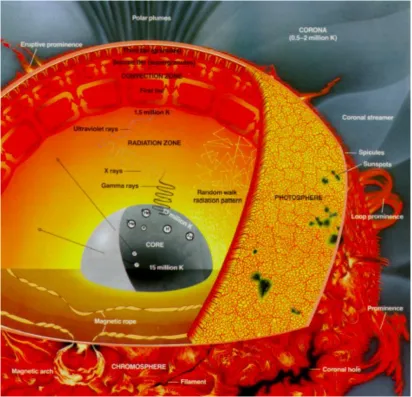
ported from the core by radiative processes in the radiation zone.
The convection zone is heated from the base at the tachocline,
al-lowing convective currents to flow to the photosphere. Locations
of strong magnetic fields inhibit convection and appear as dark
sunspots on the photosphere. These strong magnetic fields
ex-tend into the upper atmosphere of the Sun, responsible for coronal
loops, prominences and streamers.
Image credit: eu.spaceref.com. . . 3
1.2 Illustration of theαΩ effect of winding-up magnetic field due to the
differential rotation of the Sun, reproduced from Babcock (1961).
Sunspots visible on the disk are as a result of protruding field with
positivep and negative f polarity as shown. . . 7
1.3 A 1D static model of electron densityNe [cm−3] and temperature
Te[K] profiles in the solar atmosphere, reproduced from Gabriel &
Mason (1982). In the chromosphere, the plasma is only partially
ionised. The plasma becomes fully ionized at the sharp transition
from chromospheric to coronal temperatures. . . 9
1.4 Plasma β as a function of height for a regime of magnetic field
strengths between ∼100 and ∼2,500 G, reproduced from Gary
(2001). The dotted lines segregate the layers of photosphere (β >
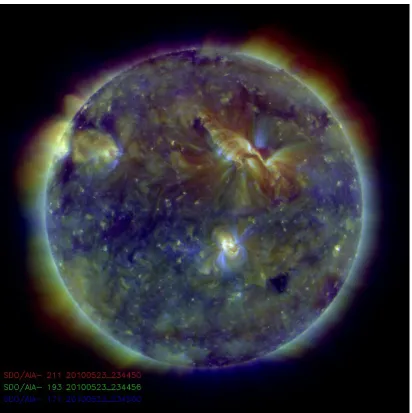
1.5 Composite EUV image of the low solar corona recorded by the
At-mospheric Imaging Assembly (AIA) onboard the Solar Dynamics
Observatory (SDO) on 23 May 2010.
Image credit: http://sdowww.lmsal.com/ . . . 13
1.6 The five classes of Parker’s solar wind solution for a steady,
spher-ically symmetric, isothermal outflow. . . 17
1.7 Schematic of the Parker Spiral in the heliosphere. The streamlines
of the solar wind act to drag out the magnetic field lines of the
Sun, which become wound up in an Archimedean spiral as a result
of the Sun’s rotation.
Image credit: Steve Suess, NASA/MSFC. . . 19
1.8 The Aurora Borealis, or Northern Lights, photographed above
Bear Lake, Eielson Air Force Base, Alaska. Aurorae result from
photon emissions of excited oxygen and nitrogen atoms in the
Earth’s upper atmosphere, as a result of geomagnetic storms and
space weather.
Image credit: Joshua Strang via Wikimedia Commons. . . 21
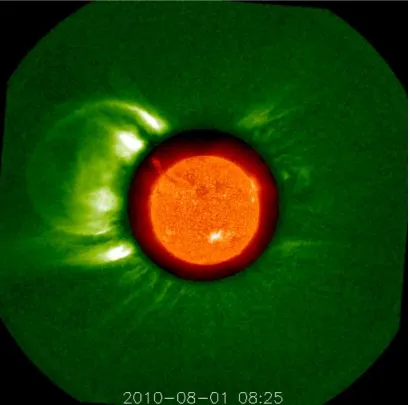
1.9 Observation of a CME and prominence lift-off from the EUVI and
COR1 instruments of the SECCHI suite on board the STEREO-A
spacecraft. The field-of-view extends to ∼4 R. The complexity
of the magnetic field driving the eruption is clearly indicated by
the twisted geometry of the bright ejecta.
Image credit: http://stereo.gsfc.nasa.gov/ . . . 24
1.10 Geometry of the Sweet-Parker (top) and Petschek (bottom)
recon-nection models, reproduced from Aschwanden (2005). . . 31
1.11 Illustrations of the different mechanical analogues of CME
erup-tions, reproduced from Klimchuk (2001). . . 34
1.12 Theoretical evolution of a 2D flux rope, reproduced from Forbes
& Priest (1995). The flux rope footpoint separation λ decreases,
increasing the magnetic pressure until the flux rope becomes
unsta-ble and erupts away from the surface (b – d). The resulting height
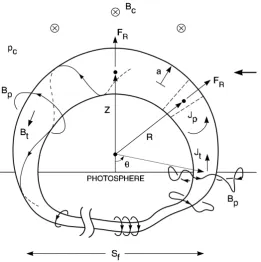
ent coronal magnetic fieldBcand plasma density ρc. Components
of the current density J and magnetic field B are shown, where
subscripts ‘t’ and ‘p’ refer to the toroidal and poloidal directions
respectively. The flux rope has a radius of curvatureR, radius of
cross-section a, apex height Z, footpoint separation sf, and the
radial force outward is FR. . . 39
1.14 Schematic, and corresponding simulation snapshots, of the main
stages of the axisymmetric 2.5D breakout model, reproduced from
Lynch et al. (2008). (a) shows the initial multipolar topology of
the system, (b) shows the shearing phase which distorts the X-line
and causes breakout reconnection to begin, (c) shows the onset
of flare reconnection behind the eruption that disconnects the flux
rope, and (d) shows the system restoring itself following the eruption. 42
1.15 The Thomson scattering geometry for a single electron, reproduced
from Howard & Tappin (2009). a) shows the electron and incident
light with different observer positions indicated. b), c), d) show
the resultant unpolarised, partially polarised, and polarised
scat-tering of light seen by observers O1, O2, O3 respectively. . . 45
1.16 Schematic of the Thomson surface, being the sphere of all points
which are located at an angle of 90◦ between the Sun and the
observer, reproduced from Vourlidas & Howard (2006). An
exam-ple line-of-sight is shown for an electron at point P, with radial
distancer from the Sun, at longitude φ relative to the solar limb. 47
1.17 (a) Synthetic coronagraph image of the model flux rope, deduced
from the integrated line-of-sight electron density, including a
con-sideration of the Thomson scattering geometry. (b) The flux rope
model represented by a mesh of helical field lines. Point A marks
the true apex of the model. The axes are in units of R.
1.18 Three example CME observations (off the limb, partial halo, and
full halo) and schematics showing how measurements of the
plane-of-sky velocityVP S and expansion velocityVexp are skewed by
pro-jection effects, reproduced from Schwennet al. (2005). . . 50
1.19 The CME velocity profile, and associated soft X-ray flare profile,
for the event on 11 June 1998, reproduced from Zhanget al.(2001).
The profiles indicate a three-phase scenario of CME evolution:
ini-tiation, impulsive acceleration, and propagation. The datapoints
are from LASCO/C1 (asterisks), C2 (triangles) and C3 (squares). 52
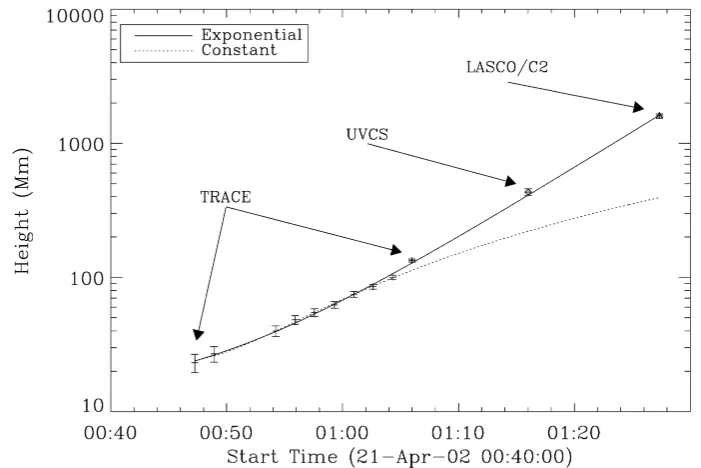
1.20 Height-time evolution of a CME observed with TRACE, UVCS
and LASCO/C2 on 21 April 2002, reproduced from Gallagheret al.
(2003). The datapoints have ±5 pixel errorbars, and the best fits
for an exponential varying and constant acceleration are plotted
for comparison. . . 53
1.21 (a) Height-time, (b) velocity and (c) acceleration profiles for the
CME on 21 April 2002, and (d) the GOES-10 soft X-ray flux for
the associated X1.5 flare during the interval 00:47 – 03:20 UT,
re-produced from Gallagher et al. (2003). A three-point difference
scheme is used on the data points, and a first-difference scheme is
plotted with filled circles. The solid line is the best fit of the
ex-ponentially increasing and decreasing acceleration of Equation 1.55. 54
1.22 The kinematics of the CME leading edge (circles), cavity (pluses)
and prominence (triangles) of the 15 May 2001 event, reproduced
from Mariˇci´cet al. (2004). (a) shows the height-time profiles. (b)
shows the distance between the leading edge and the prominence
(thick line), the cavity and the prominence (thin line), and the
leading edge and the cavity (dashed line). (c) shows the
veloci-ties determined by forward-difference technique upon the smoothed
height-times. (d) shows the onset of acceleration against height,
with a straight line fit. The horizontal bar between (a) and (c)
indicates the period of the soft X-ray burst (dotted- precursor,full
the hard X-ray flux of the associated flare (shown in red), peaking
simultaneously with the acceleration. . . 58
2.1 A schematic of the SOHO spacecraft and onboard instrument suites,
reproduced from Domingoet al. (1995). . . 63
2.2 The externally occulted Lyot coronagraph, reproduced from
Brueck-neret al.(1995), showing: front aperture A0 and external occulter
D1; entrance aperture A1 and objective lens O1; the field stop;
inner occulter D2 and field lens O2; Lyot stop A3 and relay lens
O3 with Lyot spot; filter and polariser wheels F/P; and the focal
plane F. . . 64
2.3 A LASCO/C3 image of the solar corona out to∼30 R. . . 65
2.4 Payload diagram of one of the STEREO spacecraft, indicating the
positions of the four instrument suites onboard: Sun-Earth
Con-nection Coronal and Heliospheric Imagers (SECCHI); In-situ
Mea-surements of Particles and CME Transients (IMPACT); Plasma
and SupraThermal Ion Composition (PLASTIC); STEREO/WAVES
radio burst tracker (SWAVES).
Image credit: stereo.gsfc.nasa.gov. . . 67
2.5 Diagram of the EUVI in the STEREO/SECCHI suite, reproduced
from Howard et al. (2000). . . 68
2.6 Diagram of the COR1 coronagraph in the STEREO/SECCHI suite,
reproduced from Howard et al. (2000). The measurements are
specified in millimetres. . . 70
2.7 Diagram of the COR2 coronagraph in the STEREO/SECCHI suite,
reproduced from Howard et al. (2000). The measurements are
specified in millimetres. . . 72
2.8 Diagram of the heliospheric imagers HI-1/2 in the STEREO/SECCHI
2.9 The intensity profile of a CME compared to the K & F coronae
observed at elongations up to 90◦, and the corresponding
fields-of-view of the Heliospheric Imagers (HI1/2), reproduced from Howard
et al. (2000). . . 74
2.10 Illustration of a thick front-side illuminated CCD.
Image credit: www.ing.iac.es. . . 75
2.11 Illustration of a thinned back-side illuminated CCD.
Image credit: www.ing.iac.es. . . 76
2.12 Schematics of two Sun-centred coordinate systems, reproduced
from Thompson (2006). (a) Stonyhurst heliographic coordinates
commonly used to locate features on-disk. (b) Heliocentric-cartesian
coordinates commonly used for spatially localising features in the
vicinity of the Sun. . . 79
2.13 Schematic of the celestial sphere and ecliptic plane. The celestial
equator is a projection of the Earth’s equator, and the ecliptic is
a projection of the Earth’s orbit about the Sun. . . 81
3.1 Raw (left) and pre-processed image (right) of a CME observed by
LASCO/C2 on 1 April 2004. The pre-processing includes
normalis-ing the image statistics, subtractnormalis-ing the background, and masknormalis-ing
the occulter disk. The white circle (right) indicates the relative
size and position of the Sun behind the occulter. . . 85
3.2 The top image (a) shows the detection of ridges in the (t, r) stacks
of the CACTus catalogue, through the use of the Hough transform
detailed in the bottom image (b), reproduced from Robbrecht &
black line distribution across the image represents the positive
value intensity count along each angle, and the two vertical black
lines mark the angular span at one standard deviation above the
mean intensity. (b) shows the new angular span following the
re-gion growing technique. (c) shows the intensity within the angular
span averaged across heights, and the ‘Half-Max-Lead’ is taken as
the CME height in the image. . . 90
3.4 An example of how the synoptic maps are generated for the ARTEMIS
catalogue, reproduced from Boursier et al. (2009b). At a chosen
height in the coronagraph image an annulus is unwrapped
(indi-cated with the dashed line and blue square, circle and triangle)
and these are then stacked together to illustrate how the intensity
at that height changes through time. Vertical streaks represent
transient events occurring on smaller time-scales than the more
persistent streamers in the images. . . 93
3.5 Top left, the horizontal detail, and top right, the vertical detail
from the high-pass filtering at one scale of the multiscale
decom-position (called the rows and columns respectively). Bottom left,
the corresponding magnitude (edge strength) and bottom right,
the angle information (0 – 360◦) taken from the gradient space, for
a CME observed in LASCO/C2 on 1 April 2004 (Byrneet al., 2009). 97
3.6 The vectors plotted represent the magnitude and angle determined
from the gradient space of the high-pass filtering at a particular
scale. The CME of 2004 April 1 shown here is highlighted very
effectively by this method (Byrne et al., 2009). . . 98
3.7 A normalised, background subtracted, LASCO/C2 image (left) of a
CME on 1 April 2004, and the resulting NRGF image (right). The
image radial intensity is scaled such that structure along streamers
3.8 A chosen scale of the decomposed NRGF image provides a
mag-nitude image of the edge strengths displayed on the left, which
is thresholded at one standard deviation from the mean intensity
to obtain contoured regions of interest that could contain a CME
(sample contours indicated in red). As shown, the streamers have
edges which appear on the same scale as the CME edges in this
image. The angular information from the decomposition is
dis-played on the right, and the contoured regions of interest overlaid
for comparison. The grey scale indicates angles from 0 – 360◦ and
it is clear that streamers tend to have a linear grey scale while the
CME has a gradient of greys across the scale. . . 103
3.9 Left: four contoured regions (at one standard deviation of the
mean image intensity) highlighted on the magnitude information
from the multiscale decomposition of the 1 April 2004 CME. Right:
the corresponding angular distribution of each region, normalised
and folded into the 0 – 180◦ range (centred on 90◦). The angular
distribution may be thresholded with respect to its median value
to distinguish regions corresponding to CMEs from those along
streamers. . . 104
3.10 The resulting CME detection mask from combining the
thresh-olded regions of strongest magnitude and angular distribution at
four scales of the decomposition. The 3D representation on the
right illustrates the pixel values of the mask. . . 105
3.11 The NRGF (left) and resulting detection masks (middle and right)
for different frames of a CME observed by LASCO/C2 at times
of 00:00 UT (top), 00:40 UT (middle) and 01:20 UT (bottom)
on 2 April 2004. The location of the CME front is highlighted
very efficiently by this method, although the detection masks may
contain artefacts of the chosen thresholds which must be discarded
image. (b) is the NRGF image. (c) and (d) show the magnitude
and angular information from the multiscale decomposition with
intensity contours overlaid in red. (e) and (f) show the resulting
CME detection mask in 2D and 3D respectively. . . 108
3.13 Ellipse tilted at angleδin the plane, with semimajor axisa,
semimi-nor axisb, and radial line ρ inclined at angle ω to the semimajor
axis. . . 110
3.14 A depiction of three frames sampled from the ellipse
characterisa-tion of a CME observed by LASCO/C2 on 24 January 2007. The
white dots along the CME front indicate the multiscale edge
de-tection to which the ellipse is fit. The black cross on the ellipse
indicates the furthest point measured from Sun centre which
pro-vides the height-time profile for determining the kinematics. The
opening angle from Sun centre measures the CME width. . . 112
4.1 A sample of ellipse fits to the multiscale edge detection of certain
events, reproduced from Byrne et al. (2009). For each event the
upper and lower image show LASCO/C2 and C3. . . 116
4.2 A sample of ellipse fits to the multiscale edge detection of certain
events, reproduced from Byrne et al. (2009). The two left event
images show LASCO/C2 and C3 in the upper and lower panels
respectively, while the two right events show SECCHI/COR1 and
COR2. . . 117
4.3 Kinematic and morphological profiles for the ellipse fit to the
mul-tiscale edge detection of the 2 January 2000 CME observed by
LASCO/C2 and C3. The plots from top to bottom are height,
velocity, angular width, and ellipse tilt. The CDAW heights are
over-plotted with a dashed line. The height and velocity fits are
4.4 Kinematic and morphological profiles for the ellipse fit to the
multi-scale edge detection of the 18 April 2000 CME observed by LASCO/C2
and C3. The plots from top to bottom are height, velocity, angular
width, and ellipse tilt. The CDAW heights are over-plotted with
a dashed line. The height and velocity fits are based upon the
constant acceleration model. . . 126
4.5 Kinematic and morphological profiles for the ellipse fit to the
multi-scale edge detection of the 23 April 2000 CME observed by LASCO/C2
and C3. The plots from top to bottom are height, velocity, angular
width, and ellipse tilt. The CDAW heights are over-plotted with
a dashed line. The height and velocity fits are based upon the
constant acceleration model. . . 128
4.6 Kinematic and morphological profiles for the ellipse fit to the
multi-scale edge detection of the 23 April 2001 CME observed by LASCO/C2
and C3. The plots from top to bottom are height, velocity, angular
width, and ellipse tilt. The CDAW heights are over-plotted with
a dashed line. The height and velocity fits are based upon the
constant acceleration model. . . 129
4.7 Kinematic and morphological profiles for the ellipse fit to the
multi-scale edge detection of the 21 April 2002 CME observed by LASCO/C2
and C3. The plots from top to bottom are height, velocity, angular
width, and ellipse tilt. The CDAW heights are over-plotted with
a dashed line. The height and velocity fits are based upon the
constant acceleration model. . . 131
4.8 Kinematic and morphological profiles for the ellipse fit to the
multi-scale edge detection of the 1 April 2004 CME observed by LASCO/C2
and C3. The plots from top to bottom are height, velocity, angular
width, and ellipse tilt. The CDAW heights are over-plotted with
a dashed line. The height and velocity fits are based upon the
bottom are height, velocity, angular width, and ellipse tilt. The
height and velocity fits are based upon the constant acceleration
model. . . 134
4.10 Kinematic and morphological profiles for the ellipse fit to the
mul-tiscale edge detection of the 16 November 2007 CME observed by
SECCHI/COR1 and COR2 on STEREO-A. The plots from top to
bottom are height, velocity, angular width, and ellipse tilt. The
height and velocity fits are based upon the constant acceleration
model. . . 136
5.1 Schematic of the epipolar geometry used to relate the
observa-tions from the two STEREO spacecraft, reproduced from Inhester
(2006). This geometry enables us to localise features in 3D space
by the triangulating lines-of-sight across epipolar planes. . . 143
5.2 Schematic of how tie-pointing a curved surface within an epipolar
geometry is limited in its ability to resolve the true feature, since
lines-of-sight will be tangent to different edges of the surface and
not necessarily intersect upon it. Reproduced from Inhester (2006). 144
5.3 Schematic of the Graduated Cylindrical Shell (GCS) model of a
flux rope CME, reproduced from Thernisien et al. (2009).
Indi-cated are the model parameters of front height hf ront, leg height
h, angle between the legs 2α, cross-sectional radiusa, and distance
from Sun centreOto a point on the edge of the shell r. Two views
of the GCS model are shown; (a) ‘face-on’, and (b) ‘end-on’. The
positional parameters of longitude φ, latitude θ, and orientation
5.4 The elliptical tie-pointing technique developed to reconstruct the
3D CME front, shown here for the 12 December 2008 event. One of
any number of epipolar planes will intersect the ellipse
characteri-sation of the CME at two points in each image from STEREO-A
and B. (a) illustrates how the resulting four sight-lines intersect in
3D space to define a quadrilateral that constrains the CME front
in that plane. Inscribing an ellipse within the quadrilateral such
that it is tangent to each sight-line provides a slice through the
CME that matches the observations from each spacecraft. (b)
il-lustrates how a full reconstruction is achieved by stacking multiple
ellipses from the epipolar slices to create a model CME front that
is an optimum reconstruction of the true CME front. (c) illustrates
how this is repeated for every frame of the eruption to build the
reconstruction as a function of time and view the changes to the
CME front as it propagates in 3D. While the ellipse
characterisa-tion applies to both the leading edges and, when observable, the
flanks of the CME, only the outermost part of the reconstructed
front is shown here for clarity. . . 148
5.5 An ellipse inscribed within a convex quadrilateral. An isometry of
the plane is applied such that the quadrilateral has vertices (0,0),
(A, B), (0, C), (s, t). The ellipse has centre (h, k), semimajor axis
a, semiminor axisb, tilt angle δ, and is tangent to each side of the
quadrilateral. . . 149
5.6 The back-projection of a STEREO 3D CME front reconstruction
onto the SOHO/LASCO plane-of-sky, from the observations by
STEREO-A (red) and STEREO-B (green) at 16:22 UT on 26 April
STEREO-A. The right panel shows the running-difference
point-and-click ellipse characterisation of the CME front observed as
a halo event from STEREO-B. . The middle panel shows the
LASCO/C2 observation of the CME at 16:30 UT (8 minutes later
than the STEREO observations) with the back-projected 3D CME
front reconstruction overplotted for comparison. . . 154
5.8 Composite of STEREO-Ahead and Behind images from EUVI,
COR1, COR2, and HI1 (Byrne et al., 2010). (a) indicates the
STEREO spacecraft locations, separated by an angle of 86.7◦ at
the time of the event. (b) shows the prominence eruption observed
in EUVI-B off the NW limb from approximately 03:00 UT which
is considered to be the inner material of the CME. The
multi-scale edge detection and corresponding ellipse characterisation are
overplotted in COR1. (c) shows that the CME is Earth-directed,
being observed off the east limb in STEREO-A and the west limb
in STEREO-B. . . 155
5.9 STEREO-Ahead and Behind COR1 images at 07:35 UT on the 12
December 2008. Overplotted are: the multiscale edge detections of
the CME front (red); the ellipse characterisations (blue); and the
resulting 3D reconstructions back-projected onto the plane-of-sky
(white). . . 156
5.10 STEREO-Ahead and Behind COR2 images at 14:52 UT on the 12
December 2008. Overplotted are: the multiscale edge detections of
the CME front (red); the ellipse characterisations (blue); and the
resulting 3D reconstructions back-projected onto the plane-of-sky
5.11 STEREO-Ahead and Behind HI1 images at 01:29 UT on the 13
December 2008. Overplotted are: the running difference edge
detections of the CME front (red); the ellipse characterisations
(blue); and the resulting 3D reconstructions back-projected onto
the plane-of-sky (white). . . 158
5.12 The 3D CME front reconstruction as it propagates along the
Sun-Earth line through interplanetary space. This particular frame of
the reconstruction is from the observations of COR1 at 07:35 UT
on 12 December 2008. . . 159
5.13 The 3D CME front reconstruction as it propagates along the
Sun-Earth line through interplanetary space. This particular frame of
the reconstruction is from the observations of COR2 at 14:52 UT
on 12 December 2008. . . 160
5.14 The 3D CME front reconstruction as it propagates along the
Sun-Earth line through interplanetary space. This particular frame of
the reconstruction is from the observations of HI1 at 01:29 UT on
13 December 2008. . . 161
5.15 The graphical user interface for the 3D visualisation of the CME
front reconstruction, which may be used to change the orientation
of the observer, or the location of the definable parameters such as
time-stamps and distance measures (as displayed on the right). . . 162
5.16 The 3D CME front reconstruction from the COR2 Ahead and
Be-hind frames at 14:52 UT on 12 December 2008. The lines drawn
from Sun-centre indicate the ‘Midpoint of Front’ (solid blue), the
‘Northern / Southern Flanks’ (solid red / brown), and the
‘Mid-top / Midbottom of Front’ at angles in between (dashed red / brown).
By taking these measurements across all frames we may determine
the kinematics and morphology of the CME as plotted in
separation angle. . . 165
5.18 The kinematics of the prominence and 3D reconstructed CME
front of 12 December 2008. The prominence is observed as the
in-ner material of the CME, with both undergoing acceleration from
∼06:00 – 07:00 UT, peaking at ∼40 m s−2 and ∼94 m s−2
re-spectively, before reducing to scatter about zero. Measurement
uncertainties are indicated by one standard deviation error bars. . 168
5.19 Kinematic and morphological properties of the 3D reconstruction
of the 12 December 2008 CME front. The top panel shows the
velocity of the middle of the CME front with corresponding drag
model and, inset, the early acceleration peak. Measurement
uncer-tainties are indicated by one standard deviation error-bars. The
middle panel shows the declinations from the ecliptic (0◦) of an
angular spread across the front between the CME flanks with a
power-law fit indicative of non-radial propagation. The bottom
panel shows the angular width of the CME with a power-law
ex-pansion. . . 169
5.20 The 3D CME front parameters are used as initial conditions for an
ENLIL with Cone Model MHD simulation (Xie et al., 2004) and
the output density (top) and velocity (bottom) profiles of the inner
heliosphere are illustrated here for the time-stamp of 06:00 UT
on 14 December 2008. Beyond distances of ∼50 R the CME is
slowed by its interaction with the upstream, slow-speed, solar wind
flow along its trajectory towards Earth, and this accounts for its
arrival time as detected in-situ by the ACE and WIND spacecraft
5.21 The in-situ solar wind plasma and magnetic field data observed
by the WIND spacecraft. From top to bottom the panels show
proton density, bulk flow speed, proton temperature, and magnetic
field strength and components. The red dashed lines indicate the
arrival time of the density enhancement predicted from our ENLIL
with Cone Model run providing 08:09 UT on 16 December 2008,
with a potential offset error between our reconstruction and the
derived model height profiles accounting for an arrival time up to
13:20 UT. We observe a magnetic cloud signature behind the front,
as highlighted with blue dash-dotted lines. . . 175
5.22 Top: Ellipses characterising the 3D CME front reconstruction in
the out-of-ecliptic plane along the Sun-Earth line. Bottom: The
ellipse tilt angle is indicative of the initial effects of ‘pancaking’, as
the curvature of the CME front decreases with increasing height
to cycle through different scales, and threshold any number of
con-toured regions of magnitude (edge strength). Right: Contours that
contain a wide distribution of angles signal a CME detection. The
angular information is normalised to 1 and folded into a 0 – 180◦
range due to symmetry of the edge normals. A threshold on the
normalised angular distribution is specified to flag regions as CMEs
or otherwise (e.g.,>20%). A detection mask is then built through
multiple scales. The limitations to be overcome for a robust
au-tomation of this technique include developing dynamic thresholds
such that multiple contours of CME edges are not fragmented, and
increased angular distributions due to streamer deflections are not
mistakenly labelled as CMEs (a non-trivial task). Moreover, an
automated pixel chaining of the CME edges must be included in
order to produce an ellipse characterisation of the CME front in
the image. . . 189
6.2 An example interface which could be developed for the potentially
automated multiscale filtering and ellipse tracking of CMEs
ob-served by STEREO-A and B. Images from the respective
instru-ments appear on the left, and the resulting parameters from the
characterisation of the CME front appear on the right. Any
man-ner of information may be chosen for display, and clocked through
6.3 The magnitude (edge strength) from the multiscale filtering of a
CME observation, unwrapped into polar coordinates (r, θ) with
axis units of pixels and degrees, respectively. A scanning-line runs
over the image to produce the scatter of edge normals at the
bot-tom of the image, where each normal is plotted with a vector
mag-nitude and associated angular information from the multiscale
fil-ter (cf. the edge normals of Figure 3.6). An end-projection of
the normals along the scanning-line is plotted in the bottom right
of the image. The scanning-line is located at angle 328◦, passing
over a CME in the image. The resulting edge normals show a slice
through the angular distribution of the CME, and as the
scanning-line moves along the image, the end-projection shows a continuous
rotation of angles due to the curvature of the CME front.
Detect-ing this continuous rotation of angles may be used to distDetect-inguish
CMEs from streamers which show an abrupt, stepwise change in
angle as the scanning-line crosses over them. This may alleviate a
need for the intensity thresholding and contouring which can fail
to detect faint CMEs or portions thereof. . . 192
6.4 An example ridgelet, reproduced from Gallagheret al.(2010). The
first graph shows a typical ridgelet, and the second to fourth graphs
are obtained from simple geometrical manipulations, namely
rota-tion, rescaling and shifting. . . 194
6.5 The curvelet filtered image of a CME observed by LASCO/C2 on
18 April 2000, reproduced from Gallagheret al.(2010). The detail
along the curved CME front is enhanced as a result of the curvelet
technique following the removal of certain coefficients probably due
tions of CMEs are important for testing the validity of theoretical
models.
Image credit: http://www.nrl.navy.mil . . . 197
6.7 ‘Top’ view of the polarimetric reconstruction method applied to
both STEREO-A and B observations of a CME at 01:30 UT on the
31 December 2007 (rotated to the Sun-Earth frame), reproduced
from Moran et al. (2010). The red points are the reconstruction
from STEREO-A, and the blue points from STEREO-B, with the
green points showing the regions of overlap. . . 199
6.8 A theoretical model for a CME with constant acceleration 2 m s−2 and initial velocity 300 km s−1, and two simulations of how the
resulting profiles for a noisy sample of datapoints behave using
3-point Lagrangian interpolation. . . 201
6.9 The resulting velocity profile for the 3D reconstructed CME front
of the 12 December 2008 using the inversion technique of Kontar
SEEDS and multiscale methods. Asterisks indicate analysis of
SECCHI data rather than LASCO. . . 122
4.2 Summary of CME accelerations as measured by CACTus, CDAW, SEEDS and multiscale methods. Asterisks indicate analysis of
SECCHI data rather than LASCO. . . 123
4.3 Summary of CME angular widths as measured by CACTus, CDAW,
SEEDS and multiscale methods. Asterisks indicate analysis of
The Sun, as provider of light and heat to all life on Earth, has been a
con-stant source of mystery and wonder to humankind. History recounts numerous
tales inspired by our connection with the Sun: from its worship as a deity in
the earliest civilisations, to the appreciation of its seasonal influence marked by
structures like Newgrange, and the eventual observance of its complex behaviour
with the development of telescopes and scientific intrigue. As our nearest star,
astronomers have increasingly taken interest in the complexities of the Sun, and
now in the modern age of space exploration numerous observatories have been
built specifically to monitor solar activity and further our understanding of its
1.1
The Solar Interior
The Sun is a G2V main sequence star of luminosity L = 3.85×1026 W, mass
M = 1.99×1030 kg and radiusR = 6.96×10⁸ m (Prialnik, 2000). It was born from the gravitational collapse of a molecular cloud approximately 4.6×10⁹ years
ago, is currently in a state of hydrostatic equilibrium (∇P =−ρg), and predicted
to enter a red giant phase in another ∼5 billion years before ending its life as
a white dwarf (Phillips, 1999). Since we cannot directly observe the interior
of the Sun, its structure and evolution are fundamentally realised with the use
of the ‘standard solar model’ (SSM; Bahcall, 1989), which is a mathematical
treatment of stellar structure described by several differential equations derived
from basic physical principles. The SSM is constrained by the well-determined
boundary conditions of the Sun’s luminosity, radius, age and composition, and
thus provides a basis for understanding the mechanisms of energy transport in
the solar interior. It assumes hydrostatic equilibrium, with energy generated by
nuclear fusion, although small effects of contraction or expansion are included,
and any abundance changes are caused solely by the nuclear reactions. The
SSM is the end product of an iterative process that converges on an optimum
description of the internal energy generation and transport, and overall evolution
Figure 1.1: Illustration of the structure of the Sun. The core is the source of energy, where fusion heats the plasma to∼15 MK. Energy is transported from the core by radiative processes in the radiation zone. The convection zone is heated from the base at the tachocline, allowing convective currents to flow to the photo-sphere. Locations of strong magnetic fields inhibit convection and appear as dark sunspots on the photosphere. These strong magnetic fields extend into the upper atmosphere of the Sun, responsible for coronal loops, prominences and streamers.
The fundamental energy process driving the Sun is nuclear fusion in the core,
through the proton-proton chain at temperatures of∼15 MK:
1 1H +
1 1H →
2 1H + e
++ν
e (1.1)
2 1H +
1 1H →
3
2He +γ (1.2)
3 2He +
3
2He → 4
2He + 2 1
1H (1.3)
where 1
1H is a proton, 21H is the deuteron isotope of hydrogen, 32He and 42He are
helium isotopes with 1 and 2 neutrons respectively, e+a positron, ν
e an
electron-neutrino and γ a gamma ray. The resulting energy release for one complete
reaction chain is approximately 4.3×10⁻¹² J (Phillips, 1995). The core extends
from the centre out to∼0.25 R, followed by the radiation zone out to∼0.75 R,
then the convection zone out to the solar surface at 1 R (Figure 1.1). The
temperature across the radiation zone drops to ∼5 MK with radiation being
the most efficient method of energy transport. This radiation field is closely
approximated by a black body, for which the spectral radiance is described by
the Planck equation:
Bλ(T) =
2hc2µ2
λ5[exp (hc/λkT)−1] (1.4)
where Bλ(T) is the intensity of radiation per unit wavelength interval (at
tem-perature T), h is the Plank constant, c is the speed of light, µ is the
refrac-tive index of the medium, and k is the Boltzmann constant. By Wien’s law
λmaxT = 2.8979×10⁻³ m K we determine that the radiation is in the form of
es-elements move sufficiently rapidly for the energy interchange with their
surround-ings to be negligible, i.e., they change adiabatically. A useful measure of when
convection is likely to occur is given by the Schwarzschild criterion:
dlogT dlogP
star
> γ−1
γ (1.5)
where γ = CP/CV is the ratio of specific heats, equal to 5/3 for a perfect
monatomic gas. Essentially convection occurs once the absolute magnitude of
the radiative gradient becomes larger than the absolute magnitude of the
adi-abatic gradient, so that rising elements of plasma remain buoyant and move
towards the surface before they can lose heat to their surroundings. The rising
and falling parcels of plasma create the granulation effects observed on the
sur-face, with granules ranging in size from hundreds to thousands of kilometres and
dissipating over tens of minutes. (Details of the above radiative and convective
processes are found in, e.g., Kitchin (1987); Zirin (1998)).
Between the radiation and convection zones is a relatively thin interface called
the tachocline, where the solid body rotation of the radiative interior meets the
differentially rotating outer convection zone. It thus has a very large shear profile
which could account for the formation of large scale magnetic fields in the solar
dynamo. The magnetic field of the Sun has an overall dipolar configuration, with
opposite polarities dominant at each pole. The differential rotation of the Sun’s
Ω-effect, while the effects of the coriolis force and smaller scale motions of the
plasma can give twist and writhe to the field, named the α-effect (Figure 1.2).
Buoyancy effects cause the magnetic field to rise up through the convection zone
and protrude through the surface of the Sun, observed as sunspots on-disk
mark-ing the footpoints of over-archmark-ing concentrations of magnetic flux extendmark-ing up
through the solar atmosphere. In a given hemisphere one magnetic polarity leads
the sunspot group and the opposite follows, while in the opposite hemisphere
the situation is reversed (Hale’s law). The tilt angle between leading and
trail-ing sunspots has an average value of 5.6◦ relative to the E-W line (Joy’s law).
Furthermore, sunspots are observed to migrate from high latitudes towards the
equator over an 11 year cycle due to the continual build-up of field by the α
Ω-effect (Sp¨orer’s law). These combined effects lead to an increase of oppositely
oriented poloidal field at each of the poles, neutralising the field there and
re-sulting in the magnetic dipole flipping every 11 years. This 22 year periodicity
is known as the solar cycle, and gives rise to periods of increased and decreased
solar activity manifested by the frequency of phenomena such as active regions,
Figure 1.2: Illustration of theαΩ effect of winding-up magnetic field due to the differential rotation of the Sun, reproduced from Babcock (1961). Sunspots visible on the disk are as a result of protruding field with positivepand negativef polarity as shown.
1.2
The Solar Atmosphere
The Sun’s atmosphere is composed of all regions extending from the photosphere
out into the heliosphere. It may be separated into distinct regimes dependent
on the density and temperature profiles. These are plotted in Figure 1.3 for a
1D static model of the solar atmosphere. The layers are generally stratified into
photosphere, chromosphere, transition region, and corona; having a decreasing
density with increasing height from the photosphere, but from the chromosphere
up the temperature increases with a dramatic jump in the transition region giving
rise to the so-called ‘coronal heating problem’. However this stratification is a
simplified view and the solar atmosphere in reality is an inhomogenous mix of
photospheric, chromospheric and coronal zones due to complex dynamic processes
such as heated upflows, cooling downflows, intermittent heating, nonthermal
ab-sorption and scattering in cool plasma, acoustic waves, and shocks (Aschwanden,
2005). The interplay between the magnetic and gas pressure represents an
im-portant determining factor in the behaviour of structures throughout the solar
atmosphere, quantified by the plasma-β term:
β = pgas
pmag
= nkT
(B2/8π) (1.6)
This is illustrated in Figure 1.4 for the different layers of the atmosphere. At
the photospheric level the plasma-β is large, and plasma motions dominate over
the magnetic field forces. Through the chromosphere and corona the plasma-β
decreases to low values where the magnetic field structures are seen to suspend
plasma in loops and filaments. Finally in the extended upper atmosphere the
plasma-β rises again, and the magnetic field is advected out with the solar wind
plasma flow to ultimately form the Parker spiral.
1.2.1
Photosphere
The surface of the Sun is the photosphere defined as the point where the optical
depth equals 2/3 for wavelengths of visible light, centred on 5,000 ˚A (τ5000 ∼2/3
for I/I0 = e−τ). The spectrum of light emitted has a profile like that of a black
body with an effective temperature of 5,800 K interspersed with the Fraunhofer
absorption lines due to the tenuous layers above the photosphere. It has a particle
density of∼1023 m−3 and a thickness of less than 500 km. Cooler regions called
sunspots have temperatures of 4,000 – 4,500 K and are due to intense magnetic
field activity that acts to suppress convective plasma motion. Granulation of the
Figure 1.3: A 1D static model of electron density Ne [cm−3] and temperature
Te [K] profiles in the solar atmosphere, reproduced from Gabriel & Mason (1982).
In the chromosphere, the plasma is only partially ionised. The plasma becomes fully ionized at the sharp transition from chromospheric to coronal temperatures.
zone below, with typical cell sizes on the order of 1,000 km in diameter. They
occur when hot plasma rises to the surface and is transported along it to the
granule edges, which appear darker as the plasma cools and descends. The gas
pressure dominates the magnetic pressure (β > 1), and the magnetic field is
effectively coupled to the plasma motion which sweeps it into the inter-granular
network.
1.2.2
Chromosphere
Above the photosphere lies the chromosphere where the temperature initially
drops to a minimum of∼4,500 K before increasing to∼20,000 K with increasing
0.0001 0.0010 0.0100 0.1000 1.0000 10.0000 100.0000 Plasma β (16πnkT/B2)
0.01 0.10 1.00 10.00 100.00 1000.00 10000.00
Height (Mm)
Photosphere Chromosphere Corona Solar Wind
Acceleration Region
β
> 1
β
> 1
β
< 1
Figure 1.4: Plasma β as a function of height for a regime of magnetic field strengths between∼100 and∼2,500 G, reproduced from Gary (2001). The dotted lines segregate the layers of photosphere (β >1), chromosphere and corona (β <1), and the solar wind (β >1).
density falls by a factor of almost a million from bottom to top, so the magnetic
field begins to dominate the chromospheric structure (β <1). The second law of
thermodynamics does not permit heating of the chromosphere with the thermal
energy of the cooler photosphere below. Biermann (1948), Schwarzschild (1948)
and Schatzman (1949) put forward ideas on the acoustic wave heating of the
chromosphere as a result of the convective plasma motions in the photosphere
and convection zone beneath. Referred to as the BSS model, the hypothesis is
that acoustic waves transport energy upward with little dissipation once the
ve-locity is below the sound speed. As the density drops and the veve-locity reaches
first introduced by Osterbrock (1961). An Alfv´en wave is a type of
magnetohy-drodynamic wave that propagates in the direction of the magnetic field with the
magnetic tension providing the restoring force and the ion mass density
provid-ing the inertia. In Alfv´en wave heating theories the magnetic field itself is thus
responsible for depositing energy from the subsurface into the chromosphere and
above. These theories better sit with observations of vigourous heating above
plages and emerging flux regions, since they imply the amount of heating is
pro-portional to the rate of magnetic change.
While the brightness of the photosphere overwhelms that of the chromosphere
in the optical continuum, the hotter chromospheric temperatures lead to the
hy-drogen being ionised, resulting in strong Hα emission. Filaments are observed
as dark channels on-disk in Hα images (called prominences when seen on the
limb). Numerous plasma columns called spicules are also observed on the limb,
that typically reach heights of ∼3,000 – 10,000 km above the Sun’s surface and
are very short-lived (rising and falling over ∼5 – 15 minutes).
Between the chromosphere and corona lies the transition region where the
temperature jumps rapidly to over 1 MK. It is only about 100 km thick and
it marks the point where magnetic forces dominate completely over gravity, gas
pressure and fluid motion (β 1). The extreme temperatures result in prominent
1.2.3
Corona
The outermost part of the solar atmosphere is the corona, with electron
den-sities ranging from ∼(1 – 2)×1014 m−3 at its base height of ∼2,500 km above
the photosphere, to .1012 m−3 for heights &1 R above the photosphere (As-chwanden, 2005). The density varies across coronal holes which can have a base
density of ∼(0.5 – 1)×1014 m−3, or across streamer regions with higher
densi-ties of ∼(3 – 5)×1014 m−3. Active regions that suspend and confine plasma in
strong over-arching magnetic fields usually have the highest coronal densities of
∼2×10¹⁴– 2×10¹⁵ m−3. The temperature of the corona is generally &1 MK,
as indicated by emission from highly ionised iron lines, for example, which again
appears to contradict the second law of thermodynamics given the much cooler
layers of the chromosphere and photosphere below (the ‘coronal heating
prob-lem’). Its temperature structure is far from homogeneous, revealed in images
such as that of Figure 1.5 from the Solar Dynamics Observatory (SDO). Loop
structures are observed at temperatures of 2 – 6 MK across regions of increased
magnetic field density (such as above active regions/sunspots), and closed field
regions are observed at temperatures of 1 – 2 MK across the quiet Sun, while
open field regions of coronal holes have temperatures .1 MK. These high
tem-peratures lead to EUV and X-ray emission due to ionisation and recombination
processes from the interactions between photons, electrons, atoms and ions. The
continuum and line emission of the solar corona result from the contributions of
bound-bound transitions (excitations and de-excitations), bound-free absorption
(photoionisation), free-free absorption (and its inverse bremsstrahlung emission),
Figure 1.5: Composite EUV image of the low solar corona recorded by the Atmo-spheric Imaging Assembly (AIA) onboard the Solar Dynamics Observatory (SDO) on 23 May 2010.
produces the white-light corona as visible during a solar eclipse or with the use of
a coronagraph to occult the solar disk, which is six orders of magnitude brighter
in optical wavelengths.
The corona we observe comprises several parts:
• The K-corona has a strongly polarised continuous emission spectrum due to
Thomson scattering of photospheric light by the free electrons of the coronal
gas, and it dominates within the first few R. It produces a polarised
white-light continuum without the Fraunhofer lines which are broadened by
Doppler shifts due to the fast electron motions at such high temperatures.
The intensity of the K-corona gives the coronal electron density (Koutchmy
et al., 1991).
• The F-corona is due to scattering of sunlight by interplanetary dust
parti-cles, and contains the Fraunhofer lines. It is roughly equal in intensity to
the K-corona at ∼4 R, and dominates at greater distances.
• The E-corona is due to emission from highly ionized coronal atoms such as
iron and calcium.
• The T-corona is caused by thermal (infrared) emission of the interplanetary
dust. It is an unpolarised continuum, insignificant in the visible part of the
spectrum.
In contrast to the chromosphere, solar interior, and indeed the heliosphere, the
magnetic pressure in the corona dominates over the gas pressure and so governs
the coronal plasma dynamics (β < 1). The coronal structure we observe is thus
greatly over the solar activity cycle: it appears rounder at solar maximum, when
multiple streamers emerge at various latitudes distributed across the Sun; and it
appears more elliptical at solar minimum, when only a few streamers are present,
lying closer to the equator.
Following Chapman & Zirin (1957) the description of a static corona leads
to an unreasonable pressure value at large distances from the Sun. This is
out-lined below, beginning with the assumption that the corona is in hydrostatic
equilibrium:
dP
dr = −ρ
GM
r2 (1.7)
The plasma density is ρ=nmp, the pressure contribution from the protons and
electrons is P = 2nkBT, and the coronal heat flux is q = κ∇T with thermal
conductivity κ =κ0T5/2. In the absence of heat sources or sinks∇ ·q = 0 so in
a spherically symmetric system we can write:
1
r2
d dr
r2κ0T5/2
dT dr
= 0 (1.8)
Applying the boundary condition that the temperature tends to zero at large
distances from the Sun, we obtain:
T = T0
r0
r
2/7
where T0 = 2 MK is the temperature of the low corona at height r0 = 1.05 R from Sun centre. This would mean T ≈ 4×10⁵ K at Earth (1 AU≈215 R), close to measured values. Rewriting in terms of pressure and integrating, results
in:
P(r) = P0exp
7 5
GMmp
2kT0r0
ro
r
5/7 −1
(1.10)
which implies that asr→ ∞the coronal pressure tends towards a finite constant
value significantly larger than the pressure of the interstellar medium (ISM);
P PISM. This means the static coronal model is unphysical, and a dynamic
model in which the material flows outward from the Sun must be considered,
leading to a description of the solar wind.
1.2.4
Solar Wind
The solar wind is the constant out-stream of charged particles of plasma from
the Sun’s atmosphere due to the persistent expansion of the solar corona. The
wind consists mostly of electrons and protons at energies of ∼1 keV, observed
in two regimes of propagation: the slow solar wind with speeds of ∼400 km s−1;
and the fast solar wind with speeds of ∼800 km s−1, originating from regions of
open magnetic field such as coronal holes. Thermal velocities of the particles are
calculated at ∼260 km s−1 for coronal temperatures on the order of 3×10⁶ K,
while the escape velocity in the Sun’s gravitational field in the low corona can
be ∼500 km s−1. The additional energy to accelerate the solar wind is imparted
by the pressure gradient PSun PISM to attain the measured solar wind speeds
(Parker, 1958). The Parker model assumes the outflow is steady, spherically
V
IV
II
r/r
v/v
c c0 1 2 3 4 5 6 2
1
0
I
III
Figure 1.6: The five classes of Parker’s solar wind solution for a steady, spherically symmetric, isothermal outflow.
takes the form:
ρvdv
dr = −
dP dr −ρ
GM
r2 (1.11)
Considering mass conservation ˙m= 4πr2ρv =constant, we obtain:
∂ ∂r r
2ρv
= 0 ⇒ 1
ρ ∂ρ
∂r = −
1 v ∂v ∂r − 2 r (1.12)
So for a perfect gasP =RρT Equation 1.11 can be written:
v−RT
v ∂v ∂r − 2RT r + GM
A critical point occurs when∂rv →0 so we define:
rc =
GM
2v2
c
where vc =
√
RT (1.14)
and rewrite Equation 1.13 as:
v2−v2c 1
v ∂v
∂r = 2
v2
c
r2 (r−rc) (1.15)
Integrating Equation 1.15 gives Parker’s ‘solar wind solutions’:
v vc 2 −ln v vc 2
= 4 ln
r rc
+ 4rc
r +C (1.16)
whereC is a constant of integration, leading to five potential solutions as plotted
in Figure 1.6. Solutions I and II are double-valued, with II being disconnected
from the surface. Solution III is too large (supersonic) close to the Sun.
So-lution IV is called the ‘solar breeze’ as it remains subsonic. SoSo-lution V is the
standard solar wind solution, although the assumptions of radial expansion and
isothermality are not completely true in reality, so it is only an approximate
characterisation of the observed solar wind. Nonetheless it is sufficient to convey
the dynamic expansion of the corona and ultimate supersonic regime of outflow,
often described akin to a de Laval nozzle which is used to accelerate flows from
subsonic to supersonic speeds (as detailed in Goossens, 2003, for example). The
presence of the solar wind was confirmed in 1959 by the Lunik I probe, and in
1962 by the Mariner II mission en route to Venus (Neugebauer & Snyder, 1962).
at-Figure 1.7: Schematic of the Parker Spiral in the heliosphere. The streamlines of the solar wind act to drag out the magnetic field lines of the Sun, which become wound up in an Archimedean spiral as a result of the Sun’s rotation.
Image credit: Steve Suess, NASA/MSFC.
mosphere (β > 1), the solar wind acts to drag out the magnetic field lines of
the Sun which become wound up as a result of solar rotation to form the Parker
Spiral (Figure 1.7). This is an Archimedean spiral drawn by the magnetic field
lines as they are advected outward by the solar wind, described by the equation:
r−r0 =
v
Ω(θ−θ0) (1.17)
where θ is the polar angle, Ω = 2.7×10⁻⁶ rad s−1 is the angular rotation rate
of the Sun, r is the distance, and v is the solar wind speed (Parks, 2004; Zirin,
[image:53.595.168.475.147.423.2]interaction regions (CIRs) where the fast wind encounters the slow wind ahead
of it in the Parker spiral, and can form shocks in the solar wind.
The solar wind does not extend infinitely, but eventually terminates when it
reaches the edge of the heliosphere. The point where the solar wind slows from
supersonic to subsonic speeds is called the termination shock, the observation of
which is reported in a series of papers discussing the data from Voyager II as
it began to cross the shock in August 2007 (Burlaga et al., 2008; Decker et al.,
2008; Richardson et al., 2008). Beyond the termination shock, the wind comes
into pressure balance with the ISM to form the heliosheath, whose outer boundary
is called the heliopause (Figure 1.7). In the heliosheath the continually slowing
wind is compressed and becomes turbulent through its interaction with the ISM
(Opheret al., 2009). As the heliosphere moves through interstellar space, a bow
shock is thought to form ahead of the heliopause as it encounters the ISM.
1.2.5
Space Weather
Space weather is the name attributed to phenomena involving ambient plasma,
magnetic field, radiation and other matter affecting the conditions in space as
part of the vast field of heliophysics (Schrijver & Siscoe, 2010). It is
predom-inantly due to the influences of the solar wind, flares and transients, and the
interplanetary magnetic field (IMF). Earth’s magnetosphere provides a natural
shielding of the planet from the solar wind and space radiation, although large
flares and coronal mass ejections (CMEs) that accelerate solar energetic particles
(SEPs) can lead to geomagnetic storms at Earth which perturb the
Figure 1.8: The Aurora Borealis, or Northern Lights, photographed above Bear Lake, Eielson Air Force Base, Alaska. Aurorae result from photon emissions of excited oxygen and nitrogen atoms in the Earth’s upper atmosphere, as a result of geomagnetic storms and space weather.
Image credit: Joshua Strang via Wikimedia Commons.
throughout history are an indicator of geomagnetic storm occurrences (e.g.,
Fig-ure 1.8), and by 1837 they were realised to be caused by electric currents in
the upper atmosphere (Olmstead, 1837). Sabine (1852) went on to show that
there was a detailed correlation between the sunspot cycle and the frequency
of auroral displays, implicating solar activity as the ultimate cause of the
auro-ral phenomenon. A key event in the realisation of how strongly solar activity
can influence us on Earth, was the Carrington-Hodgson flare that occurred on
1 September 1859 (Carrington, 1859), causing widespread sightings of aurorae
down to latitudes as low as ∼18◦ and the loss of a significant portion of the
comprises the ejection of two CMEs from the Sun on 27 August and 1 September
1859, whose interaction as the second CME ploughs through the first produced
a shock responsible for the extreme nature of the 2 – 3 September auroral event
(Green & Boardsen, 2006). More recently, a severe geomagnetic storm on 13
March 1989 caused the collapse of the Hydro-Qu´ebec power network due to a
transformer failure from the geomagnetically induced currents (GIC). Six million
people were left without power for nine hours, with a substantial economic loss.
The cause was a CME ejected from the Sun on 9 March 1989 impacting the Earth
several days later. Other CMEs have similarly knocked out communication
satel-lites such as the Canadian Aniks E1 and E2 and the international Intelsat K on
20 January 1994, and the AT&T Telstar 401 on 7 January 1997. Moreover, the
increased radiation of solar and space weather storms poses a risk to astronauts
and high-altitude flight passengers, particularly when travelling over the poles. In
the modern era of technological advancement and increased dependency on
satel-lites communications, GPS networks and power distribution grids, the influence
of space weather is an increasing cause for concern. A recent report by the US
National Research Council (Committee On The Societal & Economic Impacts Of
Severe Space Weather Events, 2008) indicates that the potential economic cost of
a high-level geomagnetic storm could be up to $2 trillion. Thus the monitoring
and forecasting of potentially hazardous events is of great importance to society
at large, with particular emphasis on CMEs and the dynamics governing their