Journal of Criminal Law and Criminology
Volume 34 | Issue 6
Article 5
1944
A Comparative Study of Car Thieves
Irwin August Berg
Follow this and additional works at:
https://scholarlycommons.law.northwestern.edu/jclc
Part of the
Criminal Law Commons
,
Criminology Commons
, and the
Criminology and Criminal
Justice Commons
This Article is brought to you for free and open access by Northwestern University School of Law Scholarly Commons. It has been accepted for inclusion in Journal of Criminal Law and Criminology by an authorized editor of Northwestern University School of Law Scholarly Commons.
Recommended Citation
A COMPARATIVE STUDY OF CAR THIEVES
1Irwin August Berg2
On the basis of a superficial appraisal, the crime of car theft might be considered one crime related to -lower intelligence. That is, present methods of police control make it almost certain that a car thief will be apprehended if he drives the stolen vehicle on the public highway for several days. Of course, an automobile may be stolen for the purpose of dismantling it and selling it piece-meal or for the purpose of using it but a few hours and then abandoning the machine. However, of the car thieves who have been apprehended and imprisoned, all but about five per cent were arrested when actually driving the stolen car or, at least, in pos-session of the intact machine. While hope for successful larceny of an automobile for the purpose of using it for any length of time is so small as to suggest that low intelligence may be a significant factor, several studies, such as that of Selling,3 Metfessel and Lovell do not support such an assumption.
The present 'study compares data secured from the records of 480 inmates of the State Prison of Southern Michigan who were sentenced for all types of offenses with similar data relating to 475 car thieves. All cases of car theft from January 1, 1940 to August 1, 1942 were tabulated and compared with tabulations made for the control group of 480 men. The control group was secured by drawing inmate data cards at random from the same two and one-half year period.
The mean I.Q., mean grade placement, and mean chronological age when admitted to prison were calculated for both groups. Other data such as records of previous offenses and the nature of any such offenses were also tabulated. Intelligence was measured by means of the Bregman Revision of the Army Alpha Test4 and the average grade placement was determined by means of the Stanford Achievement Test.5 The tests were administered in an isolated room to the inmates between the sixth and the fourteenth day after admittance to prison. A fairly high level of motivation was probably present in the testing situation since the inmates were told before the tests were administered that the prison classi-fication committee would include their test performance as one of the factors to be considered when assigning jobs in the prison.
'The author wishes to thank Dr. Garrett Heyns, Director of Corrections in Michigan, and Warden Harry Jackson of the State Prison of Southern Michi-gan for permission to publish these data and for their friendly encouragement
during the course of the study.
"Personnel Bureau, State University, Urbana, Ill.
IR'WZ AUGUST BERG
The use of Army Alpha I.Q.'s converted from the raw scores requires explanation. Because the raw scores were not readily available, the converted scores in I.Q. form were used. This will cause no confusion if it is remembered that mean alpha scores convert to a mental age of only 13.426 or, if a chronological age of 15 is taken as mental maturity, an I.Q. of 89. Thus an alpha I.Q. of 89 may be considered to represent the average adult per-formance of the general population. See Freeman7 for a more complete discussion of this point.
'Bregman: Revision of the Army Alpha Examination, Psychological Cor-poration, N. Y. City, 1935.
rKelly, Ruch and Terman: Stanford Achievement Test, 1940. GMemoirs, National Academy of Sciences, p. 638, 1921.
7
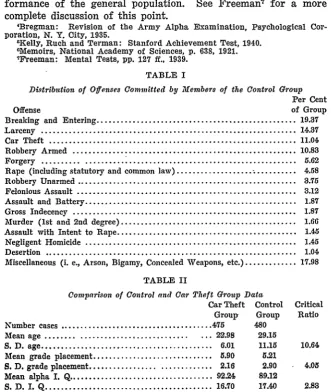
Freeman: Mental Tests, pp. 127 ff., 1939. TABLE I
Distribution of Offenses Committed by 3[embers of the Control Group
Per Cent
Offense of Group
Breaking and Entering ... 19.37
Larceny ... 14.37 Car Theft ... 11.04 Robbery Armed ... 10.83
Forgery ... ... 5.62
Rape (including statutory and common law) ... ... 4.58 Robbery Unarmed ... 3.75
Felonious Assault ... ... ... 3.12
Assault and Battery ... 1.87 Gross Indecency ... ... 1.87
Murder (lst and 2nd degree) ... 1.66
Assault with Intent to Rape ... 1.45 Negligent Homicide ... ... ... 1.45 D esertion ... ... 1.04 Miscellaneous (i. e., Arson, Bigamy, Concealed Weapons, etc.) ... 17.98
TABLE II
Comparison of Control and Oar Theft Group Data
Car Theft Control Critical Group Group Ratio Number cases ... 475 480
M ean age ... ... ... ... 22.98 29.15
S. D. age ... 6.01 11.15 10.64 Mean grade placement ... 5.90 521
S. D. grade placement ... 2.16 2.90 4.05 Mean alpha I. Q... 92.24 89.12
S. D. I. Q ... ... 16.70 17.40 2.88
Per cent of group with previous prison sentences .... 32.26 29.58
Per cent Negro offenders in group ... 12.84 24.37
Discussion, arnd Conclusions
[image:3.454.60.392.144.537.2]CAR THIEVES
TABLE III
Oomparison of Criminal Record Data 50 Cases
of Car 50 Cases of
Theft Per Control ' Per Group Cent Group Cent Men who had one or more fines, sentences, or
probationary periods for drunkenness ... 32 64 14 28 Men with a record of one or more periods of
ob-servation for mental disorder in prison hospital 11 22 3 6
Men with a record of previous car theft,
includ-ing probationary periods ... 37 74 7 14 Men with a history of acts of criminal impulse,
including probationary periods ... 41 82 19 38 alpha I.Q. of 89.12 for the control group is the same as that found
by Moskowitz8 for 2148 inmates of the same prison. Thus the
control group may be considered to be reasonably representative of the entire prison population of 5300.
From Table II it is apparent that lower intelligence or lower educational achievement is not likely to be a significant factor in car theft. The statistically reliable difference between the mean ages of the two groups suggests that car theft is a crime of youth, a fact borne out by a previous study.9 The difference in
recidi-vism between the two groups (32.26 for the car thieves and 29.58 for the control group) is probably significant when it is noted that the car theft group had an average of more than six years less life in which to commit crime. The fact that a smaller percentage of Negroes was found in the car theft group than in the control group probably relates to social conditions. That is, Negro youths tinkering with cars would perhaps be investigated more readily than white youths and, hence, could steal fewer cars. Also, it may be that automobile owners take precautions such as locking their cars more frequently when near a Negro neighborhood.
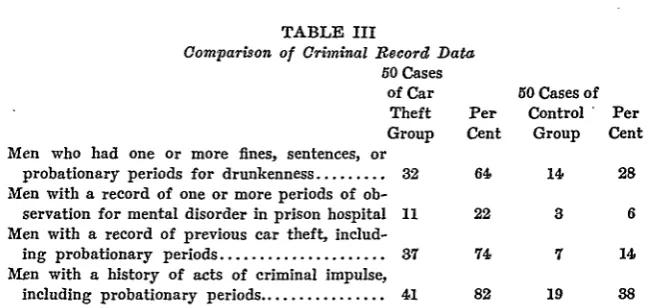
The data presented in Table III were secured by drawing at random fifty cases from each group and subjecting the complete inmate records of these men to careful examination. What ap-peared to be significant items in the inmates' records were then tabulated. The item concerning drunkenness was selected because it appeared to figure prominently in the state police records for both groups. Arrests on this charge were not counted unless a fine, jail sentence, or probation was imposed.
"Moskowitz: Psychological Testing at Jackson (Mich.) Prison, News Bule-tin, Osborne Association, Vol. XII, pp. 2 ff., 1941.
OUniform Crime Reports, xi, pp. 117-151, 1940.
[image:4.454.63.387.48.202.2]IRWIN AUGUST BERG
observation only when he observes several instances of irrational behavior on the part of the inmate, and even then only when he believes-the behavior represents potential danger to others or to the inmate himself. Other cases are, of course, detected by the psychiatrist himself. Where a category of mental disorder was given, epilepsy and paranoid schizophrenia were the classifications most frequently listed.
The item concerning records of previous car thefts includes probations for this crime as well as actual sentencings. It should be noted that the figure of 14% of the control group who had a previous record of car theft agrees fairly well with the figure of 11 per cent (Table I) of that group who were actually in prison for car theft. Part of the explanation for this increase, small as it is, may be that the inclusion probations for car theft as well as actual imprisonments inflated the percentage.
The most subjective item is the last in Table III which concerns a history of acts of criminal impulse. Offenses such as mayhem, assault and battery, or rape, as well as some cases of car theft, were considered to be crimes of impulse if the offense appeared to be committed without apparent preparation for the crime. For ex-ample, a Negro in the control group drove away a Detroit City bus
"just for the hell of it," as he explained it.
The data secured in this investigation suggest that car theft is often a crime of impulse and of youth. This is reflected in the int-rviews with these men recorded by the prison sociologists and psychologist. Examples of frequently encountered statements in these interviews are, "The motor was running; I jumped in and drove off;" "I saw that the keys were in the car ;" "I thought I'd go over to my girl's house and take her riding ;" "I saw a chance to get around faster in looking for a job." One boy of twenty boasted that he stole fourteen cars in one day, also "for the hell of it."
CAR THIEVES
as "impulsive acts" is not very specific; yet the appropriateness of
this term is illustrated by contrasting this group with other groups of offenders. For example, in a study the author is preparing concerning forgery and other crimes, it was found that many forgers very carefully plan each offense, often choosing their vic-tims with deliberation. Also, the history of previous offenses of forgers rarely includes a criminal act which could be termed "im-pulsive." Deliberation and detailed planning in the commission of crime appear to be conspicuously present among members of the forgery group. It is this aspect of forethought which is con-spicuously absent from the offenses committed by the car thieves. Other prisoners sometimes refer to car theft as "kid stuff", im-plying that immaturity and irresponsibility are associated with this offense. It is likely that a form of arrested social and emo-tional immaturity does relate to the impulsive character of this offense since these wrongdoers have been given ample opportunity to correct their behavior and adopt a more mature mode of re-sponse. In cases of simple car theft judges almost always grant probation for youthful first offenders. A youngster sentenced to prison usually has a record of one or more violated probationary periods.
Auto theft appears to be but a single manifestation of ten-dencies to precipitate action on the part of many members of the car theft group. This interpretation is strengthened by the records of acts of criminal impulse found in 829 of the car theft group.
Summary