Multiple Circular Colouring as a Model for Scheduling
Bing Zhou
Department of Mathematics, Trent University, Peterborough, Canada Email: [email protected]
Received April 30, 2013; revised May 31, 2013; accepted June 15, 2013
Copyright © 2013 Bing Zhou. This is an open access article distributed under the Creative Commons Attribution License, which permits unrestricted use, distribution, and reproduction in any medium, provided the original work is properly cited.
ABSTRACT
In this article we propose a new model for scheduling periodic tasks. The model is based on a variation of the circular chromatic number, called the multiple circular colouring of the conflict graph. We show that for a large class of graphs, this new model will provide better solutions than the original circular chromatic number. At the same time, it allows us to avoid the difficulty of implementation when the fractional chromatic number is used.
Keywords: Graph Coloring; Circular Chromatic Number; Fractional Chromatic Number; Multi-Circular Coloring; Scheduling Problem
1. Introduction
We consider the scheduling problems involving tasks 1 2 . If two tasks both use a common resource, they cannot be scheduled at the same time. A valid scheduling is a mapping f from
1 2
to the subsets of a time period [0,T] such that, , , n
T T T
, , , n
T T T
i
jf T f T if i and j use a common re-
source. Let the value of a scheduling f be
T T
min i :1
f f T T i n , which is the minimum
length of time a task has been assigned normalized by the length of the time period. The goal is to find a scheduling
f that maximizes f . One example of this type of
scheduling problem is the heavily loaded resource shar- ing system in computer science [1-3]. The tasks are proc- esses and some of them may share a common data file. Two processes that do share a common data file cannot operate at the same time. A scheduling of the processes that has the maximum value would allow the processes to operate most efficiently.
The constraints of the scheduling problem can be rep- resented by a graph, called the conflict graph. The con- flict graph G has vertex set
v v1, , ,2 vn
representingthe tasks where two vertices vi and vj are adjacent if and only if they use at least one common resource. Vertex colouring and chromatic numbers of the conflict graph have been used as models for scheduling problems (see for example [4]). If G can be coloured with kcolours such that no two adjacent vertices have the same colour, we can then divide [0,T] into k equal length periods. All ver- tices that are coloured with the same colour do not have
edges between them and therefore can be assigned to one period. For this scheduling f, we have f 1
G .Thus in general f 1
G .When the tasks are periodic in nature, circular colour- ing of the conflict graph is a more appropriate method. Circular colouring and the circular chromatic number (also called the star chromatic number) were introduced by A. Vince in 1988 [5]. A (k,d)-circular-colouring of a graph G is a mapping c V G:
0,1, , k
such
1that for each edge xy in G, d c x c y k d.
The circular chromatic number of G, , is the in- fimum of the ratio k/d for which G has a (k,d)-circular- colouring.
c G
Equivalently, we can consider a (k,d)-circular-colouring of G as a mapping c from V(G) to the open arcs of length d in a circle of length k such that if xy is an edge in G,
c x c y . If we assign the tasks using a (k,d)- circular-colouring of the conflict graph G, we would have f d k 1 c
G .A (k,d)-set-colouring of a graph G is a mapping c such that for every vertex v in G, c(v) is a d-subset of
0,1, , k1
and if xy is an edge inG,c x
c y . The fractional chromatic number ofa graph G, f
G , is the infimum of the ratio (k/d) for which G has a (k,d)-set-colouring. If we can consider a (k,d)-set-colouring as a mapping c from V(G) to the sets of arcs in the circle of length k such that the length of the union of arcs in f(v) is at least d for every vertex v and if xy is an edge inG, c x
c y . An assignment using
1 f
f d k G .
Circular chromatic number and fractional chromatic number and their variations have been extensively stud- ied in the last two decades [6-11]. More results on the circular chromatic number and fractional chromatic number can be found in the book [12] and the survey papers [13,14]. It is easy to see that by their definition, we have the relations
.f G c G G
Vince proved in [5] that
G 1 c
G .
Therefore, we have
G c
G .
While the difference between
G and c
G isalways less than 1, it is known that the difference be- tween
G and f
can be arbitrarily large for some graphs. An example is the family of graphs called Kneser graphs. A Kneser graph ([15,16]) p q, has allq-subsets of
G
K
0,1, , p1
(p > 2q) as its vertices and two vertices are adjacent if the two subsets are disjoint. It is proved in [16] that
,
,f
p K p q
q
K p q,
p 2q 2.
Another example of a family of graphs where the dif- ference between their chromatic number and fractional chromatic number is large is the graphs obtained by us-ing Mycielski’s construction.
For a graph G with vertex set V G
u u1, , , u
2 n and edge set E G
, the Mycielskian M G of G is the graph with vertex set
u u1, , ,2 un
v v1, ,2 ,vn
w
i, j: ,i j
i : 1, 2, , and edge set
[image:2.595.367.479.83.194.2]E u v u u E v w i n . M C
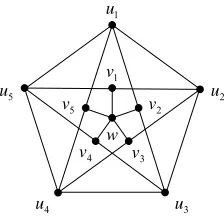
5 inFigure 1 is also called the Grotzsch graph. It is well known that
M G
G 1.
For the fractional chromatic number of Mycielskians, the authors of [17] found the recurrence relation
1
.f M G f G f
G
For the Grotzsch graph, since f
C5 5 2 , we have
5
5 2 2 5 29 10.f M C
We use the notation t
M G such that
times
( ( ( ))).
t
t
M G M MM G
We have
1 u
2 u 5
u
4
u u3
1 v
2 v
3 v 4 v 5 v
w
Figure 1. Grotzsch graph.
t 5
5 2 2.f M C t
In comparison, we have
Mt C5
3 t.
For this class of graphs, the difference between
and f is unbounded.
For the circular chromatic number, we have
t 5
t
5
1 2 .c M C M C
t
This shows that the difference between the circular chromatic number and the fractional chromatic number is also arbitrarily large for the Mycielskians. To achieve the optimal result for a scheduling problem in general, it appears that the fractional chromatic number of the con- flict graph provides the best results.
However, there are difficulties if we use (k,d)-set col- ouring and the fractional chromatic number in the sched- uling problem. To achieve f
G the optimal (k,d)-set colouring may have a very large value of d. As pointed out in [12],
5t
M C is an example of a graph G for which f
G k d for no small d. In fact, if we let5
C
2
G and Gn M
Gn1
, then
3 2n1 1n
V G
and f
n is a fraction whose denominator, whenwritten in smallest terms, is greater than . This ex- ample shows that there is no bound on the denominator of
G
2 2
2n
f that is a polynomial function of the number
of vertices of G. If this optimal set colouring is to be used for scheduling, each task would be divided into too many fragments making it impossible in practice. To combine optimality and practicality, in the next section we pro- pose a new colouring of the conflict graph that will pro- vide a better solution than the circular colouring and eas- ier to implement than the set colouring.
G
2. Multiple Circular Colouring of a Graph
.c x c y
m c G is the infimum of the ration The m-circular chromatic numberk d for which , Ghas a m-(k,d)-circular-colouring.
It is easy to see that for every positive integer m,
m
.f G c G c G
To demonstrate this colouring indeed improves the solution of the scheduling problem in some cases, we show that even for m2, c2
G can be strictly lessthan c
G for large classes of graphs.Recall that for a graph G, M(G) is the Mycielskian of G. There are many graphs G such that
Some sufficient conditions for this equality to hold are given in, for example, [18] and [19]. However,
.c M G M G
2
c
M G
will always be strictly less than
M G
.Theorem 2 For every graph G,
2 1.
2
c M G M G
Proof: Let V G
u u1, , ,2 un
, G k and
1, , ,2 n 1, , ,2 n
V M G u u u v v v w as des-
cribed in the previous section. Let
0,k be a circle oflength k. Since
G k , there is a mapping of theform
j j, 1
k
i
c u
0,1, , 1j
for each i where
such that when-
ever and are adjacent.
i1 i2
c u c u
1
i
u ui2
Let 0, 1 2
k be a circle of length k1 2. Let
0,1 1,2 2
c w
3
. Notice that
1 2
i
c w c u
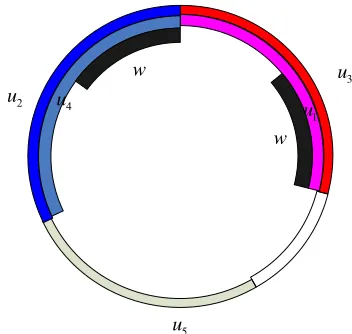
for all i. Figure 2 demonstrates this mapping when .
5
For each i, if
GC
i
c u c w , let c v
i c u
i ;otherwise, let c v
i
c u
i c w
k k, 1 2
. We show that the arcs representing these vertices in the case of GC5 in Figure 3.It is easy to check that this is a valid 2- 2 1 2 k
-cir-
cular colouring of M(G) in general. This proves that
2 1 1.
2 2
c M G k M G
□
Corollary 3 If c
M G
M G
, then
2 1.
2
c M G c M G
□
Next we show that unlike the set-chromatic number, the denominator of the m-circular chromatic number is bounded by the product of m and the number of vertices in the graph.
u3 u1
u5 u2
w
[image:3.595.333.509.84.251.2]w u4
Figure 2. A 2-circhular coloring of vertices of C5 and w in M
(C5).
u3
u1
u5
u2
w
w
v5
v4
v4
u4
v2
v2
v3
v3
v1
v1
Figure 3. A 2-circular coloring of M (C5).
Theorem 4 Let G be a graph of n vertices, and
.m c
k G
d
Then k and d can be integers such that d <
mn.
Proof: Suppose that cm
G r. By scaling if neces- sary, there is a m-circular colouring c that maps the ver- tices of G to sets of m arcs in a circle of length r such that each arc has length at least 1m and if xy is an edge then
.c x c y We assume that c is a colouring such that the set
1: is an arc in for some vertex and
l l c v v l
m
is the smallest. We fix a direction of the circle, say coun- ter clockwise.
There is at least one arc l such that l 1 m
; otherwise
[image:3.595.333.511.291.457.2]G, ii) the left end of l1 is the right end of l2 and iii)
2
1
l m
, otherwise l1 could be made larger.
Continuing this process, some arc will have to be used more than once. Say the first time this happens is at
a b. Then the arc 1
l l s l la,a1, ,lb must cover the
circle an integer number of times. Suppose that they cover the circle s times. Since there are arcs and
ba
they all have length 1
m, we have
b a
srm
and
b a
rsm
Since sn, the denominator is less than mn. □ Intuitively, when the value of m increases, the m-cir- cular chromatic number will be closer to the fractional chromatic number and thus the difference between the chromatic number and m-circular chromatic number would increase. Nevertheless, our next theorem shows that the m-circular chromatic number cannot be less than one m-th of the .chromatic number.
Theorem 5 For every graph G,
1
m
m .
c G G
Proof: Suppose that cm
G r. There is an m-circu- lar colouringc such that c v
1 for every vertex v.r
Since c(v) is a union of m arcs, at least one of the arcs has
length at least 1
mr. We insert mr points P P1, , ,2 Pmr
spaced at equal distance in the unit length circle. For every vertex v, c(v) contains at least one of these points. Let i Each Vi is an independ- ent set and
: .
i
V vG c v P
i
V G V . G can be coloured with mrcol- ours. So we have
m
,c
G mr m G
i.e., m
1
.c G G
m
□
The Kneser graphs provide examples showing this lower bound is asymptotically the best possible.
Let
G
is also bounded by a function of be the independence number of G.
m c G
G . Theproof above yields a lower bound for
G .Theorem 6 For every graph G with n vertices,
.m c
n G
m G
Proof: The set in the proof of Theorem 5 is an in-
dependent set. We have
i
V
m cm G such independent
sets. The average size of one set is
.m c
n
m G There-
fore
.m c
n G
m G
and
. mc
n G
m G
□
3. Conclusion
We proved that for a large class of graphs, this multiple circular colouring and m-circular chromatic number of the conflict graph will provide better solutions for the scheduling problem than the original circular chromatic number. It is also easier to implement than the model using the fractional chromatic number. We plan to inves- tigate more classes of graph G where cm
G c
G for small values of m. It would also be interesting to find out the probability for random graphs to have m-circular chromatic number strictly less than their circular chro- matic number.REFERENCES
[1] V. C. Barbosa and E. Gafni, “Concurrency in Heavily Loaded Neighborhood-Constrained Systems,” ACM Tran- sactions on Programming Languages and Systems, Vol. 11, No. 4, 1989, pp. 562-584. doi:10.1145/69558.69560 [2] H. G. Yeh, “A Connection between Circular Colorin and
Periodic Schedules,” Discrete Applied Mathematics, Vol. 157, No. 7, 2009, pp. 1663-1668.
doi:10.1016/j.dam.2008.10.003
[3] H. G. Yeh and X. Zhu, “Resource-Sharing System Sched- uling and Circular Chromatic Number,” Theoretical Com- puter Science, Vol. 332, No. 1-3, 2005, pp. 447-460. doi:10.1016/j.tcs.2004.12.005
[4] F. Chung, “Graph Theory in the Information Age,” No- tices of AMS, Vol. 57, No. 6, 2010, pp. 726-732.
[5] A. Vince, “Star Chromatic Number,” Journal of Graph Theory, Vol. 12, No. 4, 1988, pp. 551-559.
doi:10.1002/jgt.3190120411
[6] H. L. Abbott and B. Zhou, “The Star Chromatic Number of a Graph,” Journal of Graph Theory, Vol. 17, No. 3, 1993, pp. 349-360. doi:10.1002/jgt.3190170309
[7] H. Hatami and R. Tusserkani, “On the Complexity of the Circular Chromatic Number,” Journal of Graph Theory, Vol. 47, No. 3, 2004, pp. 226-230. doi:10.1002/jgt.20022 [8] K. Kilakos and B. Reed, “Fractionally Colouring Total
Graphs,” Combinatorica, Vol. 13, No. 4, 1993, pp. 435- 440. doi:10.1007/BF01303515
Coloring of Cubic Graphs with Girth Six,” Journal of Combinatorial Theory, Series B, Vol. 100, No. 4, 2010, pp. 351-358. doi:10.1016/j.jctb.2009.10.003
[10] I. Leader, “The Fractional Chromatic Number of Infinite Graphs,” Journal of Graph Theory, Vol. 20, No. 4, 1995, pp. 411-418. doi:10.1002/jgt.3190200404
[11] B. Zhou, “Some Theorems Concerning the Star Chromatic Number of a Graph,” Journal of Combinatorial Theory, Series B, Vol. 70, No. 2, 1997, pp. 245-258.
doi:10.1006/jctb.1996.1738
[12] E. R. Scheinerman and D. H. Ullman, “Frational Graph
,” Dis- Theory,” John Wiley and Sons, New York, 1997. [13] X. Zhu, “Circular Chromatic Number—A Survey
crete Mathematics, Vol. 229, No. 1-3, 2001, pp. 371-410. doi:10.1016/S0012-365X(00)00217-X
[14] X. Zhu, “Recent Developments in Circular Colouring of Graphs,” Algorithms and Combinatorics, Vol. 26, Spring- er, Berlin, Heidelberg, 2006, pp. 497-550.
[15] M. Knser, “Aufgabe 300,” Jahresbericht der Deutsche Mathematiker-Vereinigung, Vol. 58, No. 2, 1955, p. 27. [16] L. Lovasz, “Kneser’s Conjecture, Chromatic Number, and
Homotopy,” Journal of Combinatorial Theory, Series A, Vol. 25, No. 3, 1978, pp. 319-324.
doi:10.1016/0097-3165(78)90022-5
[17] M. Lasen, J. Propp and D. H. Ullman, “The Fractional Chromatic Number of Mycielski Graphs,” Journal of Graph Theory, Vol. 19, No. 3, 1995, pp. 411-416. doi:10.1002/jgt.3190190313
[18] G. Chang, “Circular Chromatic Numbers of Mycielski’s Graphs,” Discrete Mathematics, Vol. 205, No. 1-3, 205, 1999, pp. 23-37. doi:10.1016/S0012-365X(99)00033-3 [19] H. Jajiaholhassan and X. Zhu, “Circular Chromatic Num-
ber and Mycielski Construction,” Journal of Graph The- ory, Vol. 44, No. 2, 2003, pp. 106-115.