Hybrid Big Bang - Big Crunch Algorithm for
Optimal Reactive Power Dispatch by Loss and
Voltage Deviation Minimization
S.Sakthivel,
Professor, V.R.S. College of Engg. and Tech.,
Arasur-607 107, Villupuram Dt, Tamil Nadu, India.
S.Manimaran,
Asst. Professor, V.R.S. College of Engg. and Tech.,
Arasur-607 107, Villupuram Dt, Tamil Nadu, India.
V.Deepa A.Priya
UG students V.R.S. College of Engg. and Tech.,
Arasur-607 107, Villupuram Dt, Tamil Nadu, India
A.Suganya, S. Indumathi
UG students V.R.S. College of Engg. and Tech.,
Arasur-607 107, Villupuram Dt, Tamil Nadu, India.
Abstract.
Power system voltage security is improved by optimizing reactive power dispatch (ORPD). ORPD problem is a multi-constrained, multi-objective problem involving both continuous and discrete control variables. An efficient optimization technique is needed for handling such a challenging objective function. Generator bus voltages, transformer tap positions and shunt Var compensator settings are the design variables in optimizing reactive power. ORPD problem is attacked by intelligent algorithms in recent years. In this work, the newly proposed, Big Bang–Big Crunch algorithm is suggested for reactive power optimization problem due to its simplicity and better convergence behavior. This algorithm is efficient in local search but sometimes global searching behavior is not sufficient. The global searching ability of particle swarm optimization (PSO) is adopted to enhance the BB-BC algorithm. The resultant is a hybrid BB-BC algorithm, the HBB-BC algorithm. The efficiency of the HBB-BC algorithm is tested on the standard IEEE-30 bus system for ORPD. The results are compared with that of basic BB-BC algorithm. The improved results encourage implementing this hybrid algorithm for different power system optimizations.
Keywords:
Optimal Reactive Power Dispatch, Big Bang–Big Crunch Algorithm, Particle Swarm Optimization Algorithm, Optimal Reactive Power Dispatch, Loss Minimization, Voltage Deviation Minimization
.
I. INTRODUCTION
Modern power system networks are facing increased load demand and there are risks of stability problems. Non-optimized reactive power flow in a power system increases the transmission loss and threatens the security of the system. In general,
reactive power dispatch is optimized by real power loss minimization. Reactive power optimization is done for reasons of power system security [1]-[3]. When a power system is under heavily loaded conditions, the demand for reactive power is more than that for real power. Increased demand for reactive power may affect the system security. Sufficient reactive power generation should be made available for avoiding system instability.
To ensure adequate reactive power generation reactive power planning for the future was suggested by many researchers [4]. But it requires installation of new Var sources and the capital cost. This problem can also be dealt with by optimizing the reactive power generation from the existing var sources. Minimization of reactive power generation is equivalent to maximization of reactive reserves and it may be useful when additional var is required [5]. Var flow in a power system is optimized by controlling generator bus voltages, transformer tap positions and existing Var sources like SVCs [6]. Among these parameters transformer tap positions and SVCs settings are discrete variables and generator bus voltages are continuous variables. Hence, ORPD is a mixed inter optimization problem and it is not so easy to find a global optimal solution.
In this work, the nature inspired BB-BC algorithm is proposed for reactive power optimization. This algorithm is simple, easy for implementation and has less number of parameters. The objectives considered are real power loss and voltage deviation.
This remaining content of paper is organized as follows: Section 2 describes the problem formulation which is related to the objective function. Section 3 deals with the hybrid BB-BC algorithm and its implementation for ORPD. Numerical results are discussed in section 4. Finally, conclusions are drawn in section 5.
II. PROBLEMFORMULATION
The objective of this work is to optimize the reactive power flow in a power system by minimizing the real power loss and sum of load bus voltage deviation. Therefore, an augmented objective function is formed with the two objective components with suitable weights.
Objective function
Three different objective functions are considered in this work. The design parameter values corresponding to the minimum value of the objective functions are identified. The objective functions can be expressed as:
𝑓1= 𝑚𝑖𝑛 𝑃𝑙𝑜𝑠𝑠 1
𝑓2= 𝑚𝑖𝑛 𝑉𝐷 2
𝑓3= 𝑚𝑖𝑛 𝑤𝑃𝐿+ 1 − 𝑤 𝑉𝐷 3
Where „w‟ is the weighing factor for real power loss andvoltage deviation and is set to 0.7.
Real power loss minimization (PL)
The total real power of the system can be calculated as follows.
𝑃𝑙𝑜𝑠𝑠 = 𝐺𝑘[𝑉𝑖 2+ 𝑁𝐿
𝐾=1
𝑉𝑗2− 2 𝑉𝑖 𝑉𝑗 𝑐𝑜𝑠𝛿𝑖− 𝛿𝑗] 4
Where, NL is the total number of lines in the system; Gk is the conductance of the line „k‟, Vi and Vj are the magnitudes of the sending end and receiving end voltages of the line;δi and δj are angles of the end voltages.
Load bus voltage deviation minimization (VD)
Bus voltage magnitude should be maintained within the allowable range to ensure quality supply of electrical power. Voltage profile is improved by minimizing the deviation of the load bus voltage from the reference value (it is taken as 1.0 p.u. in this work).
𝑉𝐷 = 𝑉𝑖− 𝑉𝑟𝑒𝑓
𝑁𝑃𝑄
𝑘=1
5
Constraints
The minimization problem is subject to the followingequality and inequality constraints
Equality constraints
Load Flow Constraints:
The equality constraints represent the load flow equations, which are given below for ith bus:
𝑃𝐺𝑖− 𝑃𝐷𝑖 = 𝑉𝑖𝑉𝑗𝑌𝑖𝑗𝑐𝑜𝑠(𝛿𝑖𝑗
𝑁𝐵
𝑗 =1
+ 𝛾𝑗− 𝛾𝑖) 6
𝑄𝐺𝑖− 𝑄𝐷𝑖= 𝑉𝑖𝑉𝑗𝑌𝑖𝑗𝑠𝑖𝑛(𝛿𝑖𝑗
𝑁𝐵
𝑗 =1
+ 𝛾𝑖− 𝛾𝑗) 7
Where,PGi ,QGi are the active and reactive power of ith generator, PDi , QDi the active and reactive power of ith load bus.
Inequality constraints
Generator constraints:
Generator voltage and reactive power of ith bus lies between their upper and lower limits as given below:
𝑉𝐺𝑖𝑚𝑖𝑛 ≤ 𝑉𝐺𝑖 ≤ 𝑉𝐺𝑖𝑚𝑎𝑥𝑖 = 1,2, . . . . 𝑁𝐺 8
𝑄𝐺𝑖𝑚𝑖𝑛 ≤ 𝑄𝐺𝑖 ≤ 𝑄𝐺𝑖𝑚𝑎𝑥𝑖 = 1,2, . . . . 𝑁𝐺 9
Where, 𝑉𝐺𝑖𝑚𝑖𝑛, 𝑉𝐺𝑖𝑚𝑎𝑥 are the minimum and maximum voltage of ith generating unit and 𝑄𝐺𝑖𝑚𝑖𝑛 , 𝑄𝐺𝑖𝑚𝑎𝑥 are the minimum and maximum reactive power of ithgenerating unit.
Load bus constraints:
𝑉𝐿𝑖𝑚𝑖𝑛 ≤ 𝑉𝐿𝑖 ≤ 𝑉𝐿𝑖𝑚𝑎𝑥𝑖 = 1,2, . . . . 𝑁𝐿 10
Where, 𝑉𝐿𝑖𝑚𝑖𝑛, 𝑉𝐿𝑖𝑚𝑎𝑥 are the minimum and maximum value voltage of load bus „i‟.
Transmission line constraints: 𝑆𝐿𝑖 ≤ 𝑆𝐿𝑖𝑚𝑎𝑥𝑖 = 1,2, . . . , 𝑁
𝑇𝐿 11
Where, 𝑆𝐿𝑖 is the apparent power flow of ith branch and 𝑆𝐿𝑖𝑚𝑎𝑥 is the maximum apparent power flow limit of ith branch.
Transformer taps constraints:
Transformer tap settings are bounded between upper and lower limit as given below:
𝑇𝑃𝑖𝑚𝑎𝑥 ≤ 𝑇
Where, 𝑇𝑖𝑚𝑎𝑥 , 𝑇
𝑖𝑚𝑎𝑥 are the minimum and the
minimum and maximum tap setting limits of ith transformer.
Shunt compensator constraints
:
Shunt compensation are restricted by their limits as follows:
𝑄𝐶𝑖𝑚𝑖𝑛 ≤ 𝑄
𝐶𝑖≤ 𝑄𝐶𝑖𝑚𝑎𝑥, 𝑖 = 1,2. . . . , QC NC 13
Where, 𝑄𝐶𝑖𝑚𝑖𝑛, 𝑄
𝐶𝑖𝑚𝑎𝑥 are the minimum and maximum
VAR injection limits of ith shunt capacitor.
III. BIGBANG–BIGCRUNCH
ALGORITHM
III.1 The Basic BB-BC Algorithm
A new nature inspired optimization technique which has low computational time and high convergence speed what is called BB-BC is introduced recently [15]-[16]. The algorithm consists of two simple phases,
1. Big Bang phase 2. Big Crunch phase.
In Big Bang phase, candidate solutions are randomly distributed over the search space. The main feature of Big Bang phase is that the energy dissipation produces disorder and randomness. In Big Crunch phase, the randomly distributed solutions are drawn into an order and shrinks to a single solution called centre of mass. The Big Bang-Big Crunch optimization method generates random solutions in the Big Bang phase and shrinks these points to the global best point in the Big Crunch phase after a number sequential Big Bangs and Big Crunches.
The Big Bang phase is followed by the Big Crunch phase. The Big Crunch is a convergence operator that has many inputs but only one output, which is named as the centre of mass, since the only output has been derived by calculating the centre of mass. The centre of mass is the best solution among the solutions. In this work, the centre of mass is calculated according to the following expression.
𝑋𝐶 =
1 𝑓 𝑋𝑖 𝑁𝑃 𝑖=1 𝑋𝑖
1 𝑓 𝑋𝑖 𝑁𝑃 𝑖=1
14
Where, Xi is a point within an D-dimensional search space, f(Xi) is a fitness function value of this point, NP is the population size in Big Bang phase. The convergence operator in the Big Crunch phase is different from „exaggerated‟ selection since the output term may contain additional information (new candidate or member having different parameters than others) than the participating ones, hence differing from the population members. This
one step convergence is superior compared to selecting two members and finding their centre of gravity. This method takes the population members as a whole in the Big Crunch phase that acts as a squeezing or contraction operator; and it, therefore, eliminates the necessity for two-by-two combination calculations.
After the Big Crunch phase, the algorithm must create new agents to be used as the Big Bang of the next iteration step. Latter iterations use the knowledge gained from the previous ones for generation of agents; hence, the convergence of such an algorithm is good. In this work, the new candidates are generated around the centre of mass and knowledge of centre of mass of previous iteration is used for better convergence. The parameters to be supplied to normal random point generator are the centre of mass of the previous step and the standard deviation. The deviation term can be fixed, but decreasing its value along with the elapsed iterations produces better results.
𝑋𝑖𝑡+1= 𝑋𝑐𝑡+1+
𝑟𝛼 𝑋𝑖𝑚𝑎𝑥 − 𝑋 𝑖𝑚𝑖𝑛
𝑡 + 1 15
Where, „r‟ is a normal random number, α is a parameter limiting the size of the search space, Xmax and Xmin are the upper and lower limits, and t is the iteration step. Since normally distributed numbers can be exceeding ±1, it is necessary to limit the population to the prescribed search space boundaries. This narrowing down restricts the candidate solutions into the search space boundaries.
III.2 The Hybrid HBB-BC Algorithm [17]-[18]
The BB-BC algorithm is good in exploitation of the search space but not so good or some sluggishness is there in exploration. If all of the candidates in the initial Big Bang are collected in a small area of search space, the BB–BC method may not find the optimum solution and with a high probability, it may be trapped to a small region in the solution space.
of each candidate (
𝑋
𝑖𝑏𝑒𝑠𝑡 ) and the best global position (𝑋
𝑔 𝑏𝑒𝑠𝑡𝑡 ) to generate a new solution, as:𝑋𝑖𝑡+1=
∝2𝑋𝑐𝑡+ 1 −∝2 ∝3𝑋𝑔 𝑏𝑒𝑠𝑡𝑡 + 1 −∝3 𝑋𝑖𝑏𝑒𝑠𝑡
+𝑟𝑎𝑛𝑑 ∝1 𝑋𝑖
𝑚𝑎𝑥 − 𝑋 𝑖𝑚𝑖𝑛
𝑡 + 1
16
Where,
𝑋
𝑖𝑡+1 is the new agent for the next iteration;∝
1,∝
2,∝
3 are random numbers in the range [0,1] that assign importance to the three different best solutions of centre of mass, global best of PSO and a random number.The hybrid algorithm also has two phases. The first phase, big bang phase has NP number of solutions spread over the search space. No change is introduced in this stage. The hybrid algorithm is similar to the original algorithm. In the second phase, centre of mass is identified and PSO is also activated. In this phase, in addition to knowing the centre of mass, the best of individual agents so far and best among the individual bests are considered. The new agents for the next iteration is created by using (16).
III.3 HBB-BC Applied to ORPF:
Step 1: Initialize the algorithm parameters like population size, maximum number of generations, particle best and global best. Step 2: Each individual is a vector of the control
variables. i.e. i.e. Xi= [VG1,VG2,…..VGNG,TP1,TP2,…..TPNT,Qc1,Qc2 ….QcNC]. NP number of agents are generated by respecting the limits of control parameters.
Step 3: Calculate the fitness function values of all candidates by running the NR load flow. Step 4: Determine the centre of mass which has
global best fitness using equation (15). Step 5: Generate new candidates using the centre of
mass, particle best and global best by adding/subtracting a normal random number according to equation (16).
Step 6: Repeat steps step 2 to step 5 until stopping criteria has been achieved.
IV. RESULTSANDDISCUSSIONS
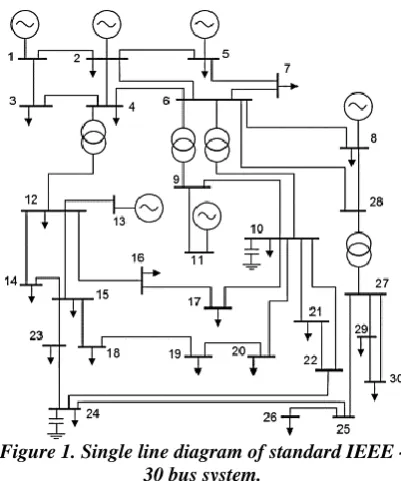
The hybrid and basic versions of BB-BC are compared to prove the improved performance of the hybrid version. The effectiveness of the proposed algorithm is tested in the standard IEEE-30 bus system [20]. The algorithm is coded in MATLAB 7.6 Environment and a Core 2 Duo, 2.8 MHz, 2GB RAM based PC is for the simulation purpose.
The test system taken has six generating units connected to buses 1, 2, 5, 8, 11 and 13. There are 4 regulating transformers connected between bus
numbers 6-9, 6-10, 4-12 and 27-28. Two shunt compensators are connected in bus numbers 10 and 24. The system is interconnected by 41 transmission lines. Therefore, the dimension of the problem is 12. The system is taken under base load condition.
Table 1. Control Variables and their limits. Design Variable Limit Generator voltage (VG) (0.9-1.1) p.u. Tap setting (TP) (0.9 -1.1) p.u. MVAR by static compensators
(QC)
(0-20) MVAR
Three different objective functions are considered to optimize the reactive power in the system. In case „a‟ only real power loss is minimized, case „b‟ considers optimization of voltage profile at the load buses and both real power loss and sum of voltage deviation are taken for reactive power optimization in case „c‟.
The optimal parameters of the algorithm in ORPD are: population size; 30, maximum number of iterations; 500,
∝
1= 0.03
,∝
2= 0.04
,∝
3=
0.06. These three parameters assign due weights to the random number, size of centre of mass and size of global best solution respectively while deciding the size of new agents for the next iteration. It is found that the parameter values are the most suitable for the proposed work.Figure 1. Single line diagram of standard IEEE - 30 bus system.
IV.1
Case a: Minimization of Real Power Lossobjective function. The proposed algorithm is run and the optimal value of total line losses is obtained. Tuned values of control variables corresponding to minimal loss are given in table 2.
Table 2. Optimal parameter values (Case ‘a’)
S.No Parame
ter
Initial value
Optimal value by HBB-BC
Optim al value
by BB-BC
1 VG1 1.05 1.1000 1.1000 2 VG2 1.04 1.0906 1.0957 3 VG5 1.01 1.0719 1.0760 4 VG8 1.01 1.0802 1.0782 5 VG11 1.05 1.0850 1.0495 6 VG13 1.05 1.0674 1.1000 7 T6-9 1.078 0.9813 1.0376 8 T6-10 1.069 1.0999 0.9083 9 T4-12 1.032 1.0537 0.9749 10 T27-28 1.068 1.0498 0.9709 11 Q10 0.0 6.9350 23.520 12 Q24 0.0 11.3811 7.3395
It is clear from table 3 that HBB-BC algorithm
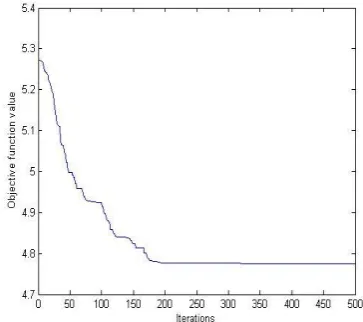
performs better than BB-BC in loss optimization. Sum of voltage deviation obtained by the hybrid algorithm is better. The loss minimization by the hybrid algorithm is 4.7754 against 4.804 got by the basic version of the algorithm.
Table 3. Minimization of objective terms (Case ‘a’)
For clear understanding of the improvement in voltage profile, the p.u. voltage magnitudes of all the buses in the system with HBB-BC and BB-BC algorithms are compared in figure 2. It is obvious from figure 2 that most of the load bus voltages are equal to about 1.0 p.u.
Figure 2. Voltage profile improvement (Case ‘a’)
The convergence efficiency of the hybrid algorithm is depicted in figure 3. Thealgorithm takes lessnumber of iterations and the global best results are retained.
Figure 3. Convergence of HBB-BC (case ‘a’)
IV.2 Case b: Minimization of Sum of Voltage Deviation.
The objective of minimization of voltage deviation is considered in this case. The optimal settings of control variables that minimize the sum of voltage deviation are minimized by HBB-BC and BB-BC algorithms. Table 4 shows the control parameter values corresponding to objective function minimization using HBB-BC algorithm.
Table 4. Optimal parameter values (Case ‘b’)
S.No Para
meter
Initial value
Optimal value
by
HBB-BC
Optimal value by BB-BC
1 VG1 1.05 0.9918 1.0200 2 VG2 1.04 1.0584 1.0043 3 VG5 1.01 1.0138 1.0290 4 VG8 1.01 0.9794 1.0104 5 VG11 1.05 1.0814 0.9896 6 VG13 1.05 1.0564 1.0408 7 T6-9 1.078 1.0740 0.9970 8 T6-10 1.069 0.9772 0.9069 9 T4-12 1.032 1.0042 1.0003 10 T27-28 1.068 0.9306 0.9458 11 Q10 0.0 10.7125 7.7001 12 Q24 0.0 9.1656 10.8798
It is evident that the total voltage deviation was originally 1.475. It is reduced to 0.1794 by the proposed algorithm but it is 0.203 by the BB-BC algorithm. In this case, the hybrid algorithm outperforms the simple BB-BC algorithm. However, when the objective is only minimization of
voltage
deviation, the loss optimization is not acceptable
0 1 2
1 3 5 7 9 11131517192123252729
Vo
ltag
e
mag
nitude
(p
.u.
)
Bus number
BB-BC HBB-BC
Paramete r
Initial value
Real Power Loss Minimization
HBB-BC BB-BC
Table 5. Minimization of objective terms (Case ‘b’)
As the objective is minimization of voltage deviation, the voltage at load buses is brought to about the nominal value. Figure 4 compares the voltages at different load buses after optimization by the algorithms
.
Figure 4. Voltage profile improvement (Case ‘b’)
Convergence capability of the HBB-BC is checked in this objective also. The algorithm founds to take slightly more number of iterations than what it took for loss optimization. But it is sticking to the best results remains well.
Figure 5. Convergence of HBB-BC (Case ‘b’)
IV.3 Case c: Minimization of Both Real Power Loss and Voltage Deviation.
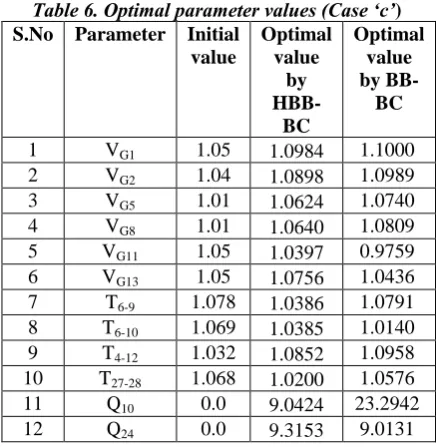
Reactive power optimization by either loss minimization or VD minimization is not sufficient. Unlike the two previous cases, this case considers both real power loss and voltage deviation optimization simultaneously. This approach is most suitable for reactive power optimization as all the parameters of reactive power is included. Table 6 shows the optimal control parameters for minimization of both real power loss and voltage deviation
Table 6. Optimal parameter values (Case ‘c’) S.No Parameter Initial
value
Optimal value
by
HBB-BC
Optimal value by
BB-BC
1 VG1 1.05 1.0984 1.1000 2 VG2 1.04 1.0898 1.0989 3 VG5 1.01 1.0624 1.0740 4 VG8 1.01 1.0640 1.0809 5 VG11 1.05 1.0397 0.9759 6 VG13 1.05 1.0756 1.0436 7 T6-9 1.078 1.0386 1.0791 8 T6-10 1.069 1.0385 1.0140 9 T4-12 1.032 1.0852 1.0958 10 T27-28 1.068 1.0200 1.0576 11 Q10 0.0 9.0424 23.2942 12 Q24 0.0 9.3153 9.0131
The two objective terms of loss and voltage deviation are optimized by the algorithm suggested. HBB-BC minimizes both the real power loss and VD in a better way. It is evident from the table 7 that the results obtained by the hybrid algorithm are really good.
Table 7. Minimization of objective terms (Case ‘c’)
Paramete r
Initial value
Both Real Power Loss & Voltage Deviation
Minimization
HBB-BC BB-BC
Ploss 5.744 4.8133 4.821 VD 1.4753 0.5554 0.602
The improvement in voltage profile at the buses of the system using HBB-BC algorithm and BB-BC algorithm are compared in figure 6. It is clear from the diagram that the VD minimization by the HBB-BC is better than that by the BB-HBB-BC algorithm.
Figure 6. Voltage profile improvement (Case ‘c’)
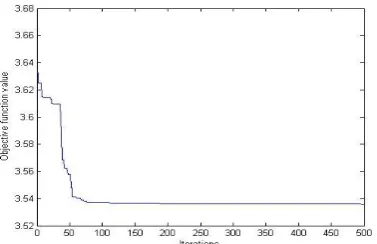
The algorithm takes the lowest number of iterations in this case than in the two previous cases. The objectives optimized are the loss and VD. Hence it
0.8 0.9 1 1.1
1 3 5 7 9 11131517192123252729
Vo
ltag
e
mag
nitude
(p
.u.
)
Bus number
BB-BC HBB-BC
0 0.5 1 1.5
1 3 5 7 9 11131517192123252729
Vo
ltag
e
mag
nitude
(p
.u.
)
Bus number
BB-BC HBB-BC
Parame ter
Initial value
Voltage deviation Minimization
HBB-BC BB-BC
may be noted that this algorithm retains its strength even when two objective terms are considered. The algorithm converges to the global best results in an augmented multi objective problem.
Figure 7. Convergence of HBB-BC (Case ‘c’)
V. CONCLUSIONS
In this paper, the strength of the hybrid version of BB-BC algorithm is demonstrated. The simple and easy to implement algorithm is enhanced by hybridization with PSO and successfully applied for power system optimization. The exploration capability of the basic BB-BC algorithm is improved by combining the exploration quality of PSO. The HBC is an enhanced version of BB-BC and has good exploitation and exploration capabilities. This ensures the strength of the proposed algorithm in both local search and global search. The numerical results show that the hybrid version of the algorithm outperforms its basic form. Three different objectives are considered for verifying the effectiveness. In all the three objectives the performance is better. Further, optimization of reactive power by the proposed algorithm is highly encouraging. Moreover, the total Var requirement suggested by HBB-BC is much smaller against the one recommended by the basic algorithm. The reduction in Var requirement is equivalent to maximization of Var reserves in a power system. Therefore, the proposed algorithm in addition to reactive power optimization maximizes the Var reserves. The algorithm may be used for other power system optimization works like economic load dispatch, optimal power flow and voltage stability improvement.
REFERENCES
[1] P.K. Roy, S.P. Ghoshal, S.S. Thakur, “Optimal VAR control for improvements in voltage profiles and for real power loss minimization using Biogeography Based Optimization”, Electrical Power and Energy Systems 43 (2012) 830–838.
[2] A.A. Abou El Ela, M.A. Abido, S.R. Spea, “Differential evolution algorithm for optimal reactive power dispatch”, Electric Power Systems Research 81 (2011) 458–464.
[3] S. Durairaj, D. Devaraj, P.S. Kannan, “Genetic algorithm applications to optimal reactive power dispatch with voltage stability enhancement”, IE (I) J. EL 87 (2006) 42– 47.
[4] Y.-T. Hsiao, C.-C. Liu, H.-D. Chiang, Y.-L. Chen, “A new approach for optimal VAR sources planning in large scale electric power systems”, IEEE Transactions on Power Systems 8 (3) (1993) 988–996.
[5] L.D. Arya, L.S. Titare,1, D.P. Kothari, “Improved particle swarm optimization applied to reactive power reserve maximization”, Electrical Power and Energy Systems Electrical Power and Energy Systems 32 (2010) 368–374.
[6] S. Durairaj, P.S. Kannan, D. Devaraj, “Multi-objective VAR dispatch using particle swarm optimization”, Emerging Electrical Power System 4 (2005) 1.
[7] Kirschen DS, Van Meeteren HP. MW/voltage control in linear programming based optimal power flow. IEEE Trans Power Syst;3(4) (1988) 481–489.
[8] Lee KY, Park YM, Ortiz J L. “A united approach to optimal real and reactive power dispatch”, IEEE Transactions on applied systems 1985; PAS-104(5):1147– 1153.
[9] Quintana V H, Santos-Nieto M. “Reactive-power dispatch by successive quadratic programming”, IEEE Transactions on energy conservation 1989;4(3):425–435.
[10] Liu WHE, Papalexopoulos AD, Tinney W F. “Discrete shunt controls in a Newton optimal power flow”, IEEE Transactions on power systems 1992; l7(4):1509–1518.
[11] Yan W, Lu S, Yu DC. “A hybrid genetic algorithm– interior point method for optimal reactive power flow”, IEEE Transactions on power systems 2006;21(3): 1163– 1169.
[12] Lai L L, Ma JT. “Application of evolutionary programming to reactive power planning-comparison with nonlinear programming approach”, IEEE Transactions on power systems 1997;12(1):198–206.
[13] H. Yoshida, K. Kawata, Y. Fukuyama, S. Takayama, and Y. Nakanishi, “A particle swarm optimization for reactive power and voltage control considering voltage security assessment,” IEEE Transactions power systems, Vol. 15, No. 4, pp. 1232–1239, Nov. 2000.
[14] S. Naka, T. Genji, T. Yura, and Y. Fukuyama, “A hybrid particle swarm optimization for distribution state estimation,” IEEE Transactions on power systems, Vol. 18, No. 1, pp. 60–68, Feb. 2003.
[15] Osman K. Erol, Ibrahim Eksin, “A New Optimization Method: Big Bang–Big Crunch”,Advances in Engineering Software, Vol. 37, No. 2, pp. 106–111, February 2006.
[16] Dr. H. K. Verma, Yogesh Manekar, “Big Bang Big Crunch Optimization for Determination of Worst Case Loading Margin”, International Journal of Engineering Research and Applications, 2(4) pp. 421-426, August 2012.
[17] A. Kaveh, S. Talatahari “Size optimization of space trusses using Big Bang–Big Crunch algorithm”, Computers and Structures 87 (2009) 1129–1140.
journal of civil engineering (building and housing) Vol. 11, No. 1 (2010) 103-122.
[19] Kennedy J, Eberhart R, Shi Y. Swarm intelligence. Morgan Kaufmann Publishers; 2001.
[20] The IEEE-30 Bus Test System. <http://www.ee.washington.edu/research/pstca/