http://dx.doi.org/10.4236/wjm.2013.36027 Published Online September 2013 (http://www.scirp.org/journal/wjm)
Linear, Cubic and Quintic Coordinate-Dependent Forces
and Kinematic Characteristics of a Spring-Mass System
Haiduke Sarafian
University College, Pennsylvania State University, York, USA Email: [email protected]
Received June 4, 2013; revised July 6, 2013; accepted August 1,2013
Copyright © 2013 Haiduke Sarafian. This is an open access article distributed under the Creative Commons Attribution License, which permits unrestricted use, distribution, and reproduction in any medium, provided the original work is properly cited.
ABSTRACT
By combining a pair of linear springs we devise a nonlinear vibrator. For a one dimensional scenario the nonlinear force is composed of a polynomial of odd powers of position-dependent variable greater than or equal three. For a chosen initial condition without compromising the generality of the problem we analyze the problem considering only the leading cubic term. We solve the equation of motion analytically leading to The Jacobi Elliptic Function. To avoid the complexity of the latter, we propose a practical, intuitive-based and easy to use alternative semi-analytic method pro-ducing the same result. We demonstrate that our method is intuitive and practical vs. the plug-in Jacobi function. Ac-cording to the proposed procedure, higher order terms such as quintic and beyond easily may be included in the analysis. We also extend the application of our method considering a system of a three-linear spring. Mathematica [1] is being used throughout the investigation and proven to be an indispensable computational tool.
Keywords: Linear; Cubic and Quintic Nonlinear Oscillations; Semi-Analytic Solution to Equation of Motion; Mathematica
1. Motivation and Objectives
Literature articles and text books are flooded with sec- tions describing the characteristics of linear oscillators [2]. One quick review of these resources reveals these are confined limited to mechanical systems. In the area of electro and magneto-dynamics, the author thoroughly has investigated scenarios of nonlinear oscillators [3,4]. La- boratory setups conducive to these scenarios have been proposed, and for the magneto-dynamic case the validity of the theoretical model is qualified with actual data [5]. For the sake of completeness, therefore, it is essential to fill in the gap considering a practical scenario conducive to a nonlinear mechanical oscillator. Although the latter is the main motivation of tackling the issue, however, in the course of analyzing the problem we stumbled on a mathematical observation constituting our secondary objective.
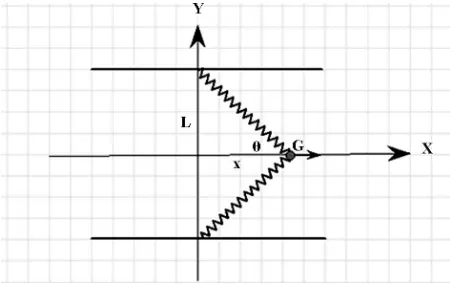
To address the first issue we consider combining two linear springs; the device is shown in Figure 1. The springs are identical in shape and have the same stiffness. They are fastened to two separate supports at one end and jointly hold a marble at the other end. In the absence of gravity, the springs exert a nonlinear force on the marble along the horizontal direction when it is pulled
away symmetrically from equilibrium. The non-linear force could be a combination of cubic and quintic coor- dinate-dependent terms; details are discussed in the next section.
[image:1.595.310.535.569.711.2]Releasing the marble somewhere off from equilibrium results in oscillations along the horizontal direction. The corresponding equation of motion is a nonlinear differen- tial equation. The issues concerning the solution of the equation will be discussed later. Nonetheless, it is worth- while mentioning not only we solve the equation utiliz-
Formulation
As shown in Figure 1, the marble is pulled from its ini- tial equilibrium position to a point such as G, stretching the linear springs with stiffness k beyond their relaxed length L. The differential length elongation of each spring is L2x2 L
, yielding the net force
2 2
2 1 . (1) x L F kx L x
For displacement x < L the quantity in the parentheses in Equation (1) may be replaced with
2
41 2 x L 3 8 x L yielding
3 5 2 4 3 4 x k k
F x x
L L
(2)
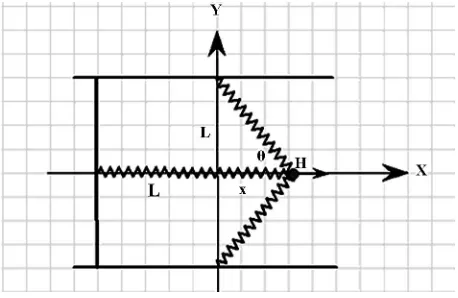
One realizes this simple mechanical device is capable of exerting nonlinear forces; the forces are a combination of cubic and quintic coordinate-dependent terms. For the sake of “completeness”, in order to include a linear coor- dinate-dependent force we modify the previous design by adding a third identical spring, shown in Figure 2.
For this three-spring system the net force is,
3 5 2 4 3 4 x k k
F kx x x
L L
(3)
The criteria x < L suggests that the impact of the third term and terms with powers higher than the fifth are to be insignificant; this is qualified later on. Nonetheless, the equation of motion of the marble under the influence of the force given by Equation (3) along the x-axis yields,
3 5
2 4
3
0. 4
k k k
x x x x
m mL mL
(4)
with this equation in hand we analyze the impact of the force terms on the kinematic characteristics of the mobile marble. First, by turning off the linear term, a scenario subject to Figure 1, we focus on the impact of the cubic and quintic terms. Then, we consider a case including the combination of the linear and the cubic terms.
3. Analysis
3.1. Case 1
[image:2.595.309.538.84.233.2]According to the scenario shown in Figure 1 and its ac-
Figure 2. Three-spring arrangement leading to a combina-tion of linear, cubic and quintic oscillacombina-tions.
companied force, Equation (2), the equation of motion is,
3 5 2 4 3 0 4 k k
x x x
mL mL
. (5)
First we consider a case assuming x < L, i.e. the initial displacement of the marble from equilibrium is less than the length of the spring; this drops the last term. Sustain- ing the cubic term only, the equation of motion is an analytically solvable DE with closed form solutions given by Jacobi Elliptic Functions [6]. Alternatively, the same equation can be solved numerically. Assigning pa- rameters to the spring length and stiffness and the marble we solve the equation numerically; output graphs of these two approaches are indistinguishable. To establish the basis for the semi-analytic method we focus on the numeric schematic. The values lists a typical set of pa- rameters in MKS units,
2 3
3.0, 6.0 10 , 10.0 10
k m
values .
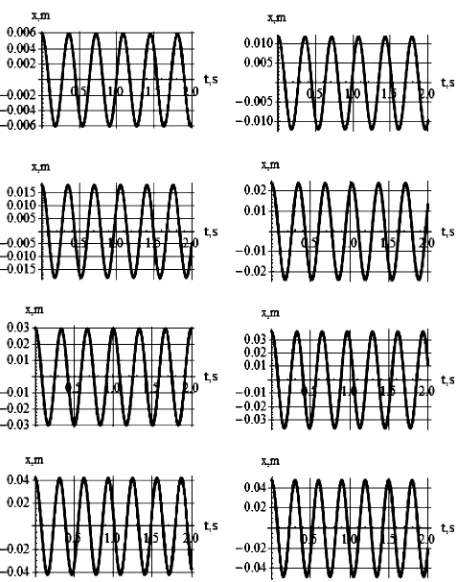
The 4 × 2 graphic-matrix shown in Figure 3 displays the position of the marble vs. time. The differences be-tween the graphs are due only to various initial dis-placements of the marble. From the top left to the bottom right these correspond to
0 0.1 1 for 1, 2, 3, ,8x respectively. The com-
mon global feature of these plots indicate irrespective of the initial condition the marble under the influence of the cubic force does oscillate. The period of oscillation is not constant; it depends on the initial value of the displace- ment. This is one the distinct characteristics of a non- linear force. An inspection of these plots reveals the ab- sence of retarding forces such as friction enforces the constant amplitude; noting the shorter the amplitude the longer the period. Figure 4 puts the observation in per- spective. This graph vividly shows a reciprocal relation- ship between the amplitude and the corresponding pe- riod.
Figure 3. Output of numeric solution of equation of motion. From the top left to the bottom right the graphs correspond to the initial values x[0] = 0.1 α l for α = 1, 2, 3, ..., 8, respec-tively.
ther by a direct comparison of the amplitudes or more elegantly by comparing their respective phase diagrams shown in Figure 5.
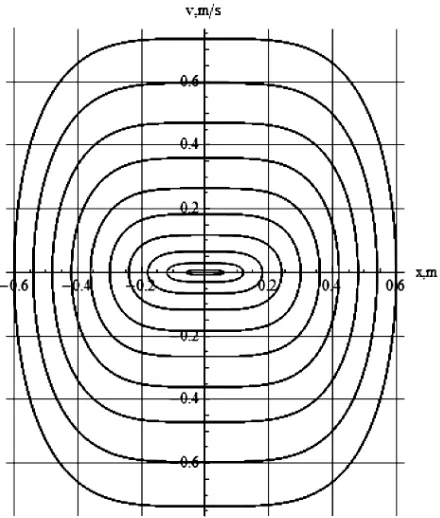
For the sake of clarity the horizontal scale of Figure 5 is magnified by a factor of 10. Figure 5 shows the dis- tinct differences between the oscillation characteristics of a linear vs. a cubic spring. As one may easily prove the phase diagram of a linear spring is a perfect ellipse. The phase diagram of a cubic spring is a depressed “ellipse” along the velocity axis. Depression severity of the latter is a function of the initial condition. A family of such curves is shown in Figure 6.
Figure 6 displays a series of phase diagrams each of which is a result of applying various initial conditions. For instance the inner depressed ellipse comes about from setting the initial displacement to x
0 0.1whereas the outer one is associated with the initial dis-placement x
0 0.1. The curves between the inner and the outer ellipses correspond to initial displacements
0 0.x 1 α for α = 2, 3, 4, ..., 9, respectively.
3.2. Semi-Analytic Method of Solving DE Motion
As we discussed in Section 3.1 the solution of equation of motion of a cubic force is an oscillating function.
Figure 4. Collective display of the oscillations shown in Figure 3.
Figure 5. Phase diagrams: (a) the ellipse corresponds to a linear spring, and (b) the depressed ellipse corresponds to a cubic spring.
Accordingly, the value of the initial condition impacts the period. With these two observations we propose a compatible alternative solution. This solution is neither purely numeric nor purely symbolic; it is somewhere in between, it is semi-analytic. From an analytic point of view, first we consider a solution such as, x t
amp
cos t , with ω = ω(amp). Because
2 T amp
, from a numeric point of view utilizing either Figure 4 or5 we hunt for T(amp). For instance, for the latter utilizing
Figure 5 for the chosen initial amplitude we evaluate the maximum ordinate of the corresponding oscillation. A set of one such coordinates are shown with dots in Fig-
ure 7. Then we fit the data with an appropriate con- tinuous function. The fitted curve is shown on the same graph as well. Utilizing this function, e.g. T(amp) we compare the semi-analytic solution
amp cos
2 amp
x t T t vs. the numeric solu- tion. A 4 × 2 graphic-matrix shown in Figure 8, qualifies the accuracy of our proposed method.
Figure 6. A family of phase diagrams of the cubic spring. The inner curve corresponds to x[0] = 0.1 while the outer one is due x[0] = 1.
Figure 7. The dots are the periods and the corresponding amplitudes are deduced from Figure 5. The solid line is the fitted curve T(amp) = 0.0256907 amp−1.
as an option, rather than utilizing the numeric solution that in general lacks the physics insight, alternatively, one may objectively apply the semi-analytic method to obtaining the same result.
3.3. Case 2
In this section we present the results pertaining scenario shown in Figure 2. The equation of motion is,
3
2 0
k k
x x x
m mL
(6)
[image:4.595.308.537.88.377.2]Equation (6) has an analytic closed solution; these are Jacobi Elliptic Functions [6,7]. These functions compar-
Figure 8. Comparison of the numeric solutions (black curves) vs. semi-analytic solution (gray curves) shown in Figure 2.
Figure 9. The dots are the periods and their corresponding amplitudes are deduced from oscillations subject to Equa- tion (6). The solid line is the fitted curve T(amp) = 0.3649 −
6.8834 amp1.5327.
ing to their counterparts of Case 1 have more complex argu- ments. This may be the trust of adapting the semi-analytic method for solving this equation. Following the proce- dure outlined in Section 3.1, Figure 9 displays the evalu- ated data, i.e. periods vs. amplitudes and the fitted curve. Utilizing the fitted function, e.g. T(amp) we compare the semi-analytic solution x t
amp cos
2 T amp
t [image:4.595.62.285.399.530.2] [image:4.595.309.536.438.567.2]Figure 10. Comparison of the numeric solutions (black curves) vs. semi-analytic solution (gray curves).
posed method.
As in Case 1, solutions are indistinguishable.
4. Conclusions and Remarks
The objective of this study is to design a mechanical sys- tem capable of oscillating under the influence of nonlin- ear forces. Utilizing a set of two and three linear springs we design two such devices; many more may be devised. These are complementary to our previous studies com- pleting the scope of nonlinear oscillations in three dif- ferent areas of physics: mechanics, electrodynamics and
magnetodynamics. Beyond discussing the physics of the problem, we introduce a semi-analytic method to objec- tively obtain analytic solutions for the equations of mo- tion. From mathematics point of view the proposed method for solving DE relies on numeric solution of DE. The output of the semi-analytic method is an analytic function embodying the desired objective properties. To distinguish the differences between the linear vs. nonlin- ear oscillations their phase diagrams are compared. How- ever, for a visual understanding (not included here), the author utilizing Mathematica has simulated the motion. Watching the movement of the marble under the influ- ence of nonlinear forces gives a valuable experience. Alternatively, one may simulate (as the author has done) the motion utilizing Cinderella. The latter is less objec- tive and bypasses the need for numeric input.
REFERENCES
[1] Mathematica, “A General Computer Software System and Language Intended for Mathematical and Other Applica- tions,” V9.0, Wolfram Research, 2013.
[2] Tronton and Marion, “Classical Dynamics of Particles and Systems,” 5th Edition, Cengage Learning, 2008.
[3] H. Sarafian, “Static Electric-Spring and Nonlinear Oscil- lations,” Journal of Electromagnetic Analysis & Applica-
tions, Vol. 2, No. 2, 2010, pp. 75-81.
[4] H. Sarafian, “Nonlinear Oscillations of a Magneto Static Spring-Mass,” Journal of Electromagnetic Analysis and
Applications, Vol. 3, No. 5, 2011, pp. 133-139. doi:10.4236/jemaa.2011.35022
[5] H. Sarafian, “Dynamic Dipole-Dipole Magnetic Interac- tion and Damped Nonlinear Oscillations,” Journal of
Electromagnetic Analysis & Applications, Vol. 1, No. 4, 2009, pp. 195-204. doi:10.4236/jemaa.2009.14030
[6] Jacobi Elliptic Functions.
http://mathworld.wolfram.com/JacobiEllipticFunctions.ht ml