http://www.scirp.org/journal/psych ISSN Online: 2152-7199 ISSN Print: 2152-7180
Relations between the Perception of
Communication Difficulties, Stress Levels
and Behavior of Children with Autism
Spectrum Disorders
Juliana Izidro Balestro, Cibelle Albuquerque de la Higuera Amato, Vanessa Sugawara,
Isabela Gibello, Letícia Segeren, Fernanda Dreux M. Fernandes
Universidade de Sao Paulo, Sao Paulo, Brazil
Abstract
The way that children are perceived by their families interferes with their experiences in society demanding that the parents’ perspectives are taken into account. The aim of this study was to identify the association among the autism symptoms reported by the parents of children with ASD, their perception of communication difficulties and the stress level reported by them. Participants were the parents of 19 children with ASD. They answered three questionnaires: the Autism Behavior Checklist, one ques-tionnaire about their difficulties in communicating with their child and another about their stress level. Each domain of each questionnaire was correlated with all items of the other two. The results indicated that there was no association among the answers. These results suggest what parents of children with ASD perceive as diffi-culties when communicating with their child and their stress level is not associated with the severity of the symptoms they identify in their child. The parents’ percep-tions about subjective issues of life reflect on how they cope with the specific needs of their children.
Keywords
Autistic Disorder, Communication, Social Behavior, Stress, Family
1. Introduction
Autism Spectrum Disorders (ASD) are characterized as a behavioral syndrome of mul-tiple etiologies, which compromises the child’s developmental process (APA, 2002; How to cite this paper: Balestro, J. I., de la
Higuera Amato, C. A., Sugawara, V., Gibel-lo, I., Segeren, L., & Fernandes, F. D. M. (2016). Relations between the Perception of Communication Difficulties, Stress Levels and Behavior of Children with Autism Spectrum Disorders. Psychology, 7, 1391- 1396.
http://dx.doi.org/10.4236/psych.2016.712139
Received: July 27, 2016 Accepted: October 31, 2016 Published: November 3, 2016
Copyright © 2016 by authors and Scientific Research Publishing Inc. This work is licensed under the Creative Commons Attribution International License (CC BY 4.0).
OMS, 2000). This syndrome affects social interaction, communication and general be-havior of the child, resulting in restricted interest and stereotyped and repetitive activi-ties. To identify and characterize children with ASD, many tools are used, including the Autism Behavior Checklist (ABC), which is comprised of a non-adaptive behavior checklist that is part of the Autism Screening Instrument for Educational Planning (ASIEP) (Marteleto & Pedromônico, 2005) and created to screen and indicate likeli- hood of diagnosis of autism, which allows a detailed description of the atypical beha-vior that is characteristic to each individual (Marteleto & Pedromônico, 2005; Tama-naha, Marteleto, & Perissinoto, 2014). Other studies suggest that the symptoms of ASD trigger high levels of stress in family members (Allen, Bowles, & Weber, 2013; Sivberg, 2002). Parents of children with ASD report going through periods of stress mainly due to the child’s difficulties in communication, behavior, social involvement in activities of daily living and the lack of understanding by the community (Balestro & Fernandes, 2012; Segeren & Françozo, 2014). One of the potential stress factors cited by parents is the difficulty of communication, and the impairments in this area include the difficul-ties of the child to make him/herself understood by others, and problems in socializa-tion and language.
Autism spectrum disorders are a complex behavioral syndrome. It impairs the de-velopment throughout life and has great variability in symptoms and intensity in the various areas that define the diagnosis (Schmidt & Bosa, 2003). Persons with autism need special care during all life and therefore the caretakers also need attention. Paren-tal stress in families with children with autism is significantly higher than the observed in families with children with other disorders or with typical development (Hayes & Watson, 2013). Communication is specially affected in autism, it is one of the parent’s first concerns and may increase stress levels. Studying the impact of speech in the stress level of parents of children with ASD may provide useful insights to the intervention planning. Therefore, this study asked if parents of non-verbal children with autism had higher levels of stress than parents of verbal children with autism and aimed to identify the association between the autism symptoms reported by them and their perception of communication difficulties (Andrade & Teodoro, 2012; Artigas-Pallarés, 1999).
Objectives
The aim of this study was to identify the association among the autism symptoms re-ported by the parents, their perception of communication difficulties and the stress lev-el reported by them.
2. Methods
2.1. Participants
2.2. Instruments
The tools used were the ABC, a stress protocol and a questionnaire about parents’ dif-ficulties in communicating with their child (Marteleto & Pedromônico, 2005; Balestro & Fernandes, 2012; Segeren, 2015).
The ABC is a questionnaire that refers to five areas of development: Sensory, Rela-tionship, Use of body and objects, language and personal and social development (ES, RE, CO, LG and PS), which has balanced score (1 - 4) according to the occurrence in ASD. From the sum of the scores, it draws up a behavioral profile that allows the analy-sis of probability for the ASD diagnoanaly-sis. It is a tool used to identify the risk, or the probability of a diagnosis within the autism spectrum. A score between 47 and 53 indi-cates a low probability; moderate risk is associated with total scores between 54 and 67, and scores from 68 up indicate a high probability of the child being diagnosed as with autism. It has been used in previous studies (Marteleto & Pedromônico, 2005; Tama-naha, Marteleto, & Perissinoto, 2014).
Both the stress protocol and the questionnaire about communication difficulties are divided into different domains. The questionnaire about communication difficulties
(Balestro & Fernandes, 2012) has four domains: the first domain involves the parents’ impression about themselves in relation to their children (D1); the second refers to their perception regarding the acceptance of their children by other people (D2); the third focus on the attitude of parents regarding their children (D3) and the fourth con-cerns the parents’ impressions about their children (D4).
The stress protocol has 39 questions divided in three domains: family, physical symptoms and the child. Questions refer to the participant’s family and their feelings regarding themselves. Participants should answer if the feelings were always, frequently, rarely or never true (Likert scale). The answers result on a score and the stress level is accordingly classified: scores equal or under 20—no apparent stress; scores between 21 and 46: medium level of stress; scores at or above 47 high stress level.
2.3. Data Analysis
Fisher’s Exact test was carried out for testing the association between each question-naire domain and both the ABC and the stress protocols separately. The statistical analysis was performed using the SPSS® 18.0.0 package. This test was used in its two- tailed mode, wherefore, p-values < 0.05 were considered for statistical significance.
3. Results
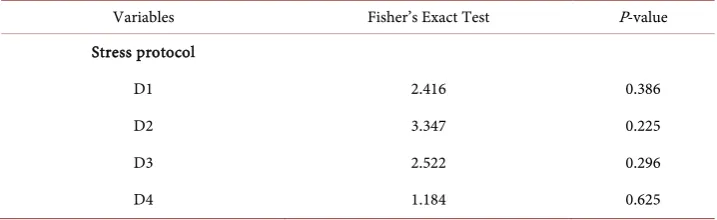
There were no correlations between the three protocols, which suggest that the stress reported by parents is not directly related to the severity of the symptoms or commu-nication difficulties they perceive in their child. Results regarding parents' perception are displayed in Table 1 and Table 2.
4. Discussion
Table 1. Association between each domain of the communication difficulties questionnaire and the ABC and stress protocols.
Variables Fisher’s Exact Test P-value
ABC protocol
D1 3.143 0.632
D2 4.762 0.391
D3 3.800 0.512
D4 5.587 0.240
Table 2. Association between each domain of the communication difficulties questionnaire and
stress protocols.
Variables Fisher’s Exact Test P-value
Stress protocol
D1 2.416 0.386
D2 3.347 0.225
D3 2.522 0.296
D4 1.184 0.625
the actual experiences of the families. The way by which difficulties and symptoms are interpreted and the meaning associated to them seems to be what determines this re-presentation (Balestro & Fernandes, 2012). It can be supposed that the stress levels are associated to the way these difficulties are perceived by the parents, thus showing their subjective responses. Other studies (Balestro & Fernandes, 2012; Sperry & Symons, 2003) have shown that the representation of parents is related to factors such as the so-cial support they receive, acceptance of people, independence, flexibility and resilience.
The ways children are perceived by their families interfere with their experiences in society, considering that language and socialization interfere mutually during commu-nicative exchanges. Therefore, it is essential to take into account the familiar perspec-tive about the communication disorders and their impact in the family’s life and that’s why each case must be analyzed and addressed individually. When data were pooled, there were no significant statistical differences, given the form parents perceive the dif-ficulties of their children and how they deal with them. However, when these data are analyzed separately they provide important information about the family context in which the child is growing and the specific coping mechanisms.
Apparently, the caregiver’s profile determines their perception of each child’s diffi-culties and interferes in the communicative process. It leads to the valorization or to the depreciation of the dyadic interaction (Sperry & Symons, 2003; Cia, Pereira, Del Prette, & Del Prette, 2006).
[image:4.595.195.554.249.359.2](Balestro & Fernandes, 2012; Hayes & Watson, 2013; Duarte, Bordin, Yazigi, & Moon-ey, 2005).
Other research concluded that the stigma is reinforced by society and its effects are nor easily overcome (McStay et al., 2013; Rivard, Terroux, Parent-Boursier, & Mercier, 2014). The family’s social relations are damaged, and the members go through a period of stress usually generated by the low acceptance of autistic behaviors by society and by other family members, as well as lack of social support (McStay et al., 2013). This means that the lack of social support and stigma are aspects with which families have necessarily to cope. However, it does not mean that this issue can be addressed without any difficulty.
Knowing and considering the parents’ perception about their child with autism is useful in planning and designing guidelines that are useful to them and their individual needs.
5. Limitations and Future Research
The sample size of this study was small. Future controlled studies using larger samples and with different parents’ profile (e.g., social economic levels, parents and services providers, parent’s occupation…) can better explore the difficulties in coping by par-ents of children with ASD.
6. Conclusions
The absence of association shows that the perception of parents is variable and is not directly related to the difficulties presented by the children, but with subjective res-ponses and the way they cope with them.
These findings are clinically important to help each family develop their own strate-gies for understanding and adapting to its consistent reality, their life style and values.
References
Allen, K. A., Bowles, T. V., & Weber, L. L. (2013). Mothers’ and Fathers’ Stress Associated with Parenting a Child with Autism spectrum Disorder. Autism Insights, 5.
American Psychiatric Association (APA) (2002). Manual de diagnóstico e estatística de distúrbios mentais (DSM-IV-TR) (4a ed.). Porto Alegre: Artmed.
Andrade, A. A., & Teodoro, M. L. M. (2012). Família e Autismo: Uma Revisão da Literatura.
Contextos Clínicos, 5, 133-142.
Artigas-Pallarés, J. (1999). El lenguaje en los trastornos autistas. Revista de Neurologia, 28,
S118-S123.
Balestro, J. I., & Fernandes, F. D. M. (2012). Questionário sobre dificuldades comunicativas percebidas por pais de crianças do espectro do autismo. Revista da Sociedade Brasileira de Fonoaudiologia, 17, 279-286. http://dx.doi.org/10.1590/s1516-80342012000300008
Cia, F., Pereira, S. C., Del Prette, Z. A. P., & Del Prette, A. (2006). Habilidades sociais parentais e o relacionamento entre pais e filhos. Psicologia em Estudo, Maringá, 11, 73-81.
http://dx.doi.org/10.1177/1362361305056081
Hayes, S. A., & Watson, S. L. (2013). The Impact of Parenting Stress: A Meta-Analysis of Studies Comparing the Experience of Parenting Stress in Parents of Children with and without Autism Spectrum Disorder. Journal of Autism and Developmental Disorders, 43, 629-642.
http://dx.doi.org/10.1007/s10803-012-1604-y
Marteleto, M. R. F., & Pedromônico, M. R. M. (2005). Validity of Autism Behavior Checklist (ABC): Preliminary Study. Revista Brasileira de Psiquiatria, 27, 295-301.
McStay, R. L., Dissanayake, C., Scheeren, A., Koot, H. M., & Begeer, S. (2013). Parenting Stress and Autism: The Role of Age, Autism Severity, Quality of Life and Problem Behaviour of Children and Adolescents with Autism. Autism, 18, 502-510.
Organização Mundial da Saúde (OMS) (2000). Classificação Internacional de Doenças CID-10. Revisão (8a ed.) (Tradução do Centro Colaborador da OMS para Classificação de Doenças em Português). São Paulo: Editora Universidade de São Paulo.
Rivard, M., Terroux, M., Parent-Boursier, C., & Mercier, C. (2014). Determinants of Stress in Parents of Children with Autism Spectrum Disorders. Journal of Autism and Developmental Disorders, 44, 1609-1620. http://dx.doi.org/10.1007/s10803-013-2028-z
Schmidt, C., & Bosa, C. (2003). A investigação do impacto do autismo na família: Revisão crítica da literatura e proposta de um novo modelo. Interação em Psicologia, 7, 111-120.
http://dx.doi.org/10.5380/psi.v7i2.3229
Segeren, L. (2015) Correlação entre a oralidade de crianças com distúrbios do espectro do autismo e o nível de estresse de seus pais. Dissertação. São Paulo: Faculdade de Medicina da Universidade de São Paulo.
Segeren, L., & Françozo, M. F. C. (2014). As vivências de mães de jovens autistas. Psicologia em Estudo, 19, 39-46.http://dx.doi.org/10.1590/1413-7372189590004
Sivberg, B. (2002). Family System and Coping Behaviours: A Comparison between Parents of Children with Autistic Spectrum Disorders and Parents with Non-Autistic Children. Autism, 6, 397-409.http://dx.doi.org/10.1177/1362361302006004006
Sperry, L. A., & Symons, F. J. (2003). Maternal Judgments of Intentionality in Young Children with Autism: The Effects of Diagnostic Information and Stereotyped Behavior. Journal of Autism and Developmental Disorders, 33, 281-287.
http://dx.doi.org/10.1023/A:1024454517263
Submit or recommend next manuscript to SCIRP and we will provide best service for you:
Accepting pre-submission inquiries through Email, Facebook, LinkedIn, Twitter, etc. A wide selection of journals (inclusive of 9 subjects, more than 200 journals)
Providing 24-hour high-quality service User-friendly online submission system Fair and swift peer-review system
Efficient typesetting and proofreading procedure
Display of the result of downloads and visits, as well as the number of cited articles Maximum dissemination of your research work
Submit your manuscript at: http://papersubmission.scirp.org/