Munich Personal RePEc Archive
Bargaining over debt rescheduling
Prokop, Jacek
Department of Economics II, Warsaw School of Economics
2012
Online at
https://mpra.ub.uni-muenchen.de/44315/
1
Bargaining over Debt Rescheduling
Jacek Prokop
Department of Economics II Warsaw School of Economics
Al. Niepodległości 162
02-554 Warsaw, Poland E-mail: [email protected]
Abstract
The objective of this paper is to investigate the bargaining over debt rescheduling between a sovereign borrower and a foreign lender in a more general framework than in the preceding literature. We propose a model in which the impact of the bargaining power of the creditor and the debtor can be analyzed in the situation of debt overhang. The concept of Nash bargaining solution is applied to predict the behaviour of international financial market’s participants. The extended framework of debt renegotiations allows to identify several possible equilibria that could serve as potential resolutions of the debt overhang problem. In an illustrative numerical example, we show that a significant level of forgiveness on the part of the lenders is indispensible in the process of bargaining over debt rescheduling. However, the actual size of the forgiveness varies with the specific distribution of the bargaining power between the debtor and the creditor.
Key words: debt rescheduling, foreign borrowing, international debt overhang, bargaining
2
Bargaining over Debt Rescheduling
Introduction
The lending by commercial banks to foreign countries has been present in the world economy for a long time. Recently, however, many sovereign borrowers have experienced difficulties in meeting their scheduled repayment obligations. Various observers speak about a debt crises of an unprecedented scale; one which might shake the financial system of the world.
Unlike the case of domestic lending, international loan contracts may not be enforceable in court, as a sovereign country cannot be easily suit by a foreign bank. But the
existence of high costs of a sovereign’s default may guarantee the enforcement of the implicit
contractual agreement between a debtor country and a foreign bank. There are at least three main costs to the debtor country, who unilaterally refuses to meet its debt obligations.1
The first cost of a country’s default on debts is the seizure of assets. The creditors of a
sovereign defaulter may be able to persuade their governments to seize any of the debtor’s assets located in their jurisdiction. These could include the foreign reserves of the defaulting
country’s central bank, foreign assets owned by the defaulting country’s individual citizens,
or even goods in international trade owned by the debtor and crossing creditors’ borders.2 The second possible cost of default is the exclusion from future borrowing. A country that has defaulted would be excluded from the international capital market, at least for some time. Once a country has already defaulted on previous debts, prospective lenders will be unwilling to believe promises that it will abide by the terms of new loan contract. Further, even if a sovereign defaulter did succeed in getting a loan abroad, its existing creditors would try to seize the new funds. Therefore a defaulting country would no longer be able to draw on foreign savings to develop profitable investment opportunities.3 In addition, the country would lose the flexibility to borrow abroad for smoothing consumption and investments in the face of temporary fluctuations in its real income. Sharper booms and busts would impose
economic costs and might also threaten country’s political stability.
The third and most serious cost of default is the reduction of the gains from trade. As a consequence of the costs discussed above, sovereign defaulters could find their ability to engage in international trade seriously curtailed. The debtor-country goods involved in international trade would be subject to seizure whenever they crossed a creditor’s border.
Furthermore, a defaulter’s exclusion from the international capital market might leave it
unable to obtain trade credits abroad or even to maintain checking accounts in foreign banks (since these accounts could be seized). Since the dependence on international trade is high,
the defaulter’s inability to trade would be very costly.4
The debtor’s “willingness-to-repay” is a factor which supports international lending without the presence of any court. Nevertheless, the economic situation of a debtor country may prevent the full repayment of debts even when the country has no a priori intention to default. In these circumstances – called “debt overhang” – the creditor bank has incentives to help the borrower to avoid the bankruptcy.5 These incentives result from substantial costs to
the creditor in the case of sovereign’s default.
1
See, for example, Bulow and Rogoff (1989).
2
Direct default costs of a sovereign borrower have been analysed, for example by Cole and Kehoe (2000).
3
The relationship between foreign loans and economic growth is discussed by, for example, Lin and Sosin (2001), Presbitero (2008), or Patillo et al. (2011).
4
Compare, for example, Eaton and Gersovitz (1981), Atkeson (1991), or Kletzer and Wright (2000).
5
3
The first, immediate cost of debtor’s repudiation is the loss resulting directly from a particular financial transaction that turned out to be a failure. The second, and even more important burden for the creditor bank results from the long-run negative effects of debtor’s default. On the one hand, a bankruptcy of a single borrower may encourage other debtors in a similar situation to stop servicing the scheduled repayments, piling up bank’s losses. On the other hand, the market reputation of the lending institution as a “loser” may have far reaching negative consequences for its future business activities.
Thus, both sides of the financial market, the borrower as well as the lender are interested in maintaining financial relations with each other, and in finding a solution to the debt overhang problem.
An important role in resolving the debt problem plays the bargaining over debt rescheduling. The models of debt renegotiations found in the literature (e.g. Fernandez and Rosenthal, 1990; Fernandez and Kaaret, 1992) give the bulk of bargaining power to the
creditor, who exploits the debtor’s willingness to make some repayments. However, this
approach minimizes, or even ignores creditor’s incentives to make concessions.
The purpose of this paper is to investigate the bargaining over debt rescheduling between a sovereign borrower and a lender in a more general framework. We offer a model in which the bargaining power could be more evenly distributed between the creditor and the debtor in the international financial market. We apply the concept of Nash bargaining solution to represent the strategically stable behaviour of borrowers and lenders. The proposed extended framework of debt renegotiations allows to identify several possible equilibria that could serve as potential solutions to the debt overhang problem. In an illustrative numerical example, we show that some level of forgiveness on the part of the lenders is indispensible in the process of bargaining over debt rescheduling. However, the size of the forgiveness varies with the specific distribution of the bargaining power between the debtor and the creditor.
The remainder of the paper is organized as follows. In the next section, we describe our model called the debt rescheduling game. Section 2 provides the equilibrium behaviour of the debtor country and the creditor bank. In Section 3, we consider a numerical example of debt rescheduling based on our model. Finally, the concluding remarks are in the last section.
1. Debt rescheduling game
The game called debt rescheduling is played by the foreign creditor and the sovereign debtor at time t=0. At the beginning of period t=0, the debtor country is endowed with an exogenously given capital stock K0 (K0>0), and some accumulated outstanding debt to
foreign creditor. The capital stock generates output according to the production function
g(K0). The resulting output may be used (in some proportion) for current consumption ( ),
further capital accumulation ( ), and/or repayment ( ), i.e., .
It is assumed that there is a scheduled repayment of size D0 to be made at time t=0.
The sovereign debtor is in an economically difficult situation described by g(K0) = D0, i.e., the
fulfilment of the scheduled repayment would not leave anything for domestic consumption and investment.
The renegotiation of the scheduled repayment means an agreement on the amount of debt to be forgiven, f0. In the case of no agreement, the borrower is going bankrupt (ε=1) at
time t=0.
The strategy of the debtor country is to choose the amount of repayment , where
, and the level of investment , where .
The payoff function for the debtor is given by:
4
where u(C0) is the debtor‘s „direct utility“ function of current consumption, and is
the debtor‘s „discounted future utility“ when the amount of repayment was , the level of investment chosen equalled , and decision about the bankruptcy was ε (equal to 1 for bankruptcy, or to 0 for good standing, no bankruptcy). Future utility comes from the access to the capital market, and from the future use of domestic capital accumulated by the debtor.
The strategy of the creditor is to choose , i.e. the portion of to be forgiven at time t=0.
The payoff function of the creditor is given as:
, (2)
where is the creditor‘s direct utility“ function of the current repayment made by the debtor, when the decision about bankruptcy or good standing of the debtor was (equal to 1, or to 0, respectively), and is the creditor’s“discounted future utility” when at t=0 he collected the repayment of and the decision about bankruptcy or good standing of the debtor was .
Future utility of the creditor results from his reputation as a successful bank in running financial business and thus depends in some way on the performance of loans made to this particular debtor.
The bargaining takes place at time t=0. For the agreement on the rescheduling to be achieved, it is necessary that . If , the debtor repudiates. Since
would be inefficient for the creditor, it must hold that
. (3)
Now, we consider the payoffs in the following three extreme scenarios: full repayment, full forgiveness, and bankruptcy (default or repudiation), respectively.
In the case of full repayment, the creditor receives the highest possible utility ( 0,0, 0). The lender extracts the largest possible direct utility from the current repayment and maintains its reputation as a perfectly successful bank, which allows him to attract many customers, and to make the highest possible profit in the future, as well, i.e.,
(4a)
Full repayment generates no utility to the debtor. The country would have to reduce the current consumption and investment to zero ( ), which would drive its direct utility from current consumption to zero. Although the access to the future international markets would continue to be opened, there would be no domestically financed investments to accommodate capital inflow. Hence the access to the capital market could not be used in an effective way and the future utility would be driven to zero, as well. Thus
. (4b)
Full forgiveness results in no positive utility to the creditor. The direct utility is zero, because no money is returned at t=0, and the reputation of the creditor as a „loser“ would take away his clients and drive his future utility to zero, as well. Therefore
. (5a)
5
international financial markets, which will generate future investment and consumption possibilities:
, (5b)
where .
In the case of default, the creditor gets some positive utility
(6a)
where , because the bank may not lose all its clients; some of them
may be attracted by his „tough“ policy towards the defaulter.
The debtor, also, obtains a positive utility, because the current consumption and domestically financed investments are not totally eliminated even when the access to the international financial market is precluded, or when foreign assets are seized. We have:
, (6b)
where .
The following orderings of payoffs to the creditor and to the debtor hold by assumption:
, (7a)
. (7b)
After setting up the necessary elements of the debt rescheduling game, we will move on to consider the equilibrium behaviour of the international market participants.
2. Equilibrium behaviour of the debtor and the creditor
We will apply the Nash bargaining solution (NBS) concept to represent the equilibrium behaviour of the sovereign debtor and the foreign creditor.6
The debtor solves the following maximization problem:
(8a)
such that . (8b)
Let‘s consider the case when ε=0, i.e., no bankruptcy. The first order condition is given by:
. (9)
The solution to the above equation is a function of , i.,e.,
(10)
6
6
Substituting the above expression into the objective function (8a), we obtain U, the utility function of the debtor, as a function of only:
(11)
Now from the payoff of the creditor defined by equation (2), we have
(12)
and by inverting the function we obtain:
. (13)
Substituting expression (13) into the utility function of the debtor given by (11), we obtain the utility U as a function of V only:
,
where (14)
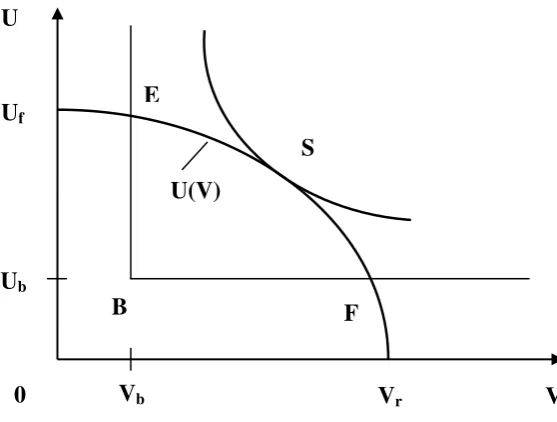
[image:7.595.158.437.372.583.2]The relationship between U and V given by (14) is presented in Figure 1.
Figure 1. The relationship between the payoffs of the debtor and the creditor
The threat point in this bargaining problem is , the point of bankruptcy; because the lender can guarantee himself at least the payoff , given by expression (6a), and the debtor is able to secure at least , given by formula (6b).
The Nash bargaining solution is based on the outcome of the following optimization problem:
. (15)
U(V) E
B
0 Vb
Ub
Uf
U
Vr V
S
7
The solution to the above problem, denoted , is the payoff to the creditor and the debtor, respectively. The payoffs are represented by point S in Figure 1.
From (13) we obtain the renegotiated repayment by the borrower as: . Hence
(16)
is the extent of forgiveness granted by the creditor to the debtor in the renegotiation process. For the Nash bargaining solution to be an equilibrium, the coordinates of the threat point B must satisfy the following inequality:
(17)
This inequality is obtained from (14) and implies Pareto dominance of point S over point B in Figure 1. If inequality (17) is satisfied then playing B, i.e., bankruptcy, will not be in the interest of anyone. Hence, as a result of successful renegotiation the point will be chosen, i.e., ε=0. Otherwise, the players will decide to play the threat point by setting ε=1.
From the first order condition given by
(18)
we obtain the optimal level of consumption in the debtor country as a function of the initial capital endowment, i.e.,
. (19)
Substituting expression (19) into formula (6b), we obtain
(22)
Hence the coordinates of the threat point , constituting the payoffs to the players in the case of unsuccessful negotiations (no agreement on rescheduling), are given by (6a) and (22).
The Nash bargaining solution, depends, clearly, on the shape of the function U(V) and the position of the threat point B. Thus, in the following section, we consider a numerical example to investigate some potential outcomes of the bargaining over debt rescheduling.
3. An illustrative example of rescheduling
The numerical analysis requires further specification of our model. The utility function of the sovereign debtor is assumed to be given by:
,
where , and . Thus
.
8
,
where , and . Thus
.
To further simplify our numerical analysis, we assume that g , , and . Hence the utility functions of the debtor country and the foreign lender can be written, respectively, as
,
.
The threat point in the bargaining process, , is obtained from the previously derived formulas:
,
.
Consider the case when ε=0. The utility function of the sovereign debtor is
.
From the first order conditions with respect to given by
,
we obtain . Substituting this expression back into the utility function of the debtor country, we have
.
Since , thus . By substituting into U, we finally obtain the relationship between U and V for given parameters a and b:
.
Using the specified functional form of our model, we consider the following three cases of numerical simulations.
First, we set , and b=2. Then , and
. Maximizing with respect to , we obtain
. Hence , and . The Nash Bargaining Solution is achieved when the repayment of is made, i.e. a debt forgiveness of 83 percent is granted by the creditor to the debtor. The bargaining over the size of repayment in this case is held over the interval of [0.5, 2.9], corresponding to points E and F in Figure 1.
In the second case, we illustrate the shift of the bargaining power by setting , and b=2. Then , and . Maximizing
with respect to , we obtain . Hence
9
increased in comparison to the first case. The interval of negotiations over the size of debt repayment illustrated by points E and F is given by [0.5, 9.7]. In this case the debtor is ready to repay a substantial amount of the borrowed money to avoid the default.
In the third case, we consider a reversed shift of the bargaining power by setting , and b=1000. Then , and . Maximizing
with respect to , we obtain . Hence
, and . The NBS is achieved when the repayment of is made, i.e. a debt forgiveness of 86 percent is granted by the creditor to the debtor. The bargaining power of the debtor has increased in comparison to the first case. The negotiations over the size of repayment in this case are held over the interval of [0.001, 2.9], i.e., the creditor is ready to
forgive „almost“ everything to avoid the repudiation.
The numerical results of our example have a straightforward interpretation: the bargaining power is higher for the party that has less to lose when the bankruptcy occurs. We have seen that a significant level of forgiveness on the part of the lender is indispensible in the process of bargaining over debt rescheduling.
Conclusion
Bargaining over debt rescheduling between the sovereign borrowers and the foreign creditors has been an important way to resolve the international debt overhang problem.7 However, the renegotiation models found in the literature give the majority of bargaining power to the foreign lenders. The strong position of the creditor, as typically assumed, stems from the losses the borrower faces after the bankruptcy.
Nevertheless, it must be noticed that there is also a substantial amount of the bargaining power on the side of the debtor country, and this fact should not be neglected. The power of the borrower comes from the threat that a bankruptcy of one debtor may substantially reduce the creditor’s current and future profits. The damage to the creditor caused by the debtor who goes bankrupt is equal not only to the money lost to this particular borrower, but it also includes the losses resulting from the negative reputational effect of the lender as an unsuccessful financial institution.
This paper was an attempt to model the negotiations over debt rescheduling between the sovereign borrower and the foreign lender when the bargaining power does not belong to one party only. The suggested model allows to analyse the impact of the distribution of bargaining power on the renegotiation outcome in the case of debt overhang.
Taking into account the fact that the bargaining power lies on both sides of the financial market, we conclude that the creditor as well as the debtor could be better off by reaching a mutual agreement in renegotiations rather than in the case of borrower’s bankruptcy. The lender has basically to agree on “some” forgiveness and the debtor has to
provide “some” repayment. The numerical analysis shows that in the Nash bargaining solution of our debt rescheduling game, the best choice for the foreign lender is to provide a significant level of debt forgiveness to the sovereign borrower. This result of an indispensible debt reduction has been reported by Yue (2010) in the case of Argentina.
It is important to stress that the game-theoretic analysis of the creditor-debtor relationship offered in this paper is more general than the contract-theoretic approach typically found in the preceding research. The contract-theoretic analysis constitutes just a special case of the game-theoretic approach to the relations between the sovereign borrower and the foreign lender.
7
10
Clearly, further research on the resolutions of the international debt overhang problem must be conducted. The bargaining over debt rescheduling between the borrower and the lender is certainly important. However, in many cases, a debtor country has borrowed money from a large number of foreign lenders at the same time. In such situations, the bargaining process might be strongly influenced by the noncooperative behaviour of the creditors, and by the existence of the secondary market for sovereign debts. For example, Diwan and Spiegel (1994), and Prokop and Wang (2012) analysed the role of debt buybacks on the secondary markets as an important element of debt overhang. The emergence of the free riding among the lenders in this context leads to a conclusion that without a collective action of the creditor community, the international debt overhang may not be eliminated.8
References
Atkeson, A. (1991), “International Lending with Moral Hazard and Risk of Repudiation”,
Econometrica, Vol. 59, No 4, pp. 1069-89.
Bulow, J. I. and Rogoff, K. (1989), “A Constant Recontracting Model of Sovereign Debt”,
Journal of Political Economy, Vol. 97, No 1, pp. 155-178.
Cole, H. L. and Kehoe, T. J. (2000), "Self-Fulfilling Debt Crises", Review of Economic Studies, Vol. 67, No 1, pp. 91-116.
Diwan, I. and Spiegel, M. M. (1994), “Are buybacks back? Menu-driven debt reduction schemes with heterogeneous creditors”, Journal of Monetary Economics, Vol. 34, No 2, pp. 279-293.
Eaton, J. and Gersovitz, M. (1981), “Debt with Potential Repudiation: Theory and Estimation”,Review of Economic Studies, Vol. 48, No 2, pp. 289-309.
Fernandez, R. and Kaaret, D. (1992), “Bank Heterogeneity, Reputation, and Debt
Renegotiation”, International Economic Review, Vol. 33, No 1, pp. 61-78.
Fernandez, R. and Rosenthal R. W. (1990), “Strategic Models of Sovereign-Debt
Renegotiations”, Review of Economic Studies, Vol.57, No 3, pp. 331-349.
Kaneko, M. and Prokop, J. (1993), “A Game Theoretical Approach to the International Debt
Overhang”, Journal of Economics, Vol. 58, No 1, pp. 1-24.
Kletzer, K. and Wright, B. D. (2000), "Sovereign Debt as Intertemporal Barter”, American Economic Review, Vol. 90, No 3, pp. 621-639.
Lin, S. and Sosin, K. (2001), “Foreign Debt and Economic Growth”, The Economics of Transition, Vol. 9, No 3, pp. 635-655.
Nash, J. (1950), “The Bargaining Problem”, Econometrica, Vol.18, No 2, pp. 155-162.
Pattillo, C., Poirson, H. and Ricci, L. A. (2011) “External Debt and Growth”, Review of Economics and Institutions, Vol. 2, No 3, pp. 25-43.
Presbitero, A. F. (2008), “The Debt-Growth Nexus in Poor Countries: A Reassessment”,
Economics - The Open-Access E-Journal, Vol. 2, No 2008-30, pp. 1-28.
Prokop, J. (1991), “Dynamics of International Debt Overhang with Two Lender Banks”, Discussion Papers 946, Northwestern University, Center for Mathematical Studies in Economics and Management Science.
Prokop, J. (1992), “Duration of International Debt Overhang with Two Lender Banks”,
Economics Letters, Vol. 38, No 4, pp. 473-478.
Prokop, J. (1995), “Organized Debt Buybacks: No Cure for Free Riding?”, Journal of Development Economics, Vol. 47, No 2, pp. 481-496.
Prokop, J. and Wang, R. (2012), “Strategic Buybacks of Sovereign Debt”, Frontiers of Economics in China, Vol. 7, No 1, pp. 1-21.
8
11
Rogoff, K. and Zettelmeyer, J. (2002), “Bankruptcy Procedures for Sovereigns: A History of Ideas, 1976–2001”, IMF Staff Papers, Vol. 49, No 3, pp. 470-507.
Sachs, J. (2002), “Resolving the Debt Crisis of Low-Income Countries”, Brooking Papers on Economic Activity, Vol. 2002, No 1, pp. 257-286.
Weinschelbaum, F. and Wynne, J. (2005), “Renegotiation, Collective Action Clauses and