http://www.scirp.org/journal/jep ISSN Online: 2152-2219
ISSN Print: 2152-2197
Study on the Effect of Different Modified Zeolite
to Phosphorus Activation in Red Soil
Jing Shi
1,2, Naiming Zhang
1,2*, Chenguang Zhang
1,2, Boxian Wei
1,21College of Resource and Environment, Yunnan Agricultural University, Kunming, China
2Soil Fertilization and Pollution Remediation Engineering Laboratory of Yunnan Province, Kunming, China
Abstract
The activation of soil-fixed phosphorus is a long-term concern in soil science. In or-der to enhance the activation effect to soil-fixed phosphorus in red soil, different modified zeolite, through physical, chemical method and the associated both physics and chemistry, was used in this paper. The results showed as following: 1) the acti-vated ability to soil-fixed phosphorus in red soil for modified zeolite was higher than the common one signally. Order of the ability for all kinds of modification zeolite in absolute activation amount and activation rate was: Modified in high temperature ammonium saturated zeolite > Ammonium saturated zeolite > Modified in high temperature zeolite > Common zeolite. 2) The increasing rate of modified phospho-rus in high temperature ammonium saturated zeolite and ammonium saturated zeo-lite had a decline trend with time postponed while that for modified phosphorus in high temperature zeolite and routine zeolite was rising gradually with time post-poned. For ammonium saturated zeolite, the increasing rate of phosphorus in low available phosphorus content red soil was significantly faster than that in red soil with the higher content of available phosphorus. 3) The activation rate for the same modified zeolite showed difference in different phosphorus level soil. The order is:
SPhigh > SPmedium > SPlow.
Keywords
Activation, Phosphorus, Red Soil, Zeolite
1. Introduction
Phosphorus is one of the necessary nutritional elements during plant growth and also
a limiting factor of water eutrophication [1]. Red soil is the main arable soil in China
and its phosphorus content is abundant, but the content of available phosphorus is
How to cite this paper: Shi, J., Zhang, N.M., Zhang, C.G. and Wei,B.X. (2016) Study on the Effect of Different Modified Zeolite to Phosphorus Activation in Red Soil. Journal of Environmental Protection, 7, 2036-2046.
http://dx.doi.org/10.4236/jep.2016.713158
Received: November 1, 2016 Accepted: December 16, 2016 Published: December 19, 2016
Copyright © 2016 by authors and Scientific Research Publishing Inc. This work is licensed under the Creative Commons Attribution International License (CC BY 4.0).
generally low. Though the phosphorus needs for the crop can be met by using phos-phorus fertilization but it is still not an effective way to solve the problem. For one
reason, the seasonal crop utilization of phosphate is only 5% - 10% [2] [3]. Besides,
most of the available P will be fixed in the soil in the form of fixed phosphorus. For one thing, phosphorus fertilizer is overused in order to ensure the yield and food se-curity. For another, there exist different levels of eutrophication in over 80% of lakes
and reservoirs [4] [5] [6]. Phosphate application must be reduced in order to protect
the environment and prevent the eutrophication. Meanwhile, phosphate mineral is nonrenewable resource. Considering these factors, to make full use of the fixed state of phosphorus in the soil, in order to balance food production, water environment protection and phosphate mineral resource, has become an inevitable choice. There-fore the research of cost-effective activation method of the soil fixed phosphorus is meaningful.
Studies showed that the accumulation of insoluble phosphate in the soil can be re-leased by the zeolite and therefore as a source of supply of plant available phosphorus
[7] [8] [9] [10]. However, the existed methods were not ideal to the activation effect on soil fixed phosphorus. In order to improve the effect of phosphorus activation using
zeolite further, the physical method of high-temperature modification, saturated NH4+
chemical methods and high-temperature modification with saturated NH4+
combina-tion of physical and chemical methods were used in this research. Together with solubi-lizing simulation experiments in three phosphorus levels, it focused on finding the me-thod that can be applied in fixed phosphorus activation of red soil.
2. Materials and Methods
2.1. Tested Soil and Regional Profiles
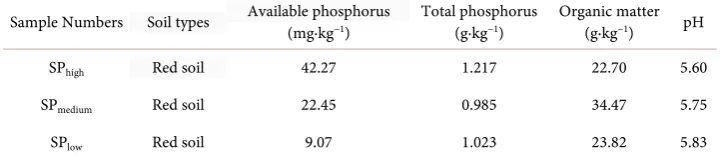
Soil samples used in this study were taken from Yunlong Reservoir farmland soil which is the largest urban centralized drinking water source of Kunming. Sampling depth was 5 - 20 cm topsoil. The soil samples were air-dried and ground through a sieve of 1mm aperture and stored in a sealed bag for use. The basic properties of the soils are shown in Table 1.
2.2. Design of Experiments
2.2.1. Experiment Materials
[image:2.595.194.556.623.703.2]Natural zeolite is an aluminum silicate mineral with basic metal frame shape. As it has
Table 1. Experimental soils’ basic properties and contents of phosphorus.
Sample Numbers Soil types Available phosphorus (mg·kg−1) Total phosphorus (g·kg−1) Organic matter (g·kg−1) pH
SPhigh Red soil 42.27 1.217 22.70 5.60
SPmedium Red soil 22.45 0.985 34.47 5.75
many internal cavities and channels, it is strong in cation exchange and selective
ad-sorption performance, as well as its rich adad-sorption capacity. Zeolite used in this study
collected from Yunnan and its main components are clinoptilolite. Cation exchange
capacity is 89.3cmol/kg. Molecular formula is (SiO2) (Al2O3). Its weight is 218.247 and
chemical formula is (CaNa2) Al2Si7O∙6H2O.
2.2.2. The Experimental Design
This experiment set up 4 treatments with 3 replications. 4 treatments are: Treatment 1 was common zeolite treatment; Treatment 2 was high temperature modified zeolite; Treatment 3 was ammonium saturated zeolite and Treatment 4 was high-temperature modification of ammonium saturated zeolite. The proportion ratio of modified zeolite
is 1:100 and three red soil samples with SPhigh, the SPmedium and SPlow were added
ac-cording to this ratio. Soil sample was taken every 10 d with a total of 4 times. The available phosphorus content was determined every time, the absolute amount of the activation of phosphorus was calculated by subtracting the available phosphorus con-tent in CK treatment from the available phosphorus concon-tent of each zeolite activation treatment; the increasing rate of available phosphorus was calculated by dividing in-creasing amount of absolute available phosphorus by available phosphorus content in CK then multiplied by 100%. By subtracting the increasing rate of previous available phosphorus from the last available phosphorus, calculating the dynamic increase rate of available Phosphorus, the activation rate of Phosphorus was calculated from dividing the increase rate of absolute available phosphorus by total phosphorus in CK soil then multiplied by 100%.
2.3. The Method of Determining Index
Soil available phosphorus was measured by sodium bicarbonate extraction-molybde- num antimony anti-colorimetric determination method. Total phosphorus in soil use NaOH-molten molybdenum, antimony anti-colorimetric determination method. pH value was tested by the precision pH meter with PHS-3C; the soil organic matter uses external heating potassium dichromate oxidation method for determination.
3. Results and Discussion
3.1. Effect and Variance Analysis of Different Modification
Zeolite to Activate Red Soil Phosphorus
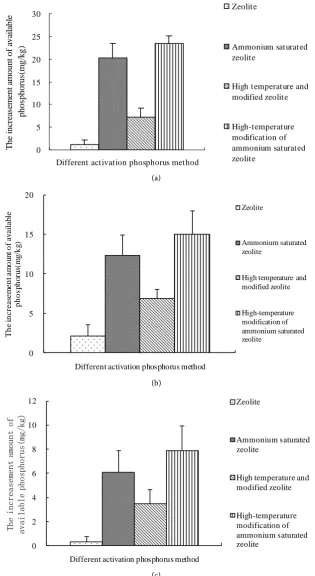
3.1.1. Effect of Different Modification Zeolite to Activate Red Soil Phosphorus It showed that the absolute increment of available phosphorus with high-temperature modification of ammonium saturated zeolite was the highest between the four modified
zeolites (Table 2). The absolute increments of available phosphorus were 23.48 mg·kg−1,
15.10 mg·kg−1 and 7.92 mg·kg−1. Solubilizing effect of the ammonium saturated zeolite
was also evident, the absolute increments of its available phosphorus were 20.30
mg∙kg−1, 12.35 mg·kg−1 and 6.13 mg·kg−1. Solubilizing effect of the high-temperature
modified zeolite was better than the zeolite, and the absolute increments of its available
Table 2. The absolute activation amount of different modification zeolite to activate red soil phosphorus.
Modification treatment
SPh SPm SPl
Absolute increments of Available phosphorus(mg∙kg−1)
(average ± Standard deviation)
Ordinary zeolite 1.10 ± 0.2c 2.11 ± 1.5c 0.35 ± 0.4c
Modified zeolite in high temperature 7.20 ± 2.0b 6.90 ± 2.6b 3.49 ± 2.2bc Ammonium saturated zeolite 20.30 ± 3.1a 12.35 ± 2.6a 6.13 ± 3.2ab High temperature modified ammonium saturated zeolite 23.48 ± 1.6a 15.10 ± 2.9a 7.92 ± 4.1a
of ordinary zeolite were 1.10 mg∙kg−1, 2.11 mg∙kg−1 and 0.35 mg∙kg−1. It follows that the
ordinary zeolite could activate the fixed state phosphorus in the soil but its activation effect was not obvious.
Overall, the combination of Zeolite and saturated NH4+ can significantly improve the
solubilizing phosphorus amount of zeolite. The main reason is to add saturated NH4+
can increase the cation exchange capacity of zeolite. So that the exchange absorption
amount of zeolite to free state metal cations in the soil (of Fe2+, of Al3+, of Ca2+) was
ef-fectively increased and the fixation to phosphate ion was reduced [11]. Meanwhile
so-luble phosphorus was released through the cation exchange interaction of Ca2+ from
insoluble calcium phosphate [12]. The exchange capacity order of different absorption
ion to Ca2+ was as follows [13]: H+ > Na+ > of NH
4+ > K+ > Mg2+ > Ba2+. It follows that
different cation has great difference in selective exchange to Ca2 +. The main reason that
the high temperature modified zeolite has better solubilizing phosphorus effect than ordinary zeolite is the adsorption in the zeolite voids with a certain amount of organic matter. The solubilizing effect of the zeolite is hindered by the relatively stable nature of organic matter, for there is no reaction with insoluble phosphate by the cation exchange role, and also the occupation of the organic matter to zeolite in adsorption capacity. High-temperature burning can effectively remove the organic matter adsorbed on the zeolite voids and thus increase the adsorption ability and adsorption capacity of the zeolite, and its phosphate solubilizing capacity will be significantly better than the zeo-lite without the high-temperature burning. The solubilizing effect of untreated zeozeo-lite is not obvious, it has the reasons: Firstly, the tested soil is red soil with strong acid, and this soil has secondary phosphorus fixation which make the secondary fixation of
acti-vated phosphate ion [14]; Secondly, low application amount of zeolite make its cation
exchange and adsorption capacity relatively smaller, which is similar with the research
result of Li [10].
3.1.2. Variance of Different Modification Zeolite to Activate Red Soil Phosphorus
It shows in Figure 1(a) that there was no significant difference between high-tempera-
(a)
(b)
[image:5.595.216.532.71.648.2](c)
Figure 1. (a) The difference of (PS high) phosphorus activation effect in different modification
treatment zeolite; (b) The difference of (PS medium) phosphorus activation effect in different modification treatment zeolite; (c) The difference of (PS low) phosphorus activation effect in dif-ferent modification treatment zeolite.
0 5 10 15 20 25 30
Different activation phosphorus method
T h e i n cr eas em en t am o u n t o f av ai lab le phos phorus (m g/ kg) Zeolite Ammonium saturated zeolite
High temperature and modified zeolite High-temperature modification of ammonium saturated zeolite 0 5 10 15 20
Different activation phosphorus method
T h e i n cr ea sem e n t a m o u n t o f a v a il a b le p h o s p h o ru s( m g /k g ) Zeolite Ammonium saturated zeolite
High temperature and modified zeolite High-temperature modification of ammonium saturated zeolite 0 2 4 6 8 10 12
Different activation phosphorus method
The increasement amount
of
available phosphorus(mg/kg)
Zeolite
Ammonium saturated zeolite
High temperature and modified zeolite
different with the high-temperature-modified zeolite; Solubilizing phosphorus effect of the high-temperature modified zeolite was also significantly different with ordinary zeolite. Regarding the red soil with high SP, the solubilizing effect order of zeolite from four different treatments are: high-temperature modified ammonium saturated
zeo-lite > ammonium saturated zeozeo-lite > high temperature modified zeozeo-lite > zeozeo-lite.
Fig-ure 1(b) shows that High-temperature modified ammonium saturated zeolite has no big difference with ammonium saturated zeolite about solubilizing effect; their solubi-lizing effects are highly different with high temperature modified zeolite. It also has significant difference between high-temperature modified zeolites and zeolite. The so-lubilizing effect of Zeolite for the red soil with medium level SP was: high temperature modification of ammonium saturated zeolite > ammonium saturated zeolite > high
temperature modified zeolite > zeolite. Figure 1(c) shows that there is no significant
difference between high-temperature modified ammonium saturated zeolite and am-monium saturated zeolite, but it has no common with high temperature modified zeo-lite in solubilizing effect; The solubilizing effect of the ammonium saturated zeozeo-lite has no great difference with high temperature modified zeolite but different with Zeolite; The difference was not vital between high temperature modified zeolite and zeolite. The solubilizing effect order of four treatments with low SP red soil was: high-temperature modified ammonium saturated zeolite > ammonium saturated zeolite > high tempera-ture modified zeolite > zeolite.
3.2. Influence of Different Modified Zeolite on the Dynamic
Increasing Rate of Available Phosphorus in Red Soil
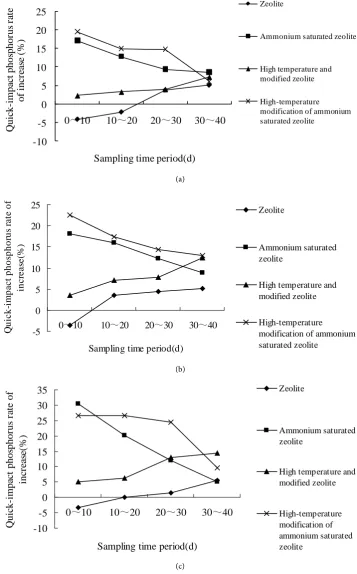
It can be seen that in the same period, the increasing rates of available phosphorus in
red soil are different for the zeolite with different treatments (Figures 2(a)-(c)). The
dynamic increasing rate of available phosphorus from 3 soil samples in the 0 - 10 d pe-riod of high-temperature modified ammonium saturated zeolite were 19.61%, 22.50% and 26.53%, which were higher than the other three periods. Within the 0 - 10 d of ammonium saturated zeolite, the dynamic increasing rate of available phosphorus from 3 soil samples were 17.17%, 18.06% and 30.34%, which were significantly higher than the results from other three periods. And the dynamic increasing rate of available phosphorus with these two treated zeolite showed a descending trends. In addition, in the 0 - 10 d for high temperature modified zeolite, the dynamic increasing rate of available phosphorus from three soil samples was 2.35%, 3.54% and 5.15%, which were lower than the results of other three periods, and their dynamic increasing rate of available phosphorus showed ascending trends. And the zeolite also has the similar pattern.
The reason that the dynamic increasing rate of available phosphorus from high- temperature modified ammonium saturated zeolite and ammonium saturated zeolite
showing descending trends is that zeolite absorbed saturated NH4
+ in extremely rich
(a)
(b)
(c)
Figure 2. (a) (PS high) dynamic increasing rate of phosphorus in different modification
treat-ment zeolite; (b) (PS medium) dynamic increasing rate of phosphorus in different modification treatment zeolite; (c) (PS low) dynamic increasing rate of phosphorus in different modification treatment zeolite. -10 -5 0 5 10 15 20 25
0~10 10~20 20~30 30~40
Q u ick -i m pa ct phos phor us r at e o f i n cr eas e ( % )
Sampling time period(d)
Zeolite
Ammonium saturated zeolite
High temperature and modified zeolite
High-temperature modification of ammonium saturated zeolite -5 0 5 10 15 20 25
0~10 10~20 20~30 30~40
Sampling time period(d)
Q u ic k -i m p a c t p h o sp h o ru s r a te o f in cr e a se( % ) Zeolite Ammonium saturated zeolite
High temperature and modified zeolite
High-temperature modification of ammonium saturated zeolite -10 -5 0 5 10 15 20 25 30 35
0~10 10~20 20~30 30~40
Sampling time period(d)
Q ui ck-im pa ct phos phor us r at e of in cr eas e( % ) Zeolite Ammonium saturated zeolite
High temperature and modified zeolite
[image:7.595.192.550.78.653.2]gradually the saturated NH4
+ was consumed and cation exchange amount was
re-duced, so that the dynamic increasing rate of available P was declined. The dynamic in-creasing rate of available phosphorus of high temperature modified zeolite and the or-dinary zeolite showing ascending trends is because that their solubilizing mechanism
was a slow reaction process, and at the beginning zeolite need to absorb the ions K+ and
NH4+ that has cation exchange ability in soil, then by cation exchanges to react with the
metal cation of insoluble phosphorus in soil, the phosphate ion will be released slowly
[15]. It is just as the existence of this time difference that there have been followed by
an upward trend of the dynamic increasing rate of available phosphorus, and also pre-cisely as this phenomenon, the zeolite cannot play the role of activating soil phosphorus and even make negative effect. This could be the reason in the early stage that zeolite showed negative value.
3.3. Effect of Different Modified Zeolite on the Activation Rate of
Phosphorus in Red Soil
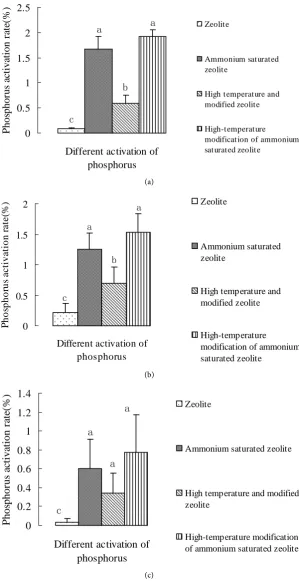
Figures 3(a)-(c) showed that the different treated zeolite has variable activation phos-phorus rates to the same soil sample. The modified ammonium saturated zeolite has the highest activation rate of phosphorus, and the phosphorus activation rates in three soil samples with high SP, medium SP, and low SP are 1.93%, 1.53% and 0.77%. It fol-lows from that the phosphorus activated mode of high-temperature modified
ammo-nium saturated zeolite has the best effect in high SP. It was seen in Figure 3(a) that
there was no significant difference of phosphorus activation rate between high-tem- perature modified ammonium saturated zeolite and ammonium saturated zeolite, the difference are significant between ammonium saturated zeolite and high-temperature modified zeolite, and also between high temperature modified zeolite and ordinary
zeo-lite. It was seen in Figure 3(b) that there was no significant difference of phosphorus
activation rate between high-temperature modified ammonium saturated zeolite and ammonium saturated zeolite, and big difference between ammonium saturated zeolite and high-temperature modified zeolite, and also big difference between high
tempera-ture modified zeolite and ordinary zeolite. Figure 3(c) showed that high-temperature
modified ammonium saturated zeolite had no difference with ammonium saturated zeolite, but it had vital difference with high temperature modified zeolite; Ammonium saturated zeolite had no difference with high temperature modified zeolite, but it had highly difference with ordinary zeolite; and also big difference between high tempera-ture modified zeolite and ordinary zeolite.
As the different mechanisms of activating phosphorus between different processed zeolite, there was a big difference for phosphorus activation effect of the same soil. High-temperature modified ammonium saturated zeolite has the best activating phos-phorus effect in the four processed zeolite because the soil organic matter absorbed in the zeolite voids was removed by high temperature, and the absorption capacity of zeo-lite was enlarged and cation exchange capacity of zeozeo-lite was also increased through
combination with saturated NH4
(a)
(b)
(c)
Figure 3. (a) The difference between activation rate of phosphorus in different modification
treatment zeolite (PS high); (b) The difference between activation rate of phosphorus in different modification treatment zeolite (PS medium); (c) The difference between activation rate of phos-phorus in different modification treatment zeolite (PS low).
0 0.5 1 1.5 2 2.5
Different activation of phosphorus P hos phor us a ct iva ti on r at e( % ) Zeolite Ammonium saturated zeolite
High temperature and modified zeolite
High-temperature modification of ammonium saturated zeolite c a b a 0 0.5 1 1.5 2
Different activation of phosphorus P h o sp h o ru s a c ti v a ti o n r a te (% ) Zeolite Ammonium saturated zeolite
High temperature and modified zeolite
High-temperature
modification of ammonium saturated zeolite c a b a
0
0.2
0.4
0.6
0.8
1
1.2
1.4
Different activation of
phosphorus
P
hos
phor
us
a
ct
iva
ti
on r
at
e(
%
)
ZeoliteAmmonium saturated zeolite
High temperature and modified zeolite
High-temperature modification of ammonium saturated zeolite
c
a
[image:9.595.223.523.70.652.2]mostly activate the fixed phosphorus in red soil. However, the phosphorus activation rate of high temperature modified ammonium saturated zeolite was quite different be-tween three soil samples. The reasons are: firstly, total phosphorus content is different in these three soil samples. Secondly, available phosphorus content in the soil sample with high SP are the highest, which makes the free cation content that can fix available
phosphorus relatively less, thus saturated NH4+ absorbed on high temperature modified
zeolite could have cation exchange reaction with metal cation in insoluble phosphate, and the activation rate of phosphorus can be maximized.
4. Conclusions
The ability of zeolite in activating phosphorus of the red soil with different modified treatment was significantly higher than the ordinary unmodified one, and the treatment with high temperature modified and saturated with ammonium ion has the highest phosphorus activation amount. The absolute amount of activating phosphorus with different treatments has the order as follows: high-temperature modified ammonium saturated zeolite > ammonium saturated zeolite > high-temperature modified zeolite > ordinary zeolite.
For the tested soil samples with high, middle and low levels of rapid available phos-phorus content, the increasing rate of soil phosphos-phorus activation with different treat-ments has the same general trend. The increasing rate of modified phosphorus in high temperature ammonium saturated zeolite and ammonium saturated zeolite had a de-cline trend with time postponed while that for modified in high temperature zeolite and routine zeolite were rising gradually with time postponed. For ammonium saturated zeolite, the increasing rate of phosphorus in low available phosphorus content red soil was significantly faster than that in red soil with the higher content of available phos-phorus. All these are related with their different activation mechanisms.
The four treatments by the usage in the soil with high, middle and low available phosphorus content have the same order of activation rate to phosphorus: high-tem- perature modified ammonium saturated zeolite > ammonium saturated zeolite > high temperature modified zeolite> ordinary zeolite, but the activation rate for the same modified zeolite showed difference in different phosphorus level soil. The order is:
SPhigh > SPmedium > SPlow.
Acknowledgements
Project supported by the science and technology innovation talent plan of Yunnan Province (No. 2015HC018); national water pollution prevention and treatment of ma-jor projects (No. 2012ZX07102-003).
References
[1] Schindler, D.W. (1997) The Evolution of Phosphorus Limitation in Lakes. Science, 195, 260-262. https://doi.org/10.1126/science.195.4275.260
Ad-sorption. Acta Pedologica Sinica, 27, 377-383. (In Chinese)
[3] Sakaih, T. (1991) Secretion of Acid Phosphatase by the Roots of Several Crop Species under Phosphorus-Deficient Conditions. Soil Science and Plant Nutrition, 37, 129-140.
https://doi.org/10.1080/00380768.1991.10415018
[4] Pomeioy, L.R., Simith, E.E. and Crant, C.M. (1965) The Exchange of Phosphorus between Estuarine Water and Sediments. Limnology and Oceanography, 10, 167-172.
https://doi.org/10.4319/lo.1965.10.2.0167
[5] Zhang, Y., Zheng, B.H., Liu, H.L., et al. (2005) The Traits Analysis of Nitrogen and Phos-phorus Nutrients after Gorges Reservoir Impounding. Water Resource Protection, 21, 23- 26.(In Chinese)
[6] Xu, D.X., Qin, Y.W. and Zhang, L. (2009) Phosphorus Forms and Its Distribution Charac-teristics in Sediments and Soils of Water Level Fluctuating Zone of the Backwater Reach from Input River of Three Gorges Reservoir. Environmental Science, 5, 83-90. (In Chinese) [7] Barbarick, L., Lai, T.M. and Eberl, D.D. (1990) Exchange Fertilizer (Phosphate Rock Plus
Ammonium-Zeolite) Effects on Sorghum-Sudangrass. Soil Science Society American Jour-nal, 54, 911-916. https://doi.org/10.2136/sssaj1990.03615995005400030050x
[8] Ando, H. and Mihara, C. (1996) The Fate of Ammonium Nitrogen Applied to Flooded Rice as Affected by Zeolite Addition. Soil Science, 42, 531-538.
https://doi.org/10.1080/00380768.1996.10416322
[9] Li, L.J. (1995) Ammonia Saturated Zeolite Increased the Yield of the Effect and the Influ-ence of the Fertilizer Utilization Ratio. Soils, 3, 147-150. (In Chinese)
[10] Li, L.J. and Zhang, L. (1996) Exchange Sex NH4+—Zeolite to Improve Soil p Force Research.
Soil Science Society of America Journal, 27, 139-140.
[11] Zorpas, A.A., Constantinides, T., Vlysside, A.G., et al. (2000) Heavy Metal Uptake by Nat-ural Zeolite and Metals Partitioning in Sewage Sludge Compost. Bioresource Technology, 72, 113-119. https://doi.org/10.1016/S0960-8524(99)00110-8
[12] Guan, L.Z. and Li, H.Z. (1992) The Effect of Increase of Natural Zeolite and Nitrogen and Phosphorus Nutrients and Some Fertility Regulation Mechanism of Nature. Chinese
Jour-nal of Soil Science, 23, 205-208.(In Chinese)
[13] Li, L.J. and Yin, X. (1999) Ammonium Saturated Zeolite-Apatite Soil Phosphorus Release the Role and Application. International Chinese Agriculture Science and Technology
An-nual Meeting.
[14] Bogumil, K. and Barbara, G. (2010) Mechanochemical Activation of Phosphate Rock in Presence of Zeolites. Praemysl Chemiczny, 89, 414-418.
[15] Abd-Alla, M.H. (1994) Use of Organic Phosphorus by Rhizobium Leguminosarum Biovar Viceae Phosphatases. Biology and Fertility of Soils, 18, 216-218.
Submit or recommend next manuscript to SCIRP and we will provide best service for you:
Accepting pre-submission inquiries through Email, Facebook, LinkedIn, Twitter, etc. A wide selection of journals (inclusive of 9 subjects, more than 200 journals)
Providing 24-hour high-quality service User-friendly online submission system Fair and swift peer-review system
Efficient typesetting and proofreading procedure
Display of the result of downloads and visits, as well as the number of cited articles Maximum dissemination of your research work
Submit your manuscript at: http://papersubmission.scirp.org/