A Lemma on Almost Regular Graphs and an Alternative
Proof for Bounds on
t
P
k
P
m
Paul Feit
Department of Mathematics, University of Texas of the Permian Basin, Odessa, USA Email: feit_p @utpb.edu
Received July 16, 2013; revised August 10, 2013; accepted September 3, 2013
Copyright © 2013 Paul Feit. This is an open access article distributed under the Creative Commons Attribution License, which per- mits unrestricted use, distribution, and reproduction in any medium, provided the original work is properly cited.
ABSTRACT
Gravier et al. established bounds on the size of a minimal totally dominant subset for graphs . This paper offers
an alternative calculation, based on the following lemma: Let
k m
PP
,
k r so k3 and r2. Let H be an -
regular finite graph, and put . 1) If a perfect totally dominant subset exists for , then it is minimal; 2) If
and a perfect totally dominant subset exists for , then every minimal totally dominant subset of must be
perfect. Perfect dominant subsets exist for when and satisfy specific modular conditions. Bounds for
, for all follow easily from this lemma. Note: The analogue to this result, in which we replace “totally
dominant” by simply “dominant”, is also true.
r
k
GPH G
> 2
r
t Pk
G G
k
PCn
k n
m P
k m,
Keywords: Domination; Total Domination; Matrix; Linear Algebra
1. Introduction
Let be a graph. In this paper, each
edge of a graph must have two different endpoints; also, two vertices may be linked by at most one edge. A subset
Z of vertices is said to totally dominate G if every vertex
of G has a neighbor in Z. We say Z perfectly totally
dominates if every vertex has exactly one neighbor in Z.
Next, suppose that G is finite. In this case, we say a
totally dominant subset Z is minimal if
,G V G E G
Z is the
smallest size possible among all dominant subsets. This
minimal size is denoted by t
G .For , we say that a graph G is r-regular if every
vertex is the endpoint of exactly r edges. Suppose G is
regular. A subset Z which perfectly totally dominates is
clearly minimal. If a perfect dominant set does not exist,
we can search for minimality among dominant subsets Z
by counting “overlaps”. That is, for each
r
vV Gv
, let
t be the number of neighbors of which lie
in Z, minus 1. If
, ,G Z
ol v1
Z and Z2 are two totally dominant
subsets, then Z1 < Z2 happens if and only if the sum
of Z1-overlaps is strictly less than the sum of Z2-
overlaps.
These elementary links between minimality, perfection
and overlaps may fail if G is not regular. For arbitrary
theorists, a challenge is to specific assertions that apply to a broad family of graphs.
The following conventions
graphs, all sorts of behavior is possible. For graph
will be used here.
(1a) For k, k2, let Pk, the k -path be the
graph whose ce the numbers 2, , k, and
whose edges are links from i to i1 for each i<k
verti s are 1,
1 .
There is an infinite member of family: Inte
as a graph in which edges consist of links from i
1
i
this rpret
to
for all i.
b) Let >k
(1 The graph consisting of plus an
ed
) Fo and
2 . n 1 an
r G
k
P
is
ge betwee d k called the k-cycle. It denoted
by Ck.
(1c H graphs, the product graph
G H is de ed asfin follows. The set of vertices
H
isV G V G
V H . Two vertices
x y1, 1
and
x y2, 2
r
ar edge if and only if
ei 2
e linked by an
the x1x and y y1 2 is an edge of H, or
x x1 2 is an edge of G and y1 y2.
For example, for k n, , PkPn is the familiar
k n grid map. A pro a aths and circuits
is called a grid graph.
A product of n copies of
duct of list of p
by
corresponds to the set
n with the “Ma hatten metric” notion of the edge: two
les
tup
n
x1, , xn
and
y1, , yn
are linked if andj j
x y for all ji.
Tiling is the route that Gravier [1] takes in computing
t
for grid graphs. The program begins with the work
herself, Molland and Payan [2] on the tiling question. The solution generates perfectly dominant subsets on
n
. Now, finite grid graphs can be interpreted as rec-
ular subsets, or (for products with Cn factors) as
such subsets with some “opposed” sides i ntified. Do- mination becomes a problem of refining the patterns at the edges.
Our curr by
tang
do
nu
de
ent work exploits the abundance of perfect
minations on graphs GPkCn. A calculation with
matrices leads to a lower t
G that can onlybe attained by a perfectly totally do t subset. Once
we classify which indices k n, admit perfect domi-
nations, an elementary trick ides upper and lower
bounds for all graphs PkCn. The bounds here do not
improve on the earlier w t are almost as narrow.
Suppose H is a finite r-regular graph for some natural
bound on
prov
ork, bu
minan
mber r, and put GPkH for k3. Then the
majority of vertices of G have a degree r2. The
vertices of the degree r1 form two conn sub-
graphs. A crude bound for minimal totally dominant
subset of G is
ected a
2
k H r . However, this bound is too
low by a positive number times H .
We find a subtler minimal bound usin he
t subset is minimal, and
bset cannot have fewer members
is odd, if a perfect totally e
nclusions follow from a formula which, for Z a
g matrices. T co
as
tha
do
tot
mputation also shows that (2a) A perfect totally dominan sumes the bound;
(2b) A minimal su n a perfect subset; and
(2c) Unless r2 and n
minant subset exists, th n every minimal subset is perfect.
The co
ally dominant subset, determines Z is a sum over
vV G of ol v Z Gt
, ,
j , where each j is aw j of v.
Remark. A variation on total d inati n
non-zero
do
do
1.1. Sa
weight associated to ro
om o is (simple)
d v has no neighbors in Z, or
Z.
rfect
mple Perfect Behavior
ts: first, exhibit a sub-
ite. Id
mination. A subset dominates (non-totally) if each
vertex v either has a neighbor in Z or belongs to Z. A
dominant subset Z is perfect (non-totally) if for each
vertex v, either
(3a) vZ an
(3b) vZ and v has exactly one neighbor in
Our theory implies that, in this context, if a pe minant subset exists, it is minimal and every minimal dominant subset is perfect.
A proof of minimality has two par
set; then prove no smaller totally dominant subset can exist. The examples here are drawn from Gravier [1].
Assume n is even. In this case, PkCn is bipart
entify Cn with n in the stan way. We can
“color” the vertices: we say
i j, (where j is readmod
dard
n ) is black if i j is even and white if i jis od hen every edg ks a black vertex with a w
one. If Z dominates PkCn, then the set of black
members of Z dominates all white vertices, and the white
vertices of Z dominate all the black. Consequently, a
minimal dominant subset is a disjoint union of two minimal “color” dominant subsets; each a subset of one color vertices that dominates all vertices of the other color. Furthermore, the “shift by 1” automorphism of
k k
PC identifies the sets of different colored vertices.
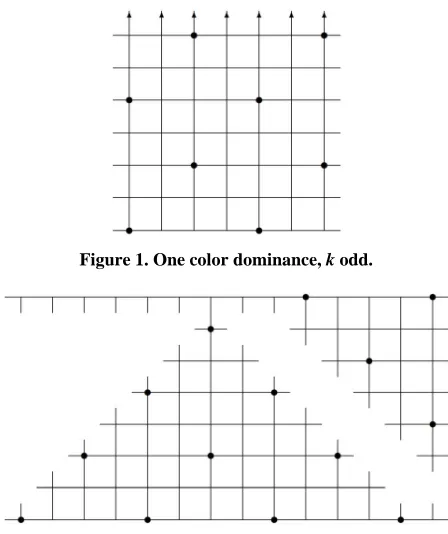
re 1 shows a pattern of vertices of one color
d. T
igu
us
e lin hite
.
stead,
F
Pr
as
ovided that k is odd, this pattern will totally domi-
nate all vertices of the opposite color.
If k is even, this pattern does not quite work. In
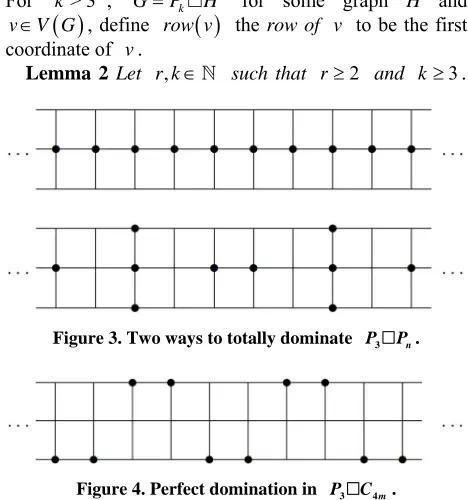
ill trated in Figure 2 for k8, one can build a
pattern by taking triangular wed of the first pattern,
and pairing them with a skew reflection. The latter
pattern can be repeated throughout PkCn provided
that
ges
2 k1 divides n.
The contribution of his pat per is a
set
n alternate con- struction of a lower bound. The bound is met for these perfect subsets. Next, using these subsets, one can estab-
lish a general upper bound for PkPm for all m.
1.2. A Tie with Perfection
Gravier [1] proves that the Z consisting of the
middle row of P3Pn, for any n, s a minimal totally
[image:2.595.310.534.458.725.2]dominant subset. Obviously, this choice of minimal i
Figure 1. One color dominance, k odd.
For each integer 1 j k, put
subset produces many overlaps. By rotating 3 3 blocks,
we can produce other minimal dominant se th fewer
overlaps, as in Figure 3. Furthermore, if n is a multiple
of 4, there is a variation which is a perfect total
domination of P3Cn, as in Figure 4. The flexibility in
the number of s which are dominated by more
than one member of
ts wi
vertice
Z reflects the presence of vertices
of two degrees, namely 3 and 4.
In this example, the size of a minimal, imperfect
to
1.3. Weights
ts of theorems based on series.
tally dominant subset “ties” the size of a perfect totally dominant set. Can a minimal subset be smaller than a perfect one? We prove that a tie is rare, and that beating is impossible.
We have two se
Definition 1 Let r be a real number. Let
r
aibe the set of infinite sequences of real numbers
i0 such that1 2 1, i i i .
i a ra a
Clearly,
r
1 i i
.
is a real vector space, and the fu
real, let i be the unique member of nction
a
a a,
is a linear isomorphism from it onto For
0 1
2
r i
r,
r s ch that and
r,1 1. Observe
r, 2 r .
In
that
th
u
e o
r,0 0
g section, we def
penin ined the overlap function
, ,
t v G Z for totally dominant subsets Z of a graph G.
or G a graph and Z a dominant (but possibly
not totally) subset, and vV G
, let ol v G Z
, ,
be
, ,
tol v G Z if vZ an G Z, Z ol
In addition, f
d ol vt
,
1 if v ., G P H f h H
vV efine the row of v to be the first
of v. Lemma 2 L t
For k> 3
G , dcoordinate
k
row
or som
v e grap and [image:3.595.54.288.484.734.2]e r k, such that r2 and k3.
Figure 3. Two ways to totally dominate P3Pn.
Figure 4. Perfect domination in P3C4m.
1, j
r k
1 1 , 1
1 , .
j
k j
r k j
r j
For each 1 j k,
0
(4a) j , and
(4b) j 0 if and only if is odd and
is
fer to
2
r , k j
even.
We re 1, ,k as the weight system for para-
m
ition 3 Let eters r k, .
Defin r k, such that r2 and
3
. Let 1, , k
k weight system r k, .
let 1,
be the for
Also, ,k be the weight system for parame
1,
r k
ters
. D
efine
1
2
2 2 , 1 2 , 1 2
, .
2 , 1
k
rk k r k r k
r k
r r k
Suppose H is an r-regular graph, and put n H
and GPkH. Define two functions on ZV
G :
Z ol v Z G
, ,
row
row
score
score , ,
t t v
v V G
t v
v V G
Z ol v Z G v
Theorem 4 Assume the hypothesis and construction of Lemma 2 and Definition 3. Let H be a finite graph, and put n H and GPkH.
(A) If Z V
G is totally dominant, then
,
score
t
Z
.2 , 1
Z n r k
r r k
(B) If ZV G
is dominant, then
1,
score
Z
.3 1, 1
Z n r k
r r k
A trivial consequence of this theorem and the pre- ce
ume the hypothesis of Theorem 4.
ding lemma is:
Corollary 5 Ass
(A) Suppose r3. If Z Z1, 2 are totally dominant subsets of G, then
1 < 2 scoret 1 < scoret 2 .
Z Z Z Z
(B) If Z Z1, 2 are dominant subsets of G, then
1 2
score < score
. 1 < 2Z Z Z Z
2. Modeled with Matrices
linear algebra model. Our results are based on a simple
For convenience,
(5) For k, let Ind
k 1, , k
.Notation 6. Let k. We identify the real vector
space k with length olumn vectors. We use trans-
pose notation to write these horizontally:
z
1 T
1
( , , ) for k .
k
z z
z
For each 1 i k, let i
k
nal
be the projection function
from each v z, , z
to its i-coordinate zi.Also define a linear f k
k
ector
1unctio
1
πi .
i
sum z z
We denote the zero vector by
d let H be a finite,
ˆ0. , a
In what follows, let k r, n
r-regular graph. Put G .
For
kP H
Z V G , define the row ount vector c z for Z to
be in
in the th u
z1, , zk
T which zi is the number of membersof Z i- row. Obvio sly, sum z
Z .Now sup ose p Z V G
totally dominates, and let
z, ,z
1 k be ount vector. Let 1 i k
z its row c .
, ,
tl v Z G over all v in the i-th r
The sum of o ow, plus
H , equals
rz1 2
1 1
1
, for 1,
, for 1 1,and
, for .
i i i k k
z i
z rz z i k
z rz i k
(6)
In particular,
lly dominates, then each of these ex- pr
(7a) If Z tota
essions must be H , and
(7b) If Z perfectly totally dominates, then each of these
expressions must equal H .
If we replace totally domination with simple domi-
na
ivate r next definition.
t be a na
tion, the analogous assertions hold after the r terms
in (6) are changed to r1.
These remarks mot ou
Definition 7 Let r be a real number and le k tural number > 1. Define L r k
, to be the k k matrix such that
,if ,
, Ind , , 1 if is 1 or 1
0 otherwise.
i j
r i j
i j k L r k i j
,
Note that L r k
, hese pais symmetric.
Also, for t rameters, define M r k
, to be theNote that the case is covered in both parts of this conditional definition.
atrix
k k matrix such that
, Ind ,
i j k
,
, , 1 if ,
,
, , 1 if .
i j
r i r k j i j
M r k
r j r k i j i
is essentially
1,
r k L .
3. Relevant Sequences
convexity for functions of a
i j
As we shall see, the m M r k
,There is a discrete analogy to
single real variable. We recall some basics.
Definition 8 Let
ai i 0 be a sequence of real num- bers, starting at index We say that the sequence is convex if
0.
1 1
, i i i i .
i a a a a
We say a
the sequence isstrictly convexif
1 > 1
i ai aiai for each i.
ai 0Lemma 9 Let i be a convex sequence. For
,v u ,
0 .
u v u v
a a a a
Moreover, au v auava0 ch that
if and only if there is a number t su
uv
, ai t ai1 . Indi
Proof.
ge
We may interchange u and v without loss of
nerality. Hence, assume uv. For each i, put
1
i i i
b a a . Then
bi i1
is a weakly increasing se-
quence. Then
0 0 0
1 1 1
0
1 1
0 1
1 1
0 1
1
u v
u v u v
i i i
i i i
v v
u v u v u i i
i i
v v
u v u v u v j i
j i
v
u v u v u v i i i
a a a a
b b b
a a a a b b
a a a a b b
a a a a b b
u v
Obse
a a
(8)
rve that
2
1i i u v v i
1
u v 0 .
For eac fo
h index i in the last sum, the term has the
rmat bpbq where >p q. Therefore
0 0.
u v
a auava
Now s au v auava00.
) must be 0. Wh
Then every term uppose
in the final sum of (8 en i1, we get
1 0
u v
b b . Since bi is an increasing ence, it
1
i
b b
sequ
follows that fo every index i u v. □
We focus sequences
r, finition 1.r
the i
on
of De0 Let r be a real number. Then
Trivial. □
Th
Proof.
e first remark is that the sign c eparated from the
magnitude.
Lemma 1
an be s
1
, 1i , , .
i r i r i
Many of the positive sequences
r i, are convex.Lemma 11 Each member of
2 is a linear se- quTrivial. □
ence. Proof.
Lemma 12 Let r> 2, and let
bi
r such that 1b b00. If b1> 0, then
bi
asing and more, bi bi1 can occur only if1
i .
is incre strictly convex. Further
Proof. For i2 , we can rewrite the relation
s
1 2i i
rb b
a
i
b
(9a) i i1bi1
bi1b2
bb
r2
b
b b
2 b
i
1 1 1
i i i i i
the two identities to induct on
b r , and
2
the double hy- po
2 .
□
Corollary 13 Let and su
(9b) .
Use
thesis that both
> > 0 an
bi bi1 d
bibi1
> bi1bi
> 0r k ch that
2
. Then
r
r k, of. This
0.
an easy conse
Pro quence mma and
Le
Fo
is of this le
mma 10. □
The next two propositions play roles in our analysis.
Lemma 14 Let r be a real number other than 2. r k1,
1, 1 , 1
,
2 .
i
r k r k
r i
r
(10)Proof. In what follows, a sum from any integer to
k
m
v 1
is defined to be 0. For this proof, we abbre iate
m
k For
for
r k, .each k
0 , define
0
, .
k i
k
s r i
Then for
i
Define a new sequence by 2
k ,
2
1 2
1 0
1 2
0 1 1 2
1
1 .
k k
i
k k
j j
k k
s r i
r j j
r s s
1 2
i i
t s r
. Replace
1 2
i i
s t r
into the previous relation to get
k
Hence,
1 2, k k .
k t r t t
ti belongs to
r .Now
0 0
1 1
1 1
2 2
1 1.
2 2
t s
r r
r t s
r r
2
, In the vector space
1 , 1,1 1 1 0,1 .
2 2 2 2
r
r
r r r r
The sequences ti and
1 1
1
2 2
i i i
r r
both belong to
rth
, and agree on the first two indices.
H e sequence. This gives the
equality of (10). □
Lemma 15 Let
ence, they are e sam
r be a real number, and let j k,
such that k j. Then
, 1 , , 2
, 1 , 1 .
r k r j r k j
r j r k j
Proof. We write
i for
r i, in this aIf k j
rgument.
, then
k 2 j
2 r,
k 1 j
1 1
recu defin
, and the f
ition.
result ollows
from a proo
1 j .
from the rsive
The remaining cases follow f is by in-
duction on j. The inductive hypothesis is
k 1
j
,
2 1
k j
k j j k
For j1, this follows from the fact that
1 1and
0 0.Assume j for which the inductive hy
true. Let
pothesis is
k so >k j1. Then
2 1 1 1
j k j j k j
r j j
11 1
1 1
2 1 1
1 .
k j
j k j
j r k j k j j k j
j k j j k j
k
1 1
1
k j j k j
r j j k j
1
□
4. The Inverse Matrices
We can now prove
Lemma 16 Let k and . The matric pr duct
r o-
, ,L r k M r k is
r k, 1
times the iden- tity matrix.ent, let
Proof. For this argum LL r k
, and
,M M r k and, for each i
0 , let
i
r i,
. Le u v, Ind
the lemmaby comparing the v en and
k . We prove
t
,
u try of L M
k1
times the u,v entry of the ident here a
t of cases.
ity matrix. T lo
Case
re a
1
L M v 1,v M2,v.Suppose 1. Recall that
1 1. Therefore
1, 2M v
1,1M2,1r k k 1 k1
.Suppose 1. Recall that
rM
v
2 r. Thenand
.
Case . For any
, this is
2
v ,
1,v v 1 1 0
rM M2, r k v
r k v uk vInd
k ,
LM
k v, Mk1,vrMk v, .If vk
1 1 1
k r k
r k k
k1
1 .Now suppose vk. Then v k 1, and
, 2 1
0 . k v v r v
v r r
Case . For any
There are three subcases here. First, suppos
L M
1 < <u k vInd
k ,
L M
, Mu1,v r v, Mr1,v .u v rM
e v u 1.
Then
The recursive definition states that
Hence, th ex-Next, suppose . Then
1 .Again, the recursive definition implies that this ex- pression is 0.
There remains only the subcase
.
By Lemma 15, this equals □
Lemma 17 Let
L
,
1 1 1
2 1
u v
M
v k u r v k
v k u r k u k u
v
k 1
u 1
u
k 2 u
r
k 1 u
k u .
pression equals 0.
e
1
v u
1 1 1 L Mu k v r u
k v
v u u u
, 1 1 u v k v u
k 1
1
r
uv.
, 11 1 2
u u
L M
k u
u r k u k u
u k u u k u
1 1 1
u k u r u k u
u
u 1
k 1 u
k 1
.
k , r and jInd
k . Assume r 2. Then
,
,1 1
, ,
k k
i j j i
i i
M r k M r k
equals
, 1
,
, 1
. 2
r k j r j r k
r
Proof. Put M M r k
, and, for each index i ,
,i
the s,
i j
i r
. Split um from i1 to k of
M at index j:
, 1 1 1 1 1 1 1 1 j k k i ji i j
j k
i i j
1
i
M i k j j k i
k j i j k
i
In the previo first sum is determined by
all the parameter is us line, the
Lemma 14. Rec r, not r
1 1 1 1 2 1 1 1 1 2 i k jk j i j j
r k j j j r j
In the second sum, change index to One
ca
1 .
p k i
n use the same Lemma.
1 1 1 kj k i
1 1 .
i j k j
p
j p
j
k j k j
2 r
Add the two terms to get
1j k j
,1
1 1 1 1
2 1 1 1 1 2 1 k i j i M
k j j k j
r
k j j k j
j k j j
k j j
r
k j j
j
By Lemma 15, this is the stated formula. □
At last, we introduce weights. Define
j
as in the
statement of Lemma 2.
Corollary 18 Let k, . Assume and let
r r2,
(A) If r2 and k is odd and j is even, then
0
j
.
(B) If r2 and either k is even or j is odd, then
> 0
j
.
(C) If r> 2, then j > 0.
(D) Let xn. Expand L r k
, x as Then
T 1, , b bn .
11 .
2 , 1
k j j j
sum x b
r r k
(11)Proof. We start with Part (D), as that is our motivation.
Given
1, , n
and
,
1, , k
, x x x bL r k x b bit f
ollows that
1, .
xL r k b
By Lemma 16, for each 1 i k,
, 1j
1 k
, .
, 1
i i j j
x M r k b
r k
ma 17
From Lem ,
,
1 1
, , 1
.
2 , 1
j i j
, 1 , 1 ,
k
j j
m x
M r k b r k
b
r r k
each
su
r k r k j r j
Now replace
r i,
by
1i1
r i, . Thej
b -coefficient becomes j
r2
r k, 1
.Recall Lemma 12. Then is a non-negative
an
,
i
r i
d convex sequence, and
r,0 0. Convexity im-plies that
k
is
(12a) and are both odd, and
(12b) trictly convex.
This lishes all our conclusions excep in
the case when k is odd and j is even. Assume
these parame and we know for all
and (A) follow
This corollary proves Lemma 2.
1
, 1 1 j , 1 1 ,
r k r k j r j
j
positive unless 1 j
,
is not skj
r i
remark estab t
2 r ,
ters,
s.
2,i i
i,
□
Corollary 19 Let k, r. Assume , and let
2 r
j be the overlain which every p w
e eights f
try is 1,
or be
n
Th
k r, that is
. Let ˆ1
1,1,the vector ,1 .
en
1
, ˆ1
, ,sum L r k r k
where is defined in Definition 3.
Proof. The easiest way is to get this formula is
(13a) Start with the formulas in Lemma 17;
s over using Lemma 14; and
onv
r k,
(13b) Sum the term j
(13c) C ert all
r i,
to
1i1
r i,
roof o .
servation f all th
pr
da e exam les of nd 1.
Fi
e
The ob of (6) completes the p
opositions in Section 1.3.
5. When
r
= 2
The numerical calculations allow us to add some
secon-ry comments on th p Sections a 1 and
1.2. x r2, and put LL
2,k . Then
2,i ifor all indices i. If Z is a perfect totally t
subset of PC and z is its row-count v
dominan ector, then
k n
ˆ1
L z n .
is odd,
If k
nˆ1
n 2,0, 2,0, , 2n n
1 .
L
cannot ex
Consequently, a perfect totally dominant subset
ist if n is odd. However, since j 0 for j even
domina bsets who
,
th s
th
ere may be totally nt su e size “ties”
e estimate for a perfect subset. In the case k3, the
set consisting of the middle row has row-count
0, ,0n
.Its image under L is
,n
.-th coordia
,3
n n
If k is even, the i nte of L1
nˆ1 is
1 if is odd, times
is even.
2 1
k i i
n
i if i
k
The ent re integral i if k1 di .
Unlike the case hen k is odd,
1
ˆ1
ries a f and only vides n
w sum L n cannot
be matched by the size of an imperfect dominant subset.
Near Perfect
Now
22 4
if is even,
8 1
2,
1 if is odd. 4
k k
k k
k k
k
Proposition 20 For k n, 4,
2,k n t
Pk Pn
n 2
2,k .
Proof. There is d and ZPkCd such at
(14a)
th
2
n divides d,
(14b) Z is a totally dominant subset of PkCd,
(14c) Z
2,k dPartition PkCm in subsets re each
.
to Y1, ,Ym whe
i
Y consists of n2 successive columns. For at least
ndex
one i i, Yi Z
2,k n2
. Ch , the su
k n
PP with Y
rough n 1
oose such an bgraph of ns 2
index. Identify
colum th of Yi. Let Z1ZY. Any
er of
memb Y which is not dominated by Z1 is domi-
ed by e
column; furthermore, each member of either col-
inates just one member of . Consequently,
n expand
(15b) E G
is union of ki1E H
i with
vh vi : 1i< k v V H
.2
n
umn dom we ca
Y
1
Z to a totally dominant Z2 for Y of
size Yi Z
6.
Our lo
P
sli
i
the asser Theorem d its Coro
o
[1] ravier, d Graphs,” D
lied Ma 121, No. 1-3, 2002, pp. 119-
128. http://dx.doi.org/10.1016/S0166-218X(01)00297-9
. □
igraph
wer bou uses only a few as the hs
ntly, alcula a
arger r hs.
nd e
pect tion
of
grap
k
Then tions of 4, an llary,
apply t G.
REFERENCES
Extended Funct
s
s
k
ghtly l family of g ap
H
. Consequ the c applies to
S. G “Total Domination of Gri iscrete App thematics, Vol.
Fix k, ,r n with n k r, , > 2. Let H1, ,H
vertices. For eac be
a
h
he (d nio
lis 1 De
t of r-regular graphs, eac
:
h
ed
t
h with n
be <i k
, l V H
i V H
i1 a bijection.fine the extend nctigraph on this data to be G in
which
(15a) V G
is isjoint) u n ki1V H
i , and[2] S. Gravier, M. Molland and C. Payan, “Variations on
//d oi.org/10.1023/A:1005106901394
et i