l i i w w . Tf*-»
[åitsäiij
M
s»:.;
tøs
EUROPEAN ATOMIC
1
m
m
INERGY
lili
¡íi¡UNITED STATES ATOMIC ENERGY COMMISSION - USAEC
!,l<; « *ί!ί
èii
tíiitit;TWO-PHASE
RS
!ΐ!.'Λ8!?ί
BB Krl' ¡IIZMUWU
wxsœi
| # fi*!.Β
ÆI
«χ¿ B W air
**··* "Æt
%!Ï P f c ! ö l
Π|ΒΗ
m
m
UtfifH t w « ; wirtii
umi
mi
1 9 6 3
wmm
wwmwy
m
MU
w >
■
¡PI« J
rJ»s>
H*g S}(Î"jp»)tÎr.·ws!
1MME*
Proceedings of the Meeting
of the Working Group Heat Transfer
■wa
m
the EuratomUnited States Joint R. & D. Board
Brussels, October 2 9 , 3 0 , 31, 1962
S
rHflpM'f Ι" Ι > ' Γ , · > · '
is document was prepared under the sponsorship of the Commission of the European Atomic Energy Community (Euratom) in pursuance of the joint programme laid down by the Agreement for Cooperation signed on 8 November 1958 between the Government of the United States of America and the European Atomic Energy Community.
It is specified that neither the Euratom Commission, nor the Government of the 'ϊ-ΐΐίιΠι "tit'
United States, their contractors or any person acting on their behalf:
¡^i'*^ Huif
χο — Make any warranty or representation, express or implied, with respect to the accuracy, completeness, or usefulness of the information contained in this document, or that the use of any information, apparatus, method, or process disclosed in this document may not infringe privately owned rights; or
EUR 352.e
TWO-PHASE FLOW PROBLEMS
European Atomic Energy Community - EURATOM United States Atomic Energy Commission · USAEC
Proceedings of the Meeting of the Working Group Heat Transfer sponsored by the Euratom-United States Joint R. & D. Board
Brussels, October 29, 30, 31, 1962 Brussels, June 1963 - pages 152
The USAEC-EURATOM Joint Board arranged a meeting in Brussels on 29, 30 and 31 October 1962 for the discussion of problems bound up with double phase. The meeting was attended by both USAEC contractors and American and European contractors of the Joint Board.
Working meetings of this kind have already been held on such matters as the dynamics of boiling-water reactors, fuel and plutonium recycling. This meeting was fully justified by the considerable attention which has been paid to the
EUR 352.e
TWO-PHASE FLOW PROBLEMS
European Atomic Energy Community - EURATOM United States Atomic Energy Commission - USAEC
Proceedings of the Meeting of the Working Group Heat Transfer sponsored by the Euratom-United States Joint R. & D. Board
Brussels, October 29, 30, 31, 1962 Brussels, June 1963 - pages 152
The USAEC-EURATOM Joint Board arranged a meeting in Brussels on 29, 30 and 31 October 1962 for the discussion of problems bound up with double phase. The meeting was attended by both USAEC contractors and American and European contractors of the Joint Board.
Working meetings of this kind have already been held on euch matters as the dynamics of boiling-water reactors, fuel and plutonium recycling. This meeting was fully justified by the considerable attention which has been paid to the
EUR 352.e
TWO-PHASE FLOW PROBLEMS
European Atomic Energy Community - EURATOM United States Atomic Energy Commission - USAEC
Proceedings of the Meeting of the Working Group Heat Transfer sponsored by the Euratom-United States Joint R. & D. Board
Brussels, October 29, 30, 31, 1962 Brussels, June 1963 - pages 152
The USAEC-EURATOM Joint Board arranged a meeting in Brussels on 29, 30 and 31 October 1962 for the discussion of problems bound up with double phase. The meeting was attended by both USAEC contractors and American and European contractors of the Joint Board.
question of double phase flow under the auspices of the Joint Board, which was anxious to take stock of the progress already achieved under the current contracts and to pinpoint the direction in which research trends were moving before the launching of the second five-year plan.
Furthermore, one of the chief benefits to be derived from the Joint Program is that it makes it possible, on the technical level, to set up a scheme of intimate collaboration between the various research workers and laboratories engaged in work in the same field. The results stemming from the double-phase program, in both quantity and quality, provided a guarantee that a thorough discussion of the problems at issue would prove most useful.
This report contains a summary of the contributions made by those present at the meeting.
question of double phase flow under the auspices of the Joint Board, which was anxious to take stock of the progress already achieved under the current contracts and to pinpoint the direction in which research trends were moving before the launching of the second five-year plan.
Furthermore, one of the chief benefits to be derived from the Joint Program is that it makes it possible, on the technical level, to set up a scheme of intimate collaboration between the various research workers and laboratories engaged in work in the same field. The results stemming from the double-phase program, in both quantity and quality, provided a guarantee that a thorough discussion of the problems at issue would prove most useful.
This report contains a summary of the contributions made by those present at the .meeting.
question of double phase flow under the auspices of the Joint Board, wliich was anxious to take stock of the progress already achieved under the current contracts and to pinpoint the direction in which research trends were moving before the launching of the second five-year plan.
EUR 352. e
EUROPEAN ATOMIC ENERGY COMMUNITY - EURATOM
UNITED STATES ATOMIC ENERGY COMMISSION - USAEC
TWO-PHASE FLOW PROBLEMS
1 9 6 3
Proceedings of the Meeting
of the Working Group Heat Transfer
sponsored by
C O N T E Ν Τ S
Lisi of P a r t i c i p a n t s 3
I n t r o d u c t i o n 5
I. USAEC TwoPhase Flow P r o g r a m 7
U.M. Scroggins
Presentation of' the TwoPhase Flow P r o g r a m at A r g o n n e N a t i o n a l
L a b o r a t o r y 11
J. M a r c h a t e r r e
Studies in TwoPhase Flow and Boiling H e a t Transfer at the Oak R i d g e
N a t i o n a l L a b o r a t o r y 18
H.W. Hoffman
TwoPhase Flow and H e a t Transfer Studies at General Electric C o m p a n y 24 S. Levy, E. Janssen, E.E. P o l o m i k , E . P . Q u i n n , F.E. T i p p e t s
TwoPhase Flow Studies 35
R. Moissis
Some Current and F u t u r e Research in TwoPhase Flow at t h e Massachu
setts Institute of Technology H e a t Transfer L a b o r a t o r y 37 W.M. Rohsenow
A Study of Convection Boiling inside Channels 42
J.K. Ferrell
TwoPhase Flow and Boiling Studies 44
G.B. Wallis
II. E U R A T O M TwoPhase Flow P r o g r a m 53
Research P r o g r a m on H e a t Transfer and Stability P r o b l e m s i n B o i l i n g
W a t e r Reactors 53
M. Bogaardt, C.L. Spigt
Instabilities in Boiling Water Loops 61
S. Fabrega
T h e Nuclear V a p o t r o n 71
P h . Démange, E. Douguet, J.D. Le F r a n c
Analysis of Various B u r n o u t D a t a ( L i t e r a t u r e Research) and C o m p a r i s o n
of Available Data 85
H.H. Agena
P r e p a r a t i o n of and P r e l i m i n a r y Tests for B u r n o u t M e a s u r e m e n t s . . . . 87 F. Mayinger
A d a p t a t i o n of Vortex Flow to a B i p h a s e L i q u i d Gas M i x t u r e 89 Cl. Moussez
S u m m a r y of a Research P r o g r a m in TwoPhase Flow in Progress at CISE 108 Pr. M. Silvestri
IIT. General Discussion on B u r n o u t H e a t F l u x 150
Conclusion 152
LIST OF PARTICIPANTS
U.S. PARTICIPANTS
Messrs. SCROGGINS (USAEC, Washington) FERREL (North Carolina State College) HOFFMAN (O.R.N.L.)
LEVY (General Electric Company) MARCHATERRE (A.N.L.)
Messrs. MOISSIS (M.I.T.)
WALLIS (Dartmouth College) HELFRICH (USAEC, Brussels) LABOWITZ (USAEC, Brussels)
E U R O P E A N PARTICIPANTS
F i r m : AEG, Germany Mr. MATTERN
F i r m : A L S T H O M , France Messrs. DOMENJOUD
ROBERT
F i r m : G.E.N.G. France Messrs. FABRÉGA
MONDIN SAUNIER VILLENEUVE
F i r m : CISE Italy Mr. SILVESTRI
F i r m : F I A T Italy Mr. PREVITI
F i r m : M.A.N. Germany Messrs. AGENA
BRADFUTE MAYINGER
F i r m : SNECMA France Messrs. FOURÉ
MOUSSEZ
F i r m : SORIN Italy Mr. CAMPANILE
F i n n : T.H.E. The Netherlands Messrs. BOGAARDT
SIMON-THOMAS SPIGT
F i r m : THOMSON-HOUSTON France Messrs. BEURTHERET
DEMANGE DOUGUET LE FRANC
U N I V E R S I T E DE G R E N O B L E France Mr. CRAYA
E U R A T O M
I N T R O D U C T I O N
The USAEC-EURATOM Joint Board arranged a meeting in Brussels on 29, 30 and 31 October 1962 for the discussion of problems bound up with double phase. The meeting was attended by both USAEC contractors and American and European contractors of the Joint Board.
Working meetings of this kind have already been held on such matters as the dynamics of boiling-water reactors, fuel and plutonium recycling. This meeting was fully justified by the considerable attention which has been paid to the question of double phase flow under the auspices of the Joint Board, which was anxious to take stock of the progress already achieved under the current contracts and to pinpoint the direction in which research trends were moving before the launching of the second five-year plan.
Furthermore, one of the chief benefits to be derived from the Joint Program is that it makes it possible, on the technical level, to set up a scheme of intimate collabo-ration between the various research workers and laboratories engaged in work in the same field. The results stemming from the double-phase program, in both quantity and quality, provided a guarantee that a thorough discussion of the problems at issue would prove most useful.
I. USAEC TWO-PHASE FLOW PROGRAM
R.M. SCROGGINS
Engineering Development Branch, Office of Nuclear Technology,
Division of Reactor Development, USAEC, Washington 25, D.C., USA
This summary will present a general description of the USAEC Two-Phase Flow Program; its purpose, present program, and future objectives. This program is under the direction of the Commission's Office of Nuclear Technology and includes both direct AEC contracts and also those U.S. projects in the field under the Joint U.S.-Euratom Research and Development Program. A brief description of the Commission's overall Heat Transfer Program is also included.
The primary objective of the Commission's Nuclear Technology Heat Transfer Program is to develop fundamental and applied information which will permit the building of civilian power, advanced space and military reactor systems having higher power density, improved thermal efficiencies and power conversion, greater reliability and safely, and ultimate lower costs.
Most of the initial work supported by the AEC in the area of two-phase flow and boiling heat transfer was highly projectized and was a part of the Commission's boiling water reactor program. The majority of the results of these studies were based on system geometries and conditions and were usually correlated by empirical techniques. The results of this work were both interesting and quite useful to the beginning of our under-standing of two-phase flow; but as the complexity of each individual project grew it became more difficult to coordinate the individual heat transfer studies.
In order to meet the objectives of the over-all heat transfer program with respect to present and proposed systems, it was decided that a single coordinated program of research on two-phase flow was necessary. It is obvious that results of such a program will be useful and necessary to the optimization of boiling water reactor systems; bow-ever, these studies should be most useful and probably necessary for lhe development of reactor systems employing other boiling fluids such as liquid metals.
It was clear that studies to determine the basic mechanisms which controlled the dynamics of two-phase coolants were very important. However, it was decided that the best initial approach to the problem consisted of combining both basic and applied developmental studies. The applied studies are very helpful in outlining the problem areas for reactor design purposes and can add much useful information to the under-standing of the basic problems.
of technical ideas and philosophy by holding frequent informal working meetings, a n d 3) insure no unnecessary duplication of effort.
T h e present program is still in the early phases of development and is expanding at this time. T h e following studies that will be described are those now u n d e r way or proposed for initiation in the very near future, and as mentioned before, contain both basic and applied approaches to the problem of understanding two-phase flow pheno-mena.
1. Argonne National Laboratory—Investigations of many aspects of two-phase flow such as vapor-liquid slip, burnout, critical flow, phase distributions, and hydraulics with various fluids such as water, freon and sodium. These studies are performed as part of both the AEC Heat Transfer Program at Argonne and the work performed at t h e laboratory by participants of Associated Midwest Universities and directed by Argonne National Laboratory. This work was presented in more detail at the meeting by Mr. J o h n Marchaterre.
2. Oak Ridge National Laboratory—Studies of high gravity (vortex) flow with boiling water, transition boiling regime studies, and heat transfer and fluid dynamics investigations of boiling potassium. This program was presented by Dr. Hoffman.
3. General Electric Company - APED—
a) Studies of two-phase flow frictional and contraction-expansion pressure losses with and without heat addition at high quality with vertical and horizontal flow.
b) Critical heat flux and two-phase flow in fuel rod bundles performed under the fuel cycle program.
c) Proposed studies of transition boiling (above b u r n o u t ) . T h e above projects were presented by Dr. Levy.
4. Dynatech Corporation—Studies of transition from slug to froth or fog flow and two-phase flow pressure losses in venturis. These studies were presented by Dr. Moissis.
5. Massachusetts Institute of Technology—Investigations of condensation of liquid metal vapors, effects of surface character on boiling of liquid metals, film boiling in forced convection inside tubes, effect of electrostatic field on boiling, and studies of slug flow. These projects were presented by Dr. Warren Rohsenow.
6. North Carolina State College—Two-phase flow frictional and contraction-expansion pressure drop studies with boiling freon and water. This study was presented by Dr. Ferrei!.
7. Dartmouth College—Investigations of the basic mechanisms of two-phase flow and boiling heat transfer. This study was presented by Dr. G r a h a m Wallis.
8. United Nuclear Corporation—Studies of Two-Phase Flow Patterns u n d e r heat addition. This project is supported under the Joint U.S.-Euratom R & D Program.
9. General Electric Company - General Engineering Laboratory—Proposed studies of the stability of two-phase flow systems with change of phase. T h e principal investi-gator will be Dr. Novak Zuber.
11. Babcock & Wilcox—Proposed studies of the effect on critical heat flux of variable heat generation rates in both the axial and radial direction.
In addition to the above studies, other work is under way with AEC support which is not a direct part of the two-phase flow program, but supply useful information to the program and whose investigators attend the working meetings and participate in the report exchanges. These organizations are:
1. Hanford Laboratories (Two-Phase Flow Pressure Drops and Critical Flow Phe-nomena), Dr. J. Batch.
2. Westinghouse Corporation (Boiling Heat Transfer Studies), Dr. L. Tong.
3. Brookhaven National Laboratory (Boiling Potassium Studies), Dr. O.E. Dwyer.
4. University of Minnesota (Critical Flow Studies and Heat Transfer and Fluid Flow in Non-Circular Geometries), Dr. H. Isben and Dr. E.R.G. Eckert.
5. Aerojet-General Nucleonics (Boiling Rubidium and Cesium Program), Dr. D. Cochran.
6. Geoscience Ltd. (Vortex Flow Investigations with Boiling Mercury and Potas-sium), Dr. H. Poppendiek.
In addition to the above AEC contractors, the Lewis Laboratory of the National Aeronautics and Space Administration will be participating in the AEC Two-Phase Flow Program.
The aforementioned studies represent the present program. As to the future pro-gram, it is difficult at this time to predict exactly what work will be performed, since these details depend to a great degree upon the results of die present work. However, it is highly probable that more work in the basic areas of flow regime and phase distribution; stability, burnout heat flux, and inpile heat transfer investigations will be initiated in the not too distant future.
Once a more basic understanding of the phenomena of two-phase flow is obtained, it is expected that the studies in this program will become more applied in order to meet our primary objective of developing design correlations, based upon coordinated theore-tical and experimental studies, for the prediction of burnout or critheore-tical heat flux, heat transfer rates, pressure drops, void fractions, and hydraulic instability in boiling reactor systems. This information will be necessary in order to mitigate the necessity for detailed heat transfer experiments to produce design data for every reactor project em-ploying two-phase coolants, and to more nearly optimize these systems.
The above information was concerned with the Commission's two-phase flow pro-gram. However, it may be of interest to mention briefly some of the other heat transfer programs presently under way in the AEC's Office of Nuclear Technology.
2. High Temperature Gas Studies—Heat Transfer, fluid dynamics, and component development studies with high temperature gases (to 4500°F) for use in space propulsion and high temperature process heat systems.
3. Advanced Coolant Technofogy—Investigations of improved coolants, such as present work on gas-solids suspensions for increased performance, reduced size, and cost of gas-cooled reactors.
4. Methods to Increase Heat Transfer Rates—Methods are continually being studied in order to increase over-all thermal efficiencies and power densities of reactor systems. Present methods being investigated include : electrical impulses, vibrations, and high gravity (vortex) flow.
PRESENTATION OF THE TWO-PHASE FLOW PROGRAM
AT ARGONNE NATIONAL LARORATORY
J. MARCHATERRE
Argonne National Laboratory, Argonne, Illinois, USA
The program in two-phase flow at Argonne National Laboratory can be divided into two parts.
The first part is that associated with the water reactor program and the second with the advanced systems and fast reactor safety programs. The emphasis in the boiling reactor system has been primarily on predicting the steady state behavior of boiling water reactors of the EBWR type.
An example of the type of studies that have been done are the studies aimed at predicting the vapor volume fraction in boiling systems. These studies have been con cluded on a general correlation in terms of the velocity ratio. We have chosen the velocity ratio for correlation, though this is a very arbitrary choice. The results are shown in figure 1.
10
1
0.1
τ ι ι ι ι π 1 — ι — ι ι ι ι ι
Fr=0.01 y 0.1 0.3
ι ι ι ι ι ι ι
40
1 10 (X/1-X)(/)f//> )
VELOCITY RATIO VS. VOLUMETRIC FLOW RATE AND FR0UDE NUMBER
Figure 1
made. We are continuing these studies in downflow systems. Preliminary results are presented in ANL-6581.
Another aspect of boiling water reactor performance which is receiving study is the problem of the entrainment of the vapor in the downcomer in a reactor of the EBWR type. This problem has been studied in some detail, both analytically and experimentally.
The study of vapor carryunder and associated problems has been completed. A simple model for the carryunder phenomenon is postulated and an analytical expression for the mixture quality ratio of the downcomer to riser Χ/,/XR is derived. The dominat
ing factor in this analysis is the definition of a specific area in the riser from which carryunder emanates. Data taken from an atmospheric air-water loop are compared with the predicted values for weight percent carryunder for the parameter range studied: mixture qualities (0.2X 10⁻³ < χ < 2.0X10⁻³), and downcomer velocities (1 ft/sec < VD
< 2.5 ft/sec). The proposed model proved to be quite successful and good agreement between measured and calculated values are obtained.
A dimensional analysis of the pertinent parameters affecting carryunder was also made and a series of dimensionless groupings were derived. These groupings were then used to develop empirical correlations for predicting carryunder. The empirical corre
lation adequately represents a series of high-pressure data over the following parameter range: void fractions (0.1 < oc R < 0,5), downcomer velocity (0.5 < VD < 2.5 ft/sec), and
pressure ( P = 600, 1000, 1500 psi). The correlation is shown in figure 2.
a - AIR-H20 D R - 5 . 5 "
o - AIR-H2O DR = 3 . 2 5 " o - 600 lb LSL
v - 1000 lb LSL Δ- 1500 1b LSL • - EBWR 600 lb x - EBWR 300 lb
D WS
I I I I I
VQ , I
100
Vent G^\JPq
Figure 2
Data have also been obtained on the associated problem areas: namely, (1) bubble-size distribution (0.01X10-:| < χ < 2.0X10"', 0.9 ft/sec < Vs < 2.8 ft/sec); (2)
bubble-size versus bubble-velocity relationship; (3) phase distributions within a conduit (1,15 <
Vs < 9.25 ft/sec, 0.0004 < χ < 0.004) ; and (4) downflow slip ratios (P = 600, 1000,
1500 psi; 0.003 < χ < 0.12; 19 ft/sec < Vs < 4.5 ft/sec). T h e results of this study are
summarized in ANL-6581.
These studies are being correlated with measurements being m a d e on EBWR. T h e reactor core has been instrumented to measure recirculation flow rate steam value
tions, and the amount of carryunder. Figure 3 shows some of the instruments in place in the core.
Another problem in two-phase flow that is under investigation is the critical flow of steam-water mixtrues. The maximum discharge of steam-water mixtures from conduits and breaks in vessels and pipes are subjects of considerable concern in the evaluation of nuclear reactor accidents and containment.
Much experimental work regarding the critical phenomenon in circular flow pas-sages of considerable lengths (most cases greater than 10 inches) has appeared recently. Experimental data of basic value beyond about 360 psia (exit critical pressure) are fragmentary. Critical flows in straight tubes of considerable lengths differ significantly from the flow from a sudden break in a vessel containing highly pressurized saturated water. A sudden break in a vessel is a more realistic picture of what might happen in a nuclear reactor assembly in case of an accident. The dependence of critical flow rate from different shaped flow passages is at present unknown. Perhaps the most important question to clarify is the nature of the flow when a sudden break occurs in the cooling system of a reactor. Is the fluid leaving the break in physical equilibrium or in a metastable state ? This question is very important, inasmuch as the flow rate is very sensitive to the compressibility of the fluid.
A good way to explore these various problems is to use flow passages of varying lengths (both circular and rectangular), decreasing to a break at the vessel wall. This approach provides the opportunity to obtain data at pressures higher than 360 psia, and to carry out void fraction measurements under critical steam-water flows. The knowledge so obtained could be used to verify or disprove existing theories on critical flow, and could provide the basis for testing new analyses.
Preliminary experimental studies with Freon 11 have been carried out. The experiments (120 tests in total) covered a range of modified cavitation numbers between 1 and 500 length, diameter ratio of small diameter tubes between 2 and 55, and sharp-edge apertures of 9 different geometries.
It was found that below the modified cavitation number of 10 the fluid exhibits completely metastable single-phase flow. When the modified cavitation number exceeds 14, two-phase critical flow seems likely to occur. In the range of modified cavitation numbers between 10 and 14, unstable transitional flow occurs.
The Euler number may be correlated with modified cavitation number and length-diameter ratio. Prediction of discharge rates can be obtained from the correlations. Euler numbers for the apertures of various configurations including square, rectangular and eye-shaped were found to be in the same order of magnitude as those of circular shapes. The triangular and IF-shaped orifices were found to possess a lower Euler num-ber than circular ones.
Cavitation N0 = ac = [\P-Pv\/p] \V"-/Zgc\
Euler N0 = gcD ( -dP/de)/P
V-This work will now be extended to high pressure steam-water systems (up to 140 atm).
A number of studies of die transient behavior of two-phase systems are under-way. One of these problems is the problem of oscillation in natural circulation systems. A large amount of experimental data on the transient behavior of these systems has been obtained. Since one method of studying a time-varying system is to perturb it externally,
observing t h e changes in the variables, studies of t h e power-to-void transfer function have been m a d e and a study of the flow-to-void transfer function is being planned. A
— 2 SEC*
% .320 ,300 ,280 .320 300 ,280 .60 .55 .60 ,55 POWER (kw)
EXPERIMENTAL FLOW RATE (#/SEC)
ANALOG FLOW RATE (#/SEC)
ANALOS STEAM VOLUME FRACTION
EXPERIMENTAL STEAM VOLUME FRACTION
Figure 4
Transient comparison between analog model and experimental measurements
130 110 _2¿ O Q-ca CO 90 70 50 30 10
1 " GEOMETRY
o ANALOG MODEL
• EXPERIMENTAL DATA
1 / 2 " GEOMETRY o
l i l i
100 200 300 400 500 PRESSURE (PSIG)
Figure 5
Comparison of predicted and measured power at the inception of oscillations
study is being made on a forced circulation system of the time-varying steam volume fraction in a test section caused by a sinusoidally-varying inlet mass velocity or test section heating power. The correlation of a dependent variable to the forcing variable provides a transfer function which can be compared to theoretical models of two-phase, time-dependent behavior in the two-phase portion of a circulating loop. The technique used to analyze the void fraction versus inlet flow compares the phase angle and ampli-tude ratio between the two signals electrically, using a noise-rejection cross-correlation of the signals.
Another approach is to write the time-dependent energy, continuity, and momen-tum equations and attempt a solution. This has been done and some of the results are shown in figures 4 and 5.
This type of study leads us to the second area of work being conducted at Argonne, namely, the area of fast reactor safety.
One of the major problems of nuclear safety in fast power reactors is related to core meltdown. There is a potential for large reactivity increase should meltdown lead to a significant increase in the effective fuel density. The calculation of this "reassembly is a complicated function of a great number of variables". One of the things which must be done is to predict coolant heat transfer and movement during transients.
Consequently, these studies are going to be extended to attempting to predict fluid movement during rapid exponential transients. The studies will be made first with H20 in static systems, then extended to flowing systems, and finally if possible to sodium systems.
Figure 6
Heat flux as a function of temperature difference for water boiling from a mercury surface 1 O Clean mercury - Increasing heat flux 2 V Used mercury - After series of runs in 1 with
decreasing heat flux 3 A Same as 1
I Q Used mercury - After 6 hours of boiling, followed by 3 days of lying under liquid with increasing heat flux
Another problem that was studied in connection with fast reactor safety was the study of boiling from a liquid-liquid interface to attempt to gain some insight into the heat transfer mechanism when molten fuel was expelled into the coolant stream. Some of the results are shown in figure 6.
The fact that the interface may never be clean unless other precautions are taken raises the most serious question concerning these results. Considerable more work remains to be done in this area.
The last thing I will discuss is the boiling sodium experiments. One of the needs of the models we have previously used for predicting transient behavior is the steady state vapor volume fractions and frictional characteristics. A loop has been constructed to measure these in the low quality region.
One of the instruments that has been developed is the use of a electromagnetic flowmeter to measure vapor volume fractions.
Figure 7 shows the results obtained with a NaK-Argon loop and shows the vapor volume fractions measured by gamma attenuation and the electromagnetic flowmeter method compared to the results of the correlation shown in figure 1.
Λ', « : i
0.191 0.372 0.517 0.662 0.643 0.206 0.362 0.478 0.533 0.575 0.270 0.367 0.436 0.488 0.534 0.225 0.335 0.401 0.459 0.481 0.209 0.367 0.446 0.559 0.578 0.236 0.350 0.108 0.436 0.458 Legend
ai attenuation method
cc-2 froude no. correlation a8 measured (E.M. flowmeter)
VAPOR FRACTION COMPARISON
STUDIES IN TWO-PHASE FLOW AND BOILING HEAT TRANSFER
AT THE OAK RIDGE NATIONAL LABORATORY
H.W. HOFFMAN
Oak Ridge National Laboratory, Oak Ridge, Tennessee, USA
The Engineering Science Group of the Reactor Division at the Oak Ridge National Laboratory has been engaged for a number of years in a general program of experimental research in heat transfer and fluid mechanics directed to increasing the heat-removal capabilities of nuclear reactors. Studies have ranged from experiments into the influence and nature of added surface roughness on the rate of heat transfer to considerations of fundamental boundary-layer and bulk-flow dynamics, from investigations of multiphase and nonaxial flows in circular and noncircular geometries to evaluation of unusual coo-lants. The portion of this program relating to two-phase flow and boiling heat transfer is listed in summary in Table 1. Several of these studies are considered in detail in the remainder of this report.
T a b l e 1
TWO-PHASE FLOW AND BOILING AND CONDENSING HEAT-TRANSFER STUDIES AT THE OAK RIDGE NATIONAL LABORATORY
Boiling Heat Transfer
a. Water —
b. Ethylene glycol e. Freon
d. Liquid metals
e. Slurries f. General
— swirl flow with inlet generators and twisted tapes under subcooled and saturated conditions
— natural circulation and forced convection in narrow parallel-plate channels under subcooled and saturated conditions
— pool boiling inside horizontal tubes
— effect of surface condition (time) on inherent variation of critical heat flux — pool boiling under agravie conditions
— pool, axial, and swirl flow boiling
— stability and flow regimes for saturation boiling in seven-rod clusters
— forced-convection axial and swirl flow boiling in vertical and horizontal tubes with saturated potassium
— swirl-flow forced convection with subcooled mercury — boiling stability with saturation boiling of potassium
— potassium boiling with flow parallel to rod clusters, in annuii, and within multiple tubes
— pool and forced-convection boiling of T h 02 slurries on horizontal tubes and vertical and horizontal strips under subcooled and saturated conditions
Condensing Heat Transfer
a. Water — condensation of steam in circular tubes of both uniform and tapered extent b. Liquid metals — condensation of potassium in horizontal and vertical (with up and down flow) tubes
Two-Phase Flows without Heat Transfer
a. Air-water — definition of flow regimes in tubes and rod clusters under vertical and horizontal aspects
— gas-liquid separation
— pressure drop in rod cluster geometries — pressure drop in tubes and rod clusters b. Steam-water
c. Potassium vapor-liquid
vapor-liquid separation
General
a. Water surface temperature transients with forced-convection under boiling and nonboiling conditions
Boiling ivith Swirl Flow. Phenomenological considerations of a swirl flow suggested
that a significant increase in the magnitude of the critical (or "burnout") heat flux should occur for a boiling heat-transfer situation. It was reasoned that (1) the large radial pres sure gradient associated with the rotating fluid would accelerate the movement of vapor away from the heat-generating surface, (2) the high pressure at the wall would reduce the size of the vapor bubbles, and (3) the higher liquid convection velocities at the wall [ for a total mass flow equal to that for an axial flow through a tube of the same dia meter] would postpone the initiation of boiling. Since the details of this work have been amply reported in the technical literature (a list of references is attached |1-4|), the following discussion merely highlights some of the more pertinent results.
As anticipated, the critical heat fluxes realized with swirling subcooled water were much greater than had been previously observed with axial flows. Thus, in short tubes with tangential inlet vortex generators, φ,.,-n was observed to be as high as
Comparison of Swirl and Axial Burnout Heat Fluxes in Identical Tubes at Constant Pumping Power.
55 Χ 10° Btu/hr-ft2 and in longer tubes widi full-length helical (twisted) tapes, the critical
flux was as large as 3 7 χ ΐ 0 " Btu/hr-ft2. Typical swirl and axial flow results are compared
at equivalent pumping power (Pf — total pressure loss including end effects X the volu
metric flow rate) in figure 1; an improvement due to swirl flow of approximately a factor of two is noted. An alternative representation of these results is given in figure 2 in the form of the incremental increase in the critical heat flux due to the action of the swirl flow alone. The axial flow contribution was calculated using a modified form of the correlation of Lowdermilk et al. [5] with zero exit subcooling; the swirl now results appear to be independent of the extent of exit subcooling. It is observed that for values of the a/g parameter (local acceleration/normal graitational force) below 200, the effect of swirl flow is negligible; by way of reference for a flow having a resultant axial velocity of 60 ft/sec within a l/4-in.-ID tube containing a twisted tape of y = 2, the
a/g value is 6.6 χ 10:t.
UNCLASSIFIED ORNL-LR-DWG. 7 5 5 4 5
3
_ » '2 : ι
SYMBOL FLO* ΤΤΡΕ r D ,.»
• FC LB 2.3-fl.O O.ia- 0.21
■ FC BB 2 . 5 , 9 . 0 0.3t
» SPB SPB — 0.134 (£>0)
Ι FC LB 3.0 0.23
! I c β u ; ■ ■c 1 (0.1
LB 12.0 0.2
FCFORCEO CONVECTION LBLOCAL BOILING BBBULK BOILING
0 0 (A1„0·5
B.I ( i
" «
m/O,
'
•
Φ 3
' f t / * I / / / / > y if·/·).
Variation of
SwirlFlow Incremental Burnout Heat Flux with Centrifugal Intensity.
Figure 2
Data for both pool boiling and axial and swirl forcedconvection boiling with water and ediylene glycol have been combined using the parameters proposed by Kutateladze [6] with the empirical introduction of the factor, (a/g)1/,s, to bring the swirlflow data into better agreement with the pool and axialflow results. As seen in figure 3, these results fall approximately 50% above Kutateladze's recommended correlation.
ForcedConvection Saturation Boiling with Liquid Potassium. Boiling liquid metals have been suggested as nuclearreactor coolants and as a source of hightemperature vapors for power conversion systems. Since data on the heattransfer characteristics of these fluids under forcedconvection boiling conditions were not available and question existed as to die validity of direct extrapolation of bodingwater correlations to this situation, an experimental study of the forcedconvection saturation boiling of potassium
in a vertical tube was initiated.
a n d c a l i b r a t e d v o l u m e t r i c tanks for m e a s u r i n g t h e flows of t h e s e p a r a t e d v a p o r and l i q u i d streams so as to establish t h e quality of t h e b o i l e r effluent m i x t u r e . T w o type 347 stainless steel tubes of different d i a m e t e r s h a v e b e e n utilized as d i e b o i l e r section: (1) a 6ft long, 0.87in.ID (0.065in.wall thickness) t u b e h e a t e d by r a d i a t i o n from a set of six s u r r o u n d i n g concentric electricresistance elements a n d i n s t r u m e n t e d w i t h 0.008in.
o GLYCOL SATURATED POOL BOILING ~ · GLYCOL AXIALFLOW FORCED
CONVECTION (LB) » GLYCOL SWIRLFLOW FORCEO
CONVECTION ( L B )
_ 4 WATER SWIRLFLOW FORCED *
POOL BOILING
y
c ( * V Ã'k
KUTATELADZE'S R E C O M M E N D A T I O N2 8II mi
i ι—
ÀÀ
or
——
,λ-5' ■f / ■
.
IO6 10' 10e 10a
WL, V (Pr),
,05_ Pt, ΡχΡνίψ V t Δρ "'t V aghp Combined Nucleate Boiling Heat-Transfer Data
for Ethylene Glycol and Water. Figure 3
dia Pt-Pt 10% R h thermocouples welded to the tube outside surface at d i e approximate mid-point of each heater, and (2) a 44-in. long, 0.325-in.-ID (0.028-in.-wall diickness) tube brazed within a segmented (21 equal sections) copper sleeve of 5-in. outside dia meter, heated by conduction from a set of 21 external heaters, and instrumented with 0.040-in.-OD sheathed Chromel-Alumel thermocouples passing axially t h r o u g h and radially distributed within the individual copper segments. I n the latter boiler section, t h e thermocouple readings in each segment were extrapolated to give the t e m p e r a t u r e at the boiling surface and, in combination with the copper conductivity, the heat flux t h r o u g h each segment.
10 θ 6 χ 3 10 < o a. o 10
>L / <
^ d » ) ' 83 0.87-in.)
( d « o.: J 2 5 ¡ I L L /
L/d
^y
j' u d
Y
= 71 2
5 8 6
4 —
10" 4 6 e1 Q4 2 4 ι
MASS FLOW, I b / h r f t2
2 3 X 10!
Critical Heat Flux for Saturated Potassium in a Vertical Tube.
Experiments thus far have been directed toward the accumulation of data on the critical heat flux, with information on twophase pressure losses and heattransfer coeffi cients being a secondary goal. The desired data were obtained by maintaining the heat flux at the boiling interface at some fixed value while decreasing the flow in a step wise pattern until "burnout" occurred. The burnout point was defined by the automatic interruption of boiler power when the wall temperature climbed to some predetermined value. In the larger diameter boiler, burnout was preceded by walltemperature oscilla tions of ± 30 to ± 50"F (and associated flow and pressure fluctuations) whose maxima eventually exceeded the 1700F limit. For the smaller diameter boiler, the burnout con dition was evidenced by a sharp rise in wall temperature with an equally sudden reduc tion in the overall pressure drop; a wall temperature rise of 50°F was taken as the power cutoff criterion.
The experimental results obtained for the critical heat flux are shown in figure 4 in comparison with the dimensional correlation of Lowdermilk et al [5J for the saturation boiling of water in a vertical tube under the conditions of low inlet liquid velocity and high exit quality (7090% for the data shown). It is interesting to note the reasonable agreement of the water and potassium data.
7 X 10
3 ω σ χ* < UJ I 10
2 X 1 0 6 5 4 3 2 5 β 6 5 4 3 4 , · .i
f " "
.«
•Λ
· > > · ·
τ» ▼
M l · •Li
• ORNL 0.325in. ID
▼ G E 0.92
■ ■
I
îin. ID
I
*
I
» —
▼
4 6 8 1 0 20 40 60 80100 2 0 0 4 0 0
TEMPERATURE DIFFERENCE, Tw,¡T8 a t CF)
Heat Transfer with Saturated Potassium Boiling in a Vertical Tube.
Figure 5
It was observed during some phases of operation with the 0.87in. tube that stable outsidetubewall temperature oscillations of very high amplitude existed. Under such circumstances, burnout occurred at heatflux values only 60% as large as those previously attained (dashed line, figure 4). The walltemperature trace in figure 6 typifies this condition; comparison is made to a stable run at approximately the same inlet mass flow and net vapor generation (in excess of 60%). The frequency of the temperature fluctuations was of the order of 3 to 5 cycles/min with walltemperature change rates
1800
1 7 0 0
ω t 6 0 0
IE
<
U.
Id
a. 1 5 0 0
1400
1 300
0 20 40 60 80 100 120 140 TIME, t«c
OutsideTubeWall Temperature during Period of Stable Oscillations with Saturated Potassium Boiling in an
0.87ÌI1.ID Vertical Tube. Figure 6
of ) 17"F/sec and — 104"F/sec. This pattern suggests that film boiling alternated with nucleate boding; the experimentally observed rate of rise of wall temperature is con sistent with the value anticipated for the heat input involved if cooling of the insidetube surface were suddenly discontinued. Again, extreme oscillations in boiler flow and pres sure were noted; these may reflect a chugflow condition due to flashing across a restriction at the boiler inlet or some phenomenon associated with a narrowing of the flow passage at the boiler exit.
REFEBENCES
[1] W.R. GAMBILL, N.D. GREENE, "Boiling Burnout with Water in Vorlex Flow," Chem. Eng. 1'rogr. 5 4 . Ño. 10, 6876 (1958).
[2] W.R. GAMBILL, R.D. BUNDY, R.W. WANSBROUGH, "Heat Transfer, Burnout, and Pressure Drop for Water in Swirl Flow through Tubes with Internal Twisted Tapes," Chem. Eng. I'rogr. Sym posium Series 5 7 , No. 32, 127137 (1961).
[3] W.R. GAMBILL, R.D. BUNDY, "An Evaluation of the Present Status of SwirlFlow Heat Transfer," ASME Paper No. 62HT42 (August 1962) [copies available from ASME until June 1, 1963J. [4] W.R. GAMBILL, R.D. BUNDY, "HighFlux HeatTransfer Characteristics of Pure Ethylene Glycol in
Axial and Swirl Flow," AIChE Journal (January 1963) [to be published].
15] W.H. LOWDERMILK, C D . LANZO, and B.L. SIEGEL, "Investigation of Boiling Burnout and Flow Stability for Water Flowing in Tubes," Nat. Adv. Comm. Aero., TN4382 (September 1958) [available through Nat. Aero, and Space Adm., Washington, D.C.J.
[6] S.S. KUTATELADZE, Heat Transfer in Condensation and Boiling, 2nd ed., Chapter 11, Mascow Leningrad, 1949, 1952. AEC Transi. 3770, August 1959.
TWO-PHASE FLOW AND HEAT TRANSFER STUDIES
AT GENERAL ELECTRIC COMPANY
S. LEVY, E. JANSSEN, E.E. POLOMIK, E.P. QUINN and F.E. TIPPETS General Electric Company, Atomic Power Equipment Department
San Jose, California, USA
The Atomic Power E q u i p m e n t Department (APED) of General Electric Company has been engaged in extensive studies of two-phase flow and heat transfer. These studies cover investigations of two-phase pressure drop, critical heat flux or " b u r n o u t " , vapor fractions, hydraulic stability, and heat transfer to superheated steam. Tests and analyses of an applied and basic nature have been performed in all the above fields. It is the purpose of this report to summarize some of the latest results obtained at A P E D . F o r the sake of brevity, the following remarks will be confined to recent findings in the field of two-phase pressure drop and b u r n o u t heat transfer. A brief description will also be given of a proposed investigation in transition boiling.
TWO-PHASE PRESSURE D R O P *
T h e most important investigations at A P E D in two-phase pressure drop are presently being carried out under a contract for die U.S. Atomic Energv Commission. These studies can be broken down into three groups. The first group is concerned with two-phase flow of high pressure (600 to 1400 psia) steam-water mixtures in rectangular and circular channels. T h e tests include measurements of two-phase pressure drop, void fraction, and flow structure for upwards, downwards, and horizontal flow. T h e second group of investigations consists of similar studies in simplified contraction and expansion geometries. T h e final group of tests deals with two-phase pressure drop tests with and without heat addition to establish the effects of heating on two-phase flow.
T h e status of this work can be summarized as follows:
1. Extensive pressure drop data have been taken in rectangular channels at 600, 1000, and 1400 psia. High speed motion movies have also been made of the flow structure.
The tests covered upwards, downwards, and horizontal flow directions.
2. Extensive pressure drop results and movies have been accumulated for the same conditions in simplified two-dimensional contraction-expansion geometries.
Additional work planned for the near future includes the measurement of voids for lhe geometries tested above and the accumulation of pressure drop data in circular
channels. Tests with and without heating are planned, and simplified circular contraction expansion geometries are to be studied.
Typical pressure drop profiles measured in a 1/2inch χ 13/4inch horizontal rectangular channel are plotted in figure 1. The pressure drop data are obtained from taps located along the flow direction on the 1/2inch face of the channel. Examination of figure 1 reveals that the test results fall on a straight line a short distance bevond the entrance point for both the single phase and twophase run. According to figure 1, the
STATIC PRESSURE DROP ALONG HORIZONTAL CHANNEL
ΔΡ
PSI]
O 1000 PSIA X = 4 0 ° t G = 0 , 5 χ 106
O L I Q U I D G = 1.0 χ 106
20 30
y (INCHES)
5 0
4 0
30
Figure 1
RATIO TWO-PHASE TO SINGLE PHASE PRESSURE LOSS VERSUS QUALITY 1000 PSIA
ΔΡ. / Δ Ρ
20
10
GILB/HR F T2)
_ 0.25
0.5 1.0 2.0
¿&Φ
SYMBOL
O D
O
Δ
^ Ο
,~""^ 0
D
- " ' M A R TINELLI
° O
o
\
0 .10 .20 .30 .40 .50 .60 .70 .80 .90 1.0 X
entrance length with high pressure steam-water flow is of the order of 20 hydraulic dia meters and is of about the same magnitude as in single-phase flow.
The frictional pressure drop in single-phase and two-phase horizontal flow can be readily calculated from the slopes of the straight lines shown in figure 1. The ratio of two-phase to single-phase frictional pressure drop can next be obtained from the com puted slopes. Values of this ratio at 1000 psia are plotted in figure 2. Comparison with the accepted Martinelli-Nelson [1] curve shows that the experimental data are slightly below the Martinelli-Nelson curves at low steam quality and well above it at higher steam contents.
Similar test data have been obtained for the channel oriented upwards and down wards. Measured pressure gradients for all three flow directions are plotted in figure 3. We can observe again that the flow reaches fully developed conditions a short distance from the inlet. It should be noted that in figure 3 the profiles shown for vertical up and downflow include both the frictional and hydrostatic head changes.
STATIC PRESSURE DROP ALONG VERTICAL CHANNEL, FLOW UP AND FLOW DOWN
ΔΡ (PSI) 0.5 0.4 0.3 0.2 0. 1 0 -0.1 -0.2
1 1 1 1 1 1
P= 1000 PSIA; G = 0.5 χ IO6 L B^ J
HR Ft? &
X = 40% /
FLOW UP /
J HORIZONTAL / '
/ S
/ /' X
fi , V ^ F L O W DCWN
/<
/sf
- A'
* / Δ/
- / *
A 1 1 I I I
0 10 20 30 40 50 y (INCHES)
Figure 3
postulate that Larson's results are valid for all three flow directions, we can calculate the frictional pressure losses from the measured pressure profiles and we can once again calculate the MartinelliNelson multiplier. The ratio of twophase to singlephase frictional pressure drop is plotted in figure 4. It can be seen from figure 4 that the calculated ratios are in relatively good agreement for all three directions at high flow velocity (which tends to substantiate die assumption of equal voids). At low flow rates, the calculated ratios become more dependent upon flow direction and in particular at low steam qualities the deviations become large. Another interesting conclusion can be drawn from figure 4. The high flow results tend to fall below the MartinelliNelson curve and appear to be lower than the results obtained at lower flows. A similar decrease in the Martinelli Nelson multiplier with increased flow has been reported by other investigators for high pressure steamwater mixtures [3],[4]. Additional test runs and actual void data are to be obtained in the near future to confirm the preliminary results shown in figure 4.
Δ Ρ ,
RATIO, TWO DENSITY 1 1
\ D
•m -^
υ
ι I
-PHASE TO SINGLE PHASE PRESSURE LOSS, BASED ON LARSONS
1 1 1
G = 0.5 χ IO6
DATA, 1000 PSIA
I I I I
HR Ff2 / , ■
. ' / . ' ^MARTINELLI \
-'4t
s rv1 /
*' H
G = 2 < l°6 H R T . 2
t ' , 1 ...
υ a o w UP \
D FLOW D O W N Η FLOW H O R I Z O N T A L
I I I I
50
X
Figure 4
Extensive singlephase and twophase pressure drop data have been obtained in twodimensional contractionexpansion geometries. The test results have not been fully reduced and will not be described at this time.
Some high speed motion pictures have also been taken at 1000 psia in a rectan gular channel with and without contractionexpansion geometries. Pertinent observations derived from projecting the movies are summarized below:
steam qualities. Water films can be discerned at the top and bottom surface of the channel, and the water film on the bottom surface appears thicker than on the top surface.
2. The annular pattern is dominant in a vertical rectangular channel at 1000 psia. Water films may be seen on both sides of the channel and the thickness of the film decreases as the steam content is raised at constant flow rate.
3. The flow structure at 1000 psia in a 1/2-inch vertical channel that contracts to 0.200 inch for 0.100 inch and expands again to 1/2 inch is as follows: an annular pattern exists ahead of the contraction and persists into the inlet of contraction; beyond the contraction, the flow is homogenized and takes the form of a jet with strong mixing along the jet boundaries, some flow reversal occurs part of the time beyond the con-traction and the flow is unsymmetrical and time varying.
CRITICAL HEAT FLUX OR "BURNOUT" INVESTIGATIONS
Four important investigations have been recently completed at APED in diis area. They are:
1. Critical heat flux determination in annular geometries heated on the inside surface only.
2. Critical heat flux tests in a 9-rod geometry.
3. Observations of the occurrence of critical heat flux conditions at high pressure in a rectangular channel.
4. Study of methods of increasing the critical heat flux.
A summary of the results obtained in each of these investigations is presented below.
Annular Geometry Test Results*
Approximately five hundred test points have been taken in an annular geometry heated on the inside surface only. The test results cover the following range of con-ditions
Rod diameter: 0.375 to 0.540 inch Hydraulic diameter: 0.245 to 0.500 inch Heated length: 29 to 108 inches Pressure: 600 to 1450 psia
Typical results are illustrated in figures 5, 6, and 7. Figure 5 shows that a change in heated length from 9 to 6 feet does not influence the critical heat flux. The effect of heated rod diameter is also negligible as inferred from figure 6. Test data obtained at Columbia University for a large heated rod of 1.375 inch are plotted on the same figure to confirm this trend. Figure 7 illustraies die effects of changing the hydraulic diameter from 0.335 to 0.500 inch. Within the range shown on figure 7 the role of hydraulic diameter appears negligible. Additional tests performed at various hydraulic diameters, however, show that the critical heat flux passes through a maximum as the
HOLLOW S Y M B O L : = 9 . 0 F T
SOLID SYMBOL: = 6 . 0 F T
2 . 4
2 . 0
1.6 I .4 ι O ce I
0 . 8
0 . 6
D, = 0 . 5 4 0 INCHES DH = 0 . 3 3 5
1000 PSIA
G = 0.56 X IO6 — — — i O
HR FT2
G= I.I2X IO6 !=£— Δ A
HR F T2
%
.10
«
Æfc
D, = 0 . 3 7 5 INCHES DH = O. 5 0 0
Ρ = 1 0 0 0 PSIA
G= 0 . 5 6 ΧΙΟ6 —L B „ Θ HR FT 2
G = I . I 2 X I O6 — — — HR F T2
Δ ▲
*F
Aβ—©
o · G
θ
. 2 0 . 3 0 . 4 0 .10 . 2 0 . 3 0 . 4 0
Figure 5 Effect of heated length
1 . 4
I .2
f* Ιο
X
CNJ
m ia.
. 2
.05 0
ah«
» f g
X Δ Δ Χ Δ Δ*
Χ Δ
Δ Χ ή
Δ Δ
Ο χ Δ Δ * *
m
Ι ι ι D, DH L Ρ G / I O6 SYMBOL
(IN) (IN) (FT)(PSIA)(LB/HRFT2)
0.375.335 6 1000 0.56 © 1. 12 Δ 0.540 " " " 0.56 é
1.12 A
1.375.370 3.5 " 1.08 Χ
G
S G
G é é G G á yO ° 4
.05 .10 .15 . 2 0 . 2 5 . 3 5 .40 .45
Figure 6
hydraulic diameter is varied. The critical heat flux decreases at both low and high hydraulic diameters and is the highest in the region of about 0.250 inch.
I O CD 2 0 Δ Δ Δ Δ A Δ Δ Α Δ ΔΔ Δ Δ * Δ Α Α Ο Δ < G G .
Τ τ
D= 0.375 INCHL = 6 . 0 FT
P= 1000 PSIA
G( ^—0) » 0.56
HR FT2
OH = 0 . 5 0 0 INCH b
D H = 0 . 3 3 5 INCH G
G G b <· G G Φ G .12 Δ Δ
.05 .05 IO .15 .20 .25 . 3 0 .35 .40
û h s
Figure 7
Effect of hydraulic diameter
The effect of flow rate can also be noted from figures 5, 6, and 7. The critical heat flux decreases as the mass flow rate is increased. This is clearly visible in all diree figures. It should also be observed that the critical heat flux does not exhibit a maximum at low steam qualities as reported by other investigators [5]. This may be due to the fact that all test data were taken with subcooled water at the inlet of the test section. Another important result obtained from the tests is the effects of system pressure. The critical heat flux was found to increase as the pressure was reduced from 1450 to 600 psia.
Application of the extensive test results to reactor design is discussed in refe rence [6]. Design limit curves are developed based upon the annular data. These limit curves are next compared to data obtained with special geometries at APED and with data reported bv other investigators.
Multirod Test Results*
Multirod tests have been carried out in 3, 7, and 9rod clusters. A schematic drawing of the 9rod test section and its instrumentation is shown in figure 8. The three rods A, R, and C were instrumented and were so designed that they operated at a higher heat flux than the remaining rods. A steam water mixture instead of subcooled water
was used at the inlet of this test section. Some typical test results obtained at 1000 psia are shown in figure 9 [7]. Plotted in the same graph as dashed are die limit curves recommended in reference [6]. Also shown on the same figure as solid lines are die mean lines obtained for the annular test section heated on the inside only. Examination of figure 9 reveals that
THERMOCOUPLE LOCATIONS
Figure 8
BURNOUT HEAT FLUX VS STEAM QUALITY-1000 PSI
1.2
(_ 0.4
<
LU X
K 0.2
DT ID
□ 1.13 O -56 O .56
V .56 Δ .56
\ V S " FÍO* G £;6_χ_Ιθ6
4 8 12 16 20 24 28 32
X, EXIT BULK STEAM QUALITY, WT. PERCENT
1. The multirod data fall above the limit lines. They are also within the range of the annular test results.
2. The effects of flow rate are not as clearcut as for the annular geometry. In fact, a reversal of the trend obtained in the annular tests appears to take place.
Thermocouples installed in the test section made it also possible to determine the location where the critical heat flux first develops. The critical heat flux was found to always occur in rods A and R and in the portions of these rods facing the rectangular channel.
Observations of Critical Heat Flux Conditions**
High speed motion pictures of boiling water flow patterns have been taken in a rectangular channel 0.5 X 2.10 inch at 1000 psia [8|. The movies were taken over a range of coolant flow rates and coolant enthalpy values. Observations were made prior to and at the critical heat flux conditions. The motion pictures yield substantial evidence that a wavy turbulent liquid film flows against the heated surface and that the film becomes more and more agitated as the critical heat flux is approached.
An analytical model was postulated based upon these observations and checked against the 80 critical heat flux points obtained in the rectangidar channel. The model was also compared with other available test results.
Study of Methods to Increase the Critical Heat Flux
One method successfully tested was the use of surface roughness on unheated sur-faces. A roughened liner, as shown in figures 10A and R, gave substantial improvements in the critical heat flux. It is postulated that the surface roughness minimizes the accu-mulation of water on the unheated surface, thus increasing the amount of water available to the heated rod. Tests have been performed with different roughness size and spacing. The tests show a substantial gain, especially in the high steam quality region.
TRANSITION ROILING
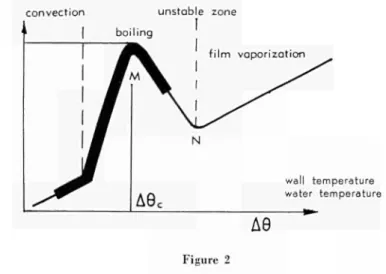
From a design viewpoint, one is not only interested in die conditions at which the critical heat flux occurs, but also in what happens beyond it. Some recently com-pleted tests [9] have shown that operation beyond the critical heat flux is possible and that such operation is accompanied by temperature oscillation in the transition boiling region.
A development program has been submitted to the Joint USAEC-Euratom Hoard to investigate the heat transfer process in the transition region in forced convection flow. Two series of tests at high pressure have been proposed. The first group of tests consist of measuring the occurrence of critical heat flux and of operating beyond it with a multi-rod geometry. The second group of tests is concerned with the mechanism of heat transfer in the transition boiling. Observation of flow and detailed surface temperature maps are proposed to understand the cause and magnitude of the oscillations.
SMOOTH LINER
Iß
Χ
CvJ s—
ι k.
JZ
■D
ω
2.2
.0
.8
.6
χ
D
1.4
σ ω
ï Ι
D Ο C
5 Ι
m
0.8 - 5
.
L Fin«, J
J
Heated Rod
^- Unheated Liner
Flow
lOOOpsia
1.12 l b / h r - f t2 X IO6
0 . 3 7 5 ¡η dia. Rod 0 . 8 7 5 in I.D. Liner
ROUGHENED LINER
m
i i —
i
LF l o wJ
Heated Rod
Unheated Liner
0 10 15 2 0 - 5 0
Steam Q u a l i t y , Percent Weight
REFERENCES
IH R.C. MARTINELLI and D.B. NELSON, "Prediction of Pressure Drop During Forced Circulation Boiling of Water," Trans. ASME, Vol. 70, 1948, pp. 695.
| 2 | H.C. LARSON, "Void Fraction of Two-Phase Steam-Water Mixtures," M.S. Thesis, University of Min-nesota, 1957.
13j N.C. SHER and S.J. GREEN, "Boiling Pressure Drop in Thin Rectangular Channels," WAPD-477, 1958.
[H R.H. MOEN, "An Investigation of the Steam-Water System at High Pressures and High Temperatures." 151 M. SILVESTRI, "Two-Phase (Steam and Water) Flow and Heat Transfer," Inst. Heat Transfer
Conference, Paper No. 39, Boulder, Colorado, 1961.
161 E. JANSSEN and S. LEVY, "Burnout Limit Curves for Boiling Water Reactors," APED-3892, April 1962.
17| E.E. POLOMIK. and E.P. QUINN, "Multirod Burnout at High Pressure," GEAP-3940, 1962.
| 8 | F.E. TIPPETS, "Critical Heat Flux and Flow Pattern Characteristics of High Pressure Boiling Water in Forced Convection," GEAP-3766, 1962.
TWO-PHASE FLOW STUDIES
R. MOISSIS
Massachusetts Institute of Technology, Cambridge, Massachusetts, USA
and
Dynatech Corporation, Cambridge, Massachusetts, USA
The work reported has been performed at Dynatech Corporation in connection with the development of a time-variant, self-controlling outlet steam quality device in boiling water nuclear reactors.
The control device consists of two venturi tubes one each at the inlet and outlet of a reactor flow channel. Since the mass flow rate through both Venturis is the same, and assuming that the two phase mixture at the outlet venturi behaves as a homogeneous fluid, then the ratio of the pressure drops across the inlet and exit tubes is a measure of the flowing quality.
In the control device under consideration, the ratio of the two pressure drops is fed into an error comparator which weighs the existing ratio against a specified value. Deviations from the null position activate a flow control valve which regulates the inlet flow to the channel and thus maintains the exit quality at the required level.
The principle of the device continues to hold good even if the homogeneous flow assumption is not valid. What is essential is that the two phase flow characteristics of the system be predictable. For this reason some basic Two Phase Flow studies have been initiated.
The first topic of investigation is the study of pressure drop and discharge coeffi-cients in a vertical venturi in two phase flow. An analytic model which takes into account slip velocity effects has been proposed. Visual observations of the flow reveal dial various flow regime transitions may occur in the venturi. A bubbly-frothy mixture at die ven-turi inlet assumes a semi-annular configuration at the throat and returns to its original flow pattern in the diffuser section.
Experiments performed in an air-water system have been correlated successfully by means of the proposed model. The equations derived can be used for calculating pressure drops for volume qualities from zero to ninety percent. For volume qualities below forty-five percent, however, the homogeneous fluid assumption can be used with equal or slightly better accuracy.
under-taken in another phase of the reported project. In particular, an analysis has been presented which describes and predicts the process of transition from the non-homoge-neous slug to the homogenon-homoge-neous frothy flow regime in the flow of two-phase mixtures in vertical pipes.
Although some idealizations have been incorporated in the proposed model, the approach is purely analytical and involves no empirical corrections or correlating cons-tants. T h e main conclusions of the investigation are as follows:
1) T h e transition from slug flow to froth flow is due to a Helmholtz h y d r o d y n a m i c instability of the liquid film-to b u b b l e interface.
2) T h e transition depends on the size of bubbles in the slug flow. Since a given system contains bubbles of various lengths, the transition cannot b e defined in terms of a line but can only be bounded within a band.
3) Increasing the pipe diameter or the Weber n u m b e r accelerates the transition process.