ISSN: 1816-949X
© Medwell Journals, 2019
Grobner Basis for Bivariate Normal with Missing Data Model Estimation Problem
1
Saad Abed Madhi and
2Saad Ali Sultan
1
Department of Biomedical Engineering, Al-Mustaqbal University College, Babylon, Iraq
2Department of Mathematics, College of Education for Pure Science,
University of Babylon, Babylon, Iraq
Abstract: The goal of this study is to study maximum likelihood estimates for a bivariate distribution with
missing data using an algebraic geometry tool, namely, Grobner basis techniques. In maximum likelihood estimation, the parameters of the model are estimated by maximizing the likelihood function which maps the parameters to the likelihood of observing the given data. By transforming this optimization problem into a polynomial optimization problem, it can be shown that the solutions of the likelihood equations can be computed using Grobner basis technique.
Key words:Bivariate normal distribution, Buchberger’s algorithm, Grobner bases, algebraic geometry,
maximum likelihood estimation, s-polynomial
INTRODUCTION
Originally, the method of Grobner bases was introduced by Buchberger (1965, 1970) for the algorithmic solution of some of the fundamental problems in commutative algebra (polynomial ideal theory, algebraic geometry). A Grobner basis technique was first introduced by Bruno Buchberger in his PhD dissertation research (1965) (Buchberger, 1970). They are named after Buchberger’s advisor, Wolfgang Groebner. Grobner basis technique is applied to solve systems of polynomial equations in several variables. In this study, we will use this technique to obtain the maximum likelihood estimation of the parameters in a bivariate normal distribution.
MATERIALS AND METHODS
Some definitions and theorems: We will assume that the
reader is familiar with the definitions of the following: ring and field.
Definition 2.1 (Cox et al., 1991): Let N denote the non-negative integers. Let α (α1, ..., αn) be a power vector
in Nn and let x
1, ..., xn be any n variables. Then a
monomial xα in x1, ..., xn is defined as the product -xα = x
1
α1... x n
αn. Moreover, the total degree of the
monomial Xα is defined as |α| = α1 + ...+αn.
Definition 2.2 (Cox et al., 1991): Let k be any field and let f = 3α aα xα be a polynomial in k [x1, ..., xn]:
C We call aα the coefficient of the monomial xα
C If aα… 0, then we call aα xα term of f
The total degree of f denoted deg (f) is the maximum |α| such that the coefficient is aα nonzero.
Definition 2.3 (Cox et al., 1991): Given a field k and a
positive integer n, we define the n-dimensional affine space over k to be the set kn = {(a
1, ..., an): a1, ..., an k}. Definition 2.4 (Pistone et al., 2000): Let be a subset of ks.
The set of polynomials defined by:
1 s 1 s
1 s
f k[x ,..., x ] : f a ,...,a Ideal S
0for all a ,...,a S
Is an ideal called ideal of S. The variety generated by a polynomial ideal I f k [x1, ..., xs] is:
s
1 s
1 s
a , ...,a K : Variety I =
f a , ...,a =0for allf I
A subset of Ks which is a variety of a polynomial
ideal in k [x1, ..., xs] is called a variety.
Definition 2.5 (Cox et al., 1991): A subset I0k [x1, ..., xn]
is an ideal if it satisfies: C 00I
C If f, g 0I then f+g 0I
C If f 0I and h 0k[x1 ,..., xn] then h f 0I
Definition 2.6 (Cox et al., 2005): Let f1, ..., fs be polynomials in k [x1 ,..., xn]. We let <f1, ..., fs> denote the collection < f1, ..., fs> =
is ans
i i 1 s 1 n
i 1h f :h , ..., h k x , ..., x
ideal.Definition 2.7 (Adams and Loustaunau, 1994): A greatest common divisor of polynomials f, g0k [x] is a polynomial h such that:
C h divides f and g
C If p 0k [x] divides f and g then p divides h C LC (h) = 1 (that is h is monic)
Definition 2.8 (Cox et al., 1991): Let α and β in Nn.
C Lexicographic order: α>lex β if and only if the left-most nonzero entry in α-β is positive
C Graded lex order: α>grlexβ if and only if |α|>|β| or (|α|
= |β| and α >lexβ)
C Graded reverse lex order (tdeg): α>grevlexβ if and only
if |α|>|β| or (|α| = |β| and the right-most nonzero entry in α-β is negative)
Definition 2.9 (Cox et al., 1991): Assume an arbitrary
admissible ordering >is fixed. Given a nonzero polynomial f 0k [x1, ..., xn], we define:
C The multidegree of f as: multideg (f) = max (α Nn:
αa… 0)
C The leading monomial of f as: LM (f) = xmultideg (f)
C The leading coefficient of f as: LC = (f) = αmultideg (f) C The leading term of f as: LT (f) = LCL (f). LM (f)
Theorem2.10:( Division Algorithm) (Cox et al., 1991):
Fix a monomial order >on and let F = (f1, ..., fs) be an
n 0
ordered s-tuple of polynomials in k [x1, ..., xn]. Then every f 0k (x1, ..., xn) can he written as fa f +...+a f +r1 1 s s where
ai, rk [x1, ..., xs] and either r = 0 or r is a linear
combination with coefficients in k of monomials, none of which is divisible by any LT (f1), ..., LT (fs). We will call
r a remainder of f on division by F.
Definition 2.11 (Pistone et al., 2000): Let I d k [x1, ..., xn]
be an ideal other than{0}:
C We denote by LT (I) the set of leading terms of elements of I . Thus, LT (I) = {cxα: there exists f 0 I with LT (f) = cxα}
C We denote by +LT(I), the ideal generated by the elements LT (I)
Proposition 2.12 (Pistone et al., 2000): Let I d k [x1, ...,
xn] be an ideal:
C +LT (I), is a monomial ideal
C There are g1, ..., gs 0I such that +LT (I), = +LT (g1), ... , LT (gs),
Theorem 2.13: (Hilbert basis theorem) (Cox et al., 1991): Every ideal I d k [x1, ..., xn] has a finite
generating set. That is i = +g1, ..., gs, for some
g1, ..., gs0I.
Grobner basis: In this study we define the fundamental
object of this study, namely, Grobner basis.
Definition 3.1 (Cox et al., 1991): Fix a monomial order.
A finite subset G = {g1, ..., gs} of an ideal I is said to be a Groebner basis (or standard basis) if +LT (g1), ..., +LT
(gs), = +LT (I),. Equivalently, a set {g1, ... ,gs} d I is a
Groebner basis of I if and only if the leading term of any element of I is divisible by one of the LT (gi).
Corollary 3.2 (Adams and Loustaunau, 1994):
Every non-zero ideal I 0 k [x1, ..., xn] has a Groebner
basis.
Theorem 3.3 (Pistone et al., 2000): Let I be a non-zero
ideal of k [x1, ..., xn]. The following statements
are equivalent for a set of non-zero polynomials G = {g1, ..., gs} d I:
C G = {g1, ..., gs} is a Groebner basis for I
C f 0I if and only if G where means the
f 0
G
f
remainder on division of f by the ordered s-tuple G C f 0I if and only if f
si 1h gi i with LT (f) = max (LT(hi), LT (gi)) C LT (G) = LT (I)
S-polynomials and Buchberger’s algorithm: Before
describing the Buchberger algorithm we define S-polynomials (S). In particular S-S-polynomials are used to test whether a set of polynomials is a Groebner basis.
Definition 4.1 (Cox et al., 1991): Let f and g be two
polynomials in R. The S-polynomial of f and g is the following combination:
L
L
S f ,g .f - .gLT f LT g
where, L is the least common multiple. .
LLCM LT f , LT g
Theorem 4.2 (Cox et al., 1991): Let I be a polynomial
ideal. Then a basis G = {g1, ..., gs} is a Groebner basis for
I if and only if for all pairs i … j the remainder on division of S (gi, gj) by G is zero.
Theorem 4.3: (Buchberger’s algorithm) (Cox et al., 1991): Let I = +f1, ..., fs … {0} be a polynomial ideal. Then
a Groebner basis for I can be constructed in a finite number of steps by the following algorithm.
Output: A Groebner basis G = (g1, ..., gt) for I with F d
G G: = F
Repeat:
G’: = G
FOR each pair {p, q}, p … q in G’ DO
G 'S : S p,q
If S … 0 then G:= G U {S} Until G = G’
Definition4.4 (Adams and Loustaunau 1994): A
Groebner basis G = {g1, ..., gs} is called minimal if for all
i, LC (gi) = 1and for all, i … j, LP (gi) does not divide LP
(gi).
Definition 4.5 (Adams and Loustaunau 1994): A
Groebner basis G = {g1, ..., gs} is called a reduced Groebner basis if for all I, LC (gi) = 1 and gi is reduced
with respect to G - {gi}. That is for all, no non-zero term in gi is divisible by any LP (gj) for any i … j.
Definition 4.6 (Cox et al., 1991): A minimal Groebner
basis for a polynomial ideal I is a Groebner basis G for I such that:
C LC (p) = 1 for all p 0G
C For all p0 G LT (p) ó+LT (G-{p}),
RESULTS AND DISCUSSION
Computation: maximum likelihood estimation and Grobner basis
Maximum likelihood estimates for a bivariate
distribution with missing data: The Maximum
Likelihood Estimators (MLE) are obtained for the parameters of a bivariate normal distribution with equal variances when some of the observations are missing on one of the variables.
Maximum likelihood estimates: Let us consider the
incomplete bivariate sample:
1 n n +1 N
1 n
x , ..., x , x , ..., x
y , ..., y
From a bivariate normal distribution with mean vector (μ1, μ2) and a covariance matrix with common
variance σ2 and correlation coefficient ρ. It may be noted
that (xi, yi), i = 1, ..., n are paired observations. The likelihood function can be written as:
(1)
- N +n / 2 -n/2
2 2
1 2
N 2
i 1 i 1
2 2 2
2 N
i 2 i 1
i 1
L , , , 2
1-x - 1
-
-2 2
1-×exp
y - - x
-
The log-likelihood function is:
(2)
N 2
i 1 2 i 1
2
2 n
i 2 i 1
2 2 i 1
x -n
log L - N+n log - log 1- -
-2 2
1
y - - x -2
1-
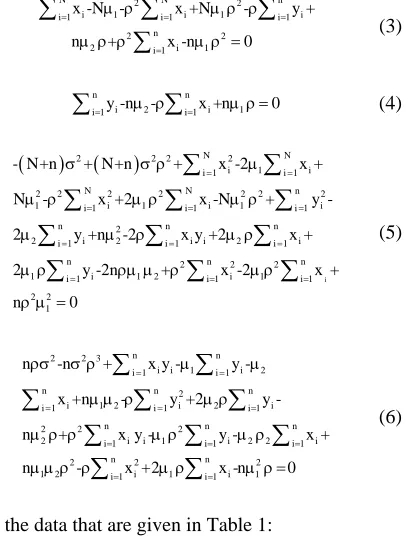
Take the partial derivatives of log L with respect to μ1, μ2, σ2 and ρ equate them to zero and rearrange the
equations, we get:
(3)
N 2 N 2 n
i 1 i 1 i
i 1 i 1 i 1
n
2 2
2 i 1 i 1
x -N - x +N - y +
n + x -n 0
(4)
n n
i 2 i 1
i 1y -n - i 1x +n 0
(5)
i
N N
2 2 2 2
i 1 i
i 1 i 1
N N n
2 2 2 2 2 2 2
1 i 1 i 1 i 1 i 1 i 1 i
n 2 n n
2 i 1 i 2 i 1 i i 2 i 1 i
n 2 n 2 2 n
1 i 1 i 1 2 i 1 i 1 i 1
2 2 1
- N+n + N+n + x -2 x +
N - x +2 x -N + y
-2 y +n -2 x y +2 x +
2 y -2n + x -2 x +
n 0
(6)
n n
2 2 3
i i 1 i 2
i 1 i 1
n n 2 n
i 1 2 i 2 i
i 1 i 1 i 1
n n n
2 2 2
2 i 1 i i 1 i 1 i 2 2 i 1 i
n n
2 2 2
1 2 i 1 i 1 i 1 i 1
n -n + x y - y
-x +n - y +2 y
-n + x y - y - x +
n - x +2 x -n 0
Using the data that are given in Table 1:
N n n
i i i
i 1 i 1 i 1
N 2 n 2 n 2 n
i i i i i
i 1 i 1 i 1 i 1
N 5, n 3, x 15, x 6, y 9,
x 55, x 14, y 29 and x y 19
[image:3.612.339.542.319.587.2]
Table 1: Data
i xi yi
2 i
x 2
i
y x yi i
1 3 3 9 4 9
2 1 2 1 16 2
3 2 4 4 9 8
4 5 - 25 -
-5 4 - 16 -
The Eq. 2-5 become:
(7)
2 2
1 1 2
15-5 -9 +2 -9 +3 0
(8)
2 1
3- -2 + 0
(9)
2 2 2 2 2 2 2 2
1 1 1 1
2
2 2 2 1 1 2
-8 +8 +84-30 +5 -41 +18 -2
-18 +3 -38 +112 +18 -6 0
(10)
2 2 3 2
1 2 1 2 2 2
2 2 2 2 2
1 2 1 2 1 1
3 -3 +19-9 -6 +3 -43 +18 -3 +
19 -9 -6 +3 +12 -3 0
Now we will apply Grobner basis method to solve this system of polynomials, let:
(11)
2 2
1 1 1 2
f 15-5 -9 +2 -9 +3
(12)
2 2 1
f 3- -2 +
(13)
2 2 2 2 2 2
3 1 1 1
2 2 2
1 2 2 2 1 1 2
f -8 +8 +84-30 +5 -41 +18
-2 18 +3 -38 +12 +18 -6
(14)
2 2 3
4 1 2 1 2 2
2 2 2 2 2 2
2 1 2 1 2 1 1
f 3 -3 +19-9 -6 +3 -43 +18
-3 +19 -9 -6 +3 +12 -3
To solve these equations we consider the ideal F = +f1, f2, f3, f4, and choose the lexicographic order where
μ1>lexμ2>lexσ>lexρ. We will finding S-polynomial of f1 and
f2. Since:
2
1 1 2 1
LT f 2 and LT f
Then:
2 1
221 1 1
L LCM LT f , LT f
LCM 2 , 2
1 2
1
21 2
L L
S f ,f .f - .f LT f LT f
2 2
2 2
1 1
1 1
1 2 2
1 2 1
2
2 1 1 2
15-15 -9 +2
-2 2
S f ,f
-2 9 +3
3- -2 + 15-5 -5 -15 +5
And:
F 21 2 1 2
S f ,f 15-15 -5 -15 +5 0
Therefore, we must add:
(15)
2
5 1 1 2
f 15-15 -5 -5 -15 +5
To the generating set. The ideal becomes:
1 2 3 4 5
F = f ,f ,f ,f ,f
And:
F 1 2S f ,f 0
Similarly:
2 2 21 3 1 2 1
2 2 2
1 2 2 2 1
S f ,f 3 +8 -8 -84+15 +
41 -9 +18 -3 +38 -12 -9
F2 2 2 2
1 3
S f ,f = -12-8 +2 +8 +8 0
Therefore, we must add:
(16)
2 2 2 2
6
f -12-8 +2 +8 +8
To the generating set. The ideal becomes:
F 1 2 3 4 5 6 1 2F f ,f ,f ,f ,f ,f andS f ,f 0
Similarly:
2 2 3 2 2 21 4 1 2
2 2 2 2 2
1 1 2 1 2 1 1
3 2 2 2 2
1 1 2 1 1 2 1 2
2 2 2
1 2 1
S f ,f -45 +27 +9 -9 +
27 -38 +12 -6 +86 -24 +
6 -36 +18 +6 +12
-6 -38
And:
F 21 4 2 1 2
2 3 3 2
1 2 1 2 1 2
S f ,f -237+353 -184 -135 +
60 +45 -15 +15 -15 0
Therefore, we must add:
(17)
2
7 2 1 2
2 3 3 2
1 2 1 2 1 2
f -237+353 -184 -135 +
60 +45 -15 +15 -15
To the generating set. The idealo becomes:
F 1 2 3 4 5 6 7 1 4F f ,f , f , f ,f ,f ,f and S f ,f 0
Similarly:
2 2 2
1 5 2 2 2 1 2 2
F
3 2 2
2 1 1 1 1 1 5
S f ,f 75 -45 -45 -25 +15
-45 -30 +10 +10 +30 S f ,f 0
And similarly:
2 2 2 2 21 6 1 2
2 3
1 1 1
S f ,f -60 +36 +12 -12 +
36 +12 -12 -8
F1 6 1 2
S f ,f -6+2 +4 +2 0
Therefore, we must add:
(18)
8 1 2
f -6+2 +4 +2
To the generating set. The ideal becomes:
F1 2 3 4 5 6 7 8 1 6
F f ,f ,f ,f ,f ,f ,f ,f and S f ,f 0
Similarly:
2 21 7 1 2 1 2 1 2
2 2 3 2
2 1 1 2 2
2 2 2 2 2 5 3 2
1 2 1 2
S f -f -225 +15 +75
-45 +135 +474 -14 -706 +
368 +270 -90 +30 -30
And:
F1 7 2
S f ,f -54-18 +18 0
Therefore, we must add:
(19)
9 2
f -54-18 +18
To the generating set. The ideal becomes:
F 1 2 3 4 5 6 7 8 9 1F f ,f ,f ,f ,f ,f ,f ,f ,f and S f ,f 7 0
Similarly:
2 2 2 2 2 33 4 2 1 1 2 1
4 2 2 4 3 2 2 3
1 2 1
2 2 2 3 4 3 2 2
2 1 1 2 1 1
2 2 2 2 3 2 2 2
1 1 1 2 1
3 2 2 2 2 2 2 3
1 2 1 2 1 1
S f ,f -36 +90 -12 +24 +
24 +18 -24 +114 -18
-9 -86 +6 -6 -18 -252 +
38 +38 +123 +36 -54 +
6 -6 -9 -54 +54
2
2
And:
F2 2 2
3 4
65
S f ,f 11- -10 +18 +20 0 2
Therefore, we must add:
(20)
2 2 2
10
65
f 11- -10 +18 +20 2
To the generating set. The ideal becomes:
F1 2 3 4 5 6 7 8 9 10 3 4
F f , f , f , f , f , f , f , f , f , f and S f ,f 0
Similarly:
2 2 2 2 23 5 2 2 2 2 1 2
2 2 3
1 2 1 2 2 2 2 1 2
2 2 2 2 3 3 2 2
2 1 2 1 1 1 1
f , f 40 +420 +40 -205 +90
-150 +25 -90 +15 190 +90 +
60 -30 +30 -10 -10 -30
And:
F3 2
3 5
40 20 10 S f ,f - -40 + 0
3 3 3
Therefore, we must add:
(21)
3 2
11
40 20 10 f - -40 +
3 3 4
To the generating set. The ideal becomes:
F 1 2 3 4 5 6 7 8 9 10 11 3 5Ff ,f ,f ,f ,f ,f ,f ,f ,f ,f ,f andS f ,f 0
Similarly:
4 2 2 2 2 2 2 23 10 1
2 2 2 2 2 2 2 2
1 1 2 2 1
2 2 2 2 2 2 2 2 2 3
2 1 1 1 1 1
f ,f -80 +840 +80 -410 +180
-300 +50 -180 +30 -380 +180 +
65
120 -60 +11 - -10 +6
2
And:
F 2 33 10
405 27
S f ,f - + +135 -81 0 2 4
Therefore, we must add:
(22)
2 3
12
405 27
f - + 135 -81 2 4
To the generating set. The ideal becomes:
F 1 2 3 4 5 6 7 83 10 9 10 11 12
f ,f ,f ,f ,f ,f ,f ,f ,
F andS f ,f 0
f ,f ,f ,f
Similarly, since, the reminders of the S-polynomials for all pairs polynomials f8, f9, f11 and f12 are zero,
therefore, the Groebner basis of F is:
8 9 11 12 1 2
3 2 2 3
2
G f ,f ,f ,f <-6+2 +4 +2 ,-54-18 +
40 20 10 405 27
18 , - -40 + ,- + +135 -81
3 3 3 2 4
So that, the reduced (minimum) Groebner basis of ideal F is:
2 2 3 2
2 1
G -3- , -3, 20-30-12 + ,12-4--2 >
V G 3,3.849,1.3596,0.8049
The maximum likelihood estmator of μ1, μ2, σ2 and ρ are:
2
1 2 ˆ
ˆ 3,ˆ 3.849,ˆ 1.8485 and 0.8049
Using maple, we get the following results: > with (Grobner)
[Basis, FGLM, Hilbert Dimension, HilbertPolynomial, HilbertSeries, Homogenize, InitialForm, IneterReduce, Is Proper, Is Zero Dimensional, LeadingCoefficient, Leading Monomial, LeadingTerm, MatrixOrder, Maximall Independent Set, Monomial Order, Multiplication Matrix, Multivariate cyclic Vector, Normal Form, Normal Set,
Rational Univariate Representation, Reduce, Remember Basis, Spolynomial, Solve,
Suggest Variable Order, Test Order, Toric Ideal Basis, Trailing Term, Univariate Polynomial, Walk,
Weighted Degree]
2 2 2
1 1 2
2 2 2 2 2 2
1 1
2 2 2
1 1 1 2 2
2 2 3
1 2 1 2
2
1 2 1 2 1 1
2 2 2
2 1 2 2
2 2
1 2
15-9 -5 +2 +3 -9 ,3- -2 +
,-8 +84+8 -41 -2 +
18 -30 +5 -18 +3 -38 +
F : 18 +12 -6 ,3 -3 +
19-9 -6 +3 -43 +12 -3 +
18 -9 -3 -6 +
3 +19
>
2 2
1 1 2 2
2 2 2 2 2 2
1 1
2 2 2
1 1 1 2 2
2 2 3
1 2 1 2
2
1 2 1 2 1 1
2 2 2
2 1 2 2
2 2
1 2
15-9 -5 +2 +3 -9 ,3- -2 +
,-8 +84+8 -41 -2 +
18 -30 +5 -18 +3 -38 +
F : 18 +12 -6 ,3 -3 +
19-9 -6 +3 -43 +12 -3 +
18 -9 -3 -6 +
3 +19
G:= basis (F, tdeg (μ1, μ2, σ, ρ))
2 2
2 1
3 2
-3- , -3, 20 -30-12 + G :
,-4-2 +12
-
> V (G) := fsolve ((3))
1 2
0.8049038101, 1.359587031 3.000000000, 3.804903810
CONCLUSION
In this study we have applied the Grobner basis technique to study the maximum likelihood estimation for bivariate normal model with missing data. For future research, this research can be extended to further application of this important technique in various scientific fields.
REFERENCES
Adams, W.W. and P. Loustaunau, 1994. An Introduction to Grobner Bases. American Mathematical Society, USA., ISBN-13: 9780821872161, Pages: 289. Buchberger, B., 1965. An algorithm for finding the bases
elements of the residue class ring modulo a zero dimensional polynomial ideal. Ph.D Thesis, University of Innsbruck, Innsbruck, Austria. Buchberger, B., 1970. An algorithmical criteria for the
solvability of algebraic systems of equations. Aequationes Math, 4: 374-383.
Cox, D., J. Little and J. O’Shea, 1991. Ideals, Varieties and Algorithms: An Introduction to Computational Algebraic Geometry and Commutative. Springer, New York, USA., ISBN: 9780387978475.
Cox, D.A., J. Little and D. O’shea, 2005. Using Algebraic Geometry. 2nd Edn., Springer, Berlin, Germany, ISBN: 978-0-387-27105-7, Pages: 575.
Pistone, G., E. Riccomagno and H.P. Wynn, 2000. Algebraic Statistics: Computational Commutative Algebra in Statistics. CRC Press, Boca Raton, Florida, USA., ISBN: 9781420035766..