http://dx.doi.org/10.4236/ce.2016.76086
How to cite this paper: Vonneilich, N., Dubben, H.-H., Kriston, L., Guse, A. H., & von dem Knesebeck, O. (2016). Basic Prin-ciples of Science in Medical Education—Development and Implementation of a Two Week Introductory Track. Creative Education, 7, 831-837. http://dx.doi.org/10.4236/ce.2016.76086
Basic Principles of Science in Medical
Education—Development and
Implementation of a Two
Week Introductory Track
Nico Vonneilich1*, Hans-Hermann Dubben2, Levente Kriston3, Andreas H. Guse4,5, Olaf von dem Knesebeck1
1Department of Medical Sociology, University Medical Center Hamburg-Eppendorf, Hamburg, Germany 2Department of Primary Medical Care, University Medical Center Hamburg-Eppendorf, Hamburg, Germany 3Department of Medical Psychology, University Medical Center Hamburg-Eppendorf, Hamburg, Germany 4Department of Biochemistry and Molecular Cell Biology, University Medical Center Hamburg-Eppendorf, Hamburg, Germany
5Medical Faculty, University Medical Center Hamburg-Eppendorf, Hamburg, Germany
Received 10 February 2016; accepted 7 May 2016; published 10 May 2016
Copyright © 2016 by authors and Scientific Research Publishing Inc.
This work is licensed under the Creative Commons Attribution International License (CC BY).
http://creativecommons.org/licenses/by/4.0/
Abstract
It has been argued that medical education lacks a specific focus on scientific skills and competen-cies. A recently developed compulsory introductory track on the basic principles of science in medicine was integrated into the medical curriculum at the University Medical Center in Hamburg, Germany. The curriculum of the two-week track included six lectures and six classes. All first term students of medicine participated on a mandatory basis. Data on student satisfaction were ob-tained in an online evaluation process. Content of the classes was reading and critical examination of scientific papers, searching and citing literature, discussion of ethical aspects in medical science and the presentation of scientific results. Lectures were held on the basic principles of the re-search process, types of epidemiological studies, ethical aspects in medical science and examples of scientific research in medicine. Evaluation showed high overall satisfaction among students. Our experiences and students’ evaluation suggest that teaching science can be successfully im-plemented in the medical curriculum. This is one of the first successful implementations of teach-ing basic principles of science in medical curricula in Germany. We suggest to integrate different disciplines in the development and implementation process and to implement the introductory track early in the medical curriculum.
Keywords
Basic Principles of Science, Medical Education, Teaching Science
1. Introduction
Medicine relies on sound scientific research. Especially during the last decades, a growing importance of and a higher need for evidence based medicine (EBM) can be observed (Aronoff et al., 2010). Still, it is argued that medical education lacks a focus on scientific skills and competencies (Pawlina, 2009; Fischer & Fabry, 2014; Spencer et al., 2008). A recent recommendation on the development of medical education in Germany by the German Council of Science and Humanities (Wissenschaftsrat) underlines this issue. The Council recommends a longitudinal integration of basic scientific skills in the medical curricula (German Council of Science and Hu-manities, 2014). Several medical faculties in Germany developed and implemented model medical degree pro-grammes, meeting the expectations of the Council in different ways. Model medical degree programmes can be found in Berlin, Düsseldorf, Hamburg or in Hannover, among others. A core ability, among others, for future medical practitioners will be to find information, to assess the information’s quality and to make evidence based decisions rather than to recall once learned facts, as knowledge in medical sciences keeps growing(Lawson Maclean et al., 2013; Grande, 2009; Smeeton, 1997). These abilities are needed in order to integrate EBM into everyday practice. Along these lines, it has been suggested that statistical and critical thinking in medical educa-tion should become an elementary part of medical educaeduca-tion, since a basic understanding of statistics is of growing importance in everyday medical practice (Smeeton, 1997; Siegrist & Giger, 2006).
Results of a critical review of different US and Canadian medical school curricula show that only few of these schools offer training on basic scientific skills and competencies during the clinical years and that this situation has not changed much since the 1980’s(Spencer et al., 2008). “Exposure to basic science principles and apprec-iation for translational research are important to maintain the science of medicine, supporting a paradigm of in-tegrative medical education” (Spencer et al., 2008: p. 663). Thus, a profound knowledge of science and basic scientific principles must form a basis of any curriculum of medicine (Grande, 2009; Norman, 2009). There is more to a good physician than being a professional in healthcare and an advocate of the patient’s health: a good physician should also be a good scholar, as it has been proposed in the CanMEDS framework of the Royal Col-lege of Physicians and Surgeons in Canada(van der Lee et al., 2013).
Moreover, it has been suggested that training in scientific research and research skills might help to improve the likelihood of pursuing a scientific career (Stallmach et al., 2011; Houlden et al., 2004; Fang & Meyer, 2003; Beck & Depew, 2001).
At the University Medical Center in Hamburg (Germany), a new medical curriculum (“iMed Hamburg”) was developed, which officially started with the beginning of the winter term 2012. This newly designed curriculum offered the opportunity to implement a stronger focus on research and scientific methods in medicine throughout the course of studies. A new aspect in this curriculum is a mandatory research thesis at the end of the 10th term. This thesis is the endpoint of a chain of scientific modules, which are integrated longitudinally into the new cur-riculum. The first of these modules is a compulsory two-week introductory track on the basic principles of science, which every medical student in the first semester has to attend. During the further course of studies, students have the opportunity to select between different compulsory tracks. Main goal of our article is a de-tailed description of the development, implementation and evaluation of this introductory track.
2. Description of the Project
2.1. Development of the Introductory Track
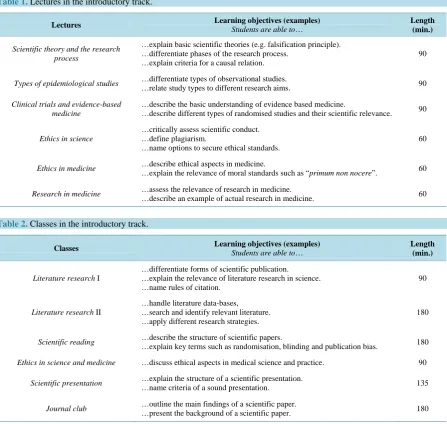
The track was developed by a working group of scientists and physicians from different departments of the medical faculty (Anatomy, Biochemistry, Endocrinology, General Medicine, Legal Medicine, Medical Psy-chology, Medical Sociology, Neurophysiology, Occupational Medicine, Radio-Oncology, Tumour Biology) over the course of almost 2 years, mainly organized and coordinated by the authors. Based on consensus deci-sion-making with all participants, an agreement on those basic principles of science in medicine was reached, that were to be integrated into the newly designed track. Basic principles included scientific theory and the re-search process, different types of epidemiological studies, ethics in medical science and finding, citing and crit-ical appraisal of scientific publications. These principles were then translated into general learning objectives (see Table 1 and Table 2). Based on these learning objectives, lectures and classes were developed and then in-tegrated into the track. Each of the lectures and classes was coordinated by a specialist with experience in the field, who also developed and compiled the respective materials such as presentations and articles or references. These specialists also organized trainings of the lecturers, which were held in the course of preliminary meetings. The materials were distributed among all lecturers in advance. By doing so, quality standards regarding the con-tents and the teaching of the classes were assured.
[image:3.595.90.538.297.721.2]In order to foster interaction between students and lecturers, each study group was led by one lecturer throughout the two weeks. 19 lecturers from different departments were trained in order to teach the classes.
Table 1. Lectures in the introductory track.
Lectures Learning objectives (examples) Students are able to… Length
(min.)
Scientific theory and the research process
…explain basic scientific theories (e.g. falsification principle). …differentiate phases of the research process.
…explain criteria for a causal relation.
90
Types of epidemiological studies …differentiate types of observational studies.
…relate study types to different research aims. 90
Clinical trials and evidence-based medicine
…describe the basic understanding of evidence based medicine.
…describe different types of randomised studies and their scientific relevance. 90
Ethics in science
…critically assess scientific conduct. …define plagiarism.
…name options to secure ethical standards.
60
Ethics in medicine …describe ethical aspects in medicine.
…explain the relevance of moral standards such as “primum non nocere”. 60
Research in medicine …assess the relevance of research in medicine.
…describe an example of actual research in medicine. 60
Table 2. Classes in the introductory track.
Classes Learning objectives (examples) Students are able to… Length
(min.)
Literature research I
…differentiate forms of scientific publication. …explain the relevance of literature research in science. …name rules of citation.
90
Literature research II
…handle literature data-bases, …search and identify relevant literature. …apply different research strategies.
180
Scientific reading …describe the structure of scientific papers.
…explain key terms such as randomisation, blinding and publication bias. 180
Ethics in science and medicine …discuss ethical aspects in medical science and practice. 90
Scientific presentation …explain the structure of a scientific presentation.
…name criteria of a sound presentation. 135
Journal club …outline the main findings of a scientific paper.
Lectures were held by specialists in the respective field.
The final curriculum included 6 lectures and 6 classes, summing up to 29 teaching units of 45 minutes. Addi-tionally, a lecture as an introduction to the track (90 minutes) was held and a presentation of all further topics in the compulsory modules, from which students are able to choose in the further course of studies (180 minutes). Each track was given the chance to present its topics and to promote its subjects. Also, free study and prepara-tion time was included in the curriculum. The introductory track was finished with a multiple choice exam. The exam comprised 20 questions and lasted 30 minutes and it was developed based on the learning objectives (see as examples in Table 1 and Table 2). All lecturers participating in the development of the track had the oppor-tunity to develop questions for the exam, which were then selected by the coordinators of the track based on their quality and applicability.
2.2. Content of the Introductory Track
Table 1 and Table 2 present a short overview over the objectives of the lectures and classes included in this in-troductory track.
The first lecture in the two-week track was on scientific theories and basic principles of the research process. Here, basic ideas of scientific thinking were introduced and important theoretical approaches were illustrated, such as the falsification principle, the principles of induction and deduction and the concept of causality. Fur-thermore, the research process, beginning with the development of a research question, the development and testing of hypotheses and the dissemination and utilisation of the results, was pointed out to the students.
We also included two lectures on different study designs in epidemiology and medicine. The first lecture in-cluded a short introduction of the history and a definition of epidemiology. In this lecture, two important types of observational studies including their advantages and disadvantages were discussed: the cohort study and the case-control study. The second lecture focused on clinical trials and evidence based medicine. After the intro-duction of key terms such as confounding, randomisation and blinding, the design of randomised controlled tri-als and examples were presented. Emphasis was put on the introduction of central ideas behind evidence based medicine.
As science in medicine is confronted with ethical problems, two lectures on the topic were included in the curriculum. A lecture on ethics in medicine discussed the importance of moral and ethical standards in medicine, on the background of the historic development of medicine. A lecture on ethics in science discussed the value of standards in science, especially in medical science. By showing examples of fallacy, scientific misconduct and plagiarism, the importance of ethical standards in medical science was demonstrated. Based on these examples possible ways for securing standards and preventing fallacy and plagiarism in science were discussed.
These two lectures were accompanied by a class, in which students had the opportunity to discuss ethical questions. Therefore, introductory theses on ethical issues were presented and then openly discussed by the stu-dents, as for example: “It is not possible to maintain the principle of non-maleficence in medicine when dealing with human experiments in medical research.”
A lecture on “scientific research in medicine” was integrated in order to present highlights from clinical and preclinical research. In this lecture, outstanding scientists and researchers from various departments of the med-ical school get the opportunity to present their work, in order to illustrate the value and the attraction of research in medicine. For example in the winter term 2015/16 a colleague from the institute of systems neuroscience pre-sented his research on chronic headache and migrane.
Two classes focussed on literature search. In the first class, the basics of literature search were taught. In ad-dition, the principle of citation and correct ways of citing were demonstrated. Moreover, the importance of cita-tion in science was discussed. The second class in collaboracita-tion with the medical library demonstrated the use of research tools and introduced different literature databases and library catalogues to the students.
After identifying and finding the literature, a class on scientific reading introduced students to the critical ap-praisal of scientific studies. Referring to the lecture on ethics in medical science and the lecture on epidemiology and study types in medicine, the basic structure of scientific publications was explained and key terms and con-cepts of medical studies such as blinding, randomisation and surrogate endpoints were introduced.
pa-pers. These papers were preselected by the lecturers, with the premise to meet the level and interest of first term students. Main objective of this exercise was to apply the knowledge gathered in class and lectures and to out-line the main characteristics and contents of the papers as well as discussing strengths and limitations of the stu-dies.
2.3. Evaluation of the Introductory Track
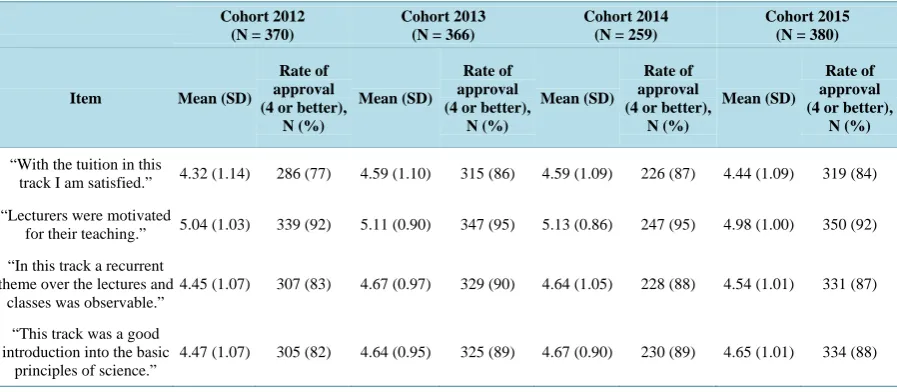
An online evaluation was introduced at the end of each track. Each student had to pass the online evaluation process in order to get access to the results of the final exam. Thereby, a high return rate was achieved. The on-line evaluation assessed among others the satisfaction of students with lectures and classes specifically. General student satisfaction with motivation of the tutors, satisfaction with tuition in the track, the perception of recur-rent themes in lectures and classes and the introduction into basic principles of science were assessed as well. A total of 1375 students participated in the online evaluation process (winter terms 2012 N = 370, 2013 N = 366, 2014 N = 259, 2015 N = 380). Due to a technical problem of the online evaluation system, in 2014/15 only 259 students were able to take part in the evaluation process. Response rates varied between 97% and 93% with the exception of 2014/15 where response rate reached only 66%.
Results of the quantitative evaluation by the students showed high overall satisfaction (Table 3). Using a 6-point Likert-scale with higher values indicating higher satisfaction, mean satisfaction was 4.32 in 2012 and since then slightly rose to 4.59 in 2013 and 2014. When looking only at those students that agree with the re-spective items (i.e. rating it with 4 or higher), about 78 percent of the students were satisfied with the introduc-tory track in 2012. In 2015 this rate was at 84 percent. Strongest agreement of the students was found for the item assessing lecturers’ motivation: in 2012 the mean was 5.04 and in 2015 it slightly decreased to 4.98. Stu-dents also mostly agreed with the statement that the track was a good introduction into the basic principles of science (M = 4.47 in 2012, M = 4.65 in 2015 respectively). Overall, the results indicate a slightly increasing student satisfaction with the introductory track, as most items show higher rates over time between the winter terms 2012 and 2015.
[image:5.595.89.538.525.721.2]Meetings of all participating tutors and lecturers are held on a regulatory basis, at the beginning and at the end of each introductory track. Within these recorded meetings participants were asked for their general perception and appraisal of the introductory course and their satisfaction with content and development of the classes and lectures. A post processing discussion of all lecturers indicated that they generally were satisfied with the con-tents and the course of the introductory track. Especially the close relationship to the student cohort, which was built within these two weeks, was viewed as helpful. The working atmosphere was regarded as good and stimu-lating. Now four years after the implementation of the newly developed track, all lecturers report confidence in handling and teaching the contents. So far, there have been only few replacements of lecturers who were unable
Table 3. Means and standard deviation (SD) for selected items of student evaluation and rate of approval from four student
cohorts (winter terms of 2012, 2013, 2014 and 2015); answers range from 1 “I totally disagree” to 6 “I totally agree”.
Cohort 2012 (N = 370)
Cohort 2013 (N = 366)
Cohort 2014 (N = 259)
Cohort 2015 (N = 380)
Item Mean (SD)
Rate of approval (4 or better),
N (%)
Mean (SD)
Rate of approval (4 or better),
N (%)
Mean (SD)
Rate of approval (4 or better),
N (%)
Mean (SD)
Rate of approval (4 or better),
N (%)
“With the tuition in this
track I am satisfied.” 4.32 (1.14) 286 (77) 4.59 (1.10) 315 (86) 4.59 (1.09) 226 (87) 4.44 (1.09) 319 (84)
“Lecturers were motivated
for their teaching.” 5.04 (1.03) 339 (92) 5.11 (0.90) 347 (95) 5.13 (0.86) 247 (95) 4.98 (1.00) 350 (92)
“In this track a recurrent theme over the lectures and
classes was observable.”
4.45 (1.07) 307 (83) 4.67 (0.97) 329 (90) 4.64 (1.05) 228 (88) 4.54 (1.01) 331 (87)
“This track was a good introduction into the basic
principles of science.”
to continue their teaching in the track, mostly due to organizational constraints.
3. Discussion
Implementation of an introductory track into the basic principles of science is intended to be the first step in preparing the students for their final thesis after the 10th term and in furthering their knowledge on scientific skills. The longitudinal design of the newly developed curriculum enables all forthcoming scientific modules to recourse on the contents of the introductory track and thereby using these contents as a standard. Among others, the critical appraisal of studies and manuscripts, the presentation of scientific results and the writing of scientific papers will be part of forthcoming modules. This should allow a stronger consolidation of the knowledge ga-thered on scientific skills in the long-run, as it will be constantly repeated and intensified in the later course of studies, thereby enabling the transfer of knowledge gathered into different contexts (see also Norman, 2009). In how far knowledge can be retained on a long-run and transferred into different context (for example in following compulsory tracks, writing of final exams or medical dissertations) should be the goal of a longitudinal evalua-tion accompanying the students until the end of their studies.
The experiences described show that this introductory track can be a promising way to integrate basic prin-ciples of science into the medical curriculum (see also German Council of Science and Humanities, 2014). There were several factors we consider facilitating in terms of the successful implementation. 1) It was impor-tant that colleagues from different disciplines participated in the development and implementation process and that the track was considered a joint project. Regular meetings with all participating colleagues were held. This approach intensified cooperation between disciplines in the medical faculty by reaching an agreement on rele-vant basic principles of science in medicine. In the course of the development process different opinions on these principles were harmonized. Decisions on changes regarding the content of the introductory track were made together with all lecturers. For example, in the course of the first introductory track it became clear that most of the students were readily prepared regarding their abilities to hold presentations. Therefore, the respec-tive class was shortened and revised. Similar is true for the journal club, which was established by the winter term 2013 in the course of active interaction of the lecturers in the track and has now been successfully repeated. There are still meetings of all lecturers and experts involved in the track on regular basis, in order to update and modify content if necessary. 2) Our experience indicates that a certain standardisation set by the presentations and lectures prepared by experts in the field and a specific training of the lecturers contributed to the successful implementation. All new lecturers participated in a one-day workshop, in which learning objectives were ex-plained and relevant materials presented. Thereby it was assured that all testable content was taught in all study groups independent of the lecturer. Moreover, preparation time for lecturers was limited by providing all neces-sary materials for the classes on a web-based platform for educaters and learners (moodle), which contributed to a high overall satisfaction of lecturers with the track. 3) In our view, it was essential for the success of the track to implement it at an early stage of the medical curriculum as this helps sensitising students for the basic prin-ciples of science and allows the recapitulation and a consolidation of the prinprin-ciples in different contexts in the later course of studies.
4. Conclusion
The introductory track into the basic principles of science was established in the winter term of 2012 at the Uni-versity Medical Center Hamburg, Germany. High overall satisfaction of the students is an indicator for a suc-cessful implementation of the introductory track into the medical curriculum. As most students in medicine seem to be rather interested in hands-on medicine, such a high satisfaction with the introduction into basic prin-ciples of science is not expected. Student satisfaction showed a slight increase over time: most items were rated higher in the winter term of 2015 than in 2012. This could be explained by the fact that tutors were more famili-ar with the contents and the structure of the introductory track than in the first yefamili-ar. Moreover, contents and presentations applied in the first year of the introductory track were revised to enhance understanding.
All further information beyond those given in the present article, especially on the details of the timetable and the content of the classes and lectures can be made accessible by the authors on demand.
Acknowledgements
dorf contributed to the development of the introductory track. Therefore, the authors would like to acknowledge the contributions of the following colleagues: Norbert Sunderbrink (Medical Library), Eva Brinkschulte, Kai Sammet, Antje Zare, Heinz-Peter Schmiedebach (all Dept. of History in Medicine), Karl Wegscheider (Dept. of Medical Biometry and Epidemiology), Nina Egger (Dept. of Health Economics and Health Services Research), Christopher Kofahl, Daniel Lüdecke (Dept. of Medical Sociology), Marcial Velasco-Garrido (Institute for Oc-cupational and Maritime Medicine), Eberhard Windler, Birgit C. Zyriax (both Clinic of Endocrinology), Annette Raabe (Dept. of Radiotherapy and Radio-Oncology), Volker Assmann, Steven A. Johnson, Klaus Pantel, Sabine Riethdorf (all Dept. of Tumorbiology), Sven Anders (Dept. of Legal Medicine), Evita Mohr (Department of Neuroanatomy), Ulrich Fickel (Department of Neurophysiology and Pathophysiology), Jelka Meyer (Office of Vice Dean of Education and Students’ Affaires).
Competing Interests
The authors declare that they have no competing interests.
References
Aronoff, S. C., Evans, B., Fleece, D., Lyons, P., Kaplan, L., & Rojas, R. (2010). Integrating Evidence Based Medicine Into Undergraduate Medical Education: Combining Online Instruction with Clinical Clerkships. Teaching and Learning in
Medicine, 22, 219-223. http://dx.doi.org/10.1080/10401334.2010.488460
Beck, I. T., & Depew, W. T. (2001). Canadian Research Fellowship Training Programs in Digestive Sciences: Achievements and Challenges. Clinical & Investigative Medicine, 24, 44-53.
Fang, D., & Meyer, R. E. (2003). Effect of Two Howard Hughes Medical Institute Research Training Programs for Medical Students on the Likelihood of Pursuing Research Careers.Academic Medicine, 78, 1271-1280.
http://dx.doi.org/10.1097/00001888-200312000-00017
Fischer, M. R., & Fabry, G. (2014). Thinking and Acting Scientifically: Indispensable Basis of Medical Education. GMS
Journal for Medical Education, 31, Doc24.
German Council of Science and Humanities. [Empfehlungen zur Weiterentwicklung des Medizinstudiums in Deutschland auf Grundlage einer Bestandsaufnahme der humanmedizinischen Modellstudiengänge]. Dresden 2014.
Grande, J. P. (2009). Training of Physicians for the Twenty-First Century: Role of the Basic Sciences. Medical Teacher, 31,
802-806. http://dx.doi.org/10.1080/01421590903137049
Houlden, R. L., Jamila, R. B., Collier, C. P., Clark, A. F., & Waugh, J. M. (2004). Medical Students’ Perceptions of an Un-dergraduate Research Elective. Medical Teacher,26, 659-661. http://dx.doi.org/10.1080/01421590400019542
Lawson Maclean, A., Saunders, C., Velu, P.P., et al. (2013). Twelve Tips for Teachers to Encourage Student Engagement in Academic Medicine. Medical Teacher, 35, 549-554. http://dx.doi.org/10.3109/0142159X.2013.775412
Norman, G. (2009). Teaching Basic Science to Optimize Transfer. Medical Teacher,31, 807-811. http://dx.doi.org/10.1080/01421590903049814
Pawlina, W. (2009). Basic Sciences in Medical Education: Why? How? When? Where? Medical Teacher, 31, 787-789. http://dx.doi.org/10.1080/01421590903183803
Siegrist, M., & Giger, M. (2006). A Swiss Survey on Teaching Evidence-Based Medicine.Swiss Medical Weekly, 136, 776- 778.
Smeeton, N. (1997). Statistical Education in Medicine and Dentistry. Statistician, 46, 521-527. http://dx.doi.org/10.1111/1467-9884.00106
Spencer, A. L., Brosenitsch, T., Levine, A. S., & Kanter, S. L. (2008). Back to the Basic Sciences: An Innovative Approach to Teaching Senior Medical Students How Best to Integrate Basic Science and Clinical Medicine.Academic Medicine, 83,
662-669. http://dx.doi.org/10.1097/ACM.0b013e318178356b
Stallmach, A., Bauer, M., Witte, O. W., & Siegmund, B. (2011). Strategien zur Sicherung des wissenschaftlichen Nachwuchses.
Deutsches Ärzteblatt, 108, 380-383.