Munich Personal RePEc Archive
Evolution of digital marketing
Morozan, Cristian and Enache, Elena and Vechiu, Camelia
Constantin Brâncoveanu University Pitesti / Faculty of
Administrative and Communication Sciences Brăila, Constantin
Brâncoveanu University Pitesti / Faculty of Management Marketing
in Business Affairs Brăila
EVOLUTIO OF DIGITAL MARKETI G
Cristian Morozan
"Constantin Brâncoveanu" University from Pite ti,
Faculty of Administrative and Communication Sciences Brăila
Elena Enache
"Constantin Brâncoveanu" University from Pite ti,
Faculty of Management Marketing in Economic Affairs Brăila
Camelia Vechiu
"Constantin Brâncoveanu" University from Pite ti,
Faculty of Management Marketing in Economic Affairs Brăila
The people who receive the information and buy products/services migrate, nowadays, from traditional to on line media, a greater number of them is accessing the desired news from specialized sites and from mobile devices, anywhere and anytime. The fast adopting of new technologies affects – and transform – manufacturing, distribution and consume, but to optimize on line channels is necessary to act objectively, and to found the decisions on performance key indicators. In the process of adapting to these market changes, the marketers have the opportunity to reach a different audience through on line and mobile instruments. This approach based on real data, facilitated by web analysis, helps companies to focus the efforts and to have success with the new offer versions.
Keywords: digital marketing, blog, mobile marketing, interactive television
General considerations about digital marketing
Digital Marketing promoting products and services using digital distribution channels to reach consumers in a manner relevant, personal and cost effective. Digital marketing includes many of the techniques and practices contained within the category of Internet Marketing. More, it extends beyond this by including other channels with which to reach people that do not require the use of the Internet. As a result of this non reliance on the Internet, the field of digital marketing includes a whole host of elements such as: mobile phones, SMS and MMS, display and banner ads, digital outdoor. In our present days, digital marketing covers more of traditional marketing areas such as Direct Marketing by providing the same method of communicating with an audience but in a digital way. This marketing method is more effective when a marketer combines multiple channels in the message campaigns.
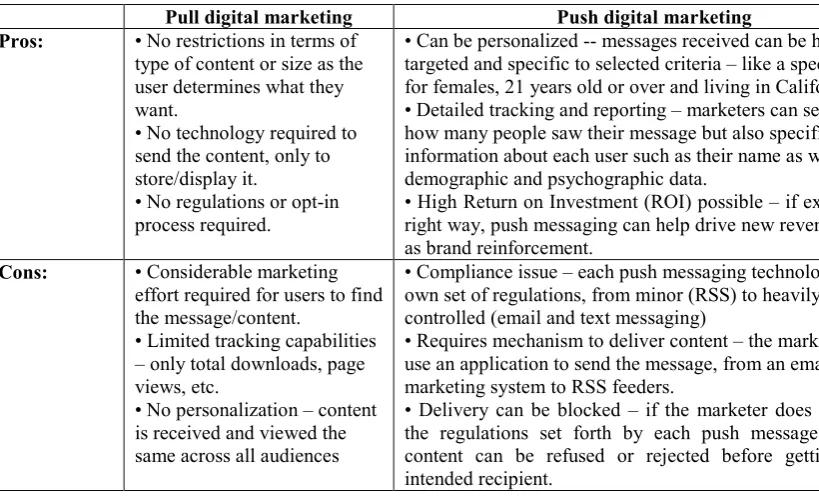
There are two different forms of digital marketing, each of which has its pros and cons, the most important of them being shown in the next table (Table no. 1) (http://en.wikipedia.org/wiki).
Advantages and disadvantages of the digital marketing
Table no. 1
Pull digital marketing Push digital marketing
Pros: • No restrictions in terms of
type of content or size as the user determines what they want.
• No technology required to send the content, only to store/display it.
• No regulations or opt in process required.
• Can be personalized messages received can be highly targeted and specific to selected criteria – like a special offer for females, 21 years old or over and living in California. • Detailed tracking and reporting – marketers can see not only how many people saw their message but also specific
information about each user such as their name as well as demographic and psychographic data.
• High Return on Investment (ROI) possible – if executed the right way, push messaging can help drive new revenue as well as brand reinforcement.
Cons: • Considerable marketing
effort required for users to find the message/content.
• Limited tracking capabilities – only total downloads, page views, etc.
• No personalization – content is received and viewed the same across all audiences
• Compliance issue – each push messaging technology has its own set of regulations, from minor (RSS) to heavily
controlled (email and text messaging)
• Requires mechanism to deliver content – the marketer has to use an application to send the message, from an email marketing system to RSS feeders.
• Delivery can be blocked – if the marketer does not follow the regulations set forth by each push message type, the content can be refused or rejected before getting to the intended recipient.
Each of the two types of digital marketing mentioned above leads to different variants. Within pull marketing category, blog marketing, advertising and personal interactive television, smart ads are worth mentioning, whereas mobile marketing, text messaging marketing, multimedia marketing and broadcasting of the latest news go into the push marketing category.
1. PULL Digital Marketing
1.1. Blog marketing
This activity refers to the fact that certain people, who have gained enough experience or researchers choose to make their study, ideas, thoughts, reactions and dilemmas public, by writing either a weblog accessible to everybody or one with restricted access, set for confidential issues.
Blogs are seen as an authentic, uncensored way of expressing our ego and get to their final version, ready to be published, a frequent and chronological one, of personal reflections and favourite web links. A much newer, integrative concept expresses the shift from personal blogs, made for our ego and personal experiences to those blogs which are used to the purpose of professional communication.
A blog is a web page with a frequent set of posts on a subject or a variety of subjects, which, more often than not, contains links to other Internet sites. They are organised in a reversed chronological order, the latest one coming first on the page.
as challenging programs and competitions, which are meant to help them disseminate further information. Specialists claim the management of a company can learn a lot by reading blogs. Thus, they can have feedback information as to what their customers and noncustomers think about the business they run.
We honestly believe that blogging can help each core fragment of what makes up a successful and viable company. The core needs for any business are as follows: decent ideas; a great product; visibility; a well trained team of people who work hard to make the company succeed
You also need good marketing, great customer relations, an awesome sales force, decent customer support, and a host of other factors. But if you have ideas, a product worth selling, a solid team behind it, and potential customers, the rest will follow naturally.
* Creating Great Ideas
Every company has a lot of great ideas waiting to come to the surface. The problem with bringing those ideas to the surface is threefold: giving ideas space to develop, helping ideas get improved, and implementing the best ideas.
Often it takes only one person to come up with a great idea, but it may take 100 or more people to support and implement that idea. If the idea loses support, the company will need another great idea to keep going.
Great ideas can increase a business’s costs and people power, but they can also increase a business’s revenue and marketing power. This is why large companies who live or die by their great ideas employ researchers who spend their time seeking epiphanies.
The challenge for companies who invest in ideas is often that the best ideas don’t get to the top, don’t get reviewed, or don’t even get considered. This idea barrier could be killing your company. A truly open and internally viewable idea blog, or even individual employee blogs that allow people to float new ideas for peer review, should allow the best ideas to rise to the surface for selection and review.
* Creating Great Products
The next challenge is deciding which great ideas get turned into products. Smart companies hire people who are able to turn a great idea into a great product. These people, often called product specialists or product managers, know customers, know the market, and know how to deliver new products on time and on budget.
However, to do their jobs well, product specialists need to talk directly to customers. This is where focus groups, customer demo days, and other customer listening techniques come into play. Some companies even employ staff evangelists to work one on one with individual customers to maintain a good relationship.
We all know cases in which even the most well intentioned products underperformed. Relying on a small sample of customers to reflect what the entire world desires is risky at best, and foolhardy at worst. If we can’t ask everyone in the world what they want, we are unlikely to be able to deliver what everyone truly desires. With blogging, we can ask—if not the entire world, then at least our entire blog readership, who are probably connected to and/or reading other blogs all over the Net.
* Increasing Visibility
Marketing is all about visibility—making the right people aware of the right product at the right time. We can say that marketing is about customers, and he’s right. The hard reality, though, is that often marketing isn’t about individual customers. Often, it’s about creating a global message to which individual customers will respond.
However, these visibility campaigns lack effectiveness on the one to one level. Companies assume that millions of people will be contacted, but only a small percentage of these people will respond. This method of marketing has its upside, but it doesn’t do anything to create relationships with customers, create positive experiences, or create customer evangelists.
* Having a Team
One of the best ways to build a great business is to create the team. Great teams will think up great ideas, build visibility, and spot defects in products, which they will then correct. They also can fix just about any problem, given the right resources, and is happy to take on just about any challenge.
Unfortunately, great teams can be difficult to create and keep motivated. Anyone who’s built successful teams knows that more often than not some particular “X Factor” will make or break the team: often the ability to find common ground and common interests can be a make or break issue.
The challenge for companies looking to enable these dynamic teams is in figuring out how to enable employees to connect based on passion. Passion is an important part of any successful team—without passion, a team will not only find itself quickly in a rut, but it will likely find its members unable to gel, have fun, or help the company in a meaningful way.
1.2. Advertising and Personal Interactive Television
The boost in high frequency band satellite television and IPTV, the fact that broadcasting mobile services will be the next important trend in mobile communication and the growing popularity of peer to peer sharing of video files, lead to the advent of new advertising patterns, highly competing with the classical video (Roxana Onea, www.comunic.ro).
Thus, television is becoming a more and more personalized environment, allowing a clear perception of the customers’ preferences. As users have more and more control over the type of advertising they want to watch, their opinions will be of uppermost importance, thanks to technology. The main reason for which television channels should broaden their horizon provided they want to stay relevant for advertisers is the customers’ possibility to choose more and more from what they want to watch, the time of their watching and the device the chosen program would be on.
Specialists in advertising wish the relationship between them and television channels would change, given the new content broadcasting policy, fighting for the viewer and demand services which allow the viewer to skip advertisements. As the content already including advertisements targets mobile phones, brands and entertainment providers have started to appreciate the value of a complex multimedia advertisement within programs.
Another possible business pattern can be the use of these demand services as a means to manage a research on a far away market in order to check people’s interest in new products, a very quick and cost effective way to get the right feedback from would be customers.
On the other hand, integrating interactivity offered by SMS service within television programs outside peak hours can lead to significant profits coming from the viewers who pay while sending messages from their mobile phones, since they want to have fun, personalize products, get access to games and socialize.
broadcast in Romania on the 9th of April 2005. The strong points of the U brand are: attitude, quality music – Romanian and international hits, dynamism, innovation, and, last but not least, “U” stands for fun. The target audience of this channel are the 15 29, up to 35 year olds. (www.hotnews.ro).
1.3. Smart advertisements on the web
In order to back a marketing system based on Internet, the pay per click network (PPC) was brought into play, and the one developed by Google is a good case in point. The text models on the right side of the main slide of the application entail two changes in the traditional relationship between editors and advertisers: the latter pay only when advertisements are on and the viewers click on them; the paid research networks draw a distinction between advertisers and editors (advertisers no longer get space on the editor’s site in exchange of payment for key words).
For a better knowledge of its public the advertisements on Internet (based on software) can contain further information on: the targeted public, the money advertising companies are willing to spend to get to that audience rate (including the cost of each click), which sites are accepted and which ones are banned etc.
2. PUSH Digital Marketing
2.1. Mobile marketing
On a well developed market, operators have to face the pressure of finding new opportunities for earnings drift, so mobile marketing could be the very solution.
Mobile services with their unique capabilities and opportunities were exclusively “bundled” within the mobile operators’ technology network, a “walled garden” controlled by the mobile operators with limited access provided to others. The mobile marketing created the fertile ground for existing to new industry players like mobile application providers, aggregators, and enablers. The discrete application providers and application solution providers (also known as “mobile ASPs”) are offering exciting and novel technology for a wide array of mobile initiatives and mobile management systems. The aggregators are providing single point connectivity with all the different mobile operator networks. The enablers are providing foundation technology, processes, regulations and related support to the value activities within each sphere. With the controlled and managed opening of the mobile operator’s walled garden, traditional brands, content owners, and marketing agencies are now able to use mobile networks for direct customer engagement(http://mmaglobal.com)
Since entertainment and advertising business are overlapping more and more, the idea that brand marketing should be budgeted for purchasing mobile content has gained ground lately (Roxana Onea, www.comunic.ro). Advertisers have to find new ways of making their brands and messages known to a public whose expectations are higher and higher, thanks to a boost in information. The old fashioned pattern, which meant direct coverage to its customers no longer seems efficient, while advertising agencies are interested in entertaining their customers with a challenging content. At the same time, mobile services providers are, more often than not, concerned with drawing into more and more customers, all paying for their content. It will all be each brand’s concern to create catchy advertising content which subscribers would like to save, send to friends all over again, turning it into something vital.
Mobile marketing offers an important means for building up cooperation relationships, since specialists in mobile marketing use SMS text messages and MMS multimedia messages to get to their users by means of one of the most personal devices, namely the mobile phone.
One can notice this trend both among the newcomers on the market, but also among the already existing companies, which add voice options to computer devices. America Online, Apple, Google, Microsoft or Yahoo have added voice services to instant messaging users. E Bay purchased the pioneer in IP Skype phoning for 2,6 billion dollars. More than that, Skype, whose technology allows vocal calls for prices representing a small fraction of traditional services costs, has also added video calls to its services.
Mobile phones have endless uses within the current socio economical background, thanks to their technical advantages, while their providers incorporate as many entertainment, commercial and media options in their devices. Here are some of the main aspects defining the various uses of mobile phones:
*Informing and entertaining
The best thing about mobile marketing is that, unlike mail and e mail, people tend to read messages from their mobile phones: 94% of messages are usually read, within an hour from their receiving, according to WIN, a mobile phone messaging service provider.
One of the first ways in which mobile phones are used by the specialists in marketing is with the “ambush” type of advertising, street advertising, since the users passing by posters in the street, for example, will get messages on certain events and advertising activities. Mobile phones have also started to be a means of entertainment generated by the specialists in advertising.
Nowadays, advertising campaigns on mobile phones have only come into existence, usually asking their users to send a text message to a number code. In exchange for that, they get information on products, free content or the chance of winning some prizes.
Since advertising campaigns are interested in exploiting the new social and technological phenomena to its full, such as blogging and in getting further images for new marketing patterns which mobile phone users would welcome, provided they were promoted according to their ability of understanding, interactivity seems to be the most significant element.
The leader in technology, Japan, whose 90% of the population owns a mobile phone, have got used to the technology based on the so called QR (“quick response”). They are very similar to code bars, only that they are square and contain much more information (www.imagoo.ro). These codes connect them to web sites, just like an underground chart, so that the user does not have to type the web site on the tiny keyboard of his mobile phone.
* Commercial communication
Mobile phones have already been widely used by companies for commercial communication or advertising mechanisms. The latter encourage users to send SMS messages or offer call tones and music in exchange of sending through SMS the codes from various product packs (coffee, chocolate, toothpaste). Campaigns are sometimes integrated, besides advertising on classical screens, in a well thought system encouraging the use and usage of 3G mobile phones. Consequently, mobile phones should become a means of showing loyalty to their clients at a larger scale, a means of buying and paying(www.mobiledigit.ro).
The fidelity card, given out when subscribing to a loyalty program can easily be replaced by the mobile phone, with great benefits for both company and user. The necessary information about the buyer’s behaviour and the things purchased is collected at each card use.
a 2D code on the mobile phone, and it can be later used as entry ticket. The code is presented at the entry check point and authenticated by means of a special device.
Mobile payment represents that type of payment by using the mobile phone at the outlet store instead of credit or debit cards. This system allows for flexibility and easy use. The user goes shopping and he is going to pay by means of a mobile phone. The bank gives the customer a personalized code for acknowledgment beforehand, which will then be scanned, while the user’s personal information is transferred to the bank to allow for the payment.
Electronic vouchers can be used for special offers, catchy promotions, discounts or other such things a printed voucher stands for. Electronic vouchers are distributed through Internet, e mail or SMS and can be printed at home or just saved on the phone. Vouchers can contain a validity term for advertising programs set in time. The customer in question gets an SMS containing the 2D code with information on discounts, which stands for a virtual voucher for the shops under promotion. By showing his mobile phone to a specialized reader, the customer gets the product and service needed at a low price.
* Partnership with mobile television
The emphasis placed on communication shows that mobile content industry and the broadcasting one are well aware of the importance of new platforms, such as mobile television and IPTV. Content makers and the ones that broadcast it need to find out how to better “sell” their product. Both industries consented to the idea that a content especially made for mobiles is to be preferred.
South Coreea and Japan are among the first countries which adopted mobile television, but the European and North American markets are not far behind (http://news.softpedia.com).
Since there is an increase in both number and type of mobile television devices, the content industry needs a simplified technique of format adjustment more and more. Just as television advertisement and music videos use techniques different from those used by the cinema, films and video productions are produced in different versions for the various types of mobile devices. The content has to be divided according to the device and produced into a new version.
2.2. Text messaging marketing
Text messaging is an efficient means for television, since it promotes interactivity and creates addiction. Thus, text messaging campaigns gain more and more ground: they are used in live sports events, films, breaking news etc. Such campaigns are backed by marketing agencies since, on condition they are well made, they give television channels key elements concerning the targeted audience, vital for the already adopted strategies. Moreover, these campaigns are important for the wireless operators, since respondents pay a small attendance fee to take part in such campaigns campaigns, while operators get a high percentage of that fee(Roxana Onea, www.comunic.ro).
Specialists in mobile marketing and text messaging companies claim that the profits of financial supporters of such a company depend on the way they are put into practice, which means that its local supporters will not get back their investment so easily, as compared to famous networks which have a more numerous audience. This drawback can be fought back by identifying some sponsors for text messaging companies, which would lead to further profits.
In this field one can also notice the expansion in the services provided through the advent and more frequent use of multimedia messaging, especially for video content broadcasting. Since messaging campaigns become more and more popular, their supporters believe that this expansion to the premium range can become an efficient marketing tool and a potential profit generator to the operator and providers of mobile content.
2.3. Multimedia messaging
phoning operators, multimedia messaging gets a positive feedback from its users, even if problems such as service knowledge, education, prices etc. can still arise.
Even if the service is appreciated, technical problems can still come out, meaning that a single format for marketing messages which can be sent to all its users cannot be yet developed, due to performance differences between mobile phones, since only some of them can receive both SMS and video messages. Moreover, many of those having phones with MMS options can’t grade their phones to get MMS messages or simply don’t want to access such messages. For this very reason, one cannot be certain that the messages created and transmitted by the marketers reach their users in a full format.
2.4. The broadcasting of recent news (RSS)
RSS technology (Really Simple Syndication) represents a format especially created to broadcast the latest news or reports. This means automatically following the changes within a site, its access being unnecessary if wanting to check if new information was introduced.
Nowadays, there are reading applications regarding flows of news in RSS format which let users know, at a specific time, if there is new information or news on the sites they selected beforehand. Thus, users can choose the sites they want to watch, and if those sites have the ESS option on (more and more sites are adopting it), by means of a small program, known as “agregator”, users can be alerted whenever their favourite sites come up with something new.
RSS technology brings forth a radical change in the way people can access information. If, so far, the user had to access information directly (search for a certain site and surf till he got the information needed), RSS technology allows for rapid spread of that news which is relevant and up to date. Some believe that RSS is the future trend in accessing information, since it has already raised a lot of questions concerning the future of traditional mass media.
This phenomenon has started to be widely accepted in Romania also, since newspapers such as Adevărul, Cotidianul, Evenimentul Zilei, Xtrem PC or CHIP already use flows of news in an RSS format.
News portals in RSS format have started to be used such as the one designed on the web site http://rss.mioritic.ro/, where almost 600 flows of news in RSS format are available from Romanian sites, either info pages, newspapers, personal diaries, clubs, forums or other such online sources.
*
As the market is under constant development, the business practices, under development themselves, will help remove some obstacles, while others might need special measures from industrial companies and legislation in order to give their users, content providers and hardware industry some legal certitude.
The discovery and adoption of innovative methods in doing business is more and more obvious in Romania, its market is rapidly catching up with the lagging behind from a technological point of view, but success is finally assured thanks to the customers’ desire to purchase such new devices or through such new devices.
Bibliography: