REPRODUCTIVE TRACT INFECTIONS AND UTERINE FIBROIDS
Kristen Renee Moore
A dissertation submitted to the faculty at the University of North Carolina at Chapel Hill in partial fulfillment of the requirements for the degree of Doctor of Philosophy in the
Department of Epidemiology in the Gillings School of Global Public Health.
Chapel Hill 2016
©2016
ABSTRACT
Kristen Renee Moore: Reproductive Tract Infections and Uterine Fibroids (Under the direction of Jennifer S. Smith and Donna D. Baird)
For decades, it has been hypothesized that reproductive tract infections (RTIs) are risk factors for uterine fibroids. However, only two recent studies have been conducted. We aimed to investigate the relationship between RTIs and fibroids in a large study using ultrasound screening for fibroids. We used cross-sectional enrollment data from African-American women ages 23-34 years with no previous fibroid diagnosis. For Aim 1, RTI history was measured by self-report. For Aim 2 we used serology, an immunological
measure of past exposure with a focus on herpes simplex virus type 2 (HSV-2) because prior published data have suggested a possible association, and serology for HSV-2 is much more accurate than self-report. For both aims, fibroid status was measured by standardized
ultrasound. Secondary fibroid outcomes were size, number, and total volume. Age- and multivariable-adjusted logistic regression were used to estimate odds ratios (ORs).
In total, 1,656 women were included; 22% had fibroids. Self-reported bacterial vaginosis (BV) was associated with a 21% increased odds of fibroids [aOR 1.21, 95% confidence interval (CI) 0.93-1.58]. Self-reported chlamydia infection and pelvic
To my loving husband and beautiful children who motivated me to press on. To my family and friends who supported me and never gave up on me; especially my parents and parents-in-love who stepped in when we needed them most. To my awesome nanny Martha who relieved a lot of stress and loved on my children during a very busy time. Most of all, to my
ACKNOWLEDGEMENTS
I would like to thank Dr. Donna Baird whose incredible mentorship, wisdom and caring spirit guided me through. She also allowed me to use data from her awesome study which enabled me to conduct the research for this project. I am extremely grateful for Dr. Jennifer Smith for believing in me and providing sound advice and expertise for this project along with the rest of my dissertation committee, Drs. Victor Schoenbach, Stephen Cole and Dirk Dittmer.
I would also like to acknowledge Dr. Trevor Archer and the National Institute for Environmental Health Sciences (NIEHS) for granting me a fellowship to conduct my dissertation research and use their facilities and equipment. I would also like to thank Dr. Dale Sandler for approving my proposal for the herpes simplex virus-2 serological tests and the whole Epidemiology Department at NIEHS for all of their support.
TABLE OF CONTENTS
LIST OF TABLES ... ix
LIST OF FIGURES ... xi
LIST OF ABBREVIATIONS ... xii
CHAPTER 1: STATEMENT OF SPECIFIC AIMS ... 1
CHAPTER 2: BACKGROUND AND SIGNIFICANCE... 4
2.1 Uterine Fibroids (myomas or leiomyomas) ... 4
2.2 African-American Heritage and Fibroids ... 7
2.3 Infection and Fibroids ... 8
2.4 Reproductive Tract Infections ... 12
2.5 Biological Mechanisms of Tumorigenesis Following Infection ... 18
CHAPTER 3: RESEARCH DESIGN AND METHODS ... 21
3.1 Overview ... 21
3.2 Study Participants and Data Collection ... 21
3.3 Outcome Assessment ... 22
3.4 Exposure Assessment ... 24
3.5 Covariates ... 24
3.6 Statistical Analyses ... 24
CHAPTER 4: SELF-REPORTED REPRODUCTIVE TRACT INFECTIONS AND ULTRASOUND DIAGNOSED UTERINE FIBROIDS IN AFRICAN-AMERICAN WOMEN ... 28
4.1 Introduction ... 28
4.3 Results ... 36
4.4 Discussion ... 37
4.5 Conclusions ... 39
CHAPTER 5: HERPES SIMPLEX VIRUS-2 SEROPREVALENCE AND ULTRASOUND DIAGNOSED UTERINE FIBROIDS IN A LARGE POPULATION OF YOUNG AFRICAN-AMERICAN WOMEN ... 43
5.1 Introduction ... 43
5.2 Methods ... 46
5.3 Results ... 51
5.4 Discussion ... 52
CHAPTER 6: CONCLUSIONS ... 62
6.1 Limitations ... 62
6.2 Strengths ... 68
6.3 Public Health Implications ... 68
6.4 Future Research ... 69
APPENDIX 1: DIRECTED ACYCLIC GRAPH ... 70
APPENDIX 2: CHAPTER 2 SUPPLEMENTAL TABLES ... 71
LIST OF TABLES
Table 1. Two Recent Studies on Reproductive Tract Infections and Fibroids ... 11 Table 2. Detectable Odds Ratio with 80% Power ... 27 Table 3. Distribution of Covariates by Self-Reported Reproductive Tract Infection Status ... 40 Table 4. Adjusted Odds Ratios for Fibroids According to Self-Reported History of Reproductive Tract Infections ... 41 Table 5. Herpes Simplex Virus Type 2 Serostatus, Stratified by Selected Enrollment Characteristics of 1,658 23-34 Year-Old African-American Women in the Study of Environment Lifestyle and Fibroids, Detroit Metropolitan Area, Michigan, 2010-2012 ... 56 Table 6. Herpes Simplex Virus Type 2 Serostatus in Relation to Fibroids among 1,658 23-34 Year-Old African-American Women in the Study of Environment, Lifestyle and Fibroids, Detroit, MI Metropolitan Area, 2010-2012: Odds Ratios and 95% Confidence Intervals ... 58 Table 7. Symptomatic and Asymptomatic Serologically-Detected Herpes Simplex Virus Type 2 in Relation to Fibroids among 1,658 23-34 Year-Old African-American Women in the Study of Environment, Lifestyle and Fibroids, Detroit, Michigan Metropolitan Area, 2010-2012: Odds Ratios and 95% Confidence Intervals ... 59 Table 8. Sensitivity Analyses of the Association of Fibroids with Herpes Simplex Virus Type 2 Serostatus among 1,658 23-34 Year-Old African- American Women in the Study of Environment, Lifestyle and Fibroids, Detroit, Michigan Metropolitan Area, 2010-2012: Odds Ratios and 95% Confidence Intervals ... 60 Table 9. Effect of Potential Selection Bias Due to Exclusion of Women Previously Diagnosed with Fibroids. Crude Odds Ratios for Fibroids
LIST OF FIGURES
Figure 1. Theorized Mechanism for Infection and Fibroids ... 20 Figure 2. Adjusted Odds Ratios for Size of the Largest Fibroid, Number of Fibroids and Total Fibroid Volume According to Self-Reported History of Reproductive Tract Infections ... 42
Figure 3. Size of largest fibroid, number of fibroids, and total fibroid volume in relation to herpes simplex virus type 2 (HSV-2) serostatus among 365 23-34 year-old African-American women with fibroids in the Study of Environment Lifestyle and Fibroids, Detroit, Michigan metropolitan area,
LIST OF ABBREVIATIONS BMI body mass index
BV bacterial vaginosis
CAWI computer-assisted web interviewing CI confidence interval
CT Chlamydia trachomatis
DMPA depot medroxyprogesterone acetate GED general education development HFHS Henry Ford Health System HSV herpes simplex virus
NAAT nucleic acid amplification tests
NIEHS National Institute of Environmental Health Sciences
OR odds ratio
PID pelvic inflammatory disease PCR polymerase chain reaction RTI reproductive tract infection
SELF Study of Environment, Lifestyle and Fibroids
US United States
CHAPTER 1: STATEMENT OF SPECIFIC AIMS
Uterine fibroids are one of the most common gynecologic conditions affecting women during their reproductive years 1, with estimated total annual costs (direct and
indirect) in the United States (US) of up to $34 billion 2. However, the cause(s) of fibroids is largely unknown. Many decades ago, a hypothesis was proposed that reproductive tract infections (RTIs) play a role in fibroid development 3; however, this hypothesis has never been adequately tested.
More recently, two published studies 4, 5 have explored the relationship between RTIs and fibroids; both studies were based on self-reported infection histories. Results from these two studies were only partially consistent. The first was a clinic-based study of 318 cases and 394 controls 4 which found a positive dose-response association between self-reported
diagnosis of pelvic inflammatory disease (PID) (and the number of PID episodes) and uterine fibroids in premenopausal women. No association was found between self-reported history of genital herpes or warts and fibroids, although there was a suggestion of an increased risk of fibroids for women with self-reported history of Chlamydia trachomatis (CT). The second, the Uterine Fibroid Study (UFS) 5, was a cross-sectional study of 1,364 women with
uterine fibroids in both ethnic groups 5. In both of these studies 4, 5, self-reported history of abnormal Pap smear was inversely associated with fibroids.
Building upon previous work which found suggestions of positive associations
between a few self-reported RTIs and fibroids, our first aim was to investigate the association of fibroids with several self-reported RTIs in the largest sample to date. We also sought to explore the relationship between self-reported RTIs and the number, size, and total volume of fibroids which has not been previously done. Our second aim was to investigate the
relationship between serological status of type-specific herpes simplex virus type 2 (HSV-2) and uterine fibroids (presence, number, size and total volume). The aforementioned studies of this often asymptomatic infection are limited by their use of self-reported exposure histories. Thus, we conducted a cross-sectional study in the ongoing Study of Environment, Lifestyle & Fibroids (SELF) based in the Detroit area among 1,696 African-American women. The primary outcome was fibroid status determined by ultrasound; the main exposures were self-reported histories of RTIs and seropositivity for HSV-2, measuring previous exposure to this pathogen. Participants with at least one fibroid ≥0.50 cm in
diameter at enrollment ultrasound were considered to have fibroids, and all women without a fibroid ≥0.50 cm in diameter at enrollment ultrasound were considered not to have fibroids. Specifically, we aimed to:
1. Estimate the association of fibroids (presence, number, size of the largest fibroid and total fibroid volume) measured by ultrasound with the following RTIs assessed by self-report: PID, CT, genital herpes, gonorrhea,
2. Estimate the association of fibroids with serologically-determined previous exposure to HSV-2
These aims were accomplished using enrollment questionnaire data, transvaginal ultrasound results and serologic findings from a cohort of 1,696 African-American women aged 23-34 years. We used laboratory testing of the blood specimens for type-specific antibodies to HSV-2 using standard serologic methods to determine past exposure to infection. We analyzed the study data using logistic regression.
CHAPTER 2: BACKGROUND AND SIGNIFICANCE 2.1 Uterine Fibroids (myomas or leiomyomas)
Uterine fibroids, benign smooth muscle cell tumors of the uterus, are one of the most common gynecologic conditions affecting women during their reproductive years 1. The Uterine Fibroid Study (UFS) of 1,364 randomly selected women 35 to 49 years of age screened by ultrasound found an estimated cumulative incidence of fibroid tumors by age 50 of >80% for African-American women and close to 70% for White women 6. A pathology study conducted in New York showed comparable estimates; fibroids were found in 77 of the 100 sequential uteri inspected. The uteri were removed at hysterectomy (only 33 with pre-operative fibroid diagnosis) and were thinly sliced in 2-mm sections for analysis 7.
The symptoms experienced by an estimated 20-50% of women with fibroids include pelvic pain and pressure, reproductive problems (infertility and adverse birth outcomes), and severe bleeding that can result in anemia 1, 8-10. These symptoms can negatively impact women’s quality of life including their sexual life, performance at work, relationships and family 11, 12. The primary treatment for fibroids is hysterectomy (the removal of the uterus) because it completely eliminates symptoms and the possibility of reemergence. Therefore, fibroids are the leading indication for hysterectomy in the US, accounting for 40% of hysterectomies or approximately 240,000 per year 13. However, for women who have not completed childbearing or who want to keep their uterus, there are other treatment options such as myomectomy (surgical removal of fibroids with uteri intact), uterine artery
(non-invasive magnetic resonance imaging-guided sound waves that heat and destroy fibroid tissue) 1, 14. However, with these treatments there is the possibility of recurrence. There is also a Food and Drug Administration approved short term therapy for reducing fibroid size and symptoms, gonadotropin-releasing hormone agonist. However, it can only be used for 3 to 6 months due to undesirable side effects (bone loss, hot flashes and depression), and once stopped, fibroids can rapidly return to their pre-treatment size 15.
Ultrasound is the clinical standard for diagnosis of fibroid tumors 16. However, it is not routinely performed unless a woman is pregnant or experiencing symptoms. Thus, in order to estimate the true prevalence of fibroids, routine population-based ultrasound screening would have to be performed. The majority of previous studies have used hysterectomy, self-report and/or clinical diagnosis of fibroids to determine prevalence. However, these studies are more likely selecting women who have more severe symptoms, not those who may be asymptomatic. The majority of women with fibroids are
asymptomatic.
As a result of the management and treatment of fibroids and their associated complications, the total estimated costs of fibroids in the US including direct (medical and surgical management) and indirect (lost work time and more complicated obstetric outcomes) are as much as $34 billion 2. Thus the societal cost of fibroids in the US is more than breast cancer, colon cancer, or ovarian cancer and approximately one-fifth the annual cost of diabetes mellitus 2.
are typically classified by their size (diameter) and location- subserosal (outer uterine wall), submucosal (protruding into the uterine cavity) or intramural (within the uterine wall). Multiple tumors of various sizes (microscopic to very large) and locations are often found in the same uterus. Most tumors are monoclonal and thus develop independently from other leiomyomas in the same uterus 17. Although their cause is unknown, fibroids are known to be hormonally responsive; both estrogen and progesterone can stimulate fibroid tissue growth 18. Fibroids begin to develop after menarche 19 and regress after menopause 7. However, what causes the initial transformation of muscle cells into abnormal muscle cells and then what causes them to proliferate and grow into clinically visible tumors is not clearly understood.
2.2 African-American Heritage and Fibroids
The disparate burden of fibroids among African-American women was acknowledged as early as the late 1800s. In Witherspoon et al. (1930), African-American women
represented a substantial proportion of the fibroid cases (90% of 2,991 cases) at a local hospital although the total gynecological admissions were only slightly greater for African-Americans compared to Whites 3. More recent estimates indicate that African-Americans are 2 to 3 times more likely to have fibroids than White women 6. They have an earlier onset (~10-15 years), have more fibroids at a given age, and are more likely to have clinically relevant fibroids (based on size and location) than Whites 6, 29-33. African-Americans are also more likely to report severe symptoms, interference with physical activities and relationships, and missed work days compared to White women 11, 34. Additionally, a study of fibroid growth found that in contrast to White women, the growth rates of fibroids among African-American women did not tend to decline as age increases 35. African-American women are also more likely to undergo hospitalization, hysterectomy and myomectomy (relative risk, 3.5, 2.4, 6.8, respectively) for fibroids compared to White women, consistent with more severe disease and an earlier age of onset 36, 37.
Studies on fibroids have primarily been conducted among women who have
racial discrimination 40, childhood abuse 41 and vitamin D insufficiency 42 that may differ by race, may be linked to fibroids. Furthermore, genetic factors could explain some of the burden, but this requires further investigation 43, 44. Witherspoon hypothesized in the 1930s that because both fibroids and RTIs disproportionately burden African-American women and certain RTIs can lead to conditions such as chronic pelvic infection that could result in
inflammatory reactions, RTIs could play an etiological role 3. However, since the 1930’s very few studies have investigated this proposed relationship.
2.3 Infection and Fibroids The two recently published studies 4, 5 that have explored the relationship between
RTIs and fibroids were both based on self-reported infection histories. Results from these two studies were only partially consistent (Table 1). The first was a clinic-based case-control study of fibroid risk factors in the Baltimore metropolitan area 4. Cases were 318 18-55 year-old pre-menopausal women with a first diagnosis of fibroids between 1990 and 1993
confirmed by histology or ultrasound. Controls were patients with intact uteri who had visited the same physicians as the cases for a routine checkup that included a pelvic exam without any reference to fibroids and no indication of fibroids in medical records. Cases and controls were frequency matched on 10 year age group, gynecologist and calendar period. The authors found a positive dose-response association between self-reported history of diagnosis of PID (and the number of PID episodes) and uterine fibroids. No association was found between self-reported history of genital herpes or warts and fibroids, although there was a suggestion of an increased risk of fibroids for women with self-reported history of CT.
determination of fibroid status and complete fibroid and questionnaire data. RTI history was obtained by a mail-in questionnaire and analyses were conducted separately for African-Americans and Whites. Infections with <15 cases were excluded. This study found no
association of uterine fibroids with self-reported diagnosis of PID in either African-American or White women. However, there were suggestions of positive associations with self-reported history of CT infection in White women, and with trichomonas, syphilis, and “other
infections” [mainly BV] in African-American women. Self-reported history of genital herpes had suggestions of a positive association in both ethnic groups 5. In both of these studies 4, 5, self-reported history of abnormal Pap smear was inversely associated with fibroids. This finding was also corroborated in our recent study that showed an inverse association between self-reported cervical treatment and fibroids 45.
Furthermore, in a small pilot study, fibroid tissue from 20 UFS participants who had reported a history of sexually transmitted disease(s) or multiple sex partners was searched for viral DNA to HSV-1 and HSV-2, cytomegalovirus, human herpes virus 6,7,8 and Epstein-Barr virus (EBV) 5 using polymerase chain reaction (PCR). They did not detect any of these pathogens in the tumor samples but did in positive controls. However, no serological
diagnosis was done to measure past exposure to herpes infection.
Table 1. Two Recent Studies on Reproductive Tract Infections and Fibroids Self-Reported
History of Infection (Ever vs. Never)
NIEHS UFS OR (95% CI) a
Faerstein, et al. OR (95% CI) b
African-American White
PID 0.9 (0.5-1.9) 1.2 (0.4-3.6) 1.8 (1.0-3.1)
No. of Episodes --- ---
0 --- --- 1.0 1 --- --- 1.4 (0.7-2.9) 2 --- --- 1.6 (0.5-5.2) ≥3 --- --- 3.7 (0.9-15.9) Genital herpes 1.6 (0.7-3.6) 1.4 (0.7-2.8) 0.8 (0.3-2.2) Genital warts 1.1 (0.5-2.2) 1.0 (0.5-2.0) 1.0 (0.4-2.5) Chlamydia 1.1 (0.6-2.4) 1.7 (0.6-4.9) 3.2 (0.8-13.7) Gonorrhea 1.3 (0.7-2.2) NR --- Trichomonas 3.1 (0.9-10.7) NR ---
Syphilis 2.2 (0.6-7.8) NR ---
Other (mainly BV) 2.1 (0.8–5.6) 1.1 (0.4–3.2) --- Abnormal Pap Smear 0.6 (0.4-1.0) 0.8 (0.4-1.4) 0.5 (0.3-1.0)
BV, bacterial vaginosis; CI, confidence interval; NIEHS, National Institute of Environmental Health Sciences; NR, not reported (<15 cases); OR, odds ratio; PID, pelvic inflammatory disease; UFS, Uterine Fibroid Study
2.4 Reproductive Tract Infections
Reproductive tract infections (RTIs) are a substantial public health problem in the US with an estimated 110 million prevalent infections and 20 million incident infections in 2008 50. RTIs also cost the US health care system close to $16 billion in health care costs every year. Youth 15-24 years of age account for half of all new RTIs, while representing only 25% of the sexually active population 50. In addition, in women, these infections can result in reproductive complications; it is estimated that undiagnosed RTIs cause 24,000 women to become infertile each year 51. Some of the risk factors for RTIs include young age, African-American race/ethnicity, lower socio-economic status (education, income, etc.), substance abuse, heavy alcohol use, single marital status, use of oral contraceptives and higher number of sexual partners (as well as other sexual behavior characteristics) 52-56. A brief description of the self-reported RTIs of interest (Aim 1) follows. The special focus of this project was on the relationship between fibroids and serologically-determined HSV-2 (Aim 2); thus, this infection will be described in more detail.
2.4.1 Self-reported RTIs of Interest
use of antimicrobials to eliminate likely pathogens such as CT and gonorrhea, regardless of the results of testing 58. Repeated episodes of pelvic inflammatory disease appreciably worsen reproductive outcomes 60, 61. Thus, it is very important to continue to work to control CT and gonorrhea infection in order to prevent the development of PID.
CT is the most commonly reported bacterial RTI in the US with about 3 million new infections each year 50. However, a large proportion of cases are asymptomatic and
unrecognized. Thus, only a minority of cases are clinically reported. If symptoms do arise, they are commonly abnormal vaginal discharge, vaginal bleeding (including bleeding after intercourse), and painful urination. Young adults (<25 years of age) and African-Americans are disproportionately affected by CT infection (incidence among African-American women is estimated to be 7 times higher than among White women) 50.
CT can be treated and cured with antibiotics. However, untreated CT infections of the upper genital tract can result in long-term sequelae such as PID (~10-15% of CT cases), salpingitis, endometritis, and perihepatitis 62. Salpingitis can lead to tubal scarring and reproductive complications such as tubal-factor infertility and ectopic pregnancy. Symptoms of these sequelae may include abnormal uterine bleeding, pelvic discomfort, or chronic abdominal pain 62 although these conditions are commonly “silent” with no or minimal signs or symptoms. In pregnant women, CT is also associated with preterm delivery and can be spread to newborns resulting in eye infection or pneumonia 63. CT typically infects columnar or transitional epithelium of the urethra, cervix-extending to the endometrium, fallopian tubes, and peritoneum (membrane lining the abdominal cavity)- and rectum 64.
that are also able to test urine and thus do not require collection of specimens from the cervix or urethra 64. Serologic testing as a means of diagnosis may be helpful for more complicated CT infections, such as lymphogranuloma venereum or neonatal pneumonia, and possibly as a screening test for tubal factor infertility; however, it is not often clinically utilized 62.
Gonorrhea is a common bacterial RTI with over 800,000 new infections annually; however, less than half are detected and reported 65. Symptoms may include a painful or burning sensation when urinating, increased vaginal discharge, or vaginal bleeding between periods. Most cases are asymptomatic. Among women, the most common site of infection is the endocervical canal 66. Similar to CT in women, gonorrhea can lead to salpingitis or PID and ectopic pregnancy 66. In addition, if left untreated, it can spread to the blood and cause disseminated gonococcal infection, a systemic complication which can be life threatening 65. Gonorrhea is typically diagnosed with a urine test (NAAT), by culture or nucleic acid hybridization tests, and can be treated with antibiotics; however, drug-resistant strains are becoming more prevalent 67.
Trichomoniasis is caused by infection with the protozoan parasite, Trichomonas vaginalis, and is the most common curable (non-viral) RTI in the US, with close to 4 million
people infected 68. It is more prevalent among women than men; and, unlike other RTIs, it is associated with older age among women 68, 69. From 2001-2004, the prevalence of
can be cured with a single dose of prescription metronidazole or tinidazole. However, after treatment, 1 in 5 people will be re-infected 68. It is usually diagnosed clinically by
microscopic examination of urine/discharge or by culture, which is the gold standard 70. Furthermore, infection with trichomoniasis has been found to be associated with preterm delivery and low birth weight as well as PID 71, 72.
Genital warts are small external bumps or groups of bumps predominately (90%) caused by HPV type 6 and 11 73. They are usually asymptomatic, but at times may be painful or itchy. The four morphologic types of genital warts include: condylomata acuminata (cauliflower shaped), papular (flesh-colored round papules), keratotic (thick, crusty layer) and slightly raised, flat-topped papules 74. They are usually located on the introitis, vulva, perineum, and perianal area in women although they can also be found on the cervix, vaginal wall, pubic area, upper thighs, and crural fold 74. They are typically diagnosed clinically by visual inspection or biopsy and, if left untreated, may resolve naturally, get larger, or remain the same. Treatment (patient-applied or provider-administered) varies depending on the size, location, symptoms, and patient preference. Treatment only targets the warts, not the virus itself, although it may reduce the amount of infectious virus present and thus, the probability of transmission 74.
understood. Thus, it may not be solely sexually transmitted, so women who are not sexually active are at risk. However, exposure to new or multiple sex partners has been shown to increase the incidence of BV, and younger sexual debut has been found to be associated with BV 76. Intrauterine device use and douching have also been found to be risk factors 76. Furthermore, BV has been shown to be associated with PID as well as low birth weight and premature delivery among pregnant women 76. BV is diagnosed by microscopic examination and the presence of other signs (white discharge, vaginal fluid pH > 4.5 and fishy odor) and is usually treated with either metronidazole or clindamycin 76.
2.4.2 Herpes Simplex Virus-2 (HSV-2)
HSV-2 can lead to painful chronic infection, spontaneous abortion, and fatal infection in newborns (neonatal herpes). HSV-2 accounts for 70% of neonatal HSV cases. Neonatal HSV-2 is transmitted transplacentally (or congenitally) in about 5 to 10% of cases but the majority of cases occur as a result of perinatal contact with the maternal genital tract when a woman has a newly acquired primary infection (seronegative for HSV-2) close to delivery 89.
The symptoms of HSV-2 are primarily lesions (blisters that later ulcerate) at the site of infection which can be very mild to painful. Other symptoms of primary infection may include fever, painful urination, swollen or tender lymph nodes in the groin area, and a general sick feeling (malaise). However, some people may not have any symptoms. Transmission usually occurs from sexual contact with an infected but asymptomatic
individual (in about 70% of cases) because HSV-2 can be excreted or shed in the absence of symptoms 90.
There is no treatment that can cure HSV-2; thus it is a lifelong companion. In fact, HSV-2 has a biologic property of staying latent in the dorsal nerve ganglia and reactivating, which can cause recurrent lesions at or near the initial site of infection or asymptomatic viral shedding. Generally, about 90% of symptomatic HSV-2 infected individuals will have one or more recurrences a year 91. Symptoms of recurrent outbreaks are typically shorter in duration and less severe (shorter period of shedding and fewer lesions) than the first outbreak of HSV-2 77. HSV-2 is clinically diagnosed with culture or PCR of tissue during active infection when a blister is present. However, most HSV-2 infections are asymptomatic or
unrecognized (over 85% of seropositive African-American women reported no history of
diagnosis) 55; thus, seropositivity to HSV-2 is the best estimate of cumulative past exposure
HSV-1 causes approximately 30% of genital herpes infections, but more recently proportions have been found of over 50% especially among college students 92. Initial episodes of HSV-1 are clinically indistinguishable from HSV-2; however, it is characterized by fewer recurrences of lesions and less viral shedding than HSV-2 infection 93. HSV-1 and HSV-2 have an intricate relationship that is still being explored.
2.5 Biological Mechanisms of Tumorigenesis Following Infection
Infectious agents have been linked to several neoplasms, with approximately 18% of cancers estimated to be due to infection (i.e. HPV, hepatitis B and C viruses, and
Helicobacter pylori) 94. Leiomyomas have also been linked to infection; one study found an increased risk of EBV-associated leiomyosarcoma and leiomyoma among children with HIV 95. Large quantities of EBV were detected in the tumor cells. These tumors were not in the uterus, but the findings reveal that smooth muscle cells may have the ability to undergo virally-initiated tumorigenesis. There has also been an association reported between Chagas disease, a parasitic infection endemic in South America, and fibroids 96. This parasite can also infect uterine smooth muscle cells. Thus, a biological mechanism for infection-related oncogenesis may also apply to the pathogenesis of fibroids 97.
HSV-2 has been isolated from the upper genital tract including the cervix 98 and endometrium 72, 99 and has also been found to infect the placenta 89, 100. HSV-2 infection also induces an inflammatory response and can cause cervicitis which is highly associated with ulceration and necrosis 93. Inflammation is an acute or chronic non-specific immune response the body uses to respond to infection and can be both beneficial and harmful 101. For
proliferation and tissue regeneration, and others may cause a decrease in apoptosis (programmed cell death) which increases cell proliferation 97.
One theorized mechanism for fibroid development is seen in Figure 1. Briefly, infection can stimulate an inflammatory immune response which can facilitate the initiation of tissue damage resulting in tissue repair/regeneration (increased extracellular matrix, cell proliferation, decreased apoptosis, etc.), leading to the formation and growth of uterine fibroids 102, 103. The chronic inflammatory state can increase local estrogen production, which increases proliferation 104. This mechanism is consistent with other theories of fibroid
pathogenesis. Cramer et al. proposed that myometrial hyperplasia, areas of increased
cellularity and nucleus/cell ratio compared to normal myometrium in the same uterus, is one of the pathogenic pathways of fibroid development 105. Myometrial hyperplasia appears to originate as early as adolescence at the junctional zone of the uterus between the
endometrium and myometrium 105 and can extend into the myometrium. Thus, paracrine signaling from infected endometrial cells to myometrial cells may also play a role. In
Figure 1. Theorized Mechanism for Infection and Fibroids (Adapted from Wegienka, 2012 103)
Tissue Damage
Tissue Repair, Increased Cell Proliferation
Inflammation Increased Local Estrogen
CHAPTER 3: RESEARCH DESIGN AND METHODS 3.1 Overview
For this project, we used transvaginal ultrasound results, self-reported questionnaire data and blood samples collected from participants in the ongoing NIEHS SELF study based in the Detroit area. We used a cross-sectional study design with history of RTIs measured by self-report (Aim 1) and serology (Aim 2) as the exposures of interest. Fibroid status
measured by enrollment ultrasound was the primary outcome. Fibroid characteristics i.e., size of the largest fibroid, the number of fibroids and the total fibroid volume, were also
examined as secondary outcomes.
3.2 Study Participants and Data Collection
chosen on the basis of ultrasound screening data 29, to capture women early enough to have a sizeable proportion without fibroids.
Women who were interested in learning more about the study contacted the study by phone or e-mail. Prospective participants were screened for eligibility by phone. Women were not eligible for SELF if they had previously been diagnosed with uterine fibroids; had a hysterectomy; had ever taken medication to treat lupus, Grave's disease, Sjogren's
scleroderma, or multiple sclerosis; or ever had any type of cancer treated with radiation or chemotherapy. Eligible prospective participants received detailed information about the study during an orientation session. Those who chose to enroll after the orientation gave informed consent and completed self-administered questionnaires and a telephone interview, and had a standardized research ultrasound examination to screen for the presence of fibroids. Some women had fibroids at enrollment of which they were unaware.
Women pregnant at recruitment were delayed enrollment until 4 months after delivery so that pregnancy did not interfere with ultrasound assessment of fibroids. SELF participants will be followed for at least 5 years after enrollment, with subsequent ultrasound examinations every 20 months. Women who screened negative at enrollment will be
followed for fibroid development; women who screened positive at enrollment and those who develop incident fibroids will be followed for development of additional fibroids and fibroid growth. The study was approved by the institutional review boards of the NIEHS and HFHS.
3.3 Outcome Assessment
completed. Focal fibroids of 0.50 cm diameter or greater were recorded. A data-collection form designed for the study was completed by the sonographer for each examination, which included documentation of the number, size and location of the fibroids. The diameters of the 6 largest fibroids were measured in cm longitudinally, anterior-posteriorly and transversely three separate times (thus, a participant with at least 6 fibroids ≥0.50 cm will have 18 fibroid measurements). Questionable fibroids were those where at least 1 diameter could not be measured. Sonographers recorded the number of fibroids visualized (up to 10) as well as the number of questionable fibroids visualized (up to 10). If more than 10 fibroids were seen, the number 10 was recorded on the form. All ultrasounds were conducted by sonographers at one of three HFHS clinics. To ensure the quality of these ultrasound data, study sonographers were required to have at least 3 years of experience in gynecologic ultrasound, receive formal training for the study, and be individually monitored by the head sonographer during their first 10 study examinations. A video clip of the uterus and still images of all measurements were archived for each ultrasound examination, and a random selection of 8% of each sonographer's ultrasound examinations, stratified to oversample participants with fibroids, was checked by comparing the data collected with the archived images.
3.3.1 Outcome Definitions
the number of fibroids at enrollment ultrasound. The size of the largest fibroid was
determined by averaging the maximum dimension of each set of fibroid measurements for each participant. Total fibroid volume (cm3) was measured by computing the volumes of each of the 3 sets of measurements (longitudinal diameter [L], anterior-posterior [A] diameter and transverse [T] diameter) using the ellipsoid formula (L x A x T x 0.5233), taking the average volume of the 3 and then summing the average volumes from each of the fibroids.
3.4 Exposure Assessment
For specific information on exposure assessment for each Aim, please refer to Chapters 4 and 5 below.
3.5 Covariates
Extensive data on demographic characteristics, medical history, medication use and personal history was collected at enrollment. Variables of interest assessed at the enrollment telephone interview include: age at menarche, parity, type of contraceptive used and cervical treatment history. Weight and height used to calculate body mass index (weight [kg]/height [m]2) were measured at the enrollment clinic visit. The web-based questionnaire at
enrollment included questions on education, employment, income, alcohol and sexual behavior variables such as age at first intercourse, and number of sexual partners before age 20.
3.6 Statistical Analyses 3.6.1 Data Preparation
check for consistency and logic. For example, did participants who reported never being sexually active also report “No” for ever being diagnosed with an RTI? Because the majority of questions were asked via telephone interview or web-based interview where participants had to respond to a question before proceeding, there was very minimal missing data. However, participants were able to respond “prefer not to answer.” Any “prefer not to answer” response was coded as missing and subjects with missing values were excluded from relevant statistical analyses. In addition, different coding schemes/methods of collapsing multi-level variables were evaluated based on the distribution of the data and comparability with the literature.
3.6.2 Descriptive Analyses
Standard descriptive statistics were reviewed for all variables of interest (exposures, outcomes and covariates). For categorical variables, proportions at each level were described. For continuous variables (age, age at menarche, BMI, etc.) the shape of the distribution was described graphically with means (standard deviations), medians (interquartile ranges), ranges and spread (skewness and kurtosis) to confirm that values were plausible. All
Correlations between sociodemographic covariates, education and income, were assessed by evaluating the bivariable distributions and strength of age-adjusted ORs (95% CIs). Because these socioeconomic variables were, we elected to use only education, which had the stronger association with the outcome. In addition, although we did not have reason to believe that sexual behavior is related to fibroids except through the RTI pathway, we evaluated the relationship between each RTI and the sexual behavior variables (number of sexual partners, age at first intercourse, etc.) for comparison with the literature. Age of menarche has not been found to be directly associated with RTIs; however, it has been identified as a predictor of sexual behavior which is highly associated with RTIs 87, 88.
Potential confounders and variables of interest were determined based on a review of the literature, and a directed acyclic graph 106 was used to provide a conceptual framework (see Appendix Figure 1). Potential confounders included: age in years (continuous), age at menarche (7 to 10, 11 to 19 years), alcohol (low, moderate, heavy), and use of Depo-Provera (ever, never). The alcohol variable reflected the drinking level each woman reported for the age(s) when she was drinking the most. Low drinkers were those who never had 10 or more drinks in any one year. Heavy drinkers were those who usually drank 6 or more drinks on days when they drank or drank 4+ drinks per sitting at least 2 to 3 times a month. Moderate drinkers were all others. Variables of interest based on the literature included education (high school/general education development or less, some college/associates/technical,
bachelors/masters/doctorate) and BMI (15-24, 25-29, 30-34, ≥35) in kg/m2; parity
Please see chapters 4 and 5 below for more specific information on statistical analyses.
3.6.12 Power Calculations
Because we knew the number of total fibroid cases (n=377) and the number of non-cases (n=1,319), we calculated power based on an unmatched case-control design using Episheet (2012) 107. The table below shows the ORs detectable with 80% power, two-sided alpha=0.05, a 3 to 1 ratio of controls to cases, and an exposure prevalence in the source population ranging from 5% to 50%.
Table 2. Detectable Odds Ratio with 80% Power Power Exposure Prevalence of Non-Diseased
0.05 0.10 0.15 0.20 0.25 0.30 0.35 0.40 0.45 0.50 80% 1.79 1.57 1.47 1.42 1.39 1.37 1.36 1.35 1.35 1.35
CHAPTER 4: SELF-REPORTED REPRODUCTIVE TRACT INFECTIONS AND ULTRASOUND DIAGNOSED UTERINE FIBROIDS IN AFRICAN-AMERICAN
WOMEN1 4.1 Introduction
Uterine fibroids, benign smooth-muscle-cell tumors of the uterus, are one of the most common gynecologic conditions affecting women during their reproductive years 1. By age 50, the estimated risk of developing fibroids is >80% for African-American women and close to 70% for White women 6. The majority of women with fibroids are asymptomatic;
however, an estimated 20-50% of women experience symptoms, i.e., pelvic pain and
pressure, severe bleeding and reproductive problems 1, 8-10. The primary treatment for fibroids is hysterectomy and they are the leading indication in the US, accounting for 40% of all procedures. The total estimated costs of fibroids in the US are as much as $34 billion annually 2.
Although fibroids are responsible for substantial morbidity and public health burden, their pathogenesis and etiology are largely unknown. Fibroids are hormonally responsive 18; they develop after menarche 19 and tend to regress after menopause 7. However, what causes the initial transformation of muscle cells into abnormal muscle cells and then their
proliferation and growth into clinically visible tumors is not understood.
Risk factors that have been established for fibroids are African-American heritage (African-Americans are 2 to 3 times as likely to have clinically recognized fibroids as White
1This whole chapter was taken from: Moore KR, Cole SR, Dittmer DP, et al. Self-Reported Reproductive Tract
women 6), older age (up to the age of menopause), younger age at menarche, and nulliparity 5, 20-22. Other factors such as BMI, smoking, and hormonal contraceptive use have been inconsistently associated with fibroid risk 5, 23, 24. More recent studies have shown no association with fibroids and smoking 24. Two studies have reported that progestin-only injectables (i.e. Depo-Provera) may be protective 20, 27. Alcohol use may be a risk factor, but the number of studies is small 24, 25.
In the 1930s, Witherspoon 3 hypothesized that RTIs play an etiological role in fibroid development. Both RTIs and fibroids disproportionately burden African-American women and certain RTIs can lead to conditions, i.e., chronic pelvic infection that could result in inflammatory reactions. Rates of reportable RTIs, i.e., CT and gonorrhea, are 6 and 14 times as high among African-American women compared to White women, respectively 108. In addition, rates of CT and gonorrhea are highest among younger women ages 15-24 years which is, in most cases, the period before the diagnosis of fibroids 50. This hypothesis is consistent with another theorized mechanism of fibroid pathogenesis involving tissue damage and aberrant tissue repair/regeneration (increased extracellular matrix, cell proliferation, and decreased apoptosis), leading to the formation and growth of uterine fibroids 102, 103.
although there was a suggestion of an increased odds of fibroids for women with self-reported history of CT 4.
The UFS 5 was a cross-sectional study of randomly selected members of an urban health plan screened for fibroids with ultrasound. No association of fibroids was found with self-reported diagnosis of PID. However, there were suggestions of positive associations with self-reported history of CT in White women, and with trichomonas, syphilis, and “other infections” [mainly BV] in African-American women. Self-reported history of genital herpes had non-significant elevated ORs in both ethnic groups 5. In both studies 4, 5 self-reported history of abnormal Pap smear was inversely associated with fibroids. This finding was also corroborated in our recent study that showed an inverse association between self-reported cervical treatment and fibroids 109.
A small study of 20 UFS participants examined fibroid tissue for evidence of HSV-1 and HSV-2, cytomegalovirus, human herpes virus 6,7,8, EBV and CT 5 using PCR and histology. They did not detect any evidence of these pathogens in the tumor samples.
The goal of this study was to further investigate the relationship between self-reported RTIs and fibroids in a large study of African-American women with ultrasound screening for fibroids. We also explored the relationship between self-reported RTIs and number, size and total volume of fibroids which has not previously been done.
4.2 Methods
4.2.3 Study Participants and Data Collection
SELF is a prospective cohort study of fibroid development. Enrollment and data collection have been described previously 109. In brief, from November 2010 to December 2012, the study enrolled a volunteer sample of 1,696 African-American women ages 23–34 without a prior diagnosis of fibroids in the Detroit, Michigan area. Women were not eligible for SELF if they had previously been diagnosed with uterine fibroids; had a hysterectomy; had ever taken medication to treat lupus, Grave's disease, Sjogren's scleroderma, or multiple sclerosis; or ever had any type of cancer treated with radiation or chemotherapy.
During 2010 to 2012, recruitment materials, primarily composed of targeted letters, media announcements and flyers, were distributed throughout the Detroit area with the aim of informing the target population about the study. Interested volunteers called the study number and began the enrollment process including an orientation that thoroughly described study activities. Those that completed all enrollment questionnaires and a clinic visit with ultrasound were enrolled. Participants gave written informed consent. The study was
approved by the institutional review boards of NIEHS and HFHS, a large medical provider in the Detroit area and a collaborating institution.
4.2.4 Fibroid Assessment
4.2.5 Outcome Definitions
The primary outcome of this study was fibroid presence (yes/no) at the transvaginal ultrasound examination completed at enrollment. Questionable fibroids were those where at least 1 diameter could not be measured. Participants who had at least one fibroid or
questionable fibroid ≥0.5 cm at enrollment ultrasound (22%; n=377) were considered to have fibroids, and all women who did not have a fibroid or questionable fibroid ≥0.5 cm in
diameter at enrollment ultrasound (n=1,319) were considered to not have fibroids. The secondary outcomes were size of the largest fibroid, number of fibroids and total fibroid volume. The size of the largest fibroid was determined by averaging the maximum diameter (L, A or T) of each of the triplicate fibroid measurements. Fibroid volume (cm3) was
measured by computing the volumes of each of the triplicate fibroid measurements using the ellipsoid formula (L x A x T x 0.5233), and averaging across the three volumes. Total fibroid volume (cm3) was calculated by adding the average volumes from each of a woman’s
fibroids. Total fibroid volume was not computed for women with only questionable fibroids (n=6) because at least 1 diameter was not measured.
4.2.6 Reproductive Tract Infection Assessment
At enrollment, SELF participants responded to questions regarding their history of RTIs via a self-administered computer-assisted web interviewing (CAWI) questionnaire. Each question on the CAWI required an answer before the next question was presented. If no answer was recorded, the same question was presented again, but an additional response category was offered: “prefer not to answer.”
diagnosed with...? 3. In total, how many times have you been diagnosed with...? These questions were asked for PID, CT, BV, gonorrhea, trichomonas, genital herpes and genital warts.
For each RTI, those exposed were the women who reported “Yes” to ever being diagnosed with that particular RTI. The unexposed were those who reported “No” to ever being diagnosed with that particular RTI. We also created a variable, “any RTI”, representing whether the participant had been diagnosed with any of the aforementioned RTIs. The
exposed group included those who self-reported at least one RTI diagnosis and the unexposed group comprised those who did not self-report any RTI diagnosis. Two
participants were not included because they responded “prefer not to answer” for at least 1 RTI and reported “No” for other RTIs; thus, we could not determine their “any RTI” status. 4.2.7 Statistical Analyses
Because the majority of questions were asked via telephone or web-based interview where participants had to respond to a question before proceeding, there was minimal missing data. Any “prefer not to answer” response (0.06% to 0.12%) was coded as missing, and complete case analysis was performed. Variables were categorized based on the
number of sexual partners and age at first intercourse for comparison with the literature. All analyses were conducted with SAS 9.3.
4.2.7.1 Primary Analyses: Association between RTIs and Fibroid Presence
Logistic regression models were used to compute ORs and 95% CIs to evaluate the associations between the self-reported RTI related variables (PID, CT gonorrhea,
trichomonas, BV, genital herpes and genital warts) and fibroid presence. Because fibroids are common, the relative odds will overestimate the relative risk, but it provides a valid method of testing for statistically significant differences between those with and without a self-reported RTI diagnosis. Potential confounders and variables of interest were determined based on a review of the literature and a directed acyclic graph, and were included in the full model: age in years (continuous), age at menarche (7 to 10, 11 to 19 years), parity
(nulliparous, parous), education (high school/general education development (GED) or less, some college/associates/technical, bachelors/masters/PhD), BMI (15-24, 25-29, 30-34, ≥35) in kg/m2, alcohol (low, moderate, heavy), and use of Depo-Provera (ever, never). The alcohol variable reflected the drinking level each woman reported for the age(s) when she was
would be included in a model investigating effects of PID)). Spearman partial correlations (adjusted for age) among the other RTIs were assessed to assure they were not highly correlated (Suppl. Table 1).
4.2.7.2 Secondary Analyses
As a secondary analysis we examined the association between RTIs and 3 outcomes: size of the largest fibroid, number of fibroids and total fibroid volume. Medians rounded to the nearest whole number were used to determine category cutpoints for size of the largest fibroid and total fibroid volume (2 cm and 2 cm3, respectively). To estimate the ORs and 95% CIs for the association of “any RTI” and each RTI and fibroids, we used multinomial logistic regression with the same potential confounders as in the primary analysis. All RTIs were included in the models together (with the exception of PID which was modeled separately).
As a secondary analysis to examine the association between RTI exposure severity and fibroid presence, we evaluated age- and multivariable-adjusted ORs of the association between the number of times diagnosed with each RTI and the presence of fibroids using 2 indicator variables (1 vs. none; 2+ vs. none). Because of limited numbers of women reporting multiple infections, each separate RTI was modeled without adjusting for other RTIs. In addition, we looked at whether self-reporting more than 1 type of infection increased the odds of fibroids using 3 indicator variables (1 vs. none; 2 vs. none; 3+ vs. none).
4.2.7.3 Sensitivity Analyses
and was found to be inversely associated with fibroids in our previous study109. Thus, the RTI associations we were investigating might be attenuated. Therefore, we repeated the primary analyses after excluding those who reported cervical treatment (n=229). 4.3 Results
Of the 1,696 women enrolled, 40 were excluded (34 reported never having sex and 6 reported having HIV). Seventy percent (70%) of participants reported at least 1 RTI
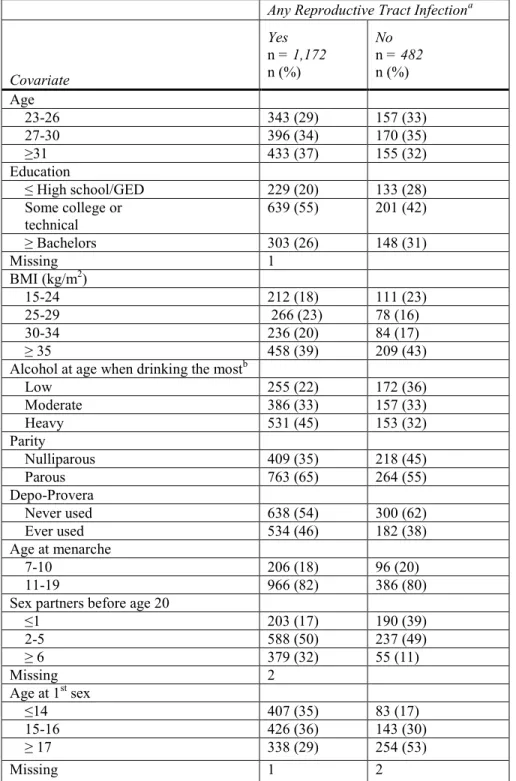
diagnosis (Table 3). Those with a prior history of an RTI, compared to women without one, tended to be older, more educated, heavier drinkers, parous, to have ever used Depo-Provera, to have more sex partners before age 20 years, and to have been younger at first sex (Table 3). The prevalences of specific self-reported RTI diagnoses were: 10% for PID, 38% for CT and BV, 32% for trichomonas, 20% for gonorrhea, 9% for genital herpes, and 7% for genital warts (Suppl. Table 2). The median time since first diagnosis of any RTI was 9 years (IQR: 5-13 years) (Supp1. Table 3).
Twenty-two percent (22%) of women had fibroids discovered at ultrasound screening (Table 4). Of those with fibroids, the size of the largest fibroid was <2 cm for 62%; 63% had only 1 fibroid. The total fibroid volume was <2 cm3 for 52% of participants with fibroids.
more fibroids [aOR: 1.47 95% CI (0.98-2.21)] and a 41% increase in the odds of having a larger total fibroid volume (≥2 cm3) [aOR: 1.41 95% CI (0.98-2.04)].
In the secondary analyses that examined “severity” of RTI based on number of different RTIs we saw an increase in odds of fibroids for those with 2 RTIs [aOR: 1.41 95% CI (0.99-2.01)], but the odds was not elevated for those with 3 or more RTIs (Suppl. Table 4). Multiple diagnoses of the same RTI were not associated with higher odds of fibroids (Suppl. Table 4).
The first sensitivity analysis, exclusion of those with a self-reported diagnosis of syphilis (n=15), resulted in little change in associations between RTIs and fibroid presence (data not shown). However, the second sensitivity analysis, removal of those with a self-reported diagnosis of cervical treatment (n=229), resulted in a somewhat stronger association for genital warts [aOR: 1.29 95% CI (0.76-2.18)]. Other RTI associations were essentially unchanged (data not shown).
4.4 Discussion
In this large study of young African-American women, there was little overall support for an association between women’s self-reported histories of RTIs and subsequent fibroid development. Even those having a history of three or more different RTIs or multiple diagnoses of the same RTI showed no indication of elevated odds of fibroids. However, our results for BV and CT are suggestive of possible associations with fibroids. Women reporting a history of BV had somewhat elevated odds of both small and large fibroids. The
protection by CT is unknown. In summary, our study results do not corroborate any of the suggestive increased odds of fibroids associated with self-reported histories of PID, CT, trichomonas or herpes previously described in smaller studies 4, 5.
This study has several limitations. It was a cross-sectional analysis with self-reported RTI diagnoses. Though the onset of fibroid development is unknown, over half of the women reported their first RTI diagnosis before the age of 20, while fibroid development in African-Americans appears to be infrequent before the mid-20s 29. Also, most of the fibroids were small suggesting relatively recent development. Finally, the median time between first RTI diagnosis and study enrollment was 9 years, again supporting the likelihood that exposure occurred before disease onset.
Self-reported data on history of RTI diagnosis may be subject to recall error 113-116. However, the frequencies of RTIs in our sample are generally similar to those reported in other studies of African-American women 117, 118. Perhaps a more important problem is that the majority of RTIs can often be asymptomatic, so even those who have not had a previous diagnosis may still have had or currently have an RTI. Some women also may have been tested and were positive but never received their results, did not understand them or just did not report them (due to confidentiality concerns or social desirability bias). Because
the possible role of RTIs in the hypothesized fibroid pathogenesis involving aberrant tissue repair 102, 103.
Our study has several strengths. We used enrollment data from an ongoing prospective study with a standardized measure of fibroid status based on systematic ultrasound screening rather than fibroids clinically detected because of symptoms. The number, diameter and volume of the fibroids were systematically measured, so we were able to examine associations with these separate characteristics. Twenty-two percent (22%) of our cohort of young African-American women had fibroids at ultrasound screening, a prevalence which falls within the range of prior US studies that conducted ultrasound screening 5, 6, 29, 30. Our sample size was sufficient to provide good precision for the main hypotheses. We also had extensive data to assess potential confounding, very minimal missing data, and we conducted sensitivity analyses to evaluate potential bias.
4.5 Conclusions
Overall, the studies of RTIs and fibroids, including ours, reveal no strong
Table 3. Distribution of Covariates by Self-Reported Reproductive Tract Infection Status
Any Reproductive Tract Infectiona
Covariate
Yes
n = 1,172 n (%)
No
n = 482
n (%) Age
23-26 343 (29) 157 (33)
27-30 396 (34) 170 (35)
≥31 433 (37) 155 (32)
Education
≤ High school/GED 229 (20) 133 (28)
Some college or
technical 639 (55) 201 (42)
≥ Bachelors 303 (26) 148 (31)
Missing 1
BMI (kg/m2)
15-24 212 (18) 111 (23)
25-29 266 (23) 78 (16)
30-34 236 (20) 84 (17)
≥ 35 458 (39) 209 (43)
Alcohol at age when drinking the mostb
Low 255 (22) 172 (36)
Moderate 386 (33) 157 (33)
Heavy 531 (45) 153 (32)
Parity
Nulliparous 409 (35) 218 (45)
Parous 763 (65) 264 (55)
Depo-Provera
Never used 638 (54) 300 (62)
Ever used 534 (46) 182 (38)
Age at menarche
7-10 206 (18) 96 (20)
11-19 966 (82) 386 (80)
Sex partners before age 20
≤1 203 (17) 190 (39)
2-5 588 (50) 237 (49)
≥ 6 379 (32) 55 (11)
Missing 2
Age at 1st sex
≤14 407 (35) 83 (17)
15-16 426 (36) 143 (30)
≥ 17 338 (29) 254 (53)
Missing 1 2
BMI, body mass index; GED, general education degree; IQR, interquartile range
aIncludes pelvic inflammatory disease, chlamydia, bacterial vaginosis, trichomonas, gonorrhea, genital herpes,
and genital warts; 2 participants not included because they responded “prefer not to answer” for at least 1 RTI and reported “No” for other RTIs; thus, their “any RTI” status could not be determined.
bLow drinkers were those who never had 10 or more drinks in a year. Heavy drinkers were those who usually
Table 4. Adjusted Odds Ratios for Fibroids According to Self-Reported History of Reproductive Tract Infections
Fibroids Age-adjusted Multivariable- adjusted
Reproductive Tract Infections
Yes
n = 363
n (%)
No
n = 1,293
n (%)
OR (95% CI) OR (95% CI)
Any RTIa
Yes 262 (72) 910 (70)
1.05 (0.80-1.36) 1.15 (0.87-1.52)b
No 101 (28) 381 (30)
Missing 2
PID
Yes 34 (9) 128 (10)
0.90 (0.60-1.35) 0.94 (0.62-1.43)b
No 329 (91) 1,164 (90)
Missing 1
Chlamydia
Yes 125 (34) 503 (39)
0.85 (0.66-1.09) 0.92 (0.70-1.21)c
No 238 (66) 788 (61)
Missing 2
Bacterial Vaginosis
Yes 147 (41) 477 (37)
1.14 (0.89-1.45) 1.21 (0.93-1.58)c
No 216 (60) 815 (63)
Missing 1
Trichomonas
Yes 116 (32) 414 (32)
0.90 (0.70-1.16) 0.90 (0.68-1.20)c
No 247 (68) 878 (68)
Missing 1
Gonorrhea
Yes 62 (17) 261 (20) 0.81 (0.60-1.11) 0.94 (0.67-1.33)c
No 301 (83) 1,031 (80)
Missing 1
Genital Herpes
Yes 31 (9) 112 (9)
0.93 (0.61-1.42) 0.89 (0.58-1.39)c
No 332 (91) 1,180 (91)
Missing 1
Genital Warts
Yes 28 (8) 85 (7)
1.10 (0.70-1.73) 1.09 (0.68-1.74)c
No 335 (92) 1,207 (93)
Missing 1
CI, confidence interval; OR, odds ratio; PID, pelvic inflammatory disease; RTI, reproductive tract infection
aIncludes pelvic inflammatory disease, chlamydia, bacterial vaginosis, trichomonas, gonorrhea, genital herpes,
and genital warts
bLogistic regression model adjusted for age (continuous), education, body mass index, alcohol, menarche,
parity, Depo-Provera use
c Logistic regression model adjusted for age (continuous), education, body mass index, alcohol, menarche,
RTI, reproductive tract infection
aAdjusted for age, education, body mass index, alcohol, menarche, parity, and Depo-Provera use
bAdjusted for age, education, body mass index, alcohol, menarche, parity, Depo-Provera use, and all other RTIs
except PID and the RTI being evaluated
CHAPTER 5: HERPES SIMPLEX VIRUS-2 SEROPREVALENCE AND ULTRASOUND DIAGNOSED UTERINE FIBROIDS IN A LARGE POPULATION OF YOUNG
AFRICAN-AMERICAN WOMEN2 5.1 Introduction
Uterine fibroids are one of the most common gynecologic conditions affecting women in the US during their reproductive years 1. Based on ultrasound screening of
randomly selected women, the estimated cumulative incidence of fibroid tumors by age 50 is >80% for African-American women and close to 70% for White women 6. Symptoms
resulting from fibroids (pain, severe bleeding, reproductive problems) are the leading reason for hysterectomy in the US, with the total annual costs of fibroids as high as $34 billion 2.
Fibroids are hormonally dependent benign tumors of the uterine smooth muscle. Their etiologic causes are largely unknown, but established risk factors include African-American heritage (African-African-Americans are 2 to 3 times as likely to have clinically
recognized fibroids as White women 6), older age (up to the age of menopause), younger age at menarche, and nulliparity 5, 20, 21. Three studies have reported that progestin-only
injectables (i.e. depot medroxyprogesterone acetate (DMPA)) are protective 20, 27, 28. Heavier alcohol use may be a risk factor, although the number of studies is small 24, 25.
A hypothesis was postulated decades ago that RTIs may play a role in fibroid
development 3. Both RTIs and fibroids disproportionately burden African-American women and certain RTIs can lead to conditions, e.g., chronic pelvic infection, that could result in
inflammatory reactions 3. This hypothesis is consistent with another theorized mechanism of fibroid pathogenesis where infection can stimulate an inflammatory immune response which can facilitate the initiation of tissue damage resulting in tissue repair/regeneration (increased extracellular matrix, cell proliferation, decreased apoptosis), leading to the formation and growth of uterine fibroids 102, 103. Furthermore, fibroids were found to be associated with serologically-determined Chagas disease (caused by a protozoan parasite) 96, and EBV was found to infect smooth muscle cell tumors at sites outside of the uterus 95, 96.
However, the limited data that examine associations between RTIs and fibroid risk 4, 5, 121, have yielded inconsistent findings. One of the primary aims for undertaking a large study of fibroids in African-American women, the SELF study was to fill this data gap 122. The data from prior studies suggested positive associations between fibroids and PID 4, CT 4, genital herpes 5, trichomonas 5, BV 5, 121 and syphilis 5. We recently published self-reported RTI data from SELF, showed no strong associations with fibroids (16). We did find that women reporting a history of bacterial vaginosis had somewhat elevated odds of multiple fibroids (>2) and larger total fibroid volume (≥2 cm3) and women reporting a history of CT tended to have fewer and smaller fibroids 121. However, all of these previous reports
measured RTI history with questionnaire data, which can be plagued by recall error as well as misclassification due to the asymptomatic nature of most RTIs 113-116. An immunological measure of exposure namely serology (diagnostic identification of antibodies in the serum that remain after infection), would provide a more nearly accurate assessment of exposure than self-reported RTI history.
the highest seroprevalence of HSV-2 (50% for 14-49 year-olds between 2007-2010) 55. Other main risk factors for HSV-2 include: higher numbers of sexual partners, heavy alcohol use, low socioeconomic status, being unpartnered vs. married/cohabiting and lack of consistent condom use 55, 79-83. Also, DMPA use may increase risk of HSV-2 seroconversion 84, 85, and age at menarche has been found to be associated with HSV-2 86 and has been identified as a predictor of sexual behavior which is highly associated with HSV-2 87, 88.
HSV-2 antibodies have been shown to persist for years post-infection 123, 124, and serologic testing for HSV-2 can be done sensitively and specifically for past exposure to HSV-2 125. Cell culture and polymerase chain reaction are the recommended laboratory tests for people who have active lesions or ulcers present 126. However, most HSV-2 infections are asymptomatic or unrecognized (over 85% of seropositive African-American women reported no history of diagnosis) 55; thus, seropositivity to HSV-2 is the best estimate of past,
cumulative exposure 55, 79.
5.2 Methods
5.2.1 Study Participants and Data Collection
We used transvaginal ultrasound results, self-reported questionnaire data and stored frozen serum specimens from participants in SELF, an ongoing study based in the Detroit, Michigan area. SELF is a prospective cohort study of fibroid development. Enrollment data and specimen collection protocols have been described previously 122. In brief, from
November 2010 to December 2012, the study recruited 1,696 African-American women volunteers ages 23-34. Women were not eligible for SELF if they had previously been diagnosed with uterine fibroids; had had a hysterectomy; had ever taken medication to treat lupus, Grave's disease, Sjogren's scleroderma, or multiple sclerosis; or had ever had any type of cancer treated with radiation or chemotherapy. The study was approved by the institutional review boards of NIEHS and HFHS.
5.2.2 Fibroid Assessment
Transvaginal ultrasound, the standard procedure for the detection and diagnosis of fibroids, was used in this study 16. Fibroids were assessed by study sonographers as described previously 122 at one of three clinics. Focal fibroids of 0.5 cm diameter or greater were
measured in triplicate. For each measurement, the 3 perpendicular diameters (longitudinal, anterior-posterior and transverse) were recorded.
5.2.3 Outcome Definitions
diameter were considered not to have fibroids. The secondary outcomes for this analysis were size of the largest fibroid, number of fibroids, and total fibroid volume. The size of the largest fibroid was estimated by averaging the maximum diameter (longitudinal, anterior-posterior or transverse) of each of the triplicate fibroid measurements. Fibroid volume (cm3) was measured by computing the volumes of each of the triplicate fibroid measurements using the ellipsoid formula (longitudinal x anterior-posterior x transverse x 0.5233), and averaging across the three volumes. Total fibroid volume (cm3) was calculated by adding the average volumes from each of a woman’s fibroids. Total fibroid volume was not computed for women with only questionable fibroids (n=6) because at least one diameter was not measured.
5.2.4 HSV-2 Assessment
HSV-2 antibody serostatus was assessed by the International Sexually Transmitted Diseases Research Laboratory at Johns Hopkins University using the Focus Diagnostics HerpeSelect® 2 Enzyme-Linked Immunosorbent Assay (Focus Diagnostics, Cypress, California) per package instructions 127. This type-specific assay to glycoprotein gG2 allows for the qualitative detection of HSV-2 immunoglobulin G antibodies with or without the presence of HSV-1 127. Antibody levels of >1.10 optical density units were categorized as seropositive and levels <0.90 were seronegative. Levels ≥0.9 and ≤1.10 were indeterminate and were retested. The level of antibody response cannot be used to determine active infection or recency of initial infection.