RENEWABLE ENERGY SUPPORT, ACTIVITIES AND DEVELOPMENTS IN THE UK
George A. Aggidis
Lancaster University, Department of Engineering Bailrigg, Lancaster, LA1 4YR, England
Abstract - Climate Change is probably the greatest long term challenge facing the human race. The Department for the Environment, Food and Rural Affairs (Defra) has overall responsibility for tackling climate change, but DTI has a major interest as a number of policies and measures affect the energy sector and business. Along with Defra and the Department for Transport, DTI shares a Public Service Agreement target of reducing greenhouse gas emissions in line with UK Kyoto commitment and domestic goal. This paper presents an assessment of the current balance of efforts towards energy research and development (R&D) in the promotion of low-carbon electricity technologies in the UK and investigates the UK’s main technological options in the medium term and the energy R&D spending with the current and expected future cost of renewable promotion policies. Policy and funding responsibilities for energy research, development and demonstration in the UK are fairly complex (perhaps this is inherently an issue in all countries, due to the wide range of sectors and government departments with a key interest). The signs that an energy R&D renaissance in the UK could be underway are positive and welcome.
1 - Introduction
Renewable energy is the term used to describe energy flows that occur naturally and continuously in the environment, such as energy from the wind, waves or tides. The origin of the majority of these sources can be traced back to either the sun (energy from the sun helps to drive the earth’s weather patterns) or the gravitational effects of the sun and the moon. This means that these sources are essentially inexhaustible. The key issue is how to extract this energy as effectively as possible and convert it into more useful forms of energy. This can range from directly using the energy from the sun to heat water to using mechanical devices, such as wind turbines, to convert the kinetic energy in the wind into electrical energy.
The UK is currently responsible for the release of around 3 per cent of the world’s global greenhouse gas emissions, despite having only 1 per cent of the world’s population. UK energy industries are the largest single contributors to UK greenhouse gas emissions, contributing over a third (54 million tonnes) of the total amount of carbon dioxide emitted in the UK. To help lessen the effects of climate change, we
must reduce the level of greenhouse gases emitted. This can be achieved by generating our energy from sources that emit low or even zero levels of greenhouse gases, such as renewable energy. We can also make sure that we use energy as efficiently as possible. However, these are not either/or options. As well as countering the effects of climate change, using renewable energy will also help to reduce other forms of environmental and social damage arising from the use of fossil fuels. For example, it will minimise the impact of acid rain on water and forest ecosystems, or reduce localised air pollution and its subsequent health impacts. Another important reason for alternative forms of energy is security of supply. We need to take steps to make sure that the UK continues to have the energy that is vital to its economy now that is no longer self-sufficient in energy. The energy industry still relies on finite, diminishing sources of fossil fuel such as coal, oil and gas. In 2005, approximately 74 per cent of the UK’s electricity was generated from fossil fuel sources, just over 19 per cent from nuclear sources, and just over 4 per cent from renewable sources. Using indigenous renewable sources of energy will reduce our dependence on imported fossil fuels and will bring diversity and security of supply to the UK’s energy infrastructure, as well as helping to improve the environment and minimise the impact of climate change.
2 - UK renewable energy
Energy research activity in the UK is framed by the UK 's energy strategy goals, set out in the 2003 Energy White Paper "Our energy future - creating a low carbon economy". These are to:
• put the UK on a path to cutting CO2 emissions by 60% by 2050;
• maintain reliability of energy supplies;
• ensure that every home is adequately and affordably heated;
• raise the rate of sustainable economic growth and improve our productivity, through competitive markets.
The Government's report on the Energy Review: "The Energy Challenge" was released on 11 July 2006. This work aims to put us in a position to meet the two major long-term challenges in UK energy policy:
• we need to tackle climate change by reducing carbon dioxide emissions;
• we need to deliver secure, clean energy at affordable prices, as we move to increasing dependence on imported energy.
One of the conclusions made by the UK Renewables Innovation Review Team in its report published in February 2004 was recognised as applicable to the whole field of energy technology funding in the UK. “The current funding landscape is complex, with a large number of schemes administered by a range of bodies over the different stages of innovation, and technologies.” The reasons behind the complex policy and funding responsibilities for energy research, development and demonstration in the UK are, as in the case of most other countries, basically the wide range of sectors and government departments with a key interest. The fact that energy research in the UK is interdisciplinary and covers the whole spectrum from basic science, applied science, industry-led research, security of skills in education, teaching and research, avoidance of fuel poverty, to regional and social considerations and risk management makes the situation even more complex, but at the same time, interesting.
Since the publication of the Review, both the Department of Trade and Industry (DTI) and the Energy Research Council (UKERC) have attempted to present the complex system and to explain, using the example of wave and tidal energy how the system is working. The development of present Energy Research in the UK is the result of long-term, interdisciplinary and continuous considerations and processes, which are regularly evaluated, reoriented and revised. The basic framework has been set by various acts of parliament, the Energy White Paper, the Science Budget, the New Energy Research Programme announced on 1st
November 2005 as well as the DTI’s Technology Programme.
Energy Research is funded by the Research Councils (academic research, EPSRC - led but with significant
input from others) and directly by the Government whereby the funds are channelled into specific support programmes with fixed objectives and work programmes. Although the barriers between the different sources of financing are fairly well-defined, these do not prevent individual compound projects, clusters or networks being financed jointly by a Research Council grant as well as from government funds.
The topic of energy research in the UK is not generally split up into specific technologies; for instance, the Carbon Abatement Technologies Programme supports both technologies related to carbon capture and storage and those related to improving the efficiency of existing technologies, like higher efficiency boilers. Fuel cells as well as energy efficiency in buildings (technology-blind technologies) were included in the Renewables Innovation Review of the DTI, 2004. In spring 2006, following a review, the government published an updated UK Climate Change Programme. This has introduced additional measures that will take us close to our domestic goal and ensure that the UK can make real progress by 2020 towards the long-term goal to reduce carbon dioxide emissions by some 60% by about 2050.
This was followed on 11th July 2006 by the publication of the government’s review of energy policy “The Energy Challenge.” The purpose of the review was to examine the UK’s progress against the medium and long-term 2003 Energy White Paper goals and consider options for further steps to achieve them.
On 30th October 2006 Nicholas Stern published his
review of the Economics of Climate Change the most comprehensive review ever carried out on this subject. The first half of the review focuses on the impacts and risks arising from uncontrolled climate change and the costs and opportunities associated with action to tackle it. The second half examines the national and international policy challenges of moving to a low carbon economy.
On 13 March 2007 the Government published a draft Climate Change Bill. Along with an accompanying strategy, the draft Bill sets out a framework for moving the UK to a low carbon economy. It also demonstrates the UK's leadership as progress continues towards establishing a post-2012 global emissions agreement. The Energy Technologies Institute (ETI) is an energy research and development institute planned to begin operating in the United Kingdom in 2008. It is being set up by the Government following an announcement in the 2006 Budget.
The purpose of the Energy Technologies Institute will be to “accelerate the development of secure, reliable and cost-effective low-carbon energy technologies towards commercial deployment”. Deployment of the technologies involved, which are expected to contribute to the reduction of the UK’s carbon emissions, is expected to begin around 2018. It is expected that the Institute will work with a range of academic and commercial bodies.
to minimise climate change. At the same time, they have pointed to the slow pace of government action in promoting energy conservation and implementing the many low-carbon technologies that already exist, compared to progress in a number of other European countries.
In addition to initial funding for the ETI, the Department of Trade and Industry is to provide funds of £50 million each year over a period of 10 years starting in 2008-09. The Government expects that the separate Energy Research Partnership will raise matching funding from commercial organisations. As of September 2006 EDF Energy, Shell, BP and E.ON UK have committed to providing funds.
Five objectives have been set for the institute:
1.To increase the level of research and development funding to meet the UK’s energy policy goals. 2.To deliver research and development that
facilitates the rapid commercial deployment of cost-effective, low-carbon energy technologies. 3.To provide better strategic focus for commercially
applicable energy related research and development in the UK.
4.To connect and manage networks of the best scientists and engineers to deliver focused energy research and development projects to accelerate eventual commercial deployment.
5.To build research and development capacity in the UK in the relevant technical disciplines to deliver the UK’s energy policy goals.
The Institute will focus research on a mixture of technologies including:
• Large scale energy supply (likely to include clean coal and carbon capture
• Small scale energy supply (such as distributed generation and micro generation)
• End-use efficiency and demand management (priority areas)
• Sustainable transport fuels (a priority area)
• Energy infrastructure and supply
• At the same time, the Institute also expects to focus on a mix of technologies to increase security of supply, and solutions to address fuel poverty.
3 - Financial support
Historically, public sector support for energy research and development in the UK has been provided by a variety of bodies with little co-ordination between them. Problems experienced as a result of this included poor continuity of funding, and the availability of funding for certain parts of the research-development-commercialisation process but not others. Funding levels have also been low by international standards (Fig 1).
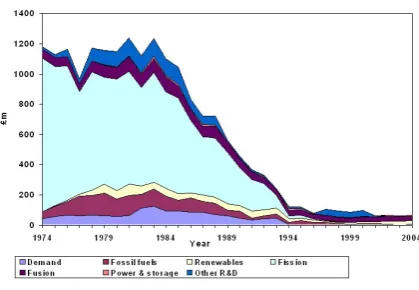
The volume of publicly funded RD&D in the UK declined sharply in the late 1980s and 1990s (Fig 2). The declines were associated with the privatisation of the utility sector and national laboratory facilities. The decline in nuclear fission research was particularly
sharp. However, it should be noted that these figures, reported to the International Energy Agency (IEA), cover only RD&D funded directly by the UK national government, and do not include support from an increasingly wide range of RD&D players in the devolved administrations (Scotland, Wales) and the English regions. The volume of energy RD&D is rising again, coupled with concerted attempts to make the research portfolio more coherent.
In addition, a significant volume of energy R&D conducted in the UK is funded through the EU Framework Programmes while the UK is active in many IEA research and technology implanting agreements as well as other international collaborations. The Energy Research Landscape aims to capture this wider range of activities and actors.
[image:3.595.321.534.267.396.2]Fig. 1 Average annual per capita R&D spending 1990-2005 Source: IEA energy R&D database
Fig. 2 UK Energy R&D (Public) Spend Source: DTI
At the national level, the key energy RD&D funders are the Research Councils, Government Departments and the Carbon Trust. As noted above their activities are reinforced by an increasing number of other bodies, many operating at the sub-national level.
[image:3.595.323.533.439.584.2]The Research Councils Energy Programme (RCEP) led by the Engineering and Physical Science Research Council (EPSRC), acts as an umbrella for all Research Council activities. RCEP encompasses: the interdisciplinary Towards a Sustainable Energy Economy (TSEC) programme; EPSRC's SUPERGEN (Sustainable power generation and supply); the fusion programme at Culham; the Carbon Vision Programme (jointly with the Carbon Trust); and a number of other capacity building initiatives.
Government Departments support a large number of energy research and innovation programmes. These range from early stage research, development and pilot scale demonstration to capital grants to assist the full scale deployment of nearer market technologies not yet able to compete on level terms with fossil fuels. The Department of Trade and Industry (DTI) supports the largest number of schemes. Its Technology Programme, operated by the Office of Science and Innovation (OSI), supports R&D into low carbon and renewable energy at around £20m pa. The marine energy challenge provides £50m scheme for wave and tidal stream demonstration projects. Capital grants totaling £117m have been made to offshore wind farms and £66m allocated to biomass projects. The Major PV Demonstration Programme has provided £31m support since 2002. The Cleaner Coal Technology programme has provided around £13m from 1999-2007 for R&D relevant to the power sector. The recent Carbon Abatement Technology (CAT) strategy allocates £50m for demonstration of clean coal technologies and carbon capture and storage.
Other key Departmental programmes include: the Department of Food and Rural Affairs (DEFRA's) provision of evidence for and monitoring of progress on its energy efficiency policy objectives (approx £3m pa); the Department for Transport's (DfT's) Vehicle Technology Fund (£4m pa); the Department for Communities and Local Government's (DCLG's) work on building regulations and domestic boiler standards; and the Health & Safety Executive's (HSE's) work on nuclear safety research (£1.5m pa supplemented by an additional £6.7m from reactor licensees).
The Carbon Trust is an independent company, Government-funded and business led, which aims to accelerate the transition to a low carbon economy in the UK. It works with business and the public sector helping them to reduce their carbon emissions. Via its £20m pa innovation and investment programme, relying on funds recycled from the climate change levy, it promotes the commercial development of new and emerging low carbon technologies. RD&D is about £5m pa. Currently, the Carbon Trust has over 90 RD&D projects in its portfolio worth in total around £22m.
In September 2006, a prospectus was issued for the Energy Technology Institute which the Government believes to be the most important development in UK energy research and innovation for decades. The work of the Institute will primarily occupy the middle ground between the longer-term research funded by the UK’s Research Councils and the deployment of proven
technologies. Core funding will be provided on a 50:50 public private partnership basis, with the ambition, when fully operational, to inject some £100 million per year into UK-based energy research. The Government will provide 50% of the core funding of the Institute, up to an agreed limit. The Institute will have a lifetime of at least 10 years. Seven major companies (BP, Caterpillar, EDF Energy, EON.UK, Rolls Royce, Scottish and Southern Energy, and Shell) have pledged a total of £32.5m pa to support the ETI.
In June 2006, the Government announced the creation of a new joint DEFRA/DTI Environmental Transformation Fund that will provide a boost to investment in renewable energies and other green technologies aimed at reducing carbon emissions. Final details of the scale and scope of the Fund will be announced in the Spending Review 2007. UK academic institutions and companies also compete for funds under the EU Research and Technology Development Framework Programmes. Systematic information on participation will be added to the Atlas shortly. Under FP7, which is due to start in 2007, over €7bn is expected to be devoted to non-nuclear energy R&D.
4 - Research activities
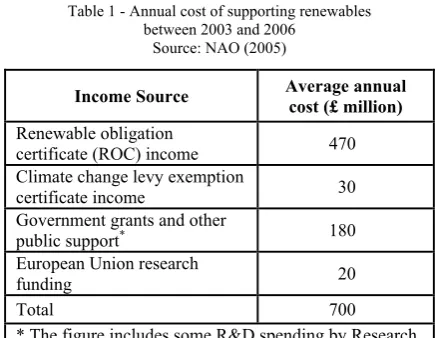
The Annual cost of supporting renewables in the UK is shown on table 1.
[image:4.595.317.535.461.630.2]The main thrust of the UK research activities on energy from Renewable sources include: Bioenergy, wind power, marine and tidal power, and solar power.
Table 1 - Annual cost of supporting renewables between 2003 and 2006
Source: NAO (2005)
Income Source Average annual cost (£ million)
Renewable obligation
certificate (ROC) income 470
Climate change levy exemption
certificate income 30
Government grants and other
public support* 180
European Union research
funding 20
Total 700
* The figure includes some R&D spending by Research Councils and other public bodies.
4.1. Bioenergy
with these ‘biofuels’ used on their own or in conjunction with conventional fuels such as coal or wood.
• The SUPERGEN Bioenergy Consortium aims to tackle a range of challenges associated with turning bioenergy into an efficient, economically viable and environmentally sustainable power source.
• Consisting of eight leading European bioenergy institutes, the Bioenergy Network of Excellence
links national bioenergy research programmes to help improve cost-effectiveness and maximise research impacts. The UK contribution is supported by EPSRC/DTI and delivered through the EU’s Sixth Research Framework Programme.
• The ERA-NET scheme aims to support the cooperation and coordination of national research programmes. It will support networks of research funding agencies across the EU in various research activities.
4.2- Wind Power
The most familiar of the renewables ‘family’, wind power still contributes a relatively small amount to our overall energy needs (less than either bioenergy or hydroelectric power). Part of the reason for this is the unpredictable nature of wind energy. Other factors include the difficulties involved in agreeing sites for wind turbines on land and the expense of building and maintaining off-shore wind turbines.
• Building foundations for offshore wind turbines involves many difficulties. EPSRC supports research groups looking at this area including engineers at the University of Oxford who have been examining whether inverted ‘buckets’ installed by suction could take the place of piled foundations. Another example is work just started at Oxford involving the modeling of the effect of waves on wind turbine foundations.
• A range of problems must be solved if the efficiency and reliability of wind turbines is to be improved. Researchers at the University of Durham, for instance, have just begun a project that aims to produce a low-cost, modular power conversion system that would greatly simplify the design of gearless, direct drive wind turbines.
• Wind farms, like many renewable energy sources, need to be managed and monitored much more closely than conventional power plants if they are to deliver a similar level of performance. One option is being developed by computer scientists at the University of Stirling who are working on a wireless sensor and management system for hilltop wind farms.
4.3 Marine and Tidal Power
The UK is surrounded by marine and tidal resources that could be used to generate energy: this may be from the up and down motion of the waves or from the flow
of strong currents. A lot of underpinning research remains to be done before we understand how to exploit our marine/tidal resources to best effect.
• The SUPERGEN Marine Energy Research
Consortium is tackling a wide range of challenges associated with wave and tidal power: these include assessing what energy-generating resources exist in a given location, what technology would most efficiently harness it and how the resulting energy can be fed into energy networks.
• Improving the conversion of wave energy into electrical power and experimenting with radical new designs of wave surge converters that could be stationed along our shoreline are just two examples of the sort of research into new marine and tidal power technologies supported through EPSRC research grants.
4.4 Solar Power/Photovoltaic Technologies
Current photovoltaic technologies – using solar cells that turn sunlight directly into electricity – are expensive and inefficient which has limited both their uptake and the amount of power they can deliver. Research into new materials and designs for photovoltaic devices could make them much more attractive for many applications.
• The SUPERGEN Excitonic Solar Cells
Consortium is coordinating research into a new kind of PV technology, bringing together four leading research groups to develop existing organic solar cells and explore new materials, designs and fabrication techniques.
The SUPERGEN consortium Photovoltaic Materials for the 21st Century is spearheading the effort to improve technologies based on advanced wafer silicon and thin film photovoltaic devices. The consortium will combine the expertise of a range of research groups in currently-used materials (silicon, cadmium telluride and the copper indium diselenide family).
5 - Expected further developments
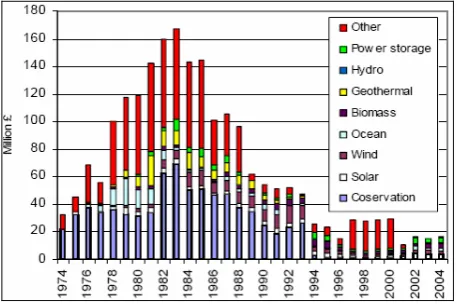
Energy RD&D priorities are set within the more general Spending Review process led by HM Treasury (Fig 3).
Science and Innovation, sitting within the DTI, was created in April 2006 and now has overall responsibility for both the Research Councils and the Technology Strategy Programme.
Fig. 3 Public renewable energy R&D spending in the UK Source: IEA energy R&D database
The Energy Research Partnership, launched in January 2006, is a public-private partnership co-chaired by the Chief Scientific Adviser and the Chief Executive of EON.UK. It provides strategic direction to UK energy research, development, demonstration and deployment (RDD&D). ERP brings together key public and private sector stakeholders in UK energy RDD&D, who promote a coherent approach to addressing UK energy challenges, set within an international context, and work to increase long-term energy related activity and investments in the UK. It currently has three work streams: Strategic Objectives and Priorities; UK Support for Energy RDD&D; and High Level Skills Development.
The UK Energy Research Centre, is a consortium of eight academic institutions, was established in 2004. Among its aims is to co-ordinate a National Energy Research Network and create this atlas of energy research activity.
It is a central part of the £28 million cross-Research Councils programme Towards a Sustainable Energy Economy (TSEC) and is funded by three research councils: the Engineering and Physical Sciences Research Council (EPSRC), the Natural Environment Research Council (NERC) and the Economic and Social Research Council (ESRC).
5 - Conclusion
Policy and funding responsibilities for energy research, development and demonstration in the UK are fairly complex (perhaps this is inherently an issue in all countries, due to the wide range of sectors and government departments with a key interest).
Research Councils, with funding provided via Office of Science and Technology, operate with a high degree of autonomy to set priorities and allocate budgets, to fund basic research and early stage applied research and also to train new people and sustain the skills and research base.
Government Departments fund energy R&D to varying extents, with DTI the biggest provider of funds. This includes significant capital grants for deployment of offshore wind (the current programme amounts to £117m), and demonstration funding for carbon abatement technologies (£35M), biomass (£66m) and marine technologies (£50m). Other Departments tend to pursue research more focused on their policy interests and involve smaller sums. These programmes cover expenditures over 4 to 5 year periods.
The Carbon Trust, focused on the business sector, supports innovation activities right across the innovation chain, with significant sponsorship funding from DEFRA. This ranges from early stage research into emerging technologies (partly via partnership with Research Councils) to encouraging business uptake of existing technologies.
The recently launched Government's Energy Review is likely to consider issues surrounding energy research and innovation strategy, to see whether any further steps may need taking. A new Energy Research Partnership (ERP) is also being introduced to bring together key senior people from the public and private sectors to help enhance the strategic direction and coherency of the total UK investments, identify priorities and address key issues such as skills and the more effective operation of "the innovation chain". There is, however, no single body that leads Energy Research in the UK, though various activities and initiatives attempt to promote coherency and joint working. The Sustainable Energy Policy Network does have a principle focus on policy, though in theory also offers a networking function for Government Departments to discuss relevant RD&D issues. ERP is probably the more focused activity on this front however, and before then a predecessor "High Level Energy RD&D Group", which essentially (and approximately) brought together the public sector side of the current ERP.
Regarding priorities: the last formal and overarching identification of priorities for energy research was probably the Energy Research Review Group's study in 2001/2, with the listed priorities: CO
2 sequestration;
energy efficiency; hydrogen production and storage; nuclear power, solar photovoltaic and wave and tidal power. The report itself expands on the more detailed priorities within each technology. The findings of this report were explicitly endorsed in the 2003 Energy White Paper. There is a need to learn lessons from other government research establishments. The latest UK Energy White Paper is anticipated to be published early June 2007. The signs that an energy R&D renaissance in the UK could be underway are positive and welcome.
References
[2] Allott “From Science to Growth, Hughes Hall City Lecture 2006” available on-line at: http://www.hughes.cam.ac.uk/City_Lecture_06030 6.pdf (accessed April 2007).
[3] V. Bush “Science - The Endless Frontier”, US Government Printing Office, Washington DC, July 1945.
[3] L. Butler, K. Neuhoff “Comparison of Feed in Tariff, Quota and Auction Mechanisms to Support Wind Power Development” Electricity Policy Research Group Working Paper CMI EP 70, Faculty of Economics, University of Cambridge, 2004.
[4] DTI “The Energy Challenge”, Energy Review, July, Department of Trade and Industry, February, London, 2006.
[5] DTI “Renewable Innovation Review – Government Action is Required”, Department of Trade and Industry, London, February 2004. [6] DTI “Review of the Feasibility of Carbon Dioxide
Capture and Storage in the UK”, DTI/Pub URN 03/1261, Department of Trade and Industry, London, 2003.
[7] DTI “Report of the Group, Chief Scientific Adviser’s Energy Research Review Group”, on-line at: http://www.ost.gov.uk/policy/issues/csa_errg/
accessed June 2006), 2002.
[8] DTI “The Economics of Onshore Wind Energy, Wind Energy Fact Sheet 3”, Department of Trade and Industry, London, June 2001.
[9] J. J. Dooley, P. J. Runci “Developing Nations, Energy R&D, and the Provision of a Planetary Public Good: A Long-Term Strategy for Addressing Climate Change”, The Journal of Environment & Development, Vol. 9, No. 3, 215-239, 2000.
[10] Eurelectric “R&D in EURELECTRIC Countries, 2002 Update”, Research and Development Working Group, Ref: 2002-520-0013, Union of the Electricity Industry, Brussels, January 2003. [11] European Commission (2005a). “Assessing the
Impact of Energy Research, EUR21354”, Available on-line (accessed June 2006) at: http://ec.europa.eu/research/energy/pdf/erevia_en. [12] European Commission (2005b). The Support of
Electricity from Renewable Energy Sources, Communication from the Commission, COM(2005) 627 final, December, Brussels.
[13] G. Glaze “The UK energy research landscape report GIN/2006-01”, 2006.
[14] R. J. Green “The Cost of Nuclear Power Compared with Alternatives to the Magnox Programme”, Oxford Economic Review, Vol. 47, 513-24, 1995.
[15] C. Hope “Memorandum by Dr Chris Hope, Judge Business School, University of Cambridge, House of Lords, Select Committee on Economic Affairs Minutes of Evidence”, 14 January 2005.
[16] T. Jamasb “Technical Change Theory and Learning Curves: Patterns of Progress in Energy Technologies”, Cambridge Working Papers in Economics CWPE 0625 / Electricity Policy
Research Group EPRG 0608, Faculty of Economics, University of Cambridge, 2006.
[17] T. Jamasb, W. Nuttall, M. Pollitt “Future Electricity Technologies and Systems”, Cambridge University Press: Cambridge, 2006.
[18] T. Jamasb et al. “The Case for a New Energy Research, Development and Promotion Policy for the UK”, University of Cambridge Paper prepared for: State of Science Review on Public Policy in the Energy Context Office of Science and Innovation Foresight and Horizon Scanning Centre 2006.
[19] T. Jamasb, M. Pollitt “Deregulation and R&D in Network Industries: The Case of Electricity Sector”, Cambridge Working Papers in Economics CWPE 0533 / Electricity, 2005.
[20] Policy Research Group Working Paper EPRG 05/02, Faculty of Economics, University of Cambridge.
[21] P. D. Henderson “Two British Errors: Their Probable Size and Some Possible Lessons”, Oxford Economic Papers, New Series, Vol. 29, No. 2, July 1977.
[22] HM Treasury (2006). Budget 200Press Notice 1, available on-line at: http://www.hm-treasury.gov.uk/budget/budget_06/press_notices/b ud_bud06_press01.cfm (accessed June 2006). [23] House of Lords “Renewable Energy: Practicalities,
Science and Technology Committee”, 4thReport of
Session 2003-2004, The Stationary Office Limited, London, 2004.
[24] House of Commons (2005). Department of Trade and Industry: Renewable Energy, Committee of Public Accounts, Sixth Report of Session 2005-06, London: The Stationary Office Limited.
[25] ICCEPT & E4tech Consulting “The UK Innovation Systems for New and Renewable Energy Technologies”, Final Report to the DTI Renewable Energy Development & Deployment Team, June 2003.
[26] ICCEPT “Innovation in Long Term Renewables Options in the UK: Overcoming Barriers and Systems Failures”, Final Report for the DTI Renewable Innovation Review, November 2003. [27] Mott Macdonald BPI “Innovation in Electricity
Distribution Networks Final Report”, Brighton: Mott Macdonald BPI, 2004.
[28] R. M. Margolis, D. M. Kammen “Under-investment: the Energy Technology and R&D Policy Challenge”, Science, Vol. 285, pp. 690-692, July 1999.
[29] NAO (2005). Department of Trade and Industry: Renewable Energy, Report by the Controller and Auditor General, HC 210 Session 2004-2005, National Audit Office, The Stationary Office, London, 2005.
[30] Newbery and Pollitt “Restructuring and Privatisa-tion of the CEGB - Was It Worth It?”, Journal of Industrial Economics, Vol. 45, No.3, 1997.
Electricity” Policy Research Group Working Paper 06/19, Faculty of Economics, University of Cambridge, 2005.
[32] A. D. Sagar, B. van der Zwaan “Technological Innovation in the Energy Sector: R&D, Deployment, and Learning-by-Doing”, Energy Policy, Vol. 34, 2006.
[33] SDC “Wind Power in the UK: A Guide to the Key Issues Surrounding Onshore Wind Power Development in the UK”, Sustainable Development Commission, London, 2005.
[34] F. P. Sioshansi, W. Pfaffenberger “Electricity Market Reform: An International Perspective”, Oxford: Elsevier.
[35] A. Wallard “Successful Contractorisation - The Experience of the National Physical Laboratory”, in Government Laboratories, Nato Science Series 4 – Vol. 34, Eds. D Cox, et al., 2001.
Appendix 1: Abbreviations and Acronyms
CSLF The Carbon Sequestration Leadership Forum
CT The Carbon Trust
DEFRA The Department for Environment, Food and Rural Affairs
DfT The Department for Transport
DTI The Department of Trade and Industry
ECM2 Engineering Centre for Manufacturing and Materials, Port Talbot
EPSRC The Engineering and Physical Sciences Research council
EUETS EU Emissions Trading Scheme
HSE The Health and Safety Executive
INREB Integration of New and Renewable Energy in Buildings
IPHE The International Partnership for the Hydrogen Economy
ITI ITI Energy Scotland
M2M Synergetic M2M Group
NaREC New and Renewable Energy Centre
ODPM Office of the Deputy Prime Minister
RDA Regional Development Agencies
REEEP Renewable Energy and Energy Efficiency Partnership
RO Renewables Obligation
SUPERGEN Sustainable Power Generation & Supply
TSEC Towards a Sustainable Energy Economy Programme
UKERC United Kingdom Energy Research