Munich Personal RePEc Archive
Loan Dollarization in V4 Countries
Bednarik, Radek
Faculty of Economics, VSB - Technical Univerzity of Ostrava
4 May 2007
Online at
https://mpra.ub.uni-muenchen.de/14695/
LOAN DOLLARIZATION IN V4 COUNTRIES
Radek Bedna
ř
ík
ABSTRACT
This paper deals with loans dollarization of V4 countries residents, its development and sectoral composition. By conducting simple OLS regression for each V4 country tries to find out some factors that may have been contributing to dollarized loans development.
ABSTRAKT
Tento příspěvek se zabývá dolarizací úvěrů rezidentů zemí V4, jejího vývoje a
sektorovým složením. Pomocí jednoduché OLS regrese se snaží určit některé
faktory, které mohly přispívat k vývoji dolarizovaných úvěrů.
Introduction
The dollarization is a phenomenon, which has begun to be discussed mainly in the nineties of the last century. Many papers have been written about it, or more precisely, about its various forms. Dollarization, either in its official form (official replacement of former currency by the new one) or in an unofficial form (simultaneous and widespread using of, at least, two currencies in the economy), indeed places some constraints on the economy and brings significant risks as well. One can say that the full dollarization issues are well mapped and described in various papers, see, for example, Sturzenegger – Levy Yeyati (2003), Berg – Borenzstein (2000), Jílek (2004) or Bednařík (2006). Recently, many papers have
been written about de facto form of dollarization, since it is really widespread and may bring some serious risks, especially to emerging or developing economies. See, for example, Ize – Levy Yeyati (1998, 2005) or Leiderman, Maino and Parrado (2006). The brief characterization of dollarization forms will be done in the first section of this paper.
This paper deals with dollarization, but in slightly different way than most of other papers do. We focus on dollarization of loans in V4 countries. The goal of this paper is to show development and composition of foreign exchange loans (that is, dollarized loans) in these countries. The reason is, that V4 countries have been experiencing steady growth of dollarized loans recently, which may pose a threat to debtors (especially households) and therefore to creditors (banks) as well. Also, we try to find out whether some selected factors have contributed to the development of dollarized loans. This will be done by simple OLS regression for each V4 country separately and the results are presented in the third section.
In the conclusion we summarize the findings of this paper. 1. What is the dollarization?
adopted currency does not have to be only the dollar, but any other foreign currency, which is seen to be suitable for adopting by country authorities1.
Full dollarization is recommended for countries, which suffer from long-run high and volatile inflation and from frequent breaches of peg. The former domestic currency ceases to exist. Adopting strong and stable currency may help stabilizing economy and as a final result, economy welfare should grow. Main pros of full
dollarization are: stable and low inflation, stable nominal (and real) exchange rate,
reduction of the interest rate differential, reduction of the speculative capital flows, deepening of trade integration with country whose currency is being adopted, lowering of the exchange rate risk and therefore lowering of the costs of external debt servicing2. However, as always, there are some negative effects of this monetary
regime. The full dollarization means, that own (and, theoretically independent)
monetary policy ceases to exist with all known negative effects3. Another problem, especially in developing economies, is the loss of seignorage income, which is, in fact, income of state budget. And the last one is the loss of lender-of-last-resort function. The carrier of this function is mostly the central bank, and when the former currency is disbanded, it may provide liquidity support to commercial bank only up to its foreign currency reserves4. Because of aforementioned cons, the full dollarization was conducted only in few countries. As relatively fresh examples can be named Ecuador (2001) or El Salvador (2000) that switched to dollar in order to solve their serious and long-run problems with inflation and unstable nominal exchange rate5.
De facto dollarization marks the situation, when, at least, two currencies are widely used in the economy. Agents switch to other currencies, because they want to hedge themselves against high and unstable inflation and unstable nominal exchange rate. In such kind of environment, the purchasing power of domestic currency is unstable and low, which brings uncertainty to agents. De facto dollarization has many forms, but most attention is paid to its financial form, because it may cause serious problems to domestic banking sector, and to whole economy as well, in case of some economic problems (economic slowdown or crisis, for example)6. This can be shown very easily. Imagine, that lot of domestic residents (especially households) have their loans (liabilities) denominated in foreign currency. But their income is in domestic currency. Now, when, for some reasons, the nominal
1 The situation of (un)officially replacing currencies is called “dollarization” since the official
replacement of former and weak currency by dollar was proposed by some economists to some Latin America countries. This monetary reform should have helped to stabilize and improve the often very unpleasant economic situation of these countries, which had problems with long-run unstable and high inflation and unstable (nominal) exchange rate.
2 For more detailed description of possible pros and cons of full dollarization ,see, for example,
Bednařík (2006).
3 However, in strongly de facto dollarized country, the independent monetary policy exists only
formally, since central bank can not manipulate „freely“ with primary interest rate or with exchange rate, because the consequent changes of (or pressures on) exchange rate may render foreign exchange debtors unable to pay their liabilities.
4 In other words, central bank cannot “print money” which is, in fact, good, with respect to low
inflation.
5 The list of fully dollarized countries can be found in Jílek (2004, p.645)
6 We may distinct between financial, real, payments, domestic and external dollarization. See
exchange rate depreciates or is devaluated, the volume of their foreign exchange liabilities expressed in domestic currency will rise, but the amount of their income remains the same. Or, since the interest rates of foreign exchange loans are derived from primary (repo) interest rates of foreign central banks, the raising of these rates will make the foreign exchange loans more expensive. All of this may cause that debtors may become to be unable to service their debts, and this will cause problems to creditors (banks), due to surge of nonperforming loans. Since banks will experience economical problems, their clients may begin to doubt about banks’ soundness and runs may appear7.
From the text above, one can see, why may excessive providing of foreign exchange loans be very dangerous, especially in developing or emerging economies. Not only it can endanger stability of certain sectors of economy (households namely) but it may lower the efficiency of domestic monetary policy, just because the changes of official primary interest rate will not influence the cost of foreign exchange loans and therefore the inflation controlling ability of central bank through the loan channel may be weakened8.
2. Data and methodology
Before we turn to FX loans analysis itself, let us say something brief about data and methodology used for regression analysis.
2.1. Data
In this paper, the following monthly time series are used: FX loans and FX deposits of residents, FX loans’ interest rates, inflation (annual rate of change) and nominal effective exchange rate.
All data about FX loans and their structure, FX deposits and about FX loans’ interest rates were taken from national central banks. Unfortunately, since each country’s central bank publish time series with various lengths, the time coverage for each country will differ. However, all monetary and banking statistics are harmonized, which ensure that data are comparable. Loans are denominated in millions of euro. Data were converted from national currencies to euro using yearly average of nominal exchange rate of domestic currency to euro of year 2006. Interest rates of FX loans presented in this paper are weighted averages of households’ (incl. NISH) and nonfinancial corporations’ FX loans interested rates9.
Other times series used for regressions are taken from the Eurostat to ensure that data were computed by the same methodology.
7 This happened, for example, in Ecuador during the crisis in the late of nineties. See
Beckerman (2001) or Jacome H. (2004).
8 But, by manipulating with its primary rate, central bank can (theoretically) influence the
growth of foreign exchange loans, at least, indirectly, because agents, when deciding whether to take foreign exchange or domestic currency denominated loan, may be influenced by interest rate differential. Simply, when foreign exchange loans are more costly, domestic currency loans may be preferred.
9 Households and nonfinancial corporations are only sectors, for whom the FX loans’ interest
2.2. Methodology
The common regression function for each country is specified as:
LOGFLt = α1t + α2t*LOGFDt + α3t*LOGINFt + α4t*LOGNEERt + α5t*LOGIRt + εt, (1)
t = 1, 2, 3, 4,
where: FL is FX loans (mil. EUR), FD are FX deposits (mil. EUR), INF is inflation (%, annual rate of change), IR is FX loans’ interest rate (%),α1 is constant
and ε is error term. All variables were converted to logarithms.
Because unit root testing shows that all time series are non-stationary (thus, integrated of order 1), we had to difference them. Differencing results in following function:
DLOGFLt = α1t + α2t*DLOGFDt + α3t*DLOGINFt + α4t*DLOGNEERt + α5t*DLOGIRt + εt. (2)
What kind of theoretical relationships between regressors and regressand can be expected?
FD – when FX deposits of residents grow, the FX loans may grow too, because agents may be more willing to take a new FX loans. This variable serves us as some kind of proxy of residents’ foreign currency denominated wealth. However, we must say, that between FX deposits and loans may be two-way relationship. Because, not only can FX deposits influence FX loans, but FX loans may influence FX deposits as well, simply because when agent receives loan, it may be put onto his (current) account, raising the volume of FX deposits artificially. If this is a case, the usual OLS regression with one function can not yield proper results10.
INF – inflation is marked as one of the main sources of high de facto dollarization in the economy. A lot of papers assume that high inflation supports de facto dollarizing by agents’ efforts to hedge against it and it is measured as FX deposits / total deposits ratio. In other words, high inflation causes FX deposits to grow. Indeed, inflation may support FX loans’ growth as well, but for different reasons. High inflation lowers real interest rate paid by debtors and therefore they may be willing to take more FX loans. And, of course, high inflation erodes the real value of domestic currency loans in term of purchasing power, possibly making FX loans more attractive.
NEER – the nominal effective exchange rate is used, because we were unable to obtain exact currency structure of FX loans. Therefore, the NEER may be better option in order to capture the possible effects of nominal exchange rates of various currencies on FX (dollarized) loans. There can be two (ambiguous) effects. First, when NEER appreciates, agents may be willing to take fewer FX loans, because their volume, expressed in domestic currency, shrinks (and vice versa). Second, some agents may be willing to take more FX loans when NEER appreciates (and vice versa). The reason is that if their income is domestic currency denominated, the appreciation of NEER means lower risk to them, in terms of debt servicing. In other words, they may feel safer and more stimulated when deciding whether to take FX loan or not.
10 However, we tested this possible two-way relationship in all examined countries by Granger
IR – here, the theoretical relationship is simple. When FX loans’ interest rate grows, agents are less willing to take FX loans and vice versa11.
3. Loan dollarization in V4 countries
In this section, we will first look at FX loans development and structure. Second, we will present the results of OLS regressions, for each country separately.
3.1. Foreign currency loans development and structure
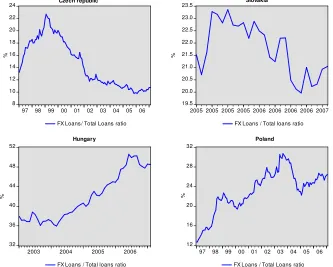
Seeing Fig. 3.1, 3.2 and 3.3, we can immediately see distinct differences between V4 countries and make some conclusions12.
3.1.1. Czech republic
One can see, that in the 10 year period, for which the data are available, FX loans volume followed really nice cyclical path. The amount of FX loans reached a peak in 1999 (almost 9000 mil. EUR) then had been declining quite sharply in two following years to less than 4000 mil. EUR. In period 2002 – 2005 remained relatively still and has begun to rise during 2006 till now. The most of the amount of loans belongs to nonfinancial corporations and the rest is divided between financial corp. and government institutions. The really interesting is, that in comparison with other countries, especially Poland and Hungary, the amount of loans belonging to households was and still is minimal.
The share of FX loans to total loans (domestic and foreign currency) exhibits the cyclical pattern too, is currently lowest from all V4 countries and does not show strong tendencies to grow.
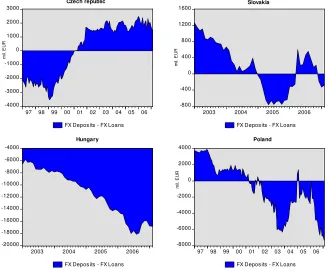
The net position of residents (computed simply as FX deposits net of FX loans) is also favorable. Till year 2001 it was negative, implying, that residents liabilities (loans) were larger than assets (deposits). The positive trend from year 1999 corresponds with declining of FX loans amount happening during the same period. The FX deposits contribute to this only slightly, since they have been growing from 1997 at very moderate pace.
3.1.2. Slovakia
As we can see from Fig. 3.1, from 2002, since the data are available, the FX loans have been experiencing quite significant growth. The structure of loans is very similar to that in Czech republic, that means, that the largest portion of total amount belongs to nonfinancial corporations, and the rest to government and financial corporations. The loans of households seem to have been expanding for last two years, but still it is nothing, compared with Poland and Hungary.
The FX loans / total loans ratio is, unfortunately, available only for period 2005 – 2007, so changes in this indicator seem large and volatile, but, because of short period, this is misleading perception. But we can see, that currently the value of this indicator hovers slightly above 20 %, which is almost two times more than in Czech republic, but much less than in Hungary.
11 Usage of interest differentials could be better, but due to data availability and compatibility
problems, it was not possible to construct them. Therefore, only FX loans’ interest rates are used, serving as some kind of proxy.
12 A warning is in order: Since the time series have different lengths, one has to examine and
The net position of Slovakia’s residents exhibits cyclical pattern, however, it seem, that it tends to be very low, which is good.
3.1.3. Hungary
From glimpse look on the Figures, one may see, that situation in Hungary is completely different from two cases described above.
First, when we look at the loans sector compositions, the development of amount of FX loans provided to households in last 3 year is striking. Compared with Czech republic or Slovakia, the amount of households’ FX loans is simply huge and may put a lot of households in danger in case of unfavorable economic situation (exchange rate depreciation, economic slowdown, etc.), as well as (consequently) banks.
Second, the total amount of FX loans is large, it reaches almost 26 000 mil. EUR.
Third, the share of FX loans to total loans reaches nearly 50 %. And looking at Fig. 3.3, one can see that residents’ net position is negative for whole observed period and tends to increase further.
3.1.4. Poland
Looking at this country’s structure of FX loans, we can see some similarity with Hungary. Here is the share of households’ FX loans even bigger (and recently growing) than in Hungary. The total amount of FX loans slightly exceeds 25 000 mil. EUR.
The ratio of loan dollarization exhibits some sort of cyclical pattern, currently stands at 26 % of total loans. Together with Hungary, these two countries show not only growth of FX loans amount, but also the FX loans / total loans ratio has been (with some swings) growing steady.
The net position figure shows cyclical pattern, however, with downwarding trend. Again, only Hungary and Poland show negative and further downward going development of this indicator.
3.1.5. Summary
Fig. 3.1 Foreign exchange loans structure in V4 countries 2000 3000 4000 5000 6000 7000 8000 9000 10000
97 98 99 00 01 02 03 04 05 06 Nonfinancial corporations
Financial corporations Governm ent Households
Nonprofit institutions serving households
m il. E U R 1200 1600 2000 2400 2800 3200 3600 4000
2002 2003 2004 2005 2006 Nonfinancial corporations Financial corporations Government Households
Nonprofit institutions serving households
m il. E U R 4000 8000 12000 16000 20000 24000 28000 32000
2003 2004 2005 2006 Nonfinancial corporations Financial corporations Governm ent Households
Nonprofit institutions serving households
m il. E U R 0 5000 10000 15000 20000 25000 30000
97 98 99 00 01 02 03 04 05 06 Nonfinancial corporations Financial corporations Government Households
Nonprofit institutions serving households
m
il.
E
U
R
Czech republic Slovakia
Hungary Poland
Source: National central banks, own computations.
Fig. 3.2 Foreign exchange loans to total loans ratio in V4 countries
8 10 12 14 16 18 20 22 24
97 98 99 00 01 02 03 04 05 06
FX Loans/ Total Loans ratio
% 19.5 20.0 20.5 21.0 21.5 22.0 22.5 23.0 23.5
2005 2005 2005 2005 2006 2006 2006 2006 2007
FX Loans / Total loans ratio
% 32 36 40 44 48 52
2003 2004 2005 2006
FX Loans / Total loans ratio
% 12 16 20 24 28 32
97 98 99 00 01 02 03 04 05 06
FX Loans / Total Loans ratio
%
Czech republic Slovakia
Hungary Poland
[image:8.595.116.449.469.736.2]Fig. 3.3 Net position of residents in V4 countries -4000 -3000 -2000 -1000 0 1000 2000 3000
97 98 99 00 01 02 03 04 05 06
FX Deposits - FX Loans
m il. E U R -800 -400 0 400 800 1200 1600
2003 2004 2005 2006
FX Deposits - FX Loans
m il. E U R -20000 -18000 -16000 -14000 -12000 -10000 -8000 -6000 -4000
2003 2004 2005 2006
FX Deposits - FX Loans
m il. E U R -8000 -6000 -4000 -2000 0 2000 4000
97 98 99 00 01 02 03 04 05 06
FX Deposits - FX Loans
m
il.
E
U
R
Czech republic Slovakia
Hungary Poland
Source: National central banks, own computations.
3.2. What factors has influenced the loan dollarization?
In this section, we present results of OLS regression, which were done for each country separately. The functional form (2) is showed in section 2.2., which is:
DLOGFLt = α1t + α2t*DLOGFDt + α3t*DLOGINFt + α4t*DLOGNEERt + α5t*DLOGIRt + εt.
All models were tested for: autocorrelation, heteroskedasticity, ARCH effect and normality distribution of residuals. All presented results in Tab. 3.1 are valid in terms of aforementioned tests, unless it is said otherwise.
Tab. 3. 1 Result of V4 countries regressions1)
Czech republic2) Slovakia Poland Hungary
α1
(constant) (0,940) -0,001 (0,003) 0,031* (0,008) 0,012* (0,001) 0,018* DLOGFD 0,023
(0,850) (0,523) 0,056 (0,603) 0,026 0,115*** (0,052) DLOGINF -0,004
(0,690) (0,184) -0,094 (0,490) -0,016 (0,121) 0,038 DLOGNEER -0,340
(0,160) (0,360) -0,884 -1,256* (0,000) -1,221* (0,001) DLOGIR -0,126**
(0,041) -0,932** (0,020) 0,002 (0,985) -0,516* (0,001)
R2 0,19 0,34 0,49 0,44
Adj. R2 0,11 0,19 0,42 0,32 * - results valid at 1 % level of significance, ** - results valid at 5 % level of significance, *** - results valid at 10 % level of significance.
1) Probability values in parentheses.
2) To account for serial correlation, model was adjusted by implementing AR(1) process of
So, what are the results telling to us? In case of Czech republic, the chosen model is not very good. Explaining power is very weak, as suggest R2 or Adj. R2. From all introduced variables, only FX loans’ interest rate seems to be statistically significant, suggesting that interest rate has played some role in agents’ decision making, whether to take FX or domestic currency loans. Thus, for this country we can conclude, that better model should be developed, either in terms of some other variables or in terms of different functional form, to capture factors, which have influenced the FX loans development.
For Slovakia we can make a very similar conclusion. Putting aside statistically significant constant, only FX loans’ interest rates seem to have influenced the FX loans development. Moreover, again, the Adj. R2 is quite low, suggesting possibly weak explaining power of chosen model.
Model for Poland yields much better results. Explaining power is sufficient, difference between R2 and Adj. R2 is negligible. It seems, that from selected variables, the nominal effective exchange rate (NEER) has played crucial role in determining FX loans development.
Also for Hungary the model seems to be fitted quite well. In case of this country, foreign deposits (FD), NEER and interest rate were important in influencing FX loans. NEER and interest rate are both highly statistically significant (at 1% level), FD is significant at 10 % level, which is still acceptable. Also, the explaining power of model seems to be good enough.
Conclusion
De facto dollarization is phenomenon, which is really widespread. One of its form, financial, may pose a threat to emerging or developing economies through excessive providing foreign exchange loans to residents, especially households. In case of some economical problems, lot of them may become unable to service their debts, since their income is mostly denominated in domestic currency, but their liabilities (loans) are not. Problems of debtors may consequently cause problems to creditors (banks) and endanger the stability of banking sector.
In this paper, we have chosen to examine the structure and development of foreign exchange loans in V4 countries. Also, we tried to find out, which of arbitrarily selected factors have contributed to foreign exchange loans development by conducting simple OLS regression for each country.
We found out, that Poland and especially Hungary may be endangered in future, because not only the loan dollarization level is quite high and rising, but currently, roughly almost half of all foreign currency loans is provided to households in case of Hungary. Also the share of foreign currency loans to total loans is especially in Hungary very high and from the long-term point of view still rising. On the other hand, the situation in Czech republic and Slovakia is quite favorable. The share of foreign exchange loans to total loans is low and shows no signs of sharp rising. The structure is also good, since most of these loans are divided between nonfinancial, financial corporations and government, who should not be endangered in case of some economical problems as easily as households.
Poland and Hungary the results were much better. The model seems to be reasonably good for capturing effect of chosen variables, especially in case of Hungary. While in Poland the significant effect may be assigned to nominal exchange rate (NEER), in Hungary played significant role NEER, foreign exchange loans’ interest rates and foreign deposits.
The challenges for future research seem clear. Developing another, more suitable model for Czech republic, introducing some other variables with more explaining power and increasing the number of examined countries. It would be interesting to extend research scope for all new member EU countries, which are not members of Eurozone. However, the data accessibility and compatibility may be a problem.
LITERATURE
1. BECKERMAN, P. Dollarization and Semi-dollarization in Ecuador [online]. WB
Working Paper, 2001.URL:
<http://wwwwds.worldbank.org/servlet/WDSContentServer/WDSP/IB/2001/08/ 29/000094946_01080904131558/Rendered/PDF/multi0page.pdf>
2. BEDNAŘÍK, R. Full Dollarization Issues: A Review. ECON’ 06 (selected
research papers). 2006, s. 23 – 31.
3. BERG, A.; BORENZSTEIN, E. The Pros and Cons of Full Dollarization
[online]. IMF Working Paper. 2000. URL:
<http://www.imf.org/external/pubs/ft/wp/2000/wp0050.pdf>.
4. GULDE ET AL. Financial Stability in dollarized economies. IMF Occasional
paper, 2004.
5. IZE, A.; LEVY YEYATI, E. Dollarization of Financial Intermediation: Causes
and Policy Implications [online]. IMF Working Paper. 1998. URL:
http://www.imf.org/external/pubs/ft/wp/ wp9828.pdf.
6. IZE, A.; LEVY YEYATI, E. Financial De – Dollarization: Is It for Real? [online].
IMF Working Paper. 2005. URL:
<http://www.imf.org/external/pubs/ft/wp/2005/wp05187.pdf>.
7. JACOME, H., L. I. The Late 1990s Financial Crisis in Ecuador: Institutional
Weaknesses, Fiscal Rigidities, and Financial Dollarization at Work [online].
IMF Working Paper, 2004. URL:
< http://www.imf.org/external/pubs/ft/wp /2004/wp0412.pdf>.
8. JÍLEK, J. Peníze a měnová politika. 1st edition. Prague: Grada Publishing,
2004. ISBN 80-247-0769-1.
9. LEIDERMAN, L.; MAINO, R.; PARRADO, E. Inflation Targeting in Dollarized
Economies [online]. IMF Working Paper. 2006. URL:
< http://www.imf.org/external/pubs/ft/wp/2006/wp06157.pdf>.
10. STURZENEGGER, F.; LEVY YEYATI, E. Dollarization: Debates and policy
alternatives. 1th edition. Cambridge: Massachusetts Institute of Technology,
2003. ISBN 0-262-12250-2.
CONCTACT
Ing. Radek Bednařík
Katedra národohospodářská, EkF, VŠB–TU Ostrava