EDB Eurasian Integration Yearbook 2009
Vinokurov, Evgeny
Eurasian Development Bank
July 2009
Online at
https://mpra.ub.uni-muenchen.de/20917/
Eurasian Integration Yearbook 2009. – Almaty, 2009. – p. 324 ISBN 978-601-7151-01-0
An annual publication of the Eurasian Development Bank
Edited by Evgeny Vinokurov
The Eurasian Development Bank is an international financial institution established to promote economic growth and integration processes in Eurasia. The Bank was founded by the intergovernmental agreement signed in January 2006 by the Russian Federation and the Republic of Kazakhstan. In December 2008, The Council of the Eurasian Development Bank approved the entrance of Armenia, Belarus and Tajikistan to the Bank. In April 2009 Armenia has completed all the admission procedures and became the third full member of the Bank. The Agreement on Establishing the Eurasian Development Bank has come into force for Belarus and Tajikistan. Both countries are in the process of finalising the required admission procedures. The Kyrgyz Republic is in the process of obtaining the inter-ministerial clearance on issues related to joining the EDB.
Electric power, water and energy, transportation infrastructure and high-tech and innovative industries are the key areas for Bank’s financing activity.
As part of its mission the Bank carries out extensive research and analysis of contemporary development issues and trends in the region, with particular focus on Eurasian integration. The Bank also hosts regular conferences and round tables addressing various aspects of integration. In 2008, the Bank launched an annual EDB Eurasian Integration Yearbook (in English) and quarterly Journal of Eurasian Economic Integration (in Russian). Both publications are available online at www.eabr.org. The Bank’s Strategy and Research Department publishes detailed Industry and Country Analytical Reports and plans to undertake a number of research projects. Developing the EDB System of Indicators of Eurasian Integration Index is the first project in the pipeline.
ISBN 978-601-7151-01-0 ББК 65.9(2)8
© Eurasian Development Bank, 2008
Address:
Republic of Kazakhstan,
Panfilov St. 98, Almaty, 050000, Eurasian Development Bank Tel.: +7 (727) 244 40 44, ext. 6146 Fax: +7 (327) 244 65 70, 291 42 63 E-mail: [email protected]
http://www.eabr.org
The EDB’s special acknowledgements go to Intera translation company, and to Stanislav Myong, Hannah Dyson and Jonathan Elliot for translating and editing materials for the Yearbook in English. The EDB also thanks Ruan publishing company.
Edited by Evgeny Vinokurov, EDB
Advisory Council: Sailau Baizakov,
Insitute for Economic Research, Astana
Michael Emerson,
Centre for European Policy Studies, Brussels
Valery Geets,
Institute for Economic Forecasting, Kyiv
Ruslan Grinberg,
Insitute of Economy RAS, Moscow
Ivan Korolev,
Institute for World Economy and International Relations RAS, Moscow
Luk Van Langenhove,
United Nations University, Bruges
Johannes Linn,
Brookings Institute, Washington
Liu Huaqin,
Chinese Academy of International Trade and Economic Cooperation, Beijing
Katlijn Malfliet,
Catholic University of Leuven
Ivan Samson,
University of Grenoble II
Leonid Vardomskiy,
Institute of Economy RAS, Moscow
Vladimir Yasinskiy,
List of Figures and Tables 6
Notes on the Contributors 9
List of Abbreviations 14
Greetings
Igor Finogenov, Chairman of the Eurasian Development Bank 16 Vladimir Yasinskiy, Head of Strategy and Research,
Eurasian Development Bank 18
1. Introduction 19
EvgEny vinokurov
2. Chronicle of Eurasian Regional Integration 2008 26 natalia MaqsiMchook
Institutions of Integration and Economic Space
3. Integrating Regional Space: New Opportunities
for Economic Growth 65
alExandEr libMan, lEon ZEvin
4. The Experience with Regional Economic Cooperation
Organisations: Lessons for Central Asia 84
JohannEs linn, oksana Pidufala
5. Regionalisation in Central Asia 95
alExandEr libMan
Expanding Mutual Trade, Investment, and Finance
6. Regional Trade and Trade Integration in the CIS 115 irina gurova
7. Russian Direct Investments in EurAsEC and Their Role
in Energy and Transport Infrastructure Development in Eurasia 127 boris hEifEtZ
9. Mutual Investments in the СIS Banking Sector 151 EvgEny vinokurov
10. The Eurasian Development Bank’s Investment Policy
and the Environment 157
vladiMir yasinskiy, alExandEr MironEnkov
11. International and Regional Development Banks in Northern
and Central Eurasia: Overview of Activities in 2008 173 Zhanar sagiMbayEva
Integrating Eurasian Transport Systems
12. The EurAsEC Transport Corridors.
EDB Industry Report 186
EvgEny vinokurov, Murat JadraliyEv, yuriy shchErbanin
13. EurAsEC: Transport Exchange and Positional Constituents 241 yuriy shchErbanin
14. Transport – Energy Water System of Eurasia
and Its Top Priority Projects 249
lEonid koZlov, alExEy bElyakov
15. Transcontinental Shipping Route Europe – Central Asia 269 lEonid koZlov, vitaly ZbaraschEnko
16. Megalogistic Intermodal Transport Technological System
Germany – Russia – Central Asia – Afghanistan – China 276 vitaly ZbaraschEnko
Monitoring and Measuring Regional Integration
17. Indicator-based Monitoring of the Eurasian Integration
Process: Preliminary Remarks 283
PhiliPPE dE loMbaErdE
18. Visa-free Travel: an Indicator of Global Integration 290 brEndan r. WhytE
Information for authors 310
List of Figures and Tables
Boxes
Box 10. 1. 161
Box 10. 2. 163
Box 12. 1. Main commodity groups that can be transported
by Eurasian routes (China–West Europe) 197
Box 12. 2. The XUAR and transit to Western Europe 198
Box 12. 3. The TRACECA Programme 209
Box 12. . Outlook for the development of container traffic 210 Box 12. . Sea and rail container freight tariffs in Eurasia
(ATC AIR Service data) 217
Figures
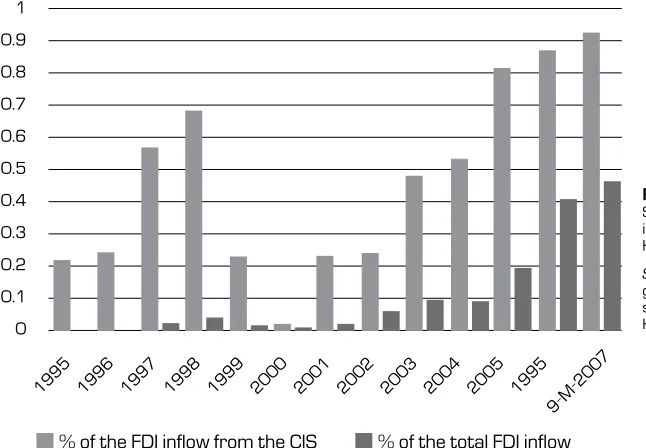
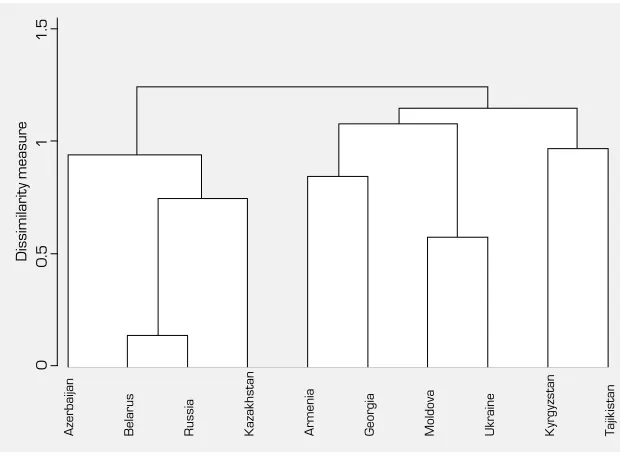
Figure . 1. Share of Kazakhstan in the FDI inflow to Kyrgyzstan 99 Figure . 2. Clusters of intraregional trade in the CIS, 200 103
Figure . 1. The CIS’ GDP in 1991-2009 116
Figure . 2. Openness of CIS economies in 199 and 200 119 Figure . 3. Trade between CIS countries in 2007 119 Figure . . CIS export market concentration in 199-200 120 Figure . . CIS export product concentration in 199-200 122 Figure . . World and CIS trade product structure in 200 123
Figure . 7. CIS trade balance in 199-200 124
Figure 12. 1. Potential cargo flows between EurAsEC countries 190 Figure 12. 2. Exports to the EU from China, South Korea and India 191 Figure 12. 3. Structure of Chinese exports to Europe, 2007 192 Figure 12. . Transshipment of containers at Dostyk 196 Figure 12. . Existing and potential cargo flows via EurAsEC 200
Figure 12. . Pan-European corridors 202
Figure 12. 7. Journey times of Trans-Siberian Railway services 206
Figure 12. 8. TRACECA 208
Figure 12. 9. Main railways in Eurasia 212
Figure 12. 10. Motorway corridors and communications
research institute (NII TK) 215
Figure 12. 11. Railway freight transportation and the freight
Figure 1. 2. The Fundamental Scheme of Eurasia and Russia
TEWS Principal Mains 256
Figure 1. 3. The Integrated Deep Water System of ETR,
the Oka and the Main Lines of its Connection with the Dnepr 262
Figure 1. . Volga-Severodvinsk waterway 263
Figure 1. . Kama-Pechorsk-Vychegodsk junction
and River Vychegda 264
Figure 1. . Transuralsk waterway 265
Figure 1. 7. The Upper Ob Basin Rivers Proposed
for Transport-Energy Reconstruction 266
Figure 1. 1. The Scheme of Transcontinental Shipping Route
Europe – Central Asia 270
Figure 1. 2. Options of water-ways transport connection
of Caspian and Azov Seas 271
Figure 1. 3. The Scheme of Perspective Port “Kuban”
and Azov-Black Sea Canal 274
Figure 1. . The Scheme of Transport-Technological System
for Transportation of Rolling and Container Modules 275 Figure 1. 1. The Chart of the railway-ferry transport complex
Germany–Russia–Central Asia–Afghanistan-China 278 Figure 18. 1. Frequency plot and percentage cumulative frequency
of travel freedom values by country 298
Figure 18. 2. Distribution of visa-free permutations vs. travel freedom
value 299
Figure 18. 3. Travel Freedom by country (equal class ranges) 300 Figure 18. . Travel Freedom by country (equal class sizes) 301 Figure 18. . Population (absolute, and cumulative percentage)
vs. travel freedom value 305
Figure 18. . Summed “National travel freedom”
(absolute, and cumulative percentage) vs. travel freedom value 306
Tables
Table 1. 1. Trade turnover between EurAsEC member states 20 Table 1. 2. Cumulative mutual investments of Russia and the EurAsEC
states, at the beginning of the year 21
Table 2. 1. Main macroeconomic Indicators 27
Table 2. 2. Economic growth in CIS 28
Table 2. 3. Unemployment 28
Table 3. 2. The efficiency of various integration models
in post-Soviet countries 76
Table 3. 3. Change in GDP growth of country A after integration
with country B 78
Table . 1. Key Dimensions of Regional Organisations Involving Central
Asian Countries 86
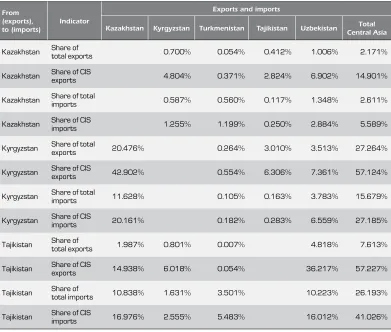
Table . 2. Key Dimensions of Regional Organisations in Other Regions 86 Table . 1. Structure of interregional and intraregional trade
in Central Asia, 200 102
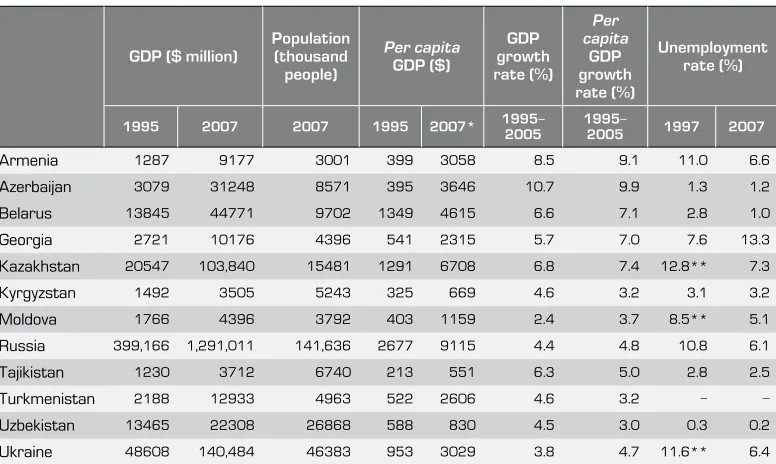
Table . 1. Macroeconomic indicators of CIS countries 117 Table . 2. Trade integration of regional blocs in 200 121 Table 7. 1. Cumulative mutual investments by Russia
and EurAsEC countries, as at the end of the year 129 Table 7. 2. Direct Russian investments in the energy sector
and infrastructure in EurAsEC countries 141
Table 8. 1. Stock market capitalisation in EurAsEC countries,
1999-2007 142
Table 8. 2. Stock exchange trade in EurAsEC countries in 2007 143 Table 8. 3. Increase in trade on the stock markets
of EurAsEC countries 143
Table 9. 1. Banking sector indicators in the CIS member states
as of 1 January 2009 151
Table 11. 1. Eurasian countries’ IFI membership 177 Table 11. 2. World Bank Group Commitments in Europe
and Central Asia Fiscal Years 2008 and 2007 (year ends June 30) 180
Table 11. 3. Approved IFIs Funding in 2008 185
Table 12. 1. Trade turnover between EurAsEC member ountries 189 Table 12. 2. China’s trade with Europe and the CIS in 2007 192 Table 12. 3. South Korea’s commodity trade with Europe
and the CIS in 2007 193
Table 12. . Aggregate transit potential
of EurAsEC member countries 216
Table 12. . Physical and non-physical barriers to trade 220 Table 12. . Forecast of cargo transit via Russia 226 Table 12. 7. Participation of EurAsEC countries in transport
infrastructure projects until 2020 238
Table 1.1. Transport characteristics of the railway-ferry transport complex Germany – Russia – Central Asia – Afghanistan – China 279 Table 1. 2. Transport characteristics of the railway-ferry transport complex Germany – Russia – Central Asia – Afghanistan – China 282 Table 18. 1. Countries of the world, ranked by Travel Freedom 291
Table 18. 2. Data Summary 297
Alexey Belyakov – Candidate of Science (1984), Doctor of Geography (2000). Chief Expert of Modern Communications Expertise Centre LLC. The author of more than 100 scientific papers. In 1970-80s he was engaged in mathematic modelling of the stressed-deformed state of the largest ground dams (Nurek and Rogun dams on the Vakhsh River and others). He also took part in Turuhansk hydro-electric power station project development on the Lower Tunguska River. Since 1990, he had been developing concepts of Russia’s surface water resources integrated regulation. Between 1999 and 2008, he was the professor of Moscow State Academy of Water Transport. E-mail: [email protected]
Mikhail Golovnin – Candidate of Economic Science, Deputy head of the Centre for Problems of Globalisation and Integration of the Institute of Economy, Russian Academy of Sciences. In 2000 he graduated Master School of Economic Faculty of Moscow State University (economic and social policy). In 2003 he received candidate of science degree for his thesis “Monetary Sphere in Transition Economies (Comparing the Experience of Russia and Central and Eastern European Countries)”. He is the author of more than 50 publications, including papers in the leading Russian economic journals (Voprosy Ekonomiki, Mirovaya Ekonomika i Mezhdunarodnye Otnosheniya, Problemy Prognozirovaniya, Obshestvo i Ekonomika etc.) Scope of research interests comprises monetary and financial integration, monetary policy, financial globalisation. E-mail: [email protected]
Modernisation and Development Foundation “Society” (2007), the German Service of Academic Exchanges (2003), the Ministry of Education of Russian Federation (2000), and Moscow Public Scientific Foundation (1998). E-mail: [email protected]
Murat Jadraliyev – MPIA Global Political Economy, University of Pittsburgh. Senior Analyst at the EDB Strategy and Research Department, Economic Analysis Unit. Prior to joining Eurasian Development Bank, he worked for the National Analytical Centre of the Government and the National Bank of the Republic of Kazakhstan. E-mail: [email protected]
Boris Heifetz – Doctor of Economic Science, Senior Research Fellow, Institute of Economics of the Russian Academy of Sciences. Russian external debt expert. Boris Heifetz has worked at the Institute of International Economic and Political Studies of the Russian Academy of Sciences since 1971. At present, he is the Chief Researcher at the Centre of Comparative Studies of Transformation Processes. He has over 220 publications, including ten monographs and five brochures published in Russia and other countries (the United States, Finland, the Czech Republic, Hungary, Mongolia, Vietnam and Bulgaria). He works on a wide range of scientific problems related to financial globalisation and the specific features of particular countries’ participation in this process, regional corporate integration, and the interaction of international and internal capital markets, and the development of Russian transnational corporations. E-mail: [email protected]
Leonid Kozlov – Doctor of Transport (2002) and a full member of Russian and International transport academies (2002). Director General of Modern Communications Expertise Centre LLC. A participant of the hydrotechnic, hydrotechnical melioration and road-transport projects, as well as repair and reconstructive works on automobile roads and take-off strips of the former Soviet Union cities’ airfields and cosmodrom Baikonur. He is the author of several scientific works and inventions in the area of construction and transport. Since 2003 he has presided over the Committee for Transport and Transit of International Manufacturers and Entrepreneurs Congress. Since 2008 he is a vice-president of International Manufacturers and Entrepreneurs Congress. E-mail: [email protected]
Prikladnaya ekonometrika, Mirovaya ekonomika i mezhdunarodnyie otnosheniya, Obschestvo i ekonomika, Rossiyskiy zhurnal menedzhmenta, Svobodnaya mysl’, etc. E-mail: [email protected]
Johannes F. Linn – Senior Fellow and Executive Director at Wolfensohn Centre for Development, Brookings Institution, Washington, DC, USA. He was trained as an economist at Oxford University, England (BA, 1968) and Cornell University, USA (PhD, 1972). He joined the World Bank in 1973. From 1996 to 2003, he was the Bank’s Vice President for Europe and Central Asia. Since September 2003 he is at the Brookings Institution, where he is currently Executive Director of the Wolfensohn Centre, a new centre dedicated to research on key development challenges. he served as lead author for the UNDP Central Asia Human Development Report published in December 2005. Since 2007, he currently serves as Special Adviser to the Central Asia Regional Economic Cooperation Programme (CAREC). He has published extensively on development and global governance issues. E-mail: [email protected]
Philippe De Lombaerde – Ph.D., Associate Director at the United Nations University – Comparative Regional Integration Studies (UNU-CRIS) in Bruges, and Visiting Lecturer at ZEI-University of Bonn. Previously he was Associate Professor of International Economics at the National University of Colombia and Lecturer at the University of Antwerp. He has recently edited Aid for Trade. Global and Regional Perspectives. Second World Report on Regional Integration (with Lakshmi Puri, Springer), and Governing Regional Integration for Development (with Antoni Estevadeordal and Kati Suominen, Ashgate). E-mail: [email protected]
Natalia Maqsimchook – MSc Business Studies; Senior Analyst at Economic Analysis Unit of the EDB Strategy and Research Department. More than ten years of experience in the UN system organisations. She has contributed to various publications on the issues of good governance, regional development, and external aid coordination. E-mail: [email protected]
Alexander P. Mironenkov – PhD, Head of Technical Assistance Unit at the Eurasian Development Bank, author of a great number of publications on water and energy system development and creation of sustainable environment issues in Central Asian region and Eurasian Economic Community. E-mail: [email protected]
Brookings, Ms. Pidufala was engaged in research work on issues of Central and Eastern European transition, regional economic cooperation in Central Asia, and early child development. Ms. Pidufala studied international relations and economics at the I. Franko National University in Lviv, Ukraine (BA, MA) and at Syracuse University, USA (MA).
Zhanar Sagimbayeva – Senior Analyst at the EDB Strategic Planning Unit. She graduated from Kazakh State University and Oklahoma State University. She has more than 10 years of experience in development area at UNDP and government organisations in Kazakhstan. During 10 years she led the production of the Kazakhstan’s Human Development Report and other UN analytical publications presenting social, economic, political developments in the country. As the head of UNDP Environment and Sustainable Development Unit, she had to deal with various environment projects including their design, implementation and evaluation. During 2006-2007s she was Coordinator of UNDP programmes in the areas of energy and environment, governance and poverty reduction. E-mail: [email protected]
Yuriy Shcherbanin – Doctor of Economic Science, professor (1997), Head of Laboratory at the Institute of Economic Forecasting of the Russian Academy of Sciences. He graduated from the Diplomatic Academy of the Ministry of Foreign Affairs of the Russian Federation (1997), the Diplomatic Academy of the Ministry of Foreign Affairs of the Russian Federation (1987), and the Bucharest Institute of Oil, Gas and Geology (Romania) in petrochemical engineering (1975). Lecturer at Moscow State Institute for International Relations, the Academy of National Economy under the Government of the Russian Federation, Moscow School of Economy of the Moscow State University, Higher School of Economy (since 2004), head of the department at Astrakhan State University (since 2008), Vice-President of the Eurasian Transport Union (EATU), Director for scientific projects of the EATU CentreConsult (since 2000). From 2000 to 2008 he was a Professor at the Diplomatic Academy of the Ministry of Foreign Affairs of the Russian Federation. From 1998 to 2000 – Head of Department for International Cooperation at the Ministry of Transport of Russian Federation. From 1977 to 1998 – the Ministry of Foreign Affairs of the USSR/Russian Federation, various assignments in the central office and abroad. E-mail: shcherbanin@ ecfor.ru
available at www.eabr.org/eng/publications/ and www.vinokurov.info. E-mail: [email protected]
Brendan Whyte – Ph.D., a political geographer and cartographer with specialisation in boundaries, transportation and military geographies. He has published studies of the 200 enclaves along the India-Bangladesh border and the 30 enclaves in the Dutch-Belgian village of Baarle-Hertog/Baarle-Nassau. He has worked in Australia and Israel and is now a private researcher in Thailand. His recent publications include a translation and analysis of the inscriptions on the First World War Volunteers Memorial in Bangkok, and an analysis of the use of cartographic symbols on flags. He is currently compiling a railway atlas of Thailand.
Vladimir Yasinskiy – Head of Strategy and Research Department, Member of the Board at the Eurasian Development Bank. He was trained as economist at the Economic Faculty of Moscow State University and at the Institute for Economy of the Russian Academy of Sciences (post-graduate studies). His professional record includes teaching at the People’s Friendship University in Moscow and multiple assignments in Nepal, China and India in the capacity of deputy Trade representative as well as deputy representative of Gazprom in China. He is with the Eurasian Development Bank since 2006. E-mail: [email protected]
Vitaly Zbaraschenko – Vice-Chairman of the Transport and Transit Committee of the International Congress of Industrialists and Entrepreneurs, Chief Expert of Modern Communications Expertise Centre LLC. From 1967 till 1988 he held executive positions in the USSR Ministry of Navy. From 1988 to 1993 he was Director General of the Soviet-German shipping company Transnautic, and from 1993 to 2003 he was Director General of Azov Shipping. Email: [email protected]
ACDE – Association of Central Depositories of Eurasia ASEAN – Association of South east Asian Nations BSEC – Black Sea Economic Cooperation
CAF – Andean Development Corporation
CAREC – Central Asia Regional Economic Cooperation Programme CES – Common Economic Space
CIS – Commonwealth of Independent States
CIS IASE – International Association of Stock Exchanges of the CIS CJSC – closed joint-stock company
CMEA – Council for Mutual Economic Assistance CNPC – China National Petroleum Corporation CST(O)- Collective Security Treaty (Organisation)
EBRD – European Bank for Reconstruction and Development EC – European Community
ECO – Economic Cooperation Organisation EDB – Eurasian Development Bank ETS – Eurasian Trade System EU – European Union
EurAsEC – Eurasian Economic Community FDI – foreign direct investment
FSU – former Soviet Union states FTA – free trade agreement G-20 – Group of Twenty GDP – gross domestic product
GLONASS – Global Navigation Satellite System HPP – hydropower plant
IATA – International Travel Association
IBRD – International Bank for Reconstruction and Development IDB – Islamic Development Bank
IDWS – integrated deep-water systems IFC – International Finance Corporation IFI – International financial institutions
IIRSA – Integration of Regional Infrastructure in South America IMF – International Monetary Fund
IPA – Inter-Parliamentary Assembly of the CIS ITS – Integrated Transport System
JSC – joint stock company
MEDT – Ministry for Economic Development and Trade MERCOSUR – Common Market of the South
MFA – Ministry of Foreign Affairs MFN – most favored nation
MICEX – Moscow Inter-bank Currency Exchange MIGA – Multilateral Investment Guarantee Agency MRC – Mekong River Commission
NAFTA – North American Free Trade Agreement NGO – non-governmental organisation
NIS – Newly Independent States
OECD – Organisation for Economic Cooperation and Development OSCE – Organisation for Security and Cooperation in Europe PPP – purchasing power parity
PSA – product sharing agreement RF – Russian Federation
Ro-Ro – Rolling method
RTA – Regional trade agreements RtW – Round the World
SCO – Shanghai Cooperation Organisation
SCO RATS – Shanghai Cooperation Organisation Regional Antiterrorism Structure
SDRs – Special Drawing Rights
SPECA – Special Programme for the Economies of Central Asia
TACIS – Technical Assistance to the Commonwealth of Independent States TEWS – Transport-Energy Water Systems
TIM – Travel Information Manual
TRACECA – Transport Corridor Europe Caucasus Asia TTS – Transport Technological Systems
UAH – hrivnia – national currency of Ukraine UN – United Nations
UN ESCAP – United Nations Economic and Social Commission for Asia and the Pacific
UNECE – United Nations Economic Commission for Europe WB – World Bank
I am pleased to have the opportunity to once again welcome the readers of the Eurasian Integration Yearbook.
Since we released our first Yearbook in autumn 2008, several events that impacted on virtually every aspect of the Bank’s operation have taken place. The Bank’s membership has grown in number, and with the addition of Armenia, Belarus and Tajikistan, the Bank has become a truly multilateral financial institution. New investment projects in Russia and Kazakhstan began, and a new Anti-Crisis Fund was established by the EurAsEC member states. All these developments, aside from expanding our horizons, call for the Bank to employ the capacity and resources that it was endowed with to the maximum effect. The status of an international development bank requires that we are well equipped and flexible to respond to the challenges of the present.
Supporting economic integration among the member states remains at the core of our mission. In particular, we prioritise projects that advance mutual trade and investments. The Bank actively seeks to identify and support business projects, which could contribute to regional economic cooperation. At present, the Bank intends to focus on electric power sector, transport infrastructure, machine-building and innovative high-tech projects. We very much look forward to seeing business empowered and taking a more proactive role in shaping economic ties between the region’s countries demanding the ideal policy environment, and engaging in partnerships with governments in the implementation of large-scale infrastructure development projects. A number of our projects lead to the creation of joint ventures and other types of corporate integration.
The effects of the global financial crisis hit the economies of the EDB member states and inevitably impacted the state of their economic cooperation. The volumes of mutual trade and investments contracted. The shortage of liquidity forced many potential borrowers to postpone new investments and projects. The crisis elevates the role and capacities of national and international development banks. And it is the development banks that are not only capable of spurring large-scale infrastructure development projects on, but also facilitating the mobilisation of additional resources in order to overcome the crisis period.
development in the region. This knowledge and understanding ensures that the Bank makes informed investment decisions.
The objective of the EDB Eurasian Integration Yearbook is to present to the international community substantive research on economic and political integration in the post-Soviet space. We welcome this opportunity to share our knowledge of Eurasian integration with the readers of the Bank’s publications and hope that our audience will grow while our list of analytical products expands.
With best wishes,
Dear readers,
I have the pleasure of welcoming you to the second issue of the Eurasian Integration Yearbook. At the EDB Strategy and Research Department, we closely monitor regional integration processes and collect data on countries and sectors, strategic issues, and economic development and cooperation. We use this information internally for project analysis and evaluation, as well as for EDB publications, including industry reports, the quarterly Journal of Eurasian Economic Integration, monthly integration digests and this Yearbook. Thousands of people subscribe to our publications.
The year 2008 was rich in events that inspired discussions, research and analytical reviews. As far as integration issues are concerned, I draw your attention to the adoption of the CIS Economic Development Strategy for the period up to 2020; the positive developments in the formation of the EurAsEC Customs Union; Georgia and Uzbekistan declaring withdrawal from CIS and EurAsEC respectively; the establishment of the EurAsEC Anti-Crisis Fund; and gas transit disputes. The net sum of positive developments and challenges does not offer a single opinion on whether integration processes in the past period were advancing or rescinding.
Nevertheless, some achievements are unquestionable. The political will of the heads of EurAsEC states advances the formation of the Customs Union. Taking bottom-up view, we observe cross-border exchange between small businesses as well as investments and acquisitions by large companies in neighbouring countries. Business is performing as an economic agent of integration that facilitates effective interaction between the countries. Our primary mission is to identify and support business projects that bring about sizeable integration effects. Networking with expert community, as well as research and analytical work, form the core of our knowledge and operations both in the member states and selected sectors. We constantly seek to better tune our services to the needs of our shareholders and clients. In October 2008, the Bank became an observer in EurAsEC. The engagement of the Bank’s representatives in expert discussions on various aspects of regional cooperation will enable the stronger coordination of activities with EurAsEC, as well as launching joint regional initiatives for the benefit of member states.
We believe that the Eurasian Development Bank is well positioned to facilitate more active economic interaction in the region through identifying and financing projects with integration potential. We also constantly seek to expand our range of analytical products in pursuit of our strategic objective of becoming a leading centre and repository of knowledge on integration processes in the CIS space.
vladiMir yasinskiy
The Crisis-Related Threats to Integration
The on-going crisis has triggered qualitative changes in the global political and economic architecture. Separate elements of global economic and financial reforms are already visible. In particular, the process of G20 institutionali-sation, which reflects the growing weight of developing economies, has finally begun. Following a slowdown of operations over the last decade, the role of IMF has increased rapidly, as the institution finds itself at the forefront of helping many national economies survive. The idea of the world reserve currency is actively discussed and IMF’s SDRs are the most commonly mentioned option. Furthermore, for better or worse, a global financial regulator is likely to be established.
There is less substance on the level of post-Soviet regional integration. The EurAsEC Anti-Crisis Fund, designed to help less developed countries of the region stabilise their economies and launch important transborder integration projects, stands out. Also, Russia’s massive financial aid to its neighbours, in particular Belarus, Kyrgyzstan, and Armenia, is worth mentioning. At the same time, the wave of protectionism is gaining ground as countries resort to any means available to counteract their shrinking GDP. Unfortunately, there is high probability that the crisis will not push the countries of the region toward qualitatively new parameters of comprehensive economic cooperation and a more efficient mode of the realisation of the vast integration potential.
In general, a global economic crisis is unlikely to affect integration in a critically damaging way. However, the introduction of protective measures in support of domestic producers by a number of countries sends a troubling message. The consequences are dire. On balance, the crisis bears in itself more threats than opportunities for the consequential development of regional economic integration. For the post-Soviet countries, which are not even bound by the WTO rules, protectionist policies are all too tempting. However, the immediate gains conflict with the requirements of optimal foreign trade policy. Recent years witnessed very promising developments along the ‘bottom-up’ approach to integration based on market economy principles – namely the rapid growth of mutual trade and investments, corporate expansion across the border, the nascent Eurasian transnationals, the technological alignment
Introduction
EvgEny
vinokurov
in crucial sectors, and the large-scale transborder infrastructure projects. Will short-sighted policies damage the first healthy sprouts of Eurasian economic integration?
The Growing Base of Economic Integration
Mutual trade, mutual investments, and corporate expansion are building a firm foundation of regional economic integration.
Volumes of mutual trade have risen continuously over the last years. For instance, trade turnover between Kazakhstan and Russia grew by 30% per year and reached $19.7 billion in 2008, increasing twofold from $9.7 billion in 2005. The bilateral trade turnover of other countries (most significantly, that of Belarus and Russia) increased at a comparable rate. All EurAsEC bilateral trades, large and small economies alike, demonstrated mutual growth of between 50% and 200% over the last three years. Table 1.1. shows trade flows between EurAsEC member states, which are marked by relatively high levels of economic interaction.
Trade turnover
between countries 2005 2006 2007 2008
Russia-Belarus 183.0 199.0 207.0 3188.9
Russia-Kazakhstan 979.0 12807.0 17.0 19731.7
Russia-Kyrgyzstan .0 7.0 1 19.0 1 802.9
Russia-Tajikistan 33.0 0.0 772.0 1002.8
Kazakhstan-Belarus 23. 3.3 2.3 7.0
Kazakhstan-Kyrgyzstan 3.1 0.7 17.0 08.
Kazakhstan-Tajikistan 17. 18.1 198.9 29.
Belarus-Kyrgyzstan 10.8 21. 2.8 7.8
Belarus-Tajikistan 12.0 18.0 3.0 7.1
Kyrgyzstan-Tajikistan 2.9 2.7 30. 3.2
Total trade: 27255.8 35023.3 45922 58362.5
Тable 1.1. Trade turnover between EurAsEC member states ($ million)
Source: CIS
Statistics Committee
The pace of trade growth looks slow compared with that of mutual investments that have boomed over the last few years (naturally, from a low starting point). Practically all of the major economic sectors were affected, including hydrocarbons, metallurgy, machine building, agriculture, transport, telecommunications, development, and electric power generation and distribution1. It is remarkable that the investment growth is reflected not only in sheer volume but also in the quality of mutual investments. We witnessed the first massive long-term investments into capital-intensive projects, the first portfolio investments (previously virtually unknown in the post-Soviet area), and the formation of the first Eurasian transnationals.
Russian investments in EurAsEC countries
EurAsEC countries’ investment in Russia
2000 2008 2000 2008
Total Total
Direct and portfolio investments
Total Total Direct and portfolio
Belarus 90.2 771.2 1.9 2. 103. 32.7
Kazakhstan 2.2 99.7 30.2 .7 89.8 228.0
Kyrgyzstan 0.0 20. 0.1 0.1 70. .2
Tajikistan 0.0 1.7 1.2 0.0 2.9 0.0
Uzbekistan 0. 333.9 20.7 3. 7.0 .2
Total EurAsEC: 92.8 1287.1 9.1 11. 1101.7 271.1
Total CIS: 555.6 2521.4 1921.3 19.3 1502.6 562.8
Тable 1.2. Cumulative mutual investments of Russia and the EurAsEC states, at the beginning of the year ($ million)*
Note: * excluding investments within the banking sector
Source: Federal
State Statistics Service of Russia
The total volume of cumulative Russian investments in other four EurAsEC countries grew by 160% over the seven years from 2000. This figure is even more impressive for the CIS – 350% (excluding banks). On the other hand, EurAsEC countries’ investment in Russia increased 100 times during the same time period, from a negligible size to a magnitude comparable with Russian investment in the EurAsEC. This fact clearly demonstrates both the growing size of the post-Soviet economies and their growing awareness of the vast advantages provided by the neighbouring large market for their goods, services, and expertise.
1 For example, MTS and Vympelcom represent brilliant cases of brand new corporate
The situation changed quite abruptly in the second half of 2008. The global economic crisis forced post-Soviet states to focus on their domestic markets, as most active market players were compelled to concentrate all available resources in their home markets in order to survive. Mutual investments virtually came to a halt. Large foreign investments suddenly became impossible without the direct participation of the states (such as the planned Russian-Kyrgyz joint venture, which was established to build Kambarata-1 HPP).
Although the absolute volumes are still relatively low compared with the absolute size of the regional economies and their economic potential, we have witnessed an unprecedented surge in mutual trade and investment. In fact, what we saw amounts to the restoration of cooperative ties between the post-Soviet ‘Eurasian’ economies, based on the new market foundations. The goal for policy makers is clear: prevent the economic crisis and related protectionist policies from reversing this very positive trend.
The Concept of the EDB Eurasian Integration Yearbook
This is the second EDB Eurasian Integration Yearbook. The first one, published in 2008, is also available online and free of charge.2 The Yearbook is there to improve access for the global community to the best articles published in Russian and to provide a comprehensive and coherent view of regional integration in the ‘Eurasian’ area. It publishes a wide range of articles and other materials on the theory and practical aspects of Eurasian integration. The major part of the almanac consists of English versions of selected articles published in the Journal of Eurasian Economic Integration and other analytical publications of the EDB. They are supplemented by the Integration Chronicles and other specialised analytical materials. Papers written specifically for the Yearbook are also welcome.While primarily focusing on economics, the Yearbook addresses a broad spectrum of urgent issues in Eurasian integration. This includes theories of integration; economic integration (trade, investment and financial institutions); institutional integration; other cooperation issues in the post-Soviet space; and experience of regional integration in the other macro regions of the world. The reputable Advisory Council ensures the quality of the volume. The Council currently comprises twelve world-class experts on various integration issues from countries like Belgium, France, Kazakhstan, Russia, the U.S.A. and Ukraine.
A pertinent and non-trivial question relevant to the idea of this volume would be the definition of ‘Eurasia’ in the context of ‘Eurasian integration’, terminology used widely on the pages of this volume. Since 1991, geographers, economists, political scientists, and social scientists have struggled with the terminological
ambiguity concerning the states of the former Soviet Union. The term ‘post-Soviet space’ is frequently used, as is the term ‘former ‘post-Soviet Union’ (FSU). Another commonly used description is the Commonwealth of Independent States (CIS). However, all of these denominators hold obvious deficiencies. To begin with, the first two terms are derivatives of the past, i.e. they draw on a non-existent political entity. Conversely, the CIS draws on an existing political entity, which has only limited relevance to the politics and economics of the region. Quite apart from these factors, all these terms artificially bind the actual political and economic geography of the region.
The straightforward solution to the problem would be to find an appropriate geographical description of the territory in question. In my opinion, ‘Northern and Central Eurasia’ would be the closest to being correct. However, this sounds a bit awkward, and would be far too long a phrase for practical use.
In our Journal of Eurasian Economic Integration, and in the Eurasian Integration Yearbook, we focus predominantly on the post-Soviet states. When doing so, we can combine the emphasis placed on the internal integration processes with the willingness to address any external integration considerations of the post-Soviet states. I believe that the current geo-economic situation is favourable to the new round of economic integration on the Eurasian continent, this time in a qualitatively ‘smaller’ world. Due to their geographic location and national economic interests, Russia, Kazakhstan, and other FSU states are directly interested in Eurasian integration, which would overspill the tight boundaries of the post-Soviet space.
The Contents of the Yearbook
The EDB Yearbook 2009 consists of an introduction, full-length papers and reports as well as a regional integration chronicle. The volume is composed of six parts.
from the CIS, accompanied by the suspension of Uzbek membership in the EurAsEC amount to a retreat in integration processes.
The next part of the Yearbook features three high quality papers dedicated to institutional integration and its relation to economic growth. Alexander Libman and Leon Zewin provide a qualitative and quantitative assessment of the relationship between the territory size and the efficiency of integration groupings. The chapter defines six organisation models. The efficiency of each model depends on its ability to support a full-scale integration project, avoid the trap of quasi-integration, and maintain the required balance between market exchange and redistribution. The chapter by Johannes Linn and Oksana Pidufala contains an analysis of the experience of regional economic cooperation organisation relevant to Central Asia. The last chapter of this part, written by Alexander Libman, defines the role of regionalisation in Central Asia and provides an analysis of bottom-up integration approaches in the region.
The next section, ‘Economic Integration: Trade, Investments, and Ecology’, contains four papers, which look into various trade- and investment-related issues. Starting with an analysis of regional trade arrangements by Irina Gurova, we logically move to Boris Heifetz ‘Russian Direct Investments in the EurAsEC Countries: Developing Energy and Transport Infrastructure in Eurasia’. These papers are followed an assessment of relevant transborder ecological problems in Central Asia by Vladimir Yasinskiy and Alexander Mironenkov.
Following on from this is a discussion about the growing cooperation in the financial sector. This part comprises one report and two papers. Zhanara Sagimbayeva of EDB provides a concise overview of the activities of international and regional development banks in the region. Multilateral development banks play a significant role in economic development. Notably, their relative standing is growing in the times of economic difficulties. They are also important actors in promoting global and regional integration through large infrastructure investment, relevant technical assistance, and research. I would like to draw the reader’s attention to this overview as it represents the first attempt to summarise the activities of multilateral development banks in our region. Further, Michail Golovnin analyses the prospects of a joint stockmarket infrastructure and Evgeny Vinokurov looks into developing mutual investments in the CIS banking sector.
given the ‘implementation problem’ faced by several regional initiatives, and to test the quality of regional governance. The paper that follows Lombaerde’s highly informed discussion of indicator-based monitoring is Brendan Whyte’s piece on visa-free travel as an indicator of global integration. He draws on the comprehensive study of visa-free travel privileges by Henley & Partners, a Swiss firm specialising in migration. The paper analyses the dataset, and confirms that the ability to travel visa-free to other countries is strongly correlated to the wealth and openness of a traveller’s own country. Using population figures for each country, a Global Travel Freedom Index was developed.
The concluding part of the volume is actually the largest one. It is devoted to the transport sector as one of the most interesting functional sector where integration can bear visible fruits. EDB has recently published a report on the EurAsEC transport corridors, which sets the stage for discussion in further papers by Yuriy Shcherbanin, Leonid Kozlov, Alexey Belyakov, and Vitaly Zbaraschenko. The authors shed light upon various aspects of transborder infrastructure, such as railway transit corridors, transport-energy water systems, proposed new navigation canals enabling transborder shipping, etc. The section is highly practical but may also be useful for more theoretically-inclined researchers.
Overall, the Yearbook intends to provide a dynamic overview of integration processes in the post-Soviet ‘Eurasian’ space and the challenges to which the Northern and Central Eurasian states will have to provide adequate responses. I genuinely hope that the yearly EDB Eurasian Integration Yearbook will become a reliable companion to those studying regional integration. Once again I am pleased to direct readers to the EDB website, where this volume, the previous Yearbook, the Journal of Eurasian Economic Integration and a number of reports and stand-alone papers relevant to regional integration are available to download free of charge.
natalia
MaqsiMchook
This section of the Yearbook offers our readers a chronicle of the integration events in the year 2008. It covers the economic, political and social dimensions of interaction between the member states of CIS and EurAsEC, updates on the status of current and new policy initiatives within and between the integration groupings, as well as an overview of business activity.
All the events of the previous year can be divided into “before” and “after” the breakout of the crisis. The integration development processes in the post-Soviet space generally showed positive dynamics in the first half of the year. The Eurasian Economic Community (EurAsEC) accelerated its work on the formation of a Customs Union with Russia, Belarus and Kazakhstan at its core. To this end, a set of documents on the Customs Union was ratified. These documents set out provisions for the establishment of a single customs territory, providing an exhaustive list of considerations to guide decision-making on consolidating customs territories of individual countries into a single space and the finalisation of the Customs Union formation. The Institutional framework of the Union started to shape up with the signing of an Agreement on the Customs Union Commission. The competencies and authority of the EurAsEC Court grew with the addition of arbitration functions within the organisation.
The Commonwealth of Independent States (CIS) concentrated on the development and adoption of the CIS Economic Development Strategy up to 2020. The overall objective of this document is to invigorate economic development in the member states, facilitate growth and economic security, and ensure a higher quality of life. Priority spheres of interaction between the CIS states included free trade zone matters, the formation of the common economic space, and the development of specialised product markets and the transport corridors network. In addition, yet another CIS priority of this Strategy up to 2020 addresses cooperation in the energy sector with a view to increasing the reliability of energy supplies and optimising the use of fuel and energy resources in the member states.
Trans-border cooperation and the large-scale modernisation of key industries, as well as infrastructural projects in energy and transport sectors, were the main themes for the Shanghai Cooperation Organisation (SCO) during 2008. Proposals on the establishment of a common energy market and transport
2 Regional Integration
corridors were announced. More so, the idea of the SCO Development Fund to support pilot projects in the member states was discussed.
It was apparent that in 2008, the manifestation of existing controversies and problems within regional groupings was stronger than ever. Membership in the CIS shrunk with Georgia announcing its exit, as did the numbers of stakeholders in the EurAsEC with Uzbekistan’s suspension from participation.
Business activity during the first three quarters of 2008 remained relatively high according to the recorded positive dynamics in mutual intra-trade between the member states. The most notable growth was observed in the mutual trade between Russia and Belarus, Russia and Kyrgyzstan, as well as between Belarus and Tajikistan, and Kyrgyzstan and Tajikistan. However, due to the financial crisis, countries’ general economic policies and, particularly, companies’ investment plans, were faced with substantive changes. By the end of 2008, the majority of countries reported a sharp drop in the GDP growth rates, as well as cuts in employment and national currency devaluations.
Main macroeconomic indicators, as % of the previous year
Kazakhstan Russia
2007 2008 Jan-Mar 2009 2007 2008 Jan-Mar 2009
Gross domestic product 108. 102.1 9.2 108.1 10. 87.71
Industrial output 10. 102.1 9. 10.3 102.1 8.7
Agricultural output 108. 9. … 103.3 110.8 …
Capital investments 108.2 10. 9.1 121.1 109.1 8.0
Exports to CIS 12.9 139.08 3. 12.3 132. 0.932
Imports from CIS 132.0 119.8 73.39 133. 122.2 2.772
Ukraine Belarus
2007 2008 Jan-Mar 2009 2007 2008 Jan-Mar 2009
Gross domestic product 107.3 102.1 … 108.2 110.0 101.11
Industrial output 110.2 9.9 8.1 108. 110.8 9.
Agricultural output 9. 117. … 10.1 108.9 …
Capital investments 128.3 10.7 … 11.1 123.1 120.0
Exports to CIS 17.0 127.9 .2 130. 128.38 8.22
Imports from CIS 127.0 131.29 3.12 130.9 137.01 9.082
Тable 2.1. Main
Macroeconomic Indicators of selected CIS member states, 2009
Source: National
Statistical Committees
1 Index of industrial output for basic kinds of economic activities computed on the basis of the
data on change in volume of agricultural production, mining and quarrying, manufacturing indus-tries, production and distribution of electric energy, gas and water supply, construction, trans-port, retail and wholesale trade.
2 January-February 2009 as % of January-February 2008.
3 January-September 2007 as % of January-September 2006.
News from regional organisations
20th meeting of EurAsEC Interstate Council
January 25, 2008
A regular 20th meeting of the Eurasian Economic Community Interstate Council was held in Moscow. Prime ministers of EurAsEC member states adopted the concept of forming a common transportation space that will give a start to a brand new stage of integration in transportation sphere. The Interstate Council also addressed the issues of development in the social spheres of EurAsEC member states and determined actions to deepen integration. The project of EurAsEC intergovernmental target programme, entitled “Innovative biotechnologies” and prepared by the government of Belarus, was also proposed for approval. Moreover, during the meeting the prime ministers of Kazakhstan, Russia and Belarus signed nine documents on establishing the EurAsEC Customs Union.
2007 2008
Russia 8.1 .
Kazakhstan 8. 3.0
Belarus 8.2 10.0
Kyrgyzstan 8. 7.
Tajikistan 8.7 7.8
Uzbekistan 9. 8.0
Armenia 13.8 .8
Azerbaijan 2.0 10.8
Ukraine 7.3 2.1
Moldova 9.9 9.0
March 08 . .8 1.1 7.
June 08 . . 0.9 .8
Sept. 08 .2 . 0.9 . Dec. 08 7.7 .7 0.8 .9 March 09 9 .8 1 7.2
Тable 2. 3. Unemployment (%)
Source:
National Statistical Committees
Тable 2. 2. Economic growth in CIS (%)
Source:
National Statistical Committees
Russia Kazakhstan Belarus Ukraine
In general, experts and analysts are unanimous in the view that a global financial In general, experts and analysts are unanimous in the view that a global financial shock cannot affect integration in a critical way. However, the introduction of protective measures in support of domestic producers by selected countries is sending a rather troubling message.
Meeting of the EurAsEC Financial and Economic Policy Council
February 20, 2008
The 5th meeting of the Council on Financial and Economic Policy of the Eurasian Economic Community was held in Moscow. EurAsEC Secretary General, Tair Mansurov, the Council members, including economy and finance ministers of EurAsEC member states, representatives of observer states, and experts all took part in the meeting.
The EurAsEC Secretary General briefed participants on the crucial issues of further boosting economic ties between EurAsEC member states, establishing a customs union and a common economic space, effective usage of economic potential for the improvement of living standards, and the development of cooperation in cultural, social and humanitarian spheres.
During the meeting, the sides came to the conclusion that EurAsEC member states should move on to implementing international agreements that form a legal base for the customs union between Belarus, Kazakhstan and Russia. The agenda of the meeting also included such issues as the draft concept of the EurAsEC intergovernmental target programme for the strengthening and arrangement of the outer boundaries of Eurasian Economic Community member states, drafts of the interstate target programmes on creation of the unified automated information system, allowing for customs transit supervision in the EurAsEC member states, and on establishing a system of informational and methodical ware of implementing a single order of export control within EurAsEC.
During the meeting, the Council’s Chairman, Alexei Kudrin spoke about the task of selecting key projects that will be of most importance to EurAsEC member states. He also noted that the improvement of the investment policies of the member states is one of the Eurasian Economic Community’s major tasks. Action plan of establishing the Customs Union by 2010 approved
April 23, 2008
“Kyrgyzstan, Tajikistan and Uzbekistan would join the customs union in due course”.
Russia to establish a federal agency for CIS affairs
May 12, 2008
A new Federal Agency for CIS Affairs is being established under the Russian government. According to the Russian President Dmitry Medvedev, the decision to establish a Federal Agency under the Russia Foreign Ministry was conditioned by Russia’s intent to develop integration processes. “The fact that an agency of this kind didn’t exist before doesn’t mean that we didn’t work on the issue. However, now there is a need to intensify interaction”, Medvedev said, “If we want to follow new forms of interaction and integration, we must also apply modern principles for cooperation with our colleagues from the CIS”.
Council of CIS Heads of Government
May 24, 2008
A Draft Strategy for the Economic Development of CIS for up to 2020 has been discussed in Minsk. It outlines the goals and tasks of economic integration and the major spheres of economic cooperation. The prime ministers of CIS member states have also discussed several propositions in the transport policy sphere, including a project for raising the operating reliability of bridgeworks on the CIS member states’ highways for 2008-2015. The project will contribute to maintaining and stepping up the traditional economic and trade transportation ties. The participants have also discussed a Draft Convention on Cross-Border Cooperation between CIS states and a Draft Convention on the Legal Status of CIS Member States’ Migrant Workers and their Families.
CIS Electric Energy Council to discuss issues of cooperation in the field of energy
May 28, 2008
energy market, which would ensure cooperation in monitoring crossflows and electric power transit between the member states of the CIS Electric Energy Council.
Informal summit of CIS Heads of State in St. Petersburg
June 6, 2008
All 12 heads of CIS member states took part in the informal summit. The president of Russia, Dmitry Medvedev, focused on some of the major objectives of CIS development. Economic cooperation was named a top priority in CIS activities. Medvedev welcomed an initiative of Kazakhstan and Kyrgyzstan to devote the year 2009 to addressing energy issues.
Common economic issues topped the agenda of discussions. The Chairman of the Executive Committee CIS Executive Secretary Sergei Lebedev – briefed the participants on the status of work on the Strategy of Economic Development. Heads of state discussed the prospects of cooperation in the fields of energy, transport and food security. Moreover, several humanitarian issues, including the implementation of joint social projects, were also on the agenda.
Medvedev held bilateral meetings with the presidents of Moldova, Turkmenistan, Azerbaijan, Armenia, Ukraine and Georgia. During the latter two meetings, presidents discussed the issues of Ukraine and Georgia’s possible entry into NATO, as well as the Georgian-Abkhazian conflict.
The regular meeting of the Council of CIS Heads of State is scheduled for October 10, 2008, in Bishkek. Following the results of the informal summit, several decisions were taken and a number of protocols signed.
CIS Economic Council meeting
June 20, 2008
A regular meeting of the CIS Economic Council was held in Moscow. The discussion on the document “On the Draft Strategy of Economic Development of the Commonwealth of Independent States for up to 2020” topped the agenda of the meeting. The draft document was approved and introduced for consideration of the next CIS Heads of State Council.
The participants also discussed draft priority directions for cooperation between CIS member states in the field of transport.
Georgia initiates procedure of withdrawal from CIS
August 19, 2008
Georgia passed a note of intent to cease its membership in the Commonwealth to the CIS Executive Committee, thus initiating the official procedure of withdrawal from the CIS.
“We have received a note from Georgia, stating that the country’s parliament adopted a resolution, which annuls the agreement on establishing the CIS in regard to Georgia. Now Georgia has 12 months for settling accounts with the Commonwealth. During this period Georgia will have to decide, which agreements within the framework of CIS will be annulled and which treaties, concluded within the CIS, will remain in effect”, the representative of the CIS Executive Committee, Vera Yakubovskaya, said.
Georgia’s withdrawal from the CIS will be completed in a year, following the submission of the appeal, i.e. August 18, 2009.
SCO Development Fund
August 29, 2008
During an extended meeting of the Heads of SCO Member States, the participants discussed the establishment of the SCO Development Fund – a facility for the mobilisation of financial resources in support of the economic integration of SCO countries. According to Kazakh President Nursultan Nazarbayev, if integration in the region succeeds, by 2020 SCO member states would be producing up to 30% of global GDP, with trade turnover totalling $70 billion.
“We consider the signing of a memorandum between the Eurasian Development Bank and SCO Interbank Association as a positive step. The memorandum will provide an example of successful interbank cooperation and create additional opportunities to allocate resources for financing SCO projects”, – Nazarbayev said.
The next meeting of the Heads of SCO Member States will be held in Yekaterinburg in 2009.
Sessions of CIS Heads of State Council and EurAsEC Interstate Council, and a Meeting of Heads of Central Asian States in Bishkek
October 9-10, 2008
The presidents discussed the status of implementing decisions taken during the CIS summit in Dushanbe, as well as programmes on transport – the central development topic of the year 2008. The CIS Executive Committee briefed the Heads of State on CIS cooperation with other regional organi-sations. The parties also exchanged opinions on the issues of strengthening collective security and fighting crime. The current situation under crisis conditions, and ways of overcoming possible negative consequences of a global economic crisis, were also on the agenda. The participants reached an agreement on establishing a working group headed by Finance Ministers of CIS member states. Based on the results of discussion, participants adopted the CIS Economic Development Strategy and signed a number of documents related to the CIS activities and widening multilateral cooperation in several spheres. The Republic of Moldova took over the CIS chairmanship.
The EurAsEC Customs Union was the key discussion point for the EurAsEC Interstate Council meeting. Presidents examined the issues of effective use of transport and transit facilities. An exchange of opinions on cooperation in agriculture took place.
After this, a meeting of the Heads of Central Asian States was held. The main issues for the discussion were rational use of water and energy resources.
Uzbekistan suspends its membership in the EurAsEC
October 20, 2008
The Foreign Ministry of Uzbekistan has forwarded a note to the EurAsEC Integration Committee expressing its desire to suspend membership in the Eurasian Economic Community (EurAsEC). Uzbek president, Islam Karimov, has sent a letter requesting the suspension of Uzbekistan’s membership in this organisation to the heads of EurAsEC member states.
It should be noted that the Agreement on Establishing the Eurasian Economic Community, dated October 10, 2000, does not provide for the suspension of EurAsEC membership unilaterally. But any country has the right to state its desire to separate from the organisation 12 months in advance of the current date, while settling its obligations to the Community and its members.
During regular sessions of the EurAsEC Integration Committee and Interstate Council at the levels of Heads of State and Prime Ministers, the issue of a quorum in the aforesaid organs without Uzbekistan will be considered in accordance with the regulatory enactment.
Meeting of SCO member states Heads of Government in Astana
October 30, 2008
The importance of large-scale modernisation of core industries and infrastructural projects in energy and transport topped the agenda of the meeting.
The projects on SCO common energy market and common transport corridors could serve as an example of the global approach to selecting forms and mechanisms of cooperation.
The People’s Republic of China confirmed its intentions to take part in all major joint investment projects and finance them. It was said that China intends to provide soft loans to SCO member states. As per the crisis, the “financial community of SCO member states needs to jointly analyse and forecast macroeconomic and financial processes in the world, strengthen the coherence of monetary and financial policy, tighten and improve financial control”, Wen Jiabao, the current Premier of the State Council of the People’s Republic of China said.
Energy, and the ways of oil transportation in particular, topped the agenda of discussions. Kazakhstan and Russia reached agreements on the “Russian route” for Kazakh oil to China. Iran is also interested in this transport corridor.
The prevention of emergency situations and disaster preparedness were also on the agenda of the meeting. Kazakhstan’s Prime Minister, Karim Masimov, suggested establishing an SCO Centre for Emergencies.
Russia suggested accelerating the preparations for establishing the SCO Development Fund that will support pilot projects in the member states.
Kazakhstan came forward with the initiative of holding a meeting of the Finance Ministers and heads of Central Bank of SCO member and observer states in Almaty.
Following the results of the meeting, the participants signed six protocols and reviewed an action plan for the programme of multilateral trade and economic cooperation. They also approved the budget for 2009 and a joint communique on the results of the meeting.
CIS Economic Development Strategy for up to 2020 approved
November 14, 2008
member states, secure stable and equitable economic growth and economic security, and improve welfare and quality of life of the population. The document evaluates the CIS position in the world economic system and the economic situation in the CIS as a whole. It also foresees the goals and tasks of economic integration, as well as major spheres of cooperation.
The document defines priority directions for CIS states, including the completion of establishing and operating a free trade zone within the framework of CIS in accordance with the provisions and rules of WTO, the shaping of preconditions for establishing a common economic space, the development of common markets for several types of goods (primarily agricultural), and interaction in transport, including the development of international transport corridors. Moreover, the deepening of cooperation in the field of energy in order to increase reliability of energy supply and effective use of fuel and energy resources was set as a priority task for CIS for up to 2020. The strategy also focuses on establishing an interstate innovation space, and effective mechanisms of currency and financial cooperation, as well as private sector development.
According to the representative of the CIS Executive Committee, “in the nearest future an economic policy of the Commonwealth of Independent States will be aimed at the development of a domestic market and the protection of domestic producers and consumers. In these terms, it is necessary to bring together the national legislation and legal and economic conditions of market participants’ activities”. According to expectations, the governments of states would work out and adopt “a range of effective measures on elimination of corruption and reduction of shadow economy”. The Strategy is to be implemented in three stages.
The CIS Heads of Government approved a range of documents, including priority directions for economic cooperation in the transport sector between CIS member states for up to 2020, food security, and the main directions of international transport services market development.
Joint meeting of EurAsEC Financial and Economic Policy Council and Council of Heads of Central (National) Bank
December 11, 2008
A joint meeting of the EurAsEC Council of Financial and Economic policy and Council of Heads of Central (National) Bank of EurAsEC member states has been held. Issues of overcoming the global financial crisis were the priority topics of the meeting.