Volume 106 - No. 14, November 2014
Every Complete Binary Tree Is Prime
Joseph Chang
Palo Alto High School 50 Embarcadero Road Palo Alto, CA 94301, USAABSTRACT
A graph with a vertex set V is said to have a prime labeling if its vertices can be labeled with distinct integers1,2,· · ·,|V|
such that for every edge{x, y}, the labels assigned to x and y are relatively prime. A tree is prime if it has at least one prime labeling. Around 1980, Entringer conjectured that every tree is prime. After three decades, this conjecture remains open. Nevertheless, a few special classes of trees, specifically paths, stars, caterpillars, spiders, and small trees, have been shown to be prime. Among different types of trees, binary trees are probably the most frequently used in computer science. Fu and Huang showed that every perfect binary tree of order2d−1is prime. Although Fu and Huang ambiguously called perfect binary trees as complete binary trees in their paper, it has been verified that they only proved that perfect binary trees are prime. In this paper, the author looked beyond perfect binary trees and devised a two-step method to prove that every complete binary tree is prime.
First, for the case of2k−1vertices, a near prime labeling was constructed such that the co-prime requirement was satisfied for every edge, except possibly for the edges between right leaves and their parents. In order to successfully construct a prime labeling without co-prime violations, the original prime labeling problem was transformed into a complete (co-prime) matching problem between the right leaves and their parents. By applying Hall’s Theorem, we proved that a complete (co-prime) matching exists for the right leaves and their parents, thus proving that a prime labeling exists for every complete binary tree with2k −
1 vertices. Second, for the case of 2k vertices, we applied Bertrand-Chebyshev Theorem and proved that a three-way child swap could be performed to construct a prime labeling for2k vertices based on the prime labeling for2k −1 vertices, thus completing the proof that every complete binary tree of any number of vertices is prime.
Our proof that all complete binary trees are prime broadens the coverage of the tree classes that are known to be prime and propels the research one step closer to prove Entringer’s conjecture.
Keywords:
prime labeling, Entringer’s conjecture, complete binary tree
1. INTRODUCTION
Prime labeling was first introduced by Tout, Dabboucy, and Howalla [8]. Given a graphG = (V, E)comprising a set V of vertices together with a setE of edges, a bijectionf : V →
{1,2,· · ·,|V|}is called a prime labeling forGif for every edge
e = {u, v} ∈ E, the greatest common factor of their labels
gcd(f(u), f(v)) = 1. A graph that admits a prime labeling is called a prime graph. Prime graphs have been studied by many researchers [3, 5, 9]. Around 1980, Entringer conjectured that every tree is prime. In 2007, Pikhurko proved that this conjecture is true for small trees with less than 51 vertices [6]. In addition, a few special classes of trees such as paths, stars, caterpillars, and spiders have been shown to be prime. Nevertheless, after 30 years, the conjecture remains open. Gallian’s survey paper in 2013 [3] contains a summary on recent progress made on Entringer’s conjecture.
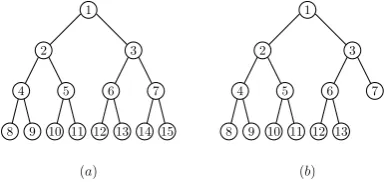
Among different classes of trees, binary trees are probably the most frequently used in computer science. There are many types of binary trees. Aperfectbinary tree is a binary tree in which every parent has two children and all leaves are at the same depth [11]. As shown in Figure 1(a), a perfect binary tree of d levels has exactly2d−1vertices, and all its internal vertices must have two
children. As a comparison, acompletebinary tree is a binary tree in which every level, except possibly the deepest level, is completely filled, and at depthd, the height of the tree, all vertices must be as far left as possible [1]. A complete binary tree of 13 vertices is shown in Figure 1(b) as an example. Because of the shape property, any complete binary tree can be conveniently stored in an array without storing any pointers. In addition, a binary heap, an important computer data structure, is stored in a complete binary tree. Note that a perfect binary tree is a special case of a complete binary tree.
(a) 1
2 3
4 5 6 7
8 9 10 11 12 13 14 15
(b) 1
2 3
4 5 6 7
[image:1.595.341.535.529.620.2]8 9 10 11 12 13
Fig. 1. (a) A perfect binary tree of four levels. (b) A complete binary tree of 13 vertices.
Fu and Huang [2] have proved that every perfect binary tree of order
2d−1(d ≥ 1) is prime. Although Fu and Huang ambiguously
we have confirmed that they only proved that perfect binary trees are prime. Their technique is to label all vertices from2to|V|+ 1
based on in-order traversal starting from the root of the tree. Then the label of the final vertex (|V|+ 1) is replaced by 1. It is easy to show that all leaf vertices are labeled with even numbers or1, and all parent vertices are labeled with odd numbers. The difference between any (odd-labeled) parent and its even-labeled child is1, and the difference between any (odd-labeled) parent and its odd-labeled child is a power of 2. With this labeling, every edge in a perfect binary tree connects a pair of coprime vertices, which proves that every perfect binary tree has a prime labeling. Figure 2(a) shows an example of Fu’s labeling for a 15-vertex perfect binary tree. However, Fu’s algorithm will not always produce a prime labeling for a complete binary tree. For example, as shown in Figure 2(b), Fu’s algorithm labels the three vertices at the top of a 8-vertex complete binary tree with 4, 6, and 8, which are not coprime.
(a) 9
5 13
3 7 11 15
2 4 6 8 10 12 14 1
(b) 6
4 8
3 5 7 1
[image:2.595.76.272.256.346.2]2
Fig. 2. (a) Fu’s prime labeling for a perfect binary tree of four levels. (b) Fu’s prime labeling algorithm not applicable to a 8-vertex complete binary tree.
In this paper, the author looks beyond perfect binary trees and shows that every complete binary tree is prime. Since a perfect binary tree is a special case of a complete binary tree, we move closer to prove Entringer’s conjecture that every tree is prime.
2. PRIME LABELING OF COMPLETE BINARY TREES
2.1 Definitions
Letvp,qbe theqthvertex (from the left) of thepthlevel (from the
top) in a complete binary tree ofnvertices. In this paper, we also sayvp,q is at location(p, q). Note that for the vertex at location
(p, q), its parent (if existent) is at location(p−1,dq2e), and its left and right children (if existent) are at locations(p+ 1,2q−1)and
(p+ 1,2q), respectively.
Define theindexof a vertex as a one-to-one and onto mappingx
from the vertex set onto{1,· · ·,|V|}as follows:
x(vp,q) = 2p−1+q−1, p∈ {1,· · ·, d}, q∈ {1,· · ·,2p−1} (1)
As illustrated in Figure 1(b), the index of a vertex is in fact its position in the level-order traversal sequence in which every vertex on a level is visited from left to right before descending to a lower level. It can be easily verified that, in a complete binary tree, theith
vertex (except the root) has the parent with the indexbi
2c. If thei
th
vertex itself is also a parent, its left child has the index2i, and right child has the index2i+ 1. Thus, the index of a left child is always even, and the index of a right child is always odd. Conversely, every vertex with an even index is a left child.
Define aleadingparent as a parent that is also a left child or the root. Since the index of a left child is always even, the index of a leading parent must be even or 1. For example, in the complete binary tree shown in Figure 1(b), vertices with indices 1, 2, 4, and 6 are leading parents.
In the next section, it will be shown that a prime labeling can be constructed in a two-step procedure for any complete binary tree with an odd number of vertices. Thereafter, it will be shown that a prime labeling for any complete binary tree with an even number of vertices can be constructed with one additional step.
2.2 The Prime Labeling Procedure for Complete Binary Trees with2k−1Vertices
Starting from an indexed complete binary tree with2k−1vertices, a prime labeling can be constructed in two steps. The first step is to bubble leading parents down their right branches. The goal of this step is to create anearprime labeling for a complete binary tree of
2k−1vertices. After the bubbling down step, it is guaranteed that the coprime requirement is satisfied for every edge, except possibly for the edges between right leaves and their parents.
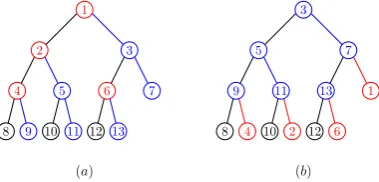
The following describes the bubbling down step in details. In this bubbling down step, each and every leading parent displaces its right child recursively until the leading parent becomes a (right) leaf. During this process, all displaced right descendants are promoted one level up. For example, the leading parent with index 1 bubbles down the path1 → 3 → 7in Figure 3(a) and becomes a right leaf in Figure 3(b), while 3 and 7 are promoted one level up. The leading parent with index 2 bubbles down the path
2→5→11in Figure 3(a) and becomes a right leaf in Figure 3(b), while 5 and 11 are promoted one level up.
(a)
1
2 3
4 5 6 7
8 9 10 11 12 13
(b)
3
5 7
9 11 13 1
8 4 10 2 12 6
Fig. 3. A complete binary tree with2k−1vertices (a) before the bubbling down step and (b) after the bubbling down step.
In a complete binary tree with2k−1vertices, every parent has exactly one right child, and every right child has exactly one parent. In other words, the pairing between every parent and its right child is a one-to-one correspondence. Thus, every leading parent bubbles down to a unique right leaf, and every right leaf was a unique leading parent before bubbling down.
After bubbling down, a new parent whose location is(p, q)must have been promoted from location(p+ 1,2q), while every left leaf remains at its original location and every right leaf was a leading parent before bubbling down. Define thelabelof a location as its index after the bubbling down step. For the parent at location(p, q), its label is the index of the vertex that used to be at location(p+ 1,2q). That is, the label for a new parent at location(p, q)is given by
[image:2.595.343.533.396.487.2]Volume 106 - No. 14, November 2014
From (2), it is clear that the labels for all the new parents after the bubbling down step are odd numbers.
Next, it will be proved that, after bubbling down, any parent and its left child are coprime. Let the parent’s location be(p, q). Then its left child is at location(p+ 1,2q−1). A left child is either a parent itself or a left leaf. First, consider the case where the left child is also a parent. Substituting location(p+ 1,2q−1)into (2), we have
`(p+ 1,2q−1) = 2p+1+ 2(2q−1)−1 = 2`(p, q)−1. (3) Applying Euclidean algorithm, we havegcd(`(p, q),2`(p, q) − 1) = 1. Therefore, a parent and its left child who is also a parent are coprime. Next, consider the case where the left child is a left leaf. Since every left leaf remains at its original location, substituting location(p+ 1,2q−1)into (1), we have
`(p+ 1,2q−1) =x(vp+1,2q−1) =`(p, q)−1. (4) In other words, a left leaf’s label is always one less than its parent’s. Applying Euclidean algorithm, we havegcd(`(p, q), `(p, q)−1) = 1. Hence, a left leaf and its parent are coprime. Combining both cases, we assert that any parent and its left child are always coprime after bubbling down.
If every parent and its right child were also coprime, then a prime labeling would exists for the complete binary tree with2k−1
vertices. Let the parent’s location be(p, q). Then its right child is at location(p+ 1,2q). A right child is either a parent itself or a right leaf. Consider the case where the right child is a parent. Substituting location(p+ 1,2q)into (2), we have
`(p+ 1,2q) = 2p+1+ 2(2q)−1 = 2`(p, q) + 1. (5) Applying Euclidean algorithm, we have gcd(`(p, q),2`(p, q) + 1) = 1. Therefore, a parent and its right child that is also a parent are coprime.
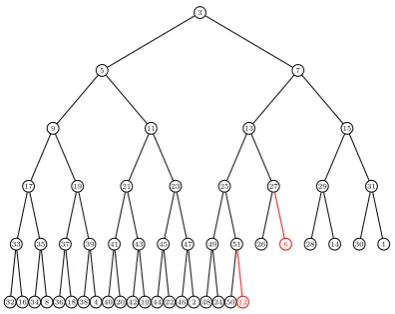
In the case where the right child is a right leaf, the right leaf and its parent are not guaranteed to be coprime after bubbling down, as shown in Figure 4. Hence, this case is more complicated and requires the second step of the procedure to be described in the following. Consider a complete binary tree with2k−1vertices. LetLkbe the set of the labels of all the right leaves, andPkbe the
set of the labels of the parents of all the right leaves. Fork = 1, the complete binary tree degenerates into a single vertex with zero edge, which is prime trivially. Fork= 2, the complete binary tree consists of two edges and three nodes labeled 1, 2, and 3, which is prime easily. Whenk≥3andkis odd,Pk={k, k+ 2,· · ·,2k−
1}andLk = {1,2,4,· · ·, k−1}. Whenk ≥ 3andkis even,
Pk={k+ 1, k+ 3,· · ·,2k−1}andLk={1,2,4,· · ·, k−2}.
In both cases,|Pk|=|Lk|=dk2e. The goal is to match each right
leafr ∈Lkwith a unique parentp ∈Pksuch thatgcd(p, c) =
1. In other words, the original prime labeling problem has been converted into a matching problem.
We need to introduce the Hall’s (marriage) theorem. In 1935, Hall [4] answered the following question, also known as the marriage problem: for a finite set of girls, each of whom knows several boys, under what conditions can all the girls marry the boys in such a way that each girl marries a boy she knows? This problem can be represented graphically by taking H to be the bipartite graph [10] in which the vertex set is divided into two disjoint sets
XandY which correspond to the girls and boys, respectively, and each edge joins a girl to a boy she knows. AmatchingM inHis a subset of edges such that no two edges inMare incident to the same vertex. A complete matching ofXintoY is a matching such that every vertex inXhas an edge incident from it. The marriage
3
5 7
9 11 13 15
17 19 21 23 25 27 29 31
33 35 37 39 41 43 45 47 49 51 26 6 28 14 30 1
[image:3.595.340.538.73.230.2]32 16 34 8 36 18 38 4 40 20 42 10 44 22 46 2 48 24 5012
Fig. 4. A complete binary tree with51vertices after bubbling down. There are two coprime violations highlighted in red. The first violation is between labels 27 and 6. The second violation is between labels 51 and 12.
problem can then be restated as follows: given a bipartite graph
H =H(X, Y), under what conditions does a complete matching fromXintoY exist? For a setA⊆X, define the setR(A)to be the vertices inY that are adjacent to at least one vertex inA. Hall proved the sufficient and necessary conditions for the existence of a complete matching.
THEOREM 1. LetHbe a bipartite graph with partsXandY. There is a complete matching ofX intoY if and only if |A| ≤ |R(A)|for everyA⊆X.
For our specific matching problem,X = Lk andY = Pk. An
elementx∈Xand an elementy∈Y are adjacent to each other if
gcd(x, y) = 1. Consider a subsetA⊆Lk. IfAcontains any pure
power of 2, thenR(A) =Pksince every member ofPkis an odd
number and coprime to any pure power of 2. Hence, the sufficient condition|R(A)|=|Pk|=|Lk| ≥ |A|is true, and the equality
holds only whenA=Lk.
Now consider the case whereAdoes not contain any pure power of 2. For any elementai ∈ A, the prime factorization ofai =
2yi×Q
jq sij
ij whereqijare odd prime factors ofai,3 ≤ qij ≤
1
2maxLk. For any elementbi ∈ Lk which has the same prime
factors asai, letbi = 2y
0
iQ
jq s0
ij
ij and letBi={bi}be the set of
all suchbi. It is trivial thatai∈BiandA⊆SiBi. By definition,
R({ai}) ={p|p∈Pk, qij-p,∀j}. Note thatR(Bi) ={p|p∈
Pk, qij-p,∀j}=R({ai}). Consequently,R(
S
iBi) =R(A).
Let ` = |Lk| = |Pk| = dk2e. Note that the elements ofLk
are (`−1) consecutive even numbers and 1. For these(`−1)
consecutive even numbers, there are at most b(`− 1)Q
jq1ijc
elements inLk that have the same prime factors as ai. That is,
|Bi| ≤ b(`−1)Qj
1
qijc. Consider the union of all such setsBi
and apply the De Morgan’s Law, and we have
|A| ≤ |∪iBi|=
∩iBi
≤
(`−1)(1−Y
i
(1−Y
j
1
gij
))
. (6)
Recall that R(Bi) = R({ai}) = {p | p ∈ Pk, qij - p,∀j}. Similar to the derivation of the Euler’s totient function, there are at leastd(`−1)Q
j(1−
1
gij)eelements in Pk that are coprime
Morgan’s Law, and we have
|R(A)| = |∪iR(Bi)|=
∩iR(Bi)
≥
(`−1)(1−Q
i(1−
Q
j gij−1
gij ))
. (7)
Sincegij ≥ 3,∀i, j, gij−1
gij >
1
gij. Hence, the lower bound of |R(A)|is always greater than the upper bound of |A|. In other words,|R(A)| > |A|if A does not contain any pure power of 2. Combined the results from both cases,|R(A)| ≥ |A|for any subsetA ⊆ Lk, and |R(A)| > |A|for any non-empty proper
subsetA⊂Lk. By Hall’s Theorem, there is a complete matching
ofLkintoPk. That is, a complete coprime matching can always
be found for the set of right leaves and the set of their parents. Therefore, a prime labeling exists for a complete binary tree with
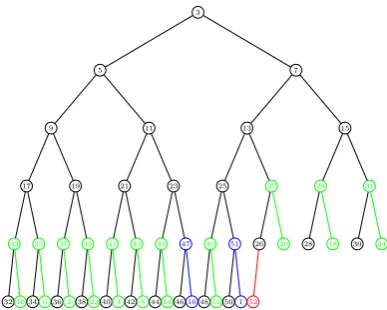
2k−1vertices. As shown in Figure 5, after completely matching the right leaves and their parents, a prime labeling is constructed for the complete binary tree with 51 vertices.
3
5 7
9 11 13 15
17 19 21 23 25 27 29 31
33 35 37 39 41 43 45 47 49 51 26 20 28 18 30 24
[image:4.595.341.535.139.294.2]32103463623822404428441446164812501
Fig. 5. A complete binary tree with51vertices after completely matching the right leaves and their parents. A prime labeling exists for any complete binary tree with2k−1vertices. Note that, this prime labeling contains a special pair(47,16).
2.3 The Prime Labeling Procedure for Complete Binary Trees with2kVertices
Recall that|R(A)|> |A|for any non-empty proper subsetA ⊂
Lk. Letr∗ ∈ Lk andp∗ ∈ R({r∗}), sogcd(p∗, r∗) = 1. Let
L=Lk\{r∗}andP =Pk\{p∗}. Then for any subsetA⊆L,Ais
a proper subset ofLk. It follows that|R(A)|>|A|or equivalently
|R(A)| ≥ |A|+ 1. Sincep∗may or may not be inR(A), it follows
that|R(A)\ {p∗}| ≥ |R(A)| −1≥ |A|, for anyA⊂L
k. By Hall’s
Theorem, there is a complete matching ofL=Lk\ {r∗}intoP=
Pk\ {p∗}. Sincegcd(p∗, r∗) = 1, a complete matching ofLkinto
Pkwith(p∗, r∗)paired together is constructed. The significance of
this fact is that there is great freedom when choosing the preferred coprime pair(p∗, r∗).
By Bertrand-Chebyshev Theorem [7], for any integert >3, there is always at least one primepsuch thatt < p <2t−2. Lett=
k+ 1. Then there is always at least one primepsuch thatk+ 1< p <2k,∀k≥3. In other words, there is always at least one prime
number inPk. Letp∗be the largest prime inPk. Letr∗= 2zbe the
largest pure power of 2 inLk. Clearly,gcd(p∗,2z) = 1. Therefore,
when a prime labeling is constructed for a complete binary tree with2k−1vertices, the special pairing(p∗,2z) can always be
made mandatory.
3
5 7
9 11 13 15
17 19 21 23 25 27 29 31
33 35 37 39 41 43 45 47 49 51 26 20 28 18 30 24
3210346362382240442844144616481250152
Fig. 6. The only difference between complete binary trees with51and52
vertices is the extra vertex52and the edge connected to its parent26.
Compare the complete binary trees of2k−1versus2kvertices. Their only difference is that the complete binary tree with 2k
vertices has an extra vertex2kas the left leaf child of the vertex
k, as shown in Figure 6. Let us temporarily remove the vertex2k
and construct a prime labeling for the resulting2k−1tree with the special pairing(p∗,2z). Letp
1be the parent of1in our prime labeling for the2k−1tree. Now re-attach the left leaf2kback to the vertexk. The only coprime violation is the pair(k,2k), as shown in red in Figure 6. Consider the following three parent-child pairs:(k,2k),(p∗,2z),and (p
1,1). If a three-way child swap is performed to form the following three pairs:(k,1),(p∗,2k),and
(p1,2z), we will establish three coprime parent-child pairs while maintaining a valid prime labeling for the rest of the tree. In other words, a prime labeling for a complete binary tree with2kvertices can be constructed from the prime labeling for a complete binary tree with2k−1vertices with a three-way child swap, which is demonstrated in Figure 7.
In summary, a complete binary tree with either2k−1or2kvertices has a prime labeling. Thus, we assert that every complete binary tree is prime.
3. CONCLUSION
[image:4.595.80.271.273.429.2]Volume 106 - No. 14, November 2014
3
5 7
9 11 13 15
17 19 21 23 25 27 29 31
33 35 37 39 41 43 45 47 49 51 26 20 28 18 30 24
[image:5.595.81.272.72.230.2]321034636238224044284414465248125016 1
Fig. 7. After performing three-way child swap, the three new parent-child pairs(26,1),(47,52),and(51,16)are all coprime pairs. The coprime violation(26,52)in Figure 6 is removed, and a prime labeling for the complete binary tree with 52 vertices is constructed.
4. REFERENCES
[1] P. E. Black.Complete binary tree. U.S. National Institute of Standards and Technology, 2011. http://xlinux.nist.gov/dads. [2] H. L. Fu and K. C. Huang. On prime labelling. Discrete
Math., 127:181–186, 1994.
[3] J. A. Gallian. A dynamic survey of graph labeling. The Electronic Journal of Combinatorics, 16, 2013.
[4] P. Hall. On representatives of subsets.J. London Math. Soc., 10:26–30, 1935.
[5] P. Haxell, O. Pikhurko, and A. Taraz. Primality of trees.J. Combinatorics, 2:481–500, 2011.
[6] O. Pikhurko. Trees are almost prime. Discrete Math., 307:1455–1462, 2007.
[7] Sondow and Weisstein. Bertrand’s postulate. From MathWorld – A Wolfram Web Resource. http://mathworld.wolfram.com/BertrandsPostulate.html. [8] A. Tout, A.N. Dabboucy, and K. Howalla. Prime labeling of
graphs.Nat. Acad. Sci. Letters, 11:365–368, 1982.
[9] S. K. Vaidya and U. M. Prajapati. Some new results on prime graphs.J. Discrete Math., 2:99–104, 2012.
[10] Weisstein. Bipartite graph. From MathWorld – A Wolfram Web Resource. http://mathworld.wolfram.com/BipartiteGraph.html. [11] Y. Zou and P. E. Black. Perfect binary tree. U.S.