Performance of Binary Locked Convolutional Codes with
Non-Transmittable Codewords in Flat and Slow
Rayleigh-Fading Channel
Salehe I Mrutu
Nelson Mandela African Institution of Science and
Technology, Arusha, Tanzania
Anael Sam
Nelson Mandela African Institution of Science and
Technology, Arusha, Tanzania
Nerey H. Mvungi
College of Information and Communication Technologies,
University of Dar Es Salaam, Dar Es Salaam, Tanzania
ABSTRACT
Communication over wireless media is vulnerable to distortion by noise. Therefore, the application of error control mechanism is necessary to minimize the Bit Error Rate (BER). It is proposed to use locked binary convolutional code with Non-Transmittable codewords to enhance Viterbi Algorithm decoders; as one of the forward error correction mechanisms. The proposed enhancement empowers Viterbi algorithm decoders to reduce one of its inherent limitations of residual errors due to burst errors. This paper evaluates the performance of the locked (2, 1, 2) binary convolutional code with Non-Transmittable codewords enhancement technique over flat and slow Rayleigh Fading channel using a MATLAB software simulation. Simulation result shows 80.92 percent reduction of residual errors when 6 Non-Transmittable Codewords were applied to Viterbi Algorithm (VA) decoding. On the other hand, the technique lowers the encoder’s data transmission rate from 1/2 to 1/6.
General Terms
Binary convolutional codes, Transmission errors, Rayleigh fading channel, Viterbi algorithm.
Keywords
Locked Convolutional encoder, Bust errors, Residual errors, Non Transmittable Codewords (NTCs), Viterbi Algorithm Decoding, Rayleigh Fading Channel
1.
INTRODUCTION
Locked binary convolutional encoder with Non-transmittable codewords (NTCs) enhancement was introduced in august 2014 [1] as one of the techniques used to improve performance of convolutional codes in controlling transmission errors in data communication. Locked convolutional encoder encodes binary data at the sender machine before data transmission over the noisy channel. Viterbi Algorithm decoder at the receiving machine uses Non-Transmittable codewords (NTCs) to gain the decoding stability.
In the literature reviewed, error correction performance of convolution codes can also be improved by increasing constraint length K of the involved code [2]. However, it was also reported that data decoding process becomes impractical when constraint length K is increased beyond 10 [3] [4]. At the same time increasing constraint length K, exponentially increases energy consumption per useful bit decoded in viterbi algorithm decoder. This fact limits the applicability of
convolutional codes in energy efficient real time applications such as sensor network[5].
Soft decision decoding (SDD) is also used to optimize performance of convolutional codes, Chip Fleming [2] and Morelos-Zaragoza [6] reported a code gain of 2 to 3dB in SDD over that of Hard Decision Decoding(HDD). However, SDD works on real numbers that demand for very complex circuits [5] [2] to implement in energy constrained real time sensor networks applications.
Recently, researchers [1] opened a new dimension on optimizing binary convolutional codes for communication systems by applying NTCs to enhance Viterbi Algorithm decoders without necessarily increasing code constraint length or using SDD at the decoding part. This technique was first assessed in another work by the same researchers [7] where it achieved 83.7 percent improvement in reducing residual errors when 6NTCs were applied to Viterbi Algorithm decoder. However, the assessment relied on the classical Additive White Gaussian Noise (AWGN) model only. AWGN channel model does not account for interference, frequency selectivity, fading, nonlinearity or dispersion [8], [9] which are significant factors in wireless communication systems. This fact motivated the researchers to extend their study using a flat and slow Rayleigh fading channel model. To the best of our knowledge there are no other work reported on the performance of locked convolutional encoders with Non-transmittable codewords.
The presentation organization in this paper is as follows: Section 2 briefly introduces the reader to locked convolutional encoder with the non-transmittable codewords technique; section 3 describes the methodology used in this work; section 4 is all about the discussion on the obtained results and section 5 is the recommendation and conclusion to these efforts
.
2.
LOCKED CONVOLUTIONAL
ENCODER WITH NTCs
0 /10
1 /10
0 /01 1 /00
1 /11
1 /01
S0 S2 S1 S3
0 /00
0 /11
Key:
Node content corresponds to a shift register contents: S0= 00, S1=01, S2=10 and S3=11.
Path labels: u/v1
v2
[image:2.595.62.297.77.187.2]-input/output(Data/Codeword)
Fig. 1: State diagram of (2, 1, 2) convolutional encoder
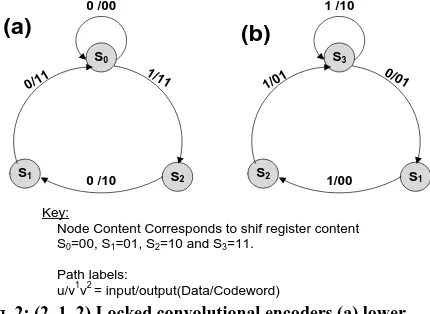
Locking a binary (2, 1, 2) Convolutional encoder does not need any change in internal or external structure of a common convolutional encoder. The encoder is locked by adding either two low bits (i.e. 00) or two high bits (i.e. 11) after each data bit to be encoded at the sender’s machine. The two lock bits forces the encoder to work either on the lower end side of the encoder or on the higher end side of the encoder but not both. Fig.2 shows a lower and higher end locked (2, 1, 2) binary Convolutional encoders.
0 /00
0/11 S0
S2
S1 0 /10
1/11
1 /10
1/01 S3
S1
S2 1/00
0/01
(a)
(b)
Key:
Node Content Corresponds to shif register content
S0=00, S1=01, S2=10 and S3=11.
Path labels:
u/v1v2 = input/output(Data/Codeword)
Fig. 2: (2, 1, 2) Locked convolutional encoders (a) lower end locked and (b) Higher end locked
The encoding process starts and ends in all zero state (i.e. S0) for the lower locked encoder and all one state (i.e. S3) for the higher end locked encoder. Lock bits are also transmitted with data in the transmission channel. This fact lowers the encoder’s data transmission rate from 1/2 to 1/6, which means for each data bit there are six bits to be transmitted in channel [1]. This is one of the tradeoffs of this method. Lower locked encoder ignores state S3 completely and works perfectly with the remaining three states. Similarly, higher end locked encoder ignores state S0.
Received Codewords from the locked convolutional encoder gives the VA decoder at the receiving machine special characteristic that enables it to use NTCs. NTC is either two zero-zero bits (i.e. 00) for lower end locked encoder or two one-one bits (i.e.11) for higher end locked encoder. The addition of NTCs is done before the received codewords are submitted to VA decoder for decoding.
3.
METHODOLOGY
In this work, performance evaluation on error correction
process was categorized into Hard Decision Decoding (HDD) or Soft Decision Decoding (SDD) [6]. The HDD is applied when the quantization level is two while SDD is applied when quantization level is more than two. For this study, only HDD was used in simulation. All the comparisons in this study were based on the assumption that the involved pairs had the same execution time and Physical memory requirement. The following are the explanations of the methods used in the study.
3.1
Simulation Codes Implementation
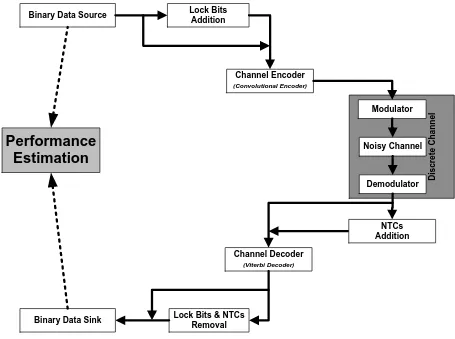
The two pairs of binary convolutional encoder-decoder codes were implemented using MATLAB software. Fig.3 is a block diagram of a communication system used in simulation. In a data source block, a “rand” function was used to generate binary data (i.e. 0 and 1) at equal probability. The generated data were duplicated to obtain two sets of the same data stream for simulation. The first data set was sent to lock bit addition block where encoder lock bits were added to the data stream before data were encoded. The other set of data was directly sent to the convolutional encoder. Both the two sets were encoded using the same (2, 1, 2) convolutional encoder. In convolutional encoder block a “conv” function where [111]2 and [101]2 were selected as generator polynomials. Each input bit produced two bits codeword, both codewords corresponding to input data bits and encoder lock bits inter and leave the discrete channel block through the Modulator – demodulator blocks. In these blocks, the application of Binary Phase Shift Keying (BPSK) to data was done where binary data were mapped to minus one (-1) and plus one (+1) and back. Noisy channel block contained flat and slow Rayleigh Fading model. Input data from modulation block were passed through the noisy model separately. All the two data sets got out of discrete channel where one set corresponding to locked convolutional encoder was channeled through Non Transmittable Codewords (NTCs) block for NTCs addition before they were submitted to VA decoder. The other set was directly sent to VA decoder for the decoding process. After VA decoding data bits corresponding NTCs and encoder locking codewords were removed leaving behind the actual transmitted data. The performance estimator compared the two data sets in the data sink block to the original data set from the source data generator to identify the encoder-decoder pair performance. A MATLAB software simulation that followed the procedures described in fig. 3 performed the following: Generated random binary data (i.e. 0 and 1) ;
Added and removed encoder lock bits and NTCs;
Encoded binary data using rate 1/2, generator polynomial [7,5]8 Convolutional code;
Passed codewords through noisy channels (i.e. Rayleigh Fading );
Modulated and demodulated the codeword signals using hard decision decoding technique ;
Passed the received coded signals to VA decoder and Enhanced VA decoder;
[image:2.595.70.285.315.472.2]D
is
c
re
te
C
h
a
n
n
e
l
Binary Data Source
Binary Data Sink
Channel Decoder
(Viterbi Decoder)
Modulator
Noisy Channel
Demodulator Channel Encoder
(Convolutional Encoder)
Lock Bits Addition
NTCs Addition
Lock Bits & NTCs Removal
Performance
Estimation
Fig. 3: Block diagram of a communication system used in simulation
[image:3.595.69.524.70.409.2]Parameters chosen for simulation are listed in table I.
Table 1. Simulation Parameters
Parameter Value
Data length 106
Constraint Length (K) 3 Generator polynomial (7,5)8
Rate (r) 1/2
Encoder lock bits 2 zero bits (i.e. 00)
NTCs 6
Modulation/Demodulation BPSK
Noise model Rayleigh Fading
Quantization Hard Decision Decoding Path evaluation Hamming Distance Metric
3.2
Rayleigh fading Channel
This channel model is considered to be more relevant in heavily built up areas having no line of sight between the transmitter and receiver. High buildings and other objects reflect, diffract, retract and attenuate the transmitted signal. Rayleigh fading channel vary randomly according to a Rayleigh distribution and it is the sum of two uncorrelated Gaussian random variables. The received signal “
y
” in Rayleigh fading channel follows the form in relation (1).
1
n
hx
y
Where:
h
is the fading vector coefficient related to Rayleigh multipath channel;x
is the communicated signal (taking values +1’s and -1’s); andn
is the Additive White Gaussian Noise (AWGN)The receiving machine knows the channel
h
. Therefore, itequalizes the received signal
y
by dividing it byh
before the decoding process as shown in relation (2).
2
'
'
x
n
h
n
hx
y
Where:
h
n
n
'
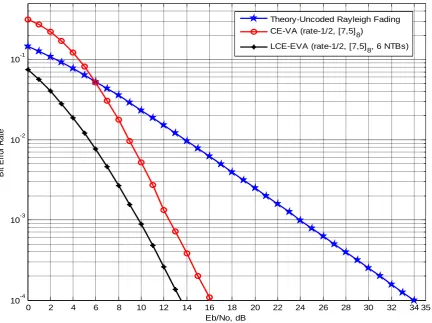
Fig. 4: BER performance of Locked (2, 1, 2) Convolutional Encoder with 6 Non-Transmittable Codewords Enhanced Viterbi Algorithm decoder (LCE-6NTCs EVA) and the classical (2, 1, 2) Convolutional Encoder with Viterbi Algorithm decoder
(CE-VA) on flat and slow Rayleigh Fading Channel
4.
RESULTS AND DISCUSION
In this section, performance comparison between the (2, 1, 2) convolutional encoder with its corresponding VA decoder and the locked (2, 1, 2) convolutional encoder with 6NTC enhanced VA decoder were presented and discussed. The number of counted residual errors from each encoder-decoder pair and the Bit Error Rate (BER) formed the base of performance comparison. The ratio of the total number of erroneous bits which occurred in communication to the total number of communicated bits is BER [5]. Appropriate choice of decoder reduces the BER to several orders of magnitude in communication channel. The difference between BER obtained by applying error control technique to that of uncoded transmission is a code gain.
4.1
Code Gain
Fig. 4 compares the BER and code gain of encoder-decoder pair between the classical (2, 1, 2) convolutional code and locked (2, 1, 2) convolutional code enhanced by 6NTCs. It is clear from fig. 4 that, 6NTCs enhanced VA decoding has an overall lower BER as it can be observed from simulation results giving a maximum code gain of 21 dB (at 10-4 BER)
negative code gain in all SNR values below 6 dB. This is because there is high concentration of burst errors in this area. It can also be deduced from fig. 4 that, the proposed technique improved the performance of the existing (2, 1, 2) convolutional encoder-decoder by at least 3 dB on a flat and slow Rayleigh fading channel.
4.2
Residual Errors
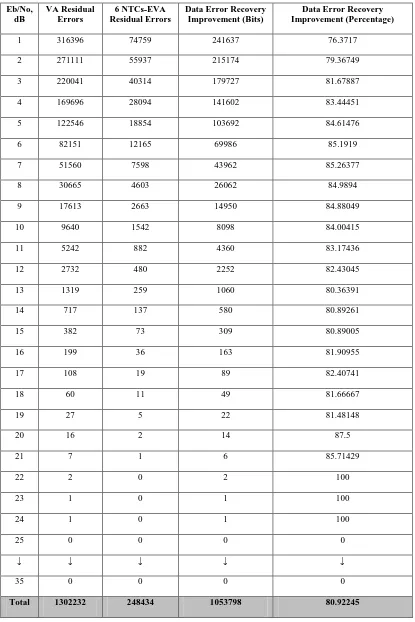
Table II presents the counted residual errors from both Locked (2, 1, 2) binary convolutional encoder with VA decoder enhanced by 6NTCs and the classical convolutional encoder with its corresponding VA decoder. The table also shows the improvement obtained in each SNR value. The results showed that the developed scheme was successfully in correcting residual errors that occurred in VA by 80.92 percent of total residual errors by applying 6NTC to the enhanced VA.
According to Akyildiz [10], BER is directly proportional to the code rate and inversely proportional to energy per symbol noise ratio and transmitter power level. At the same time, quality of a decoder is inversely proportional to its BER.
0 2 4 6 8 10 12 14 16 18 20 22 24 26 28 30 32 34 35
10-4 10-3 10-2 10-1
Eb/No, dB
B
it
E
rr
o
r
R
a
te
Theory-Uncoded Rayleigh Fading CE-VA (rate-1/2, [7,5]8)
Table 2. VA Verses 6NTCS-EVA Residual errors
Eb/No, dB
VA Residual Errors
6 NTCs-EVA Residual Errors
Data Error Recovery Improvement (Bits)
Data Error Recovery Improvement (Percentage)
1 316396 74759 241637 76.3717
2 271111 55937 215174 79.36749
3 220041 40314 179727 81.67887
4 169696 28094 141602 83.44451
5 122546 18854 103692 84.61476
6 82151 12165 69986 85.1919
7 51560 7598 43962 85.26377
8 30665 4603 26062 84.9894
9 17613 2663 14950 84.88049
10 9640 1542 8098 84.00415
11 5242 882 4360 83.17436
12 2732 480 2252 82.43045
13 1319 259 1060 80.36391
14 717 137 580 80.89261
15 382 73 309 80.89005
16 199 36 163 81.90955
17 108 19 89 82.40741
18 60 11 49 81.66667
19 27 5 22 81.48148
20 16 2 14 87.5
21 7 1 6 85.71429
22 2 0 2 100
23 1 0 1 100
24 1 0 1 100
25 0 0 0 0
↓ ↓ ↓ ↓ ↓
35 0 0 0 0
by the existing (2, 1, 2) convolutional encoder-decoder is maintained, then the obtained improvements will be reflected in enhancement of the communication system by reducing the transmitter-receiver transmission power levels because of its ability to tolerate burst errors. Reduction in data transmission link power requirement necessary to maintain a given transmission quality means lowering data communication systems operational costs or prolonged battery use for mobile devices in-between re-charge.
5.
CONCLUSION
This paper assessed and compared the performance of locked (2, 1, 2) binary convolutional encoder with 6NTCs-enhancement technique to VA decoder and that of a classical (2, 1, 2) binary convolutional encoder with its corresponding VA decoder. The enhanced encoder-decoder pairs significantly recovered data passed through a flat and slow Rayleigh-Fading channel. The two encoder-decoder pairs were simulated using A MATLAB software. Binary Phase-Shift Keying (BPSK) was used for modulation-demodulation purposes. The simulation results showed overall performance improvement of 80.92 percent in reducing residual errors when a locked (2, 1, 2) binary convolutional code with 6 NTCs were applied to VA decoder. However, the technique lowered the encoder’s data transmission rate from 1/2 to 1/6. Further research of the proposed technique in communication and non-communication applications using Viterbi Algorithm is highly recommended.
6.
ACKNOWLEDGMENTS
This work is part of the first author’s PhD work, which is supported by Tanzania Commission for Science and Technology (COSTECH), The Nelson Mandela African Institution of Science and Technology (NM-AIST) and The University of Dodoma (UDOM).
7.
REFERENCES
[1] Mrutu, S. I., Sam, A., and Mvungi, N. H., "Trellis Analysis of Transmission Burst Errors in Viterbi Decoding " International Journal of Computer Science and Information Security (IJCSIS), vol. 12-8, pp. 46-53, 2014.
[2] Fleming, C. (2006, August, 13). A tutorial on convolutional coding with Viterbi decoding. Spectrum
applications. Available:
http://home.netcom.com/~chip.f/viterbi/tutorial.html
[3] Viterbi, A., "Convolutional codes and their performance in communication systems," Communication Technology, IEEE Transactions on, vol. 19, pp. 751-772, 1971.
[4] Mrutu, S. I., Sam, A., and Mvungi, N. H., "Forward Error Correction Convolutional Codes for RTAs’ Networks: An Overview," International Journal of Computer Network and Information Security, vol. 6, pp. 19-27, 2014.
[5] Balakrishnan, G., Yang, M., Jiang, Y., and Kim, Y., "Performance analysis of error control codes for wireless sensor networks," in Information Technology, 2007. ITNG'07. Fourth International Conference on, 2007, pp. 876-879.
[6] Morelos-Zaragoza, R. H., The Art of Error Correcting Coding, Second ed. The Atrium, Southern Gate, Chichester,West Sussex PO19 8SQ, England.: John Wiley & Sons Ltd., 2006.
[7] Mrutu, S. I., Sam, A., and Mvungi, N. H., "Assessment of Non Transmittable Codewords Enhancement to Viterbi Algorithm Decoding " International Journal of Communication Science and Information Security (IJCSIS), vol. 12-9, pp. 13-18, 2014.
[8] Sklar, B., "Rayleigh fading channels in mobile digital communication systems. I. Characterization," Communications Magazine, IEEE, vol. 35, pp. 90-100, 1997.
[9] Sklar, B., "Rayleigh Fading Channels in Mobile Digital Communication Systems Part II. : Mitigation," Communication Magazine, IEEE, vol. 35, pp. 102-109, 1997.
[10]Akyildiz, I. F., Su, W., Sankarasubramaniam, Y., and Cayirci, E., "Wireless sensor networks: a survey," Computer networks, vol. 38, pp. 393-422, 2002.