74
Introduction to LCL,
A Larch/C Interface Language
J.V. Guttag and J.J. Horning
Systems Research Center
DEC’s business and technology objectives require a strong research program. The Systems Research Center (SRC) and three other research laboratories are committed to filling that need.
SRC began recruiting its first research scientists in l984—their charter, to advance the state of knowledge in all aspects of computer systems research. Our current work includes exploring high-performance personal computing, distributed computing, programming environments, system modelling techniques, specification technology, and tightly-coupled multiprocessors.
Our approach to both hardware and software research is to create and use real systems so that we can investigate their properties fully. Complex systems cannot be evaluated solely in the abstract. Based on this belief, our strategy is to demonstrate the technical and practical feasibility of our ideas by building prototypes and using them as daily tools. The experience we gain is useful in the short term in enabling us to refine our designs, and invaluable in the long term in helping us to advance the state of knowledge about those systems. Most of the major advances in information systems have come through this strategy, including time-sharing, the ArpaNet, and distributed personal computing.
SRC also performs work of a more mathematical flavor which complements our systems research. Some of this work is in established fields of theoretical computer science, such as the analysis of algorithms, computational geometry, and logics of programming. The rest of this work explores new ground motivated by problems that arise in our systems research.
DEC has a strong commitment to communicating the results and experience gained through pursuing these activities. The Company values the improved understanding that comes with exposing and testing our ideas within the research community. SRC will therefore report results in conferences, in professional journals, and in our research report series. We will seek users for our prototype systems among those with whom we have common research interests, and we will encourage collaboration with university researchers.
Introduction to LCL,
A Larch/C Interface Language
J.V. Guttag and J.J. Horning
c
Digital Equipment Corporation 1991
Abstract
This report is aimed primarily at the C programmer who wishes to begin to integrate formal specifications into the program development cycle. We present a specification language targeted specifically at C and discuss how it can be used to support a style of C programming in which abstraction plays a vital role.
Contents
1 An overview of Larch 1
2 LCL preliminaries 2
2.1 LCL specifications and C implementations: : : : : : : : : : : : : : : 2
2.2 Function specifications : : : : : : : : : : : : : : : : : : : : : : : : : 3
2.3 States and names : : : : : : : : : : : : : : : : : : : : : : : : : : : : 5
3 A guided tour through a specification 7
3.1 Gender : : : : : : : : : : : : : : : : : : : : : : : : : : : : : : : : : 7
3.2 Employee : : : : : : : : : : : : : : : : : : : : : : : : : : : : : : : 12
3.3 Empset : : : : : : : : : : : : : : : : : : : : : : : : : : : : : : : : : 17
3.4 DBase : : : : : : : : : : : : : : : : : : : : : : : : : : : : : : : : : 23
3.5 Driver : : : : : : : : : : : : : : : : : : : : : : : : : : : : : : : : : 29
3.6 Eref : : : : : : : : : : : : : : : : : : : : : : : : : : : : : : : : : : 32
3.7 Erc : : : : : : : : : : : : : : : : : : : : : : : : : : : : : : : : : : : 37
3.8 Ereftab : : : : : : : : : : : : : : : : : : : : : : : : : : : : : : : : : 39
3.9 Notes on the implementations : : : : : : : : : : : : : : : : : : : : : 44
4 Summary 45
5 Acknowledgements 46
6 References 48
A Implementations 49
B LSL for LCL users 63
List of Figures
1 gender.lcl: : : : : : : : : : : : : : : : : : : : : : : : : : : : : : : : 8
2 string.lsl fragment : : : : : : : : : : : : : : : : : : : : : : : : : : : 10
3 sprint.lsl : : : : : : : : : : : : : : : : : : : : : : : : : : : : : : : : 11
4 gender.lh : : : : : : : : : : : : : : : : : : : : : : : : : : : : : : : : 11
5 gender.h : : : : : : : : : : : : : : : : : : : : : : : : : : : : : : : : 12
6 gender.c : : : : : : : : : : : : : : : : : : : : : : : : : : : : : : : : 12
7 employee.lcl : : : : : : : : : : : : : : : : : : : : : : : : : : : : : : 13
8 employeeName.lsl : : : : : : : : : : : : : : : : : : : : : : : : : : : 14
9 bool.h : : : : : : : : : : : : : : : : : : : : : : : : : : : : : : : : : 14
10 employee.lh : : : : : : : : : : : : : : : : : : : : : : : : : : : : : : 15
11 employee.h: : : : : : : : : : : : : : : : : : : : : : : : : : : : : : : 16
12 employee.c : : : : : : : : : : : : : : : : : : : : : : : : : : : : : : : 17
13 empset.lcl, part 1 : : : : : : : : : : : : : : : : : : : : : : : : : : : : 18
14 empset.lcl fragment, prettyprinted : : : : : : : : : : : : : : : : : : : 22
15 dbaseAssumptions.lsl : : : : : : : : : : : : : : : : : : : : : : : : : 23
16 dbase.lsl, part 1 : : : : : : : : : : : : : : : : : : : : : : : : : : : : 24
17 dbase.lcl, part 1 : : : : : : : : : : : : : : : : : : : : : : : : : : : : 26
18 dbase.lh : : : : : : : : : : : : : : : : : : : : : : : : : : : : : : : : 28
19 drive.c fragment, part 1 : : : : : : : : : : : : : : : : : : : : : : : : 30
20 eref.lcl : : : : : : : : : : : : : : : : : : : : : : : : : : : : : : : : : 32
21 eref.lcl’s implied interface : : : : : : : : : : : : : : : : : : : : : : : 33
22 eref.lh : : : : : : : : : : : : : : : : : : : : : : : : : : : : : : : : : 34
23 eref.h: : : : : : : : : : : : : : : : : : : : : : : : : : : : : : : : : : 34
24 eref.c, part 1 : : : : : : : : : : : : : : : : : : : : : : : : : : : : : : 35
25 erc.lsl : : : : : : : : : : : : : : : : : : : : : : : : : : : : : : : : : 37
26 bag.lsl fragment : : : : : : : : : : : : : : : : : : : : : : : : : : : : 38
27 erc.lcl, part 1 : : : : : : : : : : : : : : : : : : : : : : : : : : : : : : 39
28 ereftab.lcl, part 1 : : : : : : : : : : : : : : : : : : : : : : : : : : : : 41
29 ereftab.lsl : : : : : : : : : : : : : : : : : : : : : : : : : : : : : : : 43
31 empset’s representation : : : : : : : : : : : : : : : : : : : : : : : : 44
32 dbase.c fragment : : : : : : : : : : : : : : : : : : : : : : : : : : : : 45
33 erc.h : : : : : : : : : : : : : : : : : : : : : : : : : : : : : : : : : : 49
34 erc.c, part 1: : : : : : : : : : : : : : : : : : : : : : : : : : : : : : : 50
35 empset.h : : : : : : : : : : : : : : : : : : : : : : : : : : : : : : : : 53
36 empset.c, part 1 : : : : : : : : : : : : : : : : : : : : : : : : : : : : 54
37 dbase.h : : : : : : : : : : : : : : : : : : : : : : : : : : : : : : : : : 57
38 dbase.c, part 1 : : : : : : : : : : : : : : : : : : : : : : : : : : : : : 57
39 table.lsl: : : : : : : : : : : : : : : : : : : : : : : : : : : : : : : : : 63
40 container.lsl : : : : : : : : : : : : : : : : : : : : : : : : : : : : : : 64
41 linearContainer.lsl : : : : : : : : : : : : : : : : : : : : : : : : : : : 65
42 priorityQueue.lsl : : : : : : : : : : : : : : : : : : : : : : : : : : : : 66
1
An overview of Larch
The most vexing problems in building systems concern overall system organization and the integration of components. Modularity is the key to controlling them, and specifications are essential for achieving program modularity. Abstraction boundaries make it possible to understand programs one component at a time. However, an abstraction is intangible. Without a precise description, there is no way to know what it really is, and it is easy to confuse an abstraction with one of its implementations.
Specifications can be written in natural languages, in semi-formal notations (with a restricted syntax but no formal semantics), or in truly formal notations. The potential advantages of formal specifications are that they have unambiguous meanings and are subject to manipulation by programs. The latter advantage can be fully realized only by using tools that support constructing and reasoning about them. The Larch Project is developing languages, tools, and techniques to aid in the productive application of formal specifications to software design, implementation, integration, and maintenance. [Guttag, et al. 85, 90, Garland et al. 90]
A Larch interface specification describes the interface that a program component provides to clients (programs that use it). Each interface specification is written in a programming-language-dependent Larch interface language. It relies on definitions from an auxiliary specification, written in a programming-language-independent specification language, the Larch Shared Language (LSL).
The Larch family of specification languages support:
ž Specification reuse. Many language-independent abstractions are useful in a wide variety of specifications, for example, integers, lists, sets, queues, arrays, relations, mappings, and orders. Larch encourages the accumulation of open-ended collections of reusable specification components in LSL handbooks.
ž Abstraction. Larch supports a style of program design in which data and functional abstractions play a prominent role.
ž Development tools. The Larch languages are designed for use with tools that support the construction and checking of specifications, implementations, and clients.
An interface specification provides information that is needed both to write client programs and to write acceptable implementations. A critical part of a component’s interface is its communication with its environment. Communication mechanisms differ from one programming language to another, sometimes in subtle ways. It is easier to be precise about communication when the specification language reflects the programming language. Such specifications are generally shorter than those written in any “universal” interface language. They are also clearer to programmers who implement interfaces and to programmers who use them.
Each Larch interface language deals with what can be observed about the behavior of program components written in a particular programming language. It provides a way to write assertions about program states. It incorporates notations that are specific to its programming language for constructs such as side effects, exception handling, concurrency, and iterators. Its simplicity or complexity depends largely on the simplicity or complexity of its programming language.
Each Larch interface language has a mechanism for specifying abstract data types. If its programming language doesn’t provide direct support for them (as C does not), the mechanism is designed to be compatible with the general style of the programming language.
LCL is a Larch interface language designed to specify program components written in, or called from, the standard C programming language [ANSI]. For comparison, LM3, a Larch interface language for Modula-3 is described in [Jones 91].
2
LCL preliminaries
This report describes most of LCL (version 1.0) and gives an informal description of its semantics. It discusses some LCL tools, but it is not a user’s guide for any of them.
LCL is not a C dialect or preprocessor. Programs specified and developed with LCL are C programs, accepted by ordinary C compilers. The use of LCL will tend to encourage some styles of development, but it does not change the programming language.
Before presenting any interface specifications, we discuss the intended relation between LCL specifications and C programs, the structure of LCL function specifications, and the relation of names appearing in LCL specifications to values in C states.
2.1
LCL specifications and C implementations
A C module M is typically represented by three files:
ž M.c contains most of its implementation, including function definitions and private data declarations.
ž M.h contains a description of its interface, plus parts of its implementation. Comments provide an informal specification of the module for the guidance of client programmers. Type declarations, function prototypes, constant definitions, declarations of external variables, and macro definitions provide all the information about M that is needed to compile its clients.
ž M.o contains its compiled form. Such files are linked together to create executable files.
C modules specified using LCL have two additional files:
ž M.lcl contains its LCL interface specification, a formal description of the types, functions, variables, and constants provided for clients, together with comments providing informal documentation. It replaces M.h as documentation for client programmers. The extra information it provides will also be exploited by a planned LCLint tool to perform more extensive checking than an ordinary C lint.
ž M.lh is a header file derived automatically from M.lcl to be included in M.h. Mechanical generation of .lh-files file saves the user from having to repeat information in the .h-file. This reduces the bulk of the implementation and avoids an opportunity for error. The implementation portion of M.h must still be provided by the implementor.
M.lcl may also refer to another kind of file:
ž .lsl-files contain auxiliary specifications in the form of LSL traits. A trait precisely defines operators used in .lcl-files.
Traits are the principal reusable units in Larch specifications. An interface specification (.lcl-file) may refer to more than one trait and a trait may be referred to by more than one interface. Commonly useful traits are collected into handbooks.
2.2
Function specifications
requires
reqP
; modifiesmodList
; ensuresensP
;A specification places constraints on both clients and implementations of the function. The requires clause states restrictions on the arguments with which the client is allowed to call it. The modifies and ensures clauses place constraints on its behavior when it is called properly. They relate two states, the state when the function is called, which we call pre, and the state when it terminates, which we call post. A requires clause refers only to values inpre. An ensures clause may also refer to values in post , including the value returned by the function, written asresult .1
A modifies clause says what a function is allowed to change. It says that the function must not change the value of any objects visible to the caller except for a specified list. Any other object must have the same value in pre and post . If there is no modifies clause, then nothing may be changed. Of course, it would be an error to include a const parameter in a modifies clause.
For each call, it is the responsibility of the client to make the requires clause true in the pre state. Having done that, the client may presume that: the function will terminate, the ensures clause will be true on termination, and changes will be limited to the objects indicated in the modifies clause. The client need not be concerned with how this happens.
The implementor of a function is entitled to presume that the requires clause holds on entry, and is not responsible for the function’s behavior if it does not. Since a function’s behavior is totally unconstrained unless its requires clause is satisfied, it is good style to use the weakest feasible requires clause. An omitted requires is equivalent to the weakest possible requirement,requires true.
In summary, a specification as a whole is a predicate on the pre and post states, interpreted as
reqP
(pre)=>(
terminates
/\modP
(pre, post)/\ensP
(pre, post))where=>stands for logical implication, and/\stands for conjunction (logical and).
1Part of the post state is the point to which control will be transferred. For most invocations, this is the
2.3
States and names
Simplifying slightly, states are mappings from locs (locations) to objects. Each variable identifier names a loc. The major kinds of objects are:
ž basic values. These are mathematical abstractions, like the integer 3 and the letter A. Such values are independent of the state of any computation. As discussed in Appendix B, LSL is used to give meaning to basic values.
ž locs. These store objects; for example, intLocs store objects of type int. The value stored in a loc in a state is the object to which the state maps the loc.
ž structs. These are collections of locs, each denoted by a member name. For example, given the variable declaration
structfint first; char second;gs;
s.first denotes an intLoc and s.second a charLoc.
ž unions. These are similar to structs, except that their locs overlap.
ž arrays. These are bounded vectors of adjacent locs, indexed from 0. If a is an array, maxIndex(a) is its upper bound.2
ž pointers. These are references to collections of one or more adjacent locs, each denoted by an offset from a base address. They can be thought of as triples consisting of a loc and two bounding indexes. For example, given the code
int a[100]; int*p; p = &(a[1]);
*p denotes an intLoc in the region allocated to a, and minIndex(p) and maxIndex(p) denote the maximum number of intLocs before and after *p, respectively (1 and 98). These locs are accessible using arithmetic on p.
2C does not make the values of maxIndex and minIndex available at runtime, but they are useful for
The following LCL primitives are available for accessing the pre and post states:
ž ˆcan be applied to locs, arrays and structs. It is used to extract their values from the pre state. It cannot be applied directly to unions, but can be applied to the loc yielded by applying a field selector to a union.
– When applied to a loc, it yields the value stored in that loc in the pre state). – When applied to an array, it yields a vector of the same length containing
the values stored in the array’s locs in the pre state.
– When applied to a struct, it yields a tuple containing the values stored in the struct’s locs in the pre state.
ž ’is likeˆ, but extracts values from the post state.
ž *is used, as in C, to dereference a pointer,3producing its loc with offset 0. ž ->, as in C, is a syntactic shorthand to dereference a pointer to a struct and then
select one of its members. For example, a->b is equivalent to (*a).b . ž [i]is used, as in C, to index into an array, producing a loc.
ž []is applied to a pointer to cast it into an array. For example, p[]is an array whose first loc is*p and whose upper bound is maxIndex(p), and p[]ˆ is a vector.
LCL is strongly typed. Each identifier’s type defines the kind of objects to which it can map in any state. Similarly, each LSL value has a unique sort. To connect the two languages, there is a mapping from C types (and LCL abstract types) to LSL sorts. Each built-in type of C, each type built from C type constructors (e.g., int*), and each abstract type defined in LCL is based on an LSL sort. LCL specifications are written using types and values. The properties of these values are defined in LSL, using operators on the sorts on which those types are based.
A standard LSL trait defines operators of the sorts upon which C builtin types and type constructors are based. Users familiar with C will already know what these operators mean.
Consider the specification fragment:
void f(int i, int a[], const int *p) { requires i >= 0 /\ i <= maxIndex(a); modifies a;
ensures a[i]’ = (*p)ˆ + 1; }
Since ints are passed by value in C, i denotes not an intLoc but an int value.4 The expression a[i]denotes the ith loc of the array a . Applying’to this loc yields the int it stores in the post state. Applying*to the pointer p yields an intLoc. Applying
ˆyields its int value in the pre state. The other operators are defined by the standard trait for int.
3
A guided tour through a specification
To illustrate the use of most of LCL’s features, we present and discuss a small specification. This example is only superficially realistic; it was structured to use language constructs in the order we want to discuss them. It is not really a typical specification, or an especially wonderful program design. As you study this report, you will probably find it instructive to consider alternative designs and how they would be specified.
The example in this section uses various conventions for names, formatting, comments, etc. These are not mandated by LCL; specifications should be written using the conventions of the organization for which they are intended. Because the example is being used to document LCL features, rather than a real interface, the density of comments embedded within the formal text is low, and most of the comments are in the accompanying prose.
This example has been machine-checked (just as the prose has been mechanically spell-checked). The .lcl- and .lsl-files have been checked by the LCL and LSL Checkers, respectively. The .lh-files were automatically generated by the LCL Checker. The .lh-, .h-, and .c-files were compiled by gcc (this took somewhat longer than all the Larch checking). Finally, the compiled code was exercised by a test driver. Although we tried to be very careful at each stage of development, each of the mechanical checks caught some errors that we had not. Based on this experience, we expect that when LCLint is available, it will find a few more errors (just as we expect that careful readers will find a few typos in the prose). These will probably be errors that would manifest themselves only in very unusual circumstances, and would therefore be difficult to root out by testing.
3.1
Gender
The interface specified in Figure 1, gender, exports a type, a constant, and two functions to its clients.
The first line defines an exposed type, also named gender, using a C typedef. Clients of this interface are being told exactly how gender is represented as a C type. They
4Within the implementation of f, a loc will be associated with the formal, but since that loc does not exist
/* Exports one type, a function to convert
gen-ders to */
/* strings and a function to (trivially) initialize the mod-ule. */
typedef enum {MALE, FEMALE, gender_ANY} gender;
constant int gender_maxPrintSize = lenStr("unknown gender");
uses sprint(gender, char[]);
int gender_sprint(char s[], gender g) {
requires maxIndex(s) >= gender_maxPrintSize; modifies s;
ensures isSprint(s’, g)
/\ result = lenStr(s’)
/\ result <= gender_maxPrintSize; }
void gender_initMod(void) { ensures true; }
Figure 1: gender.lcl
may deal with gender values in any way allowed by standard C. However, LCL’s type checking is stricter than standard C’s. LCL uses name equality for type checking, and LCLint will warn programmers about type violations that C lint will not catch.5 The theory of C’s types and type constructors is built into LCL. C’s enum types are axiomatized using LSL’s enumeration of shorthands, and struct types using tuple of shorthands.
The constant declaration gives a symbolic name for an important property of the interface: the size of the longest string gender sprint is allowed to return. LCL interface constants may be implemented either by macro definitions or by C const variables.
A uses clause invokes and auxiliary specification—an LSL trait that defines operators used in the LCL specification. Users familiar with the operators involved may not need to examine such traits closely, but most users are expected to read them. The uses clause here incorporates an LSL specification that gives the meaning of operators such as isSprint and lenStr. It also says the sort T of sprint.lsl is to be replaced by the sort gender (on which the type gender is based) and the sort String by whatever sort the type char[]is based on (its name isn’t important).
The function gender sprint is typical of a kind found in many interfaces. It converts
5But, in deference to long tradition, LCLint will use structural type checking on calls to standard library
gender values into a string form suitable for printing, and returns the length of that string. Its specification begins with its function prototype. LCL prototypes are more restricted than C’s. For example, LCL requires that each of the formal parameters be named, although names are optional in C. This guarantees that the specification can refer to any parameter by name. Since all functions in an interface are exported, the keyword extern will be added automatically when gender.lh is generated.
LCL distinguishes between pointers and arrays in prototypes. In a C prototype, char*s and char s[]are essentially equivalent. In an LCL prototype, however, char*s allows access to all of the characters from *(s-minIndex(s)) to *(s + maxIndex(s)) , while char s[]allows access only to the characters from s[0]to s[maxIndex(s)].
The body of the specification consists of three clauses. The requires clause says that the array s must be big enough to hold the longest string that will ever be returned. The modifies clause says that only the contents of the array s can be changed. The ensures clause constrains the new value of s and the function’s result.6
Arrays are passed by reference in C, so the formal s refers to the array, rather than its contents. The term s’denotes the vector of characters contained by the locs in s upon return from gender sprint. Since parameters of enumeration types are passed by value, g denotes a value of type gender. The meanings of isSprint and lenStr are given in Figures 2 and 3, which are discussed below.
This specification does not say what string will be generated for each gender value— only that it will have certain properties. We might want such freedom, for example, in a module that will have different implementations for different countries or languages. This specification doesn’t even require an implementation to be deterministic; for example, it doesn’t require gender sprint(s, MALE) to always put the same chars in s, or to always return the same int value. Although our implementation of gender doesn’t take advantage of this freedom, later interfaces will have implementations that do.
The trait sprint.lsl was written for specifying functions that convert values to strings. It includes the library trait string, which specifies the operators nullTerminated and lenStr. Note that string trait, like C, defines the value of lenStr only when it is applied to a null-terminated string.
The trait in Figure 3 is intentionally weak. It doesn’t say much about the meanings of its operators. This allows considerable flexibility in implementing the interface functions.7 The first two assertions guarantee that different T values will have different string forms, without specifying what those forms are. The second equation gives two important properties of acceptable string forms. We could repeat these properties in the interface specification of each such function, but it is better to get them right once, and then reuse the trait.
6A good rule of thumb is that each object in the modifies clause should appear in primed form at least
once in the ensures clause.
7It is hard to write a specification that leaves the implementation so much flexibility, but still imposes the
% Define the relation between C’s vectors of chars and % C’s conventions for null-terminated character strings.
string: trait includes integer introduces
null: -> char empty: -> String
append: String, char -> String len: String -> int
nullTerminated: String -> bool throughNull: String -> String sameStr: String, String -> bool lenStr: String -> int
% and many other operators not used here ...
asserts
String generated by empty, append forall s, s1, s2: String, c: char
len(empty) == 0;
len(append(s, c)) == len(s) + 1;
not(nullTerminated(empty)); nullTerminated(append(s, c)) ==
c = null \/ nullTerminated(s);
nullTerminated(s) =>
throughNull(append(s, c)) = throughNull(s); not(nullTerminated(s)) =>
throughNull(append(s, null)) = append(s, null);
sameStr(s1, s2) == throughNull(s1) = throughNull(s2);
lenStr(s) == len(throughNull(s)) - 1
% and many other axioms not needed here ...
% Defines minimum requirements for an unparse function that % converts from a T to a String without losing information.
sprint(T, String): trait
includes string
introduces
parse: String -> T unparse: T -> String
isSprint: String, T -> bool
asserts
T partitioned by unparse forall t: T, s: String
parse(unparse(t)) == t;
isSprint(s, t) == parse(s) = t /\ nullTerminated(s)
Figure 3: sprint.lsl
typedef enum {MALE, FEMALE, gender_ANY} gender;
extern int gender_sprint(char s[], gender g); extern void gender_initMod(void);
Figure 4: gender.lh
In this example, we include an initMod function as part of every interface. Later we will discuss the way in which we use these functions. The function gender initMod is required by its specification to have no visible effect, since it modifies nothing and returns no value. The absence of a requires clause (equivalent torequires true) says that it must always terminate.
From gender.lcl the LCL Checker generates the file gender.lh, Figure 4. This is used in the implementation of gender.h, Figure 5, and hence, gender.c, Figure 6.
#if !defined(gender_h_expanded) #define gender_h_expanded
#define gender_maxPrintSize (sizeof("unknown gender"))
#include "gender.lh"
#define gender_initMod() #endif
Figure 5: gender.h
#include <string.h> #include "gender.h"
int gender_sprint (char s[], gender g) {
static char *resultstr[] ={"male", "female", "unknown gender"};
s[0] = ’\0’;
(void) strncat(s, resultstr[g], gender_maxPrintSize-1);
return strlen(s); }
Figure 6: gender.c
3.2
Employee
The employee interface, Figure 7, directly exports to its clients two constants, three exposed types, and three functions.
The imports clause says that the specification of the employee interface depends on the specification of the gender interface; it gives employee and its clients access to the type gender and the function gender sprint. It also makes the trait associated with the gender interface available for use in the specification of the employee interface. Such specification dependencies should not be confused with implementation dependencies, where one module is used within the implementation of another; clients should not be concerned with what modules the implementation uses.
The constant clause equates the C constant maxEmployeeName and the LSL constant MaxEmployeeName. Looking in employeeName.lsl, Figure 8, we see that the implementation has a great deal of freedom in implementing this constant; any int greater than zero is allowed.
imports gender;
constant int maxEmployeeName = MaxEmployeeName; constant int employee_maxPrintSize =
maxEmployeeName + gender_maxPrintSize + 30;
typedef enum {MGR, NONMGR, job_ANY} job; typedef char employeeName[maxEmployeeName]; typedef struct {int ssNum;
employeeName name; int salary;
gender gen; job j;} employee;
uses employeeName, sprint(employee, char[]);
bool employee_setName(employee *e, employeeName na) { requires nullTerminated(naˆ);
modifies e->name;
ensures result = lenStr(naˆ) < maxEmployeeName /\ (if result
then sameStr(e->name’, naˆ) /\ nullTerminated(e->name’) else unchanged(e->name));
}
int employee_sprint(char s[], employee e) {
requires maxIndex(s) >= employee_maxPrintSize; modifies s;
ensures isSprint(s’, e)
/\ result = lenStr(s’)
/\ result <= employee_maxPrintSize; }
void employee_initMod(void) { ensures true;
}
Like gender.lcl, employee.lcl uses the sprint trait. This means that employee incorporates sprint.lsl twice, with different renamings: directly with employee for T, and indirectly with gender for T. It also uses employeeName, which was written specifically for use in employee.lcl, and needs no renamings.
In addition to employee sprint and employee initMod functions, this interface exports the function employee setName. This function returns a value of type bool, the one builtin type of LCL that is missing from C. When LCL specifications are checked, bool is treated as a distinct type. If the type identifier bool appears in an LCL specification, the Checker places #include"bool.h" in the corresponding .lh-file. A typical bool.h is shown in Figure 9.
The requires clause in employee setName says that it should be called only with null-terminated strings. The implementation is entitled to rely on this. Indeed, it often must. It is not generally possible to determine at runtime the maxIndex of an array. Yet without a guarantee that a string is null-terminated, it is not safe to search for its terminating null. The search might run past the end of the allocated storage and generate references to nonexistent memory. Completely defensive programming just isn’t possible in C.
The modifies clause says that employee setName may change the name field, e->name, of its first argument, but nothing else. This is a finer-grained constraint on modification than is possible using only C’s const qualifier. Unlike requires and ensures clauses, a
employeeName: trait
includes string(employeeName for String), integer
introduces MaxEmployeeName: -> int
asserts equations MaxEmployeeName > 0
Figure 8: employeeName.lsl
#if !defined(bool_h_expanded) #define bool_h_expanded #define FALSE 0
#define TRUE (!FALSE) typedef int bool; #define bool_initMod() #endif
#include "bool.h" #include "gender.h"
typedef enum {MGR, NONMGR, job_ANY} job; typedef char employeeName[maxEmployeeName]; typedef struct {int ssNum;
employeeName name; int salary; gender gen; job j;} employee;
extern bool employee_setName(employee *e, char na[]);
extern int employee_sprint(char s[], employee e);
extern void employee_initMod(void);
Figure 10: employee.lh
modifies clause constrains everything it doesn’t mention.
The ensures clause says that employee setName will have one of two outcomes. It will either:
ž Make the name field of its first argument the same as its second argument (when both are interpreted as strings), make the new value of the name field be null-terminated, and return TRUE, or
ž Change nothing and return FALSE.
Furthermore, the first outcome will occur exactly when the new name fits, (i.e., lenStr(naˆ)<maxEmployeeName). The use ofresult in several subterms of an ensures clause is a frequent idiom. Since the predicate in the ensures clause is just a logical formula, it makes no semantic difference whether the equation forresult is written first or last. We are free to choose an order that helps the exposition or emphasizes some particular aspect of the specification.
A number of design decisions are recorded in employee.lcl. It says which functions must be implemented, and for each function it indicates both the conditions that must hold at the point of call and the conditions that must hold upon return. This constitutes a contract between the implementation and the clients of employee that establishes a “logical firewall,” allowing their programmers to proceed independently of each other, relying only on the interface specification.
#if !defined(employee_h_expanded) #define employee_h_expanded
#define maxEmployeeName 20
#define employee_maxPrintSize (maxEmployeeName + gen-der_maxPrintSize + 30)
#include "employee.lh"
#define employee_initMod()\
do {bool_initMod(); gender_initMod();} while (0) #endif
Figure 11: employee.h
The file employee.h, Figure 11, defines the constant maxEmployeeName using a macro. Because of a restriction imposed by C, this definition must precede the inclusion of employee.lh, since the constant is used in the typedef of employee name contained in employee.lh. The #define cannot be automatically generated because the LCL processor has no way of knowing what value the constant is to have; the specification leaves that decision to the implementation.
The file employee.h also implements employee initMod. Our convention is for each module to initialize any modules it explicitly imports. Thus employee initMod calls gender initMod. Since the specification of this function guarantees that it modifies nothing, calling it multiple times cannot have effects visible to clients.
In general, M.h contains, in order:
ž A test of whether M h expanded is defined in the current context. This makes sure, for example, that a client of employee can safely include both employee.h and gender.h without getting an error caused by a second occurrence of the type definition for gender.
ž A definition of M h expanded.
ž Definitions of all constants declared in M.lcl, either as macros or as C const variables.
ž Concrete representations (typedefs) for any abstract types declared in M.lcl. Abstract data types are discussed in the next section.
ž An include of M.lh.
ž Macros, if any, for inline implementations of functions with prototypes in M.lh.
#include <string.h> #include "employee.h"
bool employee_setName(employee *e, employeeName na) { int i;
for (i = 0; na[i] != ’\0’; i++)
if (i == maxEmployeeName) return FALSE; strcpy(e->name, na);
return TRUE; }
int employee_sprint(char s[], employee e) { char gstring[gender_maxPrintSize];
static char *jobs[] = {"manager", "non-manager", "unknown job"};
gender_sprint(gstring, e.gen);
(void) sprintf(s, "%d, %s, %s, %s, $%d",
e.ssNum, e.name, gstring, jobs[e.j], e.salary); return strlen(s);
[image:25.612.136.466.150.383.2]}
Figure 12: employee.c
3.3
Empset
The interface empset.lcl, Figure 13, exports a set of functions and an abstract data type. Types specified in LCL can be either exposed or abstract. As we have seen, exposed types are specified using C typedefs. Abstract types are specified by specifying a collection of functions that create, examine, and manipulate their values, leaving their representation as a “secret” of the implementation.
Although C provides no direct support for abstract types, there is a style of C programming in which they play a prominent role. The programmer relies on conventions to ensure that the implementation of an abstract type can be changed without affecting the correctness of clients. The key restriction is that clients never directly access the representation of an abstract value. All access is through the functions provided in its interface.
To ensure that client programs are independent of the way abstract types are represented, several restrictions on their use are necessary. Values of abstract types must not be assigned with = or compared with ==.8 Without these restrictions, the choice of representations would be severely limited; for example, if comparison using == were allowed, structs could not be used at the top-level of a representation. More importantly, these operators would likely have surprising semantics in client programs. Consider, for example, two empsets,
s1
ands2
. Suppose each empset was implemented by a/* empset is a set of employees */ /* set.lsl can be found in an LSL handbook */
imports employee; abstract type empset;
uses set(employee for Elem, empset for Set), sprint(empset, char[]);
void empset_init(empset *s) { modifies *s;
ensures (*s)’ = { }; }
void empset_final(empset *s) { modifies *s;
ensures trashed(*s); }
void empset_clear(empset *s) { modifies *s;
ensures (*s)’ = { }; }
bool empset_insert(empset *s, employee e) { modifies *s;
ensures result = not(e \in (*s)ˆ) /\ (*s)’ = in-sert(e, (*s)ˆ);
}
void empset_insertUnique(empset *s, employee e) { requires not(e \in (*s)ˆ);
modifies *s;
ensures (*s)’ = insert(e, (*s)ˆ); }
bool empset_delete(empset *s, employee e) { modifies *s;
ensures result = e \in (*s)ˆ /\ (*s)’ = delete(e, (*s)ˆ); }
empset *empset_union(empset *s1, empset *s2) {
[image:26.612.133.457.191.617.2]ensures (*result)’ = (*s1)ˆ \union (*s2)ˆ /\ fresh(*result); }
empset *empset_disjointUnion(empset *s1, empset *s2) { requires (*s1)ˆ \intersect (*s2)ˆ = { };
ensures (*result)’ = (*s1)ˆ \union (*s2)ˆ /\ fresh(*result); }
void empset_intersect(empset *s1, empset *s2) { modifies *s1;
ensures (*s1)’ = (*s1)ˆ \intersect (*s2)ˆ; }
int empset_size(empset *s) { ensures result = size((*s)ˆ); }
bool empset_member(employee e, empset *s) { ensures result = e \in (*s)ˆ;
}
bool empset_subset(empset *s1, empset *s2) { ensures result = (*s1)ˆ \subset (*s2)ˆ; }
employee empset_choose(empset *s) { requires (*s)ˆ != { };
ensures result \in (*s)ˆ; }
int empset_sprint(char s[], empset *es) { requires
maxIn-dex(s) >= (size((*es)ˆ) * employee_maxPrintSize); modifies s;
ensures isSprint(s’, (*es)ˆ) /\ result = lenStr(s’) /\
re-sult <= (size((*es)ˆ) * employee_maxPrintSize); }
void empset_initMod(void) { ensures true;
[image:27.612.132.467.204.633.2]}
pointer to some data structure, with NIL representing the empty set. The expression
s1
==s2
would return true whenever two empty sets were compared, but otherwise would return false whenever two distinct objects were compared, even if they had the same values as sets. The statements1
=s2
would makes1
ands2
point into the same data structure; modifications to either set would then change both.For the same reasons that assignment of abstract types is not allowed, using values of abstract types as parameters or as results is forbidden. References are passed and returned, instead. For example, empset union takes and returns values of type empset
*, rather than empset.
Type checking for abstract types (like that for exposed types) in both the LCL Checker and LCLint is based on type names, not on their representations. However there are two differences in the way LCLint will check the use of abstract types. First, for exposed types, calls to functions from the standard C library will be checked using the representation of the type. For abstract types, names will be used for all type checking. Second, within the implementation of the module exporting an abstract type, the type’s representation will be used. This allows the implementation to access the internal structure that is hidden from clients.
The first two functions, empset init and empset final are typical of functions found in interfaces exporting abstract types. Since an abstract type cannot be assigned outside its implementation, its variables must be initialized by calling a function in its interface. By convention, an object of an abstract type T is initialized by the T init function before any other use. LCLint will check for this in the same way it checks for uninitialized variables of exposed types. Once it has been initialized, no reference to it should be passed to T init again.
A client of empset should call empset final when it knows that an empset object will never be referenced again. The clauseensures trashed(*s) says that upon return from empset final nothing can be assumed about the storage pointed to by s in the pre state. References to that loc could even cause the client program to crash. A good implementation of empset final will free storage that is no longer needed, although this specification does not require it to. Since a client has no information about how an empset is represented, it cannot directly free one. For example, if empset is implemented as a pointer to a data structure, the call free(&s1) would free only the pointer, not the data structure.
The third function in the interface, empset clear, appears to have the same specification as empset init. However, empset clear is provided for reinitializing an existing empset, rather than initializing a new one, and LCLint will treat it differently, because it is not the mandatory initialization function. As we will see later, empset init and empset clear implemented very differently.
function more efficiently. However, if the requirement is violated, the behavior of empset insertUnique is totally unconstrained by the specification. The implementation we give later does not check the requirement. If it is violated the implementation returns without complaint, but it breaks a representation invariant—thus leading to unpredictable behavior on subsequent uses of the empset.
The functions empset union and empset disjointUnion both return the union of two empsets. Once again, the requires clause makes it possible to implement one more efficiently than the other. Notice that even though*s1 and*s2 are not modified, the specifications refer to (*s1)ˆand (*s2)ˆ. Theˆis needed because*s1 and*s2 refer to locs containing empsets. These must be evaluated in some state to get an empset. Here*s1 and*s2 contain the same value in the pre and post states. We useˆrather than’for objects that are guaranteed to have the same values in both states.
Both functions are required (byfresh(*result)) to return sets that are not aliased to any objects visible in the pre state. Thus the sets that they return can be modified without affecting the values of other sets. One way of implementing this is to allocate new storage.
The requires clause of empset choose is necessary to guarantee that the ensures clause is satisfiable. If (*s)ˆis empty, it is not possible to return an employee that is a member of it. Should (*s)ˆcontain more than one element, the specification is silent as to which member empset choose returns. The implementation we present later gains efficiency by being abstractly non-deterministic: A single empset value may have many different representations (depending on the order in which its elements were inserted), and the value returned by empset choose is determined by the representation value passed in.
Although the remaining functions are a necessary part of this interface, they don’t illustrate any new LCL features. Its implementation is given in Appendix A, Figures 35 and 36, after we have specified the subsidiary abstractions it uses.
/* empset is a set of employees */
/* set.lsl can be found in an LSL handbook */
importsemployee; abstract typeempset;
usesset(employeeforElem, empsetforSet), sprint(empset, char[]);
void empset init(empsetŁs)f modifiesŁsI
ensures.Łs/0D fgI
g
void empset final(empsetŁs)f modifiesŁsI
ensurest rashed.Łs/I g
void empset clear(empsetŁs)f modifiesŁsI
ensures.Łs/0D fgI
g
bool empset insert(empsetŁs;employee e)f modifiesŁsI
ensuresresult D :.e2.Łs/^/^.Łs/0Dinsert.e; .Łs/^/I
g
void empset insertUnique(empsetŁs;employee e)f requires:.e2.Łs/^/I
modifiesŁsI
ensures.Łs/0Dinsert.e; .Łs/^/I
g
bool empset delete(empsetŁs;employee e)f modifiesŁsI
ensuresresult De2.Łs/^^.Łs/0Ddelet e.e; .Łs/^/I
g
empsetŁempset union(empsetŁs1, empsetŁs2)f
ensures.Łresult/0D.Łs1/^[.Łs2/^^ f resh.Łresult/I g
3.4
DBase
Up to now we have presented modules by first giving an interface specification, then its auxiliary LSL specification, and finally, its implementation. This works well when the reader has good a priori intuition about the meaning of the abstractions used in the interface specification. When such intuition cannot be relied upon, it is often better to present the auxiliary specification first, as we do here.
The definitions in trait dbase, Figure 16 use operators defined by the traits associated with gender and employee. But LSL specifications are programming-language-independent, and hence aren’t allowed to reference LCL specifications. We could copy the operator definitions into dbase.lsl, but this would be another opportunity for unchecked discrepancies between parts of the specification. Instead, dbase.lsl, Figure 16, documents them as assumptions. Figure 15, dbaseAssumptions, indicates what must be supplied by any environment in which trait dbase is used. These assumptions are discharged in dbase.lcl by the imports of gender and employee; someday the LCL Checker will make sure that all assumptions are discharged.
Figure 16 introduces operators to create, manipulate, and query dbase values and then provides axioms giving their meanings. Once these operators are understood, it is straightforward to understand the specifications of the functions exported by dbase.lcl, Figure 17 (just as an understanding of the conventional operators on finite sets is the basis for understanding the specifications of the functions in empset.lcl).
The dbase module encapsulates a database and a set of functions to query and manipulate it. It exports two exposed types, dbase q and dbase status, and a number of functions. It also contains our first use of global variables. LCL uses the same scope rules as C. However, LCL extends the function prototype by including a list of the global
dbaseAssumptions: trait
includes integer,
set(employee for Elem, empset for Set)
gender enumeration of MALE, FEMALE, gender_ANY
job enumeration of MGR, NONMGR, job_ANY
employee tuple of ssNum: int,
name: employeeName, salary: int,
gen: gender, j: job
variables referenced by the function. For example, hire is allowed to reference d, but not initNeeded. LCLint will check that each global variable accessed by the function body appears in this list.
As it happens, dbase has only private variables, defined for use only in the specification itself. Client code can refer to the functions specified in dbase.lcl, but cannot refer to private types and variables. Furthermore, since they are not exported, the private types and variables need not be implemented. The type dbase is defined only to declare the private variable d. Neither the type dbase nor the variable d appears in our implementation.
Notice that there is no dbase init function for the private type dbase. Any necessary initialization of the private variable d can be done in dbase initMod, which has access to the private variables.
The variable initNeeded is used to ensure that dbase initMod is idempotent. This guarantees that multiple clients can use the data base, and can each call dbase initMod, to ensure that the data base is initialized, without worrying about interfering with one another.
The function hire is closely related to the operator hire of dbase.lsl. The difference is that it does some error checking and returns a result indicating the outcome of this checking.
The function uncheckedHire is even more similar to the LSL operator, since it does no
dbase: trait
assumes dbaseAssumptions
dbase_q tuple of g:gender, j: job, l: int, h: int
dbase_status enumeration of dbase_OK, salERR, genderERR, jobERR, duplERR
introduces new: -> dbase
hire: dbase, employee -> dbase fire, promote: dbase, int -> dbase setSal: dbase, int, int -> dbase find: dbase, int -> employee employed: dbase, int -> bool numEmployees: dbase -> int match: gender, gender -> bool match: job, job -> bool
query: dbase, dbase_q -> empset
asserts
dbase generated by new, hire dbase partitioned by query
forall e: employee, k: int, g, gq: gender, j, jq: job, q: dbase_q, sal: int, d: dbase
fire(new, k) == new; fire(hire(d, e), k) ==
if e.ssNum = k then fire(d, k) else hire(fire(d, k), e); promote(new, k) == new;
promote(hire(d, e), k) == if e.ssNum = k
then hire(promote(d, k), set_j(e, MGR)) else hire(promote(d, k), e);
setSal(new, k, sal) == new; setSal(hire(d, e), k, sal) ==
if e.ssNum = k
then hire(setSal(d, k, sal), set_salary(e, sal)) else hire(setSal(d, k, sal), e);
find(hire(d, e), k) == if e.ssNum = k then e else find(d, k); employed(new, k) == false;
employed(hire(d, e), k) ==
if e.ssNum = k then true else employed(d, k); numEmployees(new) == 0;
numEmployees(hire(d, e)) == numEmployees(d) + (if employed(d, e.ssNum) then 0 else 1); match(gq, g) == gq = gender_ANY \/ g = gq; match(jq, j) == jq = job_ANY \/ j = jq; query(new, q) == { };
query(hire(d, e), q) ==
if match(q.g, e.gen) /\ match(q.j, e.j) /\ q.l <= e.salary /\ e.salary <= q.h then insert(e, query(d, q)) else query(d, q)
imports employee, gender, empset;
typedef struct{gender g; job j; int l; int h;} dbase_q; typedef enum {dbase_OK, salERR, genderERR, jobERR,
duplERR} dbase_status; private abstract type dbase;
private dbase d;
private bool initNeeded = true;
uses dbase, sprint(dbase, char[]);
dbase_status hire(employee e) dbase d; { modifies d;
ensures (if
re-sult = dbase_OK then d’ = hire(dˆ, e) else unchanged(d)) /\ result = (if e.gen = gender_ANY then genderERR
else if e.j = job_ANY then jobERR else if e.salary < 0 then salERR
else if employed(dˆ, e.ssNum) then duplERR else dbase_OK);
}
void uncheckedHire(employee e) dbase d; {
requires e.gen != gender_ANY /\ e.j != job_ANY
/\ e.salary > 0 /\ not(employed(dˆ, e.ssNum)); modifies d;
ensures d’ = hire(dˆ, e); }
bool fire(int ssNum) dbase d; { modifies d;
ensures result = employed(dˆ, ssNum)
/\ (if result then d’ = fire(dˆ, ssNum) else unchanged(d));
}
int query(dbase_q q, empset *s) dbase d; { modifies *s;
ensures (*s)’ = (*s)ˆ \union query(dˆ, q) /\ result = size((*s)’ - (*s)ˆ); }
bool promote(int ssNum) dbase d; { modifies d;
ensures result = (employed(dˆ, ssNum) /\ find(dˆ, ssNum).j = NONMGR)
/\ (if result then d’ = promote(dˆ, ssNum) else unchanged(d));
}
bool setSalary(int ssNum, int sal) dbase d; { modifies d;
ensures result = employed(dˆ, ssNum)
/\ (if result then d’ = setSal(dˆ, ssNum, sal) else unchanged(d));
}
int dbase_sprint(char s[]) dbase d; { requires
maxIndex(s) >= (numEmploy-ees(dˆ) * employee_maxPrintSize);
modifies s;
ensures isSprint(s’, dˆ) /\ result = lenStr(s’) /\ result <= (numEmploy-ees(dˆ) * employee_maxPrintSize);
}
void dbase_initMod(void) dbase d; bool initNeeded; { modifies d, initNeeded;
ensures if initNeededˆ
[image:35.612.131.457.199.604.2]then d’ = new /\ not(initNeeded’) else unchanged(all); }
#include "bool.h" #include "gender.h" #include "employee.h" #include "empset.h"
typedef enum {dbase_OK, salERR, genderERR, jobERR,
duplERR} dbase_status;
typedef struct{gender g; job j; int l; int h;} dbase_q;
extern dbase_status hire(employee e); extern void uncheckedHire(employee e); extern bool fire(int ssNum);
extern int query(dbase_q q, empset *s); extern bool promote(int ssNum);
extern bool setSalary(int ssNum, int sal); extern int dbase_sprint(char s[]);
extern void dbase_initMod(void);
Figure 18: dbase.lh
error checking. Of course, if it is called when its requires clause does not hold, it is likely to do something unfortunate that may not be detected for quite some time, for example, when the employee is fired. Both functions modify the private variable d. Since d is a global variable rather than a formal parameter, it can be accessed directly; there is no need to pass in a pointer to it.
The function query is also closely related to the LSL operator query. But the operator returns an empset and the function returns an int: the number of employees added to
*s as the required side effect of calling it. This is a common C idiom.
Now we can show that dbase preserves the property that there is at most one employee in d with any given ssNum. The function dbase initMod ensures that d starts out empty. The only functions that are allowed to add employees to d are hire and uncheckedHire. If hire is called with an employee whose ssNum is already in d, its specification says that it must return duplERR and leave d unchanged. And uncheckedHire’s requires clause forbids calling it with an employee whose ssNum is already in d—any subsequent havoc is purely the responsibility of uncheckedHire’s client.
Once again, we defer the presentation of dbase’s implementation to Appendix A, Figures 37 and 38, since it also relies on subsidiary abstractions to be specified later.
3.5
Driver
Before looking at the abstractions used in the implementation of dbase, we pause to take a look at some code that uses dbase. Figure 19 is part of a program we used to test our implementations of the modules specified earlier in this section.
The program begins with a series of #includes of the .h-files for the modules containing functions or types that it uses directly. It does not include any subsidiary modules that they may use. While the included .h-files are necessary to compile the driver, to understand the code one need look only at the corresponding .lcl-files. If the implementation of one of the used modules, such as empset, should change, the driver will have to be re-compiled, but the code will not have to be changed.
After declaring some variables, the driver initializes the included modules (except for stdio). LCLint will issue a warning if this initialization is not done immediately following the declarations of the function main. Since the author of main has no way of knowing what modules are used in the implementations of the included modules, the various initMod functions must themselves call the initMod functions of the modules they use. This could result in some initMod functions being called twice, which is why their specifications typically require them to be idempotent.
The driver then initializes the the variable es. Our conventions require this because empset is an abstract type. LCLint will issue a warning if a locally declared variable of an abstract type isn’t initialized immediately following the module initializations.
#include <stdio.h> #include "bool.h" #include "gender.h" #include "employee.h" #include "empset.h" #include "dbase.h"
int main(int argc, char *argv[]) {
employee e; empset es; empset *emptr; char na[10000]; int i, j;
dbase_status stat; dbase_q q;
/* Initialize the LCL-specified modules that were included */ bool_initMod();
gender_initMod(); employee_initMod(); empset_initMod(); dbase_initMod();
/* Initialize all of the variables of abstract types */ empset_init(&es);
/* Perform tests */
for (i = 0; i < 20; i++) { e.ssNum = i;
e.salary = 1000 * i;
if (i < 10) e.gen = MALE; else e.gen = FEMALE; if (i < 15) e.j = NONMGR; else e.j = MGR; (void) sprintf(na, "J. Doe %d", i); employee_setName(&e, na);
if ( (i/2)*2 == i) hire(e);
else {uncheckedHire(e); stat = hire(e);} }
if (stat == duplERR) printf("Error 1: Duplicate not found\n");
(void) dbase_sprint(na);
printf("Should print 20 employees:\n%s\n", na);
dbase_initMod(); /* Should have no effect */
if (!fire(17)) printf("Error 2: 17 not fired\n");
q.g = FEMALE; q.j = job_ANY; q.l = 15800; q.h = 18500; if ((i = query(q, &es)) != 2)
printf("Error 3: Wrong number found %d\n", i); (void) empset_sprint(na, &es);
printf("Should print two employees: \n%s\n", na);
/* ... */ }
imports employee;
constant int eref_maxPrintSize = employee_maxPrintSize + 27;
abstract type employee ref eref;
uses sprint(eref, char[]);
int eref_sprint(char s[], eref er) {
requires maxIndex(s) >= eref_maxPrintSize; modifies s;
ensures isSprint(s’, er)
/\ result = lenStr(s’) /\
re-sult <= eref_maxPrintSize; }
void eref_initMod(void) { ensures true;
}
Figure 20: eref.lcl
3.6
Eref
Now we move down a level of abstraction, and specify some modules that are useful in implementing the modules defined above. The next example introduces a new kind of type constructor. The constructor ref is a more abstract version of the *used in exposed types. Like all abstract types, values of ref types can be accessed only through the functions exported from the interface in which they are declared. Unlike other abstract types, however, the interface implicitly exports a constant and four functions (type alloc, type free, type set, and type get) in addition to those explicitly specified in the .lcl-file. The functions correspond to builtin operations on C pointers. Since their meaning is determined by LCL, they do not appear explicitly in the .lcl-file, but they must be implemented.
Figure 20 exports a ref type, eref. Figure 21 specifies its four implicitly exported functions, using a subset of LCL’s pointer operations. The functions eref free, eref set and eref get have unconstrained behavior when they are called with erefNIL.
Unlike LCL’s other abstract types, ref types can be assigned using =, passed as parameters, returned from functions, and compared using ==. Since they can be assigned, there is no need for the type initialization function that must be provided for other abstract types.
imports eref;
constant eref erefNIL = NIL;
eref eref_alloc(void) { ensures fresh(*result); }
void eref_free(eref er) { requires er != erefNIL; modifies *er;
ensures trashed(*er); }
void eref_set(eref er, employee e) { requires er != erefNIL;
modifies *er; ensures (*er)’ = e; }
employee eref_get(eref er) { requires er != erefNIL; ensures result = (*er)ˆ; }
Figure 21: eref.lcl’s implied interface
inexpensively whether two objects are the same, to handle data structures whose size varies dynamically, etc.
There are some operations on pointers that are not available for ref types. There is no arithmetic on ref types. Although LCL allows the use of*and->on ref types in specifications, LCLint won’t allow their use on ref types in client code. Instead, clients must use the functions exported by the interface.
Though ref types are more limited than pointer types, using them has some advantages:
ž It provides a level of abstraction. The implementor can change the implemen-tation, e.g., from a pointer to an index into an array, without worrying about invalidating client code.
ž It allows private storage management, even if the chosen representation is a pointer. For example, a compacting storage manager can be written, since all access must be via functions in the module.
#include "bool.h" #include "employee.h"
extern eref eref_alloc(void); extern void eref_free(eref er);
extern void eref_set(eref er, employee e); extern employee eref_get(eref er);
extern int eref_sprint(char s[], eref er); extern void eref_initMod(void);
Figure 22: eref.lh
#if !defined(eref_h_expanded) #define eref_h_expanded
#define eref_maxPrintSize (employee_maxPrintSize + 27)
#include "employee.h"
typedef int eref;
/* Private type defs used in macros. */ typedef enum {used, avail} eref_status; typedef struct {employee * conts;
eref_status * status; int size;
int index;} eref_ERP;
extern eref_ERP eref_Pool;
#include "eref.lh"
#define erefNIL (-1)
#define eref_free(er) (eref_Pool.status[er] = avail) #define eref_set(er, e) (eref_Pool.conts[er] = e) #define eref_get(er) (eref_Pool.conts[er]) #endif
Figure 23: eref.h
Figure 22 contains the .lh-file generated by LCL from eref.lcl. Notice that it includes prototypes for the implicit functions.
macro definitions, C requires it to be declaredextern in eref.h, even though clients of eref are not supposed to reference it—or even know about its existence, since it doesn’t appear in eref.lcl.
#include <stdio.h> #include "eref.h"
eref_ERP eref_Pool; /* private */
static bool needsInit = TRUE; /* private */
eref eref_alloc(void) { int i, res;
int * tmp;
for (i=0;
(eref_Pool.status[i] == used) && (i < eref_Pool.size); i++);
res = i;
eref_Pool.status[res] = used; if (res == eref_Pool.size - 1) {
eref_Pool.conts =
(employee *) realloc(eref_Pool.conts,
2*eref_Pool.size*sizeof(employee)); eref_Pool.status =
(eref_status *) realloc(eref_Pool.status,
2*eref_Pool.size*sizeof(eref_status)); eref_Pool.size = 2*eref_Pool.size;
for (i = res+1; i < eref_Pool.size; i++) eref_Pool.status[i] = avail;
}
return (eref) res; }
int eref_sprint(char s[], eref er) { int len;
(void) sprintf(s, "eref: %d. Employee: ", (int) er); len = strlen(s);
return len + employee_sprint(&(s[len]), eref_get(er)); }
void eref_initMod(void) { int i;
const int size = 2;
/* So that initMod will be idempotent */ if (needsInit == FALSE) return;
needsInit = FALSE;
bool_initMod(); employee_initMod();
eref_Pool.conts = (employee *) malloc(size*sizeof(employee)); eref_Pool.status =
(eref_status *) malloc(size*sizeof(eref_status)); eref_Pool.size = size;
eref_Pool.index = 0;
for (i = 0; i < size; i++) eref_Pool.status[i] = avail; }
3.7
Erc
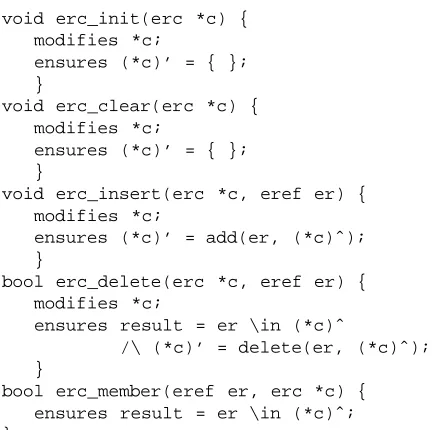
Figure 27 specifies functions operating on an abstract type, erc (for employee ref collection), that contains erefs. An erc is basically a bag with a pair of functions that make it possible to iterate over its elements. It is used in the implementation of empset and dbase.
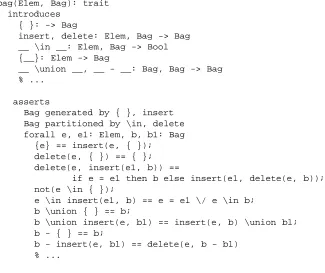
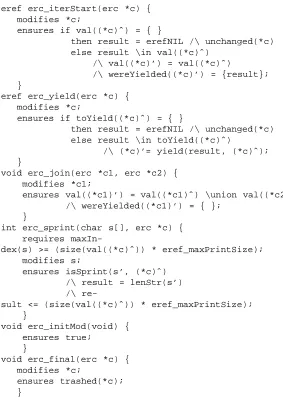
The iteration functions add some complexity to the specification. This shows up most notably in erc.lsl, Figure 25. The partitioned by clause indicates that erc values can be viewed as pairs of bags; the relevant portions of bag.lsl are given in Figure 26, and the complete trait appears in Appendix B, Figure 43. The operator val maps an erc to the bag of erefs that have been inserted (and not deleted). The operator wereYielded maps an erc to the bag of values that have been marked as yielded (by the yield operator). The derived operator toYield maps an erc to the bag of values that remain to be yielded. These operators are used in the specification of the functions erc iterStart and erc yield.
erc: trait
includes bag(eref, erefBag)
introduces { }: -> erc
add, yield, delete: eref, erc -> erc val, wereYielded, toYield: erc -> erefBag __ \in __: eref, erc -> Bool
asserts
erc generated by { }, add, yield erc partitioned by val, wereYielded forall ic: erc, e, e1: eref
val({ }) == { };
val(add(e, ic)) == insert(e, val(ic)); val(yield(e, ic)) == val(ic);
val(delete(e, ic)) == delete(e, val(ic));
wereYielded({ }) == { };
wereYielded(add(e, ic)) == wereYielded(ic);
wereYielded(yield(e, ic)) == insert(e, wereYielded(ic)); wereYielded(delete(e, ic)) == delete(e, wereYielded(ic));
toYield(ic) == val(ic) - wereYielded(ic);
e \in ic == e \in val(ic)
bag(Elem, Bag): trait introduces
{ }: -> Bag
insert, delete: Elem, Bag -> Bag __ \in __: Elem, Bag -> Bool {__}: Elem -> Bag
__ \union __, __ - __: Bag, Bag -> Bag % ...
asserts
Bag generated by { }, insert Bag partitioned by \in, delete forall e, e1: Elem, b, b1: Bag
{e} == insert(e, { }); delete(e, { }) == { }; delete(e, insert(e1, b)) ==
if e = e1 then b else insert(e1, delete(e, b)); not(e \in { });
e \in insert(e1, b) == e = e1 \/ e \in b; b \union { } == b;
b \union insert(e, b1) == insert(e, b) \union b1; b - { } == b;
[image:46.612.138.463.146.419.2]b - insert(e, b1) == delete(e, b - b1) % ...
Figure 26: bag.lsl fragment
Typically, client code that uses these functions will be of the form,
eref er; erc s;
. . .
for(er = erc_iterStart(s); er != erefNIL;
er = erc_yield(s)) {
Body of loop that does something with each er from s. }
If the body of the loop were guaranteed not to change the erc being iterated over, both the specification and the implementation of erc could be considerably simplified. However, such a restriction is not usually reasonable. Allowing for modifications within the body of the loop raises several questions about the semantics of the functions, among them,
ž If an element is inserted in the erc within the body of the loop will it be yielded?
does it get yielded?
ž If, within the body of the loop, an element gets yielded, deleted and then reinserted, does it get yielded again?
The answers, according to this specification, are Yes, No, and Yes, respectively.
Again, the implementation is deferred to Appendix A, Figures 33 and 34.
3.8
Ereftab
Ereftab, Figures 28 and 29, is the last module in our example. It is used to create a one-to-one mapping from employees to erefs. It makes it unnecessary to store multiple copies of the same employee record within the implementation of empset.
The intended use of ereftab insert is to put an employee in the table only after a lookup
imports eref;
abstract type erc;
uses erc, sprint(erc, char[]);
void erc_init(erc *c) { modifies *c;
ensures (*c)’ = { }; }
void erc_clear(erc *c) { modifies *c;
ensures (*c)’ = { }; }
void erc_insert(erc *c, eref er) { modifies *c;
ensures (*c)’ = add(er, (*c)ˆ); }
bool erc_delete(erc *c, eref er) { modifies *c;
ensures result = er \in (*c)ˆ
/\ (*c)’ = delete(er, (*c)ˆ); }
[image:47.612.134.354.406.621.2]bool erc_member(eref er, erc *c) { ensures result = er \in (*c)ˆ; }