Data Communications C25-384-101 Terminals
Digital Equipment
Corporation
VT300 Display Family
In this report:
Product Summary
Analysis ... -102
Editor's Note
Digital now offers the VT320,
Characteristics ... -104
VT330, and VT340 displays,
succes-sors to the VT200 family that
pro-Pricing ... -105
vide complete
backward-compatibility with improved
ergonomics and functionality.
Digi-tal continues to provide service for
the older line of displays, however.
Description
The VT320 is a monochrome
dis-play that provides single-session
support for text-oriented
applica-tions. The VT330 and VT340 both
provide dual sessions and graphics
capability.
Strengths
In addition to introducing
dual-session support with the VT300
fam-ily, Digital designed higher
resolution, faster processing speed,
and greater customization capability
into the displays while lowering
prices significantly.
Limitations
Vendors such as Wyse Technology,
TeleVideo, Microterm, and
Hewlett-Packard offer VT clones that provide
enhancements such as multiple
dis-play configurations, more function
keys and interfacing options, and
more internal memory.
© 1990 McGraw-Hili. Incorporated. Reproduction Prohibited. Datapro Research. Delran NJ 08075 USA
Competition
VT320-compatible displays are
of-fered by TeleVideo, Wyse
Technol-ogy, Qume Corporation,
Microterm, and Hewlett-Packard.
Microterm also offers VT330- and
VT340-compatible displays. AT&T,
Falco Data Products, and a few other
vendors offer VT320 emulation in
their general-purpose ASCII
dis-plays.
Vendor
Digital Equipment Corp. (DEC)
146 Main Street
Maynard, MA 01754-2571
(508) 493-5111
Price
The North American Version of the
VT320 sells for $575; the
interna-tional version of the display costs
$625. The VT330 and VT340 sell for
$1,995 and $2,795, respectively.
C25-384-102 Terminals
Analysis
Product Strategy
Digital Equipment Corporation's VT300 family,
which consists of the VT320, VT330, and VT340
display terminals, is the third and most advanced
generation of display terminals designed by Digital
for communications with applications running on
VAX host computers.
These displays feature full backward
compati-bility with their predecessors, the VT220, VT240,
and VT241 models, while providing ergonomic
improvements and better functionality. With the
VT330 and VT340, Digital introduced dual session
capability. The VT300 products operate up to five
times faster than the older models, provide higher
resolution, and display fonts that are more pleasing
to the eye. Enhanced setup menus provided with
these displays allow greater keyboard
customiza-tion.
The VT320 is an entry-level, single-session
display that replaces the VT220. Designed for
text-oriented applications, the VT320 includes a
14-inch monochrome screen that displays green,
The Digital Equipment Cor-poration VT300/amily con-sists a/the VT320, VT330, and VT340 displays. The
VT320 is a single-session text terminal; the VT330 is a monochrome text/graphics terminal with dual-session capability and support/or six levels
0/
shading; the VT340 is a 16-color text/ graphics terminal also with dual-session capability.JULY 1990
Dlttltal Equipment
Corporetlon
VT300 Dlaple, 'eml.,
Datapro Reports on Data Communications
amber, or paper-white characters in 80- and
132-column formats. This terminal provides the
small-est footprint of any display yet offered by Digital.
Unlike the VT240 andVT241· displays, the
VT330 and VT340 support dual-session capability
over one or two wires. The VT330, a monochrome
model, comes with a 14-inch screen that displays
either green, amber, or paper-white characters in
80- or 132-column text arrangements. For graphics
applications, up to four levels of shading are
sup-ported. The VT340 includes a 13-inch screen that
supports 16-color graphics and 80- or 132-column
text arrangements.
Competitive Position
Digital occupies a distinct but somewhat separate
subsection of the asynchronous display market
re-ferred to as the ANSI segment. With the release of
the VT100 display in 1978, Digital became the first
vendor to support the American National
Stan-dards Institute's (ANSI's) X3.64 standard, which
. was first published in 1977 to standardize control
codes for all terminals. To offer VT emulation,
other vendors have also adopted this standard for
their display terminals.
Various research organizations have
esti-mated that Digital holds from 60 to 80 percent of
the ANSI terminal market. Over 1 million VT 1 00
and one millionVT200 family displays were sold
prior to their discontinuance, and Digital has
re-cently announced the shipment of the one
mil-lionth VT320 display.
Data Communications CorpoNtIon
VT300
DI8pI.,
'.mll,Company Profile
Digital Equipment
Corporation
Corporate Headquarters 146 Main Street
Maynard, MA 01754-2571 (508) 493-5111
In Canada
Digital Equipment of Can-ada, Ltd.
P.O. Box 13000, 100 Het-zbug Road
Kanata, ON K2K 2A6 (613) 592-5111
European Headquarters is in Geneva, Switzerland. General International Headquarters is in Acton, MA.
Officers
Pres.: Kenneth H. Olsen Sr. VP, Mrktg., Sales, Ser-vice, Channels, Interna-tional: John J. Shields Sr. VP, Eng. & Mfg.: John F. Smith
Pres. & CEO, European Operations: Pier Carlo Falotti
Company Background Year Founded: 1957 No. Employees: ,125,000
Digital is a leading sup-plier of computer systems and associated peripher-als, networks, communi-cations, software, and services. The products are used in a variety of applications in business, industry, government, and scientific areas. Both di-rect and indidi-rect channels are used to market and support products world-wide.
In 1977, Digital introduced the VAX Series of 32-bit minicomputers, one of the most successful product launches in computer dustry history. Since in-troducing the first VAX, the 11/780, Digital has continued to enhance the basic VAX architecture
The rest of the ANSI market is controlled by
general-purpose ASCII display vendors that offer
VT clones and VT emulation. The VT100 is the
most widely emulated asynchronous terminal, with
over one million imitations sold. Digital also
suf-fered competition from numerous low-priced
VT200 imitators, which caused the vendor to
ad-just prices accordingly.
At present, there is a small handful
ofVT300-compatible displays on the market. Wyse
Technol-ogy's WY-185, Qume Corporation's QVT323-EV,
Microterm's model 5520, and Hewlett-Packard's
© 1990 McGraw·HiII, Incorporated. Reproduction Prohibited. Datapro Research. Delran NJ 08075 USA
and VAX/VMS operating system with announce-ments of new and more powerful VAX models. The current VAX family consists of V AXstation desktop workstations; MicroVAX departmental systems; VAX 6000 Se-ries medium-range sys-tems; and VAX 9000 Series high-end main-frames.
In addition to the VAX family, Digital offers DEC-systems that use reduced instruction set computing (RISC) technology and operate under UL TRIX, Digital's implementation of the UNIX operating system.
To support its systems, Digital offers disk, storage array, and solidstate memory products, optical disks, tape devices, dis-plays, and printers. Be-sides hardware and software, Digital offers a range of communications and networking products and services.
Financial Profile For the 1989 fiscal year, Digital reported revenues
C25-384-103 Terminals
of $12.7 billion, up 11 per-cent from $11.5 billion the previous year. Net income was $1.1 billion, down 8 percent from $1.3 billion in 1988. According to the president's letter to Digi-tal's shareholders in 1989, "Digital's revenue growth came from over-seas markets, particularly Europe and Japan." Management Statement
Digital has a $1.5 billion dollar investment in new product development. Ac-cording to the president's letter, Digital is "continu-ing to invest heavily in VAX and RISC-based sys-tems and VMS and UNIX software." Within the next year, "Digital's strategy is to focus on the computing environment of the 1990s. Digital will offer the widest selection of technology and continue to make sig-nificant investments in R&D and new products in response to dynamically changing customer needs."
HP
700/32
displays boast VT320-compatibility
with enhancements such as more programmable
function keys, greater interfacing flexibility, higher
resolution, faster transmission speeds, multiple
display configurations, and more screens of
inter-nal storage. The TeleVideo and Wyse models sell
for only $499. MMicroterm's 5530 display, a
VT330-compatible product priced at $1,495,
pro-vides 16 shades of gray. Microterm also offers a
VT340-compatible terminal, the 5540, which sells
for only $2,350 and provides color mapping for
each individual session and 16 colors from a
C25-384-104 Terminals
262, 144-color palette. Both the 5530 and 5540
sup-port transmission speeds as high as 38.4K bps. A
few vendors, including AT&T, Falco Data
Prod-ucts, and Visentech Systems, have incorporated
VT320 emulation into their general-purpose ASCII
displays. Vendors continue to play the better price/
performance game.
It
appears, however, that fewer
of them are able or willing to match Digital's
moves this time around.
Decision Points
The VT330 family provides two major
improve-ments over its predecessors-dual session
capabil-ity (for the VT330 and VT340) and up to five
times faster processing speed. These models offer
higher resolution, more versatility, easier-to-read
display fonts, and a new paper-white phosphor
character color for the monochrome VT320 and
VT330 models. The VT340 supports up to 16
col-ors, while the older VT241 supports only four.
These enhancements, with much more competitive
prices, have helped Digital to maintain its strong
position in the display market.
Digital's VT300 products are completely
backward-compatible with previous Digital
dis-plays, as well as the software supporting them-a
factor that gives Digital a decided advantage over
general-purpose ASCII terminals that offer only
VT emulation. Digital's reputation for
manufactur-ing reliability and full service and support for its
VAX systems also contribute to the vendor's
ad-vantage over competitors offering VT clones with
improved price/performance.
Characteristics
Models: VT320, VT330, and VT340
Date Announced: VT320-August 1987; VT330 and VT340-ApriI1987.
JULY 1990
Digital Equipment Corporation
VT300 Display Family
Datapro Reports on Data Communications
Date First Installed: VT320-September 1987; VT330 and VT340-May 1987.
Number of Installed Units: Over 1 million VT300 termi-nals have been installed.
Serviced by: Digital Equipment Corporation.
System Components
The Digital VT300 display terminal family consists of three models: the VT320, VT330, and the VT340. All three conform to the ANSI X3.64 standard.
Transmission Specifications
Transmission is asynchronous in full-duplex mode, with user-selectable local echo, seven- or eight-bit ASCII code, one or two stop bits, and any of the following types of parity: even, odd, none, even no-check, odd no-check, mark, and space (seven-bit only). Users se-lect host communications parameters through setup screens. Characters are transmitted one by one, as each key is depressed. Selectable transmission speeds of 75, 110, 150,300,600, 1200,2400,4800,9600, and 19,200 bps are supported over DEC423 or RS-232-C cable.
Device Control
The VT300 is fully backward compatible with the VT220 display; similarly, the VT330 and VT340 are fully com-patible with the VT240 and VT241 displays, respectively. Users can install and use VT300 family terminals with-out software modifications to existing application pro-grams that support VT200 family products.
The default character sets for these displays are the Digital Multinational ISO Latin-1 character sets. With VT330 and VT340 displays, and the international version of the VT320, users can optionally select English, Ger-man, or French versions of the setup menu system, and any of 12 national replacement character sets.
Visual attributes of these displays include reverse video and text highlighting using a blinking block or a blinking underline. Both the VT330 and VT340 support two high-level graphics instruction sets: Digital's Re-mote Graphics Instruction Set (ReGIS) and Tektronix' 4010/4014 graphics protocols.
Programmable function keys enable the user to define and store commonly used sets of commands (up to 256 characters in length), which can be executed with a single keystroke.
The VT320 includes a 14-inch, flat, antiglare monochrome screen with either green, amber, or paper-white characters, a Digital LK201 keyboard that comes in 16 different international versions, and an integrated tilt mechanism. Swivel capability is offered optionally
Data Communications Corpol'lltlon
VT300 DI.play Family
through an alternate type of base. Each keyboard style provides 15 programmable function keys and a numeric keypad.
Designed for text-oriented applications, the VT320 provides single-session capability with a screen ar-rangement of 24 lines by either 80 or 132 columns, and a maximum screen resolution of 1,200 pixels by 300 scan lines. The screen includes a 25th status line, which can be programmed to display either system messages or terminal-specific information, such as cursor position or printing status. The VT320 provides a series of setup screens, allowing the user to customize keyboard, host communications, printing, and display characteristics.
The VT320 comes in two versions: a North Ameri-can version and an international version. Both types include two DEC423 MMJ serial communications ports-one for a host connection and one for a display-attached Digital printer. Adapters for connecting non-Digital printers are also available optionally. The North American version accommodates 120 volt power, and includes a DEC423 cable and a 25-pin adapter that is compatible with most standard U.S. modems. The inter-national version accommodates 240 volt systems, and provides full modem support through an RS-232-C, 25-pin adapter. The international version also includes setup screens in English, French, and German.
The VT330 and VT340 are dual-session displays designed for graphics and text applications. They both provide storage of six screens of text or two screens of graphics for fast switching between sessions. The VT330 includes a 14-inch, flat, monochrome screen with either green, amber, or paper-white characters. For graphics applications, the VT330 supports four levels of shading, providing a maximum screen resolution of 800 pixels by 500 lines. The VT340 includes a 13-inch con-vex screen that displays up to 16 colors selectable from
© 1990 McGraw-Hili, Incorporated. Reproduction Prohibited. Datapro Research. Delran NJ 08075 USA
C2S-384-105 Terminals
a palette of 4,096 colors, and a maximum screen resolu-tion of 800 pixels by 500 lines, Both models come with a Digital LK201 keyboard available in 16 international ver-sions. Each keyboard style provides 15 programmable function keys and a numeric keypad.
The VT330 and VT340 provide screen arrange-ments of 24 lines by 80 or 132 columns, and a 25th sta-tus line for system messages or terminal-specific information, such as cursor position or printing status. Users can view two sessions simultaneously in split-screen mode, or switch between full-split-screen sessions with a hot key. A comprehensive set of menu screens (in English, French, and German) allows users to cus-tomize keyboard, display, host communications, and printing characteristics.
The VT330 and VT340 provide one RS-232-C host communications port and one DEC423 host communi-cations port. Dual sessions, running on a single host, can be conducted over a single cable, if desired, using Digital's Session Support Utility (SSU). Each VT330 and VT340 display also includes one DEC423 port for a display-attached printer. Adapters for non-Digital print-ers are available optionally.
Pricing
The North American version of the VT320 sells for $575, while the international version of the same display sells for $625. The VT330 and VT340 displays are priced at $1,995 and $2,795, respectively. Digital offers a wide selection of warranty and service agreements for these products. Users can choose on-site coverage up to 24 hours a day, seven days a week. Carry-in and mail-in repair arrangements are also available . •
Data Communications C25-384-101 Terminals
DEC
VT300 Video Display
Terminal Family
In this report:
Product Summary
Analysis ...
-102
Editor's Note
Digital now offers the VT320,
Characteristics ...
-104
VT330, and VT340 displays,
succes-sors to the VT200 family that
pro-Pricing ...
-105
vide complete
backward-compatibility with improved
ergonomics and functionality.
Digi-tal continues to provide service for
the older line of displays, however.
Description
The VT320 is a monochrome
moni-tor that provides single-session
sup-port for text-oriented applications.
The VT330 and VT340 both provide
dual sessions and graphics capability.
Strengths
In addition to introducing
dual-session support with the VT300
fam-ily, Digital designed higher
resolution, faster processing speed,
and greater customization capability
into the displays while lowering
prices significantly.
Limitations
Vendors such as Wyse Technology,
TeleVideo, Microterm, and
Hewlett-Packard offer VT clones that provide
enhancements such as multiple
dis-play configurations, more function
keys and interfacing options, and
more internal memory.
© 1990 McGraw-Hili, Incorporated. Reproduction Prohibited. Datapro Research. Delran NJ 08075 USA
Competition
VT320-compatible displays are
of-fered by TeleVideo, Wyse
Technol-ogy, Qume Corporation,
Microterm, and Hewlett-Packard.
Microterm also offers VT330- and
VT340-compatible displays. AT&T,
Falco Data Products, and a few other
vendors offer VT320 emulation in
their general-purpose ASCII
dis-plays.
Vendor
Digital Equipment Corp. (DEC)
146 Main Street
Maynard, MA 01754-2571
(508) 493-5111
Price
The North American Version of the
VT320 sells for $575; the
interna-tional version of the display costs
$625. The VT330 and VT340 sell for
$1,995 and $2,795, respectively.
C25-384-102 Terminals
Analysis
Product Strategy
Digital Equipment Corporation's VT300 family,
which consists of the VT320, VT330, and VT340
display terminals, is the third and most advanced
generation of display terminals designed by Digital
for communications with applications running on
VAX host computers.
These displays feature full backward
compati-bility with their predecessors, the VT220, VT240,
and VT241 models, while providing ergonomic
improvements and better functionality. With the
VT330 and VT340, Digital introduced dual session
capability. The VT300 products operate up to five
times faster than the older models, provide higher
resolution, and display fonts that are more pleasing
to the eye. Enhanced setup menus provided with
these displays allow greater keyboard
customiza-tion.
The VT320 is an entry-level, single-session
display that replaces the VT220. Designed for
text-oriented applications, the VT320 includes a
14-inch monochrome screen that displays green,
The Digital Equipment Cor-poration VT300 family con-sists of the VT320, VT330, and VT340 displays. The
VT320 is a single-session text terminal; the VT330 is a monochrome text/graphics terminal with dual-session capability and support for six levels of shading; the
VT340 is a 16-color text/ graphics terminal also with dual-session capability.
MAY 1990
DEC
VT300 Yid.eo Display Terminal Family
Datapro Reports on Data Communications
amber, or paper-white characters in 80- and
132-column formats. This terminal provides the
small-est footprint of any display yet offered by Digital.
Unlike the VT240 andVT241 displays, the
VT330 and VT340 support dual-session capability
over one or two wires. TheVT330, a monochrome
model, comes with a 14-inch screen that displays
either green, amber, or paper-white characters in
80- or 132-column text arrangements. For graphics
applications, up to four levels of shading are
sup-ported. The VT340 includes a 13-inch screen that
supports 16-color graphics and 80- or 132-column
text arrangements.
Competitive Position
Digital occupies a distinct but somewhat separate
subsection of the asynchronous display market
re-ferred to as the ANSI segment. With the release of
the VT 1 00 display in 1978, Digital became the first
vendor to support the American National
Stan-dards Institute's (ANSI's) X3.64 standard, which
was first published in 1977 to standardize control
codes for all terminals. To offer VT emulation,
other vendors have also adopted this standard for
their display terminals.
Various research organizations have
esti-mated that Digital holds from 60 to 80 percent of
the ANSI terminal market. Over 1 million VT100
and one million VT200 family displays were sold
prior to their discontinuance, and Digital has
re-cently announced the shipment of the one
mil-lionth VT320 display.
Data Communications VT300 Video Dlapl.y Termin.1 F.mlly
Company Profile
Digital Equipment
Corporation
Corporate
Headquarters
146 Main StreetMaynard, MA 01754-2571 (508) 493-5111
In Canada
Digital Equipment of Can-ada, Ltd.
P.O. Box 13000,100 Het-zbug Road
Kanata, ON K2K 2A6 (613) 592-5111
European Headquarters is in Geneva, Switzerland. General International Headquarters is in Acton, MA.
Officers
Pres.: Kenneth H. Olsen Sr. VP, Mrktg., Sales, Ser-vice, Channels, Interna-tional: John J. Shields Sr. VP, Eng.
&
Mfg.: John F. SmithPres. & CEO, European Operations: Pier Carlo Falotti
Company Background
Year Founded: 1957 No. Employees: 125,000Digital is a leading sup-plier of computer systems and aSSOCiated peripher-als, networks, communi-cations, software, and services. The products are used in a variety of applications in business, industry, government, and scientific areas. Both di-rect and indidi-rect channels are used to market and support products world-wide.
In 1977, Digital introduced the VAX Series of 32-bit minicomputers, one of the most successful product launches in computer dustry history. Since in-troducing the first VAX, the 11/780, Digital has continued to enhance the basic VAX architecture
The rest of the ANSI market is controlled by
general-purpose ASCII display vendors that offer
VT clones and VT emulation. The VT100 is the
most widely emulated asynchronous terminal, with
over one million imitations sold. Digital also
suf-fered competition from numerous low-priced
VT200 imitators, which caused the vendor to
ad-just prices accordingly.
At present, there is a small handful
ofVT300-compatible displays on the market. Wyse
Technol-ogy's WY-185, Qume Corporation's QVT323-EV,
Microterm's model 5520, and Hewlett-Packard's
II> 1990 McGraw-Hili, Incorporated. Reproduction Prohibited. Datapro Research. Delran NJ 08075 USA
and VAXNMS operating system with announce-ments of new and more powerful VAX models. The current VAX family consists of VAXstation desktop workstations; MicroVAX departmental systems; VAX 6000 Se-ries medium-range sys-tems; and VAX 9000 Series high-end main-frames.
In addition to the VAX family, Digital offers DEC-systems that use reduced instruction set computing (RISC) technology and operate under UL TRIX, Digital's implementation of the UNIX operating system.
To support its systems, Digital offers disk, storage array, and solidstate memory products, optical disks, tape devices, dis-plays, and printers. Be-sides hardware and software, Digital offers a range of communications and networking products and services.
Financial Profile
For the 1989 fiscal year, Digital reported revenuesC25-384-103
Terminals
of $12.7 billion, up 11 per-cent from $11.5 billion the previous year. Net income was $1.1 billion, down 8 percent from $1.3 billion in 1988. According to the preSident's letter to Digi-tal's shareholders in 1989, "Digital's revenue growth came from over-seas markets, particularly Europe and Japan."
Management
Statament
Digital has a $1.5 billion dollar investment in new product development. Ac-cording to the president's letter, Digital is "continu-ing to invest heavily in VAX and RISC-based sys-tems and VMS and UNIX software." Within the next year, "Digital's strategy is to focus on the computing environment of the 1990s. Digital will offer the widest selection of technology and continue to make sig-nificant investments in R&D and new products in response to dynamically changing customer needs."
HP
700/32 displays boast VT320-compatibility
with enhancements such as more programmable
function keys, greater interfacing flexibility, higher
resolution, faster transmission speeds, multiple
display configurations, and more screens of
inter-nal storage. The TeleVideo and Wyse models sell
for only $499. MMicroterm's 5530 display, a
VT330-compatible product priced at $1,495,
pro-vides 16 shades of gray. Microterm also offers a
VT340-compatible terminal, the 5540, which sells
for only $2,350 and provides color mapping for
each individual session and 16 colors from a
C2S-384-104 Terminals
262, 144-color palette. Both the 5530 and 5540
sup-port transmission speeds as high as 38.4K bps. A
few vendors, including AT&T, Falco Data
Prod-ucts, and Visentech Systems, have incorporated
VT320 emulation into their general-purpose ASCII
displays. Vendors continue to play the better price/
performance game.
It
appears, however, that fewer
of them are able or willing to match Digital's
moves this time around.
Decision Points
The VT330 family provides two major
improve-ments over its predecessors-dual session
capabil-ity (for the VT330 and VT340) and up to five
times faster processing speed. These models offer
higher resolution, more versatility, easier-to-read
display fonts, and a new paper-white phosphor
character color for the monochrome VT320 and
VT330 models. The VT340 supports up to 16
col-ors, while the older VT241 supports only four.
These enhancements, with much more competitive
prices, have helped Digital to maintain its strong
position in the display market.
Digital's VT300 products are completely
backward-compatible with previous Digital
dis-plays, as well as the software supporting them-a
factor that gives Digital a decided advantage over
general-purpose ASCII terminals that offer only
VT emulation. Digital's reputation for
manufactur-ing reliability and full service and support for its
VAX systems also contribute to the vendor's
ad-vantage over competitors offering VT clones with
improved price/performance.
Characteristics
Models: VT320, VT330, and VT340
Date Announced: VT320-August 1987; VT330 and VT340-April 1987.
MAY 1990
DEC
VT300 Video Display Terminal Family
Datapro Reports on Data Communications
Date First Installed: VT320-September 1987; VT330 and VT340-May 1987.
Number of Installed Units: Over 1 million VT300 termi-nals have been installed.
Serviced by: Digital Equipment Corporation.
System Components
The Digital VT300 display terminal family consists of three models: the VT320, VT330, and the VT340. All three conform to the ANSI X3.64 standard.
Transmission Specifications
Transmission is asynchronous in full-duplex mode, with user-selectable local echo, seven- or eight-bit ASCII code, one or two stop bits, and any of the following types of parity: even, odd, none, even no-check, odd no-check, mark, and space (seven-bit only). Users se-lect host communications parameters through setup screens. Characters are transmitted one by one, as each key is depressed. Selectable transmission speeds of 75, 110, 150,300,600, 1200,2400,4800,9600, and 19,200 bps are supported over DEC423 or RS-232-C cable.
Device Control
The VT300 is fully backward compatible with the VT220 display; similarly, the VT330 and VT340 are fully com-patible with the VT240 and VT241 displays, respectively. Users can install and use VT300 family terminals with-out software modifications to existing application pro-grams that support VT200 family products.
The default character sets for these displays are the Digital Multinational ISO Latin-1 character sets. With VT330 and VT340 displays, and the international version of the VT320, users can optionally select English, Ger-man, or French versions of the setup menu system, and any of 12 national replacement character sets.
Visual attributes of these displays include reverse video and text highlighting using a blinking block or a blinking underline. Both the VT330 and VT340 support two high-level graphics instruction sets: Digital's Re-mote Graphics Instruction Set (ReGIS) and Tektronix' 4010/4014 graphics protocols.
Programmable function keys enable the user to define and store commonly used sets of commands (up to 256 characters in length), which can be executed with a single keystroke.
The VT320 includes a 14-inch, flat, antiglare monochrome screen with either green, amber, or paper-white characters, a Digital LK201 keyboard that comes in 16 different international versions, and an integrated tilt mechanism. Swivel capability is offered optionally
Data Communications VT300 Video Display Terminal Family
through an alternate type of base. Each keyboard style provides 15 programmable function keys and a numeric keypad.
Designed for text-oriented applications, the VT320 provides single-session capability with a screen ar-rangement of 24 lines by either 80 or 132 columns, and a maximum screen resolution of 1 ,200 pixels by 300 scan lines. The screen includes a 25th status line, which can be programmed to display either system messages or terminal-specific information, such as cursor position or printing status. The VT320 provides a series of setup screens, allowing the user to customize keyboard, host communications, printing, and display characteristics.
The VT320 comes in two versions: a North Ameri-can version and an international version. Both types include two DEC423 MMJ serial communications ports-one for a host connection and one for a display-attached Digital printer. Adapters for connecting non-Digital printers are also available optionally. The North American version accommodates 120 volt power, and includes a DEC423 cable and a 25-pin adapter that is compatible with most standard U.S. modems. The inter-national version accommodates 240 volt systems, and provides full modem support through an RS-232-C, 25-pin adapter. The international version also includes setup screens in English, French, and German.
The VT330 and VT340 are dual-session displays designed for graphics and text applications. They both provide storage of six screens of text or two screens of graphics for fast switching between sessions. The VT330 includes a 14-inch, flat, monochrome screen with either green, amber, or paper-white characters. For graphics applications, the VT330 supports four levels of shading, providing a maximum screen resolution of 800 pixels by 500 lines. The VT340 includes a 13-inch con-vex screen that displays up to 16 colors selectable from
@ 1990 McGraw-Hili, Incorporated. Reproduction Prohibited. Datapro Research. DelranNJ 08075 USA
C2S-384-10S Terminals
a palette of 4,096 colors, and a maximum screen resolu-tion of 800 pixels by 500 lines. Both models come with a Digital LK201 keyboard available in 16 international ver-sions. Each keyboard style provides 15 programmable function keys and a numeric keypad.
The VT330 and VT340 provide screen arrange-ments of 24 lines by 80 or 132 columns, and a 25th sta-tus line for system messages or terminal-specific information, such as cursor position or printing status. Users can view two sessions simultaneously in split-screen mode, or switch between full-split-screen sessions with a hot key. A comprehensive set of menu screens (in English, French, and German) allows users to cus-tomize keyboard, display, host communications, and printing characteristics.
The VT330 and VT340 provide one RS-232-C host communications port and one DEC423 host communi-cations port. Dual sessions, running on a single host, can be conducted over a single cable, if desired, using Digital's Session Support Utility (SSU). Each VT330 and VT340 display also includes one DEC423 port for a display-attached printer. Adapters for non-Digital print-ers are available optionally.
Pricing
The North American version of the VT320 sells for $575, while the international version of the same display sells for $625. The VT330 and VT340 displays are priced at $1,995 and $2,795, respectively. Digital offers a wide selection of warranty and service agreements for these products. Users can choose on-site coverage up to 24 hours a day, seven days a week. Carry-in and mail-in repair arrangements are also available . •
Terminals
Digital Equipment Corporation VT100
Video Display Terminal Family
Since its introduction in
1978,Digital Equipment Corporation
has sold 1,000,000 VT100 terminals.
MANAGEMENT SUMMARY
UPDATE: Upon the introduction of the VT200 display
terminal family in
1983,Digital Equipment Corporation
stated that
itwould continue to offer the older VT100 line for
at least two years. Digital has recently slashed prices for its
VT100 video display terminal family, indicating that the
product line will soon be discontinued. As of now,
~heVT100
terminals are no longer being manufactured; we have
updat-ed this report due to the significance of the product line.
The end is finally near for the VT 1 00 display terminal.
Following the introduction of the VT200 terminal family in
1983, Digital has made good on its promise to keep the
VT100 available for at least two additional years. In
Octo-ber 1985, however, the company announced significant
price cuts for the VT 1 00; this move is likely to clear out
Digital's remaining inventory of VT100 terminals.
Digital's VT100 Video Display Terminal stands as the
most successful and most widely emulated ASCII display
terminal ever. The VT100, which is used chiefly with
Digital's V AX line of computers, created an emulation
market that is second only to the IBM 3270 market in size.
According to Digital, VT100 sales reached the 1
million-unit mark in the fall of 1985, some seven years after its
introduction in 1978. The VT 100 succeeded the company's
earlier VT52 terminal; in November 1983, Digital
intro-duced the VT200 Series of displays, which succeeds the
VT100.
In its basic configuration, the VT 1 00 can display 24 lines of
80 characters, or 14 lines of 132 characters. Transmission is
performed in character mode. Like all members of the
family, the VT100 features a 12-inch (diagonal) display
screen and detachable, typewriter-style keyboard. Other
standard features include scrolling (jump or smooth),
re-The VT100 Video Display Terminal is an acknowledged standard in the terminal in-dustry. It is the most popular ASCII terminal ever produced, with 1,000,000 units sold since its introduction in 1978. A large emu-lation market has sprung from the VT100. Digital Equipment Corporation has intro-duced the VT200 display terminal family, a new generation that will replace the VT100 product line.
MODELS: VT1 00, VT102, VT125, and VT131.
DISPLAY: All models feature a 12-inch (di-agonal) display; characters are displayed in white. All models feature 80-/132-column display capability.
KEYBOARD: All models feature a detach-able keyboard with a typewriter-style layout.
COMPETITION: Several vendors continue to offer terminals with VT100 emulation; how-ever, the market is now geared toward VT200 terminal emulation.
PRICE: Purchase prices range from $895 to $3,800.
CHARACTERISTICS
VENDOR: Digital Equipment Corporation, 146 Main Street, Maynard, MA 01754-2571. Telephone (617) 897-5111.
DATE OF ANNOUNCEMENT: VT100-June 1978; VT125-July 1981; VTlOl and VTl31-September 1981.
DATE OF FIRST DELIVERY: VT100-September 1978; VTl25-September 1981; VTI0l, VTI02, and
VT131-October 1981. .
NUMBER DELIVERED TO DATE: 1,000,000 (worldwide).
SERVICED BY: Digital Equipment Corporation. MODELS
The VT100 terminals are stand-alone, desktop units featur-ing a 12-inch (diagonal) display screen and a detachable, typewriter-style keyboard. The following models currendy comprise the famBy:
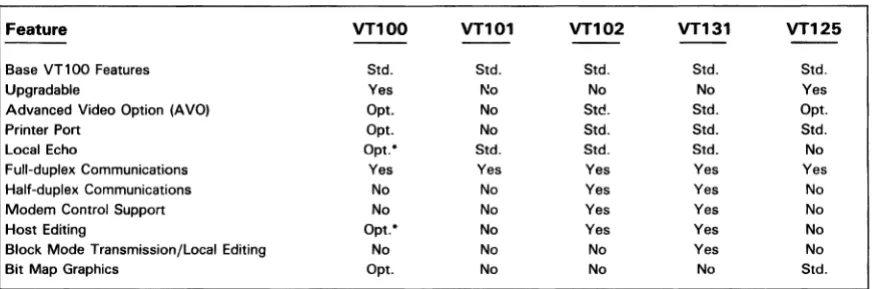
• VT100-The basic model. The unit is upgradable, and can be configured with the Advanced Video Option and the Printer Port Option.
• VTI01-A nonupgradable, entry-level model; it contains all of the base features of the VT100, but will accept no options. The VTlOI is no longer available.
• VTI02-A1so nonupgradable, but contains all VT100 base features plus the AVO and Printer Port Option as standard features.
MARCH 1986 © 1986 DATA PRO RESEARCH CORPORATION, DELRAN, NJ 08075 USA
C25-384-102 Terminals
Digital Equipment Corporation VT100
Video Display Terminal Family
J::>
verse video, variable screen brightness, audible key click,
and auto repeat keys. The VT100 will support expanded
capabilities and options. By adding the Advanced Video
Option (AVO), the VT100 gains the following features: four
alternate character attributes-bold, underline, blink, and
reverse-which can be selected on a character-by-character
basis; expanded display memory allowing for a display
format of 24 lines by 132 characters; and provision for
alternate character sets.
In 1981, Digital Equipment Corporation expanded the
VTl 00 family by adding several submodels of the VTl 00.
These included the VTlOI (no longer available), an
entry-level model without the expansion capabilities of the
VT100; the VTl02, like the VT101, a nonexpandable
model, but including the Advanced Video Option and
Printer Port Option; the VT131, a block mode version of
the VTl02; and the VTl25, a terminal with business
graphics as well as alphanumeric capability. With the
intro-duction of the VT200 Series, Digital Equipment
Corpora-tion placed these submodels in "maintenance mode"; this
meant that they would no longer be manufactured, but
Digital would continue to supply them on an "as available"
basis and to support them. Production of the VT 1 00 has
also ceased, but Digital has promised to continue to
sup-port its installed base of VT100 terminals for service and
repair.
COMPETITIVE POSITION
As was mentioned earlier in this report, the VT100 Video
Display Terminal achieved such widespread acceptance
that
it
created a sizable emulation market. Virtually every
major general-purpose ASCII display terminal vendor
in-cluded a VT100 emulator in its product line. Now, the
same can be said of the new VT200 terminals, particularly
the VT220, a direct replacement for the VT100. However,
Digital is now positioned to take an even larger share of this
market.
When the VT 1 00 was introduced, Digital did not anticipate
the huge demand for the terminal; because of this, it was
unable to sufficiently meet the demand
it
had created for
the terminal. Lead time for delivery of a VTl 00 terminal
was often three-to-five months. In addition, the VT100
carried a high price tag. The independent terminal vendors
made the most of this opportunity, offering lower priced
emulators and shorter delivery times.
Digital has apparently learned from its VT100 experience.
The new VT200 terminals are priced competitively, and
are readily available. Nevertheless, the independent
ven-dors have jumped on the VT200 bandwagon quickly, and
VT200 clones are plentiful. The result, of course, is that the
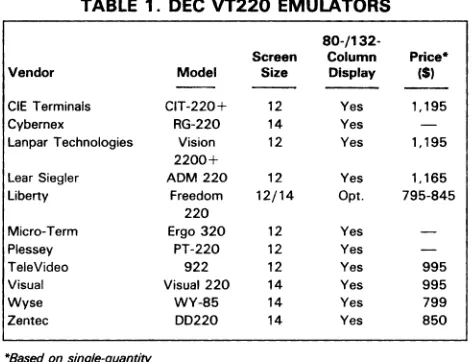
user can now purchase a VT220 emulator for as little as
$795; and prices may fall even lower.
ADVANTAGES AND RESTRICTIONS
The VT100 achieved its high degree of success despite the
fact that, traditionally, it carried a high price tag. The
functions available on the VT 190 (particularly the full-
J::>
~ • VT12S-Contains all of the features of the VT100, plus a business graphics capability. The VT100 can be upgraded to the VT12S via the VT12S upgrade kit.
• VT131-The block mode/local edit version ofthe VT102.
TRANSMISSION SPECIFICATIONS
Transmission is asynchronous, in full-duplex mode (the VT102 and VT131 also support half-duplex mode); at speeds of SO, 75, 110, 134.5, 150, 200, 300, 600, 1200, 1800, 2000,2400,3600,4800,9600, and 19,200.bits per second. The 7- or 8-bit ASCII code is used. Odd, even, mark, or no parity is selectable from the keyboard. Local echo is stan-dard on the VTI01, VT102, and VT131, and available on VT100s equipped with the printer port. An RS-232-C inter-face is standard; a 20 ma current loop interinter-face is optional. DEVICE CONTROL
On the VT100, VT101, VT102, and VT12S, transmission is performed on a character-by-character basis as each key is depressed by the operator. On the VT131, data is stored in the terminal buffer as it is keyed. It is then transmitted in block form. The VT100 terminal memory is nonvolatile-feature settings are retained when the terminal is powered down.
The selection and storage of local terminal features is performed in Set-Up mode. When entering Set-Up mode, the status ofthe features stored in the temporary memory is shown on the screen. Features can be changed, and new features stored on a temporary basis by leaving Set-Up mode. The new features can be stored on a fixed basis by performing a save operation. If a recall operation is per-formed, the terminal is reset, or terminal power is turned off, all temporary settings are replaced by the features that have been stored on a fixed basis.
The VT100 family terminals are compatible with either of two different programming standards: ANSI, or Digital F,quipment Corporation VTS2. In ANSI mode, the VT100 terminals will respond to software based on ANSI stan-dards. In VTS2 mode, the terminals will respond to software written for use with Digital Equipment Corporation's older VTS2 video display terminal.
In addition to selection of ANSI or VTS2 mode, the follow-ing features can be selected when in Set-Up mode (note that not all features are available on all models); answerback message, full-duplex communications, host editing, local edit/block mode transmission, local echo, auto X-on/X-off, display format (80- or 132-column), on-line/local operation, new line, parity, parity sense, receive/transmit speeds, scroll, tabs, wraparound, character set (U.S., U.K., and special line drawing sets are standard on all models), cursor, key click, margin bell, screen background (normal or re-verse), screen brightness, and auto repeat.
Cursor controls move the cursor up, down, left. right, home, and return. The cursor may be selected as either a blinking block or blinking underline.
Advanced Video Option provides dual intensity, blink, and underline functions in any combination with each other and with reverse video. This option also adds 10 additional 132-character display lines for a total of 24 lines. The Advanced Video Option also provides additional circuitry to add an alternate or custom character set in the future. Thus, two character sets would reside in the terminal.
The VT100 provides composite video input and output. Composite video input permits the user to overlay video output from a remote terminal or processor without interfer-
J
© 1986 DATAPRO RESEARCH CORPORATION, DELRAN, NJ 08075 USAREPRODUCTION PROHIBITED
Terminals
Digital Equipment Corporation VT100
Video Display Terminal Family
Feature
VT100
Base VT 1 00 Features Std.
Upgradable Yes
Advanced Video Option (AVO) Opt.
Printer Port Opt.
Local Echo Opt.'
Full-duplex Communications Yes
Half-duplex Communications No
Modem Control Support No
Host Editing Opt.'
Block Mode Transmission/Local Editing No
Bit Map Graphics Opt.
'With Printer Pa/t.
E>
screen 132-column display capability) were not always
available from less expensive imitators, and obviously
offset the higher price. Also, given the popularity of
Digi-tal's V AX series computers, the VT 1 00 terminals served a
huge market. Digital Equipment Corporation, with the
introduction of the VT200 terminals, has moved to close
the price/performance gap that competitors had
tradition-ally used to obtain a share of this market.
USER REACTION
In Datapro's 1985 Terminal Users Survey, conducted in
conjunction with
Data Communications
magazine, a total
of 111 users responded with ratings for the VT100 family
terminals. These users represented a total installed base of
7,975 units. Seventy-one of these users reported on their
experiences with the VT100, totalling 6,096 installed
termi-nals; the remaining 40 users reported on the various
sub-models of the VT100 family, covering 1,879 VTlOI,
VTl02, VTl25, and VTl31 terminals. The users were
asked to rate their terminals with regard to seven separate
categories. The ratings given to the VTI 00 family terminals
by these users are summarized in the (ollowing tables:
VT100
Excellent Good Fair Poor W A
*
Overall performance 33 34 4 0 3.4 Ease of operation 33 31 5 0 3.4Display clarity 23 38 6 2 3.2
Keyboard feel & usability 29 28 12 0 3.3
Ergonomics 8 18 31 10 2.4
Hardware reliability 31 30 5 3 3.3 Maintenance service/ 28 26 9 4 3.2
technical support
*Weighted Average based on a scale of 4.0 for Excellent.
Other VT100 family (VTlOl, VTl02, VT125, VT131)
Excellent Good Fair Poor W A
*
Overall performance 15 24 1 0 3.4 Ease of operation 17 20 3 0 3.4Display clarity 14 18 8 0 3.2
Keyboard feel & usability 18 16 5 0 3.3
Ergonomics 3 10 20 5 2.3
Hardware reliability 14 21 5 0 3.2 Maintenance service/ 13 14 10 I 3.0
technical support
*Weighted Average based on a scale of 4.0 for Excellent.
VT101
VT102
VT131
VT125
Std. Std. Std. Std.
No No No Yes
No Std. Std. Opt.
No Std. Std. Std.
Std. Std. Std. No
Yes Yes Yes Yes
No Yes Yes No
No Yes Yes No
No Yes Yes No
No No Yes No
No No No Std.
~ ing with local usage. Composite video output permits the VT100 to drive an auxiliary monitor which is useful where data or text must be displayed to a group of people. The VT12S directly executes Digital Equipment Corpora-tion's general-purpose graphics descriptor, ReGIS (Remote Graphics Instruction Set), providing a bit map graphics capability, ReGIS allows the creation and storage of pic tori-al data as simple ASCII text. Graphics capabilities in the ReGIS firmware allow for the plotting of trend lines, bar charts, and pie charts. In engineering laboratory applica-tions, point plot graphs and strip charts can be plotted. Digital Equipment Corporation makes available an upgrade kit to convert a VT100 to the VT12S.
COMPONENTS
CRT DISPLAY UNIT: A l2-inch (diagonally measured) display screen is standard on all models. Characters are displayed in white (P4 Phosphor) on a dark background, and are formed utilizing a 7-by-9 dot matrix with descend-ers. The 96-character upper-/lowercase ASCII set is dis-playable. U.S., U.K., and line drawing character sets are standard on all models. The VT12S provides business graphics display.
The standard display format on the VT100, VT12S, and VTlOl is either 24 lines of 80 characters, or 14 lines of 132 characters. By adding the AVO to the VT100 and VT12S, the l32-column format is increased to 24 lines. The AVO is standard on the VTl02 and VT13l; it is not available on the VTlOI.
Standard video attributes include normal or reverse video (full screen), double-high/-wide characters (line-by-line ba-sis), and adjustable screen brightness. Terminals equipped with the AVO have these additional video attributes; bold, underline, blink, and reverse. These attributes can be select-ed on a character-by-character basis. The AVO also pro-vides for alternate character sets to be mapped in a ROM and inserted into the terminal. These alternate characters can also be selected on a character-by-character basis. KEYBOARD: A sculptured typewriter-style, detachable keyboard which is attached to the monitor via a 6-foot coiled cord. The keyboard contains 83 keys, including a 6S-key main array and an I8-key numeric/function pad. The nu-meric pad includes four program function keys. Visual indi-cators on the keyboard include seven LEDs; three are dedicated to ON-LINE, LOCAL, and KDB LOCKED, and four are user-programmable. Audible signals include key _
click and bell.
C25-384-104
Terminals
.'
Digital Equipment Corporation VT100
Video Display Terminal Family
t>
The users were also asked
wheth~t
or not they wouid
recommend the VT100 family terminals to other users.
Overall, 83 users said that they would recommend them; 11
stated that they would not. The remaining users were
undecided, or chose not to answer the question.
0
EQUIPMENT PRICES
..
VT100PRICING
VT102 The VT100 family terminals are available for purchase VT131 only, on an "as available" basis; they are no longer
manufac-tured. Digital Equipment Corporation will continue to sup- VT125 port the terminals through its Field Service, available
worldwide. Advanced Video Option (AVO)
© 1986 OAT APRO RESEARCH CORPORATION, DELRAN, NJ 08075 USA REPRODUCTION PROHIBITED
Purchase Monthly Price Maint.
($) ($)'
895 18
995 22
995 22
3,800 29
95
--.
Terminals
Digital Equipment Corporation VT100
Video Display Terminal Family
Since its introduction in
1978,Digital Equipment Corporation
has shipped over 500,000 VT100 terminals.
MANAGEMENT SUMMARY
UPDATE:
Digital Equipment Corporation's VT100 video
display terminal family, despite the introduction of the
VT200 series, remains an active product line.
Digital Equipment Corporation's VT100 Video Display
Terminal is the most successful, and most widely emulated,
ASCII display terminal ever. The VT100 has created an
emulation market that rivals the IBM 3270 market in size.
According to Digital Equipment Corporation, over 500,000
VT100 terminals have been shipped since its introduction
in 1978. The VT 1 00 succeeded the company's earlier VT52
terminal; in November 1983, Digital Equipment
Corpora-tion introduced the VT200 Series of displays, which will
eventually succeed the VT100. Digital Equipment
Corpo-ration announced, however, that it would continue to
manufacture the VT100 for at least the next two years; as of
this writing, the VT 1 00 family ofterminals is still available.
In its basic configuration, the VT 1 00 can display 24 lines of
80 characters, or 14 lines of 132 characters. Transmission is
performed in character mode. Like all members of the
family, the VT100 features a 12-inch (diagonal) display
screen and detachable, typewriter-style keyboard. Other
standard features include scrolling (jump or smooth),
re-verse video, variable screen brightness, audible key click,
and auto repeat keys. The VT 1 00 will support expanded
capabilities and options. By adding the Advanced Video
Option (AVO), the VT1 00 gains the following features: four
alternate character attributes-bold, underline, blink, and
reverse-which can be selected on a character-by-character
basis; expanded display memory allowing for a display
format of 24 lines by 132 characters; and provision for
alternate character sets.
1:>
The VT100 Video Display Terminal is an acknowledged standard in the terminal in-dustry. It is the most popular ASCII terminal ever produced, with over 500,000 units in-stalled since its introduction in 1978. A large emulation market has sprung from the VT1 00. Digital Equipment Corporation has introduced the VT200 display terminal fam-ily, a new generation that will eventually replace the VT100.
MODELS: VT1 00, VT1 01, VT102, VT125, and VT131.
DISPLAY: All models feature a 12-inch (di-agonal) display; characters are displayed in white. All models feature (80-/132-column) display capability.
KEYBOARD: All models feature a detach-able keyboard with a typewriter-style layout.
COMPETITION: A large number of vendors provide VT100 emulators, including CIE Ter-minals, Visual Technology, Teleray, and Lear Siegler.
PRICE: Purchase prices range from $1,945 to $3,800.
CHARACTERISTICS
VENDOR: Digital Equipment Corporation (DEC), 146 Main Street, Maynard, MA 01754-2571. Telephone (617) 897-5111 or 1-800-DIGITAL Ext. 990.
DATE OF ANNOUNCEMENT: VT100-June 1978; VT125-July 1981; VTI0l and VTI31-September 1981.
DATE OF FIRST DELIVERY: VT100-September 1978; VT12S--September 1981; VTI0l, VTI02, and VT131-October 1981.
NUMBER DELIVERED TO DATE: Over 500,000.
SERVICED BY: Digital Equipment Corporation.
MODELS
The VT100 terminals are stand-alone, desktop units featur-ing a 12-inch (diagonal) display screen and a detachable, typewriter-style keyboard. The following models currently comprise the family:
• VT100-The basic model. The unit is upgradable, and can be configured with the Advanced Video Option and the Printer Port Option.
• VTI01-A nonupgradable, entry-level model; it contains all of the base features of the VT100, but will accept no options.
• VTI02-Also nonupgradable, but contains all VT100 base features plus the AVO and Printer Port Option as
standard features. ~
NOVEMBER 1985 © 1985 DATAPRO RESEARCH CORPORATION. DELRAN. NJ 08075 USA
C2S-384-102 Terminals
Digital Equipment Corporation VT100
Video Display Terminal Family
p
In 1981, Digital Equipment Corporation expanded the
VT100 family by adding several submodels of the VT100.
These included: the VTIOI, an entry-level model without
the expansion capabilities of the VTl 00; the VT 102, like
the VTlOl, a nonexpandable model, but including the
Advanced Video Option and Printer Port Option; the
VTl31, a block model version of the VTl 02; and the
VTl25, a terminal with business graphics as well as
alpha-numeric capability. With the introduction of the VT200
series, Digital Equipment Corporation has placed these
submodels in "maintenance mode"; they will no longer be
manufactured, but Digital Equipment Corporation will
continue to supply them on an "as available" basis and to
support them.
Itis likely, however, that these submodels
will remain available for some time through Digital
Equip-ment Corporation distributors; therefore, we will continue
coverage in this report.
Digital Equipment Corporation also offers the option of
converting the VTl 00 terminal into a personal computer
through the addition of the VTl8X Personal Computing
Option. The VTl8X kit consists of a Z80 microprocessor,
64K bytes of memory, dual 5if4-inch diskette drives, and
installation hardware. The resulting VTl80 Personal
Com-puting Terminal features a CP/M operating system. The
VTl81X option is not available for models in the VT100
family other than the VTl 00 itself.
COMPETITIVE POSITION
As was mentioned earlier in this report, the VT 1 00 Video
Display Terminal has achieved such widespread
accep-tance that it has spawned a sizable emulation market.
Virtually every major general-purpose ASCII display
ter-minal vendor includes a VT100 emulator in its product
line. Advanced Resources Development, a market research
firm, estimated 1982 shipments ofVT 1 OO-type terminals at
155,000. Of these, approximately SO percent were Digital
Equipment Corporation units, the remainder were
emula-tors from various vendors, including CIE Terminals,
Visu-al Technology, Datamedia, Teleray, Ann Arbor,
Micro-Term, and Lear Siegler. Given the huge number of Digital
Equipment Corporation computers in use, the demand for
VT100 emulators should remain strong for some time to
come. The new VT200 products should further strengthen
this market, keeping it profitable for both Digital
Equip-ment Corporation and its competitors.
ADVANTAGES AND RESTRICTIONS
The VT100 has achieved its high degree of success despite
the fact that, traditionally, it has carried a price tag that has
been somewhat high for the ASCII terminal market. The
functions available on the VT100 (particularly the
full-screen 1 32-column display capability) are not always
avail-able from less expensive imitators, and obviously offset the
higher price. Digital Equipment Corporation, with the
introduction of the VT200 terminals, has moved to close
the price/performance gap that competitors have used to
obtain a share of this market.
~• • VT125-Contains all of the features of the VT100, plus a business graphics capability. The VT100 can be upgraded to the VT125 via the VTl25 upgrade kit.
• VT131-The block mode/local edit version ofthe VTI02.
TRANSMISSION SPECIFICATIONS
Transmission is asynchronous, in full-duplex mode (the VTl02 and VT131 also support hitlf-duplex mode); at speedsof50,75,110, 134.5,150,200,300,600, 1200, 1800, 2000, 2400, 3600, 4800, 9600, and 19,200 bits per second. The 7- or 8-bit ASCII code is used. Odd, even, mark, or no parity is selectable from the keyboard. Local echo is stan-dard on the VTlOl, VTl02, and VT131, and available on VT100s equipped with the printer port. An RS-232-C inter-face is standard; a 20 ma current loop interinter-face is optional.
DEVICE CONTROL
On the VT100, VTI0l, VTI02, and VT125, transmission is performed on a character-by-character basis as each key is depressed by the operator. On the VT131, data is stored in the terminal buffer as it is keyed. It is then transmitted in block form. The VT100 terminal memory is nonvolatile-feature settings are retained when the terminal is powered down.
The selection and storage of local terminal features is performed in Set-Up mode. When entering Set-Up mode, the status of the features stored in the temporary memory is shown on the screen. Features can be changed, and new features stored on a temporary basis by leaving Set-Up mode. The new features can be stored on a fixed basis by performing a save operation. If a recall operation is per-formed, the terminal is reset, or terminal power is turned off, all temporary settings are replaced by the features that have been stored on a fixed basis.
The VT100 family terminals are compatible with either of two different programming standards: ANSI, or Digital Equipment Corporation VT52. In ANSI mode, the VT100 terminals will respond to software based on ANSI stan-dards. In VT52 mode, the terminals will respond to software written for use with Digital Equipment Corporation's older VT52 video display terminal.
In addition to selection of ANSI or VT52 mode, the follow-ing features can be selected when in Set-Up mode (note that not all features are available on all models); answerback message, full or fully duplex communications, host editing, local edit/block mode transmission, lQC8l echo, auto X-on/ X-off, display format (80- or 132-column), on-line/local operation, new line, parity, parity sense, receive/transmit speeds, scroll, tabs, wraparound, character set (U.S., U.K., and special line drawing sets are standard on all models), cursor, key click, margin bell, screen background (normal or reverse), screen brightness, and auto repeat.
Cursor controls move the cursor up, down, left, right, home, and return. The cursor may be selected as either a blinking block or blinking underline.
Advanced Video Option provides dual intensity, blink, and underline functions in any combination with each other aud with reverse video. This option also adds 10 additional 132-character display lines for a total of 24 lines. The Advanced Video Option also provides additional circuitry to add an alternate or custom character set in the futnre. Thus two character sets would reside in the terminal.
The VT100 provides composite video input and output. Composite video input permits the user to overlay video output from a remote terminal or processor without interfer- •
© 1985 OAT APRO RESEARCH CORPORATION. DELRAN. NJ 08075 USA REPRODUCTION PROHIBITED
Terminals
Digital Equipment Corporation VT100
Video Display Terminal Family
Feature VT100
Base VT100 Features Std.
Upgradable Yes
Advanced Video Option (AVOI Opt.
Printer Port Opt.
Local Echo Opt.'
Full-duplex Communications Yes
Half-duplex Communications No
Modem Control Support No
Host Editing Opt."
Block Mode Transmission/Local Editing No
Bit Map Graphics Opt.
"With Printer Port.
t>
USER REACTIONIn Datapro's 1985 Terminal Users Survey, conducted in
conjunction with Data Communications magazine, a total
of 111 users responded with ratings for the VTl 00 family
terminals_ These users represented a total installed base of
7,975 units_ Seventy-one of these users reported on their
experiences with the VT 1 00, totalling 6,096 installed
termi-nals; the remaining 40 users reported on the various
sub-models of the VT100 family, covering 1,879 VTI0l,
VTl02, VTl25, and VTl31 terminals. The users were
asked to rate their terminals with regard to seven separate
categories. The ratings given to the VTl 00 family terminals
by these users are summarized in the following tables:
VT100
Excellent Good Fair Poor W A
*
Overall performance 33 34 4 0 3.4 Ease of operation 33 31 5 0 3.4Display clarity 23 38 6 2 3.2
Keyboard feel & usability 29 28 12 0 3.3
Ergonomics 8 18 31 10 2.4
Hardware reliability 31 30 5 3 3.3 Maintenance service/ 28 26 9 4 3.2
technical support
·Weighted Average based on a scale of 4.0 for Excellent.
Other VT100 family (VTIOl, VTI02, VT125, VT131)
Excellent Good Fair Poor W A
*
Overall performance 15 24 1 0 3.4 Ease of operation 17 20 3 0 3.4Display clarity 14 18 8 0 3.2
Keyboard feel & usability 18 16 5 0 3.3
Ergonomics 3 10 20 5 2.3
Hardware reliability 14 21 5 0 3.2 Maintenance service/ 13 14 10 1 3.0
technical support
*Weighted Average based on a scale of 4.0 for Excellent.
The users were also asked whether or not they would
recommend the VTl 00 family terminals to other users.
Overall, 83 users said that they would recommend them; 11
stated that they would not. The remaining users were
undecided, or chose not to answer the question. 0
VT101 VT102 VT131 VT125
Std. Std. Std. Std.
No No No Yes
No Std. Std. Opt.
No Std. Std. Std.
Std. Std. Std. No
Yes Yes Yes Yes
No Yes Yes No
No Yes Yes No
No Yes Yes No
No No Yes No
No No No Std.
~ ing with local usage. Composite video output permits the VT100 to drive an auxiliary monitor which is useful where data or text must be displayed to a group of people. The VT12S directly executes Digital Equipment Corpora-tion's general-purpose graphics descriptor, ReGIS (Remote Graphics Instruction Set), providing a bit map graphics capability, ReGIS allows the creation and storage of pictori-al data as simple ASCII text. Graphics capabilities in the ReGIS firmware allow for the plotting of trend lines, bar
charts, and pie charts. In engineering laboratory applica-tions, point plot graphs and strip charts can be plotted. Digital Equipment Corporation makes available an upgrade kit to convert a VT100 to the VTI2S.
COMPONENTS
CRT DISPLAY UNIT: A 12-inch (diagonally measured) display screen is standard on all models. Characters are displayed in white (P4 Phosphor) on a dark background, and are formed utilizing a 7-by-9 dot matrix with descend-ers. The 96-character upper-/lowercase ASCII set is dis-playable. U.s., U.K., and line drawing character sets are standard on all models. The VT12S provides business graphics display.
The standard display format on the VT100, VTI2S, and VTI0l is either 24 lines of 80 characters, or 14 lines of 132 characters. By adding the AVO to the VT100 and VTI2S, the 132-column format is increased to 24 lines. The AVO is standard on the VTI02 and VT131; it is not available on the VTI0l.
Standard video attributes include normal or reverse video (full screen), double high/wide characters (line-by-line
ba-sis), and adjustable screen brightness. Terminals equipped with the AVO have these additional video attributes; bold, underline, blink, and reverse. These attributes can be
select-ed on a character-by-character basis. The ABO also pro-vides for alternate character sets to be mapped in a ROM and inserted into the terminal. These alternate characters can also be selected on a character-by-character basis. In September 1981, Digital Equipment Corporation intro-duced two new options for the VT100 CRT. The first option is a tilt-and-swivel base, enabling the user to adjust the display for ease of viewing. The second new option is an antiglare filter kit for use with the display screen.
NOVEMBER 1985 © 1985 DATAPRO RESEARCH CORPORATION, DELRAN, NJ 08075 USA