ISSN: 1992-8645 www.jatit.org E-ISSN: 1817-3195
MODELING OF COMMUNICATION PROCESS IN SOCIAL
ENVIRONMENT
ISKANDAR MARATOVICH AZHMUHAMEDOV
Federal State Educational Institution of Higher Professional Education "Astrakhan State University" - ASU; 20A Tatischev st, Astrakhan 414056
AL'BERT ISKANDAROVICH AZHMUHAMEDOV
Federal State Educational Institution of Higher Professional Education "Astrakhan State Technical University" - ASTU; 16 Tatischev st, Astrakhan 414056, Russia Tel. (8512)250923; fax 257368;
е-mail: [email protected], http//www.astu.org
DINA ALUEVNA MACHUEVA
The Federal State Budget Educational Institution of the Higher Education "Grozny State Oil Technical University by Academician M.D. Millionshikov"
FSBEI HE GSOTU by Acad. M.D. Millionshikov
ABSTRACT
The social component is an essential element of most real-world systems, the efficiency of it’s control largely influences any company success and competitiveness. Control manipulations of the staff are divided into measures related to the control over the staff members and the structure of the social subsystem (SSS), as well as measures of institutional, motivational and informational manipulation. Informational manipulation takes a special place in this case. It involves the management of the structure and the amount of information available to the participants of a certain process. It is usually used to create a supportive and safe environment, maintain and strengthen the authority of the leadership, manipulate the consciousness of people in order to increase the level of motivation and loyalty to the system, create the atmosphere of zero tolerance for violations of certain norms of behavior, raise awareness of the decision-maker (DM), misinform hostile environment, etc. However, the effective use of informational manipulation is constrained by the fact that the specificity of human behavior inherently contains uncertainty. This uncertainty is subjective and cannot be described by classical methods of mathematical statistics that use the concept of objective probability. To account for this feature, the concept of the theory of fuzzy sets was applied when building the model. Communication in the SSS is presented in the form of dissemination of information in a graph whose vertices are the people and a plurality of ribs reflects a potential exchange of information between them and forms a "matrix of information exchange." The model built takes into account such factors as a possible asymmetry of the "matrix of information exchange", availability of the certain topic for the block of information that carries the vector of control signals, availability of the information exchange subject's own initial views on the information disseminated, degree of "conservatism" of the subject and his or her trust in the other members of the information exchange, level of his or her exposure to " social integrated force", etc. The model of communication in the social environment built in the work and the algorithm of informational manipulation of the staff developed on its basis with the purpose of bringing the SSS to a state set by the DM contribute to improving the efficiency of managing the social component. The experimental check conducted on the basis of a large international collection agency showed the adequacy of the proposed model and the usefulness of the approach in practice.
Keywords: Social Subsystem, Information Exchange, Concept Of Fuzzy Sets; Information Control
1.
INTRODUCTIONMost of the systems that we have to deal in reality contain a social subsystem as an essential element.
The modern management paradigm considers a human as one of the main resources that largely
ISSN: 1992-8645 www.jatit.org E-ISSN: 1817-3195
highly specialized project-oriented companies – design offices, large advertising and PR-agencies, major recruiters, etc.
The importance of managing the social component in such organizations is hard to overestimate: the staff through their actions could "wipe out" all the efforts of the management to establish effective work. The most important and valuable information is stored in the "heads" of employees, and every evening about 65% of this information leaves the company. The carriers of this information may not come back in the morning or even go to competitors [9].
In addition, at certain stages of the life cycle of the company, there is often a discrepancy between the global goal (mission) of the organization and the private purposes of its active anthropogenic elements. Therefore, a very urgent task is the selection and application of methods and mechanisms that allow to change the behavior of social subsystems in a direction set by a decision maker (DM).
Thus, the specificity of human resources is that
they inherently contain uncertainty. This
uncertainty is subjective and cannot be described by classical methods of mathematical statistics that use the concept of objective probability, which reflects the relative frequency of occurrence of any event in the total observations.
In contrast to the objective probability, the subjective probability is understood as a measure of confidence of some person or a group of people (experts) that the event will actually take place. The subjective probability can be formally presented in different ways. Most often it is presented as a probability measure on the set of events received by expertise [8].
The subjective probability in the current works in the field of system analysis is not just a measure of confidence on the set of events, but is linked with the system of preferences of the decision-maker (DM), and eventually with a utility function that reflects his or her preferences on the set of alternatives. The goals in the goal setting are often formulated by the DM qualitatively (fuzzily), which leads to their "blur", appearance of the "range of acceptability" in achieving the goals.
Therefore, modeling of processes in systems with man-made elements turns into a hardly formalized problem [2], [21].
This, in turn, leads to the fact that despite the large number of works devoted to the study of
human behavior and how to manipulate them [1], [3], [5], there are almost no formal methodology for finding optimal (or even acceptable) managerial decisions in this field.
According to [16], [17], control manipulations are divided into measures related to the control over the staff members and the structure of the social subsystem (SSS), as well as measures of
institutional, motivational and informational
manipulation.
Informational manipulation takes a special place in this case. It involves the management of the structure and the amount of information available to the participants of a certain process. It is usually used to create a supportive and safe environment, maintain and strengthen the authority of the leadership, manipulate the consciousness of people in order to increase the level of motivation and loyalty to the system, create the atmosphere of zero tolerance for violations of certain norms of behavior, raise awareness of the decision-maker (DM), misinform hostile environment, etc.
The advantages of informational manipulation include "high selectivity of manipulation, rapid restructuring of the methods and means of manipulation depending on the changing situation, possibility of operational focus on a particular object, possibility of comprehensive use of various methods and means of information impact,
relatively low cost of development and
implementation of managerial decisions at the high efficiency of their implementation" [10-12].
The system approach to the analysis of information control features is the most completely set forth in the works of ICS RAS scientists [16], [10-12], [17].
They introduced the concept of information control as the "process of formulating managerial decisions in a situation where the control manipulation is implicit and indirect, and the control object is presented certain information about the situation (information picture), focusing on which the object somewhat independently chooses its line of conduct" [15].
Informational manipulation of man-made
elements can have internal or external source of origin (initiated by the DM or spontaneously arising within the system), be of one-time, periodic or permanent nature and be aimed at a specific person, group of persons or a social subsystem as a whole.
ISSN: 1992-8645 www.jatit.org E-ISSN: 1817-3195
the relevance of developing models of the spread of information in social systems, which became the purpose of this study.
2.
MODEL OF INFORMATIONDISSEMINATION
The following model is proposed to describe the dissemination of information in the social environment. Communication in SSS consisting of N persons is represented as the dissemination of information in the graph S(M; D), whose vertices are people M={M1; M2; …; MN}, and the plurality of ribs D={Dij} reflects the potential information exchange between them and forms a "matrix of information exchange":
=
. element th -j the with e communicat t doesn' SSS of element th -i the if , 0
; element th -j the with es communicat SSS of element th -i the if , 1 ij D
(1)
It should be noted that the Dij matrix doesn’t need to be symmetrical. The fact that the j-th member of the SSS shares information with the i-th does not mean that the latter will do the same in response. It is likely that the i-th member of the SSS, after having received information from the j-th colleague, won’t want to share his or her opinion with him or her for any reason.
Receipt of information by the i-th element is reflected by the change from 0 to 1 of the corresponding coordinate in the vector of awareness
)
;...;
;
(
21
z
z
Nz
Z
:
=
n. informatio have
t doesn' ,
0
n; informatio has
, 1
i i i
M if
M if
z (2)
The process of informational manipulation of the SSS by the DM is carried out as follows. The information block I that has a specific topic TI and carries a vector of control signals PI (p1; p2; …) is introduced in the SSS through its individual
members
M
=
{
M
l}
(
l
=
1
;
L
,
L
<
N
)
withclearly positive attitude to I. The set
M
is said to be the initiating multiple (IM).Interpersonal exchange of information ensures dissemination of this information among the members of the SSS, which contributes to bringing
the vector of control signals to them. At the same time, the j-th element that has information I brings it to the attention of the i-th element, together with his or her opinion on this information.
2.1. Methods of formalization of fuzzy
information
Since the opinions are expressed in the form of verbal assessments and are not numerically measurable quantities, it is proposed to introduce the linguistic variable (LV) L “Factor level” for their formalization and define the term-set of its values consisting generally of 9 elements belonging to the negative QL- and positive QL+ range of values:
QL ={QL- ; Н; QL+}={Highly neg. (В-); Above average neg. (ВС-);
Average neg. (С-); Below average negative (НС-);
Neutral (low) (Н);
Below average pos. (НС+); Average pos. (С+);
Above average pos. (ВС+); Highly pos. (В+)} (3)
Thus, the opinion of each member of the SSS can be estimated by the value of the term-set (3) and be of a negative (QL-) or positive (QL+) nature (neutral opinions are ignored).
Then we need to build a display of the term-set of LV values on the set of fuzzy numbers (FN), set by the membership functions (MF) on the interval [-1;1] of the real axis.
There are various methods of construction of the MF [19], [20], [14]. But since it is necessary to formalize the information of a verbal nature, we need to choose the method of forming the MF in a way that it can produce fuzzy numbers with the following properties:
continuity (MF µ(x) must be defined at any point
of
x
∈
D
, where D – range of FN definition);normality (
∃
x
∈
D
:
μ
(
x
)
=
1
);unitoleration
(
∃
!
[
x
1;
x
2]
∈
D
:
µ
(
x
)
=
const
=
1
at
x
∈
[
x
1;
x
2]
).ISSN: 1992-8645 www.jatit.org E-ISSN: 1817-3195
parameters. These methods allow to form trapezoidal and triangular fuzzy numbers [22].
On this basis, it is suggested to use the nine-level classifier as the family of membership functions for the term-set of linguistic variable L, in which the respective membership functions of fuzzy numbers defined on the interval [-1;1] are trapezoids:
{ В-(-1;-1;-0,85;-0,75); ВС-(-0,85;-0,75;-0,65;-0,55);
С(0,65;0,55;0,45;0,35); НС(0,45; 0,35; -0,25; -0,15);
Н (-0,25;-0,15;0,15;0,25); НС+(0,15;0,25;0,35;0,45);
С+(0,35;0,45;0,55;0,65);
ВС+(0,55;0,65;0,75;0,85); В+(0,75;0,85;1;1) }, (4)
where in the fuzzy trapezoidal number XX(а1, а2, а3, а4): а1 and а4 are abscissas of the lower base; а2 and а3 are abscissas of the upper base of the trapezoid.
The essence of this fuzzy classifier is that if nothing is known about the factor other than the fact that it can take any values in the range [-1; 1] (the principle of equal preference), and it is necessary to draw association between qualitative and quantitative assessment of the factor, the proposed classifier does it with the maximum reliability.
The sum of all membership functions for any x ∈ [-1; 1] is equal to one, which indicates its consistency.
The classifier built is a kind of so-called "gray" scale of Pospelov [18], which is a polar (opposition) scale, in which the transition from the property А+ to the property А– is smooth and gradual. It is believed that the "gray" scales better reflect the expert opinions in the conditions of uncertainty [23].
Thus, the proposed classifier performs a projection of the fuzzy linguistic description of the opinion of the employee on the interval [-1;1], thus making it in a consistent way, symmetrically positioning the classification units [8].
2.2. Formalization of the inherent properties of the subjects of information exchange
Each SSS member Mk participating in the exchange of information shows interest in a
particular list of topics
{
}
k m k
T
T
=
(not interested in other topics). In this case, Mk has the following inherent properties:
• own initial opinion
0
~
k
V
on the
information contained in I, depending on his or her
individual character traits, psychological
characteristics, moral principles, etc. This value is estimated by the experts by the value from the term-set (3), and it is assigned the FN from the classifier (4);
• degree of confidence
I T kj
TR
in the j-th colleague in matters of topic TI. This value is also expressed as the value from the term-set (3), estimated by the respective FN from (4) and affects the attitude if Mk to the information I obtained from
j-th source. The plurality
I T kj
TR
forms a "matrix of
trust" I T
TR
on the TI topic. Matrix I T
TR
, as well as the matrix D, does not need to be symmetrical.
2.3. Assessment of the current attitude of the subject to the information disseminated
In view of the above, to assess the current (at the
discrete point in time t = t+1) attitude
1
~
t+k
V
of the k-th SSS member to the information I after the exchange of views with colleagues, we suggest to use the following formulas:
1
1
~
(
)
(
1
)
~
+=
⋅
+
−
⋅
t+k T
k k
T k t
k
C
V
t
C
CSP
V
I I , (5)(6)
where
V
~
kt+1 is a fuzzy value of the attitude of MkISSN: 1992-8645 www.jatit.org E-ISSN: 1817-3195
(t+1);
[
1
;
1
]
1
∈
−
+
t k
V
is a defased (distinct) value of the attitude of Mk to the information I at the discrete point in time (t+1) (the "center of gravity" method is used for defasing (Def) of the
fuzzy value);
∈
[
0
;
1
]
I
T k
C
is a conservatism factor of Mk reflecting how much he or she relies
on their own opinion on the topic TI
(
C
k TI=
0,
if T
I∉
T
k) (the closer the value
∑
==
N k T kTI I
C
N
C
1
1
to 1, the more conservative is the "collective opinion" under the topic TI);
G
W
W
CSP
kt k k− +
+1
=
+
is the so-called
“cumulative social power”) reflecting
the contribution to the change of the opinion of Mk of the information that has become known to him or her from others at the discrete point in time (t+1);
+ k
W
and − kW
are the weighted by the degree of confidence to the source of the sum of negative and positive opinions expressed by colleagues at the discrete point in time (t+1):
∑
++
=
+
+
=
1⋅
1
)
(
t I T N j kj kW
W
TR
kj ; (7)∑
−+
=
−
−
=
1⋅
1
)
(
t I T N i ki kW
W
TR
ki ; (8)− + + +
+
=
N
t 1N
t 1G
; (9)+
kj
W
is a positive opinion (which has an assessment from QL+) received by Mk from the
j-th colleague at j-the point in time (t+1);
−
ki
W
is a negative opinion (which has an assessment from QL-) received by Mk from the i-th colleague at the
point in time (t+1);
+ +1 t
N
and − +1 tN
are the number of positive and negative comments about the information I received at the discrete point in time (t+1), respectively.
A step (cycle) of the time is understood as the time interval required for a single implementation of all communication links reflected in the matrix of information exchange D.
The plurality
{
}
11 +
+
=
tk t
I
V
V
reflects a "range of views" of the SSS members with respect to the information I at the point in time (t+1). The statistical parameters of the distribution of the range of views for various information blocks reflect the sentiments in the SSS and allow to follow the moral and psychological climate in the social subsystem.
According to the Harrington scale, the values of 1
+
t k
V
can be interpreted as follows:
64
,
0
1
≤
1≤
−
−
t+ kV
is a strongly expressed negative attitude, which encourages to disseminate information I together with the negative opinion (negative assessment) (the attitude of the SSS member S = S–).
64
,
0
64
,
0
<
1<
−
t+k
V
is a weakly
expressed negative (
0
,
64
0
1<
<
−
t+k
V
) or
weakly expressed positive (
0
0
,
64
1<
≤
t+k
V
) attitude to I that doesn’t lead to the further dissemination of information (the attitude of the SSS member S = S 0).
1
64
,
0
≤
V
kt+1≤
is a strongly expressed positive attitude, which encourages to disseminate information I together with the positive opinion (positive assessment) (the attitude of the SSS member S = S +).
The probability that Mk will disseminate the information I that became known to him/her depends not only on his/her attitude to this information (on how he/she is emotionally "affected"), but also on his/her level of sociability.
2.4. Level of the subject's sociability
ISSN: 1992-8645 www.jatit.org E-ISSN: 1817-3195
nature, which excludes the possibility of falsification of the results.
Let’s mark the propensity of Mk to dissemination of information (level of sociability) as Ok. This parameter can be assessed as a value from the term-set {Low; Average; High}. Then the following formula can be used to find the value of “Indicator of the information transmission” by the k-th SSS member ("Repost indicator") at the discrete point in time (t+1):
= = =
=
+
. ,
1
0); ( ) Low" " (
,
0 0
1
otherwise
z or O
and S S if
Rt k k
k
(10)
2.5. Calculation of the «repost vector» of the information
The plurality of "indicators of information
transfer"
1
+
t k
R
is called "repost
vector"
{
}
1
1 +
+
=
tk t
R
R
.
The process of information exchange is
terminated when Hamming distance
ρ
H between the current vector1
+
t I
V
and the vector t
I
V
obtained at the previous step in time does not
exceed the certain value of
N
* set by the DM:* 1
)
;
(
V
V
N
ρ
H It+ It≤
(11)
Hamming distance
ρ
H∈
[
0
;
N
]
correlates with the number of SSS members who changed their opinions between the two successive steps in time. When this number becomes insignificant from the DM’s point of view, discussion of the information block I is considered over.3. MODELING ALGORITHM
In accordance with the above, the algorithm for modeling the process of the informational manipulation of the SSS can be presented as follows:
1. At the first phase corresponding to the zero step in time (t=0), the information block I is communicated to the individual SSS members with the known positive attitude to this information (SSS elements from the set
)
,
;
1
(
}
{
M
ll
L
L
N
M
=
=
<
).
At this phase, the following is formed:
• initial “awareness vector” Z, in which the indexes of the SSS elements’ awareness from the
initiating multiple
M
are equal to 1, for the rest – equal to 0;• initial "vector of opinions" of the SSS
members 0
~
I
V
.
2. At the next phase, the dissemination of information and exchange of views between the SSS members occur at the step in time t=t+1:
• "repost vector" of the information I according to formula (10) is formed;
• elements whose "repost indicator" is equal to 1 transmit information I to other elements according to the information exchange matrix D (formula 1);
• calculation of the current "vector of
opinions" 1
+
t I
V
using the formulas (5)-(9) is carried out.
3. At the third phase, the Hamming distance
between the current vector 1
+
t I
V
and the vector t
I
V
obtained at the previous time step is calculated, and the condition (11) is checked. If the condition (11) is true, then the algorithm is terminated, and the findings are presented to the DM for analysis. Otherwise, it returns to the 2nd phase of modeling.
The presented algorithm has been implemented as software written in C#.
4. TEST OF THE ADEQUACY OF THE PROPOSED MODEL
ISSN: 1992-8645 www.jatit.org E-ISSN: 1817-3195
The following list of topics was defined for the organization: changes in working conditions, changes in staff structure, information on managers, financial rewards, staff support, advanced training, unscheduled work, corporate events, appointment to the position, business development, competitors, means of the staff manipulation (rewards and punishment), emergency situations and their consequences.
As a typical example, let’s consider the results obtained for the case of the dissemination of information about the forthcoming restructuring of the Russian branch of the company.
The process was modeled with the following given data: the number of employees N=182, topic of the implemented information ("changes in staff structure") was "interesting" to all employees:
k I
T
T
k
k
∈
∀
(
=
1
;
182
)
:
.
The information exchange matrix D and the
matrix of "trust" I T
TR
for the implemented information block were pre-filled by the experts from the Human Resources Department (HRD) and the Security Department (SD) of the company.
The initial "vector of opinions" of the employees about the implemented information has been determined by the same experts on the basis of the individual characteristics of each employee (38% of employees would be expected to positively react to the information being implemented, 49% negatively, and the opinion of 13% would presumably be neutral).
The HRD and SD employees also assessed I
T k
C
factors that reflect the level of “conservatism” of the k-th employee on the topic "Changes in staff structure."
Information exchange in the modeling shall be deemed completed at the condition (11) at
5
*
=
N
. The number of employees, through whom the information was assumed to implement, varied: L ϵ {6; 10; 14; 18}. [image:7.612.313.524.123.221.2]Depending on the L value, the number of cycles of the algorithm before stop by condition (11) varied. With increasing L, the number of cycles and the number of employees remaining uninformed decreased (Table 1).
Table 1. Dependence Of The Modeling Results On The Power Of The Initiating Multiple
Power of the initiating multiple: L
Number of modeling
cycles
Number of employees remaining uninformed
6 13 21
10 11 17
14 7 7
18 3 6
Based on the results of simulation modeling, the optimal set of employees
)
18
;
1
(
}
{
=
=
M
ll
M
was determined, through whom the information about the upcoming reorganization of the company was actually disseminated.
After 10 days, the attitude of employees to this information has been identified with the aid of special techniques. Testing was conducted remotely using the employees’ automated workplaces (AWP). To ensure the results, it was suggested to implement the following procedure: access to computers at the workplace was provided only after the answers to all the questions had been formulated by the experts of the Human Resources Department. At the same time, the employees were warned that attempts to falsify the answers would be identified by HRD experts, and such action would be prevented.
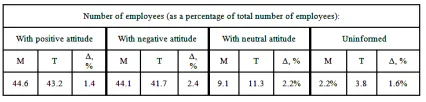
The results obtained in the modeling process (M), as well as data of the direct determination of the employees’ opinion by the experts of the Human Resources Department using testing (T) and the deviation (Δ) are given in Table 2.
Table 2. Results Of Dissemination Of Information About The Upcoming Restructuring
5. DISCUSSION OF THE RESULTS
[image:7.612.312.525.591.642.2]ISSN: 1992-8645 www.jatit.org E-ISSN: 1817-3195
The comparison of the calculated values with the values obtained directly by employees’ testing led to the conclusion that the proposed model adequately reflects the process of the information exchange in the collective of the collection agency. The results of the simulation modeling conducted using the developed software allowed to make more informed managerial decisions on the informational manipulation of the company's staff.
6. CONCLUSION
The model proposed in the work allows to formalize the process of disseminating information in the social environment (e.g. among the employees of the organization or the participants in the social network). An algorithm of informational manipulation of the social subsystem was formulated on the basis of this model. The experimental testing conducted on the basis of an international collection agency confirmed the adequacy of the proposed approaches, which allows to move to building a decision support system in this area on their basis.
In the future, the model must be tested on a larger number of employees of the social subsystem, and the adequacy of the proposed solutions must be assessed in modeling the dissemination of information in social networks. In addressing the latter problem, the most difficult seems to be the problem of collecting baseline data on the participants in the social network and the development of criteria for matching the simulation results to the real situation, because it requires access to the "closed" personal data of participants of information exchange.
REFERENCES:
[1] Bogolib, T.A. (2012). Human capital management at the industrial enterprise. Problems of Management Theory and Practice, 11-12, 53-57.
[2] Chi-Jen Lin (2013). Assignment Problem for Team Performance Promotion under Fuzzy Environment. Hindawi Publishing Corporation. Mathematical Problems in Engineering, Vol. 2013, 10 (Article ID 791415). http://dx.doi.org/10.1155/2013/791415
[3] Dixon, S.E.A., Day, M., & Brewster, C. (2014). Changing HRM systems in two Russian oil companies: Western hegemony or Russian specificity? The International Journal of Human
Resource Management, 12/2014, 25(22), 255-267.
[4] Dobrynin, V.N. et al. (2010). Self-organization and intelligent management of the development of sociotechnical systems. Part 1: state and ways of solving the problem. System Analysis in Science and Education, 3, 12-42.
[5] Fan, L. (2012). Strategic human resource management in "Haier" corporation. Actual Problems of Modern Science, 2, 39-45.
[6] Greben, N.F. (2007). Psychological tests for professionals (auth. – P86 comp. by N.F. Greben, pp. 496). Minsk: Modern sch. ISBN 978-985-6807-75-9.
[7] Gubanov, D.A., Novikov, D.A., & Chkhartishvili, A.G. (2009). Models of influence in social networks. Managing Large Networks, 27, 205-281.
[8] Kaufmann, A., & Gupta, M. (1991). Introduction to Fuzzy Arithmetic: Theory and Applications (pp. 161). Van Nostrand Reinhold. [9] Khramtsovskaya, N.A. (2005). Information
security and personnel. Human Resources and Personnel Management of the Enterprise, 3, 68-79.
[10] Kononov, D.A., Kulba, V.V., & Shubin, A.N. (2004a). Information management in socioeconomic systems: formalized description of information elements, Problems of Management, 2, 45-51.
[11] Kononov, D.A., Kulba, V.V., & Shubin, A.N. (2004b). Information management in socioeconomic systems: information actions in information fields. Problems of Management, 4, 81-87.
[12] Kononov, D.A., Kulba, V.V., & Shubin, A.N. (2004c). Information management in socioeconomic systems: management elements and methods of information influence. Problems of Management, 3, 25-33.
[13] Korchenko, A.G. (2006). Construction of information security systems on fuzzy sets. Theory and practical solutions (pp. 320). Kiev: MK-Press.
[14] Korchenko, A.G., & Ryndyuk, V.A. (2002). Study of statistical methods for forming membership functions. Information Security: Collection of Scientific Papers, Kyiv: NAU, 2(9). 54-60.
ISSN: 1992-8645 www.jatit.org E-ISSN: 1817-3195
[16] Novikov, D.A. (2007). Theory of managing organizational systems (2nd edition, pp. 584). Moscow: Fizmatlit.
[17] Novikov, D.A., Gubanov, D.A., & Chkhartishvili, A.G. (2010). Social networks: models of information influence, management and confrontation (pp. 228). Moscow: Fizmatlit. [18] Pospelov, D.S. (1994). "Grey" and/or "black and white" [scales]. Applied Ergonomics. Special edition "Reflexive processes", 1, 26-39. [19] Pramanik, S., & Biswas, P. (2012).
Multi-objective Assignment Problem with Generalized Trapezoidal Fuzzy Numbers. International Journal of Applied Information Systems ((IJAIS) – ISSN : 2249-0868. Foundation of Computer Science FCS, New York, USA), Vol. 2, 6. Retrieved from: www.ijais.org
[20] Protalinskiy, O.M. (2004). The use of artificial intelligence methods in the automation of technological processes (pp. 184). Astrakhan: ASTU publishing house.
[21] Protalinskiy, O.M., & Azhmukhamedov, I.M. (2012). System analysis and modeling of poorly structured and poorly formalized processes in sociotechnical systems. "Engineering Herald Don": an electronic research and innovation magazine, 3/2012. Retrieved from http://www.ivdon.ru/magazine/latest/n3y2012/9 10/.
[22] Rothstein, A.P., & Shtovba, S.D. (1997). Fuzzy reliability of algorithmic processes (pp. 142). Vinnitsa: Continent – PRIM.