A RECOMMENDER SYSTEM USING COLLABORATIVE
FILTERING AND K-MEAN BASED ON ANDROID
APPLICATION
1KUNYANUTH KULARBPHETTONG, 2SUNISA SOMNGAM, 3CHOLTICHA TONGSIRI, 4PATTARAPAN ROONRAKWIT
1,2
Suan Sunandha Rajabhat University, Computer Science Program, Thailand
3,4
Silpakorn University, CAT Tower 8 floor, Bangkok, Thailand
E-mail: [email protected], [email protected], [email protected], [email protected]
ABSTRACT
The objective of this research is to develop the diamond recommendation system by using K-Means and Collaborative Filtering techniques. The prototype system suggests users automatically in order to maximize users’ satisfaction. The system design and development will be in the form of Android (android operating system). We illustrate the methodologies and experimental results of this system. In this project, it was divided the result by the research purposes into 2 parts: developing the Mobile application for diamond recommender users and evaluating and testing the system. The results showed that the experts and users are satisfied with the system at a good level. The guide to buying diamonds actually works.
Keywords: Recommendation system; K-Mean; Collaborative filtering; Android
1. INTRODUCTION
With the advance technologies, there is an overwhelming amount of information available in the world and it is very difficult for customers to find the suitable products. To provide needed information, recommender system is the application of knowledge used to make a decision to users and it is a significant component to the businesses. Many recommendation systems were developed for use in industry and education that aim to create a list of suggestions and provide information to help customers for choosing the products. For instance, a Grundy system [1] is the first recommendation system that described models of users by using stereotypes and the result shown that user modes are effective in guiding its performance.
Collaborative Filtering is one of the significant techniques used in recommender systems to suggest products and services for customers on e-Commerce systems. This approach advices user based on the preferences of similar users and it generally analyzes relationships between users and products or services to identify the user product/service associations [2]. Ratings were given by customers to catalog items/products and
users who have similar tastes will have similar tastes in the future [3]. The number of items associated with users is evaluated the accuracy of a collaborative filtering approach. There are two types of collaborative filtering: user-based and item-based. User-based collaborative filtering predicts user’s preference items from rating preference of similar users in the past and item-based collaborative filtering depends on the similarity items and this approach is based on the user rating history to indicate the ratings pattern [4]-[5].
the sparsity rating problem. Furthermore, user preferences were considered to enhance the quality of this prototype. Android operating system is popular to use for mobile application. For instance, the development of lifestyles of Thai Buddhist application [6] based on Android operating system is to develop a database system about lifestyle of Thai Buddhist serving as a channel for disseminating information and there are many researches focusing on implementation on this operating system.
The contribution of this paper lies in preliminary
investigation results based on data mining
techniques and proposes the model adapted on Android operating system. The remainder of this paper is organized as follows. Section 2 presents related works and research methodologies used in this work. Section 3 we describe the system architecture based on the purposed model and section 4 shows the results of this experiment. Finally, the conclusion and future research are presented in section 5.
2. THE METHODOLOGIES
2.1 Collaborative filtering (CF)
Collaborative filtering (CF) is one of the most effective and successful techniques of recommender systems. This technique uses the relevant feedback from other similar users to predict or recommend to other users. Amazon.com [7] is the most famous recommendation system. This recommendation system incorporates a matrix of the item similarity. In order to find the similarity of the users, the Pearson’s correlation coefficient is used to compute similarity between usera and useru
u a r r u a u a, σ σ ) r , covar(r C = (1)
where Ca,u is the Pearson’s correlation
coefficient between user a and user u
ra and ru is the received score from user a and user
u m ) r r )( r r ( ) r , r ( ar cov m 1 i u i , u a i , a u a
∑
= − − = (2)Let ra,i and ru,i are the received score of
product i from user a and user u
u aandr
r are the average of score product from user
a and user u and m is the number of the co-rated items
According to Herlocker et al [8], they suggested to weight user similarity and computed a prediction by performing a weighted average of deviations from the neighbor’s mean.
∑
∑
= = − + = n u u a u a n u u i u a i a w w r r r p 1 , , 1 , , . ) ( (3)where pa,i is the prediction for item i of user a
n is the number of neighbors
wa,u is the similarity weight between user
a and user u
2.2 K-means
K-means is one of the simplest unsupervised learning algorithms for clustering data. The procedure follows a simple and easy way to classify a given data set through a certain number of clusters (assume k clusters) fixed a priori [9]. This algorithm aims at minimizing an objective function, in this case a squared error function. The formula of Euclidean distance is as follows:
∑ ∑
= =−
=
x j x i j j ic
x
j
1 1 2 ) ( (4) where 2 ) (c
x
j ji − is a chosen distance measure
between a data point
x
ji
) (
and the cluster centre
c
j,is an indicator of the distance of the n data points from their respective cluster centers
3. THE EXPERIMENTAL SETUP
to 5 for 5 criteria: round, oval, pear, square, and marquise as shown in table 1.
Table 1: The results of users rating
Item1 Item2 Item3 … Itemn
User1 1 4 3 … 2
User2 3 3 5 … 4
… … … …
Userm 4 2 4 … 2
The rating data from 150 users with 197 different diamond jewelry was used to analyze and K-means was used to cluster into 3 groups of users by measuring distance from a point centriod Euclidean of the Rating of cosmetics that users provided to the system. Then collaborative filtering step calculated the similarity among each user and selected a user that is similar to the current users from finding the similarities and then the rating data is processed to predict the value prediction. Finally, the system will present the results by selecting from the highest rating for the current user. Also, the F-measure was used to evaluate the performance of this proposed system and precision and recall were considered as follow:
recall
precision
recall
precision
F
+
=
.
.
2
(5)The data set were divided in to the training set and the test set with 70:30 to test the performance system.
4. THE EXPERIMENTAL RESULTS
In this project, it was divided the results by the research objectives into 2 parts: developing the mobile based on K-Means and Collaborative Filtering techniques and evaluating and testing the application.
4.1 Developing the mobile application
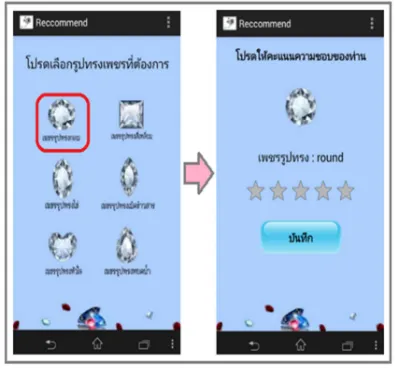
In this section, to develop the mobile application, From Figure 1 to Figure 3 was shown the results of mobile application.
When the user enters the first of this application, users can log in and register for membership in the system. Also, users rate the score of satisfaction ratings on the diamond jewelry.
Figure 1: The main page of application
[image:3.595.306.504.374.558.2]Application will show the result that has been introduced and users can view the information.
Figure 2: The example pages of application
4.2 Evaluating and testing the application
test, Usability test, Performance test and Security test.
Figure 3: The result pages of application
4.2 Evaluating and testing the application
[image:4.595.308.512.229.375.2]Black box Testing and Questionnaires by experts and users were used to evaluate and test the qualities of this application. Respondents were asked to rate the recommendation results and the rating score was from 1 to 5. Black Box testing is the testing approach that focuses only on the outputs generated in response to selected inputs and execution conditions and the internal mechanism of a system or component is ignored [10]. Black box testing was assessed in the error of the project as following: functional requirement test, Function test, Usability test, Performance test and Security test.
Table 2: The results of Black box testing
Teachers Students
࢞
ഥ
SD࢞
ഥ
SD1.Function Requirement Test
4.46 0.51 4.22 0.56
2. Functional Test 4.2 0.57 4.27 0.64 3. Usability Test 4.16 0.55 4.25 0.59 4.Performance Test 4.00 0.50 4.33 0.63 5. Security Test 4.25 0.47 4.19 0.54
Summary 4.46 0.51 4.22 0.56
Functional Requirement Test is evaluated the satisfaction on the ability of the system so as to meet the needs of users and functional test
was used to evaluate the accuracy of the system. Usability test is a measurement of the suitability of the system. The performance of the system is assessed the processing speed of the system in Performance Test. Finally, Security test was evaluated the security of the system and Table 2 and Figure 4 were shown the results of Black box testing.
Figure 4: The results of Black box testing
The results showed that the Diamond recommender system based on Mobile application was satisfied the requirements of users. Means for 5 experts and 150 users were 4.2 and 4.25 respectively.
5. CONCLUSION AND FUTURE WORKS
In this work, we proposed the diamond recommendation system by using K-Means and Collaborative Filtering techniques based on Mobile Application. This system provides more suitable recommendation information to users. K-means was used to cluster optimal groups and Collaborative filtering produced recommendation results based on user’s voting and preferences. The initial results showed that our approach is successfully generated the recommendation results matching with the group of users. As for the future work, we need to explore more reasonable other technologies to apply in this project to enhance the quality and quantity of services to users.
6. ACKNOWLEDGEMENT
[image:4.595.87.292.595.699.2]REFRENCES:
[1] Rich, “User Modeling via Stereotypes,” Cognitive Science, vol. 3,no. 4, pp. 329-354, 1979.
[2] Y. Hu, Y. Koren, and C. Volinsky, “Collaborative filtering for implicit feedback datasets”, ICDM’08. Eighth IEEE International Conference on, pp. 263–272, 2008
[3] Dietmar Jannach, Markus Zanker and Gerhard Friedrich, “Tutorial: Recommender Systems”, International Joint Conference on Artificial Intelligence Beijing, August 4, 2013.
[4] Ricci F, “Mobile Recommender Systems”, International Journal of Information Technology and Tourism, Vol. 12, No. 3, pp. 205-231, 2011.
[5] Su, X., Khoshgoftaar, T.M., X. Zhu, and R. Greiner, “Imputation-Boosted Collaborative Filtering Using Machine Learning Classifiers”, Proceedings of the ACM symposium on Applied Computing, pp. 949-950, 2008. [6] Rattanathip Rattanachai, Sila Luebangyai, and
Kunyanuth Kularbphettong, “Developing a Lifestyle of Thai Buddhist knowledge Mobile Application”, In Proceeding of 6th World Conference on Educational Sciences.
[7] Greg Linden, Brent Smith, Jeremy York, “Amazon.com Recommendations Item-to-Item Collaborative Filtering”, “IEEE Internet Computing”, IEEE Computer Society, vol. 7, no 1, pp 76-80, January 2003.
[8] MacQueen, R., "Some Methods for classification and Analysis of Multivariate Observations” Proceedings of 5-th Berkeley Symposium on Mathematical Statistics and Probability, Berkeley, University of California Press, vol.1, pp.281-297, 1967.
[9] Herlocker JL, Konstan JA, Borchers A and Riedl J, “An algorithmic framework for performing collaborative filtering”, In: Hearst MA, Gey F and Tong R, eds., Proceedings of the 22nd International Conference on Research and Development in Information Retrieval (SIGIR’99). ACM Press, New York, pp. 230– 237, 1999.