HYBRID FUZZY PSO ALGORITHM FOR DYNAMIC
ECONOMIC LOAD DISPATCH
1P.SIVARAMAN, 2D.GUNAPRIYA, 3K.PARTHIBAN, 4S.MANIMARAN 1
M.E(PSE), M.Kumarasamy College of Engineering, Karur, Tamilnadu, India
2
Assistant Professor, M.Kumarasamy College of Engineering, Karur, Tamilnadu, India
3
M.E(PSE), M.Kumarasamy College of Engineering, Karur, Tamilnadu, India
4
M.E(POWER MANAGEMENT), Anna University Regional Office, Madurai, Tamilnadu, India E-mail: [email protected] , [email protected]
ABSTRACT
The Dynamic Economic Load Dispatch (DELD) is the major problem in power system operation and control. The main objective of DELD is to minimize the total fuel cost of the generators while satisfying all the operating constraints. Premature convergence is the major problem of DELD in large power system. Conventional methods took long time to converge the DELD. To handle the DELD problem, an efficient hybrid approach is proposed. Combination of Fuzzy and PSO algorithm is called FPSO which is effectively to solve the DELD problem. This algorithm is tested in 6 and 15 units thermal system.
Keywords: Dynamic Economic Load Dispatch, Power System Operation, Operating Constraints, Fuzzy Adaptive Particle Swarm Optimization, Power Demand
1. INTRODUCTION
DELD is an essential optimization problem in power system operation. The objective is to determine the optimum power output’s of all the generating units by minimizing the total fuel cost. Operating constraints is a power balance equation that is sum of all power generation output is equal to the sum of all load demand and total transmission loss. The power output limit of each generator unit must be in minimum and maximum limits [1]. There are different method is used to solve DELD problems are lamda-iteration[2], the base point and participation factors method[3], the gradient method[4], and newton method[2]. These methods can solve the DELD problems efficiently if the fuel cost curves of the generating units are piece wise linear and monotonically increasing [2]. Unfortunately, this assumption could lead to infeasible practical use due to nonlinear characteristics of generators. A dynamic programming (DP) method had been used for solving the DELD problem with valve point loading effect[5]. The DP technique decomposes a multi stage decision problem into a progression of single stage decision problems. However, the DP method could be cause the dimensions of DELD problem to become extremely large, therefore it requiring large computational efforts.
So these methods are not fit when modern power systems are considered with large number of generators.With the development of computer science and technology the evolutionary algorithms have been effectively used to solve the ELD problem, such as particle swarm optimization [8,9], hybrid PSO and sequential quadratic programming (PSO-SQP) [10], evolutionary strategy optimization (ESO) [12], self organizing hierarchical PSO (SOHPSO) [14] and new PSO (NPSO) [16]. Emmanuel Dartey Manteaw, Dr. Nicodemus Abungu Odero are discovered the hybrid ABC and PSO for combined economic and emission dispatch but it requires high computational time [18]. When compared with conventional techniques, modern heuristic optimization techniques have been paid much more attention by many researchers due to their ability to find an almost global optimal solution for ELD problems with operating constraints.
characteristics than other stochastic methods [9]. Recently PSO has been successfully used to solve the ELD problem while considering generator constraints and non smooth cost constraints [7]. However the performance of the original PSO greatly suffers from the problem of being trapped in local optimum. Eiben et al [12] describes two ways of defining the parameter values: adaptive parameter control and self adaptive parameter control. In previous parameter values change according to a heuristic rule that takes feedback from the current search state, while in the latter, the parameters of the meta-heuristic are incorporated into the representation of the result. Thus the parameter values change together with the solutions of the population and in the SOHPSO approach, the particle velocities are reinitialized whenever the population stagnates at local optimum during search. A relatively large value of cognitive component results in excessive wandering of particles while a higher value of the social component causes premature convergence of particle [13]. M.Vanitha, K.Thanushkodi, EHSA for economic load dispatch problem [19] they reduce the convergence time; however it’s not enough for DELD. Ghasem Mokhtari, Ahmad Javid Ghanizadeh, Esmaeil Ebrahimi [20], ICA for ED slow convergence is the problem. J. Jasper, T. Aruldoss Albert Victoire discuss the DE and VNS to improve the quality of solution [21].
2. PROBLEM FORMULATION
Economic load dispatch is a one of the major problem in power system operation. The overall fuel cost of the generators is high and load demand also changing with time. In practical ELD is a non linear optimization problem, due to non linear characteristics conventional optimization methods are not suitable to converge the problem. ELD is schedule the power output is optimally in minimum fuel cost while satisfying all operating constraints.
2.1. Objective Function
The main aim of ELD is to reduce the total fuel cost of the generators, it operating at minimum fuel cost whereas satisfying the all constraints. The Dynamic Economic Load Dispatch (DELD) is formulated to find the optimum power output, when the fuel costs of the generators are low. To calculate the ELD for different load demand at various time duration is called as DELD. The objective function is to minimize the total generating cost (total power generation cost) subjected to the various constraints of the system.
( )
t i i
i
F
=
∑
F P
(1)
Where
t
F
= Total fuel cost
i
P
= Real power output of ith generator Cost of every thermal generator is represented by a quadratic equation as define below2
( )
i i i i i i i
F P
=
a P
+
b P
+
c
(2) Where
a
i,b
i,c
i are fuel cost coefficients2.2. Equality Constraints
Σ Pi=PD+PLoss (3)
Where
PD = Total power demand PLoss = Total line loss
2.3. Inequality Constraints
,min ,max
i i i
P
≤
P
≤
P
(4)The power output of each generator should be in minimum and maximum limits. His is also called as generator constraints.
The transmission loss can be calculated by B-coefficients method or power flow analysis method. To calculate the losses by using B-coefficients method is
T
P
L=
P B P
(5)Where
P = Power output.
3. OVER VIEW OF PARTICLE SWARM OPTIMIZATION
The particle swarm optimization technique is a population based stochastic optimization technique introduced by James Kennedy and Russel Eberhart in the year of 1995. PSO based on the concept of swarms and their intelligence as well as their movement.
The swarms are mostly the groups that serve the same purpose like food hunting. The PSO is motivated from the relative behavior of the creatures that live and move in groups like swarm of birds and school of fishes etc.
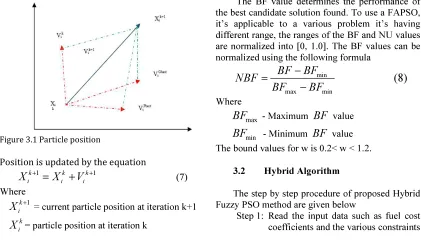
All particles contain a particular fitness value which is evaluated by the fitness function. The velocity and particle position is updated by their rules. The position of the particles is updated with the flying experience of the particle and its neighbors. The best values is achieved by the particles are stored in the memory as Pbest or personal best and the best among all the particles is called as Gbest or global best. By using the concept of Pbest and Gbest the velocity of each particle is updated by the equation is
1
1 1 ( ) 2 2 ( )
k k k k k k
i i i i i i
V + =ωV +c r× Pbest −X +c r× Gbest −X
(6) Where
ω
= Inertia weight
c
1,
c
2= Acceleration constants
r
1,r
2 = Random number between 0 and 1
X
ik= Position of individual I at kthiteration
Pbest
ik= Best position of individual i at kthiteration
Gbest
ik= Best position of the group at iteration kIn equation (7) the inertia weight
ω
is [image:3.595.88.509.503.755.2]introduced to enable the swarm to fly in the larger search space. The right value of
ω
should be selected so as to provide balance between the local and the global explorations. This reduces the iterations to find the optimal solution.Figure 3.1 Particle position
Position is updated by the equation
1 1
k k k
i i i
X
+X
V
+=
+
(7) Where
X
ik+1 = current particle position at iteration k+1
k i
X
= particle position at iteration k
V
ik+1= particle velocity at iteration k+1
In general, the inertia weight can be set according to the following equation
max min
max
max
Iter
Iter
ω
ω
ω
=
ω
−
−
×
(7)
Where
ω
max,ω
min= max and min weights,
Iter
max= maximum iteration number,
Iter
= current iteration number.3.1 FPSO
(i) When the finest fitness is found at the end of the iteration, high learning factors and low inertia weight are generally preferred.
(ii) When the best fitness is stagnated at one value for a long time, the number of generations for unaffected best fitness is great. The inertia weight supposed to be increased and learning factors should be decreased. Based on this knowledge, a fuzzy system is utilized to tune the inertia weight and learning factors with the best fitness (BF) and the number of generations for the best unchanged fitness (NU) as the input variables, and the inertia weight (w) and learning factors (c1 and c2) as the output variables.
The BF value determines the performance of the best candidate solution found. To use a FAPSO, it’s applicable to a various problem it’s having different range, the ranges of the BF and NU values are normalized into [0, 1.0]. The BF values can be normalized using the following formula
min
max min
BF
BF
NBF
BF
BF
−
=
−
(8)
Where
BF
max - MaximumBF
value
BF
min - MinimumBF
value The bound values for w is 0.2< w < 1.2.3.2 Hybrid Algorithm
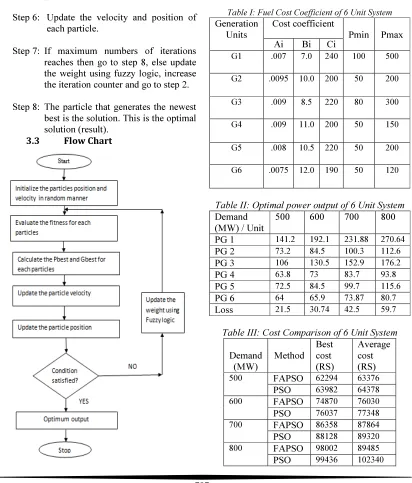
The step by step procedure of proposed Hybrid Fuzzy PSO method are given below
like as generator constraints and transmission line loss coefficients etc.
Step 2: Initialize the population of the particles in random manner.
Step 3: Evaluate the fitness for each particle.
Step 4: Now compare the fitness with Pbest and the value of fitness is improved then set this value as Pbest.
Step 5: The best value among the Pbest of all particles is Gbest.
Step 6: Update the velocity and position of each particle.
Step 7: If maximum numbers of iterations reaches then go to step 8, else update the weight using fuzzy logic, increase the iteration counter and go to step 2.
Step 8: The particle that generates the newest best is the solution. This is the optimal solution (result).
3.3 Flow Chart
4. SIMULATION RESULTS
The DELD problem was solved using the FAPSO and its performance is compared with Simple PSO. The proposed FAPSO technique has been applied to 6 and 15 generators power systems (PS).
1) Case Study 1
[image:4.595.96.508.283.766.2]Six-Unit System: The load demand is 500, 600, 700, 800 MW. The system contains six thermal units, 46 transmission lines, and 26 buses . The characteristics of the six thermal units are given in Table I .
Table I: Fuel Cost Coefficient of 6 Unit System Generation
Units
Cost coefficient
Pmin Pmax
Ai Bi Ci
G1 .007 7.0 240 100 500
G2 .0095 10.0 200 50 200
G3 .009 8.5 220 80 300
G4 .009 11.0 200 50 150
G5 .008 10.5 220 50 200
G6 .0075 12.0 190 50 120
Table II: Optimal power output of 6 Unit System
Demand (MW) / Unit
500 600 700 800
PG 1 141.2 192.1 231.88 270.64
PG 2 73.2 84.5 100.3 112.6
PG 3 106 130.5 152.9 176.2
PG 4 63.8 73 83.7 93.8
PG 5 72.5 84.5 99.7 115.6
PG 6 64 65.9 73.87 80.7
Loss 21.5 30.74 42.5 59.7
Table III: Cost Comparison of 6 Unit System
Demand (MW)
Method Best cost (RS)
Average cost (RS)
500 FAPSO 62294 63376
PSO 63982 64378
600 FAPSO 74870 76030
PSO 76037 77348
700 FAPSO 86358 87864
PSO 88128 89320
800 FAPSO 98002 89485
2) Case Study 2
The load demand is 1600,1750,1950,2150 MW and the system contains 15 thermal units.
Table IV: Cost Comparison of 15Unit System
Power
Output
Demand (MW)
1600
1750
1950
2150
PG1
188.3 241.2 280.17 316.47PG2
220.5 239.2 282.55 384.39PG3
43.3 49.67 48.28 46.07PG4
73.02 68.4 49.17 20.0PG5
202.95 232.6 301.66 321.56PG6
203.5 198.6 279.33 324.20PG7
187.3 192.3 294.43 295.88PG8
113.2 101.6 185.45 136.50PG9
54.6 41.9 77.58 100.27PG10
99.7 76.7 80.57 44.28PG11
48.06 75.26 38.54 43.77PG12
49.05 83.08 20.04 73.88PG13
41.5 55 42.48 67.01PG14
50.9 54.39 18.49 15.02PG15
54.9 54.18 15.01 17.01Figure 4.1 Convergence characteristics of HFPSO and PSO
Table V: Cost Comparison of 15 Unit System
Demand (MW)
Method Best cost (RS)
Average cost (RS)
1600 FAPSO 186203.8 205804.2
PSO 198630.2 217845.5
1750 FAPSO 225674.34 234578.9
PSO 239453.4 245349.3
1950 FAPSO 248957.87 253489.58 PSO 253429.41 263245.42 2150 FAPSO 265672.30 274598.5
PSO 273427.49 289567.37
5. CONCLUSION
In this paper a new hybrid optimization algorithm is called as Hybrid Fuzzy PSO (HFPSO) is used to solve the dynamic economic load dispatch problem of 6 and 15 unit systems. This proposed hybrid algorithm, PSO is used to find the optimal point of generator power output and fuzzy logic is used to tune the inertia weight. The results obtained from HFPSO method is compared with conventional PSO method. HFPSO method effectively reduces the convergence time when compare to PSO. Numerical results show the proposed method output. From the results HFPSO gives a better solution and convergence characteristics and it’s suitable for large power systems. For future, I will extend my work to 40 and 75 units thermal system.
REFRENCES:
[1] Nisha Soni, Dr.Manjree Pandit “A Fuzzy Adaptive Particle Swarm Optimization Algorithm to Solve Non-Convex Economic Dispatch Problem”, International Journal of Engineering and Innovative Technology (IJEIT) Volume 1, Issue 4, April 2012.
[2] S.S. Kumar, V. Palanisamy, “A dynamic programming based fast computation Hopfield neural network for unit commitment and economic dispatch”, Electr. Power Syst. Res. 77 (2007) 917–925.
[3] J.B. Park, K.S. Lee, J.R. Shin, K.Y. Lee, “A particle swarm optimization for economic dispatch with nonsmooth cost function”, IEEE Trans. Power Syst. 20 (1) (2005) 34–42.
[4] W.M. Lin, F.S. Cheng, M.T. Tsay, “Nonconvex economic dispatch by integrated artificial intelligence”, IEEE Trans. Power Syst. 16 (2) (2001) 307–311.
[5] Yuan X, Su A, Yuan Y, Nie H, Wang L. “An improved PSO for dynamic load dispatch of generators with valve-point effects”, Energy J 2009; 34(1):67–74.
[6] Park JB, Lee K-S, Shin J-R, Lee KY. “A particle swarm optimization for economic dispatch with non-smooth cost functions”, IEEE Trans Power Syst 2005;20(1):34–42.
[7] Ratnaweera, S. K. Halgamuge, and H. C. Watson, “Self-organizing hierarchical particle swarm optimizer with time-varying acceleration coefficients”, IEEE Trans. Evol. Comput., vol. 8, no. 3, pp. 240–255, Jun. 2004.
economic dispatch considering the generator constraints”, Energy Convers. Manage. 48 (2007) 645–653.
[9] P. Venkatesh, R. Gnannadassa, E. Pandimeena, G. Ravi, R. Chakrabarti, and S. Choudhary, “A improved evolutionary programming based economic load dispatch of generators with prohibited operating zones”, J. Inst. Eng. (India), vol. 86, pt. EL, pp. 39–44, Jun. 2005. [10] P. Bajpai and S. N. Singh, “Fuzzy adaptive
particle swarm optimization for bidding strategy in uniform price spot market”, IEEE Trans. Power Syst., vol. 22, no. 4, pp. 2152–2160, Nov. 2007.
[11] Sinha N, Chakrabarti R, Chattopadhyay PK. “Evolutionary programming techniques for economic load dispatch”, IEEE Trans Evol Comput 2003;7(1):83–94.
[12] Victoire TAA, Jeyakumar AE “Hybrid PSO-SQP for economic dispatch with valve-point effect”, Electr Power Syst Res 2004;71(1):51–9.
[13] Neto AP, Unsihuay C, Saavedra OR. “Efficient evolutionary strategy optimization procedure to solve the nonconvex economic dispatch problem with generator constraints”, IEEE Proc Gen Transm Distrib 2005;152(5):653–60.
[14] Swarup KS, Kumar PR. “A new evolutionary computation technique for economic dispatch with security constraints”, Int J Electr Power Energy Syst 2006;28(4):273–83.
[15] Selvakumar AI, Khanushkodi T “A new particle swarm optimization solution to nonconvex economic dispatch problems”, IEEE Trans Power Syst 2007;22(1):42–51.
[16] T. Niknam, H. D. Mojarrad and M. Nayeripour, “A new fuzzy adaptive particle swarm optimization for non-smooth economic dispatch”, J. Energy, vol.35, no.4, pp.1764-1778, 2010.
[17] P. H. Chen and H. C. Chang, “Large-scale economic dispatch by genetic algorithm”, IEEE Transactions on Power Systems, vol.10, no.4,
pp.1919-1926, 1995.
[18] Emmanuel Dartey Manteaw, Dr.
Nicodemus Abungu Odero, “Combined Economic and Emission Dispatch Solution Using ABC_PSO Hybrid Algorithm with Valve Point Loading Effect” International Journal of Scientific and Research Publications, Volume 2, Issue 12, December 2012 1 ISSN 2250-3153.
[19] M.Vanitha, K.Thanushkodi, “Solving Non-Convex Economic Load Dispatch Problem by Efficient Hybrid Simulated Annealing Algorithm” IEEE International Conference on Advanced Communication Control and Computing Technologies (ICACCCT) 2012.
[20] Ghasem Mokhtari, Ahmad Javid Ghanizadeh, Esmaeil Ebrahimi, “Application of Imperialist Competitive Algorithm to Solve Constrained Economic Dispatch” International Journal on Electrical Engineering and Informatics Volume 4, Number 4, December 2012.