1
A Framework for People Capability Enhancement to Support
Sustainable Facility Management Practices
Speakers:
Yang, J.1 and Sarpin, N.1.
1
Queensland University of Technology, Brisbane, Australia, Email: [email protected]
Abstract: Spans over a considerable length of time, facility management is a key phase in the development cycle of built assets. Therefore facility managers are in a commanding position to maximise the potential of sustainability through the operation, maintenance and upgrade of built facilities leading to decommission and deconstruction. Sustainability endeavours in facility management practices will not only contribute to reducing energy consumption, waste and running costs, but also help improve organisational productivity, financial returns and community standing of the organisation. At the forefront facing sustainability challenge, facility manager should be empowered with the necessary knowledge and capabilities. However, literature studies show a gap between the current level of awareness and the specific knowledge and necessary skills required to pursue sustainability in the profession. People capability is considered as the key enabler in managing the sustainability agenda as well as being central to the improvement of competency and innovation in an organization. This paper aims to identify the critical factors for enhancing people capabilities in promoting the sustainability agenda in facility management practices. Starting with a total of 60 factors identified through literature review, the authors conducted a questionnaire survey to assess the perceived importance of these factors. The findings reveal 23 critical factors as
significantly important. They form the basis of a mechanism framework developed to equip facility managers with the right knowledge, to continue education and training and to develop new mind-sets to enhance the implementation of sustainability measures in FM practices.
Keywords: sustainability, people capability, facility management, knowledge
Introduction
2 However, despite the emerging awareness of sustainability in facility management, very few facilities managers and built asset owner voluntarily actively take on the sustainability agenda due to the infancy of sustainability in the FM profession (Elmualim et al. 2008). There is a lack of understanding and skills required to put the sustainability agenda into action (Shah 2007; Elmualim et al. 2008). It is believed that appropriate capabilities and skills among FM practitioners can contribute enormously to the implementation of the sustainability agenda in the FM sector (Hodges 2005; Shah 2007). Yet according to previous studies, FM practitioners suffer from the lack of capabilities and inconsistency of the required skills in this area.
Moreover, problems such as the lack of specific sustainability knowledge and new environment friendly products, systems and technology add to the difficulty (Shah 2007; Elmualim et al. 2009; Elmualim et al. 2010). A complete transition to sustainable FM practice will not materialise until facility managers are empowered by the necessary knowledge and capability.
This paper discusses an ongoing research aimed at identifying the critical factors for enhancing enhancing people capabilities and on such basis, to develop a framework of promoting the development of professional capabilities to deliver the sustainability agenda in FM practices. A total of 60 factors were first identified through a comprehensive literature review. A questionnaire survey was then conducted to identify the perceived importance of those factors. A framework is developed to promote the necessity of people capability enhancement and equip facility managers with the right knowledge, encoverage them for continuing education and training, and to develop new professional mind-sets. By doing so over time, it is hoped that the work force of facililty management can uplift its capacility and become better prepared for the implementation of sustainability measures in FM practices. People Capability to Support Sustainable Facility Management Practices
Because of their long term involvement and ability to make major operational decisions, FM professionals are at the forefront of integrating sustainable practices through work routines. In addition to their technical and operational skills, FM professionals have a great opportunity to make a valuable strategic contribution towards their organisation’s sustainable business. However, limited capabilities among professionals in achieving this vision has entered into an alarming situation and solutions were much needed (Shah 2007; Elmualim 2013; Hodges 2005). To start with, the FM professionals need to understand and recognise how the growing importance of sustainability is influencing the way they carry out their duties, roles and responsibilities. FM personnel must become professionally competent and knowledgeable about the sustainability issues that will impact on their business environment, both
operationally and strategically (Elmualim 2013).
3 required for FM practices. Factors related to people capability in the construction profession were identified from the existing related studies. These factors cover a wide spectrum of issues, such as understanding whole-life value concept, ability to work across disciplines and a vision for a better future. The literature review conducted has also contributed to the
development of research methodologies suited for this research project.
Sixty factors were identified through literature as having influence over people capabilities related to pursuing sustainabliyt. They were grouped into five categories based on Wiek et al. (2011)’s classification for a similar application. These include interpersonal capabilities, system thinking capabilities, anticipatory capabilities, normative capabilities and strategy capabilities. In this research context, interpersonal capability relates to enabling FM personnel to solve issues and respond to challenges of sustainability applications. System thinking is about being able to analyse complex systems across three different pillars of sustainability and over different scales. Anticipatory capability will facilitate analysis and evaluation of sustainability actions and consequences. Normative capability is to map, apply and resolve sustainability values and principles in a person that should either be discarded or maintained to sustain the balance of nature. Finally, strategic capability will contribute to specific sustainability implementation strategies in an organisation.
Research Methodology
This research aims to promote the uptake and implementation of sustainability measures in FM practices through identifying the criticality of people capability factors, and use it as the basis for the establishment of a mechanism to equip facility managers with the right
knowledge, to continue education and training and to develop new mind-sets. A questionnaire survey was selected as the primary tool to identify the significance of 60 people capability factors revealed by the comprehensive literature review.The accuracy and suitability of the questionnaire questions were validated through 6 pilot surveys with industry practitioners and academics before distribution to the survey correspondents. The questionnaire included 4 parts, namely; 1) Respondents’ demography, 2) People capability factors, 3) Further comments, and 4) Invitations to further participate in this research. The respondents were selected among the members of facility management association in Australia and Malaysia including Facilities Management Association of Australia (FMA), Tertiary Education Facilities Management Association (TEFMA) and Malaysian Association of Facilities Management (MAFM). These are leading professional institutions for FM practice in these two countries. During the pilot survey, it was also identified that FM practices in both
countries follow very similar procedures with almost no distinctive variation due to cultural or political differences. It is expected that consensus among the respondents will represent the general views of the FM profession.
4 (33%), asset and facilities management consultants (25%), company directors (21%), building engineers (15%) and academics (6%). Almost 50% of respondents had over 21 years’
experience in the construction industry. Furthermore, 74% of the respondents had been involved in the FM sector for more than 5 years.
Ranking of Critical People Capability Factors
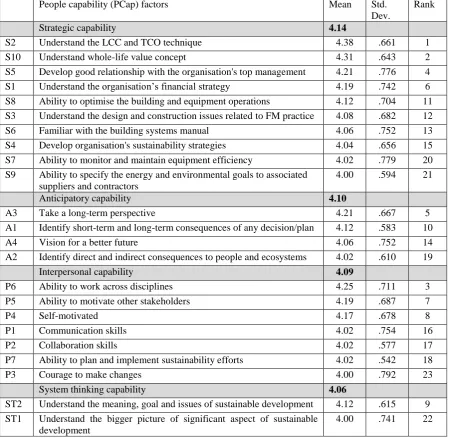
[image:4.595.71.526.321.759.2]The level of significance of the 60 people capability (PCap) factors was identified through the analysis of the survey data. The mean value of each factor was calculated first. 23 of them were finally selected as critical PCap factors with their mean value ≥ 4.00 (“significant”) as shown in Table 2. In addition, the uniformity of the standard deviation (all below 1.0) demonstrates data accuracy and consistency in the research.
Table 2: Ranking of the 23 critical people capability (PCap) factors for enhancing sustainability measures in FM practices
People capability (PCap) factors Mean Std.
Dev.
Rank
Strategic capability 4.14
S2 Understand the LCC and TCO technique 4.38 .661 1
S10 Understand whole-life value concept 4.31 .643 2
S5 Develop good relationship with the organisation's top management 4.21 .776 4
S1 Understand the organisation’s financial strategy 4.19 .742 6
S8 Ability to optimise the building and equipment operations 4.12 .704 11
S3 Understand the design and construction issues related to FM practice 4.08 .682 12
S6 Familiar with the building systems manual 4.06 .752 13
S4 Develop organisation's sustainability strategies 4.04 .656 15
S7 Ability to monitor and maintain equipment efficiency 4.02 .779 20
S9 Ability to specify the energy and environmental goals to associated suppliers and contractors
4.00 .594 21
Anticipatory capability 4.10
A3 Take a long-term perspective 4.21 .667 5
A1 Identify short-term and long-term consequences of any decision/plan 4.12 .583 10
A4 Vision for a better future 4.06 .752 14
A2 Identify direct and indirect consequences to people and ecosystems 4.02 .610 19
Interpersonal capability 4.09
P6 Ability to work across disciplines 4.25 .711 3
P5 Ability to motivate other stakeholders 4.19 .687 7
P4 Self-motivated 4.17 .678 8
P1 Communication skills 4.02 .754 16
P2 Collaboration skills 4.02 .577 17
P7 Ability to plan and implement sustainability efforts 4.02 .542 18
P3 Courage to make changes 4.00 .792 23
System thinking capability 4.06
ST2 Understand the meaning, goal and issues of sustainable development 4.12 .615 9 ST1 Understand the bigger picture of significant aspect of sustainable
development
5 The research findings reveals that the FM practitioners believed the strategic capability will affect the enhancement of sustainability endeavour the most, with the highest overall mean value of 4.14 among the four micro-categories of key factors. The two top ranked factors, S2 “Understand the LCC and TCO technique” (mean value=4.38) and S10 “Understand the whole-life value concept” (mean value=4.31) are in the Strategic Capability category. This finding supports the existing views that the understanding of LCC and TCO is a driving force of sustainable practice in FM because of the large proportion of operation and maintenance costs in the overall cost of building assets (Fuller 2010; Hodges 2005; Shah 2007). Factors S5 “Develop good relationship with the organisation’s top management” (mean value=4.21) and S1 “Understand the organisation’s financial strategy” (mean value=4.19) was ranked fourth and sixth and thus was also regarded as an important capability since the financial starategy regarding sustainability policy can only be decided by the organisation’s top management (Elmualim 2013; Hodges 2005).
An overall second rank is the Anticipatory Capability category with the overall mean value of 4.10. Factor A3 “Take a long term perspective” (rank 5) and Factor A1 “Identify short term and long term consequences of any decision/plan” (rank 10) are also regarded as highly important ones for sustainability integration in FM practices. It is essential to be able to think beyond the present in order to develop different alternatives of action based on present condition. Through foresighted thinking, the potential opportunities and risks can also be identified.
Followed closely in the third rank is the Interpersonal Capability category with an overall mean rank of 4.09. In terms of individual factors, P6 “Ability to work across discipline” (mean value=4.25) was ranked as the third most significant factors among overall PCap factor. It is also noted that other factors related to interpersonal capability dimension also received a higher ranking. They were ranked as “significant” or “very significant” in the survey, such as P5 “Ability to motivate other stakeholders” and P4 “Self motivated”, with a high mean value of 4.19 and 4.17 respectively. This is consistent with several viewpoints of previous studies (Sexton and Barrett 2003; Sterling and Thomas 2006; Barth et al. 2007), which highlighted that solving sustainability issues and generating sustainability opportunities requires strong collaborations as well as negotiation skills among the stakeholders.
The survey revealed that system thinking capability factors were less viable and were ranked as the least significant factors among all. This may reflect the fact that FM practitioners have realised their roles in supporting the sustainable development agenda (Nielsen et al. 2007). However, the bigger challenge is how to identify the most appropriate approach to attend to sustainability and how FM practitioners can equip themselves with new knowledge, tools and competencies to overcome the challenges. None of the people capability factors categories in normative capability was considered as significant factors in order to enhance the
6 A Framework for People Capability Enhancement to Support Sustainability in Facility Management Practices
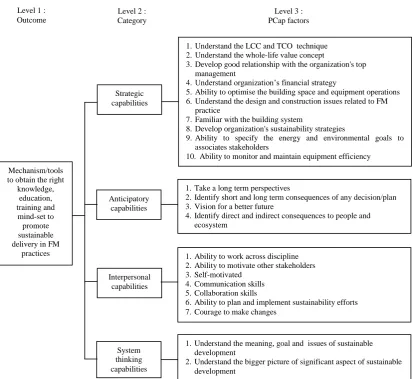
[image:6.595.77.494.256.635.2]Twenty three factors that significant in supporting sustainability in FM were extracted from the questionnaire survey analysis. To summarise the findings and results of this survey, a three-level hierarchical conceptual framework for people capability enhancement to support sustainable facility management practices was proposed as shown in Figure 1. The top level is the expected outcome, and following this is the four groups of PCap category. Lastly, the third level comprise the factors expending from the people capability.
Figure 1: A conceptual framework for people capabilities in promoting sustainability in FM practice
Conclusions
There is an increasing level of awareness to incorporate sustainability principles into facilities management practices. This presents a high pressure for the construction professionals to equip themselves with proper knowledge, skills and capabilities to face the new sustainability challenges. Against such a backdrop, people-centred approaches have a good prospect to assist facility managers. In this study, twenty three critical people capability factors were identified through the questionnaire survey of industry practitioners.They are categorised into
Level 1 : Outcome
Level 2 : Category
Level 3 : PCap factors
Mechanism/tools to obtain the right
knowledge, education, training and mind-set to promote sustainable delivery in FM
practices Strategic capabilities Anticipatory capabilities Interpersonal capabilities System thinking capabilities
1.Understand the LCC and TCO technique 2.Understand the whole-life value concept
3.Develop good relationship with the organization's top management
4.Understand organization’s financial strategy
5.Ability to optimise the building space and equipment operations 6.Understand the design and construction issues related to FM
practice
7.Familiar with the building system
8.Develop organization's sustainability strategies
9.Ability to specify the energy and environmental goals to associates stakeholders
10. Ability to monitor and maintain equipment efficiency
1.Take a long term perspectives
2.Identify short and long term consequences of any decision/plan 3.Vision for a better future
4.Identify direct and indirect consequences to people and ecosystem
1.Ability to work across discipline 2.Ability to motivate other stakeholders 3.Self-motivated
4.Communication skills 5.Collaboration skills
6.Ability to plan and implement sustainability efforts 7.Courage to make changes
1.Understand the meaning, goal and issues of sustainable development
7 1) Strategic capabilities, 2) Anticipatory caapbilities, 3) Interpersonal capabilities and 4) System thinking capabilities. The top ranked factors include “understanding of life cycle costs”, “understanding of whole life value concepts”, “ability to work across disciplines”, “develop good relationship with the organisation's top management” and “take a long-term perspective”. Using an established people capability categorisation, these factors are
summarised into a Conceptual People Capability framework to provide guidance to the FM practitioners to improve their core capabilities. Work is ongoing to further investigate these factors in terms of interdependency and hierarchical significance. A pair-wise comparison study will be used together with Interpretive structural modelling (ISM) to develop a hierarchical model showing the driving forces among all identified factors. A final people capabilities framework will be formulated and case studies will be used to test, improve and validate the framework. These combined efforts will help raise the awareness of the FM practitioners and provide them with a tool to develop new mindset and continue professional development for the implementation of sustainability facility management practices.
References
Akintoye, Akintola. 2000. "Analysis of factors influencing project cost estimating practice." Construction Management & Economics 18 (1): 77-89.
Barth, M., J. Godemann, M. Rieckmann and U. Stoltenberg. 2007. "Developing key competencies for sustainable development in higher education." International Journal of Sustainability in Higher Education 8 (4): 416-430.
CIOB. 2004. Sustainability and construction. Ascot: Chartered Institute of Building.
Elmualim, A.A. 2013. "Sustainability in FM: Trends in policy and FM competence consequences." Paper presented at the World Building Congress 2013, Brisbane Convention & Exhibition Centre, Brisbane, Queensland.
Elmualim, Abbas, A Czwakiel, Roberto Valle, Gordon Ludlow and Sunil Shah. 2008. "Barriers for
implementing sustainable facilities management." In World Sustainable Building Conference September 2008, Melbourne, Australia, edited: CSIRO, Australia.
Elmualim, Abbas, A Czwakiel, Roberto Valle, Gordon Ludlow and Sunil Shah. 2009. "The Practice of Sustainable Facilities Management: Design Sentiments and the Knowledge Chasm." Architectural Engineering and Design Management 5: 91-102.
Elmualim, Abbas, Daniel Shockley, Roberto Valle, Gordon Ludlow and Sunil Shah. 2010. "Barriers and commitment of facilities management profession to the sustainability agenda." Building and Environment 45 (Compendex): 58-64.
Fuller, Sieglinde. 2010. "Life-Cycle Cost Analysis (LCCA)".
Hodges, P. 2005. "A facility manager's approach to sustainability." Journal of Facilities Management Vol. 3 (Iss; 4): pp.312 - 324.
Lai, J.H.K. and F.W.H. Yik. 2006. "Knowledge and perception of operation and maintenance practitioners in Hong Kong about sustainable buildings." Facilities 24 (3/4): 90-105.
Nielsen, Susanne Balslev, Jesper Ole Jensen and Per Anker Jensen. 2009. "Delivering Sustainable Facilities Management in Danish Housing Estates." In 2nd International Conference on Sustainibility Measurement and Modelling ICSMM 09 © CIMNE, Barcelona, Barcelona.
Sexton, M. and P. Barrett. 2003. "Appropriate innovation in small construction firms." Construction Management and Economics 21 (6): 623-633.
Shah, Sunil. 2007. Sustainable Practice for the facilities manager: Oxford; Malden, MA: Blackwell Publishing, 2007.
Sterling, Stephen and Ian Thomas. 2006. "Education for sustainability: the role of capabilities in guiding