Licensed under Creative Common Page 194 http://ijecm.co.uk/
HEALTHCARE IN SMART CITIES - A REVIEW OF DATA
MINING WITH JULIA vs PYTHON vs R
Antonio CLIM
Faculty of Cybernetics, Statistics and Economic Informatics, Department of Economic Informatics and Cybernetics, The Bucharest University of Economic Studies, Romania
Abstract
Technology application has revolutionised healthcare and medicine just like technology is
revolutionizing cities and other critical aspects of human life. With the application of various
aspects of technology in healthcare, doctors and caregivers are in a position of observing
specific elements of healthcare such as the abnormal blood pressure values in personalised
medicine. High blood pressure (BP) is a key risk factor in the cardiovascular system, yet its
awareness, as well as the control rates, are quite low in comparison to the expectations by the
healthcare professionals. The paper proposes comparative approaches based on Flux.jl and
scikit-learn in the analysis of the blood pressure values of patients. Flux.jl vs scikit-learn are
examples of applications in Julia which help in smart applications and understanding of the
application in healthcare. Julia programming language outperforms Python and R at times due
to its flexibility, machine-friendly approaches as well as the fast execution capabilities. Julia is
regarded by data scientists as being effective in scientific computing as well as analysis of
numerical data. The language is thus among the options to consider for the personalised
medicine as it is fast in execution, speed and accuracy.
Keywords: Big Data analysis for business, Big Data analysis for researchers, Julia-radix,
Licensed under Creative Common Page 195 INTRODUCTION
The incorporation of technology in healthcare has enhanced personalised medicine and at the same increased opportunities for the doctors and nurses to effectively administer appropriate patient care. Julia is among the programming languages which could be used to replace Python and R which are all languages which were previously used in a scientific analysis of various medical conditions of patients. Real-time machine learning-based analysis for the abnormal blood pressure in personalised medicine is enhanced through the use of Julia programming language which potentially analyses various medical scenarios as well as performing an in-depth data analysis into the complications that are related to high blood pressure (Voulgaris, 2016). Blood pressure is regarded as being abnormal when the pressure rises above the recommended levels, and this is among the features that are enhanced through the use of the Julia programming language.
The ubiquitous monitoring of blood pressure could likely improve the capabilities of hypertension management. However, the existing devices require the inflatable cuff and are not in any way compatible with the measurement of BP. Hypertension is a major condition that is likely to lead to severe illness for instance stroke and heart-related diseases. Risk assessment of the disease is complicated and depends majorly on a number of factors which includes environmental conditions which are likely to raise the readings of blood pressure. These are all mechanics that could be analysed by the proper use of Julia as a machine learning algorithm. Julia is the open-source programming language created for ease of use as compared to other languages such as R and Python while being just fast as C or reborn FORTRAN. Julia is vital for data science as it supports data mining capabilities.
Licensed under Creative Common Page 196 suitable language suite that works appropriately with the machine learning algorithms for effective delivery of results to the patients.
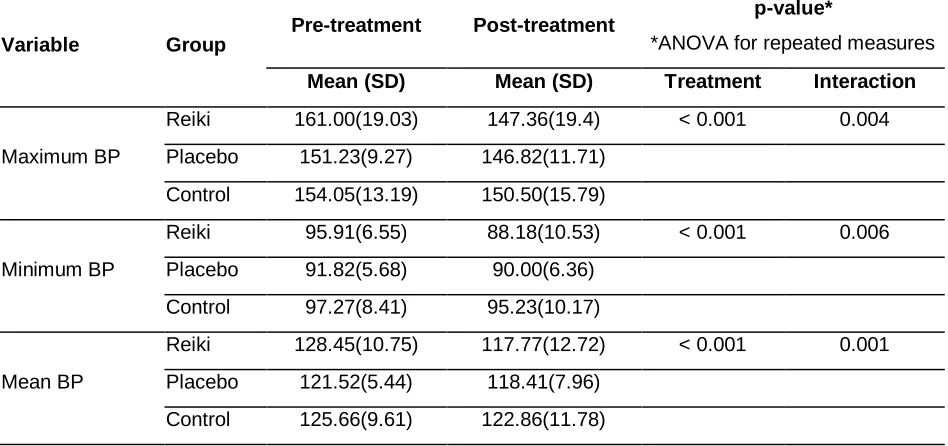
The table below is presents an analysis of blood pressure values through the use of ANOVA analysis.
Table 1 Comparison of blood pressure variation values (Salles, Vannucci, Salles, & da Silva, 2014)
Variable Group
Pre-treatment Post-treatment p-value*
*ANOVA for repeated measures
Mean (SD) Mean (SD) Treatment Interaction
Maximum BP
Reiki 161.00(19.03) 147.36(19.4) < 0.001 0.004 Placebo 151.23(9.27) 146.82(11.71)
Control 154.05(13.19) 150.50(15.79)
Minimum BP
Reiki 95.91(6.55) 88.18(10.53) < 0.001 0.006 Placebo 91.82(5.68) 90.00(6.36)
Control 97.27(8.41) 95.23(10.17)
Mean BP
Reiki 128.45(10.75) 117.77(12.72) < 0.001 0.001 Placebo 121.52(5.44) 118.41(7.96)
Control 125.66(9.61) 122.86(11.78)
Such data can be fed into the Big Data analytic tools.
STATE OF THE ART
Licensed under Creative Common Page 197 analytics. The languages possess different interesting features which provide programmers with the opportunity of using the robustness and flexibility in developing and coding algorithms. Julia Lang heavily focusses on numerical analysis, machine learning as well as statistical computations. The language was primarily developed to enhance the multi-purpose languages that are critical in the modelling and the analysis of Big Data within the healthcare systems (Steward & Jones, 2017). Julia programming language is unique and could be used in a variety of application which therefore makes it possible for its incorporation with the Big Data.
METHODOLOGY
The research adopted a qualitative study where Julia, R and Python were analysed using sources and articles that are centred on the issue of machine learning in personalised medicine. The systematic research review offered the methodology guideline for this research. The research included an analysis of journals on Big Data in healthcare, neural networks as well as machine learning algorithms performed through the use of Julia, R and Python (McNicholas & Tait, 2019). The review in this research paper focused particularly on the articles and sources that review compares and contrasts the programming languages for use in abnormal pressure values in personalised medicine (Daim, Behkami, Başoğlu, Kök, & Hogaboam, 2016). After an
analysis of the strengths and weaknesses of each of the languages, a suitable model for the implementation of a mobile-based application that detects the patient's abnormal blood pressure was proposed by the researcher. Journal sources that are directly related to the sources used in the analysis of blood pressure and other chronic diseases were used in the analysis (Thuemmler & Bai, 2017). A semantic analysis into the facts was provided by the researcher through the use of secondary sources most of which were retrieved from libraries and other secondary sources.
Flux.jl
Flux.jl is the machine learning library that is written wholly in Julia. The library focuses majorly on neural networks and possesses great interactive examples that an individual can try out using a browser of their choice. Some of the packages that are made for Flux.jl environments include:
Metalhead.jl
The package runs on top of Flux.jl and provides the common vision models for computers such as the VGG19. It also helps in downloading the common computer vision datasets.
Licensed under Creative Common Page 198 The package implements source-to-source automatic differentiation which is significant for the backprop. The package is however at the early stages of prototypes.
FluxJS.jl allows to run on the Flux.jl models in the browser by the use of TensorFlow.js
Scikit-learn
The scikit-learn is popular with the machine learning researchers as well as data scientists as it provides for a uniform interface for training and use of the models. It also contains a set of tools that help in evaluation and the turning model for the hyper-parameters. The scikit-learn might bring these data modelling and analysis capabilities to Julia (Voulgaris, 2016). The primary goal of this algorithm is for integration of both Julia and Python together so as to integrate the scikit-learn framework (Yang, 2014).
R is the friendly programming language that is often available in open-source. It provides flexibility in data analysis especially in instances where statistical data need to be analysed. R is efficient in the manipulation of data sets as well as the production of graphics of high quality (Ebeling, 2016). Researchers can use this programming language in documentation and statistical analysis of data that are closely related. Compared to Python and R, Julia is seen as providing better and efficient support to the control engineers. Python is the general-purpose programming language that is mostly used by researchers in the data analysis (Fatt & Ramadas, 2018). With the significant help of a plethora of libraries, Python offers several features of the data analysis.
FEATURE ANALYSIS AND SELECTION
Feature selection is critical in successful machine learning. When performing operations within machine learning, feature selection needs to be done from scratch through the use of various statistical methods, for instance, visual analysis and use of domain experts (Conway & White, 2012; Tinică, Bostan, & Grosu, 2008). Uploading the blood pressure values in personalised
Licensed under Creative Common Page 199 that are involved in healthcare research, for instance, the prediction of the abnormal blood pressure trends. The syntax that is used in computing various mathematical functions in Julia is simple and can be simply understood by non-programmers. Julia Lang, as wellas R, haveradix as interpreter which promises to substantially reduce the compilation time with an effect being less optimisation.
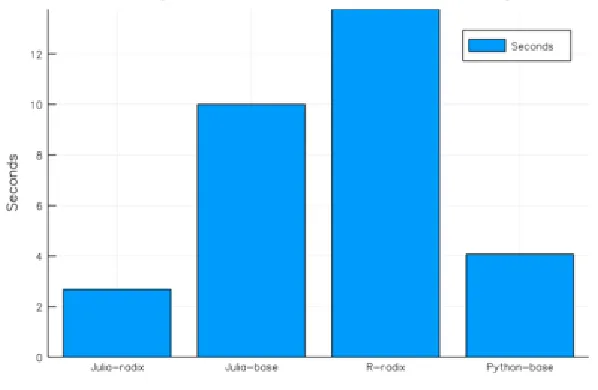
The graphical analysis below offers is an illustration of the comparative performance with R-base, R-radix, Julia-base, Julia-radix and Python-base.
Figure 1 Comparison of Languages for Sorting Function (Zhuo, 2018)
The analysis is a “sort” function not a “order” function (which returns an integer vector compares with “sort” which returns the input data sorted). Also, it is noticeable that Python has not yet
support radix. The figure 1 shows that the Julia-radix is the speed winner for a string sort performance in 10 million unique id strings, returned in array with columns grouped by similar cardinality.
JULIA vs PYTHON vs R FOR RESEARCHERS
Licensed under Creative Common Page 200 provide them with the strengths and weaknesses of each of the languages(Weiss, Natarajan, Peissig, McCarty, & Page, 2012).
As the language that is designed for Machine Learning, Data Science as well as other methodologies, Julia has made research much more comfortable and fast as compared to C and FORTRAN. Julia has made research easy while at the same time not sacrificing the performance of the related processes (Wang, Li, & Perrizo, 2014). It is the language that is designed to ship the fancy the data science algorithms without necessarily having to rewrite these algorithms on a different language. With the extensive mathematical library function, Julia potentially analyses an action and gives real-time feedback on how the action could be mitigated (Wenkel, 2018). Among the features that are crucial to researchers is providing a predictive analysis of the aspects of research. Julia is programmed such that it can perform statistical analysis and generate results for the researchers (Madsen, 2014). One might find the performance of Julia as being unintuitive at first because of the fact that its compiler is entirely different from those of Python and R. Writing a code especially for smart cities using Julia is easy as data that is needed are collected from the devices that are located at specific points in these cities under analysis. Julia is multi-paradigm while at the same time, it combines the features of imperative, functional as well as programming that is object-oriented and data-centred (Salceanu, 2018). The accessible, intuitive, as well as the highly efficient base language that has speed exceeding R and Python, is a feature that makes Julia a formidable language for the researchers.
JULIA vs PYTHON vs R FOR BUSINESS APPLICATIONS
Licensed under Creative Common Page 201 On the other hand, an analysis of Julia as one of the languages critical for business applications, it is much faster in optimisations and involves an extensive algorithm. Business modelling requires a relatively faster execution speed in the programming language adopted (McCormick, Gugerty, & Mattison, 2017). The only drawback with Julia is the lack of experience as compared to the old languages of R and Python due to the fact that the language is barely a decade old.
JULIA vs R IN HYPERTENSION
Licensed under Creative Common Page 202 characteristics which makes it a formidable option and choice for the programmers within the healthcare sector.
Medical records often contain huge data amounts of data belonging to patients. The data could be used in enhancing surveys as well as the analytical models so as to uncover the facts behind the spread of diseases (Coleman, Lyon, Maliar, & Maliar, 2018). The selection of a programming language is quite a challenge since R does not have real-time data analysis capabilities. Julia is suitable for various medical uses because of the fast pace capabilities of data analysis that come with Julia. Therefore, the analytic tools, as well as gadgets, could help in the development of suitable models which helps in the prediction of chronic diseases for instance hypertension and the blood pressure that is elevated. Julia provides a number of advantages to Big Data analysis in healthcare because of the tools used together with the algorithms in the analysis of elements such as the high heart rate. Therefore, Big Data would help in the incorporation of the required tools (Wang, Li, & Perrizo, 2014). Speed and scalability are some of the properties that qualify Julia as one of the best programming language suites to use with the Big Data in healthcare setups for analysis and prediction of certain unique conditions in chronic illness (Steward & Jones, 2017). Julia serves the purpose of data analysis and scientific computational management and is relatively fast as compared to the other basic programming languages (Yang, 2014). Among the key advantages of Julia is the fact that the users are in a position of writing routines as well as short codes in this language which performs quite better as compared to the libraries of the other programming languages (McNicholas & Tait, 2019).
BIG DATA ANALYTICS IN HEALTHCARE
Licensed under Creative Common Page 203 healthcare applications as it is a critical featured database where the information generated is used for treatment as well as the management of diseases (Voulgaris, 2016).
Consequently, Big Data application is applicable in the analysis of blood pressure values in personalised medicine as it provides for predictive formulae which are used in the analysis as well as detection of the emergencies in cases of chronic diseases (Nimmala, Ramadevi, Sahith, & Cheruku, 2018). In countries such as Malaysia, focus on big data is in progress and several initiatives have been implemented to share the medical data and related patient information. However, there exist an array of challenges in the implementation of big data in healthcare especially with regards to the privacy, standards, governance as well as the integration of data(Weiss, Natarajan, Peissig, McCarty, & Page, 2012). It is therefore imperative that such challenges be addressed using various data governance models for the successful integration of Big Data in healthcare.
IMPLICATIONS FOR PRACTICE
Application of various programming language is critical to healthcare and in particular in the analysis of most of the chronic illnesses (Bakris & Sorrentino, 2017). Introducing wearables that are incorporated using the Big Data analytic tools together with the use of Julia and other programming algorithms, detecting an emergency situation shall be possible. Such is likely to reduce the immortality rates arising from people dying of heart attacks or high blood pressure and hypertension. Real-time monitoring of chronic illnesses and the observance of patient’s
heart rate is likely to enhance the provision of urgent medical attention to the patients who have high blood pressure related complications (Ebeling, 2016). Such is aided by the use of Big Data analytic tools as well as Julia programming language in incorporating various medical interventions to address the issue of real-time analysis of the abnormal blood pressure values in personalised medicine (Cleophas & Zwinderman, 2015). The result is an improved and quality healthcare to the hypertension patients and the other patients who are at risk of chronic illness and require close monitoring (Cerebral Herniation Syndromes and Intracranial Hypertension, 2016).
FUTURE WORKS
The present research provides for a foundation for adopting smart health services such as the use of e-Ambulances mostly in the developed nations. The research analysed the real-time analysis of abnormal blood pressure in personalised medicine (Daim, Behkami, Başoğlu, Kök, &
Licensed under Creative Common Page 204 of medical services to patients with chronic illnesses (Zhi-yu Luo, et al., 2018). The future research in the real-time machine learning in the analysis of abnormal blood pressure should consider sophisticated languages for instance MATLAB, Octave and Java. These languages have strong capabilities for scientific computing, mathematical formulation as well as accurate data analysis. These are all functions that are of significance as they provide for an adequate, thus efficient, prediction of abnormalities in blood pressure especially because of its synchronisation with the machine learning algorithms (Joshi, 2016). Future researchers could study the effectiveness of the additional languages in the analysis and prediction of blood pressure values as this is likely helping in eliminating the high mortality rates experienced from cardiovascular chronic diseases and related.
Another area that could be explored for future research is the implementation of e-Ambulances. Such systems work with the Big Data analytic tools in that once an emergency is determined through the smart health services, the ambulance will get to the location of the emergency through the GIS algorithm (Bilbro, 2017). The smart systems are going to provide for the patient to be taken to the desired facility and the desired physician. Future researchers could engage in actively researching on the technology of e-Ambulances in a bid to improve the healthcare services and at the same time enhance the development of smart cities.
REFERENCES
Arnold, T., Kane, M., & Lewis, B. W. (2019). A Computational Approach to Statistical Learning (1 ed.). Chapman and Hall/CRC. Retrieved from http://www.comp-approach.com/
Bakris, G. L., & Sorrentino, M. (2017). Hypertension: A Companion to Braunwald's Heart Disease (3 ed.). Elsevier. Balbaert, I., Sengupta, A., & Sherrington, M. (2016). Julia : high performance programming : leverage the power of Julia to design and develop high performing programs : a course in three modules. Pakt Publishing.
Bilbro, R. (2017, December 27). Visual Diagnostics for More Informed Machine Learning. Retrieved February 2018, from District Data Labs: https://medium.com/district-data-labs/visual-diagnostics-for-more-informed-machine-learning-b7ea4371bb14
Cerebral Herniation Syndromes and Intracranial Hypertension. (2016). In M. A. Koenig (Ed.). Rutgers University Press.
Cleophas, T. J., & Zwinderman, A. H. (2015). Machine Learning in Medicine - a Complete Overview. Springer International Publishing. doi:10.1007/978-3-319-15195-3
Coleman, C., Lyon, S., Maliar, L., & Maliar, S. (2018). Matlab, Python, Julia: What to Choose in Economics? CEPR Discussion Papers, 13210. Retrieved from https://EconPapers.repec.org/RePEc:cpr:ceprdp:13210
Conway, D., & White, J. M. (2012). Machine Learning for Hackers (1 ed.). O'Reilly Media. Retrieved from https://github.com/mindis/002_MachineLearning_eBook/blob/master/Conway%20D.%2C%20White%20J.M.%20-%20Machine%20Learning%20for%20Hackers%20-%202012.pdf
Daim, T. U., Behkami, N. A., Başoğlu, N., Kök, O. M., & Hogaboam, L. (2016). Healthcare Technology Innovation Adoption (1 ed.). Springer International Publishing. doi:10.1007/978-3-319-17975-9
Ebeling, M. (2016). Healthcare and Big Data: Digital Specters and Phantom Objects. Palgrave Macmillan US. doi:10.1057/978-1-137-50221-6
Licensed under Creative Common Page 205 Grech, G., & Grossman, I. (2015). Preventive and Predictive Genetics: Towards Personalised Medicine (Vol. 9). Springer International Publishing. doi:10.1007/978-3-319-15344-5
Hostettler, S., Besson, S. N., & Bolay, J. C. (Eds.). (2018). Technologies for Development. Springer International Publishing. doi:10.1007/978-3-319-91068-0
Huang, S. (2019, March 6). Julia: a Language for the Future of Cybersecurity. Retrieved March 27, 2019, from Hackernoon: https://hackernoon.com/julia-a-language-for-the-future-of-cybersecurity-76f13b869924
Joshi, A. (2016). Julia for Data Science. Birmingham: Packt Publishing Ltd.
Lubin, M., & Dunning, I. (2015, March). Computing in Operations Research using Julia. INFORMS Journal on Computing, 27(2), 238-248. doi:10.1287/ijoc.2014.0623
Madsen, L. B. (2014). Data-Driven Healthcare: How Analytics and BI are Transforming the Industry (1 ed.). Hoboken, New Jersey; John Wiley and Sons Inc. Retrieved from https://www.bloomberglaw.com/browser/105.525372
Martin, O. (2018). Bayesian Analysis with Python (2 ed.). Packt.
McCormick, K. A., Gugerty, B., & Mattison, J. E. (2017). Healthcare Information Technology Exam Guide for CHTS and CAHIMS Certifications (2 ed.). McGraw-Hill Education.
McNicholas, P. D., & Tait, P. (2019). Data Science with Julia (1 ed.). Chapman and Hall/CRC.
Nimmala, S., Ramadevi, Y., Sahith, R., & Cheruku, R. (2018). High blood pressure prediction based on AAA++ using machine-learning algorithms. (H. Nisar, Ed.) Cogent Engineering, 5(1). doi:10.1080/23311916.2018.1497114
Popuri, S. K., & Gobbert, M. K. (2017). A Comparative Evaluation of Matlab, Octave, R, and Julia on Maya. University of Maryland, Baltimore County: UMBC Faculty Collection. Retrieved from https://mdsoar.org/handle/11603/11302 Ramesh, P. (2018, October). Julia for machine learning. Will the new language pick up pace? Retrieved March 23, 2019, from Paktpub.com: https://hub.packtpub.com/julia-for-machine-learning-will-the-new-language-pick-up-pace/ Salceanu, A. (2018). Julia Programming Projects: Learn Julia 1.x by building apps for data analysis, visualization, machine learning, and the web (1 ed.). Packt Publishing. Retrieved from https://github.com/PacktPublishing/Julia-Programming-Projects
Salles, L. F., Vannucci, L., Salles, A., & da Silva, M. P. (2014, October). The effect of Reiki on blood hypertension. Acta Paulista de Enfermagem, 27(5). doi:10.1590/1982-0194201400078
Shen, B., Tang, H., & Jiang, X. (2016). Translational Biomedical Informatics: A Precision Medicine Perspective (1 ed.). Springer.
Steward, J., & Jones, C. (2017). Key Algorithms in Python, R and Julia. Berlin: Springer.
Tailor, K. (2015). The Patient Revolution: How Big Data and Analytics Are Transforming the Health Care Experience (1 ed.). Wiley. Retrieved from http://index-of.co.uk/Big-Data-Technologies/The%20Patient%20Revolution%20-%20Krisa%20Tailor.pdf
Thuemmler, C., & Bai, C. (2017). Health 4.0: How Virtualization and Big Data are Revolutionizing Healthcare (1 ed.). Springer International Publishing. doi:10.1007/978-3-319-47617-9
Tinică, G., Bostan, I., & Grosu, V. (2010). Correlations regarding the economic growth and the direct and indirect costs incurred by chronic diseases. Romanian Journal of Bioethics, 8(3), 116-124.
Tinică, G., Bostan, V., & Grosu, V. (2008). The dynamics of public expenses in healthcare and demographic evolution in Italy and Romania. Romanian Journal of Bioethics, 6(3), 56-63.
Toma, A., Constantinescu, R., & Zota, R. (2010). Enhancing Administrative Services through Document Models. The Proceedings of the 5th international conference Knowledge Management: Projects, Systems and Technologies (pp. 94-102). Bucharest: “Carol I” National Defence University Publishing House.
Voulgaris, Z. (2016). Julia for Data Science (1 ed.). Technics Publications. Retrieved from https://books.google.ro/books?id=9rA-DQEACAAJ
Wang, B., Li, R., & Perrizo, W. (2014). Big Data Analytics in Bioinformatics and Healthcare (1 ed.). IGI Global. doi:10.4018/978-1-4666-6611-5
Licensed under Creative Common Page 206 Wenkel, S. (2018, October 5). Julia for Data Science, Machine Learning and Artificial Intelligence. (SimonWenkel.com) Retrieved March 22, 2019, from https://www.simonwenkel.com/2018/10/05/Julia-for-datascience-machine-learning-and-artificial-intelligence.html
Yang, G.-Z. (2014). Body Sensor Networks (2 ed.). Springer-Verlag London. doi:10.1007/978-1-4471-6374-9 Zaccone, G., Karim, R., & Menshawy, A. (2017). Deep Learning with TensorFlow (2 ed.). Packt Publishing Limited. Zhi-yu Luo, Ji Cui, Xiao-juan Hu, Li-ping Tu, Hai-dan Liu, Wen Jiao, . . . Jia-tuo Xu. (2018, November 11). A Study of Machine-Learning Classifiers for Hypertension Based on Radial Pulse Wave. BioMed Research International, 2018. doi:10.1155/2018/2964816