BOTTLENECK-BASED HEURISTIC FOR THREE MACHINE FLOW SHOP SCHEDULING
MOHD SALLEH BIN ABDUL RAHIM
A thesis submitted as partial fulfillment of the requirement for The Award of Masters of Mechanical Engineering.
Faculty of Mechanical and Manufacturing Engineering Universiti Tun Hussein Onn Malaysia
ABSTRACT
This paper considers a 3 machine flow shop (M1M2M3) with tendency of dominant (bottleneck) machine at M1. The developed bottleneck based heuristics from previous studies are considered in this case by Hezzeril (2010) and Irwan (2010), but were only tested for dominant machine at M2 and M3 respectively. The heuristics have
ABSTRAK
CONTENTS
TITLE i
DECLARATION ii
DEDICATION iii
ACKNOWLEDGEMENT iv
ABSTRACT v
CONTENTS vii
LIST OF TABLES x
LIST OF FIGURES xii
LIST OF SYMBOLS xiii
LIST OF APPENDICES xiv
CHAPTER 1 INTRODUCTION 1
1.1 Introduction 1
1.2 Problem statement 2
1.3 Objectives of study 3
1.4 Scope of study 3
1.6 Expected result 4
CHAPTER 2 LITERATURE REVIEW 6
2.1 Introduction 6
2.2 Concept of scheduling 7
2.2.1 Forward scheduling 8
2.2.2 Backward scheduling 8
2.2.3 Scheduling criteria 9
2.3 Shop scheduling models 9
2.4 Flow shop scheduling problem 10
2.5 Bottleneck-based heuristic 12
2.6 Nawaz, Enscore, and Ham heuristic 13
2.7 Sequencing rules 15
2.8 Previous research 16
CHAPTER 3 METHODOLOGY 19
3.1 Introduction 19
3.2 Methodology of the study 19
3.3 Gather information 22
3.4 Develop bottleneck-based heuristic 22
3.5 Simulate program 23
3.6 Evaluate heuristic performance 24
3.7 Compare heuristic performance 25
CHAPTER 4 DISCUSSION 27
4.1 Introduction 27
4.2 Bottleneck Machine M1 (BMM1) heuristic 27 4.2.1 Brief example of BMM1 heuristic 30
4.3 BMM1 heuristic performance 38
4.4 Combination of heuristics 41
4.4.2 Justification of heuristic at each process 43
4.5 Combination of heuristics performance 47
4.6 Discussion on results 49
CHAPTER 5 CONCLUSION 51
5.1 Introduction 51
5.2 Discussion of study 51
5.3 Recommendation of study 52
5.4 Conclusion 53
REFERENCES 55
LIST OF TABLES
2.1 Summary of previous research 15
3.1 Heuristic performance for 6 jobs problem 25 3.2 Heuristic performance for 10 jobs problem 26 4.1 Processing time data (hour) for 6 jobs problem 30 4.2 Minimum and maximum processing time range for each
machine (hour) 30
4.3 31
4.4 Occurrence of
of other job 31
4.5 BMM1 index computation for 5th job 33
4.6 BMM1 index computation for 4th job 33
4.7 BMM1 index computation for 3rd job 34
4.8 BMM1 index computation for 2nd job 34
4.9 Start and stop time data analysis for EDBAFC sequence 35 4.10 BMM1 list of scheduling sequences for 6 jobs 37 4.11 Sample of makespan data from 720 sequences list for 6 jobs 37 4.12 P1 dominance level groups for 6 jobs analysis 38 4.13 P1 dominance level groups for 10 jobs analysis 38 4.14 BMM1 heuristic accuracy for 6 jobs problem 39 4.15 BMM1 heuristic accuracy for 10 jobs problem 39 4.16 Average ratio of BMM1 heuristic makespan for 6 jobs 40 4.17 Average ratio of BMM1 heuristic makespan for 10 jobs 40 4.18 Dominance level computation for 6 jobs with bottleneck at
first machine 42
4.19 Dominance level computation for 6 jobs with bottleneck at
4.20 Dominance level computation for 6 jobs with bottleneck at
third machine 43
4.21 BB heuristic results for 10 jobs, bottleneck at first process 44 4.22 BB heuristic results for 10 jobs, bottleneck at middle process 44 4.23 BB heuristic results for 10 jobs, bottleneck at last process 44 4.24 DLMP heuristic results for 10 jobs, bottleneck at first
process 45
4.25 DLMP heuristic results for 10 jobs, bottleneck at middle
process 45
4.26 DLMP heuristic results for 10 jobs, bottleneck at last process 45 4.27 BMM1 heuristic results for 10 jobs, bottleneck at first
process 46
4.28 BMM1 heuristic results for 10 jobs, bottleneck at middle
process 46
4.29 BMM1 heuristic results for 10 jobs, bottleneck at last
process 46
4.30 BMM1 heuristic performance for 6 and 10 jobs, bottleneck
at first process 47
4.31 DLMP heuristic performance for 6 and 10 jobs, bottleneck at
middle process 48
4.32 BB heuristic performance for 6 and 10 jobs, bottleneck at
LIST OF FIGURES
LIST OF SYMBOLS AND ABBREVIATIONS
GT - Group Technology
NP - Non-Deterministically Polynomial M1 - Machine number 1
M2 - Machine number 2 M3 - Machine number 3
MRP - Material Requirement Planning MRP II - Manufacturing Resources Planning WIP - Work-in-Progress
J1 - Job 1 J2 - Job 2 J3 - Job 3
NEH - Nawaz, Enscore and Ham CDS - Campbell, Dudek and Smith P1 - Process 1
P2 - Process 2 P3 - Process 3
FCFS - First-Come, First-Served SPT - Shortest Processing Time EDD - Earliest Due Date
CR - Critical Ratio
BBFFL - Bottleneck-based Heuristic for Flexible Flow Line TCG - Transform Classical Flow Shop to Generalized Shop DLMP - Dominance Level of Middle Process
LIST OF APPENDICES
APPENDIX TITLE PAGE
A Gantt chart 58
A1 Gantt chart for PS I 59
A2 Gantt chart for PS II 60
B Flow chart of project 61
C Macro-Programming coding in Microsoft Excel 63 C1 BMM1 Heuristic for 6 jobs 64
C2 BMM1 Heuristic for 10 jobs 68
C3 6 jobs data generation for combination 73 C4 BMM1 Heuristic combination for 6 jobs 74 C5 DLMP Heuristic combination for 6 jobs 78 C6 BB Heuristic combination for 6 jobs 82
C7 10 jobs data generation for combination 86 C8 BMM1 Heuristic combination for 10 jobs 87 C9 DLMP Heuristic combination for 10 jobs 91 C10 BB Heuristic combination for 10 jobs 95 D Spreadsheet in Microsoft Excel 99
D1 Screenshot of processing time data generated 100
D2 Screenshot of job selection by heuristic 101
D3 Screenshot of makespan calculation at 1000 simulations 102
D4 Screenshot of heuristic performance evaluation 103
CHAPTER 1
INTRODUCTION
1.1 Introduction
Scheduling is a decision-making process that concerns the allocation of limited
resources to a set of tasks with the view of optimizing one or more objectives. In today’s world of global competition, effective scheduling has become vital in order to meet customer requirements as promptly as possible while maximizing the profits. Scheduling in manufacturing systems is classically associated with scheduling a set of jobs on a set of machines in order to maximize the profit. Manufacturing system is classified as job shop, flow shop and open shop. Technological constraints demand that each job should be processed through machines in a particular order and gives a significant special case named as flow shop.
Flow shop scheduling is one of the most important problems in the area of production management. It can be briefly described as follows: There are a set of m
In scheduling, the “bottleneck” in the processing is the main problems concerned by the manufacturing and process industries. A bottleneck is a constraint within the system that limits throughput. A bottleneck may be a machine, scarce or highly skilled labor, or specialized tool. Many researchers in production and operation management have come out with various heuristic with estimated optimal value to solve the scheduling problem of interest.
Heuristic are general guidelines or “rules of thumb” for obtaining feasible but not necessarily optimal solution to problems. Heuristic is developed by considering the work centre that may be a single machine; group of machines or an area where a particular type of work in done; or by product in a flow, assembly line or group technology-cell (GT-cell) configuration. Therefore, in current manufacturing world, the optimal heuristic is needed in order to minimize the effect of the bottleneck. This means, it will intend to minimize the time it takes to do work, or specifically, the makespan in flow shop. The makespan is defined as the amount of time from start to finish completing a set of multi-machine jobs where multi-machine order is pre-set for each job.
1.2 Problem statement
The n job with m machine flow shop scheduling is a Non-Deterministically Polynomial (NP) Hard problem. Optimal solutions can only be obtained by enumeration techniques. But these methods take a large amount of computational effort and time. That is why heuristic method is developed to solve these problems. Independent research (Jeffries et al. 1991) has indeed confirmed that heuristic evaluation is a very efficient usability engineering method.
process and 90.98% at the last process. This study is directed towards developing a new heuristic for solving the three machine flow shop scheduling problem for six jobs and ten jobs at the first process and combining it with the previously developed heuristics. It also involves the development of a new algorithm for dominance level computation and a new computer program to evaluate the effectiveness of the overall heuristic.
1.3 Objectives of study
The main objective is to develop a new scheduling heuristic and to evaluate its performance for M1M2M3 flow shop by combining the developed heuristics from previous studies.
1.4 Scope of study
i. The study will focus on M1M2M3 flow shop.
ii. The study will develop a new scheduling heuristic for M1M2M3 flow shop scheduling problem by combining the heuristics from previous studies.
iii. The study involves the development of a computer program that can be used to evaluate the performance of the new heuristic.
iv. The computer program will be developed using Microsoft Excel and Visual Basic for Application.
v. The performance evaluation of the heuristic will be done by using makespan computation of six jobs and ten jobs problem.
1.5 Significance of study
In order to remain competitive in current global environment, enterprises must be competent in certain areas such as short product lifecycle, product varieties, minimal inventories, concurrent processing of different products and short delivery times. Scheduling system is a very important criterion in manufacturing industry. The main objective in the scheduling system is to decrease the processing time of products so that the products could be delivered to customers on time.
Previous research has found several ways in developing scheduling heuristic using bottleneck approach and Macro-Programming in Microsoft Excel. The good thing about this method is there is no high skilled person required and it involves low cost in developing the scheduling. The programs are flexible enough which allow user to modify the existing scheduling data and can easily be understood.
Hence, the previous research should be continued because it can give big impact on the productivity of such companies. This cheap and easy to understand method should be very useful for small companies to save budget and time while productivity can be increased.
1.6 Expected result
CHAPTER 2
LITERATURE REVIEW
2.1 Introduction
Scheduling is a decision-making process that is used on a regular basis in many
manufacturing and services industries. It deals with the allocation of resources to tasks over given time periods and its goal is to optimize one or more objectives. The resources and tasks in an organization can take many different forms. The resources may be machines in a workshop, runways at an airport, crews at a construction site, processing units in a computing environment, and so on. The tasks may be operations in a
2.2 Concept of scheduling
In scheduling, the limited resources consist of one or more machines, and tasks are modeled as jobs that can be executed by the machines. A task (job) first becomes
available for processing at its ready time, and it must receive amount of processing equal to its processing time. Typically, a problem in scheduling is characterized by the types of machines and jobs in the system, by the constraints imposed, and by a desired optimality principle (Jain, 2005).
A characteristic of the machine environment is that a machine can handle, at most, one job at a time, and each job can be processed by only one machine at a time. In general, a machine can begin its next job immediately after the current job is completed, and there are no machine breakdowns at any moment of time. For the scheduling
problem considered in this thesis, preemption is not allowed during the processing of any operation, which means that the execution of a job on a machine will proceed without interruption once it starts. A machine scheduling problem is in fact a sequencing problem where a schedule is completely specified by the sequence in which jobs are performed.
In manufacturing area, the purpose of scheduling is to minimize the production time and costs, by telling a production facility what to make, with which staff and on which equipment. The aim of the production scheduling is to maximize the efficiency of the operation and reduce costs. The production scheduler tools are great. They provide the production scheduler with powerful graphical interfaces which can be used to visually optimize real-time workloads in various stages of the production, and pattern recognition (Wikipedia, 2010).
The benefits of production scheduling include: i) process change-over reduction
ii) inventory reduction
iv) increased production efficiency
v) labor load leveling
vi) accurate delivery date quotes
vii) real-time information
2.2.1 Forward scheduling
Forward scheduling or in push mode operations, the provider sends work along in the absence of any call from the customer. In this mode, the providers determine when and what is the work flow. Some system uses this approach, for example, radio and
television station. Many manufactured goods flow because the provider chooses to produce them, not because a customer ordered them. The schedule starts from its start time until the whole process is finished without considering its due date.
2.2.2 Backward scheduling
Backward scheduling is also known as pull scheduling where it is a method of determining a production scheduling by working backwards from the due date to the start date and computing the materials and time required at every operation or stage. The example using the backward system are material requirement planning (MRP) and manufacturing resources planning (MRP II).
This method is more complicated than forward scheduling because the possibility of infeasibility caused by creating jobs that should have been started
2.2.3 Scheduling criteria
Scheduling in the right technique depends on the volume of orders, the nature of
operations, and the overall complexity of jobs, as well as the importance placed on each of four criteria. Those four criteria are (Heizer and Render, 1999):
i) Minimize completion time – This criterion is evaluated by determining the average completion time per job.
ii) Maximize utilization – This is evaluated by determining the percent of time the facility is utilized.
iii) Minimize work-in-progress (WIP) inventory – This is evaluated by determining the average number of jobs in the system. The relationship between the number of jobs in the system and WIP inventory will be high. Therefore, the fewer the number of jobs that are in the system, the lower the inventory.
iv) Minimize customer waiting time – This is evaluated by determining the average number of late days.
2.3 Shop scheduling models
processing and has to remain at the upstream machine. This occurrence prevents a job in queue at that machine from beginning its processing.
The shop scheduling models are divided into two types of model that is flow-shop model and job-flow-shop model. In the aforementioned flow-shop models, there are no precedence relationships between jobs prescribing the order in which job processing must be carried out. While the machine sequence (i.e., the processing route) of all jobs is given, the scheduling problem is to find the best job processing sequence according to a desired optimality principle (Jain, 2005).
Scheduling can be difficult for a number of reasons. One is that in reality, an operation must deal with variability in setup time, processing time, interruption and change in the set of jobs. Another major reason is that except for very small problems, there is no method for identifying the optimal schedule and it would be virtually impossible to sort through the vast number of possible alternative to obtain the best schedule.
2.4 Flow shop scheduling problem
Flow shop scheduling problem is one of the most well known problems in the area of scheduling. It is a production planning problem in which n jobs have to be processed in the same sequence on m machines. Most of these problems concern the objective of minimizing makespan. Makespan is the time between the beginning of the execution of the first job on the first machine and the completion of the execution of the last job on the last machine. To minimize the makespan is equivalent to maximize the utilization of the machines.
A flow shop is characterized by more or less continuous and uninterrupted flow of jobs through multiple machines in series. In such a shop, the flow of work is
Although this description of flow shop resembles an assembly-line operation, there are several differences:
i) A flow shop is equipped to handle a variety of jobs as opposed to a standard product manufactured by an assembly-line.
ii) The jobs in a flow shop do not have to be processed on all machines; that is, a job may skip some operations according to its technological
requirements. However, in an assembly-line, all jobs have to move from one station to another without skipping any work-station.
iii) In a flow shop, each machine is independent of other machines and can be loaded independently; whereas in assembly-line operations, each work station depends on the preceding one.
iv) Each job has its own processing time at each machine in a flow shop; however, all units of a product have a standard time at each work station in an assembly-line (Ashour, 1972). Because of these differences, Heller (1959) characterized a flow shop as a conservative assembly line.
Johnson (1954) is the pioneer in the research of flow shop problems. He
proposed an ‘‘easy’’ algorithm to the two machine flow shop problem with makespan as the criterion. Since then, several researchers have focused on solving m machine (m >2) flow shop problems with the same criterion. However, these fall in the class of NP-hard (Garey, Johnson, & Sethi, 1976; RinnooyKan, 1976), complete enumeration techniques must be used to solve these problems. As the problem size increases, this approach is not computationally practical. For this reason, researchers have constantly focused on
developing heuristics for the hard problem.
machines. The objective is to compute the completion times of all jobs on the final machine (makespan). A flow shop instance consists in scheduling n jobs ( i=1………n) on m machines M (j=1……m) . A job consists in m operations and the jth operation of each job must be processed on machine j. So, one job can start on machine j if it is completed on machine j-1 and if machine j is free. Each operation has a known processing time which specifies the time required by machine m for processing job j . Each job is to be processed on all machines M1, M2,……,Mm in this order.
In this context, each job has been assigned exactly m operations where as in real situations a job may have fewer operations, certain heuristic algorithms propose that the jobs with higher total process time should be given higher priority than the jobs with less total process time. From a review of the literature, it can be noticed that several heuristic approaches in the field of flow shop scheduling have been developed to minimize both the maximum flow time and the makespan.
2.5 Bottleneck-based heuristic
Heuristics can be classified into three types: index-development, solution-construction, and solution-improvement. However, some heuristics may consist of one or more of these types. A dispatching rule is an index-development type, and a multiple- insertion heuristic, such as NEH, is a solution-construction type. Meta-heuristics, such as tabu search and simulated annealing, can be regarded as a solution-improvement type. Obviously, solution- improvement type heuristics require the longest computation time to find a solution (Chun-Lung Chen and Chuen-Lung Chen, 2009).
considered a practical scheduling problem for plants that produce multiple paper bags. The machine environment can be regarded as a flexible flow shop, and the machines at a stage may not all be identical. They developed an ad hoc bottleneck-based heuristic to solve the specific problem.
Chen and Lee (1998) suggested a bottleneck-based group scheduling procedure to solve flow line cell scheduling problems. The procedure was based on the bottleneck machine and attempted to fully utilize the bottleneck machine and minimize makespan. Lee et al. (2004) developed a bottleneck-based heuristic to solve a multistage hybrid flow shop problem with identical parallel machines at each stage and with minimum total tardiness as the objective. The heuristic first focuses on the bottleneck stage, constructs the schedule of the bottleneck stage, and constructs schedules for other stages based on the schedule of the bottleneck stage. The heuristic uses the sum of processing times of a job at the upstream stages to be the arrival time of the job at the bottleneck stage. If the procedure results in an infeasible schedule, then the arrival times of the jobs at the bottleneck stages will be iteratively modified until a feasible schedule is obtained. They compared the performance of eight well-known dispatching rules and the
bottleneck-based heuristic. The computational results showed that the heuristic dominated all the dispatching rules.
2.6 Nawaz, Enscore, and Ham (NEH) heuristic
The well known NEH heuristic from Nawaz, Enscore and Ham proposed in 1983 has been recognized as the highest performing method for the permutation flowshop scheduling problem under the makespan minimization criterion. This performance lead is maintained even today when compared against contemporary and more complex heuristics as shown in recent studies.
NEH is shown to provide better results than other highly cited heuristics such as the CDS method of Campbell et al. (1970). More importantly, in Ruiz and Maroto (2005), NEH was tested against 25 other heuristics, including the more modern and complex algorithms of Koulamas (1998), Suliman (2000) and Davoud Pour (2001), as well as those of Hundal and Rajgopal (1988) and Ho and Chang (1991). The results supported by careful statistical analyses, show that NEH is vastly superior to all tested methods and at the same time are much faster. As a result, NEH is used today as a seed sequence in many, if not all, effective metaheuristics proposed for the permutation flowshop scheduling problem.
The idea of the NEH heuristic is very simple. First, NEH finds the priority order by sorting the jobs according to their non-increasing total processing times. Later, the first unscheduled job in this order is inserted in the best position among all possible positions of the current subsequence of already scheduled jobs. The NEH insertion phase is rather straightforward with the exception of an undefined tie-breaking method.
The heuristic procedure proposed by Nawaz, Enscore Jr. & Ham is based on the assumption that a job with more total processing time on all the machines should be given higher priority than a job with less total processing time. The algorithm can be stated as follows;
Step 1: For each job v calculate
where pkv = processing time of job v on machine k, and m = number of machines.
Step 2: Arrange the jobs in descending order of Pv .
Step 3: Pick the two jobs from the first and second position of the list of Step 2, and find the best sequence for these two jobs by calculating makespan for the two
Step 4: Pick the job in the ith position of the list generated in Step 2 and find the best sequence by placing it at all possible i positions in the partial sequence found in the previous step, without changing the relative positions to each other of the already assigned jobs. The number of enumeration at this step equals i. Step 5: If n = i, STOP, otherwise set i = i + 1 and go to Step 4.
2.7 Sequencing rules
Sequencing is prioritizing jobs assigned to a resource. The form of the optimal
sequencing rule depends on several factors, including the pattern of arrivals of jobs, the configuration of the job shop or flow shop, constraints, and the optimization objectives.
There were four sequencing rules commonly used in practice as:
1) First-come, first served (FCFS) – Job is processed in sequence in which they entered the shop.
2) Shortest processing time (SPT) – Job is sequenced in increasing order of their processing times. The job with the shortest processing time is first, the job with the next shortest processing time is second and so on.
3) Earliest due date (EDD) – Job is sequenced in increasing order of their due dates. The job with the earliest due date is first, the job with the next earliest due date is second, and so on.
2.8 Previous research
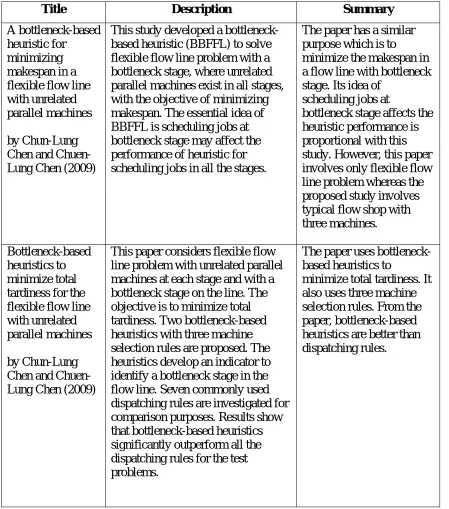
Table 2.1: Summary of previous research
Title Description Summary
A bottleneck-based heuristic for
minimizing makespan in a flexible flow line with unrelated parallel machines by Chun-Lung Chen and Chuen-Lung Chen (2009)
This study developed a bottleneck-based heuristic (BBFFL) to solve flexible flow line problem with a bottleneck stage, where unrelated parallel machines exist in all stages, with the objective of minimizing makespan. The essential idea of BBFFL is scheduling jobs at bottleneck stage may affect the performance of heuristic for scheduling jobs in all the stages.
The paper has a similar purpose which is to minimize the makespan in a flow line with bottleneck stage. Its idea of
scheduling jobs at
bottleneck stage affects the heuristic performance is proportional with this study. However, this paper involves only flexible flow line problem whereas the proposed study involves typical flow shop with three machines. Bottleneck-based
heuristics to minimize total tardiness for the flexible flow line with unrelated parallel machines by Chun-Lung Chen and Chuen-Lung Chen (2009)
This paper considers flexible flow line problem with unrelated parallel machines at each stage and with a bottleneck stage on the line. The objective is to minimize total tardiness. Two bottleneck-based heuristics with three machine selection rules are proposed. The heuristics develop an indicator to identify a bottleneck stage in the flow line. Seven commonly used dispatching rules are investigated for comparison purposes. Results show that bottleneck-based heuristics significantly outperform all the dispatching rules for the test problems.
The paper uses bottleneck-based heuristics to
Heuristic
algorithms for two machine re-entrant flow shop
by Caixia Jing, Guochun Tang and Xingsan Qian (2008)
This paper focuses on a two machine re-entrant flow shop scheduling problem with the objective of minimizing makespan. The authors assume that all jobs are available at time zero and machines do not breakdown during the work. Each machine can handle only one sub-job at a time and different operations of the same job cannot be processed simultaneously. Preemption is not allowed. There is no setup time required before jobs are processed on any machine or setup times are included in the processing times.
The purpose of this paper is similar with this study which is to minimize makespan. The authors made some assumptions or limitations. This shows that before developing a schedule, assumptions have to be identified.
Improvement heuristic for the flow-shop scheduling problem: An adaptive-learning approach by Anurag Agarwal, Selcuk Colak and Enes Eryarsoy (2006)
In this paper, the authors propose an improvement-heuristic approach for the general flow-shop problem based on the idea of adaptive learning. The authors compare their results to the best-known upper-bound solutions and find that for many problems they match the best known upper bound. For one problem the authors discover a new upper bound.
The authors use a different approach by using heuristic based on adaptive learning. This is different than bottleneck-based heuristic in this study but can be used to solve flow shop scheduling problem. The authors use upper-bound solutions to compare results. While in this study, makespan from complete enumeration and maximum lower bound are used to compare results. A Fast Method for
Heuristics in Large-Scale Flow Shop Scheduling by Li Xiaoping, Liu Lianchen and Wu Cheng (2006)
This paper describes a generalized flow shop model, which is an extension of the classical model, in which not all machines are available at time zero. The general completion time computing method is used to compute completion time of generalized flow shops. The transform classical flow shop to generalized shop (TCG) method is used to transform classical schedules into generalized schedules with
The authors develop a fast method for heuristics to solve a large-scale flow shop scheduling. They describe a generalized flow shop model in which not all machines are available at time zero. They compute completion time of
fewer jobs. This study uses start stop data to compute
completion time of flow shop scheduling.
A heuristic for minimizing the makespan in no-idle permutation flow shops by Pawel Jan Kalczynski and Jerzy
Kamburowski (2005)
The paper deals with the problem of finding a job sequence that
minimizes the makespan in m-machine flow shops under the no-idle condition. This condition requires that each machine must process jobs without any interruption from the start of processing the first job to the completion of processing the last job. Since the problem is NP-hard, the authors propose a
constructive heuristic for solving it. The purpose of this paper is to present a new constructive heuristic for minimizing the makespan in no-idle permutation flow shops
The purpose of this paper is similar with the study which is to minimize makespan. The authors concentrate on m-machine flow shops under the no-idle condition. The same limitation is used which is each machine must process jobs without any
interruption. The problem is also an NP-hard.
From previous research in Table 2.1, all of the researches have used heuristic to solve flow shop scheduling problem. Several types of heuristic were involved and some of them used bottleneck based heuristic which is the same approach with this study. Most of them are with the objective to minimize makespan. Although the methods used by them are different with this study, the purpose is the same. There are also several types of flow shop involved such as re-entrant flow shop, large scale flow shop and
CHAPTER 3
METHODOLOGY
3.1 Introduction
The methodology consists of the steps of every work progress for completing a new scheduling heuristic for flow shop. This chapter delivers the explanation in details about the methods followed in conducting the research. It also acts as a guideline to develop a bottleneck-based heuristic for three machine flow shop scheduling and simulate it by using the macro programming in Microsoft Excel.
3.2 Methodology of the study
i. Gather the information about bottleneck-based heuristic, flow shop scheduling and existing popular heuristics for flow shop with three machines, how to develop and simulate the scheduling system.
ii. Understand the concepts of flow shop scheduling and focus on flow shop with three machines and existing popular heuristics for flow shop with three
machines.
iii. Understand bottleneck-based makespan algorithm for flow shop.
iv. Develop bottleneck-based heuristic for flow shop.
v. Convert the algorithm to Microsoft Excel coding.
vi. Develop simulation program in Microsoft Excel.
vii. Pilot runs the simulation for validation and error checking.
Start
Gather information from existing heuristics by
previous research
Understand bottleneck-based makespan algorithm
for 3 machine flow shop
Develop bottleneck-based heuristic for 3 machine
flow shop
Simulate program by using Microsoft Excel
Evaluate heuristic performance using makespan computation
Compare heuristic performance against result
End
Figure 3.1: Work progress flow chart 3.3 Gather information
This project begins by gathering information about Bottleneck-based Heuristic for solving the scheduling problem. This information is taken from sources such as previous journals, thesis, internet and related books from library. At this stage, this study will define each resource that is related to the flow shop scheduling. The study also defines the input and output of the flow shop scheduling.
Below are the assumptions or limitations identified for developing the scheduling:
i. No machine can process more than one job at a time. ii. No preemption is allowed.
iii. All setup times are included into the job processing times. iv. There is unlimited storage between the machines.
v. All machines are continuously available (no breakdown).
3.4 Develop bottleneck-based heuristic
bottleneck analysis, the same algorithms from previous studies will be used as a basis. The elaborations about the algorithm are shown below:
In cases where the M1 is always the dominant machine, the index can be described as below:
Let i = process sequence of the job I = 1, 2, 3 representing Ml, M2, M3
j = number according to the scheduling sequence (j = 1, 2, 3...n) P (i,j) = processing time of the jth job at ith process sequence
(Equation 3.1)
In cases where the M2 is always the dominant machine, the index is:
(Equation 3.2)
In cases where the M3 is always the dominant machine, the index would be:
(Equation 3.3)
A computer program will be used to simulate the data and measure the performance of the heuristic. In this research, the heuristic performance will be tested by using
Microsoft Excel with built-in Microsoft Visual Basic. A computer requires programs to function, typically executing the program's instructions in a central processor and
enables to develop the heuristic program. Microsoft Excel is used to develop generalized algorithm for flow shop scheduling. By using it, optimum scheduling can also be
obtained for minimizing the completion time.
3.6 Evaluate heuristic performance
The performance evaluations of the heuristic using makespan computation of six and ten jobs problem will be evaluated by simulation experiment. In six jobs problem, the best schedule arrangement comes from complete enumerations which will provide the
minimum makespan value. For comparison purpose, a similar test will also be conducted by using maximum lower bound technique. This technique will also be used for ten jobs problem.
A total of 1000 simulations will be conducted to six and ten jobs problem by using this new heuristic. The results from this new heuristic and lower bound technique will be compared with the optimum makespan obtained from complete enumeration except for ten jobs problem.
During each simulation, makespan from the heuristic and optimum makespan from complete enumeration are recorded. The ratio between this heuristic makespan and the optimum makespan from enumeration and from lower bound is then computed for performance measurement. The percentage of occurrence in which the makespan from this heuristic equals to the optimum makespan from complete enumeration and lower bound will also be calculated and these performances are based on the equations below:
Makespan ratio =
REFERENCES
Agarwal, A., Colak, S., & Eryarsoy, E. (2006). Improvement heuristic for the flow-shop scheduling problem: An adaptive-learning approach. European Journal of Operational Research 169, pp. 801–815.
Ahmad, Bareduan, S & Hasan, S. (2007). Makespan Computation for
Cyber Manufacturing Centre Using Bottleneck Analysis: A Re-entrant Flow Shop Problem. IMECS 2008, Vol. 2.
Chen, C. L. & Chen, C.L. (2009). a) Bottleneck-based heuristics to minimize total tardiness for the flexible flow line with unrelated parallel machines.
Computers & Industrial Engineering 56, pp. 1393–1401
Chen, C. L. & Chen, C.L. (2009). b) A bottleneck-based heuristic for minimizing makespan in a flexible flow line with unrelated parallel machines. Computers & Operations Research 36, pp. 3073–3081
Chen, J. S., Pan, J. C. H., & Lin, C.M. (2008). A hybrid genetic algorithm for the re-entrant flow-shop scheduling problem. Expert Systems with Applications 34,
Dhingra, A. & Chandna, P. (2010). A bi-criteria M-machine SDST flowshop
scheduling using modified heuristic genetic algorithm. International Journal of Engineering, Science and Technology, Vol. 2, No. 5,pp.216-225.
Gupta, J. N. D. & Stafford Jr., E. F. (2006). Flowshop scheduling research after five decades. European Journal of Operational Research 169, pp. 699–711.
Jing, C., Tang, G., & Qian, X. (2008). Heuristic algorithms for two machine re-entrant flow shop. Theoretical Computer Science 400, pp. 137–143
Kalczynski, P. J. & Kamburowski, J. (2008). An improved NEH heuristic to minimize makespan in permutation flow shops. Computers & Operations Research 35, pp. 3001 – 3008
Kalczynski, P. J. & Kamburowski, J. (2005). A heuristic for minimizing the makespan in no-idle permutation flow shops. Computers & Industrial Engineering 49, pp. 146–154
Rad, S. F., Ruiz, R., & Boroojerdian, N. (2006). New High Performing Heuristics for Minimizing Makespan in Permutation Flowshops. Amirkabir University of Technology, Tehran, Iran.
Xiaoping, L., Lianchen, L., & Cheng, W. (2006). A Fast Method for Heuristics in Large-Scale Flow Shop Scheduling. Tsinghua Science and Technology ISSN 1007-0214 03/21, pp. 12-18
Mansfield, R. (2008). Mastering VBA for Microsoft Office 2007. Indianapolis: Wiley Publishing.
Abdul Mutalib, M. A. H. (2009). Bottleneck based heuristic for three machine flow shop scheduling with the tendency of dominant machine at the first process. Universiti Tun Hussein Onn Malaysia: Bachelor Degree’s Thesis.
Hairuddin, M. H. (2010). Performance evaluation of M2 bottleneck based heuristic
for M1M2M3 flow shop using computer program. Universiti Tun Hussein
Onn Malaysia: Bachelor Degree’s Thesis.
Shariffuddin, I. (2010). Performance evaluation of M3 bottleneck-based heuristic for M1M2M3 flow shop by using computer programming in Microsoft Excel.
Universiti Tun Hussein Onn Malaysia: Bachelor Degree’s Thesis.
Universiti Tun Hussein Onn Malaysia (2009), Thesis Writing Guide, Centre for Graduate Studies.