Developing a Building Construction Associated
Social Cost Estimation System for Turkish
Construction Industry
PhD. Thesis
2014
University of Salford
Developing a Building Construction Associated
Social Cost Estimation System for Turkish
Construction Industry
TOLGA ÇELİK
College of Science and Technology
School of the Built Environment
The University of Salford
i
ABSTRACT
Purpose - Construction projects, especially in the urban areas, generate serious environmental nuisances for the adjacent residents. Construction causative adverse impacts on the neighbouring communities are known as the social costs. The amount of social cost changes from country to country depending on the applied building code of practices and building permission regulations. If the relevant code of practice is mandatory or the regulations are strict, contractors inherently will pay more attention to obey them and the occurrence of the social cost is less likely. However, in many especially developing countries, like north Cyprus and Turkey, those rules are either not existing or loose and in this case high amount social costs are caused by the contactors. The presence of the social costs are broadly embraced in theory however, they are not predominantly applied yet during project initial cost estimation practices. One of the reasons for that is, the social costs are rather complicated to measure and quantify due to lack of a paradigm for practice that guides the professionals on how to classify and assess them in the most applicable way possible. Thus, this research aims to develop a generic a social cost estimation system for Turkey and North Cyprus construction industries which assists to identify the social cost drivers, to estimate the social costs on the basis of the identified drivers, to incorporate social cost into project initial cost and to compensate it for the third parties. In this system, the contractors will be enforced to minimize the nuisances of the people residing around a construction site. Otherwise, the contractors will be forced to compensate them through a bonding system.
Design/Methodology/Approach – the research adopts a triangulation strategy adopting multi-method approach in tackling the social cost phenomenon through a rigorous research process. For example, through comprehensive literature review, the research identified the social cost impact types; social cost components are established by the focus group through brainstorming sessions, and observations and self-experience in case study projects either via site visits or participating in the case study projects; the enumeration of the qualitative components of the social costs are obtained via questionnaire based survey.
ii
Practical implications – It paves a solid foundation for the professionals in the Turkish construction industry to perform precise building construction associated social cost estimations.
Originality/value – This research provides sound and sequential system to estimate and compensate social costs for building constructions in the residential areas of developing countries.
iii
I dedicate this thesis
with love and eternal appreciations to my father,
Prof Tahir Çelik,
and in honour of my recently born son,
iv
ACKNOWLEDGEMENTS
I would like to formally thank:Dr.Yusuf Arayici, my research supervisor. It has been an honour to be his PhD student.
The joy and enthusiasm he has for research was contagious and motivational for me,
even during the tough times in the PhD pursuit. Throughout the last four years, I have
been extremely lucky to have a supervisor who responded to my questions and queries
very promptly. His genuine support, expertise, understanding and patience added
significantly to my research.
Prof. Ghassan Aouad, my former supervisor for motivating me to do a PhD in University
of Salford and helping to set up this project. His feedback on an earlier version of this
thesis is highly appreciated.
Prof. Halil Guven, my mentor in San Diego State University. His steadfast integrity and
inspirational speeches devoted to my personal and academic development was highly
beneficial.
University of Salford; for providing a lively research community, and members of the staff
in the School of the Built Environment; thank you all the work you have done with and on
behalf of the students. I would also like to thank my colleagues in the PGR room 413,
who have given me their support, friendship, and ideas.
My friends: Cenk, Zafer, Murat, Iklima, Suleyman, Gokce, Sancar, Ozlem, Erkan, Yasser,
Seren and Suat, The debates, dinners, birthday parties, stormy game nights as well as
excessive times we have spent in Rusholme were all greatly appreciated. It is by the
chance that we met, by choice that we became friends.
Faik Kordemir and Matthew Johnson, my favorite uncles. Since I came to Manchester,
they have not withheld their love, time, caring, and encouragement from me. They always
had faith in me and they have mulishly motivated me to do the best I can. Having them in
my life is priceless.
Berna Çelik Doğruyol, my sister. A sister is a little bit of childhood that can never be lost.
Special and profound thanks to her who has always been a gift to my heart and a friend
v
was born during my research. Thank you so much for making me an uncle for the first
time in my life and giving me the opportunity to live one of the happiest moments of my
life on 12th May 2012.
My parents in law, Rubbiye and Mehmet Uzunoğlu as well as my brothers in law Alper Uzunoğlu and Kağan Doğruyol. Being a family means you are a part of something very
wonderful. It means you will love and be loved for the rest of your life no matter what. I
would express my gratitude to my in laws for their love, motivation and blessings.
My mother, Nevgül Çelik whose timeless faith in me, unconditional and endless love,
guidance, support, encouragement and blessings have been the source of my strength to
overcome any obstacle in life. Thank you, for raising me to be the person I am today
Mom! I love you!
My father, Prof. Tahir Çelik who is the only man I can depend on in my life. He did not tell
me how to live; he lived, and let me watch him do it. Now that I have followed the glorious
path of his, it is an honour to be a professional colleague with him. Thank you for being
who you are Dad!
And finally, the woman who made me a father, my beloved wife Gülşah Çelik. I would like
to express my biggest and endless appreciation for her. There are no words that can
describe the debt I owe to this woman for being great source of motivation and inspiration
for me. Her care, encouragement, quiet patience and unwavering love were indisputably
the bedrock upon which the past days of my life have been built. She already knows my heart is hers so, I will give her a heartfelt thank you; “Thank you for being mine, thank you for yesterday, today and tomorrow”. I love you!
vi
DECLARATION
This thesis is presented as an original contribution based on Doctorate of Philosophy
research at University of Salford, Salford, United Kingdom and has not been previously
submitted to meet requirements for an award at any higher education institution under my
name or that of any other individuals. To the best of my knowledge and belief, the thesis
contains no materials previously published or written by another person except where
due reference is made.
………. (Signature) TOLGA ÇELİK
vii
TABLE OF CONTENTS
ABSTRACT ... i
ACKNOWLEDGEMENT ... iv
DECLARATION ... vi
TABLE OF CONTENTS ... vii
LIST OF FIGURES ... xiii
LIST OF TABLES ... xv
CHAPTER 1 : INTRODUCTION TO THE RESEARCH ... 1
1.1 INTRODUCTION ... 1
1.2 PROBLEM STATEMENT AND RESEARCH JUSTIFICATION ... 4
1.3 RESEARCH QUESTION, AIM AND OBJECTIVES ... 7
1.4 SCOPE OF THE RESEARCH ... 7
1.5. RESEARCH METHODOLOGY ... 8
1.6 RESEARCH NOVELTY AND CONTRIBUTION ... 9
1.7 GUIDES TO THESIS ... 9
CHAPTER 2 : CONSTRUCTION ASSOCIATED SOCIAL COSTS ... 11
2.1 INTRODUCTION ... 11
2.2 COST ESTIMATION OF CONSTRUCTION PROJECTS ... 13
2.3 ESTIMATE CONSIDERATIONS ... 16
2.3.1 Project Size ... 16
2.3.2 Project Quality ... 16
2.3.3. Location ... 17
2.3.4 Time ... 17
2.3.5 Market Conditions ... 17
2.3.6 Social Cost Estimate Considerations ... 18
2.4 COMPOSITION OF CONTRACTOR’S BID BRICE ... 18
viii
2.4.1.1 Material costs ... 19
2.4.1.2 Labour costs ... 19
2.4.1.3 Equipment costs ... 20
2.4.1.4 Subcontractor works ... 20
2.4.2 Overhead Costs ... 21
2.4.3 Mark-Up ... 22
2.4.3.1 Profit ... 22
2.4.3.2 Risk contingency ... 23
2.5 SOCIAL COSTS TO BE CONSIDERED UNDER PROJECT INITIAL COSTS ... 23
2.6 CONSTRUCTION BONDS ... 24
2.6.1. Bid Bond ... 24
2.6.2. Performance Bond ... 24
2.6.3 Payment Bond ... 25
2.7 SOCIAL COSTS ... 25
2.7.1 Social Costs: A Notion In Need Of Definition ... 25
2.7.2 Social Costs: A Notion In Need Of Consideration ... 28
2.8 SOCIAL COST ESTIMATE CONSIDERATIONS ... 30
2.8.1 Location of Construction Site ... 30
2.8.2 Building Permission Regulations ... 30
2.8.3 Applied Construction Methods ... 31
2.8.4 Culture, Tolerance and Way of Living of Nearby Residents ... 31
2.9 SOCIAL COSTS OCCUR THROUGHOUT A CONSTRUCTION PROJECT ... 32
2.9.1 Potential Adverse Impacts of Construction Related Activities ... 34
2.9.2 Traffic ... 34
2.9.2.1 Prolonged closure of road space ... 35
2.9.2.2 Detours ... 36
2.9.2.3 Utility cuts ... 36
2.9.3 Economic Activities ... 36
2.9.4 Pollution ... 37
2.9.4.1 Noise ... 37
2.9.4.2 Dust ... 38
ix
2.9.4.4 Air pollution ... 38
2.9.5 Ecological/Social/Health ... 38
2.9.5.1 Surface/subsurface disruption ... 39
2.9.5.2 Damage to recreational facilities ... 39
2.10 QUANTIFICATION OF CONSTRUCTION SOCIAL COSTS ... 39
CHAPTER 3 : CONSTRUCTION INDUSTRY IN TURKEY AND NORTH CYPRUS ... 43
3.1 INTRODUCTION ... 43
3.2 TURKISH CONSTRUCTION INDUSTRY ... 43
3.3 NORTH CYPRUS CONSTRUCTION INDUSTRY ... 47
3.4 SOCIAL COSTS IN TURKEY AND NORTH CYPRUS ... 49
3.5 NECESSITY OF INVESTIGATION ON THE EXISTENCE OF THE SOCIAL COSTS .. 50
CHAPTER 4 : RESEARCH METHODOLOGY ... 52
4.1 INTRODUCTION ... 52
4.2 ASPECTS OF RESEARCH ... 53
4.3 RESEARCH PHILOSOPHY ... 55
4.4 RESEARCH APPROACHES ... 57
4.5 RESEARCH METHODS ... 58
4.5.1 Adopted Data Collection Tools ... 59
4.5.2 Data Analysis Tools ... 61
4.5.3 Evaluation of the Data ... 62
4.6 RESEARCH DESIGN ... 62
CHAPTER 5 : A CONCEPTUAL SYSTEM FOR BUILDING CONSTRUCTION ASSOCIATED SOCIAL COSTS IN TURKEY AND NORTH CYPRUS ... 66
5.1 INTRODUCTION ... 66
5.2 THE EXISTENCE OF SOCIAL COSTS IN TURKISH CONSTRUCTION INDUSTRY . 67 5.3 DEVELOPMENT OF A GENERIC FRAMEWORK FOR QUANTIFICATION OF SOCIAL COSTS ... 68
x
5.3.2 Phase 2: Segregation of Social Costs Components ... 69
5.3.3 Phase 3: Segregation of Social Cost Sub-Components ... 71
5.3.4 Phase 4: Identification of Perceived Nuisance Criteria ... 75
5.3.5 Phase 5: Estimation of the Social Costs ... 76
5.3.6 Phase 6: Implementation of the Proposed Framework ... 79
5.3.6.1 Identification of the perceivable nuisances in relation to phase 4 ... 79
5.3.6.2 Measuring the effects of nuisances perceived by local residents (phase 5) ... 79
5.4. SOCIAL COSTS COMPENSATION METHOD ... 80
5.4.1 Proposed Social Cost Category ... 80
5.4.2 Proposed Social Cost Compensation Method ... 82
CHAPTER 6 : CONDUCTED QUESTIONNAIRE TO ENUMERATE ALTERATIONS IN THE DAILY ROUTINE OF RESIDENTS ... 86
6.1 INTRODUCTION ... 86
6.2 DESIGN OF QUESTIONNAIRE ... 87
6.2.1 Part A of the Questionnaire ... 88
6.3 SAMPLING ... 96
6.4 VOLUNTARY NATURE OF THE STUDY / CONFIDENTIALITY OF THE QUESTIONNAIRE ... 99
CHAPTER 7 : ANALYSES AND DISCUSSIONS OF THE QUESTIONNAIRE RESULTS 100 7.1 INTRODUCTION ... 100
7.2 DEMOGRAPHIC STRUCTURE OF THE RESPONDENTS (PART D) ... 101
7.3 GENERAL PERCEPTIONS OF THE RESIDENTS ABOUT THE ON-GOING CONSTRUCTION (PART A) ... 103
7.4 IDENTIFYING THE ADVERSE IMPACTS OF ON-GOING CONSTRUCTION ON HOUSE, HOUSEHOLDS AND NEIGHBOURHOOD (PART B) ... 104
7.5 ENUMERATION OF THE CONSTRUCTION ACTIVITIES BASED ADVERSE IMPACTS UPON THIRD PARTIES (PART C) ... 110
CHAPTER 8 : MONETISATION OF THE SOCIAL COSTS AND APPLICATION OF THE DEVELOPED SOCIAL COST ESTIMATING FRAMEWORK ... 120
xi
8.2 MONETISATION OF THE SOCIAL COSTS ... 120
8.2.1 Monetisation of the Nuisance Criterions in the House Set ... 123
8.2.2 Monetisation of the Nuisance Criterions in the Household Set ... 126
8.2.3 Monetisation of the Nuisance Criterions in the Neighbourhood Set ... 128
8.3 CALCULATION OF THE TOTAL SOCIAL COST INCURRED ON THE THIRD PARTIES ... 132
CHAPTER 9 : EVALUATION OF THE PROPOSED SOCIAL COST ESTIMATION SYSTEM……….. ... 134
9.1 INTRODUCTION ... 134
9.2 EVALUATION OF GENERIC SOCIAL COST ESTIMATION FRAMEWORK VIA EXPERTS’ OPINION ... 135
9.2.1 Views of the Experts ... 135
9.2.2 Discussions of Experts’ Evaluations ... 138
9.3 EVALUATION OF THE PROPOSED SOCIAL COST COMPENSATION METHOD .. 139
9.3.1 Evaluation of Cost Category Method ... 140
9.3.2 Evaluation of Method of Compensation for the Affected People ... 140
9.4. A CASE STUDY: ESTIMATION OF THE SOCIAL COSTS BASED ON THE DURATION OF THE CONSTRUCTION COMPARING IN-SITU REINFORCED CONCRETE AND LIGHTWEIGHT STEEL BUILDINGS ... 141
9.4.1 Purpose of the Case Study ... 142
9.4.2 Specification and Justification of the Case Study ... 142
9.4.3 Collaborated Contractor ... 143
9.4.4 Shared Duties of the Collaboration ... 144
9.4.5 Mutual Benefits for Parties ... 144
9.4.6 Comparison of Alternatives ... 145
9.4.7 Key Findings of the Case Study ... 150
CHAPTER 10 : CONCLUSION AND RECOMMENDATIONS ... 152
10.1 CONCLUSIONS ... 152
10.2 RECOMMENDATIONS FOR FURTHER WORKS... 155
xii
APPENDICES ... 171
APPENDIX A – Sample of Conducted Questionnaire Survey ... 171
APPENDIX B – Participant Invitation Letter for the Questionnaire (anonymised) ... 178
APPENDIX C – Participant consent form for the questionnaire (anonymised) ... 179
APPENDIX D – Breakdown of the cost items for reinforced concrete and lightweight steel building construction methods ... 182
Appendix D.1 – Cost of structural frame for a two storey detached villa designed by reinforced concrete construction ... 182
Appendix D.2 – Cost of brickworks and internal plastering works for a two storey detached villa designed by reinforced concrete construction ... 183
Appendix D.4 – Cost of structural frame for a two storey detached villa designed by lightweight steel construction ... 184
Appendix D.5 – Cost of walls and ceiling panels construction for a two storey detached villa designed by lightweight steel construction ... 185
xiii
LIST OF FIGURES
Figure 1-1: Research Process ... 8
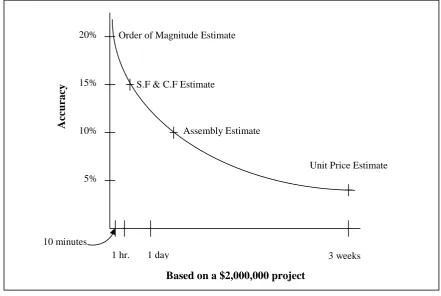
Figure 2-1: Project moves on in time, the time required to complete the estimate and the accuracy provided increases re-drawn (Waier and Chiang, 2007). ... 15
Figure 2-2: Learning curve re-drawn (Gould and Joyce, 2008) ... 16
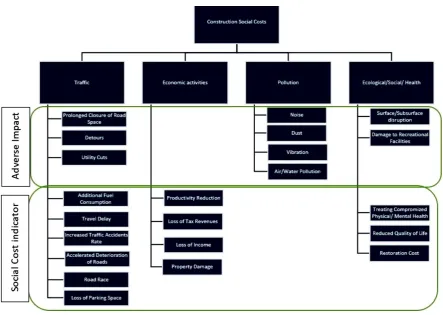
Figure 2-3: Potential construction adverse impacts which lead to formation of the social costs re-drawn (Gilchrist and Allouche, 2005) ... 34
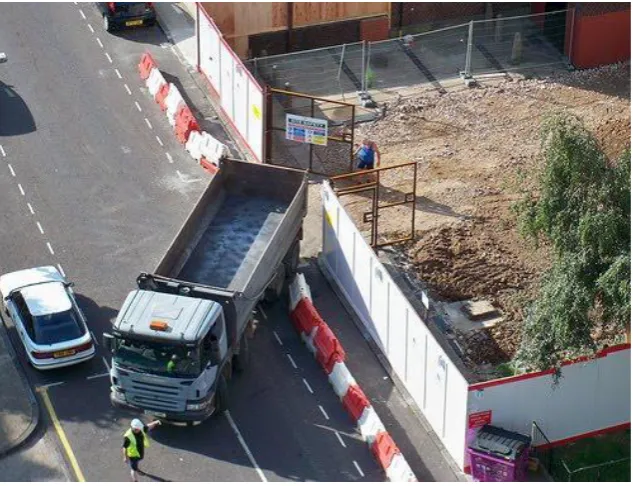
Figure 2-4: Traffic congestion in an urban area due to construction works (DjCoregon, 2010) ... 35
Figure 2-5: Loss of parking spaces due to manoeuvre space provided for the lorry (MERA, 2010) ... 36
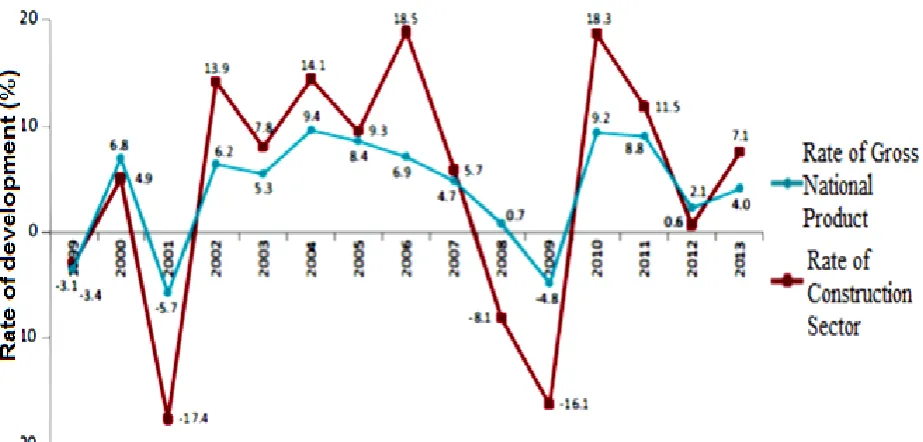
Figure 3-1: Increase in Turkish construction sector (TCA, 2014a) ... 46
Figure 3-2: Photographs (a), (c), and (d) are from Famagusta, north Cyprus, photograph (b) is from Ankara, Turkey. ... 50
Figure 4-1: Research Design ... 63
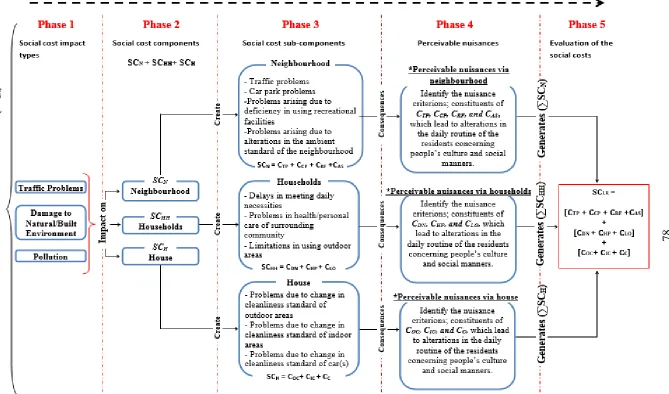
Figure 5-1: Phase 1: Identification of building construction causative adverse impacts ... 69
Figure 5-2: Phase 2: Segregation of building construction causative adverse impacts in terms of the social cost components. ... 71
Figure 5-3: Phase 3: Identiciatoin of the social cost sub-components ... 75
Figure 5-4: Phase 4: Identiciatoin of the perceivable nuisance criteria ... 77
Figure 5-5: Cost category for the social costs ... 82
Figure 7-1: The distribution of 266 respondents based on their gender ... 102
Figure 7-2: The distribution of 266 respondents based on age groups ... 102
Figure 7-3: Distribution of 266 respondents based on the level of education ... 102
xiv
Figure 7-5: Means of the adverse impacts of on-going construction on the three nuisance criterions of the households ... 108
Figure 7-6: Percentage of the adverse impacts of the on-going construction on each nuisance criterion related to households depending on the exposed ... 108
Figure 7-7: Residents who have altered their daily routine due to perceived nuisances for their house ... 112
Figure 7-8: Residents that have altered their daily routine in meeting their daily necessities 115
Figure 7-9: Residents who have altered their daily routine to maintain their health/ well-being/ personal care ... 116
Figure 7-10: Residents that have altered the time they spent at the outdoor areas of their houses ... 117
Figure 7-11: Respondents that have altered their daily routine due to perceived nuisances related to their neighbourhood ... 119
Figure 9-1: Construction schedule of a two storey detached villa designed by reinforced concrete ... 148
Figure 9-2: Construction schedule of a two storey detached villa designed by lightweight steel ... 149
Figure 9-3: Comparison of costs of alternative construction methods on the basis of traditional ... 151
xv
LIST OF TABLES
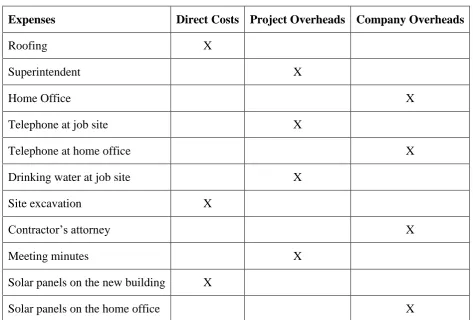
Table 2-1: Comparison of Costs (Dykstra, 2011) ... 22
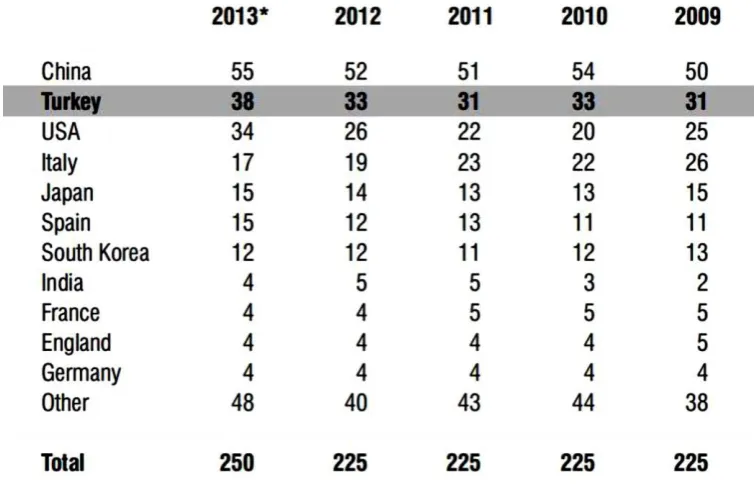
Table 3-1: Ranking of top international contractors (TCA, 2014b) ... 45
Table 3-2: Building permits in Turkey (TCA, 2014a) ... 46
Table 3-3 : Building permits in north Cyprus (SPO, 2009) ... 48
Table 4-1 : Distinctions between positivist and phenomenological philosophies (adopted Easterby-Smith et al., 2008) ... 56
Table 5-1: Association of perceivable nuisance criteria with the social cost sub-components . 79 Table 6-1 : Grouping of nuisance criterions ... 91
Table 7-1: Descriptive statistics of criterions of standards ... 104
Table 7-2: Descriptive analysis of the adverse impacts of on-going construction on the six criterions of house. ... 106
Table 7-3: Descriptive analysis of the adverse impacts of on-going construction on the three criterions of households ... 107
Table 7-4 : Descriptive analysis of the adverse impacts of on-going construction on the eight criterions of neighbourhood ... 109
Table 7-5 : The mean values of hours spending for each criterion ... 113
Table 7-6 : ANOVA between Values of Parameters before and throughout Construction ... 113
Table 7-7 : Additional distance travelled by the people due to on-going construction ... 118
Table 9-1 : Total cost of a two storey detached villa constructed by reinforced concrete. ... 146
1
CHAPTER 1
: INTRODUCTION TO THE
RESEARCH
1.1 INTRODUCTION
Construction is a large, multifaceted, and dynamic industry that plays an important role for the growth of local and national economies (Chen, 1996; Lewis, 2004; Rameezdeen, 2005; Behm, 2008; Osei, 2013). Constructing residential and office buildings, hospitals, factories, schools, bridges, sewers and ports along with many other things is only part of what this sector undertakes. Additionally, the sector carries out repair and maintenance to accomplish improvements on all of those structures (OECD, 2010).
The built environment which comprises all structures and living spaces constructed or modified by human beings offers social and welfare benefits (Ofori, 2002; Sarkis et al., 2008). For instance, housing accomplishes to meet the second necessity of mankind by offering shelter from the elements (George, 2002; Ijigah et al., 2013). Concordantly, construction industry underpins to foster a good quality of life as it creates the built environment and provides the tangible facilities and infrastructures in accordance with the needs, wants and values of the people (Bartuska, 2007; Myers, 2013). Therefore, happiness, life and need satisfactions of the society are interrelated with the quality of the built environment thus it is one of the standard indicators of the quality of life (Pearce, 2003; Mohit, 2013).
Despite the fact that completion of construction projects and their entry into service have a direct influence on people’s wellbeing, development phases of construction projects generate countless unintentional adverse impacts on their surrounding environments (Butterworth, 2000; Gilchrist and Allouche, 2005; CGG, 2006 ; Sev, 2009; Abidin, 2010; Balaban, 2012).
2
term “environment” as the society who surround the construction sites that are adversely impacted by the operation of these sites in terms of pollution, traffic problems, economic activities and damage to natural/built environment, embark to estimate the cost of contractors’ “apology” on behalf of the society (Wang et al., 2008; Appeldoorn, 2013).
These researchers have commonly entitled this attempt as the quantification of the construction causative “social costs”. Many definitions of the social costs particularly associated with civil engineering projects have been proposed over the past 17 years (Boyce and Bried, 1998; McKim, 1997; Rahman et al., 2005; Pucker et al. 2006; Yu and Lo, 2005). For instance, Tanwani (2012) offered the following definition: construction causative adverse impacts that neighbouring communities are inevitably being exposed to due to implementation of construction projects and for which in traditional practices parties involved in the project such as; owner, designer, contractor, and users are not held accountable is named as “social costs”.
On the other hand, the quantification of social costs is set of procedures followed to evaluate the cost of construction originated adverse impacts. Various scholars have proposed numerous approaches where each approach accommodates similar procedures to evaluate the social costs. It is construed that majority of the performed studies focused on evaluation of the infrastructure projects related adverse impacts.
For instance, Jiang (1999) focused on evaluation of the highway construction causative additional travel time, consumption of extra fuel oil, and wear and tear of vehicle parts incurred on the third parties due to traffic bottlenecks.
3
Civil engineering projects’ development phases associated social costs while widely acknowledged, are predominantly not considered during estimation process of the project initial cost hence, they are rarely considered in the design, planning or bid evaluation phases of construction projects (Gilchrist and Allouche, 2005).
According to Ferguson (2012), this can be ascribed to the reality that it is rather complicated to measure and quantify the social costs. Three reasons are put forward by Yu and Lo (2005) to explain why the social costs are not considered in traditional construction management practices. At first, the construction social costs are incurred to the public rather than to the parties involved in the project. Therefore, these costs are not included in the bill of quantities or in any construction contractual documents. Secondly, construction social costs are difficult to measure and quantify with the available techniques, since most of them are intangible, rather than visible costs. Thirdly, the public who are incurred by the construction social costs do not participate in the project planning and management process.
By virtue of the difficulties in quantifying the social costs and traditionally applied contractual and bid evaluation practices in which majority of the contractors’ goals are limited; to complete the project for the lowest cost, within the time limits, and the quality requirements (Bowen et al., 2012), necessity to take cognizance of the social cost notion is overlooked by parties involved in construction projects.
However, during design build and construction phases of a project, only considering needs, wants, and expectations of parties involved in the project and responding to these accordingly without being concerned about the expectations of other interest groups as in the present case, surrounding community of a construction site who are incurred by the social costs, leads to lack of responsibility and improper management of the social costs which can in return result with public objection hence delay the completion date of the project (Yu and Lo, 2005).
This is why many researchers who have a consensus about the difficulty of predicting the social costs due to lack of a standard estimating method attempted to develop applicable estimating methods (Boyce and Bried, 1994; McKim, 1997; Gilchrist and Allouche, 2005; Yu and Lo, 2005; Rahman et al., 2005; Pucker et al., 2006; Matthews and Allouche, 2010). Additionally, each proposed method suggests a cost category for the consideration of the social costs but the way to compensate these costs for the society is yet to be determined.
4
locations. People’s perception about the felt nuisance varies according to their culture and manners of the society (Oltedal et al., 2004).
Additionally, location of the construction site (i.e. densely populated or not), the building permission regulations and code of practice of the country, and applied construction methods are also parameters which are necessary to be considered during estimation of the construction associated social costs.
Within the context of Turkey and North Cyprus, although no data was ever recorded concerning definition of the social costs, their quantification method and a way to compensate these costs, at the end of field surveys which are performed as a part of this study, it is revealed that the social cost issue is well recognised by the society remaking the necessity of consideration of the social costs by the industry professionals.
Therefore, this study seeks to develop a generic a social cost estimation system for Turkey and North Cyprus construction industries which assists to identify the social cost drivers, to estimate the social costs on the basis of the identified drivers, to incorporate social cost into project initial cost and to compensate it for the third parties.
1.2 PROBLEM STATEMENT AND RESEARCH JUSTIFICATION
Over the last two decades, many definitions of the social costs particularly associated with civil engineering projects have been proposed (Boyce and Bried, 1998; McKim, 1997; Rahman et al., 2005; Pucker et al. 2006; Yu and Lo, 2005).
For instance, Allouche et al. (2000) defines the social costs as costs generated due to execution of a construction project incurred by the parties involved in the contractual agreement. For measuring purposes, they encompassed social costs by the costs incurred on the third parties as a result of being exposed to air pollution, noise, vibration, disruption to traffic and increased level of traffic accidents. In their work, they identified costs subject to contract as direct, indirect, and social costs.
Gilchrist and Allouche (2005) just as Allouche et al. (2000) proposed that project contractual costs should be comprised of direct, indirect and social costs but for measuring purposes distinctively grouped the social costs based on the area of impact namely: traffic, pollution, economic activities, and ecological/social/health.
5
They categorised the encompassing social costs as direct, indirect and intangible costs. Apeldoorn (2013) offers the following definition: Implementation of construction projects generates disruptions to common life patterns of the society around the construction zones. Equivalent monetary values of these disruptions are called social costs. Contrary to previous researches, they offered two categories for costs associated with a construction project namely, costs incurred to the owner of the project: direct and indirect costs; and costs incurred to the society: quantifiable and non-quantifiable social costs.
It is clear enough that suggested definitions for the term “social cost” and suggested cost categories for consideration of these costs shows differences. One of the most common ways of eliminating differences in the use of a term is achieved by defining it in accordance with what is intended, or actually is, expressed or indicated by the meaning of the term to set out the essential attributes of the defined term. Essential attributes of an approach for a specific subject varies in accordance with the people’s point of view. As the people’s point of view for a specific subject cannot be standardised as so the social cost estimation methods.
Pucker et al. (2006) explained why project participants do not take responsibility for considering the infrastructure related social costs as follows;
“For the most part, social costs are not considered during a construction project’s planning, design and bid evaluation stages because they cannot be calculated using standard estimating methods. In recent years efforts have been made to introduce approaches for predicting social costs associated with utility construction projects. Nevertheless, unit cost data needed for the verification of such prediction methods is lacking.”
This is why in practice the contractors’ estimators did not involve in estimating the social costs for bidding purposes so far. Having not performing an effort to estimate the social cost does not mean that, the social costs are not existent. The study found that social costs can account for up to 400% of construction costs on certain projects (Rahman et al., 2005).
6
known that, the construction activities in residential areas have adverse impacts on the daily routine of the people residing in the vicinity of them.
As aforementioned, in the present case what is intended, or actually is, expressed or indicated by the meaning of “social costs” can be offered in different contexts. Since previously offered definitions will not be adopted for use in this research, there is a need to clearly define the term “social cost” in order to set out the essential attributes of the defined term. Below given definition is offered to demarcate the boundaries of the social cost notion recognized throughout this study, and to underpin the mounted arguments on the scope illustrated by the definition.
Construction social costs defined by the author;
“The people themselves and the environment they live in; their homes and neighbourhoods if located around the building construction zones are exposed to adverse impacts of the construction activities. In return, people react via altering their daily routine to resolve or alleviate the exposed disruptions to their common life patterns. Cost of this reaction is defined as the social costs associated with building construction projects”.
Therefore in this study, in accordance with the adopted use of the “social cost” term, there is a need to identify building construction causative adverse impact types which are the typical social cost indicators, considering the social and cultural manners of the Turkish society. Afterwards, there is a need to propose social cost estimation and compensation methods for Turkish construction industry. Meanwhile it is critical to determine an appropriate cost category for considering the social costs as it should be kept out of bidding because due to lack of standard it could result with unfair contractor selection.
7
1.3 RESEARCH QUESTION, AIM AND OBJECTIVES
In this respect, the research question identified for this study is as follows;
“How to estimate the cost of alterations in the daily routine of the people residing in the vicinity of building construction sites and how to compensate it in North Cyprus and Turkey?
After considering all the aforementioned grounding information for the research, the aim of the research is fixed as;
“The aim of this project is to develop a system to identify the changes in the items of daily routine of the people residing near building construction sites, to estimate the cost (social cost) of those changes by developing a monetizing method, and propose a cost category and a compensation method for the estimated social costs in north Cyprus and Turkey.”
In order to achieve the stated aim, the following research objectives were identified;
I. To identify the key drivers of the social costs occurring due to execution of building construction projects in residential areas.
II. To explore the existence of the social costs for Turkish construction industry in Turkey and North Cyprus.
III. To determine the alterations in the daily routine of people residing in the vicinity of building construction sites in residential areas.
IV. To conceptualise a social cost monetising system applicable for Turkish construction industry in Turkey and North Cyprus.
V. To identify an appropriate cost category for social costs.
VI. To specify a building construction caused social cost compensating method for the affected people for Turkish construction industry in Turkey and North Cyprus.
VII. To evaluate and validate the proposed social cost monetising compensating methods
1.4 SCOPE OF THE RESEARCH
The main reason of having a research scope is to narrow down the research area and also to set boundaries to what should be investigated. In this context the scope is further discussed as follows:
i. Definition of the social costs
8
Phase 1: Identification of the social cost impact types via: literature review
Phase 2: Segregation of social costs components via: literature review, focus groups for brainstorming sessions, case study observations, self-experience in case studies.
Phase 3: Segregation of social cost sub-components via: literature review, focus groups for brainstorming sessions, case study observations, self-experience in case studies.
Phase 4: Identification of perceived nuisance criteria via: literature review, focus groups for brainstorming sessions, case study observations, self-experience in case studies.
Phase 5: Estimation of the social costs: questionare based Survey and numerical analysis
Phase 6: Implementation and validation of the framework via: case study implementation for empricial validation
social cost also has varied interpretation. In this thesis the author defined the social cost as “the cost of building construction caused alterations in the daily routine of the people residing in the vicinity of a site”.
ii. Variation of the social cost depending on the characteristics of building permission
regulations
The amount of social cost changes from country to country depending on the applied building code of practices and building permission regulations. If the relevant code of practice is mandatory or the regulations are strict, contractors inherently will pay more attention to obey them and the occurrence of the social cost is less likely. However, in many especially developing countries, like north Cyprus and Turkey, those rules are either not existing or loose and in this case high amount social costs are caused by the contactors. Therefore, the developed framework to estimate the building construction caused social cost is more meaningful in many developing countries like north Cyprus and Turkey.
1.5. RESEARCH METHODOLOGY
Considering the beliefs, assumptions, and the nature of reality and truth about the phenomenon under investigation, set of processes which reflect the way in which this research is undertaken from design through to conclusion are sequentially organised as illustrated in Figure 1.1. Due to the nature of this study, triangulation has been applied to the overall research strategy to ensure the reliability and validity of the research through adopting multi-methods for data collection and analysis. Types of research methods and techniques adopted to perform each process are also depicted in the Figure 1.1. By all means, designed research process is compatible with the tasks performed to accomplish this study.
9
1.6 RESEARCH NOVELTY AND CONTRIBUTION
The contribution to knowledge of this research can be organized into two contexts which are theoretical and practical. Within the theoretical context, the main deliverable of this study is the framework developed for estimation of the social cost which is defined as the cost of alterations in the daily routine of the people living in the vicinity of building construction site in residential areas.
The development of this framework is the main contribution to the current body of knowledge. This framework is especially a useful tool to estimate the social costs in cases where the building permission regulations are not strict and the contractors do not pay too much attention to lessen or eliminate the construction caused social costs as in north Cyprus and Turkey.
Having estimated the social cost, determining a way to apply these costs in practice is another matter to concern. Therefore, within the practical context first, a cost category and then a compensation method for the social costs are proposed.
The proposed social cost compensation method is discussed with the local municipalities and it was decided to be applied in the major cities of north Cyprus. In this system, the contractors will be enforced to minimize the nuisances of the people residing around a construction site. Otherwise, the contractors will be forced to compensate them through a bonding system.
1.7 GUIDES TO THESIS
In chapter 2, comprehensive literature review about contractors’ bid price, social costs associated with construction projects, estimation considerations and methods of the social costs are discussed. Additionally, definitions made on the social costs and the types of the social costs generated due to construction projects are discussed in detail. Additionally, quantification methods from literature are explained in a critical manner.
In chapter 3, construction industries of Turkey and North Cyprus as well as current social cost notions for the Turkish construction market is addressed.
Chapter 4 presents the research methodology of the thesis. In this chapter followed research philosophies and approaches, adopted data collection and analysis methods are discussed in detail. Additionally, phase by phase processes that are followed to perform this principal study is presented within the context of conceptualised research design.
10
the social costs for Turkish construction sector and proposes a generic framework to quantify those costs accordingly.
Chapter 6 presents the conducted questionnaire as a part of this resaerch in order to enumerated the alterations in the daily routine of the residents neighbouring construction sites. Additionally, the chapter discusses the procedure followed in designing the questionnaire, how participants invovled in the questionnaire are selected, and how the confidentiality of the participatants is obtained. The chapter concludes by discussing what each question diverted to respondents intends to achieve. Chapter 7 is comprised of the data analysis of the questionnaire results. Additionally, interpretations of the findings are discussed thoroughly.
Chapter 8 addresses the application of the developed social cost estimation framework in order to monetise the previously obtained daily alterations in order reveal the social cost incurred to per house located within the vicinity of construction zone.
In chapter 9, evaluations of the proposed social cost estimation and compensation system for Turkish construction industry is performed via experts’ opinions and a case study. Discussions of the experts’ opinions and findings of the case study are presented thoroughly.
11
CHAPTER 2
: CONSTRUCTION
ASSOCIATED SOCIAL COSTS
2.1 INTRODUCTION
Construction is a large, dynamic and complex sector that accommodates processes for building new structures and engineering projects. Construction works also concern processes for renovation encompassing additions, alterations, or maintenance and repair of existing structures and engineering projects (Behm, 2008).
In order to complete a construction project successfully, it is significant that the structure is delivered at the right time (schedule), within the budget, and expected quality is attained (Ergonul and Yilmaz, 2011). Due to the role of the contractors which is to plan, develop and coordinate the activities which coincide with the building/renovation of the structures and engineering projects, contractors have a very important role for the progress and success of construction projects (Jaskowski, Biruk and Bucon, 2010; Alzahrani and Emsley, 2013; Palaneeswaran and Kumaraswamy, 2001; Yawei et al., 2005). For that reason, selection of a contractor for the intended project is very significant task for the construction clients.
Irrespective to the construction process, in the construction industry direct negotiation and competitive bidding are the two methods followed by the owners (clients) to determine which contractor may be awarded with a construction project (Dikmen et al., 2007; Drew, Sktimore and Lo, 2001). Under normal conditions, public clients prefer to deliver construction projects through competitive tendering in order to make a reasonable justification about which contractor will be given with the job (Harris, McCaffer and Edum-Fotwe, 2013).
On the other hand, private clients are free to select the either bidding methods. In this context, the public clients are those who are Central government departments, public corporations and local authorities and all the other promoters are private clients. In general, the decision about which contractor will be selected for the tendered construction project is made subsequent to receiving several tenders from a number of different contractors.
12
prior to tendering (Woodward, 1997; Gould, 2011; Yu et al., 2006). Estimation is executed with respect to the contract documents prepared by the owner of the project which describes the necessary work to be performed (Harris, McCaffer and Edum-Fotwe, 2013). Ability of construction companies in estimating the costs associated with a construction project with optimum accuracy contributes for obtaining competitive advantage hence, commercial success in the industry. This obligates construction companies to take operation of the marketing practices into account. In order to ensure that a company maintains a significant market profile, it is crucial to precisely comprehend and include all cost constituents associated with a construction project during estimation of bidding price (Apanaviciene and Daugeliene, 2011).
On the other hand, despite the fact that construction projects are designed to support and satisfy the needs of human activities and they are beneficial for the growth of local/national economies (Osei, 2013), the development phases of it, in other words, the required activities to fulfil a construction project can cause a lot of disturbances to the environment (Sev, 2009; Abidin, 2010; Balaban, 2012).
Within the context of this research, the term ‘environment’ refers to the society surrounding the construction sites that are impacted by the operation of these sites in terms of economic activities, traffic problems, damage to natural/built environment, and pollution (Wang et al., 2008; Appeldoorn, 2013).
Especially in urban areas, due to high density of population implementation of construction projects turn out to be the sources of serious environmental nuisances for the adjacent residents and businesses (Gangolells et al., 2009; Ferguson, 2012). Appeldoorn (2013) put forward that level of construction causative nuisances incurred to the surrounding society is highly dependent on the location of a project. He performed several case studies and determined that in densely populated areas the negative effects of construction activities is greater compared to the areas with lower population.
Construction causative adverse impacts that neighbouring communities are inevitably being exposed to due to implementation of construction projects and for which in traditional practices parties involved in the project such as; owner, designer, contractor, and users are not held accountable is called “social costs” (Kapp, 1950; Boyce and Bried, 1998; Tanwani, 2012).
13
(2012), this can be ascribed to the reality that it is rather complicated to measure and quantify the social costs. Three reasons are put forward by Yu and Lo (2005) to explain why the social costs are not considered in traditional construction management practices. At first, the construction social costs are incurred to the public rather than to the parties involved in the project. Therefore, these costs are not included in the bill of quantities or in any construction contractual documents. Secondly, construction social costs are difficult to measure and quantify with the available techniques, since most of them are intangible, rather than visible costs. Thirdly, the public who are incurred by the construction social costs do not participate in the project planning and management process.
By virtue of the difficulties in quantifying the social costs and traditionally applied contractual and bid evaluation practices in which majority of the contractors’ goals are limited; to complete the project for the lowest cost, within the time limits, and the quality requirements (Bowen et al., 2012), necessity to take cognizance of the social cost notion is overlooked by parties involved in construction projects.
This chapter is composed by two parts. In the first part cost estimation of construction projects, estimate considerations, composition of contractor’s bid prices and the types of bonds are discussed. In the second part definitions of the social costs, types of the construction generated adverse impacts which lead to formation of the social costs, at what phase of the project initial cost estimation process these costs should be considered, proposed methods for compensating the social costs, and potential quantification techniques of the social costs are discussed in detail.
2.2 COST ESTIMATION OF CONSTRUCTION PROJECTS
The process of determining the probable cost of workmanship, equipment, materials, and overheads associated with a proposed construction project is defined as estimation. During estimation process, estimators seek to predict the cost of a construction project and the required amount of materials, labour, and equipment necessary to construct it with optimum accuracy (Peterson, 2007).
14
estimates are essential for a construction company to be successful in bidding process while maintaining an acceptable profit (Peterson, 2007; Manfredonia et al., 2014).
The estimator is the person who is responsible for preparing the cost estimates. An estimator must possess the following skills to be a good estimator (Peterson, 2007).
- An estimator must have a sound understanding of the construction methods, materials, and productivity of labours and equipment.
- An estimator must possess the basic skills needed to determine the quantities of materials, labour, time, and equipment.
- An estimator must be a good communicator, both verbally and in written form to obtain the prices from vendors and subcontractors.
- An estimator must possess good computer skills since computers are widely used in estimating processes.
- An estimator must be detail oriented for careful and accurate determining the work quantities and costs.
- An estimator must have the confidence to quickly prepare take-offs and make decisions even under pressure. The bid days are always so hectic.
- Finally, an estimator must have a desire for constant improvement.
Even though the specific format adopted by the estimator changes with the type of estimate, type of project, and company procedures, all estimates incorporate the following common traits (Gould and Joyce, 2008).
- Owners want the largest building with the best quality and the highest performance capacity for the least amount of money. Therefore, as project develops, the design and construction team estimates to ensure the expectations of the owner within the available budget, time and quality constraints.
- Estimates are not guarantees of costs. The cost developed during design and even at the bidding stages are almost never the final and completed cost of the project.
15
[image:32.595.86.528.228.524.2]- An estimate can only be as accurate as the information upon which it is based. As figure 2.1 depicts, the accuracy of estimate also depends on the time required to complete the estimate. It can be said that, the accuracy of estimate depends on project document completeness, data base for past projects, and the skill and judgment of the estimator. As the design process proceeds, the level of project detail increases and the methodology and procedure of estimating changes from conceptual estimate to detailed estimate as they are discussed in section 2.4.
Figure 2-1: Project moves on in time, the time required to complete the estimate and the accuracy provided increases re-drawn (Waier and Chiang, 2007).
In traditional cost estimating procedures bid price prepared by the estimators for the tendered project does not include the social costs because they cannot be calculated using standard estimating methods (Apeldoorn, 2013; Pucker et al., 2006). Additionally Yu and Lo (2005) emphasises that construction social costs are difficult to measure and quantify with the available techniques, since most of them are intangible, rather than visible costs.
Therefore, in order to make social cost estimation, it is necessary to develop a new system in order to estimate the social costs specifically caused by building constructions in residential areas. This system development is explained in detail in chapter 5.
Unit Price Estimate Assembly Estimate
S.F & C.F Estimate Order of Magnitude Estimate
1 hr. 20%
15%
10%
5%
10 minutes
1 day 3 weeks
A
cc
uracy
16
2.3 ESTIMATE CONSIDERATIONS
Irrelevant to the project phase, every estimate considers the same basic issues. These are project size, project quality, project location, construction start and duration, and other general market conditions (Ogunlana and Thorpe, 1991; Gould, 2005; Gould and Joyce, 2008).
2.3.1 Project Size
Bigger the project size is more efficient use of the people and equipment and as a result, lesser unit costs for the works. The reason is that, as people repeat a task they get better, faster and reduce the labour cost. As illustrated in figure 2.2, as the operation continues, workers “learn” thereby the time required to complete the next similar unit lessens (Gould, 2005; Gould and Joyce, 2008).
Figure 2-2:Learning curve re-drawn (Gould and Joyce, 2008) 2.3.2 Project Quality
Apart from meeting the planned schedule and cost, maintaining good quality is one of the significant goals of project owners as quality is one of the significant factors when determining the success of a construction project (Belassi and Tukel, 1996; Chua et al., 1999). Required quality of a construction project varies from stakeholders to stakeholders as their expectations are not necessarily the same. An owner may require a high quality project for many reasons.
However, as the quality and complexity of a project increases, so does the project’s cost. Cost of quality is defined as all the efforts put by the project management team to attain the quality of the structure. These efforts incorporate every work to meet the project specification and rework (PMBOK, 2000). The tools that the estimator uses to estimate the expected quality get clearer as the design of the project proceeds. At the bidding stage, the quality of the project must be precisely
Number of units
Time
r
equir
ed p
er
17
specified for individual units. This is the reason why estimating requires longer time for bidding purposes (Gould, 2005).
2.3.3. Location
Location of the proposed construction project is considered to be one of the critical elements during estimation process. Depending on the project location, the purchasing cost of materials and delivery, rental or purchase of necessary equipment, and cost of labour may show great dissimilarities.
Availability, competition and access to efficient transportation methods widely affect the cost of materials. If the available numbers and the skill levels of workers required are not adequate locally, labour forces have to be imported from elsewhere at a higher cost. The cost estimation of construction projects can be implemented by using “location indices” for different parts of a country (Gould, 2005).
2.3.4 Time
The time of physical construction of a project has a major impact on the cost of the project. Since estimates, by definition, are prepared in advance of the construction, the estimator must anticipate the future cost of the work. The estimators preferably use “historical indices” to adjust a project future cost by using historical costs. This adjustment also assists an estimator to estimate the cost of a new project today by looking at a similar project built recently.
However, it is difficult to predict the accuracy of what the index will be for a future year. So, the best thing that an estimator can do is to look at the current trends and predict future labour, equipment, and material prices (Baalousha and Çelik, 2011).
2.3.5 Market Conditions
18 2.3.6 Social Cost Estimate Considerations
The estimate considerations explained above are for the estimation of direct costs and overhead costs of construction projects and these costs are explained further in section 2.4. On the other hand, estimation process of the building construction associated social costs should also concern set of issues that are likely to have an impact on the estimated social cost. Due to the nature of the social cost notion, it is asserted that probable issues in need of consideration during social cost estimation should differ from those considered during direct and indirect cost estimation. The author of this thesis proposes the basic social cost estimation consideration as follows;
i. Location of the construction site ii. The building permission regulations iii. Applied construction methods
iv. Culture, tolerance and way of living of the nearby residents of the site These considerations are explained in detail in section 2.8.
2.4 COMPOSITION OF CONTRACTOR’S BID BRICE
Work unit of a construction project can be described as an activity, a work-item or a work-package and at least one cost element is present. Cost of labour, material, equipment, and administrative costs are the few examples of cost elements associated with a construction project. As a matter of course, direct correlation of different cost elements with specific construction activities incurring them is very complex.
Alternatively, numerous researchers (Chitkara, 1998; Assaf et al., 2001; Callahan, 2005; Gahlot and Dhir, 2007; Greenhalgh, 2013) indicated that determination of the costs formed by execution of construction activities should be performed by considering them as two different cost groups namely; direct costs and overhead costs (indirect costs).
Aforementioned cost estimation process paves the way to obtain the anticipated direct and indirect costs associated with a construction project. On the other hand, project owners generally choose which contractor will be awarded with the tendered project based on the bid price they receive. Bid price of a contractor is determined subsequent to estimation process and it is composed of;
Bid Price = Base Cost + Mark-up
19
According to Smith (2007), generally in tendering, 90% of the bidding price is composed of the estimated base costs and the remaining 10% is represented by the mark-up of a project. It is obvious that, the amount of mark-up plays an important role in determination of the contractor that will be awarded with the project. In light of this information, constituents of base cost and mark-up are explained in depth in the following sections.
2.4.1 Direct Costs
Subsequent to comprehensive literature review (Chitkara, 1998; Callahan, 2005; Harris, McCaffer and Edum-Fotwe, 2013; Gahlot and Dhir 2007, Greenhalgh, 2013), the author acknowledges that direct costs are composed of cost elements that can be recognized by the implementation of a piece of construction activity. Moreover, in construction contracts, direct costs are the elements that are attributable directly to a labour, material, equipment and probable subcontractor works.
2.4.1.1 Material costs
Determination of material prices for a project is considered to be the most straightforward price computation compared to other units of a project that needs cost evaluation. Suppliers are the most reliable sources for material prices. It is estimator’s duty to make sure that price quoted actually covers all the specification requirements.
Harris, McCaffer and Edum-Fotwe (2013) highlights that parameters such as; material quoted being the correct model number, colour, and finish; price quoted by supplier being valid until the scheduled delivery time; price including the delivery cost of materials to project site; supplier giving adequate warranties and guarantees for the purchased material; adequacy of the stock availability; and payment terms, discounts, and credits being well documented needs to be confirmed and approved by the project management team.
2.4.1.2 Labour costs
Determining the price for labour is the most difficult task as hourly wage rate and productivity of the team needs to be considered. Factor of the rates which are paid for a specific trade is called wage rate. The wage rate increases needs to be factored in especially for projects that are run for long-terms.
20
the experience and capacity to picturing how the work will be accomplished on site (Harris, McCaffer and Edum-Fotwe, 2013).
It has been widely expressed in the literature that (Stewart, 1991; Sweeting, 1997; Harris, McCaffer and Edum-Fotwe, 2013; Smith, 2007; Ogershok and Pray, 2009) in order to be capable of determining labour costs of a project, estimator should know; the expected efficiency rate of labour; other work occurring at the same time that could interfere with this activity; expected weather conditions; specific conditions of the proposed work: that is, working on ladders or scaf-folding versus working on the ground; duration and frequency of overtime.
2.4.1.3 Equipment costs
Relevant equipment required for undertaking the pre-specified tasks, including small tools needs to be covered item by item. Large plants which are being operated such as crane, lift truck and resembling are normally covered on a project basis as they are often used during the job for various activities.
There are two categories for the equipment costs where the equipment itself is the one and the operating the equipment is the other. Lease, rental, storage, interest, ownership, insurances, taxes and license are all covered within the costs of equipment itself. In cases where the plant is owned by the company these costs are determined within the company. If equipment will be hired, these costs are quoted by equipment suppliers.
Operating the equipment costs include gasoline, oil, periodic maintenance, transportation and mobilization of the plant. Plant operator’s cost is not included under the cost of equipment but under the labour line item (Harris, McCaffer and Edum-Fotwe, 2013).
2.4.1.4 Subcontractor works
In construction industry starting from 1980s, main contractors started to break down their bidding into work packages in order to obtain tenders for every single package from prequalified subcontractors. Afterwards, in order to mitigate the misunderstandings about the scope of work assumed by subcontractors, literature discusses that (Harris, McCaffer and Edum-Fotwe, 2013; Ng and Luu, 2008) it is very significant to be in close contact with subcontractors during bidding period.
21
subcontractor’s work from the contractor’s when overhead and profit are being applied at the top of base costs. The reason for this is, tax, insurance, overhead and profit is included in subcontractor prices. Alterations on this price will be dissimilar from the alteration done for the work of the contractor’s own forces (Harris, McCaffer and Edum-Fotwe, 2013).
2.4.2 Overhead Costs
Contractors generally categorise overhead costs by approaching from two different perspective; project overheads (site overheads) and company overheads. Project overheads are comprised of costs which can be attributable to a given project but cannot be attributable for a specific construction activity (Chitkara, 1998).
Project overheads are considered to be construction site costs that incorporate costs related with running the construction site such as; field office people, safety, security, scaffolding and gantries, site accommodation, photography, clean-up etc. Generally these costs are itemized according to their types, with amounts and unit prices are figured exactly (Harris, McCaffer and Edum-Fotwe, 2013).
On the other hand, company overheads which are also named as general and administrative overheads incorporate the entire costs incurred due to contractor maintaining the company in business and supporting the construction process. It is noteworthy to mention at this stage that company overheads are not attributable for a specific construction project (Assaf et al., 2001). In addition, company overheads is generally carried out as a percentage and it covers costs such as; office rent, real estate costs, vehicles, engineering support, clerical staff, top management salaries, marketing, legal and accounting fees (Harris, McCaffer and Edum-Fotwe, 2013).
22
Table 2-1: Comparison of Costs (Dykstra, 2011)
Expenses Direct Costs Project Overheads Company Overheads
Roofing X
Superintendent X
Home Office X
Telephone at job site X
Telephone at home office X
Drinking water at job site X
Site excavation X
Contractor’s attorney X
Meeting minutes X
Solar panels on the new building X
Solar panels on the home office X
2.4.3 Mark-Up
Mark-up which is an important bid component is comprised of accumulation of the percentage of profit and the contingency risks considering the market conditions. Mark-up is generally evaluated once the contractor reaches the decision to bid for a construction project (Egemen and Mohamed, 2007).
2.4.3.1 Profit
A company produces and keeps its corporate health depending on its ability to make a profit. Time and energy investment as well as the acceptance of risk inherent in a construction project enhances the importance of adding profit. Subsequent to pricing the labours and equipment participated in the project, profit is added.
23
Adding a profit margin for every single project is a must-do for companies. Type of project, size of project, amount of competition anticipated, the desire to get the job and extent of the risks are the parameters that specifies the amount of profit.
If company requires taking the work, strongly desires to form a new relationship with the client amount of profit charged might be small. On the other hand, the company should not have too many small-margin projects on the books simultaneously, so that it has adequate coverage if something happens on one job. Generally projects with higher risks or little competition encourages the company to add a higher profit (Harris, McCaffer and Edum-Fotwe, 2013).
2.4.3.2 Risk contingency
Risk is an uncertain event or condition that if it occurs has an effect on at least one of the project objectives; duration, cost and quality of the project. The reason behind contractor’s inclusion of risk contingency is to provide a safeguard against uncertain circumstances that are expected to have adverse impact on the routine of the project such as weather, labour problems, soil conditions and etc. (Harris, McCaffer and Edum-Fotwe, 2013). The general risk contingencies used by the contractors are as follows (Holm et al., 2005):
Design contingencies to cover the risks resulted from any deficiencies of design.
Escalation contingencies are used to cover the risk associated with material and labour inflation.
Estimating contingencies are used for the deficiencies in the cost estimation by estimators. It is common to add the contingencies to the budget estimates.
2.5 SOCIAL COSTS TO BE CONSIDERED UNDER PROJECT INITIAL COSTS
24
research, the social costs associated with building construction projects are proposed to be included under the project non-contractual costs. These are explained further in chapter 5.
2.6 CONSTRUCTION BONDS
Construction bonds are normally part of contract documents. The types and the amounts of bonds required by the owner are specified in the project specifications which are part of contract documents. The contractors who are interested in the project and willing to join a tendered project, are required to find a bonding company (a finance institution or a bank) to provide a means of guarantee to the owner on behalf of the contractor.
Contractor submits bonds to the owner to provide a guarantee that in the event the contractor does not perform as stated in the contract documents, bonding company, an independent third party, will cover the owner’s damages to the amount of the bond (Gould, 2005; Russell, 2000). The bonding company investigates the contractor’s ability and the capacity to perform the work that the bond will be provided.
The project types, the contractor’s resources, and the size of the project are only a few of the matters to be considered before bonding is provided by the bonding company. There are three types of bonds most commonly used in construction contracts. These bonds are the bid bond, the performance bond, and payment bond (Benton et al., 2011).
2.6.1. Bid Bond
Bid bond is a kind of guarantee given by the contractors to the client. The guarantee includes the condition that if the owner accepts the contractor’s bid, the contractor will enter into a contract with the owner in accordance with the contract terms. Otherwise, either the contractor will lose the guarantee (bid bond) he offered to the client or will require the bonding company to pay the difference between the submitted bid and the next lowest bid (Gould, 2005).
The amount of bid bond may change from project to project however, in most of the project it is normally about 5% of the tender. At the end of the bidding if a contractor is not awarded with the job, the bid bond is paid back to him (Çelik, 2013; Russell, 2000).
2.6.2. Performance Bond