Exploring The Cultural Ecosystem Services Associated With Unmanaged Urban Brownfield Sites:
An Interdisciplinary (Art and Sciences) Approach
Kerry Morrison
School of Environment and Life Sciences
University Of Salford
TABLE OF CONTENTS
TABLE OF CONTENTS……… i
LIST OF FIGURES………. vi
LIST OF TABLES……….……….. x
ACKNOWLEDGEMENTS………. xi
ABSTRACT……….. xii
CHAPTER 1: INTRODUCTION 1 1:1. Brownfields………... 1
1:2. Aims of This Research………... 2
1:3. Blank Canvases and Restoration ………... 3
1:4. Connecting CES to Unmanaged Urban Brownfields………. 4
1:5. Interdisciplinary Approach……… 5
1:6. Findings, Outcomes and New Insights……….. 8
CHAPTER 2: LITERATURE REVIEW 11 2:1. Introduction………... 11
2:2. What are Brownfield Sites?... 11
2:3. Uniting Features of Brownfields……….. 15
2:4. Ecosystem Services……… 19
2:5. Brownfields Through the Lens of Ecosystem Services…… 31
2:6. A Complex Reality of Brownfield Perspectives……….. 57
2:7. Gaps for Further Investigation………. 59
CHAPTER 3: METHODOLOGY 68 3:1. Introduction………... 68
3:1-i Epistemology: Constructivism………. 68
3:1-ii Theoretical perspective: interpretivism……….. 69
3:2. Methodology: Interdisciplinary……… 70
3:2-ii Eco-art……… 73
3:2-iii The social turn……….. 75
3:2-iv The performative turn……….. 77
3:2-v ‘Planning’, ‘Acting’, ‘Observing’, and ‘Reflecting’………. 78
3:2-vi Collaboration………. 80
3:3. Methods……….. 82
3:3-i Performative happenings ………... 83
3:3-ii Site interventions……….. 91
3:3-iii Drawing……….. 92
3:3-iv Photography……….. 97
3:3-v Mapping………. 99
3:3-vi Site-surveys ………. 104
3:3-vii Site-user survey: a quantitative approach ………... 106
3:3-viii The diaries……… 109
(i). The observation logbook ……… 110
(ii). The blog diary……….. 112
(iii). The fieldwork research diary………. 113
3:4. Summary……… 115
CHAPTER 4: FIELDWORK CASE STUDIES 117 4:1. Introduction………... 117
4:2. Case Study 1:Examining A Linear Brownfield > 0.25ha and Locating CES……….. 120 4:2-i Introduction………... 120
4:2-ii Recording life along the canal as a performative happening……….. 130
4:2-iii Encounters and observations………. 133
4:2-iv A sign of neglect………... 141
4:2-v Thoughts to carry forward to the final discussion………. 141
4:3. Case Study 2: Investigating Perceptions of Unmanaged Nature and CES Goods Connected to Weeds……… 142
4:3-ii Rationale for stepping outside of brownfields and into
managed green spaces………... 143 4:3.2a: Case Study Nerotal Park, Wiesbaden, Germany. Garten
- Wiesbadener Kunstsommer 2010... 144 4:3.2a-i Introduction………... 144 4:3.2a-ii Recording life in the overgrown lawn as a
performative happening……….. 149 4:3.2a-iii Encounters and observations………. 152 4:3.2a-iv Public perceptions: Weeds or a Wild Flower
Meadow………. 160
4:3.2a-v Thoughts to carry forward to the final discussion…... 163 4:3.2b: Case Study University of Salford: what lies in lawns….. 164 4:3.2b-i Introduction………... 164 4:3.2b-ii Recording life in the overgrown lawn as a
performative happening and reflexive writing……….. 168 4:3.2b-iii Encounters and observations………. 169 4:3.2b-iv Thoughts to carry forward to the final discussion…... 173 4:4. Case Study 3: Orientation and Experience of an
Unmanaged Urban Brownfield < 0.25 ha………. 174 4:4-i Introduction……… 174 4:4-ii Orientation and experiencing of an unmanaged urban
brownfield < 0.25 ha over twelve months………. 177 4:4-iii Encounters and observations……… 180 4:4-iv A Year in Anyone’s Brownfield Garden draws to a
close……… 193
4:4-v Return visit to Anyone’s Brownfield Garden……… 197 4:4-vi Thoughts to carry forward to the final discussion……… 198
CHAPTER 5: DISCUSSION 199
5:1. Introduction………... 199 5:2. Summation of the literature review and gaps identified for
5:3. A summary of the gaps identified and investigated in the
research reported……….. 204
5:4. Summary of research aims………... 205 5:5. Summary of research questions investigated though three
fieldwork case studies………... 205 5:6. Discussion of case studies………... 206
5:6-i. Case Study 1: Examining a Linear Brownfield > 0.25ha
and Locating CES………. 207
5:6-ii. Case Study 2: Investigating Perceptions of Unmanaged
Nature and CES Goods Connected to Weeds………. 212 5:6-iii. Case Study 3: Orientation and Experience of an
Unmanaged Urban Brownfield < 0.25 ha. Conducted over
twelve months (February 2011 to February 2012)……….. 218
5:7. Overall findings……… 221
5:7-i. Findings in relation to Aim 1: unmanaged urban
brownfields as CES providers………... 221 5:7-ii. Findings in relation to Aim 2: an interdisciplinary
approach to illuminate CES’s associated with
unmanaged urban brownfields………. 229
5:8. Moving on……….. 233
5:9. Suggestions for Future Research Informed By The
Findings Of The Research Reported……….. 234 5:9-i. Barriers to accessing CES goods or barriers enticing
activities, which generate a connectedness to nature….. 234 5:9-ii. Safety……… 235 5:9-iii. Classification of brownfield land………... 236 5:10. Concluding……….. 237
APPENDIX 239
A1. Preamble. Journeying into brownfields through art and
A1-iii. Developing a method of inquiry into urban brownfields:
liverpool wastelands………... 241
A1-iv. Artwork into CES research………. 247
A2. Extracts from Research Diaries, Case Study 2b: Investigating Perceptions of Unmanaged Nature and CES Goods Connected to Weeds. Grass is not Green: what lies in lawns, University of Salford campus lawns………. 250
A2-i. First investigation of the lawns 13 April 2011………. 250
A2-ii. An afternoon on the library lawn 7 June 2011……… 262
A2-iii. Discovering secret gardens 15 June 2011……….. 272
A2-iv. 1 summer, 1 season, 1 lifetime for some 15 September 2011……….. 284 A3. People’s comments about the overgrown lawn. Case Study 2a: Investigating Perceptions of Unmanaged Nature and CES Goods Connected to Weeds; Nerotal Park, Wiesbaden, Germany, August 2010……… 295
LIST OF FIGURES
CHAPTER 2. Literature Review
Fig. 2-1 Brownfield sites in England reused for residential
development, 2001–08……… 17 Fig. 2-2 Ecosystem Services diagram (MA, 2005)……… 21 Fig. 2-3 Relationships among Ecosystem Services and Human
Well-Being (MA, 2005)……… 22
Fig. 2-4 Network analysis diagram illustrating the links between elements of the green infrastructure, ecosystem services currently provided by the Kent Thameside Green Grid, and the benefits people derive from these services (European
Environment Agency, 2011)………... 38 Fig. 2-5 The High Line, New York, April 2010……… 43 Fig. 2-6 The High Line, New York. KEEP IT WILD KEEP ON THE
PATH sign April 2010……….. 44
Fig. 2-7 IN/fromtheout, Manchester, 2011……….. 54 Fig. 2-8 Lara Almarcegui; Top Bauschutt Hauptraum, 2010; bottom
The Abandoned Island Of Murano, 2013………. 56
Fig. 2-9 Understanding a complex system………. 58
CHAPTER 3. Methodology
Fig. 3-1 Epistemology, theoretical perspectives, and methods
model………. 68
Fig. 3-2 Fluxus Manifesto1963………. 72 Fig. 3-3 Helen and Newton Harrison, schematic matrix of practice… 74 Fig. 3-4 Action Research flow of action, reflection, observation, and
planning………. 78
Fig. 3-5 The wild and productive warehouse overall coat, March
Fig. 3-6 Portable studio cart passing through ‘A’ frame barrier and
set up on the canal corridor with umbrella up, June 2009…. 87 Fig. 3-7 White lab coat: Alternative Views, July 2010; green lab
coat: Grass is not Green and white apron: Alternative
Views, August 2010………. 89
Fig. 3-8 Drawing of fledgling blackbird from memory of an
observation, Case Study 1, 2009……….. 94 Fig. 3-9 Drawings capturing vibrant nature colours observed during
Case Study 1, 2009 and Case Study 2b, 2011………... 95 Fig. 3-10 Woman and young child feed geese, Case Study 1, 2009... 96 Fig. 3-11 Boys fishing the canal, Case Study 1, 2009……… 97 Fig. 3-12 Example of A4 map printout with handwritten notes……….. 101 Fig. 3-13 Drawn map of Litherland Road bridge to Carling Warf,
Case Study 1, 2009………. 102
Fig. 3-14 Anyone’s Brownfield Garden drawn from memory by Dr
Prowse, March 2012……… 103
Fig. 3-15 Site survey: Human Activity Record sheet. 108 Fig. 3-16 Reflecting on conversations and encounters with four
visitors and Lydia, Case Study 2a, Nerotal Park, 25 June
2010……… 112
CHAPTER 4. Fieldwork Case Studies
Fig. 4-1 Fieldwork case study overview……….. 118 Fig. 4-2 Leeds Liverpool Canal from Litherland to Stanley Dock
Scale at source 1:10000………. 121 Fig. 4-3 Angling with tents on the towpath; observation logbook
follow-on sheet, 29 August 2009………... 125 Fig. 4-4 Sections 1 – 7: from the Red Lion, Bridge Street to Linacre
Lane bridge. Scale at source 1:10000……….. 128 Fig. 4-5 Sections 8 – 17: from Linacre Lane bridge to the Warf Inn,
Fig. 4-8 The first sheet of the observation logbook recording the
environmental setting of section 23 on 29 August 2009…… 132
Fig. 4-9 Frequency of activities observed between June and August 2009 in each of the thirty-two sections………. 136
Fig. 4-10 Activities in each section between May and August 2009…. 137 Fig. 4-11 Factory workers on a lunch break making their way to the water’s edge……….. 140
Fig. 4-12 A lawn in Nerotal Park as photographed from one of the pathways, September 2009……… 146
Fig. 4-13 Nerotal Park Lawn selected for intervention, September 2009……… 148
Fig. 4-14 Nerotal Park overgrown grass lawn, June 2010………. 148
Fig. 4-15 Performative happening in the overgrown with Lydia Gilbert, Nerotal Park, June 2010………... 150
Fig. 4-16 Performative happening plant identification with Lydia Gilbert, Nerotal Park, June 2010………... 150
Fig. 4-17 Overgrown lawn species list, June 2010……….. 151
Fig. 4-18 Flora map of case study area, June 2010……… 152
Fig. 4-19 Attracting visitors and conversations, June 2010……… 152
Fig. 4-20 A participant rummaging for aphids, July 2010………... 153
Fig. 4-21 Use of sweep-nets by four girls, August 2010………. 155
Fig. 4-22 Lydia assisting a child spot insects within a quadrat, August 2010……….. 156
Fig. 4-23 People using quadrates, August 2010……….. 156
Fig. 4-24 Boy drawing a wasp spider inside a quadrat, August 2010.. 156
Fig. 4-25 One-off tour of the overgrown lawn, July 2010……… 157
Fig. 4-26 Recreational, leisure, and spiritual CES captured in photographs, summer 2010……… 159
Fig. 4-27 Comments of tags in the grass and on the portable studio cart, August 2010………. 161
Fig. 4-28 Triangle lawn, January 2011……….. 167
Fig. 4-29 Library lawn, January 2011……… 167
Fig. 4-31 Bee orchid drawn on site, 7 June 2011……… 171
Fig. 4-32a Red line defining area of investigation………. 176
Fig. 4-32b Wider context of the case study site………. 176
Fig. 4-33 Imaginings of a brownfield garden……… 180
Fig. 4-34 Her view, my view, mattress view, 17 Feb 2011………. 183
Fig. 4-35 Variety of surface sealants, photographs taken February 2011……… 183
Fig. 4-36 Sat in deckchairs placed on the island of yellow Tarmac, 21 April 2011………. 184
Fig. 4-37 Anyone’s brownfield garden pathways, 4 May 2011……….. 185
Fig. 4-38 Traffic cone under mattress, 31 March 2011………... 186
Fig. 4-39 Mattresses and flora, 18 May 2011………... 186
Fig. 4-40 Sat in deckchairs overlooking a mattress, 5 June 2011…… 186
Fig. 4-41 How the mattresses arrive on site, 9 October 2011………... 187
Fig. 4-42 Audience watching House, 2010. ………. 188
Fig. 4-43 Checking on each visit, 3 April 2011………. 188
Fig. 4-44 Pioneer ruderal plants colonizing the small brownfield…….. 189
Fig. 4-45 Orchid species growing on the Salford brownfield, June 2011……… 191
Fig. 4-46 Mattress gone, November 2011……… 193
Fig. 4-47 A brownfield garden no more, June 2013. ……….. 198
CHAPTER 5: Discussion Fig. 5-1 CES of unmanaged urban brownfield illustrated within a biophysical domain. Adapted from UK NEAFO 2012………. 222
Appendix Fig. A1-1 Independents Biennial cone on the bike, Banks Road, Liverpool, 2006………. 244
LIST OF TABLES
Table 2-1 Open Mosaic Habitats on Previously Developed Land
Criteria (OMH PDL)………. 34
Table 3-1 Case studies and methods used………... 83 Table 3-2 Collated human activity data as recorded on 20 May 2009.. 108 Table 4-1 Summary table for the Fieldwork Case Studies……….. 119 Table 4-2 First page of data collated from Human Activity survey, 29
August 2009……….. 126
Table 4-3 Flowering species identified in two grassy areas of Nerotal
Park during September 2009………. 147 Table 4-4 Flowering species identified in two lawns at the University
of Salford in January 2011……….. 165 Table 4-5 Flowering plants species seen in February, March, April,
and May 2011………... 190
Table A-1 People’s comments expressing an appreciation of the overgrown lawn. Translated from German to English by
Helmut Lemke……….. 295
Table A-2 People’s comments written onto bags and tags expressing a dislike of the overgrown lawn. Translated from German to
ACKNOWLEDGEMENTS
Although, at times, a solitary process, this PhD, from start to finish, would not have been possible without the support and encouragement of many. Friends, family, and colleagues have supported me in numerous ways. Their patience too does not go unacknowledged. Thank you.
I am particularly indebted to:
Emily Fallows, Lydia Gilbert, and Emma Kemp, who assisted in the fieldwork case studies. Their involvement extended beyond merely assisting. They were fellow experiencers of the situations and environmental settings and
companions. They shared their experiences and their voices are integrated into the research reported.
Alicia Prowse, collaborative partner in the fieldwork case studies, botany mentor, critical friend, and a real friend.
My supervisory team Dr Andrew Clark (School of Nursing, Midwifery, Social Work and Social Sciences) and Prof. Philip James (School of Environment and Life Sciences) who embraced the interdisciplinary approach of this research. I especially want to thank Prof. Philip James.
Helmut Lemke, my husband. The support of a partner can never be underestimated.
Rita Morrison. My Mum.
ABSTRACT
Unmanaged urban brownfields are widely perceived as wastelands and derelict empty spaces in need of a determined future end-use; how people utilize these spaces and connect with unmanaged nature appears inconsequential. There is a dearth of knowledge on the Cultural Ecosystem Services (CES) of seemingly abandoned urban brownfields. The benefits of these sites as natural green space CES providers are neglected. Consequently, they are latent landscapes not fully understood or taken into consideration by decision-makers.
Perspectives on brownfields vary: informed by profession, discipline,
experiential knowledge, and brownfield terminology. Knowledge from across disciplines that articulates connections that shed light on unmanaged
brownfields as CES providers is reviewed critically. Process-led interdisciplinary fieldwork - integrating participatory social art practice, durational and performative public art - was used to explore every day
phenomena of brownfields, and link the environmental settings and nature of unmanaged brownfields to cultural practices, benefits, and values.
Analysis of the data generated by the fieldwork reveals that unmanaged brownfields are accessed for cultural practices - play and exercise; creating and expressing; producing and caring; gathering and consuming - that yield cultural benefits. Reflexive practice provides a rich picture of unmanaged urban brownfields as CES providers: as natural green space for near-by communities and urban nature explorers. It also reveals physical and sociocultural barriers that affect access, perception, and appreciation.
Unmanaged urban brownfields have cultural value for those who use them. The interdisciplinary Arts and Sciences research and practice presented here reveals cultural practices and hitherto not-yet-valued CES of
CHAPTER 1 INTRODUCTION
1:1. Brownfields
In this thesis the cultural ecosystem services (CES) of pockets of brownfield land in urban areas are explored and examined. Brownfield land is land lying abandoned and neglected; land that has had a previous use but now sits in a form of limbo, and its future possibly undecided; land that has been left unmanaged and subsequently supports unplanned ecosystems along with maintenance free ecosystem services (Wilson, n.d.; Taylor, 2008). The
terminology used to describe such land is extensive and indicative of the value attributed to such sites, but also of value judgements; much of which is
pejorative.
For the purpose of the research reported in this thesis, for clarity, and continuity, the term ‘brownfield’ is being used throughout as the governing descriptor. A brownfield is:
…any land or premises which has previously been used or developed and is not currently fully in use, although it may be partially occupied or utilized. It may also be vacant, derelict, or contaminated (Alker et al., 2000, p.2).
This definition is one of the least provocative of terms applied to such spaces. It describes the physical state of the landscapes appraised in the case studies of this research, and, importantly, it is widely acknowledged as a sound definition within the fields of Environmental Science and Urban Planning (for example; Homes and Communities Agency, n.d.; Environment Agency, 2004; English Partnerships, 2006, 2007, 2008; Roberts et al., 2006; Riding et al., 2010; Communities and Local Government, 2012). However, due to the association with Town Planning (brownfield sites being prime development land for new build (Environment Agency, 2003; Wong and Schulze Bäing, 2010; The
the word wasteland (for example, Mabey, 2010; Foster et al., 2011). In this thesis when referring to authors who have used the word ‘wasteland’ that word will be used but should be seen as being interchangeable with ‘brownfield’.
1:2. Aims of This Research
If left unmanaged, brownfield land will become colonised by plants and then animals (through natural succession). The result of this process will be an unplanned ecosystem, along with which there will be maintenance free
ecosystem services (Wilson, n.d.). However, brownfield land is not considered as a CES provider within the frameworks proposed by Millennium Assessment (2005); TEEB (2010); UK NEA (2011); or Haines-Young and Potschin (2013). This omission indicates that the CES benefits brownfields provide have been neglected within the ecosystem service framework. If overlooked, the CES value of brownfield land is in danger of not being taken into account by decision-makers. Hence, the first aim of the research reported here is:
1. To examine unmanaged brownfields as CES providers and explore the associated CES as defined by the Millennium Assessment (MA, 2005); the UK National Ecosystem Assessment (Church et al., 2011); and Haines-Young and Potschin (2013). (TEEB (2010) uses CES definitions from MA (2005)).
In developing the argument presented throughout this thesis, my proposition is that unmanaged urban brownfields where nature has encroached are
overlooked as CES providers even though they hold an allure that begets an array of CES goods. To evidence and articulate the CES of unmanaged urban brownfields, the second aim of this research is:
2. To bring together knowledge and learning from the sciences – quantitative and qualitative - and the arts and develop an
interdisciplinary approach which, through novel site surveys will
conversations with site users which listens into existence the voices of the CES beneficiaries.
In 2014, the UK National Ecosystem Assessment Follow-on (UK NEAFO,
2014) was published. This is a significant document, published as the research
reported in this thesis was drawing to a close. The UK NEAFO (2014) provides
new information about UK ecosystems and the services they provide, in particular, advances were made in the understanding of cultural ecosystem
services. Still, brownfield land is not examined as a CES provider within the UK
NEAFO (2014). However, the UK NEAFO (2014) does acknowledge that brownfields are unexamined as CES environmental settings. Further, the UK NEAFO (2014) calls for multidisciplinary and interdisciplinary research
spanning the Sciences and the Arts and Humanities (AH) to articulate and evidence CES and the CES value and benefits of not yet examined
ecosystems such as brownfields and urban edgelands (Church et al., 2014; Coates et al., 2014). As a consequence, the UK NEAFO (2014) has latterly underpinned the original contribution to knowledge of this thesis: an
interdisciplinary (art and sciences) approach to explore the CES associated with unmanaged urban brownfield sites.
1:3. Blank Canvases and Restoration
wastelands to wildflower meadows (for example, Green Estate, n.d.; Wrap, n.d.; Prentis and Norton, 1992), and community gardens or urban agriculture plots (for example, Gov.UK, n.d.; McClintock, 2010; EPA, 2011; McPhearson et al., 2013). They are also spaces ripe for ecological restoration – the practice of restoring and renewing degraded, damaged or destroyed ecosystems and habitats by human activity (Westphal, 2010; EPA, 2010; Hartley et al., 2012). While acknowledging that the concerns for redevelopment, restoration, and re-use are real and relevant to society, during the course of the research reported in this thesis another set of values was identified: CES value of brownfields as they are – unmanaged and not (re)developed. CES of unmanaged brownfields are explored in greater detail as this thesis unfolds.
1:4. Connecting CES to Unmanaged Urban Brownfields
Interaction with nature can nurture spiritual, mental, and physical well-being, thereby developing understandings and connectedness with the natural world (Kellert and Wilson, 1993). People officially and unofficially use unmanaged, abandoned brownfields for their existing value of experiencing nature in an urban landscape, for example, entomology (Jones, 2003). Unmanaged brownfields provide unplanned ecosystems, and nature amid ruin and
dereliction can inspire creativity (Woodward, 2002 and 2007). Locations and places giving rise to CES, for example inspiration, leisure and recreation,
information and knowledge, and spiritual and symbolic meaning, are referred to in some literature as environmental settings (UK NEA, 2011, Haines-Young and Potschin, 2013). Environmental settings can be semi-natural as well as natural settings (i.e. can include cultural landscapes) providing they are dependent on in situ living processes (Haines-Young and Potschin, 2013, p.18). In these terms, unmanaged brownfields containing unplanned ecosystems can be seen as environmental settings that give rise to CES.
The CES are the so-called soft, non-material goods and benefits, of
ecological phenomena which are unifying characteristics of the supporting, provisioning, and regulating ecosystem services (Fisher et al., 2009). CES connections to places are often complex and personalized and identifying their value to society is problematic, even when a consensus of appreciation is agreed - as with natural heritage sites and areas of outstanding natural beauty (AONB) (Church et al., 2011). Consequently, the CES is considered to be one of the most difficult ecosystem services to measure by many researchers (for example; MA, 2005; Church et al., 2011). With this in mind, to attempt to apply a cultural value to disorderly, unmanaged, non-picturesque, brownfields in urban areas may seem incongruous; their inherent nature aesthetic - which could be described as a negative aesthetic - or ugly truth (Brady, 2011) - in discord with the canonized Picturesque and Romantic ideals of beauty (Saito, 1998; Shaw, 2006; Brady, 2011). Yet, as is argued in this thesis, landscapes that lack scenic beauty, such as unmanaged brownfields, returning to a natural state of re-wilding can still hold an aesthetic allure and should not be
overlooked simply because they do not confirm to Romantic or Picturesque ideals of beauty.
1:5. Interdisciplinary Approach
To further understanding of the CES of brownfield sites, an interdisciplinary
research approach has been undertaken.
… an interdisciplinary approach is one where an individual or a group work at the boundaries of traditional disciplines and often in gaps that emerge between disciplines, … (James et al., 2009, p.66)
In Chapter 2, The Literature Review, the literature pertaining to unmanaged brownfields, natural green space, the ecosystem service framework, and health and well-being benefits of nature is examined. The literature review draws in work from across the arts, sciences, and humanities, as well as literary text, popular culture, and social media. Examining literature across different
gaps in knowledge, and identifying gaps that lie within the interstices of interdisciplinary practice.
Epistemology to methods is discussed in Chapter 3: Methodology. This research has been undertaken from a constructionist stance: rejecting the search for a single or universal truth in order to recognize the multiple
meanings and interpretations given to (social) realities by the actors, agents, and social groups who interact with them. Different methods of inquiry and recording have been integrated. Participatory social art practice, durational and performative public art (performative happenings), drawing, photography, mapping, site-surveys, site-user surveys, observation, reflection, reflexive writing, and thick descriptions are used to explore and recount everyday phenomena of brownfields, and link the environmental settings and nature of unmanaged brownfields to cultural practices, benefits, and values. This fusing of different approaches cuts across modes of thought, strategically
restructuring processes (methods) from art and the sciences to open another space: a ‘Secondspace’ (Soja, 1996). Knowledge formation is constructed around ‘being’ and ‘becoming’: empirical analysis, critical enquiry, and social practice in a space where new insights and connections are gained (Soja, 1996).
literary voice, will be used to stimulate the imagination of the reader and transport them to a place (in their mind) where they can smell, hear, or even taste, the vivacity of unmanaged urban brownfields (Gregson, 2011).
The thesis presents insight from three case studies. Two of these examine the environmental settings of two unmanaged urban brownfields overtime; taking into account seasonal changes.
• Case Study 1: Examining a Linear Brownfield > 0.25ha and
Locating CES investigates a disused (6.5 km) stretch of the Leeds Liverpool Canal (a linear brownfield) from Stanley Dock, Liverpool, to Seaforth, Sefton, January 2009 to September 2009. A durational and collaborative investigation including social art practice, performative public art, mapping, site surveys, and site-user surveys, was used to record the environmental setting, CES goods and practices, and physical and psychological barriers that may prevent, deter – or alternatively, encourage - people from accessing the brownfield canal corridor.
• Case Study 3: Orientation and Experience of an Unmanaged Urban
Brownfield < 0.25ha is a subtle, performative intervention in
collaboration with a botanist on an open access site in Salford. Over a twelve-month period (February 2011 to February 2012) we familiarized ourselves with the site, observed and recorded changes in the site, and recorded shifts in our attitude towards the site in relation to CES and feelings of well-being. Seasonal changes in flora and ‘moving’ detritus were recorded in photographs and reflexive writing; and, our own
subjective perceptions and shifting appreciation of the site was recorded through creative writing and poetry.
to explore interactions with nature and social interactions in an unmanaged grassed area in an otherwise managed landscape; in two urban settings:
• Case Study 2: Perceptions of Unmanaged Nature and CES Goods
Connected to Weeds is the only case study not performed in, on, or near a brownfield site. It was performed in a Grade I listed park in Wiesbaden, Germany (June to August 2010), and in the landscaped campus grounds of the University of Salford (April to November 2011). Perceptions of Unmanaged Nature and CES Goods Connected to Weeds, investigates attitudes to non-managed green space and so-called weeds. Lawns were left to grow: unmanaged. Changes in the environment were recorded as well as people’s interactions with, and perceptions of, re-wilding amid ordered, managed landscapes. The purpose of this case study was to gain a deeper understanding of people’s attitudes towards unkempt nature and weeds in order to try to unpick whether or not weeds are an ugly truth (Brady, 2011) of urban nature that might negatively affect appreciations of unmanaged urban brownfields.
The fieldwork case studies were conducted as investigative, interdisciplinary, performative process-led – and reflexive – practice. The methods used in the case study investigations revealed that - regardless of size or biological diversity - unmanaged urban brownfield sites are used in ways that align with CES; however, barriers – both physical and socio-cultural - affect access, perception, and appreciation.
1:6. Findings, Outcomes and New Insights
The final chapter, Chapter 5: Discussion, brings together findings, outcomes, and new insights gained from the case studies combined with continuous literature review. The hitherto not-yet-valued environmental settings of
reported has evidenced that unmanaged brownfield sites are environmental settings that are used in a manner that aligns directly to the CES, and as such have a value for aesthetic appreciation, sense of place, spiritual enrichment, education, inspiration, social interaction, recreation, and knowledge systems, as well as shared and plural values.
The findings from the research indicate that CES opportunities are inherent within re-wilding, unmanaged, urban brownfield sites. However, unmanaged brownfields as environmental settings for CES are not yet valued within the ES framework, and as such, they are at risk of being developed or designed for a specific meanwhile use such as community gardening or ad hoc car-parking. While acknowledging that community gardening in the meanwhile has
community benefits and ES benefits (food provision), it brings into question inequalities of access to nature and green space. Elsewhere, literature, for example, Bey (1985), Edensor (2005), and Edensor et al., (2012), discuss the importance of such places for social interactions. Further, there is evidence in the literature to suggest that adult professional interests in ecology and nature aesthetics have been fostered through childhood interaction and play in
brownfield sites (Mabey, 1973; Louv, 2005; James, et al., 2010; Farley and Symmons Roberts, 2011; Wells and Lekies, 2012). The research reported in this thesis sheds light on inequalities that may exist within CES value, for example, placing the needs and desires of some over others. What was discovered during the case studies is that the physical barriers around urban brownfields, so called weeds, and detritus, play an important role in how
brownfields are perceived, and subsequently how they are used, and by whom. While this study records the types of barriers around brownfield land, further research is required to understand the role that barricaded brownfields play in relation to access, and inequalities of access to natural green space and CES – and benefits thereof - in urban areas.
The UK NEAFO (2014) outwardly acknowledges the need for research from the arts and humanities – including the practice of artists - to shed light on what has been illusive to the disciplines leading ES research for the past two
2014). The research presented takes this initial step. Feeding on knowledge and methods from beyond the arts - integrating sciences – and weaving together the social, the ecological, the political, and the everyday to shed light on the CES of the latent landscapes of brownfields. The research reported illustrates that artists are drawn to the aesthetics and politics of such
landscapes; and, through applying some of the more scientific techniques used during the case studies, other artists could also consciously contribute within an ES framework.
This research also identifies a need for a multidisciplinary characterization of brownfields to fully understand brownfields as environmental settings and the gamut of CES they provide. Unmanaged urban brownfields vary in size, physical accessibility, topography, landscape characteristics, vegetative succession, biodiversity, habitats, and context (for example, urban,
CHAPTER 2 LITERATURE REVIEW
2:1. Introduction
Within our urban environments there are numerous brownfield sites: areas of land no longer of use as originally intended, and subsequently - seemingly - abandoned. They come in various shapes and sizes and with differing
landscape characteristics. Some are managed, and some are not. What urban brownfields are, what they may contain, how they can be utilized, and the value attributed to them by people from different professional backgrounds, are
reviewed.
The prevailing literature on urban brownfield land lies predominantly within nature conservation; green infrastructure; children’s natural play; health and well-being through access to [natural] green space; urban regeneration; and landscape remediation. This literature is reviewed and an overview of the different perspectives is presented. To gain a broader understanding of unmanaged brownfields and a deeper understanding of inspirational and aesthetic values of these environmental settings the literature review also delves into art: literature and artworks inspired by unmanaged brownfield environments. Gaps in this knowledge are identified and are presented at the end of the chapter.
2:2. What are Brownfield sites?
The term ‘brownfield’ began to be used in the early 1990s (Smith, 2002). It came to the fore in Britain in 1998 when the then Labour Government
In the opening of her paper: …badlands, blank space, border vacuums, brown fields, conceptual Nevada, Dead Zones ..., Doron (2007, p.10) sets out twenty seven terms used to describe previously used and now abandoned land:
...badlands, blank space, border vacuums, brown fields, conceptual Nevada, Dead Zones, derelict areas, ellipsis spaces, empty places, free space, liminal spaces, ,nameless spaces, No Man’s Lands, polite spaces, post architectural zones, spaces of indeterminacy, spaces of uncertainty,
smooth spaces, Tabula Rasa, Temporary Autonomous Zones [TAZ], terrain vague, urban deserts, vacant lands, voids, white areas, Wasteland... SLOAPs [space left over after planning] (Doron, 2007, p.10).
This is not an exhaustive list of terms ascribed to brownfield sites. They are also described as: ‘degraded ground’ and ‘contaminated land’ (Smith, 2002); ‘edgelands’ (Shoard, 2002; Farley and Symmons Roberts, 2011); ‘wasted space’ (CABE Space, 2003); ‘land in limbo’ (Taylor, 2008); ‘the third landscape’ (Clement, 2006); ‘ambivalent landscapes’ and ‘wilderness in urban interstices’ (Jorgensen and Tylecote, 2007); ‘meanwhile’ sites (Dutton and Armstrong, 2012); and ‘vague spaces’ (Larsen, 2010). Some more positive terms are used that afford respect to what these sites may contain: ‘ruderal biotopes’ (Scholz, 1956 in Lachmund, 2013) ‘urban commons’ (Gilbert, 1992); ‘Greenfield’ (Frith and Chipchase, 2002), Open Mosaic Habitat (Harrison, 2006); ‘Open Mosaic Habitat on Previously Developed Land’ (Riding et al., 2010); and ‘urban
wildscapes’ (Jorgensen and Keenan, 2012). The descriptors are as provocative as the sites themselves. While some words used to describe these sites have robust definitions, for example brownfield (Alker et al., 2000) only Open Mosaic Habitat on Previously Developed Land (OMH PDL) is defined as a set of
criteria (Riding et al., 2010).
a multidisciplinary definition of brownfield acceptable to stakeholders working in, or affected by, brownfield redevelopment such as planners, surveyors, lawyers and developers; local authorities; other public agencies; environmental groups; and local communities (p.3). Terms and definitions of brownfields - as used at that time by different agencies and disciplines - are discussed:
contaminated land, vacant land, derelict land, and previously developed land; and, how people and agencies appropriate these plots of land was considered. The rigorous research and debate of the terms and associated use resulted in key criteria for ‘brownfield’ land:
• Previously developed land no longer in use, having been abandoned for
a significant period of time (Handley, 1996, in Alker et al., 2000, p.6).
• The previous development and uses can be any anthropological
endeavour, for example: agriculture; mining; amenities: sewage, gas, waste disposal; airports; transport networks: roads, railways, and canals; buildings; business and industrial premises; military sites; churchyards and cemeteries; and recreation amenities: allotments, gardens, parks, and greens.
• ‘Brownfield’ land may exist in both urban and rural locations, as well as
within designated Green Belt areas.
• When ‘use’ no longer occurs – as intended in connection to the
development - the land may be abandoned for a significant period of time so premises and land lie vacant: sliding into dereliction (hence, sometimes being referred to as derelict land or vacant land).
• A ‘brownfield’ may be a section of land that is unused, vacant, or
derelict, within a larger site that is in use. (Up until June 2010 this included gardens within the grounds of occupied dwellings
(Communities and Local Government Committee, 2011)).
• Some previous uses will result in land contamination.
• Much ‘brownfield’ land will not be contaminated. Re-wilding, overgrown,
• Contaminated land does not automatically equate to brownfield land. If
land is in use, regardless of levels of contamination, it cannot be classified as ‘brownfield’.
These criteria led Alker et al., (2000) to a succinct definition pertinent to their identified stakeholders:
A brownfield site is any land or premises which has previously been used or developed and is not currently fully in use, although it may be partially occupied or utilised. It may also be vacant, derelict or
contaminated. Therefore a brownfield site is not available for immediate use without intervention. (Alker et al., 2000, p.17)
This definition has been widely adopted and cited (albeit with the last sentence omitted) by built environment agencies; conservation trusts; government
departments (local authority and central government); and academics,
al., 2006). What this – seemingly - abandoned land should be called continues to be contentious and opinion remains divided with regard to sites that do not meet specific criteria such as that outlined in Open Mosaic Habitat on
Previously Developed Land (OMH PDL) (reviewed later in this chapter).
Without going into detailed specifics of brownfield characteristics, size, location, or uses, the Alker et al., (2000) brownfield definition adequately accounts for land previously developed, subsequently abandoned, and no longer in use as originally intended. It is not (intentionally) aligned to a single profession. Although the authors’ intention was a multi-disciplinary definition, it appears that the term has since been appropriated within the rhetoric of Town Planning.
The definition of ‘brownfield’ used throughout this research – as set out on p.1 - omits the final sentence from the original: Therefore a brownfield site is not available for immediate use without intervention (Alker et al., 2000, p.17). The omission of this sentence is in common with other authors, for example, Benson 2002; Environment Agency, 2004; English Partnerships, 2006a; Roberts et al., 2006; Office of the Deputy Prime Minister, 2006; Doick et al., 2009; Riding et al., 2010; Communities and Local Government, 2012. The term intervention refers not only to major redevelopment intervention as carried out by agencies: new build, landscaping, remediation; but also subtle actions that may not necessarily alter the structure and habitat of brownfield land, what Alker et al., (2000) refer to as other forms of [unspecified] action and
interventions undertaken by local communities. The unspecified actions and interventions as undertaken by different (geographical and interest-groups) communities, which may include artists, are among the least debated. This is an issue that will be explored in the literature review and research case studies presented in this thesis.
2:3. Uniting features of Brownfields
edges of towns and cities (Mabey, 1973; Harrison et al., 1995; Herbst, 2003; Edensor, 2005; Homes and Communities Agency, 2009; Farley and Symmons Roberts, 2011; Kattwinkel et al., 2011; Jorgensen and Keenan, 2012; Chell, 2013). Unmanaged, brownfields succumb to natural succession and begin to host evolving ecosystems, which, in essence, are beneficial to the health and well-being of near-by communities (Kuo and Sullivan, 2001; Groenewegen, 2006; and Mayer et al., 2009). Regardless of how these sites are perceived or enjoyed, the health and well-being benefits they might provide, or the part they play in green infrastructure, species conservation, and biodiversity (all reviewed in this chapter), what unites all brownfields is the rhetoric of Town - and
Country - Planning (Smith, 2002; de Sousa, 2006). The word rhetoric is pertinent. Over the past decade, it would appear that the aim of Alker et al., (2000), to define brownfield as a multidisciplinary term, has been swallowed by planning policy, urban planning, and regeneration agendas. Within this
Fig. 2-1: Brownfield sites in England reused for residential development, 2001-08 (Wong and Schulze Bäing, 2010, p.15)
Brownfield land is thus a commodity with a price tag. Over the course of the
past twenty years, the price of residential (brownfield) land for sale has risen
eight-fold (Donaldson, 2013). This economic value is considered to be a threat
to Green Infrastructure networks, OMH PDL, Priority Habitats, BAP
Ishimatzu and Ito, 2011): developers destroy habitats to replace them with new build developments.
Brownfields in towns and cities where property market values are high are at greater risk of redevelopment, for example, London, and the Thames Gateway (Robins et al., 2013). The Thames Gateway is the largest regeneration area in the UK and Europe, and the redevelopment of brownfield land is central to the regeneration economic policy (Robins et al., 2013). In areas such as the Thames Gateway, economic reasons are presented for brownfield development. For example, it has been estimated that brownfield
redevelopment in the Thames Gateway will provide 110,000 new homes and 225,000 new jobs by 2016 (Department for Communities & Local Government 2007 in Robins et al., 2013, p.7). Within the context of mass redevelopment, brownfield habitats are in danger of becoming fragmented. This fragmentation can result in species becoming isolated; species isolation can lead to local extinction; and, ultimately, the loss of a single site has the potential to bring about national extinction of a species (Robins et al., 2013, p.7). While this may be the situation in the Thames Gateway, in areas of the UK where the housing market is less profitable, such as areas in economic decline (Wong and
Schulze Bäing, 2010), locations where there is low demand for property
(Donaldson, 2013), and the parts of northern towns and cities identified in the
2:4. Ecosystem Services
Brownfields are all too often seen as sites of opportunity and pockets of land
that can be used in the interim for the benefit of nearby communities and interest groups. For example, urban ecologist Timon McPhearson views urban brownfields as: underutilized land [that] has the potential to provide cities with opportunity to create and develop new ecosystems that support biodiversity and increase the provisioning of vital ecosystem services for urban residents. Vacant land is ripe for transformation into more sustainable, resilient urban forms (McPhearson, 2012, no page numbers); and, that with small amounts of investment brownfields can be transformed into more useful spaces.
McPhearson has an ecosystem service approach to brownfield land whereby he examines vacant lots (an Americanism for brownfield land) through an ES lens as an heterogeneous matrix of social–ecological patches that provide multiple ES (McPhearson et al., 2013). In his paper: Vacant Land In Cities Could Provide Important Social And Ecological Benefits, McPhearson provides us with a list of the potential ES benefits brownfields could provide if adapted
(through varying degrees of landscaping) and managed:
• Stormwater absorption
• Air temperature regulation
• Wind speed mitigation
• Air purification (pollution absorption)
• Carbon absorption
• Flood control
• Habitat for biodiversity (e.g. plants and pollinators)
• Green corridors between urban natural areas
• Recreation space
• Community garden space
• Social gathering space
• Temporary art installation space
• Crime reduction
• Noise reduction
• Increased adjacent property value
• Sense of place
• Environmental education opportunity
• Sense of well-being
• Green spaces for low-income neighborhoods
• Residential and commercial building energy savings
(McPhearson, 2012, no page numbers)
The ecosystem service concept provides a framework for cost–benefit analysis for ecosystem provision and change to aid environmental decision-making (Fisher et al., 2009). To unravel the complexities of ecosystems and nature’s services to humankind, the construct of ecosystem services was developed in the late 1960s; though research in this field did not begin to become prevalent until 1997 (Daily, 1997). In 2003 an international ecosystem service framework for assessment was established (Millennium Assessment, 2003) and in 2005 an international scientific basis for actions needed to augment ecosystem conservation and sustainability – for their contributions to human health and well-being – was established: The Millennium Ecosystem Assessment 2005 (Millennium Assessment, 2005).
The ecosystem service framework endeavours to place anthropomorphic values on nature - the benefits that people obtain from ecosystems - that can be logically understood while, at the same time, raising awareness of the multifarious and interconnected values (economic and non-material) of ecosystems (Daily, 1997; Daily et al., 1997; Millennium Assessment, 2003, 2005). The Millennium Ecosystem Assessment (MA) divided ecosystem services into four interrelated categories, providing a framework for
Fig. 2-2: Ecosystem Services diagram (MA, 2005, in Rodríguez et al., 2006)
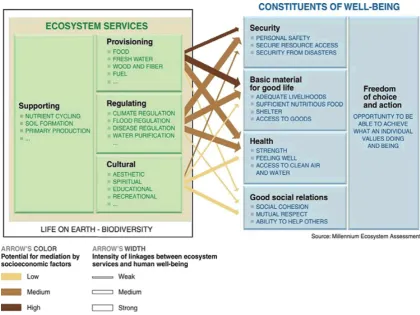
These services, and the goods provided, give rise to multifarious health and well-being benefits (Fig. 2-3).
!"#$%$&'()*'+,-"'$).-/0+/()1234)56674)-8)9#.+:0;'<4)'&)/=>!566?@>)
) ) ) ) ) ) ) ) ) ) ) ) ) ) ) ) ) ) ) ) ) ) ) ) ) ) ) )
Fig. 2-3: Relationships among Ecosystem Services and Human Well-being (MA, 2005, p.vi)
Even though ecosystems are interconnected biological systems providing interconnected benefits for human life and well-being, there is a danger that the provisioning ecosystem service - the basic natural resources needed for human survival: food, water, fuel, and fibre (all commodities with direct economic or monetary values tied into capitalist structures) – could be the primary focus of most human societies (Rodríguez et al., 2006). Land managed to provide an optimum of provisioning goods, such as fossil fuel extraction, intensive farming, and mineral extraction, could erode biodiversity and, ultimately, the
sustainability of life on earth. Hence the need for ecosystem conservation and a framework that places value – directly linked to human health and well-being - on biodiversity (MA, 2005).
ecosystem services (Foley et al., 2005; Pereira et al., 2005; van Jaarsveld et al., 2005; in Rodríguez et al., 2006).Yet, the supporting ecosystem services, although perceived as last in priority and the most likely to be taken for granted by people (Rodriguez et al., 2006), underpin all other ecosystem services (MA, 2005). The supporting ES give rise to the provisioning, regulating, and cultural ecosystem services.
The supporting ecosystem services are, in short, those that support the cycles of life on earth. Supporting ecosystem services include the ground beneath our feet: the inert, the micro life, lower life forms, and invertebrates that, in
conjunction with air, water, and light, support vegetation and thus all higher life forms (Daily et al., 1997; Rodriguez et al., 2006; MA, 2005). Soil and soil fertility is critical to the cycle of life (Daily et al., 1997; Rodriguez et al., 2006; MA, 2005). In the paper Ecosystem Service: Benefits supplied to Human Societies by Natural Ecosystems (Daily et al., 1997), five interrelated services (functions) provided by soil are described including three that lie within the supporting ecosystem services: one, soil protects seeds and physically
supports their growth as they mature into plants; two, soil retains and delivers nutrients to plants; and three, soil plays a crucial role in the decomposition of dead and decaying matter. Without these functions, higher life forms, including humans, would not be able to survive. So, although often taken for granted, the supporting ecosystem services are as critical to human life as the provisioning service.
The concept of provisioning ecosystem services is easy to grasp because it is that which provides the basic natural resources needed for human survival: food, water, fuel, and fibre. These natural resources have a quantifiable economic value and a value that most people will intuitively, as well as
services, resulting in ecosystem changes that could have a detrimental effect on human health and well-being (Carpenter et al., 2006). For example,
deforestation for meat cattle rearing is an ecosystem change that leads to a loss of regulating ecosystem services.
The regulating ecosystem services: air quality, water purification, climate regulation, natural pest control, and disease regulation, provide less tangible support and protection for human health and well-being; yet, these ecosystem services and goods are equally as critical to life on earth as the provisioning ecosystem services and goods, not least because the interconnected web of air quality, water quality, and natural pest control, directly affect food production (Zhang et al., 2007).
Some ecosystems have a profound effect upon climate, and air quality. For example, trees, woodlands, and forests regulate climate: cooling air, and acting as sinks for greenhouse gases (MA, 2005). In addition, vegetation, water
(including ice), and soil, also sequester or hyper-accumulate gasses, fine particles, and toxins, as well absorb heat, and reflect solar radiation (MA, 2005). Along with purification of air and water, partial climate stabilization, and moderating the effects of extreme weather conditions, the regulating
ecosystem services also provide: drought and flood mitigation,protection from water erosion, pollination of vegetation, natural pest control, and disease regulation (Daily et al., 1997).
The supporting, provisioning, and regulating ecosystem services are all ecological phenomena: nature and natural ecosystem cycles that occur whether humans are around or not (Fisher et al., 2009). For example, seeds will continue to disperse, germinate, and grow regardless of being a ‘service’ to humankind. However, the cultural ecosystem services are not an ecological phenomenon, it is a human construct: a perception of, and interaction with, nature (Fisher et al., 2009).
2009), the cultural ecosystem services only manifest if people are around to experience nature (MA, 2003; Fisher et al.,2009), in other words, they reflect and represent people’s emotional connections to nature and interactions with nature for personal motivation. The cultural ecosystem services are the
benefits gained by people from experiencing ecosystems (Fisher et al., 2009). For many people, nature and ecosystems are an unparalleled source of wonderment and inspiration, peace and beauty, fulfillment and rejuvenation (Kellert and Wilson, in Daily et al., 1997, p.11). The Millennium Ecosystem Assessment (2003) classified cultural ecosystem services as the non-material benefits obtained from ecosystems. Ten criteria were identified:
1. Cultural diversity: acknowledging that nature is an influencing factor of cultural diversity, for example, a Sami’s identity is inextricably bound to the nature of the Finish tundra, which is very different to the cultural identity of Australian Aborigines (originating from an arid outback). 2. Spiritual and religious values and the attachment of spiritual and
religious symbolism and faith-constructs to biotopes, for example, gardens of Eden; or specific species, for example, a tree (of life). 3. Knowledge systems (traditional and formal), knowledge developed by
different cultures, societies, and communities influenced by nature and ecosystems.
4. Educational values in many societies are linked to ecosystems and their components and processes through formal education as well as informal learning such as play.
5. Inspiration: nature can be a mental stimulus, inspiring creativity within people expressed through folklore, art and design, music, dance, drama, and writing.
6. Social relations, social cohesion, respect, and provision for others - including children - are influenced by ecosystems, that is to say, social relations linked to cultural traditions or practices that take place within natural environments; for example, hunting.
7. Sense of place is valued by many people and is often associated with ecosystems, features in an environment, and social relations.
values placed on landscapes perceived to be important, for example, the Grand Canyon, and also culturally significant species, for example, the red rose of Lancashire.
9. Recreation and ecotourism:many people choose to spend their leisure time in natural landscapes or cultivated landscapes where they can partake in practices such as swimming, walking, angling, or less physically active past-times such as sightseeing.
10. Aesthetic values: many people find beauty or aesthetic value in various aspects of ecosystems, from scenic beauty to an aesthetic appreciation derived from a deeper knowledge of ecosystem functions.
(MA, 2003, p.58-59)
In the Millennium Assessment 2005 (MA, 2005, p.120) CES goods were clustered into six categories:
1. Cultural diversity and identity;
2. Cultural landscapes and heritage values; 3. Spiritual services;
4. Inspiration; 5. Aesthetics;
6. Recreation and tourism.
Besides the services and goods that ecosystems provide to humankind, it has been claimed that nature also has an intrinsic value, something of worth in itself and not as a means to something else. Intrinsic values and questions relating to humans’ place within nature have occupied philosophers since Plato (Butler and Acott, 2007). An intrinsic value of nature has sustained and is upheld among conservationists, ecologists, and nature philosophers; furthermore, it is a view that dominates many people’s attitude towards the conservation of the natural world (Butler and Acott, 2007; MA, 2005; UK NEA, 2011). Within the ecosystem service framework,intrinsic value is acknowledged (MA, 2003, 2005; UK NEA, 2011). However, the viewpoint that nature – ecosystems, biodiversity, and geodiversity – merit conservation regardless of
anthropocentric benefits, lies outside of the ecosystem service framework (MA, 2005; UK NEA, 2011).
An intrinsic value cannot be compared with other value assessments within the ecosystem service framework. Yet, it is acknowledged as being an important consideration, and a view that flows towards feelings of well-being. An
anthropocentric assessment of the intrinsic value of nature may appear to be a paradox, however, because many people uphold intrinsic views. The
Parliamentary Office of Science and Technology Ecosystem Services Post note 281 (2007) ascribed three categories of intrinsic value:
• Altruistic values – derived from knowing that others can enjoy the goods
and services from ecosystems;
• Bequest values – passing on ecosystem services intact to future
generations; and,
• Existence value – the satisfaction to humans from knowing that
ecosystems continue to exist.
(Parliamentary Office of Science and Technology, 2007, p.4)
global scale. In response to the Millennium Assessment (2005), the UK NEA (2011) provides an evidence base for ecosystem service - provision and change - to inform decision-making within the United Kingdom. It applies the ecosystem service framework to the UK’s natural environment with an ecosystem approach (an integrated management of land and water that promotes conservation, encompassing the structures, processes, functions,
and interactions among organisms and their environment) towards conserving,
managing and enhancing the natural environment of Britain (Brown et al., 2011).
The research reported in this thesis sets out to explore, and examine, the CES associated with unmanaged brownfield sites in urban areas. As such, Chapter 16: Cultural Services, of the UK NEA (2011) is most germane. This ascribes the CES within the context of British culture, landscape, heritage, economics, education, faith systems, recreation, knowledge, and health and well-being. Of the previously mentioned MA (2005) CES goods, the UK NEA (2011) considers only five:
1. Leisure, recreation, and tourism goods: time set aside for the pursuit of activity, done at leisure, within a local environment or a wider
national/international context: tourism.
2. Health goods: provided by places where people can access and interact with nature, and partake in physical activity.
3. Heritage goods: access to historic environmental settings including: battlegrounds, villages, parks, stately gardens, ecclesiastical environs, National Trust land; and landscapes with [past] art and literary
associations.
4. Educational and ecological knowledge goods: outdoor engagement with nature which can lead to a connectedness with nature and a deepened understanding of the natural environment, that in turn can lead to increased ecological knowledge.
(Church et al., 2011)
Notably, what is missing here are ‘aesthetics’ and ‘inspiration’. The stated reasoning for their absence as a category within the CES is that they are deeply subjective: aesthetic taste and inspiration will be expressed in different ways, by different people and groups of people, and they are subject to change – over time; aesthetic judgements are outcomes of local circumstances and specific times, as such, they are context specific (UK NEA, 2011). Aesthetics and inspiration are considered to be beyond the scope of the UK NEA (2011) because there is lack of evidence to allow for an assessment of their
characteristics, goods, and value; as such, they are incommensurable (UK NEA, 2011). Nonetheless, aesthetic taste is acknowledged as significant, and considered within discussions of the Romantic, Sublime, and Picturesque landscape aesthetics, aligned with Heritage goods (UK NEA, 2011).Yet, as argued by nature aesthetic philosopher, Holmes Rolston III: To try to
understand the beauty of wildness with … pictorial criteria is inevitably to
misunderstand it … [leading to] … dreadful category mistakes (Holmes Rolston III in Saito, 1998, p.102).
Within the CES, aesthetic value, sense of place, spiritual enlightenment, educational value, inspiration, social intercourse, and knowledge systems are inextricably bound to subjective human values (Millennium Assessment, 2005; Church et al., 2014). By-and-large these are subjective, even abstruse values; and, as such, difficult to quantify (Church et al., 2011). However, within the Arts – particularly in contemporary art and modern literature - there is evidence to corroborate that unmanaged brownfields are valued for their aesthetics - all-be-it often a negative aesthetic appeal - and that rank landscapes and the ugly truths of nature (for example decay, decomposition, and detritivores and
necrophagous species), inspire creativity (for example, Hirst, 1990; Bourgogne, 2004; Brady, 2006: Haarmann and Lemke, 2009; Mabey, 2010; Farley and Symmons Roberts, 2011; Foster et al., 2011; Gwilliam and Lemke, 2012; Jorgensen and Keenan, 2012).
are human nature relationships and principles that guide human behaviour. Ethical principles, aesthetics, and inspiration are hermeneutic and cannot be expressed meaningfully in monetary terms; they go beyond the remit of the UK NEA (2011) but are highlighted as a priority area for further research (Fish et al., 2011 in Church et al., 2011).
The cultural ecosystem services is considered the hardest and most
controversial service to place monetary value on (M.A., 2003, 2005; UK NEA, 2011); the economic valuation being difficult or even impossible to calculate unless there is direct economic value, for example, facilities where money is exchanged to access ecosystems for leisure and recreation such as angling or skiing, or tourism (Church et al., 2011). When it comes to the CES different people will value different landscapes – and components within landscapes - in different ways and for different reasons.
The research reported in this thesis is concerned with urban landscapes. Within UK NEA (2011) Chapter 10: Urban, twelve urban sub habitats are recognized as ‘green space’:
i) natural and semi-natural greenspace (woodlands, Sites of Special Scientific Interest (SSSIs), urban forestry and scrub); ii) street trees; iii) public parks and formal gardens; iv) domestic gardens; v) green
corridors; vi) outdoor sports facilities and recreational areas; vii) amenity greenspace; viii) allotments, community gardens and urban farms; ix) cemeteries, churchyards and burial grounds; x) Previously Developed Land (brownfield); xi) water; and xii) peri-urban areas (the urban fringe between the suburbs and the open countryside).
(Kwiatkowski et al., 2011, p.364)
location, social background and income (Church et al., 2011, p.678) and calls for initiatives to tackle knowledge gaps linked to these inequalities of access of CES (Church et al., 2011). Yet, brownfield land is not considered within the discussion of CES environmental settings in urban areas even though unmanaged brownfields can be, and have been, classified as natural green space (Harrison et al., 1995, Kwiatkowski et al., 2011) and urban areas – particularly areas in economic decline – are strewn with unmanaged
(consequently re-wilding) brownfield sites (Harrison et al., 1995; CABE, 2003, 2009a; Herbst, 2006, Natural England, 2008, 2014; Wong and Schulze Baing, 2010). As such, unmanaged brownfields are latent CES landscapes: they exist, but the CES goods, practices and benefits, have, until now, remained
concealed even though urban brownfields are acknowledged as supporting, provisioning, and regulating ecosystem service providers. If brownfield sites have permeable surfaces and are open to the elements (air, water, and light) they will provide supporting, provisioning, and regulating ecosystem services. According to the ecosystem service framework, a permeable substrate
provides both supporting and regulating ecosystem services; and the loss of permeable brownfield land - including fragmenting a site - will result in a reduction of these services: a reduction in biodiversity, flood regulation, and climate regulation (Kwiatkowski et al., 2011). The UK NEA (2011)
acknowledges that the reduction of brownfield land has implications for urban ecosystem service provision. However, even though brownfield sites are used on a local scale by people for cultural goods: leisure and recreation; interaction with nature and physical activity (health goods); educational and ecological knowledge; and solace, fulfillment, renewal or reflection (religious and spiritual goods) - as well as for inspiration linked to brownfield aesthetics, the CES of unmanaged brownfield sites (or managed brownfield sites, for example, OMH PDL) is not debated. The CES of brownfield land is the least debated within the ecosystem service framework.
2:5. Brownfields through the lens of Ecosystem Services
hold: transforming brownfields into ruderal biotopes (Scholz, 1956 in Lachmund, 2013).
Recently abandoned sites with manufactured surfaces can be greyish in
appearance with large swathes of hard surface in various shades of grey, from light grey [concrete] to deep grey [tarmac]. Ostensibly, the grey-looking sites can give the impression that not much is going on in them: void of vegetation, void of life. Closer inspection is likely to reveal the early stages of nature reclaiming the built environment and the early pioneer species taking hold. Brownfield sites with hard surfaces, or rubble and disturbed ground, that are open to the elements and left unmanaged - seemingly neglected - will succumb to nature; opportunistic plant species will gradually re-colonise through natural succession or re-wilding, resulting in ungoverned habitat creation. Lower plant life, such as Bryophyta (mosses, liverworts) and Mycetozoa (slime molds) disperse across surfaces; and, ruderal, higher plant species take root: some in loose substrates, some bursting through surface sealants, some growing in cracks and gaps. Native and non-native plants grow and bloom where so-ever. What was grey or brown land will – if left free of human intervention – through the process of natural succession become shades of greens splashed with an array of vibrant colours (wild flowers and insects); and colours will shift through the colour spectrum as the seasons change. Natural succession on brownfield land (regardless of contamination levels) can result in biodiverse habitats and habitats with unique ecological value supporting rare or endangered taxa and Red List species (for example, BRIG, 2008; Buglife, 2009; Natural England, 2010b; Kattwinkle et al., 2011).
Analysing brownfields for the nature and species they contain brings to the fore nature conservation value. From the perspective of nature conservation, some brownfields are recognized and highly valued as important urban wildlife
flower-rich meadows (Jones, R.A. 2003 in Roberts et al., 2006). Such sites are of particular interest to invertebrate ecologists: between 12% and 15% of all nationally rare insects have been recorded on brownfield land (Gibson, 1998; BRIG, 2008). In 2005, Buglife (a charity dedicated to maintaining sustainable populations of insects, spiders, and earthworms) provided evidence of the importance of brownfield sites in the Thames Gateway as significant habitats for insects and bugs (Roberts et al., 2006). Between 2005 and 2008, Buglife - in collaboration with Natural England assessed the ecological importance of four hundred and fifty brownfield sites along the Thames Gateway as Red Data
Book and UKBAP invertebrates (Roberts et al., 2006; Natural England, 2008).
One hundred and ninety- eight sites were assessed as being of medium to high ecological importance (Natural England, 2008). An increased awareness of the biodiversity interest of brownfield land, particularly post-industrial land with nutrient-poor or contaminated substrates, resulted - in 2007 - in the UK Biodiversity Action Plan (BAP) for Open Mosaic Habitats On Previously Developed Land (OMH PDL) (Natural England, 2008). The Natural England publication, The State Of The Natural Environment, Chapter 3.1 Urban and Brownfield Land, advocates the importance of some brownfield land for wildlife, noting their value as urban habitats for species in decline and rare species (Natural England, 2008, p.119-125). However, brownfields must meet set criteria to be considered of high conservation value: Priority Habitats (BRIG, 2008).