International Journal of Emerging Technology and Advanced Engineering
Website: www.ijetae.com (ISSN 2250-2459,ISO 9001:2008 Certified Journal, Volume 5, Issue 7, July 2015)
423
The Cloud Computing and its Security Issues
Mohd Nazim
1, Razi Ashgher
21
Sr. Lecturer in Dept of C.S.E, NICT, Near Kalindi Kunj, Jamia Nagar, Okhla, New Delhi-25, India 2
Senior Technical Support, WorldPhone Internet Services Pvt. Ltd, C-153, Okhla Phase I, New Delhi25, India
Abstract- In the present era, the cloud computing is a term that is influencing the entire world with its property of forming the conceptual and infrastructural basis for future’s computing. The cloud based architecture continuously attracting entire world, that’s why the global computing
infrastructure is moving towards it very fast. Now it becomes
important to take the advantages of cloud computing by using it in varied sectors but in parallel the security aspects are also remains at the core of interest. The new business trend based on cloud computing has been evolved by evolving the cloud based services and service providers. By evolving of numerous cloud based services and different service providers at the different geographical locations, the remote servers are used to store the sensitive information of different entities. In the situations, if the cloud servers are compromised, the information may be exposed to unwanted parties. In this paper we discuss the basic concept of cloud computing as well as security issues for cloud computing as storage security, data security and the network security.
Keywords-- Cloud computing, cloud service, cloud security,
computer network, distributed computing, security.
I. INTRODUCTION
Due to the growth in the field of the cloud computing, the concept of computing resources as well as way of computing has been changed out at the huge level. In a cloud based computing infrastructure, the resources are normally in someone else's premise or network and accessed remotely by the cloud users (Petre, 2012; Ogigau-Neamtiu, 2012; Singh & jangwal, 2012). From a person, the data and the other things are transmitted to the server or cloud infrastructure for the processing, and after the completion of this processing, the output is returned. By a person, it might be needed to store his or her data on the cloud server. These give the following scenarios:
The transferring of personal important data to the cloud server,
The transferring of data from the cloud server to clients' machine and
The storage of personal data of client in cloud servers which are remote server not owned by the clients. (Monjur Ahmed & Mohammad Ashraf Hossain, 2014)
There have been a number of different compounds that are being used in cloud computing kingdom, but the core concept remain same – the infrastructure, or roughly speaking, the resources remain somewhere else with someone else's ownership and the users 'rent' it for the time they use the infrastructure (Bisong & Rahman, 2011; Rashmi, Sahoo & Mehfuz, 2013; Qaisar & Khawaja, 2012). When by diverse methods of hacking, an unwanted party can sneak on any private computer; the security concern rises. Security has always been an issue with cloud computing practices. (Monjur Ahmed & Mohammad Ashraf Hossain, 2014). Cloud is mainly categorized as private cloud, community cloud, public cloud and hybrid cloud (Ogigau-Neamtiu, 2012; Singh & jangwal, 2012; Rashmi et al., 2013; Qaisar & Khawaja, 2012; Kuyoro, Ibikunle & Awodele, 2011; Suresh & Prasad, 2012; Youssef, 2012) – in this paper only public cloud is discussed; because all the characteristics of any other type of cloud will well satisfy by this category. Due to its diversified potentiality, the approach to cloud computing is being thought to be as the 5th utility to join the league of existing utilities water, electricity, gas and telephony (Buyya, Yeo, Venugopal, Broberg & Brandic, 2009) rather than being just another service.
II. INFRASTRUCTURE OF CLOUD COMPUTING
Cloud computing is described as the offspring of distributed and grid computing by some authors (Che, Duan, Zhang & Fan, 2011). In simple words, we can say that cloud computing means the characteristic and scheme where total computing could be done by using the network of someone else and the external parties manages the hardware and soft resources. In the recent decade, the cloud has evolved in two wide perspectives as follows:
1. To rent the infrastructure in the cloud (it deals with the usage of hardware and software on the cloud). 2. To rent any specific service in the cloud (it confined
International Journal of Emerging Technology and Advanced Engineering
Website: www.ijetae.com (ISSN 2250-2459,ISO 9001:2008 Certified Journal, Volume 5, Issue 7, July 2015)
[image:2.612.332.553.132.305.2]424
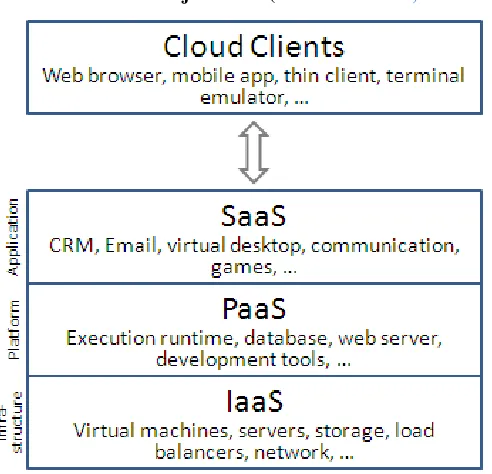
Some new terminologies like SaaS (Software as a service), PaaS (Plateform as a serviece) and IaaS (Infrastructure as a service) has been developed with the evolution of cloud computing. cloud computing is nothing but a specialized form of grid and distributed computing which varies in terms of infrastructure, services, deployment and geographic dispersion (Hashizume et al. 2013; Westphall et al., 2011; Hamlen, Kantarcioglu, Khan, & Thuraisingham, 2010). In a pervasive meaning within the context of computer networks, infrastructure could be thought of as the hardware as well as their alignment where platform is the operating system which acts as the platform for the software (Singh & jangwal, 2012; Lee, 2012). Thus the concept of cloud based services is hierarchically built from bottom to top in the order of IaaS, PaaS and SaaS (Monjur Ahmed & Mohammad Ashraf Hossain, 2014). The extent to which an end-user could 'borrow' the resources ranging from infrastructure to software define by the level of abstraction. This level of abstraction does not influence the core concern of security and the way of computing. As a result, security is to be considered within any form of cloud computing (Bisong & Rahman, 2011) regardless of spirit, hierarchy and level of abstraction. Virtualization is an unavoidable technology that is highly paired with the concept of cloud computing (Buyya et al., 2009; Ogigau-Neamtiu, 2012; Hashizume et al. 2013; Kim, 2009; Mosher, 2011; Atayero & Feyisetan, 2011; Zissis & Lekkas, 2012). The cloud services (specially in the form of PaaS and SaaS) are complemented by the virtualization technology where the services or platforms are contained by one physical infrastructure to deliver a number of cloud users simultaneously. This leads to the addition of total security aspects of virtualization technology on top of the existing security concerns and issues of cloud computing (Monjur Ahmed & Mohammad Ashraf Hossain, 2014). Figure 1 illustrate a typical cloud based scenario that includes the cloud service provider and the cloud users in a cloud computing architecture (Monjur Ahmed & Mohammad Ashraf Hossain, 2014).Figure 1: A Typical Cloud Architecture
International Journal of Emerging Technology and Advanced Engineering
Website: www.ijetae.com (ISSN 2250-2459,ISO 9001:2008 Certified Journal, Volume 5, Issue 7, July 2015)
[image:3.612.54.300.127.364.2]425
Figure 2: Cloud Service Hierarchy
The cloud user uses the different services (like SaaS, PaaS or IaaS) from the service providers. The cloud user doesn’t worry about the internal working of the network of cloud service provider. Any form of disruption believes to the cloud user as service unavailability or quality declining. For any aforementioned disruption, Security issues might play a activating role as a driving factor
III. CLOUD AUTHENTICATION
For any form of computing, security is the most prioritized prospect as well as for cloud environment, security issues are significant. As the cloud computing approach could be associated with having users’ sensitive data stored both at clients’ end as well as in cloud servers, identity management and authentication are very crucial in cloud computing (Kim & Hong, 2012; Emam, 2013; Han, Susilo & Mu, 2013; Yassin, Jin, Ibrahim, Qiang & Zou, 2012). Verification of eligible users’ credentials and protecting such credentials arepart of main security issues in the cloud - violation in these areas could lead to undetected security breach (Kumar, 2012) at least to some measure for some period. Figure 3 shows a possible authentication scheme for a cloud infrastructure.
Figure 3: Authentication in the Cloud
The above figure shows that the authentication for the cloud users can be done either by the cloud service provider or the service provider can outsource the identity management and authentication service to third party specialists (Gonzalez, Miers, Redigolo, Simplicio, Carvalho, Naslund & Pourzandi, 2012; Sharma & Mittal, 2013).It is cloud service provider who needed joining with the third party authentication specialist. This type of joining during the authentication process of cloud users is done basically through cloud. The above description of the authentication in the cloud is simple. The total authentication process might be more complicated in terms of security, fundamental algorithm as well as performance level; if the cloud service provider arranges the geographically dispersed servers. The goal of the introduction of third party authentication and identity management specialist into any cloud architecture is to reinforce the robustness of security in the concerned area, doesn’t matter what is the level of complexity.
IV. CLOUD SECURITY ISSUES
[image:3.612.326.579.139.335.2]International Journal of Emerging Technology and Advanced Engineering
Website: www.ijetae.com (ISSN 2250-2459,ISO 9001:2008 Certified Journal, Volume 5, Issue 7, July 2015)
426
Data location is a crucial factor in cloud computing security (Teneyuca, 2011). Location transparency is one of the noticeable flexibilities for cloud computing, which is a security threat at the same time – without knowing the special location of data storage, the condition of data protection act for some region might be strictly affected and violated (Monjur Ahmed & Mohammad Ashraf Hossain, 2014). Cloud users’ personal data security is thus a crucial concern in a cloud computing environment (Joint, Baker & Eccles, 2009; Ismail, 2011; King & Raja, 2012). In terms of customers’ personal or business data security, the strategic policies of the cloud providers are of highest significance (Joint & Baker, 2011) as the technical security merely is not adequate to address the problem. Trust is another problem which raises security concerns to use cloud service (Ryan & Falvy, 2012) for the reason that it is directly related to the credibility and genuineness of the cloud service providers. The Trust establishment may be the key to build a successful cloud computing environment. For any given cloud computing situations, the common interest area for all stakeholders is the condition of trust model that’s why it is necessary in cloud computing. Belief in cloud might be dependent on a number of factors among which some are automation management, human factors, processes and policies (Abbadi & Martin, 2011). The attacks in cloud based services are same as the attacks that are suitable to a computer network and the data. Some threats in this category are man-in-the-middle attack, phishing, eavesdropping, sniffing and other similar attacks. DDoS (Distributed Denial of Service) attack is one common yet major attack for cloud computing infrastructure (Dou, Chen & Chen, 2013). The security of virtual machine will define the integrity and level of security of a cloud environment to greater extent (Rakhmi, Sahoo & Mehfuz, 2013; Agarwal & Agarwal, 2011). Accounting & authentication as well as using encryption falls within the practice of safe computing - they can be well considered as part of security concerns for cloud computing (Lee, 2012; Ogigau-Neamtiu, 2012; Singh & Jangwal, 2012). Yet, in this regard, differentiate between risk and security is important. For example, vendor lock-in which does not necessarily have to be related to security concerns might be considered as one of the possible risks in cloud based services. On the diametrically, using specific type of operating system (e.g. open-source vs. proprietary) might pose security threat and concerns which, of course, is a security risk (Monjur Ahmed & Mohammad Ashraf Hossain, 2014). Licensing issues, service unavailability, and provider’s business irregularity are the some other examples of business risks of cloud computing.International Journal of Emerging Technology and Advanced Engineering
Website: www.ijetae.com (ISSN 2250-2459,ISO 9001:2008 Certified Journal, Volume 5, Issue 7, July 2015)
427
All the traditional security risks are thus applicable with added degree of potency in a cloud infrastructure which makes the ongoing success of cloud computing a quite challenging one (Monjur Ahmed & Mohammad Ashraf Hossain, 2014). The security concerns of a cloud environment falls into the three generalized categories namely confidentiality, availability and integrity. Threats for a cloud infrastructure are applicable both to data and infrastructure (Agarwal & Agarwal, 2011). In a cloud environment, the common anticipation is the transferring of a huge amount of data therefore the communication technology used along with the security concerns of the adapted communication technology also becomes a security concern for the cloud computing approach (Monjur Ahmed & Mohammad Ashraf Hossain, 2014). The broadcast nature of some communication technology is a core concern in this regard (Celesti, Fazio, Villari & Puliafito, 2012). Cloud environment is associated with both physical and virtual resources and they pose different level of security issues – having no sophisticated authentication mechanism to fully address the security threats is an existing problem for cloud computing (Monjur Ahmed & Mohammad Ashraf Hossain, 2014). It has mainly resulted in the situations where grid computing has been taken as an embedded part of cloud computing (Casola, Cuomo, Rak & Villano, 2013). Arbitrary interrupted intrusion needs to be monitored in the operational context of a cloud computing infrastructure where the severity of possibility for a virtual machine to be compromised is to be taken into account (Arshad, Townsend & Xu, 2013). Some authors have argued that using Internet technologies is not a must for cloud computing (Khorshed et al., 2012) - but almost all the businesses will be provoke and enforced by the cost efficiency and globalization vogue to admit Internet and associated technologies to be the ultimate means towards cloud computing approach. As a result, total Internet related security concerns are anticipated to be automatically added on top of the cloud-specific security issues (Monjur Ahmed & Mohammad Ashraf Hossain, 2014). To make the cloud services adaptable, the one important mean is portability that would also be associated with security concerns. Cloud portability enables the cloud users to switch among different cloud service providers without being affected with the necessity to change the ways to accomplish tasks in different ways (Monjur Ahmed & Mohammad Ashraf Hossain, 2014). It is a clear provision on bargaining power for the cloud users; but at the same time, the security issues with cloud portability are to be counted (Monjur Ahmed & Mohammad Ashraf Hossain, 2014).Cloud portability might bring severe degree of API based security threats (Petcu, Macariu, Panica & Craciun, 2013). In recent years the broad transition to mobile computing practices has made it unavoidable to include mobile computing and its associated technologies as a necessary part of cloud computing. For the mobile end-user devices the demand of data processing in large amount is a problem. For mobile cloud computing, the device level limitations has inspired researchers to suggest the inclusion of another level of cloud termed as ‘mobile cloud’ to aid the processing of the specific computing and processing for mobile computing devices (Fernando, Loke & Rahayu, 2013). Besides, the addition of mobile cloud into the perspective would add another cloud with all its security issues for a service provider having both mobile cloud and conventional cloud and the addition of mobile cloud in the scenario would boost performance, but it would also add another layer of security issue not only to the mobile cloud users, but also to the total infrastructure of the cloud service provider (Monjur Ahmed & Mohammad Ashraf Hossain, 2014). The hierarchical arrangement of cloud computing facilitates different level of extensibility for the cloud users with varying degree of associated security issues (Che et al., 2011). Some authors portray the security issues for cloud computing as an obvious one due to its nature. In a business model, the risks for the consumers are related to and dependent on the relevant approaches and policies of the cloud service providers the consumers are dealing with (Monjur Ahmed & Mohammad Ashraf Hossain, 2014). If the consumers are not well conscious with the type and particulars of the products or services they are to gain or to use in a cloud environment, it may lead to security concerns for the consumers. One of the inherent problems in this context is that, the consumers might normally not be able to identify or foresee all the risks involved in the specific cloud transaction they are dealing with or involved in (Svantesson & Clarke, 2010).
V. CONCLUSIONS
International Journal of Emerging Technology and Advanced Engineering
Website: www.ijetae.com (ISSN 2250-2459,ISO 9001:2008 Certified Journal, Volume 5, Issue 7, July 2015)
428
The immense possibilities of cloud computing cannot be reject solely for the security issues reason – the ongoing investigation and research for robust, consistent and integrated security models for cloud computing could be the only path of motivation (Monjur Ahmed & Mohammad Ashraf Hossain, 2014). The cloud infrastructures could be influenced by the security issues. Security itself is conceptualized in cloud computing infrastructure as a distinct layer (Dukaric & Juric, 2013). Cloud computing is necessary to become the ideal (and possibly the ultimate) approach to business computing though the security obstructions along with other issues need to be resolved for cloud computing to make it more viable(Marston, Li, Bandyopadhyay, Zhang & Ghalsasi, 2011). Yet, given its total advantages and dynamism and provided it is deployed within an integrated and secured infrastructural framework, cloud computing can offer virtual ownership and access to 'super computers' without procuring them physically(Monjur Ahmed & Mohammad Ashraf Hossain, 2014). Perhaps this is what inspired coining the term SCC (Scientific Cloud Computing). Research effort has been contributed to develop faster yet secured SCC tools (Jorissen, Villa & Rehr, 2012) which will greatly affect the pace of research and motivation in various fields together with clouding computing itself. If robust security models for cloud computing do not exist, the social implications of cloud computing approaches might develop with harsh impact. The security issues for cloud computing are not related to the technical and direct security breach only; a number of social inconsistency might also be resulted even without any ‘hard’ security breach having taken place (Monjur Ahmed & Mohammad Ashraf Hossain, 2014).The behind reason are the transmission, dispersive processing and storage features. Obtaining digital proofs is one of such example. The evolution of cloud computing might significantly affect the collection and retention of digital evidence (Mason & George, 2011). The vastness and potentiality of cloud computing cannot be overlooked, subsequently robust security models for cloud computing scenarios is the most prioritized factor for a successful cloud based infrastructure development and deployment (Monjur Ahmed & Mohammad Ashraf Hossain, 2014).On the basis of the sociological and technological viewpoints, in cloud computing the security issues are somewhat sensitive and critical. Technical as well as epistemological factors are equally important to take into consideration when dealing with cloud computing and its security issues.Service oriented architecture and other characteristics of cloud computing suggests that the concept of cloud computing would require to analyze the practicality in line with social, business, technical and legal perspectives – all these facets will incorporate security issues either in technical or strategic form (Monjur Ahmed & Mohammad Ashraf Hossain, 2014). Regardless of the nature of security issues, it can be undoubtedly concluded that the severe adverse effects as a consequence of security breaches in cloud computing, the deployment of any form of cloud computing should deal with the security concerns corresponding to those of the safety critical systems (Monjur Ahmed & Mohammad Ashraf Hossain, 2014).
REFERENCES
[1] Monjur Ahmed & Mohammad Ashraf Hossain, (2014). Cloud computing and security issues in the cloud. International Journal of Network Security & Its Applications (IJNSA), Vol.6, No.1, January
2014.
[2] Agarwal, A. and Agarwal, A. (2011). The Security Risks Associated with Cloud Computing. International Journal of Computer Applications in Engineering Sciences, 1 (Special Issue on CNS), 257-259.
[3] Atayero, A.A. and Feyisetan, O. (2011). Security Issues in Cloud Computing: The Potentials of Homomorphic Encryption. Journal of Emerging Trends in Computing and Information Sciences, 2(10), 546-552.
[4] Buyya, R., Yeo, C.S., Venugopal, S., Broberg, J. and Brandic, I.
(2009). Cloud computing and emerging IT platforms: Vision, hype, and reality for delivering computing as the 5th utility. Future Generation Computer Systems, 25, 599–616.
[5] Celesti, A., Fazio, M., Villari, M. and Puliafito, A. (2012). Virtual machine provisioning through satellite communications in federated Cloud environments. Future Generation Computer Systems, 28, 85– 93. doi:10.1016/j.future.2011.05.021
[6] Dou, W., Chen, Q. and Chen, J. (2013). A confidence-based filtering method for DDoS attack defense in cloud environment. Future Generation Computer Systems, 29, 1838–1850. doi:10.1016/j.future.2012.12.011
[7] Emam, A.H.M. (2013). Additional Authentication and Authorization using Registered Email-ID for Cloud Computing. International Journal of Soft Computing and Engineering, 3(2), 110-113. [8] Hamlen, K., Kantarcioglu, M., Khan, L. and Thuraisingham, V.
(2010). Security Issues for Cloud Computing. International Journal of Information Security and Privacy, 4(2), 39-51. doi: 10.4018/jisp.2010040103
[9] Ismail, N. (2011).Cursing the Cloud (or) Controlling the Cloud? Computer Law & Security Review, 27, 250 – 257. doi:10.1016/j.clsr.2011.03.005
International Journal of Emerging Technology and Advanced Engineering
Website: www.ijetae.com (ISSN 2250-2459,ISO 9001:2008 Certified Journal, Volume 5, Issue 7, July 2015)
429
[11] Kim, W. (2009). Cloud Computing: Today and Tomorrow. Journal of Object technology, 8(1), 65-72.
[12] Kuyoro, S.O., Ibikunle, F. and Awodele, O. (2011). Cloud Computing Security Issues and Challenges. International Journal of Computer Networks, 3(5), 247-255.
[13] Mason, S. and George, E. (2011). Digital evidence and ‘cloud’ computing. Computer Law & Security Review, 27, 524-528. doi:10.1016/j.clsr.2011.07.005.
[14] Mosher, R, (2011). Cloud Computing Risks. ISSA Journal, July Issue, 34-38.
[15] Petcu, D., Macariu, G., Panica, S. and Crăciun, C. (2013). Portable
Cloud applications—From theory to practice. Future Generation
Computer Systems, 29, 1417–1430.
doi:10.1016/j.future.2012.01.009
[16] Rashmi, Sahoo, G. and Mehfuz, S. (2013). Securing Software as a Service Model of Cloud Computing: Issues and Solutions. International Journal on Cloud Computing: Services and Architecture, 3(4), 1-11. Doi: 10.5121/ijccsa.2013.3401
[17] Singh, S. and Jangwal, T. (2012). Cost breakdown of Public Cloud Computing and Private Cloud Computing and Security Issues. International Journal of Computer Science & Information Technology, 4(2), 17-31.
[18] Teneyuca, D. (2011). Internet cloud security: The illusion of inclusion. Information Security Technical Report, 16, 102-107. doi:10.1016/j.istr.2011.08.005
[19] Yassin, A.A., Jin, H., Ibrahim, A., Qiang, W. and Zou, D. (2012).
Efficient Password-based Two Factors Authentication in Cloud Computing. International Journal of Security and Its Applications, 6(2), 143-148.
[20] Zissis, D and Lekkas, D. (2012). Addressing cloud computing security issues. Future Generation Computer Systems, 28, 583–592. doi:10.1016/j.future.2010.12.006
[21] Abbadi, I.M. and Martin, A. (2011). Trust in the Cloud. Information Security Technical Report, 16, 108-114. doi:10.1016/j.istr.2011.08.006
[22] Arshad, J, Townsend, P. and Xu, J. (2013).A novel intrusion severity analysis approach for Clouds. Future Generation Computer Systems, 29, 416–428. doi:10.1016/j.future.2011.08.009
[23] Bisong, A. and Rahman, S.S.M. (2011). An Overview of the Security Concerns in Enterprise Cloud Computing. International Journal of Network Security & Its Applications, 3(1), 30-45. doi:10.5121/ijnsa.2011.3103.
[24] Casola, V., Cuomo, A., Rak, M. and Villano, U. (2013). The CloudGrid approach: Security analysis and performance evaluation. Future Generation Computer Systems, 29, 387–401. doi:10.1016/j.future.2011.08.008
[25] Che, J. Duan, Y, Zhang, T. and Fan, J. ().Study on the security
models and strategies of cloud computing. Procedia Engineering, 23, 586 – 593. doi:10.1016/j.proeng.2011.11.2551
[26] Chen, D. and Zhao, H. (2012). Data Security and Privacy Protection Issues in Cloud Computing. International Conference on Computer Science and Electronics Engineering, 647-651. doi: 10.1109/ICCSEE.2012.193
[27] Dukaric, R. and Juric, M.B. (2013). Towards a unified taxonomy and architecture of cloud frameworks. Future Generation Computer Systems, 29, 1196–1210. doi:10.1016/j.future.2012.09.006
[28] Fernando, N., Loke, S.W. and Rahayu, W. (2013). Mobile cloud
computing: A survey. Future Generation Computer Systems, 29, 84– 106. doi:10.1016/j.future.2012.05.023
[29] Gonzalez, N., Miers, C., Redigolo, F., Simplicio, M., Carvalho, T.,
Naslund, M. and Pourzandi, M. (2012). A quantitative analysis of current security concerns and solutions for cloud computing. Journal of Cloud Computing, 1(11), 1-18.
[30] Kim, J. and Hong, S. (2012). A Consolidated Authentication Model in Cloud Computing Environments. International Journal of Multimedia and Ubiquitous Engineering, 7(3), 151-160.
[31] Han, J., Susilo, W. and Mu, Y. (2013). Identity-based data storage in cloud computing. Future Generation Computer Systems, 29, 673– 681. doi:10.1016/j.future.2012.07.010
[32] Hashizume et al. (2013). An analysis of security issues for cloud computing. Journal of Internet Services and Applications, 4(5), 1-13.
[33] Joint, A. and Baker, E. (2011). Knowing the past to understand the
present 1 e issues in the contracting for cloud based services. Computer Law & Security Review, 27, 407 - 415. doi:10.1016/j.clsr.2011.05.002
[34] Joint, A., Baker, E. and Eccles, E. (2009). Hey, you, get off of that cloud? Computer Law & Security Review, 25, 270–274. doi:10.1016/j.clsr.2009.03.001
[35] Khorshed, T.M., Ali, A.B.M.S. and Wasimi, S.A. (2012). A survey
on gaps, threat remediation challenges and some thoughts for proactive attack detection in cloud computing. Future Generation Computer Systems, 28, 833–851. doi:10.1016/j.future.2012.01.006
[36] King, N.J. and Raja, V.T. (2012).Protecting the privacy and security of sensitive customer data in the cloud. Computer Law and Security Reviews, 28, 308-319.
[37] Kumar, A. (2012). World of Cloud Computing & Security.
International Journal of Cloud Computing and Services Science, 1(2), 53-58.
[38] Lee, K. (2012). Security Threats in Cloud Computing Environments.
International Journal of Security and Its Application, 6(4), 25-32.
[39] Marston, S., Li, Z., Bandyopadhyay, S., Zhang, J. and Ghalsasi, A. (2011).Cloud computing — The business perspective. Decision Support Systems, 51,176–189. doi:10.1016/j.dss.2010.12.006 [40] Mircea, M. (2012). Addressing Data Security in the Cloud. World
Academy of Science, Engineering and Technology, 66, 539-546. [41] Ogigau-Neamtiu, F. (2012). Cloud Computing Security Issues.
Journal of Defense Resource Management, 3(2), 141-148. [42] Suresh, K.S. and Prasad, K.V. (2012). Security Issues and Security
Algorithms in Cloud Computing. International Journal of Advanced Research in Computer Science and Software Engineering, 2(10), 110-114.
[43] Youssef, A.E. (2012). Exploring Cloud Computing Services and Applications. Journal of Emerging Trends in Computing and Information Sciences, 3(6), 838-847.
[44] Okuhara, M., Shiozaki, T. and Suzuki, T. (2010). Security Architectures for Cloud Computing. FUJITSU Science Technology Journal, 46(4), 397–402.
[45] Petre, R. (2012). Data mining in Cloud Computing. Database Systems Journal, 3(3), 67-71.
International Journal of Emerging Technology and Advanced Engineering
Website: www.ijetae.com (ISSN 2250-2459,ISO 9001:2008 Certified Journal, Volume 5, Issue 7, July 2015)
430
[47] Ryan, P. and Falvey, S. (2012). Trust in the clouds. Computer Law
and Security Reviews, 28, 513- 521.
http://dx.doi.org/10.1016/j.clsr.2012.07.002
[48] Sharma, S. And Mittal, U. (2013). Comparative Analysis of Various Authentication Techniques in Cloud Computing. International Journal of Innovative Research in Science, Engineering and Technology, 2(4), 994-998.
[49] Westphall, C.B., Westphall, C.M., Koch, F.L., Rolim, C.O., Vieira, K.M., Schulter, A., Chaves, S.A., Werner, J., Mendes, R.S., Brinhosa, R.B., Geronimo, G.A. and Freitas, R.R. (2011). Management and Security for Grid, Cloud and Cognitive Networks. Revista de Sistemas de Informação da FSMA, 8, 8- 21
[50] Svantesson, D. And Clarke, R. (2010). Privacy and consumer risks