International Journal of Emerging Technology and Advanced Engineering
Website: www.ijetae.com (ISSN 2250-2459,ISO 9001:2008 Certified Journal, Volume 5, Issue 4, April 2015)
297
An Efficient Data Dissemination Mechanism for Wireless
Sensor Network with Mobile Sink
Khustar Ansari
1, Md Hussain Ansari
21,2
Assistant Professor, Department of Computer Science and Engineering, Guru Gobind Singh Educational Society’s Technical Campus, Bokaro Steel City, India
Abstract— This work investigates into the design of sink location propagation in wireless sensor network with mobile sink. In our proposed work, few sensor nodes are assigning a role to propagate the sink location information to the remaining nodes. We refer such nodes as beacon nodes (BNs). We design a distributed algorithm to select BNs. The selection of BNs depends on their sensor node degree. To ensure connectivity among the BNs, we also select few more sensor nodes to act as gateways between the BNs and we refer them beacon gateways (BGs). Combining BNs and BGs leads to formation of backbone network to propagate the sink location. In this project, we compare proposed algorithm a well known data dissemination technique, i.e., flooding. Simulation results show that the proposed algorithm achieves remarkable improvement over flooding in terms of energy consumptions.
Keywords—Sensor Nodes (SNs), Beacon Nodes (BNs), Beacon gateways (BGs), Wireless Sensor Network (WSN), Energy Model.
I. INTRODUCTION
A. Wireless Sensor Networks: An Overview
A wireless sensor network consists of a large number of sensor nodes, each equipped with three basic functional components: a sensing unit, a processing unit, and a transceiver unit. The sensing unit collects information from the surrounding environment; the processing unit performs some local information processing, such as quantization and compression; and the transceiver unit transmits the locally processed data to a fusion center where the information from different sensor nodes is aggregated and fused to generate the final inference. Though each sensor is characterized by low power constraint and limited computation and communication capabilities, when suitably deployed in large scale, potentially powerful networks can be constructed to accomplish various high-level task with sensor collaboration, One of the primary objectives of current research in sensor networks is the development of protocols and algorithm subject to a severe set of resource constraints.
Energy consumption is one such key constraint as the battery power cannot be replaced or recharged for sensor nodes deployed in a hostile environment. Multihop communication, topology control, data aggregation, exploiting, node redundancy, inbuilt trade-off mechanisms between network lifetime and throughput are some of the standard energy conserving practices used in sensor networks. As the cost of designing, implementing and deploying sensor networks progressively reduces, these networks will transcend from research labs to everyday life.
B. Application of Wireless Sensor Networks
Sensor networks can be potentially used for a broad spectrum of applications across various domains. The current popular application domains of sensor networks are environment, health, home, military, security and commercial areas.Figure1 shows an example of a wireless sensor network for environment monitoring, where the sensors are scattered in a sensor field to observe one or more environmental parameters such as temperature, light level, and soil moisture. Each sensor can route its data (locally processed observations) via single –hop or multi-hop wireless channels to the sink node, which makes the final inference based on the received data. This sink node communicates with the end user via public networks over satellite, wireless, or wired links. Sensor networks need to be designed and implemented keeping the application in view, as different applications may have different resource constraints. Minimizing energy dissipation in the network is one constraint that is universal to all applications. A brief overview of some of the key applications is as follows:
Military - Sensor networks have the potential to be a
key component of command, control,
International Journal of Emerging Technology and Advanced Engineering
Website: www.ijetae.com (ISSN 2250-2459,ISO 9001:2008 Certified Journal, Volume 5, Issue 4, April 2015)
298 Environmental Applications - These consist of
applications like temperature monitoring, forest fire detection, flood detection, wildlife tracking and precision agriculture. It is possible to deploy sensor networks for the above mentioned applications due to the remote sensing and automated data collection features of sensor nodes.
Health Applications - These include applications like Tele monitoring of human physiological data, tracking doctors and patients etc.
Home and Commercial Applications - Applications like smart spaces, office environmental control, home automation, management of inventory control, vehicle tracking and detection fall in this category.
C. Sensor Network Design Factors
Some of the parameters that influence the design of sensor networks are scalability, production cost, network topology, fault tolerance, power consumption and hardware constraints.
Fault tolerance deals with the issue of minimizing the effect of failing nodes on the entire network. The required level of fault tolerance in the network is application specific. One of the models used for measuring fault tolerance of a sensor node is Poisson’s distribution. Protocols and algorithms need to be designed which provide the application specified fault tolerance in the system.
Scalability is determined by factors like total number of deployed nodes and density of sensor nodes. Density and number of nodes in the network should be exploited to increase the network operational lifetime.
As wireless sensor networks are made up of a large number of densely deployed nodes, individual node cost greatly impacts the total network cost. The aim here is to keep the sensor node cost low enough so that the wireless sensor network cost is less than that of the traditional network.
Topology control includes factors like mode of deployment, self configuration after deployment, deployment of additional nodes etc. Maintaining the topology of sensor network is particularly challenging as sensor nodes are mobile, prone to random failures, subject to harsh physical conditions is the deployment area and often have a nonrenewable energy source.
II. RELATED WORKS
A. Data Dissemination Protocol and its Drawback for static Sink
Several data dissemination protocols have been proposed for wireless sensor networks with a static sink.
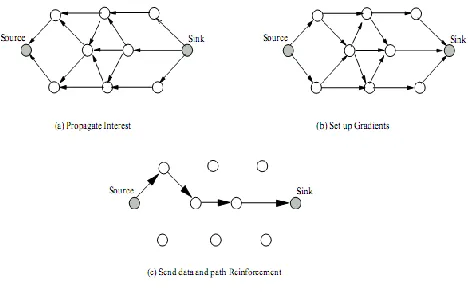
[image:2.612.327.561.335.481.2]DD (Directed Diffusion) or Flooding techniques: - It is the first proposed data-centric communication protocol for WSNs with Static Sink. The sink node periodically broadcasts an interest in the network for a data. Each sensor node will establish a gradient towards its neighbouring nodes from which it receives the interest. The gradient specifies both the data rate and the direction towards which the data should then be sent. Hence a forwarding based data dissemination structure is formed. However the maintenance of this structure is not localized. It is periodically launched by the sink node.
Figure 1- Directed Diffusion
International Journal of Emerging Technology and Advanced Engineering
Website: www.ijetae.com (ISSN 2250-2459,ISO 9001:2008 Certified Journal, Volume 5, Issue 4, April 2015)
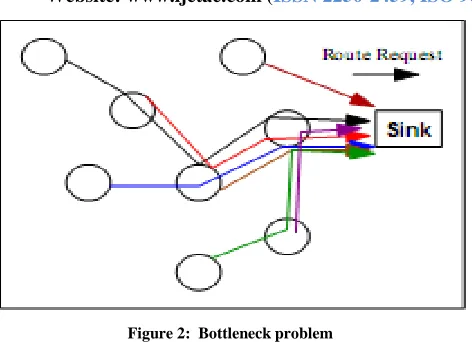
[image:3.612.53.289.127.298.2]299 Figure 2: Bottleneck problem
B. Advantage of mobile sink over static sink
Use of mobile sinks, instead of static ones, in a wireless sensor network is thus an interesting concept to enhance the network lifetime by avoiding excessive transmission overhead at nodes that are close to the location that would be occupied by a static sink(i,e avoid bottleneck problem which happen with static sink). The sink mobility assumption may be useful for numerous applications. A typical application scenario is target tracking and intrusion detection. As shown on Figure 1, sensors are deployed and placed in strategic locations to monitor the battlefield area and detect enemy intrusions. When an intrusion is being detected, sensors report an alarm to the mobile sink which monitors the progression of intruders and takes the appropriate actions (e.g., sending the enemy position to the command centre via a satellite). The sink represents an important component of a wireless sensor network as it acts as a gateway between sensors and the end-user.
The sink mobility assumption can be imposed by the nature of the deployed application. For example, in security constrained scenario the use of a mobile sink makes harder the damage of such component. Indeed, if a static sink is located, it can be easily compromised and damaged by malicious users, thus making the sensors disconnected from the end user. On the other hand, sink mobility may improve the network connectivity by allowing the retrieval of collected measurements from several isolated parts of the sensor field. Furthermore, mobile sinks have been shown to improve the network lifetime by spreading the overhead of nodes that are close to the sink location.
C. Challenges in designing data dissemination protocols of mobile sink:
Despite the numerous advantages discussed above, the sink mobility brings several challenges when designing energy efficient data dissemination protocols. These issues are discussed below in more details.
1. Sink location and reporting method: - The main goal of a sensor is to monitor the surrounding environment and to forward measurements and events towards the sink. If the sink location information is known by the sensors, data reports can be sent directly to the sink. In such a case, periodic and event-driven data reporting methods can be considered. However, in a wireless sensor network with a mobile sink, sensors do not have any a prior knowledge of the mobile sink location. Thus, the difficulty is for sensors to efficiently track the sink and report the measurements and events. A convenient solution to this problem is to overlay a virtual infrastructure, or a beacon, over the physical network, and to exploit this structure during the data dissemination process. The underlying idea is to consider the structure as a rendezvous region for storing the generated data reports such that the mobile sink can easily collect them using a query-based data reporting method. If this virtual structure is well designed, one can achieve scalability and energy-efficiency.
2. Mobility support: - The last issue concerns the management of the sink mobility. This can be performed using the progressive footprint chaining strategy. The sink elects among its neighbours a sink manager. This sink manager forwards the sink queries’ towards the sensors, and transmits the received data reports to the sink. If the distance between the sink and its sink manager exceeds a given value, a new sink manager is chosen and a logical link towards the old sink manager is established. This approach is used by DDB.
International Journal of Emerging Technology and Advanced Engineering
Website: www.ijetae.com (ISSN 2250-2459,ISO 9001:2008 Certified Journal, Volume 5, Issue 4, April 2015)
300
4. Transmission Media: - In a multi-hop sensor network, communicating nodes are linked by a wireless medium. The traditional problems associated with a wireless channel (e.g., fading, high error rate) may also affect the operation of the sensor network. In general, the required bandwidth of sensor data will be low, on the order of 1-100 kb/s. Related to the transmission media is the design of medium access control (MAC). One approach of MAC design for sensor networks is to use TDMA based protocols that conserve more energy compared to contention based protocols like CSMA (e.g., IEEE 802.11). Bluetooth technology can also be used.
III. PROPOSED WORK
A.Design of Backbone network
It has several phases
(i) Deployment of sensor node (ii)Beacon node selection (iii) Beacon gateway selection
1. Deployment of sensor node
Deployment of sensor node is done in a random fashion i.e. sensor node deployed randomly.
2. Beacon node (BN) selection
Selection of Beacon node depends on their degree i.e. neighbour of that sensor node. All the sensor nodes start their timer (t BN) at the same time by using the following
formula
D
t
BN
1
(1)Where
D= degree of a sensor node.
Process involves following steps:
1. Calculate degree of each sensor node 2. Sort node with respect to their degree(D)
3. Select node i with the highest degree and mark as BN.
4. Set P = {i}
5. Select node j with next highest degree such that j is not neighbour of any elements of P
6. Mark j as BN 7. P = P U {j}
8. Repeat step 5 -7 until no node are left.
3.Beacon gateway (BG) selection
Selection of Beacon gateway depends on their beacon node degree i.e. number of beacon nodes connected to sensor node. All the sensor nodes start their timer (tBG) at
the same time by using the following formula
BN BG
D
t
1
(2)Where,
DBN = degree of beacon gateway i.e number of
beacon node connected with sensor node.
Process involves following steps:
1. Calculate Beacon node degree of each sensor node which is neighbour of BNs.
2. Sort node w.r.t to their Beacon node degree 3. Select node i which has highest BN degree and
mark as BG 4. Set P= {i}
5. Select node j with next highest BN degree such that j is a disjoint set with each element of P w.r.t their neighbour list
6. Mark j as BG
7. P=P U {j}
8. Repeat step 5 to 7 until no node are left
Figure 3: - Backbone Network
International Journal of Emerging Technology and Advanced Engineering
Website: www.ijetae.com (ISSN 2250-2459,ISO 9001:2008 Certified Journal, Volume 5, Issue 4, April 2015)
301
B. Sink location propagation
The sink propagates its location to all sensor nodes of backbone network in three ways:-
First the sink propagates its location to its nearby sensor node and that sensor node happens to a member of backbone network then that sensor node passes the sink location to its beacon node. Then that beacon node forwards this sink location details to the rest of the member as well as to others beacon’s node through beacon gateways. This process continues until each and every sensor node is informed about the sink location.
When the nearby sensor node is a beacon node itself then the sink location details is forwarded to all its member nodes and to the other nodes of the network through beacon gateways.
When the nearby sensor node is a beacon gateway node then its passes the sink location information to the beacon node connected to it and further the beacon node passes this location information to its members and the process continues until each and every sensor node is informed about the sink location.
IV. SYSTEM MODEL
A. WSN model
A homogenous set of sensor nodes are deployed in the target area. All the sensor nodes become static once they are deployed. The sink is mobile and it can be move to random location inside the target area. Initially, the sensor nodes have equal amount of energy. Clocks of the sensor nodes are synchronized. The sensor nodes are aware of their locations through some localization techniques. The wireless link is symmetric and bidirectional.
B. Energy model
The energy model of the sensor nodes is adopted from [3]. The energy is consumed to transmit β-bit data form node i to node j over the distance d is given as
Where αtx and αrx are the energy dissipated in
transmitting and receiving the data bit respectively. If the distance between the sender and receiver is less than d0
then free space (εfs) channel model is used. Otherwise,
multi-path fading (εmp) channel model is used. The energy
consumed in receiving the β-bit data is given by
β
j
E
rx(
)
rx(2)
V. SIMULATION
We compare our proposed algorithm with the flooding techniques, followings are the results.
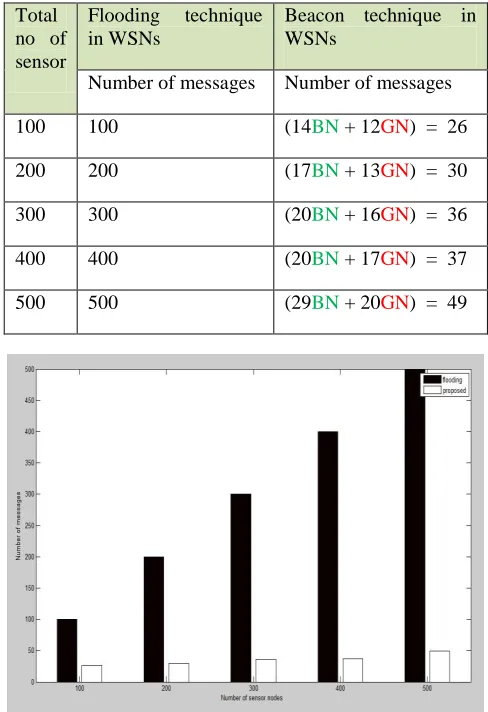
A. Sink location propagation result
Number of messages required to propagates the sink location to all sensor nodes of backbone network in proposed and flooding techniques.
Table 1:
Comparison between Flooding technique with Beacon technique in WSNs
Total no of sensor
Flooding technique in WSNs
Beacon technique in WSNs
Number of messages Number of messages
100 100 (14BN + 12GN) = 26
200 200 (17BN + 13GN) = 30
300 300 (20BN + 16GN) = 36
400 400 (20BN + 17GN) = 37
[image:5.612.321.565.267.623.2]500 500 (29BN + 20GN) = 49
International Journal of Emerging Technology and Advanced Engineering
Website: www.ijetae.com (ISSN 2250-2459,ISO 9001:2008 Certified Journal, Volume 5, Issue 4, April 2015)
302
B. Network Lifetime
1. Random deployment
[image:6.612.323.561.121.305.2]If the sensor nodes are deployed randomly then followings are the result.
[image:6.612.49.289.192.356.2]Figure 5: Number of active sensor nodes per rounds.
Figure 6: Number of active sensor nodes per rounds.
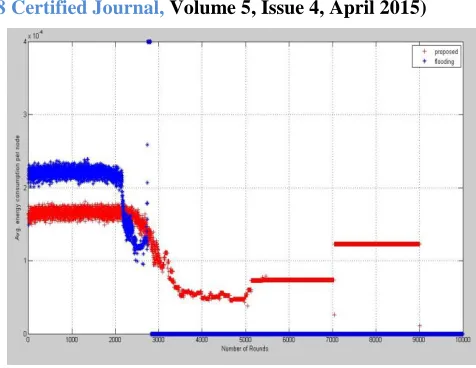
Figure 7: Average energy consumption per node on each round.
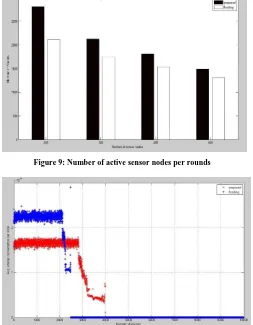
2.Grid deployment
[image:6.612.327.558.366.537.2]If deployments of sensor nodes are grid then followings are the results.
[image:6.612.49.287.375.561.2]International Journal of Emerging Technology and Advanced Engineering
Website: www.ijetae.com (ISSN 2250-2459,ISO 9001:2008 Certified Journal, Volume 5, Issue 4, April 2015)
[image:7.612.48.296.127.316.2]303 Figure 9: Number of active sensor nodes per rounds
Figure 10: Average energy consumption per node on each round
Above result shows that our techniques are much better than the flooding techniques for sink location propagation and data dissemination towards Sink.
VI. CONCLUSION
In this paper we compare data dissemination technique i.e. flooding with our technique and achieve remarkable improvement over flooding in terms of energy consumptions. And sink mobility chosen to increase the network lifetime as well as the network connectivity.
Data dissemination protocols can be classified into several approaches for mobile sink. Here we discussed about backbone network approaches and their efficient design so that with very less involvement of sensor node it disseminate data towards the sink efficiently. And also propagate the sink location information to the sensor node so that node can disseminate message towards the sink.
REFERENCES
[1] Third IEEE International Conference on Wireless and mobile computing, networking and communications (wimbo 2007) 0-7695-28889-9/07 $25.00 @2007 IEEE.
[2] C. Rahul, J. Rabaey, Energy, IEEE Wireless Communications and Networking Conference (WCNC), vol.1, March 17-21, 2002, Orlando, FL, pp. 350-355, Aware Routing for Low Energy Ad Hoc Sensor Networks.
[3] E. B. Hamida and G. Chelius, New York, NY, USA: 2007, pp. 3-10, Analytical evaluation of virtual infrastructures for data dissemination in wireless sensor networks with mobile sink, in SANET ’07: Proceedings of the First ACM workshop on Sensor and actor networks.
[4] Jia-LiangLuand Fabrice Valois, INRIAARESTeam-CITILab.INSALyon,France, Dominique Barthel, France Telecom R&D TECH/ONE, Meylan, France1-4244-0860-1/07/25.00 © 2007 IEEE.
[5] J. Cartigny, F. Ingelrest, D. Simplot-Ryl, and I. Stojmenovic. 3(1):1– 16, January 2005, Localized LMST and RNG based minimum energy broadcast protocols in ad hoc networks. Ad Hoc Networks. [6] Hongfang Yu1, Vishal Anand2 , Chunming Qiao3, University of
Electronic Science and Technology of China, China. 978-1-61284-233-2/11/$26.00 ©2011 IEEE, Gang Sun11School of Communication and Information Engineering.
[7] Mohammad Muntasir Rahman1, Md. Ibrahim Abdullah2, Md. Shamim Hossain3, Department of Computer Science & Engineering Islamic University, Kushtia, Bangladesh, International Journal of Advanced Science and Technology, Vol. 32, July, 2011.
[8] HongweiDu, QiangYe∗, WeiliWu†, WonjunLee‡, DeyingLi, DingzhuDu And Stephen Howard, Department of Computer Science and Information Technology, University of Prince EdwardIsland, Canada.978-1-4244-9921-2/11/$26.00 ©2011 IEEE.
[9] Shrinivasa Kini, Srinivasan Rama subramanian, Amund Kvalbein, AudunF. Hansen, IEEE INFO COM 2009 conference.
[image:7.612.46.299.144.469.2]