REQUIREMENT ELICITATION USING KNOWLEDGE
CAPTURING (KC) TECHNIQUES DURING THE CLIENT
BRIEFING PROCESS FOR IMPROVED CLIENT
SATISFACTION IN THE UK CONSTRUCTION INDUSTRY
EMMANUEL OLUWAFEMI OLATOKUN
ii
REQUIREMENT ELICITATION USING KNOWLEDGE
CAPTURING (KC) TECHNIQUES DURING THE CLIENT
BRIEFING PROCESS FOR IMPROVED CLIENT
SATISFACTION IN THE UK CONSTRUCTION INDUSTRY
EMMANUEL OLUWAFEMI OLATOKUN
School of the Built Environment
The University of Salford
Salford, UK
Submitted in Partial Fulfilment of the Requirements of the Degree of
Doctor of Philosophy
iii
Table of Contents
Table of Contents ... iii
LIST OF FIGURES ... xi
LIST OF TABLES ... xiii
LIST OF ABBREVIATIONS ... xvii
ACKNOWLEDGEMENTS ... xx
DECLARATION ... xxi
ABSTRACT ... xxii
Chapter 1 – Introduction ... 1
1. 1 Background to Research ... 1
1.2 Research Problem/Justification ... 5
1.3 Research Aim and Objectives ... 11
1.4 Research Questions ... 12
1.5 Scope of Research ... 12
1.6 Research Methodology ... 13
1.7 Structure of Thesis ... 16
1.8 Summary ... 18
Chapter 2- Knowledge and Knowledge Management ... 19
2.1 Introduction ... 19
2.2 History of Knowledge ... 19
iv
2.3.1 Components of Knowledge ... 27
2.3.2 Hierarchy of Knowledge ... 29
2.4 Schools of Thought on Knowledge ... 33
2.4.1 Knowledge Based View and Resource Based View (KBV And RBV) ... 33
2.4.2 Core Competence ... 35
2.4.3 Dynamic Capabilities ... 36
2.4.4 Knowledge Production ... 37
2.5 Different Knowledge Models ... 38
2.5.1 DIKW Model ... 38
2.5.2 E2E Model ... 39
2.5.3 SECI Model ... 40
2.6 Characteristics and Types of Knowledge ... 23
2.6.1 Tacit Knowledge ... 24
2.6.2 Explicit Knowledge... 25
2.6.3 Individual or Group Knowledge ... 25
2.7 Knowledge Management (KM) ... 42
2.7.1 History of Knowledge Management ... 42
2.7.2 Components of Knowledge Management... 47
2.7.3 Various Definitions of Knowledge Management ... 48
2.7.4 Knowledge Codification ... 50
2.8 Knowledge Management Processes ... 51
2.8.1 Knowledge Creation ... 51
2.8.2 Knowledge Sharing ... 52
2.8.3 Knowledge Transfer ... 54
v
2.9.1 What is Knowledge Capturing? ... 55
2.9.2 Knowledge Capturing Techniques ... 60
2.9.3 Knowledge Elicitation (KE) ... 65
2.9.4 Importance of KC ... 68
2.9.5 Barriers and Enablers to KC Process ... 70
2.9.6 Challenges Associated with Knowledge Capturing ... 74
2.10 Summary ... 76
Chapter 3 – The UK Construction-Client Briefing and Knowledge Capturing ... 77
3.1 The UK Construction Industry ... 77
3.1.1 Client Dissatisfaction ... 79
3.1.2 Direction from Major Clients ... 80
3.1.3 Fragmentation ... 80
3.1.4 UK Construction Industry KPI ... 82
3.2 The UK Construction Process ... 85
3.3 Building Procurement route. ... 88
3.3.1 Traditional or Design-Bid-Build ... 90
3.3.1.1 Key points to consider with traditional procurement ... 92
3.3.1.2 Advantages and disadvantages of traditional procurement ... 92
3.4 The Role of KM in the Construction Industry. ... 92
3.5 Who is A Client? ... 93
3.5.1 Client Types ... 94
3.5.2 The Client Brief (CB) ... 95
3.5.3 Importance of Client Briefing ... 100
3.5.4 Factors Affecting Client Briefing ... 102
vi
3.6 Requirement Management ... 116
3.6.1 The Need for Requirement Management (RM) ... 117
3.6.2 Difference between Client Needs and Requirements ... 119
3.6.3 Requirement Capture /Elicitation ... 121
3.6.5 Stakeholders Involvement in Requirement Elicitation ... 123
3.6.6 Barriers to Requirement Elicitation ... 124
3.6.7 Requirements Documentation and communication ... 126
3.7 Knowledge (Requirement) Capturing/ Elicitation in Client Briefing ... 129
3.7.1 Importance of Knowledge (Requirement) capturing or Elicitation in Client Briefing ... 130
3.8 Client Satisfaction in the Construction Industry... 133
3.8.1 Factors Affecting Client Satisfaction ... 136
3.9 Conceptual Framework ... 139
3.9.1 The Conceptual Framework Explained ... 141
3.10 Chapter summary ... 144
Chapter 4 – Research Methodology ... 145
4.1 Introduction to Research Methodology ... 145
4.1.1 Types of Research ... 148
4.2 Research Philosophy ... 149
4.2.1 Ontology ... 151
4.2.2 Epistemology ... 152
4.2.3 Axiology ... 154
4.2.4 Philosophical stance of this study ... 154
4.3 Research Approach ... 156
vii
4.3.2 The Inductive Approach ... 156
4.3.3 The Abduction Approach ... 156
4.3.4 Rationale for Choice of Research Approach ... 157
4.4 Research Strategy ... 157
4.4.1 Survey ... 163
4.4.2 Literature review synthesis ... 164
4.5 Research Choices ... 165
4.6 Time Horizon ... 167
4.7 Research Techniques ... 168
4.7.1 Data Collection ... 168
4.7.1.1 Sampling ... 170
4.7.1.2 Qualitative- Semi-Structured Interviews ... 172
4.7.1.3 Quantitative -Questionnaire Surveys ... 174
4.7.1.4 Literature Review ... 175
4.7.2 Data Analysis ... 175
4.7.3 Objectives of This Research and the Corresponding Methods of Investigation ... 177
4.7.4 Reliability and Validation ... 179
4.7.5 Triangulation ... 183
4.7.6 Ethical Approval ... 184
4.8 Chapter Summary ... 184
Chapter 5 – Qualitative Data Analysis ... 185
5.1 Introduction ... 185
5.2 Design of the Interview Process ... 185
5.2.1. Section I - Profile of participants ... 185
viii
5.2.3. Section – III- Exploring the various KC techniques used in the client briefing process.
... 186
5.2.4. Section IV – Barriers to KC That Occur During the Briefing Process ... 187
5.2.5. Section V – Factors Influencing or Impacting the Client Briefing Process ... 187
5.3 Presentation of findings ... 187
5.4 Theme 1- Importance of KC in Client Briefing ... 187
5.4.1. Theme 1.1- Importance of the Client to the Briefing Process ... 189
5.4.2 Theme 1.2- Importance of the First stage of the Construction Process ... 190
5.4.3 Theme 1.3 - Client satisfaction ... 191
5.5 Theme 3- Effective KC techniques used in client briefing ... 192
5.5.1 Theme 3.1- Agile (Collaboration) vs Traditional procurement ... 194
5.6 Theme 4 - Barriers affecting KC in the client briefing process ... 196
5.6.1 Theme 4.1- Tacit nature of requirements as a barrier ... 201
5.7 Theme 2- Factors influencing the client briefing process ... 202
5.8 Relationships between Themes ... 210
5.8.1 Relationship between Factors, Barriers and Client satisfaction in relation to performance ... 210
5.8.2 Relationship between KC techniques, First step in the briefing process and Client satisfaction ... 211
5.9 Summary ... 214
Chapter 6 – Quantitative Data Analysis ... 216
6.1 Introduction ... 216
6.2 Quantitative Data Collection – Questionnaire ... 217
6.3 Questionnaire Design ... 217
ix
6.5 Findings from Questionnaire ... 220
6.5.1 Respondent Profile ... 220
6.5.2 Number of Years in the Construction Industry ... 220
6.5.3 Number of Years in Current Organisation ... 221
6.5.4 Number of Years as an Architect in the Construction Industry ... 222
6.6 Theme 1: Knowledge Capturing Techniques ... 222
6.6.1 Cronbach Alpha Test ... 223
6.6.2 Kendall W Coefficient Test ... 226
6.7 Theme 2: Barriers to the KC Process ... 228
6.7.1 Frequency Distribution of Responses For Theme 2 ... 229
6.7.2 Cronbach Alpha Test for Barriers to KC ... 230
6.7.3 Kendall W Coefficient Test for Barriers to KC ... 234
6.7.4 Factor Analysis for Barriers to KC ... 235
6.8 Theme 3: Factors Affecting the CB process ... 241
6.8.1 Cronbach Alpha Test for Factors Affecting CB ... 243
6.8.2 Kendall W Test for Factors Affecting CB ... 246
6.8.3 Factor Analysis for Factors Affecting CB ... 248
6.9 SUMMARY ... 262
Chapter 7 – Discussion of Findings ... 264
7.1 Introduction ... 264
7.2 Discussion of Findings ... 264
7.3 Importance of Knowledge Capturing in Client briefing ... 265
7.4 Effective Knowledge Capturing Techniques ... 267
x
7.6 Factors Affecting the Client Briefing Process ... 277
7.7 Framework Development ... 281
7.7.1 Proposed Framework for KC during CB in the UK Construction Industry ... 282
7.7.2 Framework Guidelines ... 285
7.8 Summary ... 285
Chapter 8 – Conclusion, Limitations and Recommendations ... 286
8.1 Conclusion ... 286
8.1.1 Contributions to the Body of Knowledge ... 289
8.1.1.1 Contribution to Academia and Industry ... 289
8.2 Recommendation ... 292
8.3 Limitations of This Study ... 293
8.3 Future Research ... 294
LIST OF REFERENCE ... 295
APPENDICES ... 340
Appendix 1- Draft Interview Questions ... 340
Appendix 2- Draft Questionnaire Survey ... 346
Appendix 3- Ethical Approval ... 356
xi
LIST OF FIGURES
Figure 1. 1: Responses of construction professionals involved in construction projects ... 9
Figure 1. 2: Most frequently used procurement method in construction projects ... 10
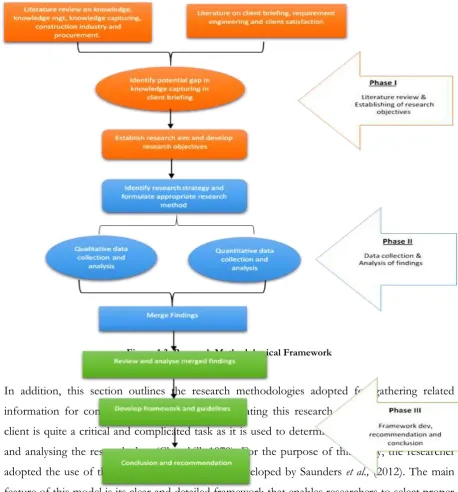
Figure 1. 3: Research Methodological Framework ... 15
Figure 2. 1: Hierarchy of Knowledge (Source: Swap et al., 2005) ... 30
Figure 2. 2: A Philosophical view of Knowledge (Source: Plat, 427-347 B.C.) ... 31
Figure 2. 3: The DIKW model (Source: Rowley, 2007) ... 38
Figure 2. 4: Knowledge System (Source: Faucher et al., 2008) ... 40
Figure 2. 5: SECI Model (Source: Nonaka and Takeuchi, 1995) ... 41
Figure 2. 6: Tacit and Explicit continuum (Source: Hislop, 2013) ... 23
Figure 3. 1: Client satisfaction by project size 2015 ... 83
Figure 3. 2: Client satisfactions against produce, service and handover ... 84
Figure 3. 3: Simplified model of the construction process (Source: RIBA, 2013) ... 85
Figure 3. 4: Detailed RIBA plan of Work (Source: RIBA 2013) ... 87
Figure 3. 5: Risk apportionments between client and contractor Holt et al. (2000) ... 89
Figure 3. 6: Traditional Procurement (construction excellence, 2004) ... 91
Figure 3. 7: Breakdowns of Cost Overrun (Source: Shanmugam et al., 2006) ... 101
Figure 3. 8: A typical Client-side structure ... 123
Figure 3. 9: Client’s project needs (Source: Chinyio, 1998) ... 128
Figure 3. 10: Cyclic Model of Knowledge Management System (adapted from Turban, 2001) . 129 Figure 3. 11: Framework for knowledge management processes and sub-processes (Sokhanva et al., 2014) ... 140
xii
Figure 3. 13: Conceptual frameworks for KC in client briefing ... 143
Figure 4. 1: The Research Onion (Saunders et al., 2012) ... 147
Figure 4. 2: Philosophical stance of this research ... 150
Figure 4. 3: Continuum of core Ontological assumptions Source: Morgan and Smircich (Collis & Hussey, 2003) ... 152
Figure 4. 4: Philosophical stance of this research ... 155
Figure 4. 5: Research Onion showing the adopted philosophies, and other layers ... 183
Figure 5. 1: Relationships between factors, barriers and client satisfaction ... 210
Figure 5. 2: Relationship between KC techniques, client satisfaction the briefing process ... 211
Figure 5. 3: Word cloud for the interview ... 212
Figure 5. 4: Relationship models between variables ... 214
Figure 6.1: Pie chart showing discipline of respondents. ... 220
Figure 6.5: Effective KC techniques ... 226
Figure 6.6: Effectiveness of KC Techniques ... 227
Figure 6.7: Barriers to KC during CB ... 234
Figure 6.8: Scree plot of barriers to KC during CB ... 239
Figure 6.9: Factors affecting CB ... 247
Figure 6.10: Scree plot for factors affecting CB ... 252
Figure 6.11: Scree plot for the 25 factors affecting the CB process ... 258
xiii
LIST OF TABLES
Table 2. 1: Generic Knowledge Types (Source: Hislop 2013) ... 26
Table 2. 2: Components of Knowledge management ... 47
Table 2. 3: Definition on Knowledge Management ... 48
Table 3. 1: Project requirements (Source: Kamara et al., 2002) ... 120
Table 4. 1: Definition of research ... 145
Table 4. 2: A selection of Research Strategies that may be used for this research (Saunders et al., 2012) ... 159
Table 4. 3: Methodological Choice (Saunders et al., 2012) ... 166
Table 4. 4: Convergent Mixed Method Research Strategy (Creswell and Plano (Clark 2011)... 167
Table 4. 5: Research Objectives and methodologies adopted. ... 178
Table 4. 6: Reliability statistics results from SPSS 23 for KC techniques, Barriers to KC and Factors affecting CB. ... 181
Table 5. 1: Profile of respondents ... 186
Table 5. 2: Importance of KC in the CB process ... 188
Table 5. 3: Importance of the Client in the CB process ... 189
Table 5. 4: Importance of the First stage of the CB process ... 190
Table 5. 5: Client satisfaction ... 191
Table 5.6: Effective KC techniques used in CB ... 192
xiv
Table 5. 8: Barriers affecting KC in the CB process ... 196
Table 5. 9: Different barriers to KC during the CB process ... 197
Table 5. 10: Tacit nature of requirements as a barrier ... 201
Table 5. 11: Factors influencing the CB process ... 202
Table 5. 12: Different factors influencing the CB process ... 203
Table 6. 1: Objectives and Data analysis tests ... 216
Table 6. 2: Respondents profile ... 220
Table 6. 3: Number of Years in the Construction Industry ... 220
Table 6. 4: Number of Years in Current Organisation... 221
Table 6. 5: Number of Years as an Architect in the Construction Industry ... 222
Table 6. 6: Knowledge capturing techniques ... 223
Table 6. 7: Cronbach alpha test for KC techniques ... 224
Table 6. 8: Item Statistics table for KC techniques ... 224
Table 6. 9: Item-total statistics ... 225
Table 6. 10: Kendall’s W test for effectiveness of KC techniques ... 228
Table 6. 11: Barriers to the KC process... 229
Table 6. 12: Frequency distribution of respondents for Barriers to KC... 229
Table 6. 13: Cronbach Reliability statistics ... 231
Table 6. 14: Item Statistics for Barriers to KC ... 232
Table 6. 15: Item-Total Statistics for Barriers to KC... 233
xv
Table 6. 17: Descriptive Statistics ... 236
Table 6. 18: KMO and Bartlett’s Test ... 237
Table 6. 19: Total Variance Explained ... 238
Table 6.20: Pattern Matrix ... 240
Table 6.21: Factors influencing the CB process ... 242
Table 6.22: Reliability Statistics ... 243
Table 6.23: Item Statistics ... 243
Table 6.24: Item-total Statistics ... 245
Table 6.25: Kendall Test Statistics ... 248
Table 6.26: Descriptive Statistics ... 249
Table 6.27: KMO and Bartlett's Test ... 250
Table 6.28: Total Variance Explained ... 251
Table 6.29: Pattern Matrix for General Factors influencing the CB process ... 254
Table 6.30: Pattern Matrix after rotation ... 255
Table 6.31: Matrix after rotation ... 256
Table 6.32: Matrix after rotation ... 256
Table 6.33: Matrix after rotation ... 257
Table 6.34: Final Pattern Matrix after several rotations ... 257
Table 6.35: Total Variance Explained for CSF's ... 259
Table 6.36: Pattern Matrix of CSF's ... 259
Table 6.37: Pattern Matrix of CSF's after rotation ... 260
xvi
Table 6.39: Final Pattern Matrix of CSF's after several rotations ... 261
xvii
LIST OF ABBREVIATIONS
CB Client Briefing
KC Knowledge Capturing KM Knowledge Management KS Knowledge Sharing KT Knowledge Transfer RE Requirement Elicitation RM Requirement management KE Knowledge Elicitation S&D Sketching and Diagrams INT Interviews
COLL Collaboration OBS Observation
RPF’s Request for proposals
BIM Building Information Modelling QST Questionnaires
REQWKSP Requirement Workshops SA Scenario Analysis
BS Brain Storming ST Storytelling
IT information Technology FACWKSP Facilitated Workshop PRT Prototype
xviii
CSF’s Critical Success Factors KPI’s Key performance indicators ID Identification number BARR Barriers
FAC Factors
RBV Resource Based View KBV Knowledge Based View
SECI Socialisation, Externalisation, Combination, Internalisation DIKW Data, Information, Knowledge and Wisdom
xix
xx
ACKNOWLEDGEMENTS
Praise is to God Almighty creator of the heavens and earth who has made this a reality, leading me through this path of self-discovery and a humbling experience.
I would like to express my heartfelt gratitude and appreciation to my supervisor Dr Chaminda Pathirage for his utmost patience, warmth, kindness, endless motivation and support throughout my entire PhD journey. His invaluable insights, critical comments and exceptional guidance have brought out the researcher in me which I have never known to exist. Thank you Dr Chaminda, May God bless you richly.
I am also eternally grateful to my parents Rev and Mrs Olatokun who funded this PhD research from inception to culmination; without which this PhD dream would not be a reality. I wish to also thank my Pastors Abimbola and Folu Komolafe for the support and guidance given to me through this journey of 4 years, a massive thank you to all my colleagues within the SoBE who have given me invaluable assistance and support, as well as the ever-helpful research administration staff Moira Mort, Jill, Rachel Lilley, Cheryl Batley and Catriona Barkley for their unrelenting support and kindness during my time at Salford. I appreciate you all from my heart, thank you.
xxi
DECLARATION
This thesis is presented as an original contribution based on Doctorate of Philosophy research at the University of Salford, Salford, United Kingdom and has not been previously submitted to meet requirements for an award at any higher education institution under my name or that of any other individuals. To the best of my knowledge and belief, the thesis contains no previously published or written by another person except where due reference is made.
……….. (Signed)
xxii
ABSTRACT
xxiii
1
Chapter 1 – Introduction
1. 1 Background to Research
Rhodes (2015) in a briefing paper at the House of Commons asserts that the contribution of any industry to the UK economy is best measured by its Gross Value Added. He added that in 2014, the overall output of the construction industry was approximately £103 billion, which is approximately 6.5% of the total economy. In 2014, the output rose 9.5% which was the biggest increase since at least 1990. The industry accounts for approximately 2.1 million jobs as at 2015 which is approximately 6.2% of the total economy. In the last ten years, the number of jobs in the construction industry has been broadly steady (despite falling in 2009 and 2010), however, the number of construction jobs as a proportion of all jobs has experienced a decline from 7.0% compared to the current figure of 6.2%. Rhodes (2015) further added that the UK construction industry has experienced a considerable amount of returns in the performance of project related functions and as a result has been able to contribute to the overall economic state of the nation, making it one of the pioneering industries in the nation’s economy. According to Construction 2025 report (2013), the construction industry accounts for nearly 7% of UK’s gross domestic product (£92.4 billion gross value added), which is equivalent to about 10% of total UK employment.
2
There are a number of parties involved in construction processes ranging from the design team, consultants, architects, project managers and owners or clients of the project (Doloi, 2012). These parties especially the client which in some case is the owner of the project, have zero tolerance for delays and design mistakes in construction projects and want such projects to complete within the required time and estimated cost. Due to the highly knowledge-intensive nature and high fragmentation level of the construction industry, which makes it characterised by a high degree of tacit knowledge, there is a need for such factors responsible for variations such as time delays, design changes and cost overruns to be controlled and properly managed (Fathi et al., 2016; Hari et al., 2005). One of the major success factors that have been noticed to contribute to the realization of these is the management and exploitation of knowledge within the construction industry (Ahmad and An, 2008). The concept behind managing knowledge mainly hinges on how well organisations can generate, capture, retrieve, store, transfer, share and re-use knowledge within the organisation, making sure that there exist no knowledge gap in the organisation.
In the 21 century, with increasing demands on the construction industry due to population growth, the need for fast economic development push construction industries to develop Knowledge Management (KM) strategies, which are considered as asset to an organization. Knowledge management is a discipline that involves the capture, storage, sharing, transfer and re-use of knowledge for organisational competitiveness and effectiveness. Organizational knowledge is a valuable, rare, inimitable and non-replaceable strategic asset (Alemu et al., 2016). This asset can be organized in a way that it creates value and make usable by the organization (Alemu et al., 2016). In the process of value creation in connection with KM in large and complex projects, knowledge capture, transfer, sharing, set-based thinking, proper iteration management and system integration are crucial (Bashouri and Duncan, 2014; Shokri-Ghasabeh and Chileshe, 2014).
3
improving efficiency of project delivery and competitiveness of organisation (Egbu, 2001 & 2005; Sheehan et al., 2005; Fong, 2005; Orange et al., 2005). For projects to deliver these competitiveness and increased performance, attention needs to be given to the various Knowledge Capturing (KC) techniques available in capturing knowledge. Generally, knowledge has been described as either tacit or explicit. The concept of explicit and tacit knowledge was introduced by Polanyi (1966). The explicit knowledge is articulated, codified, stored and distributed in certain media, whilst the tacit knowledge is hard to codify and distributed because it is associated with experiences and skills of the individuals (Easterby-Smith and Jackson, 2008). Therefore, the importance of knowledge is more significant in knowledge-based industries in which the construction industry is a major actor. Due to the high knowledge intensity nature of the industry, several factors affect and influence the successful delivery of the project objectives in the long run. Example of such factors is interaction between the client and the design team or architect during the client briefing process. However, most construction errors identified during the construction phase under the traditional procurement route are problems due to inadequate capturing or elicitation of the client’s requirement during the client briefing process which could be caused by lack of experiences of the architect or inadequate knowledge of the wealth of capturing techniques or requirement elicitation techniques available in construction practices (Love et al., 2013).
4
enablers that can promote or inhibit the effective capturing of knowledge from construction clients and if such knowledge is not elicited effectively, could lead to reduced performance in construction output and lead to project variations such as cost and time overruns (Alemu et al., 2016, Ahmad and An, 2008, Hari et al., 2005).
Certain factors however, affect the interaction and communication process between the client and architect during the briefing process which can lead to variation such as increase cost of re-work as a result of errors and mistakes caused by inadequate capturing of clients requirement by the architects who may not have the right knowledge of the techniques available for capturing or eliciting clients requirements during the briefing process (Love et al., 2011). Olatokun and Pathirage (2015) elucidated that capturing knowledge properly provide opportunities for organisations to innovate, reduce variations such as design changes, cost overruns, re-work and time delays. Capturing client’s knowledge in form of requirements using KC techniques during the briefing process is vital for the competitiveness of an organisation as well as performance (Love et al., 2011). The type of decisions made is based on the quality of information (knowledge) elicited from clients during the client briefing process (Bashouri and Duncan, 2014; Hari et al., 2005). The availability of accurate and timely knowledge captured during the client briefing process enables effective project management and the delivery of successful project which leads to increased client satisfaction (Love et al., 2011). Salter and Gann, (2003) also mentioned that project knowledge and experiences held by project team members plays a key role in solving problems project related problems. Therefore, for organisations to have a successful competitive advantage and effective completion of a project, there needs to be adequate time and attention given to knowledge is managed and exploited during the construction project processes (Hari et al., 2005).
5
1.2 Research Problem/Justification
The research problem and justification section will be addressing problems of variations that occur in construction projects such as, cost overrun, time delay, design changes and re-work, client engagement, the client briefing process and knowledge capturing techniques in overcoming variations and improving client briefing process.
Variations in construction industry is a major problem that inhibits project progress and leads to client dissatisfaction, one of which is cost overrun which has the ability to reduce the contractor’s profit leading to enormous losses, and making the client unhappy with the output and outcome of the project (Sindhu et al., 2016). Cost overruns occur almost in every construction project and the magnitude varies significantly from project to project. This leads to the severe need of addressing the acute issue of such variations in the construction industry and how to manage them. Cost overrun occurs when project objectives are not met within estimated budget (Laesen et al., 2016; Sindhu et al., 2016). Another terminology used to connote cost overrun is budget overrun which involves unforeseen costs incurred in excess of estimated amount due to an underestimation of the actual cost during budgeting or unforeseen situations that come up in the course of the project as well as not adequately capturing the clients requirement during the briefing process. Nine out of ten projects have experienced variations such as cost overrun at some point of the project (Flyvbjerg et al., 2002). Cost overrun affect both developed and developing countries and this is due to certain factors such as poor management of resources and improper clarification and elicitation of client’s requirements which is addressed in due course of this research (Angelo and Reina 2002). Sindhu et al., (2016) in their study identified certain research carried out by some authors to identify the various factors that leads to project variations in relation to cost and time overruns. A study carried out by Jackson (2002) on construction projects in UK identified certain factors causing variations in construction projects which leads to cost and time overrun; these factors include poor project planning and management, unexpected ground conditions, lack of adequate information during the design briefing stages, estimating method, procurement route, commercial pressure, time limit and external factor.
6
leading to project variations which increases cost and time delays. They recommended that to reduce these variations, allocation of sufficient time and money at the client briefing phase, requiring availability of adequate funds by project owners and selection of a competent consultants and reliable contractor to carry out the work will help reduce the chances of these variation factors. Ameh et al. (2010) and Kasimu M. A. (2012) revealed some of the major factors that lead to variations in relation to cost overruns as lack of experiences of contractors, lack of experience of the consultant, cost of materials, frequent design changes due to inadequate capturing of requirement, fluctuation in the price of the materials, economic stability, mode of financing, high interest rates charged by banks on loans received by contractors, insufficient time, and incomplete drawings due to improper capturing of requirements. Remon (2012) further added to factors causing variations in construction projects by carrying out research in construction of waste water projects in Egypt, the factors identified are availability of raw materials, allocation of sufficient time to gathering information from the client, cost of design phase, fraudulent prevention, bulk material purchase and by applying short term goals were marked as vital factors to be considered to overcome cost overrun.
Variation in construction project does not only lead to cost overruns but also leads to time delays in project completion or delivery. Raj (2016) elucidated that insufficient time allocated for the client briefing process could be a major cause of variation which could lead to increased cost of re-work, time or cost overrun. In this case, clients and architects are not given adequate time to properly engage in the client briefing process which aims to capture the client requirement before project implementation commences. In the first few minutes of the requirement elicitation meeting, participants may not remember all the requirements since they are in new environment or talking to new team. They may not be able to express the requirements appropriately but with time they will be relaxed and be able to articulate all their requirements (Jeffery et al., 2016). Several research have been undertaken to investigate and determine the causes of time delays in construction projects. Research into determining the causes of time delays has reached saturation point, however, construction projects are still suffering from variations in relation to time delays (Yang et al., 2013, Le-Hoai et al., 2008, Frimpong et al., 2003).
7
changes in client requirements which invariably leads to design changes will manifestly cause time delays and cost overruns if not adequately controlled or managed. Ramanathan et al. (2012) in addition to the previous authors carried out a research in the Malaysian construction industry and identified it is not uncommon to experience poor time performance in construction industry, but it has now become even more common given that most projects are reported as being late (Ting et al., 2007). Four studies were carried out to identify some of the major factors affecting project performance which in turn leads to unsatisfied clients (Othman et al., 2006; Alaghbari et al., 2007; Sambasivan and Soon, 2007; Ramanathan et al., 2012), all the studies carried out agree that variations such as time and cost overruns in construction projects is a central concern in the construction industry, and many stakeholders are not only aware but are also concerned about the problem and how to solve it. Other studies that have also investigated the causes of time delays include the Hong Kong projects by Chan and Kumaraswamy (1997); causes of project delays in Lebanon (Mezher and Tawil, 1998; Bordoli and Baldwin, 1998); delays in public utility projects in Saudi Arabia (Al-Khalil and Al-Ghafly, 1999); delays in Nigerian construction projects (Elinwa and Joshua, 2001; Aibinu and Jagboro, 2002), delays in ground water projects in Ghana (Frimpong et al., 2003). They all indicate that project delays or time overruns are common, and costly; which is perhaps why understanding and analysing them has become an important aspect of construction project performance. One of the objective of this research however, is to increase attention and focus on how design (client) requirements are gathered which could reduce the chances of re-work due to improper documentation of requirements thereby leading to project delays.
8
omissions and inconsistent site condition. Mohamad et al. (2012) reported that improper documentation of the client brief, inconsistent information in drawings, discrepancy between contracts, lack of geotechnical investigation/ wrong interpretation of findings and insufficient detail of existing site condition are factors that could cause design changes in construction projects.
Kaming et al. (1997) in Jeffrey et al., (2016) describe that the magnitude of design changes depend upon consultant’s inability or inadequate knowledge of the process, design omission as a result of inadequate time given to the briefing process, incomplete drawings, design errors and quality of design lead to variations of cost and time increases. Design errors due to improper capturing of clients requirements can significantly degrade project performance and affect business relationships by generating rework, requiring additional time and resource expenditure which will invariably lead to client dissatisfaction if the not caused by client (Hashim et al., 2016; Hamzah et al., 2011) which will inevitably degrade project performance leading to unsatisfied clients (Jeffrey et al., 2016). Mohamed et al., (2012) and Josephson et al., (2002) noted that the contributing factors of client to re-work in Swedish construction industry are client’s changes, extra orders, bad choice of material/method and wrong information, modifications to the original design, addition of new work/scope and unclear initial design brief. Alnuaimi et al. (2010) in a study on public construction projects in Oman identifies clients having additional work as a major factor causing changer orders. According to Hwang et al., (2014) client-related factors include change of plans or scope by the client, inadequate/incomprehensive project objectives by the client change in specification by the client, financial problems faced by client, impediment in prompting the decision making by the client, replacement of materials by the client, change in specification by the client and obstinate nature of the client.
9
into design and technical specifications. They added that some clients find it difficult to get across the knowledge in their minds which is tacit in nature to architectural professionals during the briefing process while other clients do not necessarily know what they want or what the output and outcome of the construction process would be like. As a result, professionals need to have the right knowledge, expertise and tool to elicit this tacit knowledge (requirements) from their clients. Another problem faced by the construction industry is failure to consider the perspectives of the client (Mohamed et al., 2012; Dorst & Cross, 2001). Professional team may come up with solutions that are based on their own understanding of the requirements rather than what the client really needs (Morledge & Smith, 2013, Kelly, et al., 2008).
The National Construction Contracts and Law survey (2015) carried out a survey in the summer of 2015 on the construction industry legal and contractual practice. The survey reported that attaining compliance with contractual and legal obligations, and addressing occurring disputes, are integral parts of the construction process. However, information about the happenings across the industry is not readily available in the construction industry. The report brings together the views of the three main groups involved in the construction process: clients, contractors and consultants. Often times, their views are very similar and at other times they diverge significantly. The survey was designed to gather views from these different groups within the construction industry.
Client 15%
Contractor
25% Consultant or Advisor
61%
Figure 1.1: Responses of construction professionals involved in construction projects (National Construction Contracts and Law survey 2015)
10
projects who in most cases under the traditional procurement route are the major sponsors of most projects.
Procurement is one of the five barriers to innovation identified within ‘Construction 2025’ strategy (NBS National construction contracts and law survey, 2015). The type of procurement method adopted creates the platform within which clients, consultants and contractors establish and legally describe their often complex relationship within a project. The type of procurement strategy adopted will most likely influence the contractual framework of a project, and may, to a large extent, determine it (NBS National construction contracts and law survey, 2015). It was discovered that the traditional procurement methods is often used in construction projects. Almost 50% of the respondent stated that the traditional procurement method was their preferred and most used method. On another hand, contractors tend to opt for the design and build procurement route most often while consultants and clients tend more towards traditional procurement, hence this research seeks to focus on the role of the client in the briefing process with emphasis on the traditional procurement route, and how the use of KC techniques can be used in eliciting client’s requirements during the client briefing process with the aim of improving project outputs which invariably improves client satisfaction.
20% 40% 60% 80% 100%
Design and Build 29% 49% 37%
Traditional procurement 53% 34% 52%
Client Contractor Consultant
Figure 1.2: Most frequently used procurement method in construction projects (National Construction Contracts and Law survey 2015)
11
organisations face the difficulty of construction delays, cost overruns, disputes, poor planning and design, construction reworks, mistakes/errors as a result of not adequately managing the knowledge that occur in project processes. A lot of these problems occur as a result of ineffective and inadequate strategy/policy to manage these construction project problems. One of the pivotal and vital strategies in managing construction project performance is how knowledge is captured, documented, secured, stored, and shared. Khaksar, et al., (2011) added that for construction projects to deliver and improve performance, adequate attention needs to be given to the wealth of techniques that are available in capturing project knowledge which can also help in mitigating against variations in construction projects and documenting effective client requirements during briefing.
Variations in construction project have been seen to be a major challenge and problem facing construction project and the industry at large. Such variations include cost overruns, time delays, project re-work and design changes. One underlying factor that has been identified to cut across the major problems of variations investigated in this course of research is the issue related to client management. Under the traditional procurement route which this research is underpinned, clients are a major influence to the success of the project and this is dependent on how they are adequately managed. Adequately capturing or eliciting clients requirement at the briefing stage could be a potential solution to the causes of variation that occur in construction projects thereby reducing design change errors which occur at the client briefing stage which could lead to cost overruns, time delay and project re-work. The next section highlights the aims, objectives and research questions of this study.
1.3 Research Aim and Objectives
This research aims to develop a framework needed to support the effective capturing of clients requirements during the client briefing process in order to improve client satisfaction in the UK construction industry. Client briefing is the thorough and systematic process of evaluating and prioritizing the requirements of the client during the briefing process with the aim of proffering solution to the client problem. The major objective of this process involves the use of certain techniques in eliciting Client’s Requirements (CR) during the client briefing process. The aim of this study is achieved through following objectives:
12
To document and explore the most effective and often used knowledge capturing techniques in client briefing in UK construction industry.
To critically analyse barriers to knowledge capturing during client briefing in UK construction industry.
To critically investigate factors that influence proper client briefing in the UK construction industry.
To develop a framework that would help construction professionals capture and elicit knowledge-requirements effectively from clients during client briefing.
1.4 Research Questions
How important is Knowledge capturing to the client briefing process for improved client satisfaction?
What knowledge capturing techniques are most effective in helping professionals adequately capture client’s requirements and to what extent would effectively capturing CR’s have on client satisfaction?
What key barriers impede the successful capturing of clients requirements during the briefing process.
What important factors influence or impact the capturing of clients requirements during the briefing process.
1.5 Scope of Research
13
and projects where functionality, time predictability and cost certainty is a prime objective. In some cases, the client is responsible for developing the business case for the project, provides a brief and budget and appoints a team of consultants to prepare a design and tender documents while in other cases, the client requires the expertise of a consultant (architect) to help capture and document their requirements accordingly before proceeding to the design phase of the project. The traditional procurement strategy focuses more on the functionality of the client and the communication between the client and the design team (constructing excellence, 2004). Since this research focuses on interaction between client and the design team (architect) and the use of knowledge capturing techniques in capturing or eliciting client’s requirement during the client briefing process, the traditional procurement route is the most appropriate type of procurement route for this study.
This strategy is a low-risk option for clients who wish to minimise their exposure to the risks of cost overruns, time delays or design failure. This research will also identify the different KC techniques that exist in KM and analyse some of the KC techniques used in capturing or eliciting client’s requirements during the briefing process with the aim of exploring which KC techniques are more effective. This research will also explore the importance of effectively capturing client’s requirements using KC techniques during the client briefing process, the barriers to knowledge capturing during the briefing process and the various factors that affect the client briefing process in the UK construction industry. A framework is developed to help architects capture client’s requirements effectively using effective KC techniques during the client briefing process for improved client satisfaction in UK construction industry. Although the findings and data collection strategy is carried out within the UK, knowledge capturing techniques and client briefing systems are more likely to be the same in all construction industry, hence the findings have the potential to be replicated elsewhere. The next section highlights the strategy, method and techniques that are used in addressing the aim and objectives of this research.
1.6 Research Methodology
14
the history of knowledge, types of knowledge, knowledge management, schools of thought on KM, various KM models, KM processes and Knowledge capturing. The second part of the literature review critically investigates and explores the general construction industry, the UK construction industry, the various procurement routes in the UK construction industry, the client briefing (CB) process, requirement engineering, client satisfaction, and the various factors influencing the CB process and so on. The entire research process is shown in Figure 1.2. The second phase of this research focuses on developing a sound methodology to achieve the aim and objectives of this research, as well as answering the research questions posed. Through justifications of research design and methodologies selected, both qualitative and quantitative data collection is conducted at this phase. The data collection revolves around 4 major themes namely;
Importance of KC
KC techniques
Barriers to KC
Factors influencing CB
15
Figure 1.3: Research Methodological Framework
16
documentation, and questionnaire survey was also administered to over 220 respondent with 100 responses generated from the survey responses. The techniques adopted to collect these data are both qualitative and quantitative data techniques. The content analysis technique (Nvivo23) was used as analysis tool for the qualitative data and statistical analysis software (SPSS 11) was used as analysis tool for the quantitative data for this research. The research structure is describe in the next section.
1.7 Structure of Thesis
The thesis is divided into seven chapters. A brief breakdown of the chapters and what the researcher seeks to address in each chapters are as follows:
Chapter 1 Introduction
This chapter provides the background of the research, the research problems, aim and objectives as well as the relevant research questions which is the foundation for all discussions in the following chapters. Accordingly, the achievements of this research are also briefly mentioned besides the scope of this research. Finally the structure of the thesis is presented at the end of the chapter.
Chapter 2 Knowledge Management in the Construction Industry
This chapter will address the definition and overall concept of knowledge, knowledge management, knowledge capturing, the construction industry and procurement route in construction industry. It includes a detailed exploration of current and past literature relating to knowledge management especially knowledge capturing in the construction industry. The various KC techniques, barriers to KC and factors influencing the CB process are explored extensively in this chapter. The chapter throws light into the concept of knowledge capturing and its ability to exploit and manage barriers and factors that influence the CB process helping to identify gap in knowledge with regards to the use of effective KC techniques. This chapter ends with a summary of key findings, which direct the decisions for the coming stages in this research.
Chapter 3 Client Briefing in the Construction Industry
This chapter discusses in detail who the client is, what the client brief is about, requirement engineering, factors influencing the client briefing process and client satisfaction in the UK construction industry. Apart from that, this chapter also highlights the importance of client briefing and how this can influence overall client satisfaction. The model selected is incorporated in the following data collection and data analysis stages in this research.
17
This chapter discusses the design and methodology selected for this research. Firstly, the philosophical standpoint of the research, research approach, and techniques adopted in the research are discussed in this chapter. The second part of this chapter discusses the formulation and design of data collection methods employed in this research. The explanation and justification of decisions made pertaining to research design and methodology selected is also included in this research.
Chapter 5 Qualitative Data Analysis
This chapter concentrates on the qualitative data analysis; specifically the participants in interview sessions and the rationale of sampling, the management of qualitative data, the coding process, methods chosen and the steps in analysing the qualitative data. The findings from qualitative data analysis are discussed in detail in this chapter.
Chapter 6 Quantitative Data Analysis
This chapter includes the discussion of findings from quantitative data analysis. It will also include discussion on the sample included in the questionnaire survey, tests conducted in the analysis and the findings from each section of the questionnaire.
Chapter 7 Discussion
This chapter will revisit the findings in accordance with the objectives first set out at the initial stage of this research. It outlines the proposed framework for partnering in Malaysian construction industry, which takes organisational culture into consideration for success of partnering. The reflection of the researcher on the applicability of the framework and the research process is also included. The final section of this chapter includes the limitations for this research, recommendations and suggestion for future research. The chapter ends with conclusions for this research.
Chapter 8 Framework Development
This chapter discusses the development of the framework which is the core aim of this research. The chapter addresses the triangulation of literature, qualitative and quantitative analysis in a bid to develop a robust framework and set of guidelines that will enable architectural professionals capture clients knowledge-requirements with the aim to improve client satisfaction by reducing variations in design changes, cost and time of delivery.
18
This chapter will summarise the thesis in accordance with the objectives first set out at the initial stage of this research, while highlighting the limitations that confronted the research and the contribution of the research to the body of knowledge.
1.8 Summary
19
Chapter 2- Knowledge and Knowledge
Management
2.1 Introduction
The first chapter of this thesis created the basic understanding of the use of KM most especially KC in addressing the various problems and challenges that confront construction project outputs. Accordingly, it is important to develop a thorough understanding of the overall concept of knowledge management and its benefits within current practices in the UK construction industry as it will form the basis for informed decision making in the progress of this research. Therefore, the main purpose of this chapter is to provide a review knowledge and knowledge management based on extensive search of existing literature published in academic and trade journals. The chapter begins by describing and exploring the history of knowledge and the various definitions of knowledge. The chapter progresses to identifying the different components of knowledge, how knowledge is explored hierarchically, the various schools of thought on knowledge, the different knowledge models and the characteristics and types of knowledge. The chapter then explores how knowledge can be properly managed, the various components of knowledge management and the different processes involved in KM. Emphasis is placed on KC which is one of the fundamental processes in KM. The chapter then proceeds to explore the various KC techniques, importance of capturing knowledge and the various barriers that occur during KC. Finally, a summary of key findings from the extensive literature review is provided at the end of this chapter.
2.2 History of Knowledge
20
justifying personal belief toward the truth’’ at the organisational level. Bell (1973) in addition defined knowledge as “a set of organized statements of facts or ideas, presenting a reasoned judgment or an experimental result, which is transmitted to others through some communication medium in some systematic form’’ (Bell, 1973). Other authors such as Davenport and Prusak (1998), expanded on the definition of knowledge as a dynamic mix of experiences, values, data, information and insight’’. Boisot (1998) added to the pool of knowledge definition stating that knowledge is generated from a collection of information overtime derived from series of data or set of ideologies an observer hold with respect to an event.
Aidemark (2009), expands more on Drucker’s definition of knowledge stating that knowledge is product of information that propels a desired and more effective action as a result of new knowledge obtained (specialized knowledge). Furthermore, in the work of Drucker, a study was carried out which identified a phenomenon known as knowledge work (Drucker, 1995). This phenomenon accentuates that systematic learning (formal schooling) is the most effective way that knowledge required for knowledge work is acquired. He explained further that such knowledge for knowledge work will most likely not be acquired through processes such as mentorship or apprenticeship (Drucker, 1994). Another aspect of knowledge discussed by Drucker is the utility of knowledge, which involves the application of knowledge to businesses. The work of Drucker and Nonaka believe that knowledge should cause or create a corresponding action. The contrasting feature of argument between Drucker and Nonaka lies in the fact that Drucker places emphasis on knowledge produced by the knowledge workers which in-turn leads to their productivity, while Nonaka argues that everyone in the organisation should be involved in knowledge-creating activities. The difference mainly comes from the different types of organisation they addressed when they discussed, knowledge management and knowledge creation.
21
in human cognitive ability such as the ability to know what is beautiful and how we know if we have passion (Polanyi, 1962, 1966). Recognising and discovering new ways and processes to how things are done is fundamental to acquiring existing knowledge and generating new knowledge (Gao et al., 2009). Hayek’s (1945) idea on knowledge centres on the contextual nature of knowledge which is widely distributed throughout communities and societies. He further explained that the use of circumstantial knowledge is never concentrated or integrated in its natural form but expresses itself as incomplete and frequently contradictory knowledge which is possessed by separate individuals which is the more reason why it is important to manage knowledge in an organisational context in order to identify features of contexts to enable the processes that can facilitate the flow of knowledge of individuals in organisations, communities and societies for a purposeful objective.
In Gao’s et al., (2009) early work, it was reported that organisational knowledge can be considered at two levels: the first being the individual knowledge level and the second being the
organisational level. Individual knowledge level corroborates the work of Drucker on specialised
22
of knowledge and how it came into existence helps to investigate in-depth on what the concept of knowledge really is.
2.3 What is Knowledge
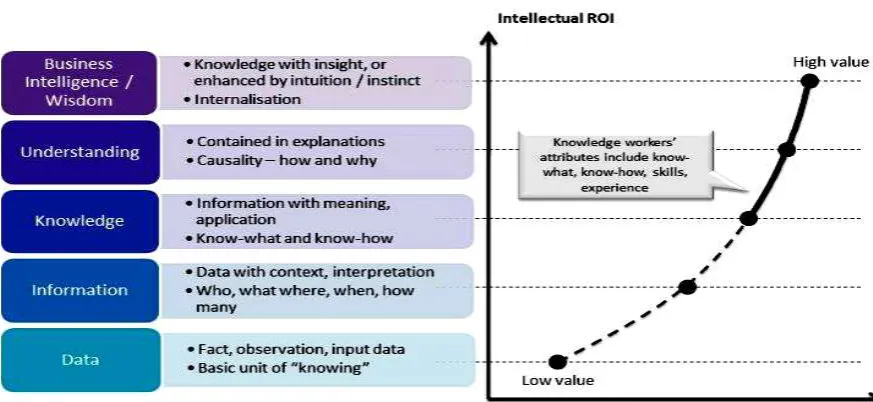
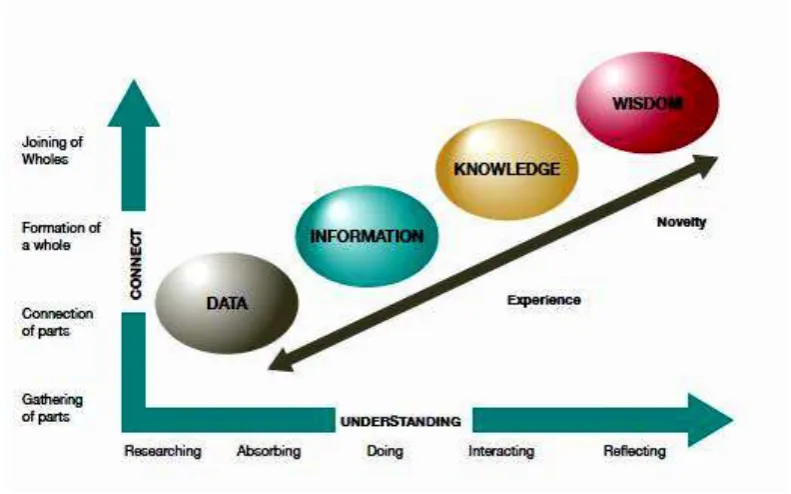
A dictionary definition of knowledge defined knowledge as “facts, information, and skills acquired through experience or education; the theoretical or practical understanding of a subject” (Oxford dictionary). Knowledge is a by-product of organised information which was developed from processed data but it’s richer and carries more meaning than information (Fahey and Prusak, 1998). Such knowledge includes experiences and understanding gained through study, which results from making comparisons, identifying consequences, and making connections (Fahey and Prusak, 1998). Some authors have discussed that some of the product of applied knowledge is wisdom and insight (Servin and Brun, 2005). Organisations generally see knowledge as “know how” which involves the ability to know have the right knowledge at your disposal when the need arises (Servin and Brun, 2005). Some other authors see knowledge as neither data nor information, which might have an element of both, but however the difference between these terms is often a matter of degree. This has generated an on-going debate about the many differences that exists between knowledge, data and information; however, there might actually be a lack of correlation between data, information, and knowledge (Davenport and Prusak, 2000). For knowledge to be effective, the need to manage such knowledge is essential hence the concept of KM which will be discussed later in the course of this research. Orange et
al. (2000) describe knowledge as the end-product of acquiring information through learning
23
knowledge has different components under which it operates. These components are discussed in the next section.
2.4 Characteristics and Types of Knowledge
After studying and analysing different definition of knowledge and its frameworks, it is worth to highlight some key characteristics of knowledge. Blakeley et al., (2005) consider six characteristics of knowledge from an economic standpoint. These characteristics are; rivalry,
Non-excludability, Cumulative, Uncertainty and Lags. Non-rivalry is seen as one of the most important
[image:46.595.87.518.453.670.2]characteristics of knowledge, which asserts that using an idea and knowledge by an individual does not prevent other individuals from using same simultaneously. The second characteristic implies the inability of knowledge to exclude individuals from using it, which depends on some factors like; the legal and environmental regulations, characteristics of both imitators and knowledge creators and the state of technology. The other characteristics of knowledge imply that knowledge is dependent on past knowledge, uncertainty and long lags before practical application. Generally, there are two common dichotomies of knowledge types that used by researchers which are tacit and explicit knowledge, and individual and collective or group knowledge (Hislop, 2013).
24
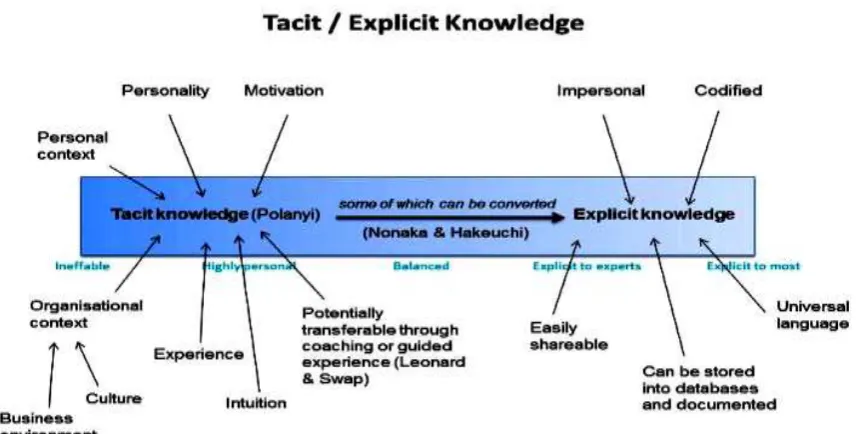
Despite various classification of knowledge, most scholars have consensus on using two types of knowledge, tacit and explicit, in their research (Gourlay, 2006; Nonaka & Takeuchi, 1995). This dichotomy is generally used for analysing organisational knowledge. According to Nonaka (1994), tacit knowledge is the kind of knowledge that can only be experienced and achieved in relevant context but cannot be easily articulated. In other words, it consists of individual’s values, beliefs and mental models that ingrained in their minds and skills. Nonaka et al., (2000) define tacit knowledge as knowledge based on past experiences of individuals in the form of attitudes, commitment, evaluation, points of view and motivation. In contrast, explicit knowledge is the knowledge that can be articulated, codified and stored in certain media. It can easily be understood and transferred to another person by verbalising it and appropriate without knowing subject. However, transferring tacit knowledge requires full potential of personal interaction in order to build trust and share understandings between knowledge holder and recipient (Nonaka & Takeuchi, 1995). According to Cook & Brown (1999), Nonaka & Takeuchi (1995), and Alavi and Leidner (2001), there are three main areas that tacit knowledge differs from explicit knowledge;
Codifying and methods of transferring knowledge
Methods of accumulation and acquisition of knowledge
Modes of appropriation and aggregation of knowledge
Having discussed the characteristics of knowledge, the next section sheds more light on the different types of knowledge.
2.4.1 Tacit Knowledge
25
they themselves possess or of its value to others. Tacit knowledge is considered more valuable because it provides context for people, places, ideas and experiences. It generally requires extensive personal contact and trust to share effectively. Knowledge management tends to have a connecting and a collecting dimension (Nonaka and Takeuchi, 2003). The connecting dimension involves linking people with people specifically people who need to know with those who do know, and so enhancing tacit knowledge flow through better human interaction, so that knowledge is diffused around the organisation and not just held in the heads of a few. Connecting is necessary because knowledge is embodied in people, and in the relationships within and between organisations. Examples include collaborative working, communities of practice, brainstorming sessions, networks of people with a common interest, and various “socialisation” activities designed to support knowledge flows (Servin and Brun, 2005).
2.4.2 Explicit Knowledge
Explicit knowledge is more or less the mirrored version of tacit knowledge. This type of knowledge is easy to capture and write down in documents or databases (Nonaka and Takeuchi, 2003). Examples include, best practices, instruction manuals, diagrams, graphs, repositories, lesson learned just to mention a few. This type of knowledge is further divided into structured and un-structured knowledge (Nonaka and Takeuchi, 2003). Structured explicit knowledge as the name implies is information or knowledge that follows a particular structured pattern for the purpose of relating or presenting such documents in a more presentable way for easy retrieval in the future. Examples include documents, databases and spread sheets. Un-structured explicit knowledge is information or knowledge that does not follow a particular format. These information or knowledge are said to be un-structured in nature. Examples include emails, images, audio and video materials (Servin and Brun, 2005). From characteristic viewpoint; tacit knowledge is Inexpressible in a codifiable form, Subjective, Personal, Context-specific and Difficult to share. Explicit knowledge on the other hand is codifiable, Objective, Impersonal, Context independent and Easy to share.
2.4.3 Individual or Group Knowledge
26
Automatic and Collective. Objectified and Collective types are more important because they exist in
social groups. For example, formalised organisational routines or documented rules are objectified knowledge, which are both explicit and reside in social group. An example of collective knowledge on the other hand is informal organisational routines and ways of accomplishing task and working. This type of knowledge is the most important one because it is not only exists in social group but also it is form of tacit knowledge that cannot be codified.
Collective knowledge is not limited to specific type, size or characteristics of community. It exists and develops in different types of communities from small-scale level, like teams or communities, to large-scale level like departments, business units, sites and organisations. Hecker (2012) did a deep analysis and distinguished three types of collective knowledge which is worth to be highlighted. According to his analysis collective knowledge consists of Shared Knowledge,
Complementary Knowledge and Artefact-Embedded Knowledge. The first type is located in individuals, for
example the way of managing customer interactions within a sales team is a type of shared knowledge. The complementary knowledge focuses on the importance of the distribution of expertise within a group or the community. Group members could benefit from this type of knowledge to effectively coordinate their work activities, because sum of individual (expertise) knowledge and their collective effort is greater than individual’s effort and knowledge. The last type of collective knowledge is about knowledge that embedded in artefacts which are used by group members like shared presentation or database, or collectively developed products which is an example of technological artefacts. Table 2.5 represents different types of collective knowledge.
Table 2.1: Generic Knowledge Types (Source: Hislop 2013)
Individual Social
Explicit Conscious Objectified
Tacit Automatic Collective
27
knowledge is to be managed. The next section investigates critically the concept of KM with the aim to create the needed foundational understanding for this research.
2.4.4 Components of Knowledge
The work of Davenport and Prusak (2000) assert that organisation success depends on knowing what the organisation’s needs, what is available to them and what they can and cannot do with each. They identified two basic component of knowledge which is data and information. Data is said to be a set of discrete and objective facts about events. In the context of organisational usage, data is described as set of structured records of transactions. An example of such is when a customer with a loyalty card goes shopping for groceries; such transaction carried out by the customer can be partly described by the store as data. Information such as how much was spent, how many point were received, the customers purchase history, what the customer buys more often and so on can be set of data generated on behalf of the customers. Such facts in themselves say nothing about whether the service station is well or badly run, whether it is failing or thriving. One of the founding brains behind the idea of management, Drucker (1993) discussed that information is "data endowed with relevance and purpose," this of course shows that data usage by itself is not relevant and does not serve any given purpose. Drucker (1993) further stated that data is a set of description of a process but does not provide adequate information or knowledge on which judgment or decisions can be made. While the raw material of decision making may include data, it cannot tell you what to do. All organisations need data to some extent to run their systems, some organisations such as Banks, insurance companies, utilities, and government agencies such as the IRS and the Social Security Administration use data and the management of these data in the effective and successful running of the organisation (Davenport and Prusak, 2000).
Information is defined as meaningful message which is usually in form of a written document,