International Journal of Emerging Technology and Advanced Engineering
Website: www.ijetae.com (ISSN 2250-2459, ISO 9001:2008 Certified Journal, Volume 4, Issue 1, January 2014)573
Embedded Based Optimized Power Consumption in Smart Grid
D. Mohanapriya
1, T. Shanthi
21PG Scholar, Kumaraguru College of Technology, Coimbatore. 2Assistant Professor (SRG), Kumaraguru College of Technology, Coimbatore.
Abstract— In present days power shutdown is a major issue during demands. This paper proposes the system that describes the solution for power shutdown during demands. The proposed system reports the integration between wireless technologies with the embedded systems, which provides the signals for controlling the power consumption. It comprises of two units EB office unit and residential unit (power based or energy based connections) for monitoring and controlling the power consumption. The information related to the power limiting will be sent from a computer in the EB office unit at a predefined interval of time to the respective area with the help of RF receiving and transmitting systems. Based on this information and energy meter reading, the system will verify the data and activate the load accordingly as 25%-100%. In addition with this the energy consumption information is recorded and transmitted to the consumers with the help of Global System for Mobile Communication (GSM).
Keywords — Energy meter, EB office unit, GSM, Residential unit.
I. INTRODUCTION
In human life each and everything is getting automated which in turn emphasis the importance of electricity. In recent years, the demand for power has been a major issue this is due to increase in consumption and limitations in power generation. Because of this the industrial sector as well as the public utility has been affected. This demand for power leads to frequent power cuts and the employment opportunities in industrial sector is reduced to a great extent and the agricultural sector has incurred a major loss. The residential consumers also get affected in many different ways. Even though people opt for alternate energy resources like generator, solar energy the efficient power supply and expected performance cannot be achieved. On the other hand it increases the cost which is not affordable for all. The power consumption is increased which arises the demand for power, it can be reduced by minimizing the standby power with the help of zigbee and infrared remote control separately for each room and these zigbee hubs are controlled by the home server[2]. But the for the above system the web connection is necessary[2].The other method is using zigbee smart energy profile(i.e., zigbee cluster library) it consists of general and smart energy cluster it includes price, demand, response, simple metering ,messaging, key establishment.
Controller is used to collect the data from the clusters and store the data in data center[6].Dynamic price response includes sensing technology and machine learning algorithm to achieve a real time pricing response control strategy for residential loads such as heaters, air conditioners, washing machine, dish washer, dryer[7]. The information is collected based on RTP, consumer preference, human activities at home, status of load and battery based on this analyzed information it modifies the load and send feedback to the load serving entity through web server[7].
The existing research in demand response includes the genetic algorithm for power scheduling. In this when power consumption exceeds particular threshold, peak average value is reduced [8]. Other method for power optimization insists peak to average ratio is reduced via real time pricing with the help of two stage optimization for demand response. This method uses optimal energy consumption and Stimulated Annealing based Price Control (SAPC) algorithm to communicate between users and retailers [5].Power consumption optimization using variable load, the variable load is scheduled between the home area network and neighborhood area network based on this information and meter data management system the power is obtained from generator, the efficiency of this system cannot be achieved to the desired extent [1]. Automatic meter billing system collects the power related information from the zigbee hubs; the prepaid billing methodology involved disables the load once the amount value gets increased [3].
International Journal of Emerging Technology and Advanced Engineering
Website: www.ijetae.com (ISSN 2250-2459, ISO 9001:2008 Certified Journal, Volume 4, Issue 1, January 2014)574
When the demand arises the home loads are controlled from the transmission side accordingly to the user preference [10]. The real time remote monitoring achieves the wireless data transmissions system for power optimization but the efficiency of this system depends on the data rate transmitted[11].
In the proposed system the power consumption has been managed in a more efficient way in introducing limitations in power supply. If the allotted power gets reduced below 25% the consumers will get an alert by means of buzzer. The electricity meter reading gets recorded and information is sent to the consumers through Short Message Service (SMS) with the help Global System for Mobile communication (GSM).The limitations in above existing methods has been overcome in the proposed method. The proposed method works without the help of web server, which is the major advantage of the system.
II. RELATED WORKS
A. Power based supply
In this method the maximum power (MP) is allocated to the users (i.e.,) the user can utilize only certain amount of power at a time. During peak time the usage of power is limited by providing the power limiting percentage which means only the particular percentage of maximum power can be utilized.
The power P can be calculated by using the formula
P=V*I*COS Ф
Where, V is voltage, I is current and Ф is a phase angle.The power limiting percentage is transmitted periodically from EB office unit to Residential unit.
The limited power (PL) can be achieved using the formula,
PL=X*MP
Where, X is the limiting percentage of power sends from the EB office unit, and MP is the maximum power allocated.
The value of the limited power and utilization power is continuously monitored at the residential unit. When the power reaches the limit the buzzer gets ON to intimate the power usage to the consumers, the time interval of 3 minutes is provided to the consumers for reducing the consumption if the consumption is not reduced within that 3 minutes the power will shut off for that particular unit till the next control signal gets received.
III. PROPOSED SYSTEM
The proposed system for power sharing comprises of two units which includes EB office unit and residential unit. The EB office unit is shown in Fig.1. It is equipped with personal computer (PC), RF module and a PIC controller. The power limiting percentage is decided manually in the PC. The percentage can be from minimum 25% to maximum 100%. During the peak time the percentage will be less and during day time the percentage will be more than 50%. This percentage is transmitted to the residential unit at every particular interval of time by using RF module. The power consumption information is stored in the EB office unit and this information will be transmitted to the consumers with the help of Global System for Mobile communication (GSM).
Fig.1.EB Office Unit
The information related to power limiting will be sent from the computer at a pre defined interval to the respective area with meter id. Based on this information, system will verify the data and activate the load accordingly as 25%- 100%.
International Journal of Emerging Technology and Advanced Engineering
Website: www.ijetae.com (ISSN 2250-2459, ISO 9001:2008 Certified Journal, Volume 4, Issue 1, January 2014)575
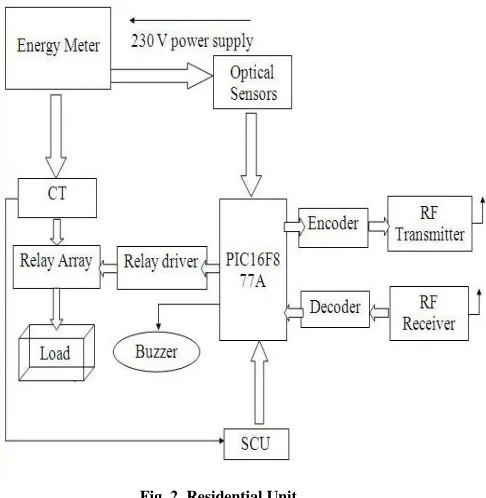
[image:3.612.59.302.220.469.2]Once the meter id gets matched the controller monitors the energy meter reading when the consumption meets its limitation the buzzer gets ON which in turn the power will remains ON for few seconds for providing the chance to consumer, reduce the utilization. Still the consumption exceeds the limited value the power will shut off in that unit till the next interval begins.
Fig. 2. Residential Unit
IV. SYSTEM WORKFLOW
The system work flow consists of cycles. Each cycle has an interval of 2 hours. The system operation in each cycle is shown in fig.3. This flowchart shows that, at the starting of the cycle the power is supplied to each and every unit. Generation and consumption is continuously monitored in EB office unit. When the consumption exceeds the generation, demand arises. This can be sorted out by transmitting the power limiting percentage from EB office unit to residential unit with meter id to control the power consumption.
International Journal of Emerging Technology and Advanced Engineering
Website: www.ijetae.com (ISSN 2250-2459, ISO 9001:2008 Certified Journal, Volume 4, Issue 1, January 2014)576
Fig.3. System operation workflow
V. SIMULATION RESULTS
The simulated result for optimized power sharing is shown in fig.4. In this case there are 4 switches used with different power limitation value from EB unit. The values are 25%, 50%, 75%, 100%. Based on the limitation percentage entered manually, the appropriate switch gets connected and the limited power will be calculated. The power is supplied to the consumers until their usage is within the limited power.
When the consumers exceed the limited power value the buzzer gets ON and the power related message will be sent to the consumers’ mobile phone. The buzzer remains ON for three minute to provide the chance to the consumers to reduce their consumption. If the consumption is not reduced below the limited power, the power will be shut off for that unit till the next control power percentage arrives.
Fig.4.Simulation model for Optimized Power consumption
VI. CONCLUSIONS
In this paper, we proposed a system to provide the solution for power cuts during heavy demands. The system explains about the EB office unit and residential unit. The power cut is reduced by limiting the power utilization of consumers. The power is shared between the consumers accordingly as 25% to 100 % of allocated power with the help of the values obtained from the EB office unit.
International Journal of Emerging Technology and Advanced Engineering
Website: www.ijetae.com (ISSN 2250-2459, ISO 9001:2008 Certified Journal, Volume 4, Issue 1, January 2014)577
REFERENCES
[1] Dusit Niyato, Qiumin Dong, Ping Wang and Ekram Hossain, “Optimizations Of Power Consumption And Supply In The Smart Grid: Analysis Of The Impact Of Data Communication Reliability”,IEEE Transactions On Smart Grid, Vol.4, No.1, March 2013.
[2] Jinsoo Han, Chabg-Sic Choi, and Ilwoo Lee,“More Efficient Home Energy Management System Based On Zigbee Communication And Infrared Remote Controls,” IEEE Transactions On Consumer Electronics, Vol. 57, No. 1, February 2011.
[3] P.Corral, B.Coronado, A.C.D.C Lima and O.Ludwig, ”Design Of Automatic Meter Reading Based On Zigbee”,IEEE Latin America Transactions, Vol.10, No.1, Jan 2012.
[4] Yuanxiong Guo, Miao Pan And Yuguang Fang,”Optimal Power Management Of Residential Customers In The Smart Grid”, IEEE Transactions On Parallel And Distributed Systems, Vol.23, No.9, september 2012.
[5] Li Ping Qian, Ying Jun(Angela) Zhang, Jianwei Huang And Yuan Wu,”Demand Response Management Via Real-Time Electricity Price Control In Smart Grids”, IEEE Journal On Selected Areas In Communication, Vol.31, No.7, July 2013.
[6] Champ Prapasawad, Kittitach Pornprasitpol, And Wanchalerm Pora, “Development Of An Automatic Meter Reading System Based On Zigbee PRO Smart Energy Profile IEEE 802.15.4 Standard”, Proc. IEEE International Conference On Electron Devices And Solid State Circuit(EDSSC), pp 1-3, December 2012.
[7] Qinran Hu And Fangxing Li, “Hardware Design Of Smart Home Energy Management System With Dynamic Price Response”, IEEE Transactions On Smart Grid, Vol.4, No.4, December 2013. [8] Zhuang Zhao, Won Cheol, Yoan Chin and Kyung-Bin Song, ”An
Optimal Power Scheduling Method For Demand Response In Home Energy Management System”, IEEE Transactions On Smart Grid, Vol.4, No.3, September 2013.
[9] Li Kaicheng, Liu Jianfeng, Yue Congyuam And Zhang Ming, “Remote Power Management And Meter-Reading System Based On ARM Microprocessor”, Proc.IEEE Conference On Precision Electromagnetic Measurements Digest, Pp 216-217, June 2008. [10] J.A.Rodriguez-Mondejar, R.Santodomingo and Colin Brown, “The
ADDRESS Energy Box: Design and Implementation”, proc. IEEE International Energy Conference and Exhibition, pp.629-634, September 2012.
[11] Wu Chunming and Geng Qiang, “The Transformer Station Remote Monitoring System Based on ARM/GPRS Network”, Second International Workshop on Intelligent Systems and Applications(ISA), pp.1-4, May 2010.
AUTHOR’S PROFILE
D. Mohanapriya, received her Bachelor’s degree from Kalaignar Karunanidhi Institute of Technology, Coimbatore, india in Electronics and Communication Engineering during 2008 and currently pursuing final year M.E (Embedded Systems) in Kumaraguru College of Technology, Coimbatore, india. Her area of interest includes Embedded Systems and microcontrollers.