IMPACT OF THE MULTINATIONAL ENTERPRISE IN THE
INTERNATIONALIZATION PROCESS
Ms. Kiran Chaudhary
Assistant professor,
Shivaji college, Delhi university, Delhi, INDIA.
ABSTRACT
The concern of home- and host-country stakeholders about companies‘ international operations
increases with their international commitments. For example, home-country stakeholders are
generally unconcerned when a company begins to export, but they are concerned when the
company begins producing abroad because of fear that jobs and growth are being transferred
Likewise, host country stakeholders give much more attention to foreign companies that are
wholly owned direct investors than those who share ownership locally or those that are merely
exporting-into &eir1ii This greater attention occurs because the company now employs local
personnel, and with full ownership, the company may be able to pursue global or home-country
objectives at the expense of local ones. Therefore, companies‘ needs to justify their operations
grow in tandem with their increased international commitment.
Introduction
The concern of home- and host-country stakeholders about companies‘ international operations
increases with their international commitments. For example, home-country stakeholders are
generally unconcerned when a company begins to export, but they are concerned when the
company begins producing abroad because of fear that jobs and growth are being transferred
Likewise, host country stakeholders give much more attention to foreign companies that are
wholly owned direct investors than those who share ownership locally. This greater attention
occurs because the company now employs local personnel, and with full ownership, the
company may be able to pursue global or home-country objectives at the expense of local ones.
Therefore, companies‘ needs to justify their operations grow in tandem with their increased
international commitment.
Countries tend to be more concerned about large companies than small ones because of greater
potential impact on national economic and political objectives. But not all companies operating
internationally are large. These are generally smal1e with smaller foreign investments.
Generally, they have to do less to justify their- entry and operations because they are assumed to
have less impact on host countries often treat their entries differently. Further, many LDC
governments prefer the entry of smaller companies because they may be more willing to yield to
host-country wishes, increase competition because of their numbers, and supply
sma11er-scaleIedi more suited to LDC needs.
The perception of a company‘s operations in one country may have an effect on the perception of stakeholders in other countries as well. For example, a company‘s confrontation with labor, tax
authorities, or environmental pressure groups in one country may cause similar stakeholders in
another country to be wary of the company‘s behavior. Further, as communications have become
more rapid, negative publicity about company practices has become more extensive. As a
company expands to more countries, the possibility of wide scale negative perceptions about its
The Operational Impact of MNEs Activities
The relationship between MNEs and societies has generated so many allegations and
controversies that it is impossible to examine all of them in detail. A number of them deal not so
much with whether international business should take place but rather with certain practices. In
these cases, the targets are specific operational areas of management. The operational impact of
MNEs activities are--
In transferring technology to LDCs, MNEs set prices too high and restrict too stringently
MNEs‘ centralization and control of key functions in their home countries: - perpetuate the neocolonial dependence of LDCs
Sensitive information about countries is disseminated internationally by MNE global
intelligence networks
MNEs introduce superfluous products that do not contribute to social need that perpetuate
class distinctions
MNEs avoid paying taxes
Through artificial transfer pricing, MNEs undermine attempts by government to manage
their countries economic affairs
The best jobs are given to citizens of the country in which an MNE has its quarters
Inappropriate technology is introduced into LDCs by MNEs
National labor interests are undermined because of MNEs‘ global activities
Critical Evaluation of MNCs
There has been a lot of discussion on the benefits and drawbacks of MNCs/MNEs. According to
ILO report on Multinational Enterprises and social policy, ―MNCs are an invaluable dynamic
they are monsters which our present institutions national or international cannot adequately
control.‖
Benefits of MNCs
MNCs have played a significant role in the development of poor countries. Be it transfer of
technology, introducing best management practices, help in improving productivity, making
local people become competitive or improving the equality of life of people, the contribution of
MNCs has been praiseworthy. Specifically, the contribution of MNCs to developing countries
has been on the following lines.
Provide employment Train managers
Provide products and services that raise the standard of living Introduce and develop new technical skills.
Introduce new managerial techniques
Provide greater access to international markets Raise the gross national product
Increase productivity
Help build foreign exchange reserves
Encourages the development and spin off of new industries. Assume investment risk that might not otherwise be undertaken. Mobilize capital for productive purposes from less productive uses.
Naturally, MNC managers and their defenders respond that many of the criticism of their
behavior are only partially true at best and outright false at worst. Despite their alleged
shortcomings, they say, MNCs significantly help host governments achieve their national aims.
Criticism/ Problems of MNCs
(i) Costly Damages: - We state only two instances ot preve this criticism against MNCs. Take
the case of OK Tedi, a gold and copper mine, in Papua, New Guinea. The company dumped
80,000 tons of contaminated material daily, for 12 years, into the OK Tedi and Fly Rivers, as it
extracted some $6 billion worth of ore. Once the mine was exhausted, the Australian - Majority
ownership. after admitting that it had vastly underestimated the environmental impact, deserted
the mines, leaving the local government to bear the cleaning up costs.
Nearer to home, the infamous Union Carbide caused the explosion at Bhopal, killing more than
20,000 instantly and injuring 100,000 people. The company was forced to pay paltry $500 per
person. Dow Chemical has h the Bhopal plant, taking all of Union Carbide‘s assets but assuming
no liability.
(ii) Self Interests are primary: - Earlier we argued that when interests of MNCs clash with the
needs of host countries, the former must compromise its interests for the satisfaction of the latter.
This is not happening in practice. Take the case of Coca-Cola‘s self-serving fights in countries
where its subsidiaries are located.
In Mexico, the company is trying to stop a plan to levy 20 per cent tax on soft drinks. In Costa
Rica, it is battling anti trust allegations that it entered exclusive agreements with retailers to stop
competition. If found guilty, it could be fined 10 per cent of its annual sales in that country. In
India, the company silenced an NGO which revealed that the soft drink contained pesticides.
Food companies entice children with sugary cereals that are bad for their teeth, auto companies
campaign against public transportation and in some cases, actively remove it, regardless of its
effect on the environment. Los Angeles once had the world‘s largest urban rail system, until a
group led by GM bought it, dismantled it and replaced it with GM buses.
(iii) Bribes add to the Bottom line: - MNCs justify bribery as it adds to their bottom-line.
Mining and oil companies often reduce the cost of acquiring natural resources by bribing
government officials for concessions. It is far cheaper to pay a government official a large bribe
than to pay market price for oil or some other natural resource. In practice, companies in many
industries pay bribes to get all types of favours, such as protection from outside competition
which allows them to raise prices, or enables them to overlook environmental or safety
In some societies, US for example, bribing has been banned. But this has been replaced by
contributions to political parties. 41 companies (including GE, Microsoft and Disney), which
invested (read contributed) $150 million in political parties and campaigns for US Federal
candidates between 1991 and 2001, enjoyed $55 billion in tax breaks in three years alone.
Pharmaceutical firms spent $759 million to influence 1,400 confessional bills between
1998-2004; the pharmacy industry ranks first in terms of lobbying money and the number of lobbyists
employed (3,000). In return, the US government has made their interests paramount in
international trade negotiations. The ‗big five‘ US accounting firms contributed $29 million to
federal candidates and parties between 1989 and 2001. in order to shield themselves from
threatened regulations.
(iv) Small and Marginal Firms are Worst Hit: Thousands of small firms in developing
countries have closed their shutters because of the competition from large MNCs (see Report 1).
Corporate giants like Wal-Mart believe in buying cheap and at such low rates that they drive
small firms to bankruptcy. Much of Wal-Mart‘s success lies in its ability to squeeze its suppliers
and workers. Its strict policy against unionization means that its workers are often low-paid, and
their low wages force down wages at competitor organisations and thus, the entire workforce is
affected Survey Report 1 confirms this view point.
(v) Interference with Economic Objectives: - Interference can occur in many ways. For
example, an MNC may wish to locate a plant in an area of prosperity when the host
country would prefer its location in an underdeveloped region. MNC demands of
local support can add to host-country expenditures for infrastructure. Since MNCs
typically do their research and development at home, host countries become
technologically dependent on the MNCs for innovation and invention. The MNCs
have the strength to attract bank loans that otherwise might be available for local
Survey Report 1
Many Looms in Bangalore have fallen Silent
The looms that once produced quality silk saris and provided livelihood to thousands of households in and around Bangalore for decades are falling silent at a rapid pace.
Unable to compete with the flooding of imitation silk saris, the traditional weaving families are moving out of the profession in search of other employment avenues. For hundreds of weavers’ families, the dreams of earning a decent livelihood have evaporated, as they are unable to sustain the onslaught of art S1ik blend silk. China silk and other varieties -at closely resemble a sari made of pure silk.
Small weavers owning two or three looms are facing a crisis because they are not getting the right price for the product. “Dumping of saris made of blends and produced in Surat, as well as mill products, has killed the source of livelihood of the weavers. The weavers are also at the mercy of the traders who often pay less than the cost incurred on the product,”
If a pure silk sari costs around Rs 2,500, the imitation could cost just around Rs500 a weaver said.
Mr. Hanumaraju a weaver is not alone in his community who has taken the drastic decision of puffing an end to the family tradition. Hundreds of weavers have sold their looms to weavers from across the border in Tamil Nadu and have started working in other professions. While some have joined garment factories that have mushroomed in Bangalore a large number of weavers today are driving autorickshaws or working as construction labourers.
The statistics provided by the Department of Textiles has also confirmed the decline of both powerlooms and handlooms in Bangalore, which once patronised these looms for its quality. While a survey conducted in 1996 identified 8,308 handlooms in and around the city, the number had declined to 4,960 by 2005. Similarly, the number of power looms came down from 58,887 to around 42,030 during the same period.
What less developed countries need is investment in infrastructure? But MNCs are hardly known
for developing this sector. A Wharton School study cites a survey of 7,500 MNCs, which
showed that 84 per cent of operations initiated in the infrastructure sector during the last three
years failed to meet their financial targets. The host country may also lose control over its own
economy. International businesses are guided more by worldwide needs than internal needs of
the host nation. Thus, some actions may not be consistent with what is desired by the host
country.
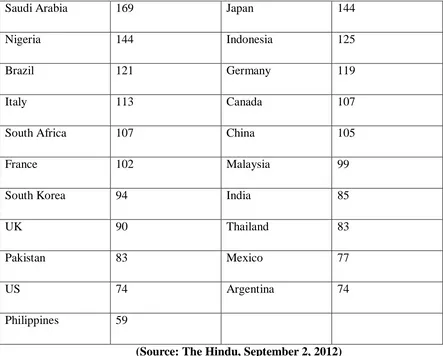
India invited MNCs with a fond hope that they would make the country a strong export base. The
hope has not been realized as Table 1.1 shows. The table shows the export-import ratio of India
and other countries. The ratio of a country‘s exports to imports is one indication of the extent to which an economy‘s imports are financed by what it earns by selling its goods and services to
other countries. India import ratio was at a low of 66 per cent in 1990—91, before it increased
substantially over the next few years.
Subsequently, the ratio declined. Exports paid 85 per cent of imports in 1994—95 and 82 per
E.T. Report 2
Coke Pours into Asia
The biggest prize and challenge is China. To woo the country of more than 1.2 billion people, the company has made unprecedented compromises.
In 1993, it entered a marriage of convenience with the Chinese government, gaining wide access to the market—but at a high cost. Coke pledge to keep its predatory instincts in check, promising to do everything from upgrading the local industry to providing cash income to farmers by starting a new line of fruit drinks.
Beijing is counting on Coke to provide its expertise in key areas from hygiene to packaging to distribution. In return, the Chinese have allowed Coke and its partners to invest $300 million to build 10 new bottling plants, giving it a total of 23 by the end of 1997
The first fruits of the company’s investment are in sight. Coke says it has grabbed 23 per cent of the soft drink value in China and figures on eventually topping 40 per cent. A new study by Mckinsey & Co. says Coca-Cola is one of a handful of consumer goods companies that has a chance to hit $1 billion in sales in China by 2000, thanks to its large, systematic investment in the country
The problem is, China is so large that Coke can’t rely on its usual methods to ensure that all is well. In more developed markets, Coke bottlers distribute all of the products directly, giving the company complete control over its goods. But that’s not feasible in China, where some 75 per cent of Coke products go through independent wholesalers. That means it is nearly impossible for the company to police such things as coolers, product display, and pricing. All Coke can do in most cases is ship its product out and hope for the best.
Moreover, Coke doesn’t always succeed in staying out of the way of nationalist crosscurrents. n 1995. a group of National People’s Congress legislators called for Beijing to restrict the expansion of Coke and Pepsi to protect local manufacturers. This legislative motion spurred an announcement last May that further approvals of soft drink plants for joint ventures would be put on hold.
Table 1: International Comparison ( Export-Import Ratio Percent, 2012)
Saudi Arabia 169 Japan 144
Nigeria 144 Indonesia 125
Brazil 121 Germany 119
Italy 113 Canada 107
South Africa 107 China 105
France 102 Malaysia 99
South Korea 94 India 85
UK 90 Thailand 83
Pakistan 83 Mexico 77
US 74 Argentina 74
Philippines 59
(Source: The Hindu, September 2, 2012)
Further MNCs were invited into the country to set up Greenfield projects so that additional
manufacturing capacity may be created. The experience has not been encouraging as a very large
amount of foreign capital used for acquiring local companies or merging with them, thus denying
the country the benefits of new manufacturing capacity.
(vi) MNCs bring Social Disruption: The introduction of different mores, habits, behaviour, and
ethical values, new management styles. distribution systems, more money, and technology, do
affect local ways of and doing things. The introduction of blue jeans, movies, Western attitudes
towards women, work or automobiles, shifts cultures towards Western values. Some locals may
applaud the changes while deplore them. Illustration of P& G‘s efforts to advertise Camay Soap
The ethical fabric of the society of a host country is of Len dented by undesirable and corrupt
practices of MNCs. A report of the UN has brought to light many such practices as unfair
competition and restrictive trade practices, rigging of bids, price discrimination and other forms
of market distortions. They also resort to devious means to increase their profits. MNCs
repatriate profits surreptitiously through transfer pricing and increase the import content of the
production.
(vii) Environmental Degradation: Many nations are becoming more concerned about the
impact of MNCs on their en Environmental concerns are rapidly moving higher in the chain of
priorities throughout the world, including in most of the LDCs.
(viii) Danger of Imperialism: Many of the awakening nations look on foreign managers with
fear and distrust as the embodiment of an old, not easily forgotten, exploitative colonialism.
Many LDCs feel relegated to the role of supplying raw materials and cheap labour because they
are denied the technology to develop into industrialized nations.
(ix) Symbol Frustration and Antipathy: - The LDCs have grievances about their position in
the world nothing to do with the MNC but the MNC is a convenient visible target for their anger.
Many of the LDCs are governed by some form of dictatorship that is antagonistic to the free
market mechanism decision-making of the MNCs.
Many LDCs insist on being partial owners of undertakings set up by MNCs. In situations of
sudden Social upheaval or changes in government control, a host country may nationalise or
expropriate the assets of a company or plant even without paying compensation. There are
examples such as Cuba‘s nationalisation of $1.5 billion of assets of assets in 1960 and Iraq‘s
seizure of all Kuwait assets in 1990.
The anger against MNCs often forces them to leave a host country. Unable to cope with
domestic public opinion several MNCs quit Myanmar. They include Pepsi, Apple, Walt Disney,
Motorola, HP, Eastman, Kodak, Heineken, Carlsberg, Levi Strauss, Peregrine, and others.
(x) MNCs Sometimes bring unsuitable Technology: The technology brought in by MNCs is
expensive. The MNCs charge exorbitantly in the form of fee and royalty, which put a severe
strain on the foreign exchange resources of a developing country. There are also instances of
―technology dumping‖, which implies that MNCs use obsolete technology with the help of
turnkey projects shipped down from the principals of other countries. MNCs tend to make
industries in developing countries permanently dependent on foreign expertise and technology.
Take the case of Japan. If only Japan had followed a free trade policy along with free entry of US
and European firms in the 50‘s, there would have been no Toyota or Nissan.
Conclusion
It may be reallocated that the MNCs‘ main objective is to earn money. They are operating in any
country and in any form to earn profit and not to indulge in Philanthropic activities. It may also
be stated that the MNCs are not the only entities that indulge in activities unacceptable to the
developing countries. Many of the domestic businesses in the respective developing countries
may engage in much more harmful practices. Why, then, are MNCs singled out? It is because of
their clout, the resources they command the deep pockets and the high visibility they exhibit. A
United Nation‘s report describe several developments that points to a rapidly changing context
for economic growth, along with a growing role for transnational corporations in that process.
These include: -
Increasing emphasis on market forces and a growing role for the private sector in nearly
all developing countries.
Rapidly changing technologies that are transforming the nature of organization and
location of international production.
The globalization of firms and industries.
Bibliography
1. NEVEN D.J. and GOUYETTE C. (1994), Regional convergence and the European Community, CEPR Discussion paper 914, February.
2. OECD (1991), Taxing profits in a global economy, domestic and international issues, Paris.
3. OUGHTON C. (1993), Growth, structural change and real convergence in the E.C., in HUGHES K.S., ed, European competitiveness, Cambridge University Press, Cambridge.
4. PIERRE I. (1996), Le treaty shopping, la taxation effective et le coût du capital des sociétés multinationales, Bulletin de documentation du Ministère des Finances, 1, 83-150.
5. SHAH A. (1995), ed, Fiscal Incentives for Investment and Innovation, Oxford University Press, Oxford.
6. TANZI V. (1995), Taxation in an integrating world, The Brookings Institution, Washington.
7. YOUNG S. and HOOD N. (1993) Inward investment policy in the European Community in the 1990‘s, Transnational corporations, 2(2), 35-62.
8. YOUNG S., HOOD N. and PETERS E. (1994), Multinational enterprises and regional economic development, Regional studies, 28.7, 657-677.
9. Mahmoud M. I. (1986) The Determinants of foreign investment in African countries, Dakar, Senegal.
10.Nigerian Economic Society (1988) Rekindling Investment for economic Development in Nigeria. Selected papers for the annual conference.